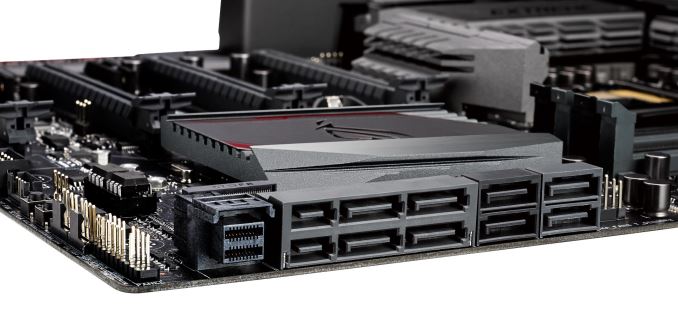
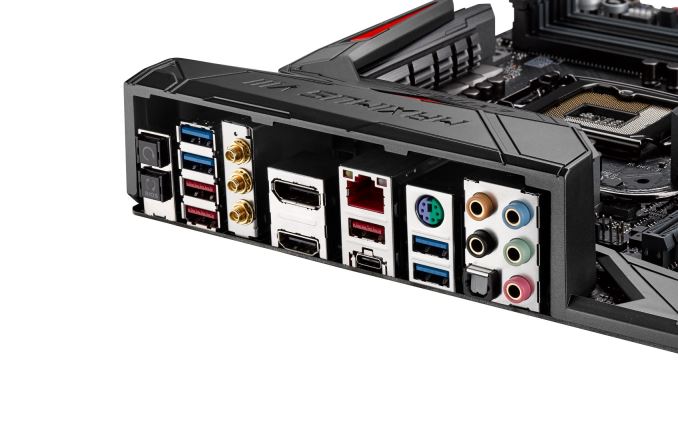
The ASUS Z170-A Motherboard Review: The $165 Focal Point
In
the world of technology, you could speculate if there is ever a golden
age, or a renaissance. All the time we expect technology to grow and
improve, being better than the last. Sometimes there is nostalgia, but
it never stops us using the latest because it provides the user
experience we expect at a minimum. Like all the motherboard
manufacturers, I've followed ASUS for years, and observed their constant
iteration as platforms evolve. The newest Skylake platform is upon us,
and we review the ASUS Z170-A motherboard to see their interpretation of
the desktop this generation.
Read More ...
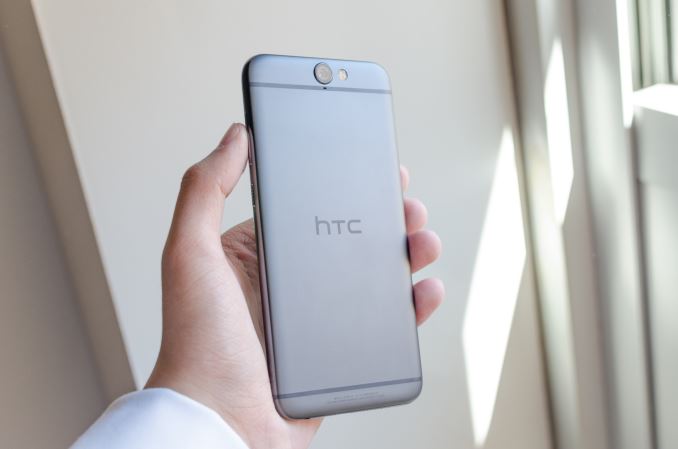
Hands On With the HTC One A9
Today,
HTC is launching their flagship smartphone for the holiday season. For
those that have followed HTC, this launch shouldn’t be too much of a
surprise given that the CEO announced that they would be launching a
hero product in October. This hero product is the HTC One A9, which
brings a new design and a new product lineup for HTC. According to HTC,
the new A series is intended to be a design-focused smartphone as
opposed to the technological leader that is the M series. Of course,
while design matters quite a bit probably the first thing that matters
in a smartphone are the internal parts so the usual spec sheet is below.
| HTC One A9 |
| SoC |
Qualcomm MSM8952 Snapdragon 617
4 x Cortex A53 @ 1,5GHz
4 x Cortex A53 @ 1.2GHz |
| GPU |
Adreno 405 |
| RAM |
2/3GB LPDDR3 |
| NAND |
16/32GB + microSDXC |
| Display |
5.0" 1920x1080 AMOLED |
| Dimensions |
145.75 x 70.8. x 7.26 mm, 143g |
| Camera |
13MP Rear Facing with F/2.0 aperture + OIS
4MP UltraPixel Front Facing with F/2.0 aperture |
| Battery |
2150mAh (8.17Wh) |
| OS |
Android 6.0 Marshmallow with HTC Sense |
| Cellular Connectivity |
2G / 3G / 4G LTE (Qualcomm X8 Category 7 LTE) |
| Other Connectivity |
2.4/5GHz 802.11a/b/g/n/ac + BT 4.1, GNSS, microUSB 2.0 |
| SIM |
NanoSIM |
| Price |
$399 |
In some ways, HTC is really an outlier with the
release of this phone. For the most part this year I’ve seen OEM after
OEM releasing phones that are either uncomfortable or basically
impossible to use with one hand with the rare exception of the Galaxy
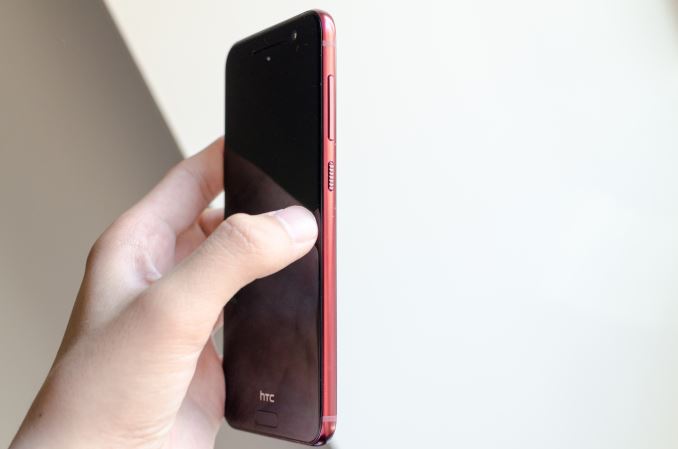
S6. In fact, the One A9 is almost identical to the Galaxy S6 in height
and width, but is roughly half a millimeter thicker. However, the One A9
is noticeably thinner in the hand by virtue of a more rounded
transition to the back of the phone.
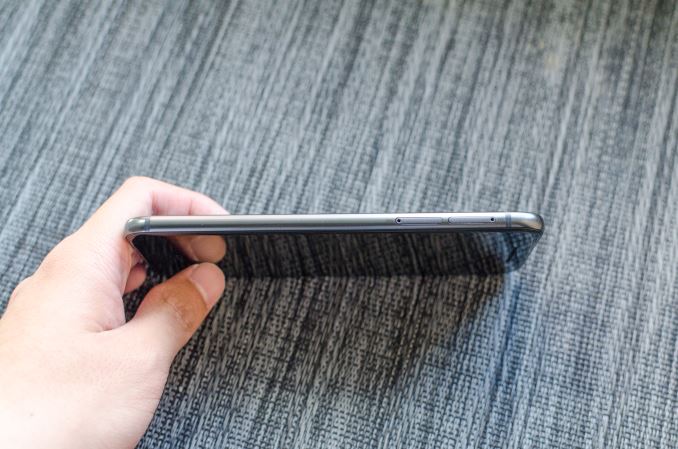
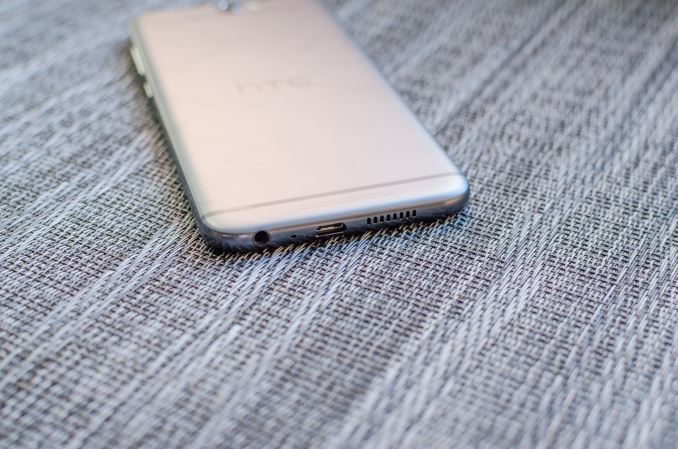
Since
we’re talking about the form of the phone, it’s probably obvious by now
that this phone bears at least a passing resemblance to an iPhone 6 or
6s. HTC claims that this design isn’t designed to ape the iPhone, and in
some ways they are correct as the antenna design is noticeably
different when directly compared to the iPhone 6 and 6s. The sides of
the phone are also curved differently and reminiscent of the Desire 800
series as the sides of the phone have a much less aggressive radius of
curvature than what is seen in recent iPhones. These sides are also
relatively glossy instead of the coarser sand-blasted finish seen on the
iPhone.
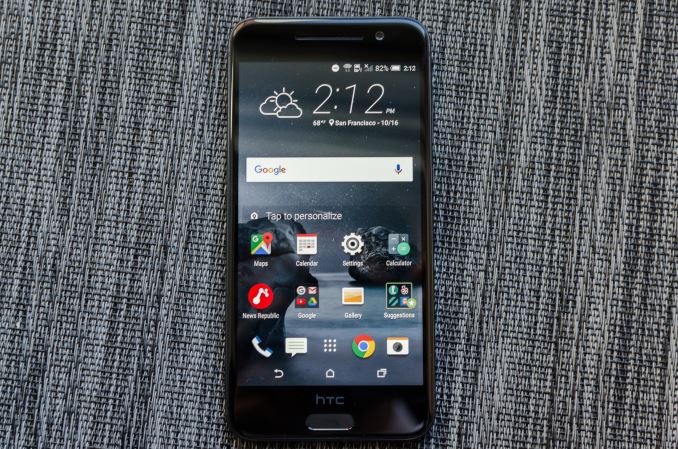
In
some ways, the comparisons seem unavoidable. From the front of the
phone, the design doesn’t really look like a Desire smartphone due to
the all glass design. The earpiece is also a departure from recent HTC
designs, although HTC has used such a design before with the EVO LTE.
The fingerprint scanner was seen as recent as the One M9+, but at the
time it was partially shared with the speaker grille instead of part of
the glass. The glass is also a 2.5D curved piece so edge swipes are
smooth, which is something we saw with the One X but hasn’t made a
return until now.
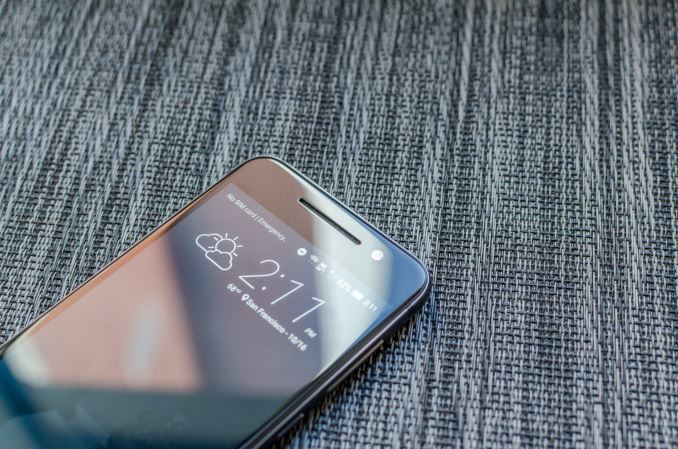
These
are all design elements that we’ve seen in HTC phones before, but the
sum results in a phone that looks a bit too close to the iPhone 6 for
comfort. In practice, it does feel like a very different phone than the
iPhone 6, but when only looking at photos it’s probably hard to tell
that this is the case. If I were to look at previous HTC smartphones, I
do see a strong resemblance to the One S, but the design of the One S is
still quite different from what we see in the One A9. Regardless of
whether this is an iPhone-inspired design or not, the design is a breath
of fresh air after multiple launches of 5.5” size phones with
ever-increasing size.
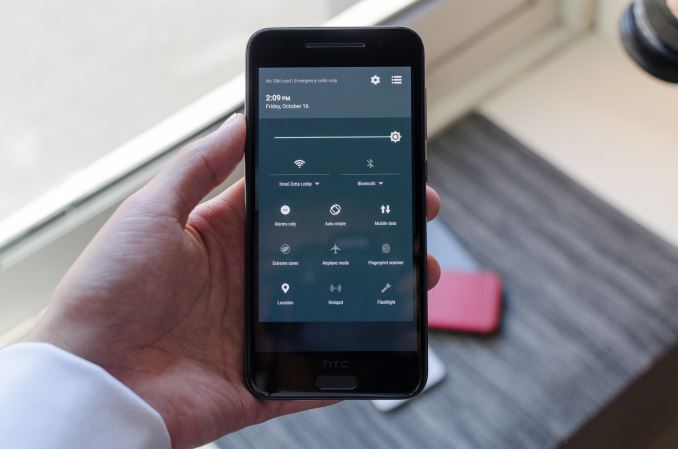
Putting
design aside, there are some other major departures in this phone for
HTC. The first is that this is a return to an AMOLED display, in the
form of a 1080p AMOLED display. I wasn’t able to determine whether this
is equivalent to the Galaxy S5 or S6 generation of AMOLED but the
display gives a noticeably blue reflection when the screen is off when
compared to the Galaxy S6 and S5, which could be indicative of what
generation AMOLED technology we’re dealing with. Interestingly enough,
HTC has included a display setting to toggle between “AMOLED” and sRGB
mode, which could bode well for those that care about color accuracy in
displays.
The
SoC is also not exactly the definition of high-end, as HTC has elected
to use a Snapdragon 617 which is likely due to issues with the
Snapdragon 810 and 808. As far as I can tell Snapdragon 618 or 620
weren’t possible at this time so it seems that HTC is in some ways stuck
between a rock and a hard place when it comes to SoC choice. In some
ways, I don’t really see another choice here, especially given the price
point that HTC is competing in. The SoC platform choice also means
battery PMICs and handshake ICs with support for Qualcomm’s QC 3.0 quick
charge standard.
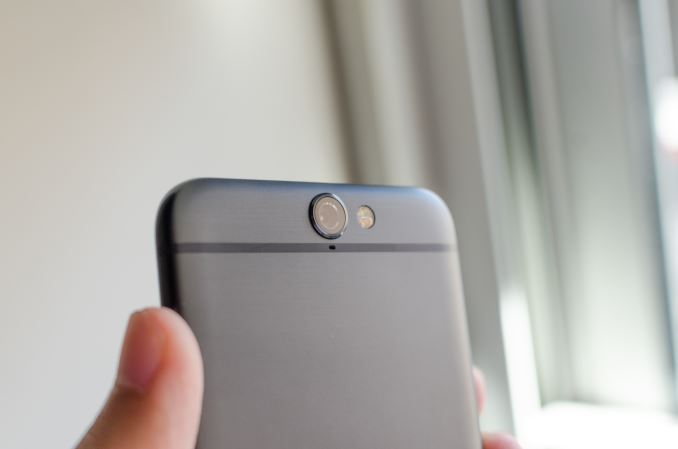
The
camera is arguably one of the major notable points for HTC here, as
it’s a 13MP IMX214 sensor with F/2.0 optics and second generation OIS.
This sounds kind of boring at first glance but taking some quick
relative comparison shots indoors with the iPhone 6 and Galaxy S6 for
comparison was shocking to see when the One A9 was comparable, if not
even better than the Galaxy S6 in the dimly lit room in which I tried
the One A9. There’s also a feature that allows for automatic processing
of RAW photos on the phone, which is impressive but processing a single
photo took a significant amount of time relative to the near-instant
output of normal photos. I would estimate that a single photo took as
long as 10-20 seconds to process, which suggests that a better SoC would
go a long way towards improving the UX here.
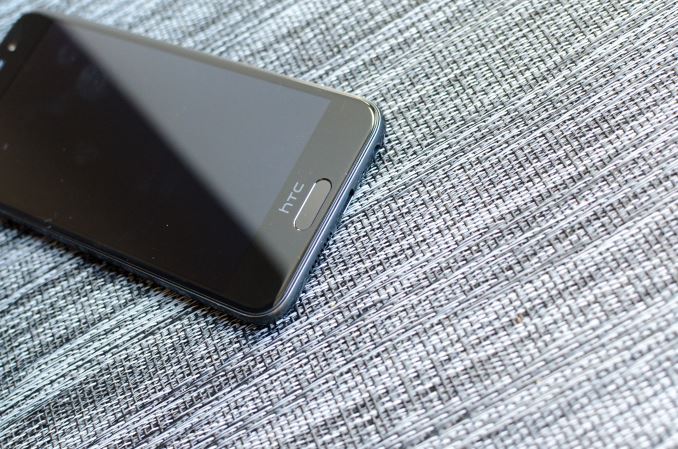
The
fingerprint sensor is also surprisingly fast and accurate in my
experience, and noticeably improved over the One M9+. HTC emphasized
that this was necessary for a good Android Pay experience, which means
that this phone also has NFC which appears to work off of the top metal
antenna but lacks the boosting system seen in the iPhone 6 so NFC
behavior is going to be similar to other HTC phones.
The
software experience is also notably changed when compared to the One
M9. Although many parts of the phone are still going to look like the
same HTC Sense that we’ve seen since the start of this year, other parts
like the notification drawer, camera app UI, multitasking menu, and the
removal of a number of HTC Sense apps like the HTC Music and Internet
apps and the HTC Calendar widget. I personally think HTC may have taken
out too many HTC apps and widgets here, but the updates to make HTC
Sense fit better with Material Design is definitely a good thing.

On
the audio side, HTC is claiming that Dolby Audio enhancement and 24-bit
192 KHz will dramatically improve audio quality. I didn’t get a chance
to test these claims, but the headphone jack does use an RT5506
amplifier from the One M8 which had great audio quality from our
testing. The speaker also has a TFA9895 amp on it which should help with
quality but due to the downward-firing nature of this speaker the
quality is likely to be worse than what we saw on the One M8.
Overall,
while this isn’t the holiday season flagship that some might be
expecting, I came away quite impressed with this phone. Despite the
mid-range SoC I was more impressed with this phone than the One M9 at
launch. Obviously, the true successor to the One M9 is the phone that
everyone is really waiting on, but this phone shows that HTC is capable
of responding to clear market demands. Although not every piece of the
A9 is what I’d want to see in the M10, aspects like the dramatically
improved camera processing, renewed focus on industrial design, and
changes to HTC Sense should definitely be carried over.
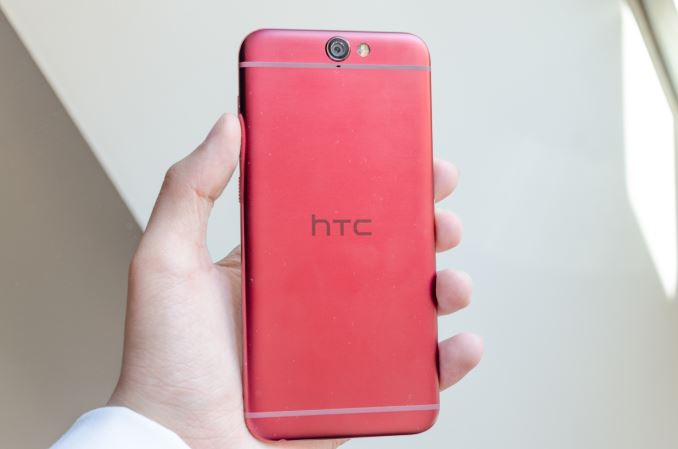
The
HTC One A9 will be offered in Opal Silver, Carbon Gray, and Deep Garnet
starting at 399.99 USD unlocked with 3GB of RAM and 32GB of storage.
One variant will support Sprint, while the other will support T-Mobile,
AT&T, and Verizon with a pre-activated SIM. HTC will also offer
their Uh-Oh protection for phones sold through HTC.com, which means 12
months of coverage for accidental damage from drops or water damage with
one free replacement, along with a 6 month subscription to Google Play
Music.
Read More ...
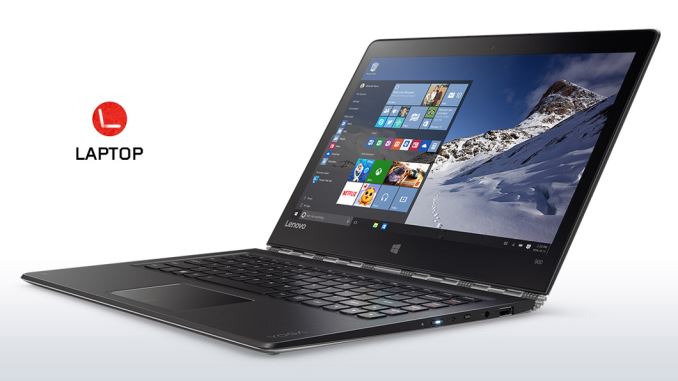
The Lenovo Yoga 900 Series Launched: The ‘Thinnest’ Core Laptop and a 27-inch Portable All-In-One
Lenovo’s
Yoga line has been consistently at the forefront of attempting to
define exactly what a combination clamshell laptop ‘that’s also a sort
of tablet’ should be. Over the years we’ve reviewed several models,
including the
Yoga 2 Pro and the
Yoga 3 Pro.
The latter was the first Broadwell-Y device, taking a high frequency
4.5-watt Intel processor into a 13.3-inch QHD+ high-end device weighing
only 2.6 lbs and with an interesting hinge that seemed to be a feat of
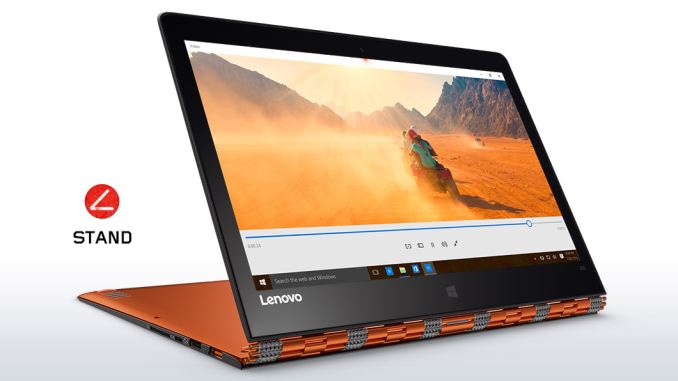
mechanical engineering. The new Lenovo Yoga 900 released this week is in
many ways the update to the Yoga 3 Pro but with full-fat 15W Skylake
laptop processors and is advertised as the world's thinnest 'Core i'
laptop with Skylake.
Lenovo Yoga 900
| Lenovo Yoga Specifications |
|
Yoga 2 Pro |
Yoga 3 Pro |
Yoga 900 |
| Processor |
Intel Core i3-4010U (15W)
Intel Core i5-4200U (15W)
Intel Core i7-4500U (15W) |
Intel Core M-5Y71 (4.5W) |
Intel Core i7-6500U (15W) |
| Memory |
4-8GB DDR3L-1600 |
8GB DDR3L-1600 |
8-16GB DDR3L-1600 |
| Graphics |
Intel HD 4400
(20 EUs, Gen 7.5) |
Intel HD 5300
(24 EUs, Gen 8) |
Intel HD 520
(24 EUs, Gen 9) |
| Display |
13.3" Glossy IPS
16:9 QHD+ (3200x1800) |
13.3" Glossy IPS
16:9 QHD+ (3200x1800) LCD |
13.3" Glossy IPS
16:9 QHD+ (3200x1800) LED |
| Hard Drive(s) |
128GB/256GB/512GB SSD
(Samsung mSATA) |
256GB/512GB SSD
(Samsung PM851) |
256GB/512GB SSD (Samsung ?) |
| Networking |
Intel Wireless-N 7260
(2x2:1 802.11n) |
Broadcom 802.11ac
(2x2:2 802.11ac) |
Intel Wireless AC-8260 (2x2:2 802.11ac) |
| Audio |
Realtek HD
Stereo Speakers
Headset jack |
JBL Stereo Speakers
1.5w x 2
Headset jack |
JBL Stereo Speakers Dolby® DS 1.0
Headset jack |
| Battery |
4 cell 55Wh
65W Max AC Adapter |
4 cell 44Wh
40W Max AC Adapter |
4 cell 66Wh |
| Buttons/Ports |
Battery status indicator
Novo button
1 x USB 2.0
1 x USB 3.0
Headset Jack
Volume
Screen Rotation Lock
AC Power Connection
1 x Micro-HDMI
SD Card Reader
|
Power Button
Novo Button
2 x USB 3.0
Headset Jack
Volume Control
Auto Rotate Control
DC In with USB 2.0 Port
1 x Micro-HDMI
SD Card Reader |
Power Button
2 x USB 3.0-A
1 x USB 3.0-C
Headset Jack
SD Card Reader
DC In with USB 3.0-A Port
|
| Back Side |
Exhaust vent |
Watchband Hinge with 360° Rotation
Air Vents Integral to Hinge |
| Dimensions |
12.99" x 8.66" x 0.61"
330 x 220 x 15.5 mm |
13" x 9" x 0.5"
330.2 x 228.6 x 12.8 mm |
12.75" x 8.86" x 0.59"
324 x 225 x 14.9 mm |
| Weight |
3.06 lbs (1.39 kg) |
2.6 lbs (1.18kg) |
2.8 lbs (1.3 kg) |
| Extras |
720p HD Webcam
Backlit Keyboard |
| Colors |
Silver Grey
Clementine Orange |
Light Silver
Clementine Orange
Golden |
Platinum Silver
Clementine Orange
Champagne Gold |
| Pricing |
$879 (256GB)
$1049 (512GB) |
$1148 (256GB)
$1379 (512GB) |
$1200 (8GB/256GB)
$1300 (8GB/512GB)
$1400 (16GB/512GB) |
With Intel’s 6
th Generation, as most
OEMs will be moving to, Lenovo is hoping to leverage new features such
as Speed Shift and video decode to improve both performance and battery
life. Over the previous generation of Yoga laptops, the Yoga 900 comes
in a little heavier than the Yoga 3 Pro but allows up to 16GB of memory,
comes immediately with Windows 10 Home and also sports a USB Type-C 3.0
with video out functionality. Currently all versions listed online come
with the i7-6500U, one of the top Skylake Core i7 15W models with GT2
integrated graphics. Lenovo is listing the battery life as nine hours of
local video playback, as well as sporting a 50% increase in battery
density.
Prices
start at $1200 for the 8GB/256GB version, rising to $1400 for
16GB/512GB models. There will be versions in Lenovo’s Clementine Orange,
but also Platinum Silver and Champagne Gold. From
looking at the breakdown online, not all colors will be available in all specifications.
Lenovo Yoga Home 900
Cast
your minds back to 2014. It was a fun time, with Haswell and Broadwell
processors from Intel being talked about as bringing a revolution to the
mobile computing market. I remember some of the product ideas becoming
quite amusing at the time, especially when Intel was talking about
making all-in-one devices (where the PC built into the monitor and you
just add a keyboard/mouse) something that could be carried around.
Clearly something that measures up to 32-inches in this context is going
to be heavy and short on battery life, and was perhaps not something to
be taken too seriously as a product idea. Fast forward to the end of
2015, and Lenovo is going to sell you one.
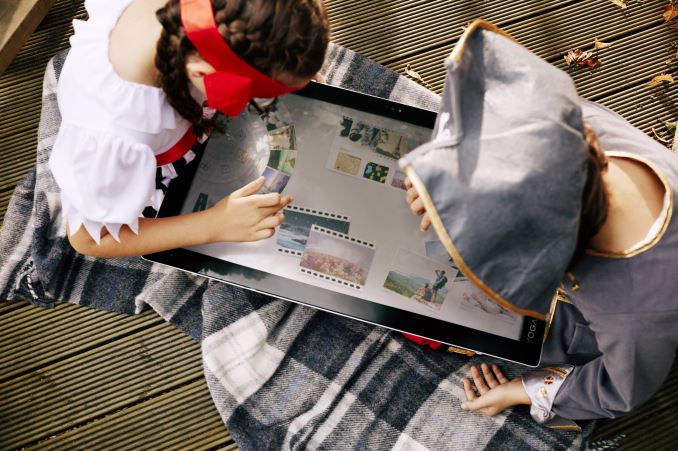
Information about the specifications is small right now, but we are told that at 27-inches, the device will come with a 5
th generation processor, Windows 10 and offer up to three hours of battery life. The 5
th
generation processor part is interesting, suggesting a Broadwell part –
if this is a 47W or 65W processor, it could be an eDRAM equipped
processor in that instance. Nevertheless there will probably be a range
available, as Lenovo is going to offer the Yoga Home 900 with optional
NVIDIA GeForce 940A graphics as well. The software package from Lenovo
will include the AURA 3.0 interface which allows for image manipulation
and a selection of apps from the Windows Store developed with portable
AIOs in mind.
Prices for the Lenovo Yoga Home 900 will start at $1549 and be available from the end of October.
Source:
Lenovo
Read More ...
ARM Announces Mali-470 GPU: Low Power For Wearables & More
One of the more surprising facts we learned from ARM when we
sat down with them last year to discuss their Mali GPU architecture
was just how successful the Mali-400 family was and is; not just in the
past tense but in the present tense as well. Although ARM has been
selling Mali T600/700/800 designs based on their Midgard architecture
for a few years now, the Utgard based Mali-400/450 have continued to
sell well due Utgard’s “no-frills” OpenGL ES 2.0 design. This has made
the Mali-400/450 popular parts in low cost and low power environments,
where a complete Mali design takes up a minimal amount of die space and
similarly small amounts of power.
Though chasing the
low-end of the market doesn’t come with the glamour of the high-end (and
for that there’s Midgard), for ARM it has in many ways the textbook
low-price/high-volume success story. The company’s estimates put them in
plenty of low-end tablets and smartphones, but more unexpectedly they
have a lion’s share of the smart TV market, with 75% of TVs implementing
a Mali design. With TVs only requiring enough graphics power for basic
UI functions and video decoding at 1080p – few smart TVs play games or
do fancy transparency/animation effects – even after having been
eclipsed by more powerful GPUs at the high-end, the Mali-400 family has
found a second home in these sort of simple devices that need little
more than a no-frills GPU, be it for cost reasons, power reasons, or
both.
Given the continued success of the Mali-400
family it should come as little surprise then that ARM has continued to
develop the family, as the need for OpenGL ES 2.0 won’t be coming to an
end any time soon. To that end, today ARM is announcing the release of
the next iteration of the Mali-400 family IP, the Mali-470. Mali-470
serves as something of a decedent of both Mali-400 and Mali-450, with
ARM intending to make it a direct successor to Mali-400 while also
integrating some of the improvements that original went in to Mali-450
as well.
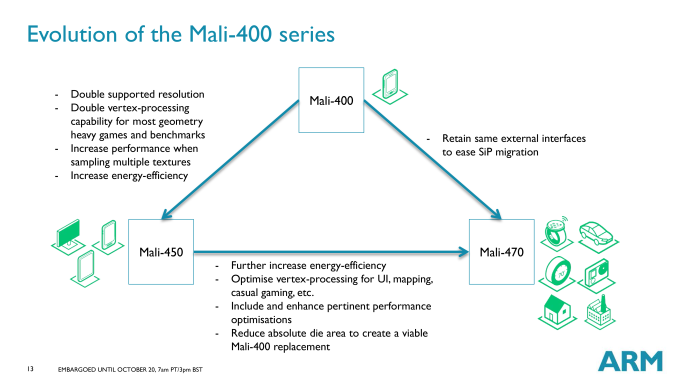
With
the Mali-470 ARM is specifically targeting the IoT and embedded market,
even more so than they were already going after it with the Mali-400
and Mali-450. In recent times the Mali-450 has been ARM’s more powerful
Mali-400 family GPU, specifically going after low-end devices and the
aforementioned TV market. Meanwhile thanks in part to the introduction
of smaller processes since its introduction in 2008, the Mali-400 has
already been something of a darling for low-power applications,
appearing in wearable devices such as
Samsung’s Gear S2.
ARM and their licensees continue to be bullish on wearables and IoT in
general, and this has lead to ARM setting out to develop a more direct
update to the Mali-400 to further improve on its energy efficiency.
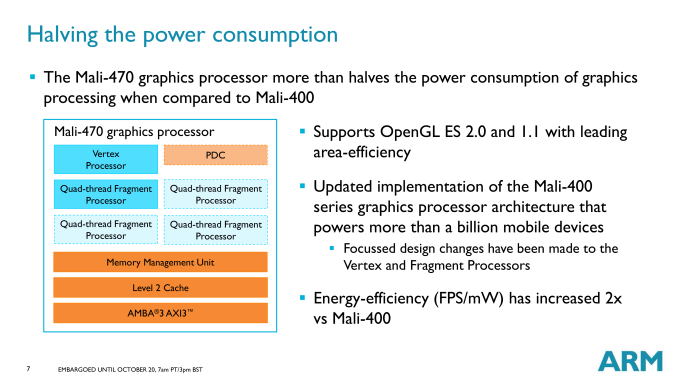
Overall
ARM is aiming to double Mali-400’s energy efficiency with Mali-470, in
accordance with their goals to reach further into the wearables and IoT
market. To do so, ARM has taken some of Mali-450’s energy optimizations
and further built on them; chief among these changes are far more
extensive use of power gating to shut off transistors when they’re not
needed, and improved use of clock gating when power gating isn’t an
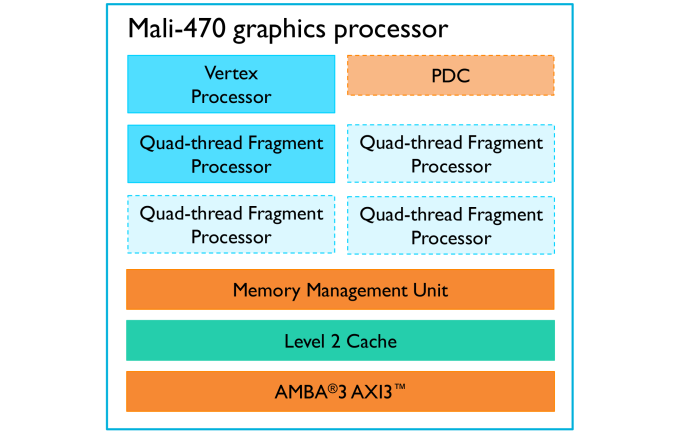
option. In order to accomplish this ARM has implemented separate power
domains on Mali-470 – each pixel/fragment block can be on its own domain
– and working with these domains is an on-GPU power controller, which
works with the system power controller to better manage the GPU.
Improving
the use of power and clock gating can greatly impact overall energy
efficiency by cutting down on the amount of energy wasted by the GPU
waiting for its next job, but it’s especially potent for bringing down
idle power consumption. In turn, given that idle power consumption
continues to be one of the chief issues dogging wearables vis-a-vis
battery life, the Mali-470 should help out battery life to a degree
thanks to these improvements.
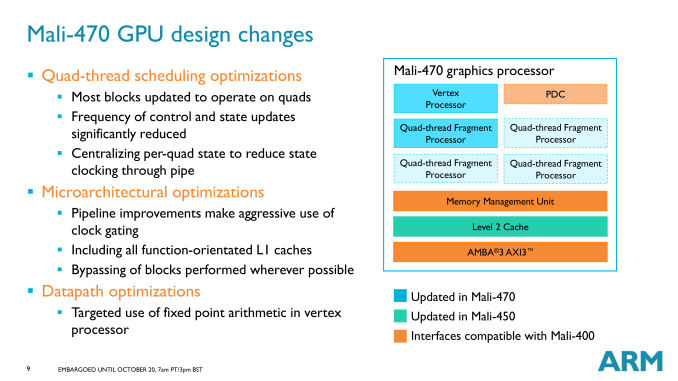
Along
with these immediate power optimizations, ARM has also made some
smaller optimizations to the Mali-400 family architecture to cut down on
wasted power at a workload level. Mali-470’s vertex processor has been
optimized to better handle fixed-point arithmetic, a use case that is
again very common in simple UIs and can be even more power efficient
than floating-point arithmetic. The pixel/fragment processor on the
other hand has not gone untouched, with ARM working to cut down on the
amount of time spent by the fragment processors changing between states.
| ARM Mali-400 Family |
|
400 |
450 |
470 |
| Fragment Shader Blocks (MP#) |
1-4 |
1-8 |
1-4 |
| Vertex Shader Blocks |
1 |
1 |
1 |
| Architecture |
Utgard |
Utgard |
Utgard |
| OpenGL ES |
ES 2.0 |
ES 2.0 |
ES 2.0 |
| Year Released (IP) |
2008 |
2012 |
2015 |
Moving on, in terms of scalability Mali-470
retains the multi-processor capabilities of the previous Mali designs,
allowing Mali-470 to be scaled up from 1 fragment processor (MP1) to as
many as 4 (MP4). Mali-470MP1 will in turn be the intended design for
wearables given its spot as the lowest-power design, while the more
powerful designs will allow Mali-470 to be used in other environments
where more performance is needed. That ARM would retain their
scalability for Mali-470 is a very intentional choice; as we mentioned
earlier Mali-470 is intended to be the successor to Mali-400, with ARM
going so far as to keep Mali-400’s MMU and bus interfaces and holding
Mali-470’s die area closer to Mali-400’s. This in turn means that
Mali-470 needs to be able to carry on from where Mali-400 has left off,
not only in the wearables/IoT market but in the embedded market as well.
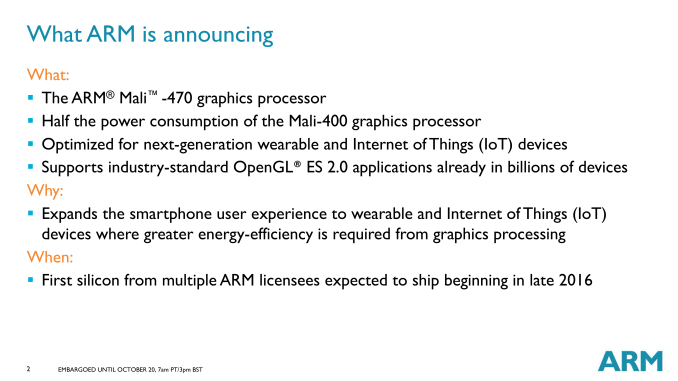
Wrapping
things up, as with past ARM IP launches today’s announcement coincides
with the general release of new IP to ARM’s customers. ARM tells us that
they expect chips integrating Mali-470 designs to start leaving the
fabs in the second-half of 2016, which would in turn have Mali-470 start
appearing in consumer devices in the first-half of 2017. Ultiamtely ARM
doesn’t control which products use which IP, but given their intentions
with Mali-470, there’s a good chance that those consumer devices will
include Android/Tizen wearables launching early that year.
Read More ...
More Greenlow Motherboards Announced: ASRock Rack’s C230 Series
On
the back of Intel’s muted launch for the Xeon E3-1200 v5 platform, the
server based business units from normal motherboards consumer facing
companies are announcing their C230 series. We covered GIGABYTE Server’s
offering in a previous pipeline post, and next up comes ASRock Rack
with ATX, microATX and mini-ITX offerings for workstations set up for
server-based airflow.
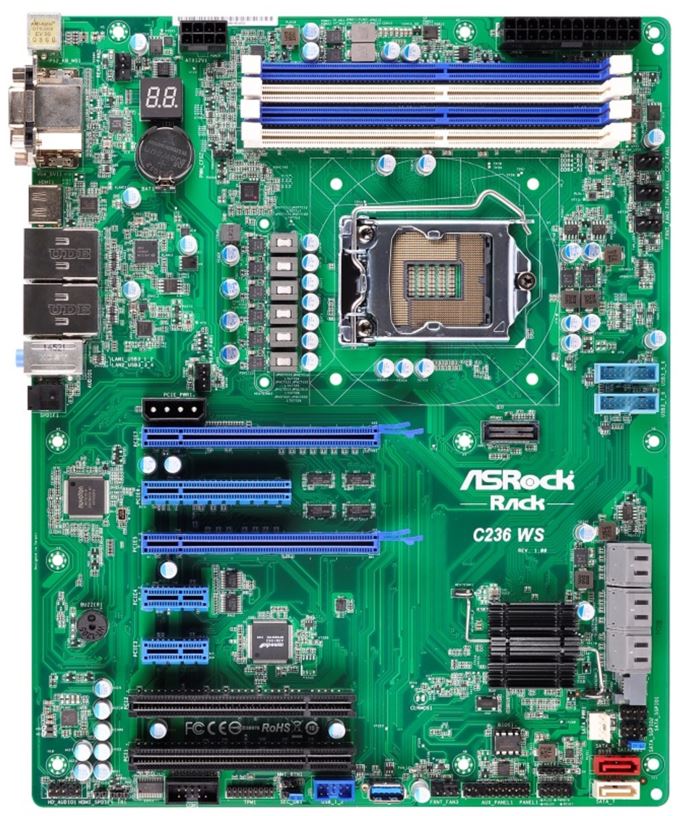
C236 WS
First
up is the full ATX model, giving support for dual PCIe co-processors at
PCIe 3.0 x8/x8, dual Intel networking (I210 and I219), another PCIe 3.0
x4 slot from the chipset, a total of eight SATA ports with SATA Express
in there as well, an onboard USB 3.0 Type-A port and eight other USB
3.0 ports through two headers and a four ports on the rear panel.
Compared
to the consumer ASRock motherboards, this is eminently more clinical
and aimed at its specific market – there is low end onboard audio
(ALC662 or lower), COM and TPM support, display outputs and PCIe to PCI
bridges for legacy connections.
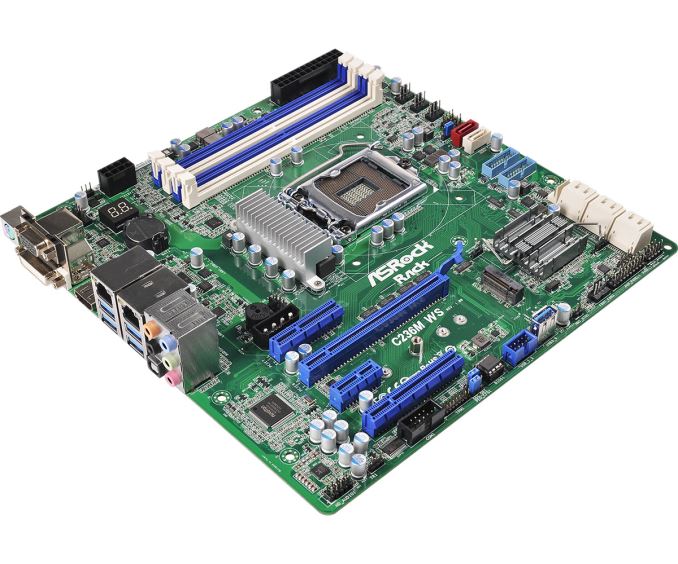
C236M WS (link)
The
micro-ATX member of this family carries over a number of features, such
as the dual networking (this time I219-LM and I210) and eight SATA
ports, but also implements an M.2 connector and a SATA DOM. Audio is
boosted up to at least the ALC892 with 5.1 support, and the power
delivery on the processor gets a heatsink for good measure. Perhaps
surprisingly we see a total of six fan headers as well.
Despite
the layout of the PCIe slots, the bottom open-ended x8 is part of the
CPU lanes, offering x8/x8 configuration with a PCIe 3.0 x4 at the top
from the chipset. Unfortunately, despite the free PCIe lanes in the
system, that M.2 slot is only geared for PCIe 3.0 x1 bandwidth.
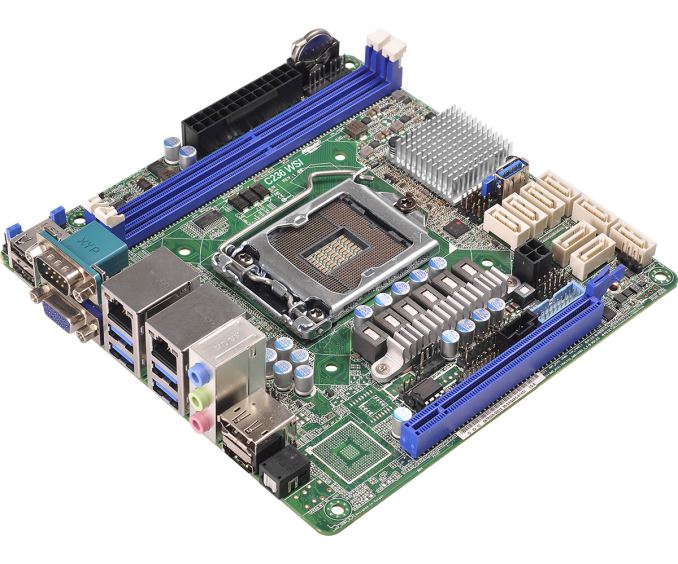
C236 WSI (link)
Similar
to the boards from GIGABYTE Server, the smaller mini-ITX one is the
more interesting out of the set. Here’s a small board with support for
up to 32GB of ECC DDR4 memory, a total of eight SATA ports, dual network
controllers (again I219 and I210), a full PCIe 3.0 x16 and a rear-IO
COM header.
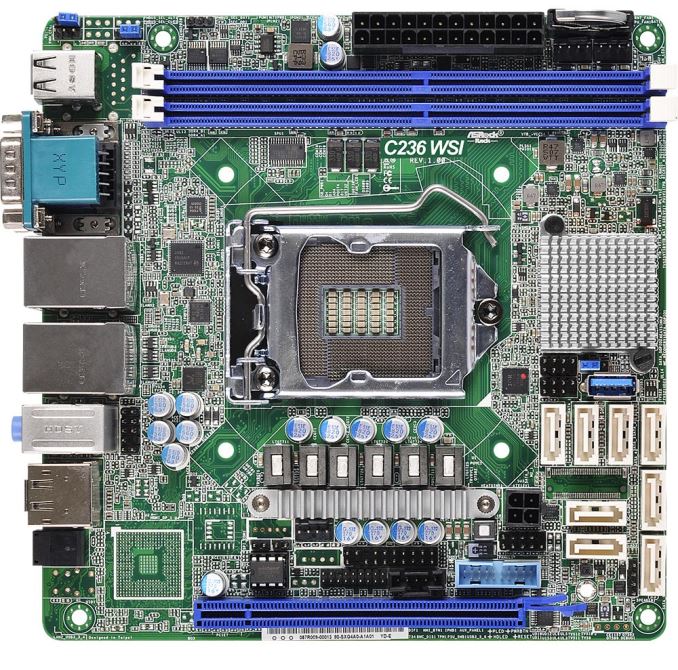
There’s
an interesting large gap in the bottom left however, showing solder
pads but no integrated chip. The size of the pad suggests that there is
room here for an Alpine Ridge controller, suggesting that in the future
there might be a version with either USB 3.1 or Thunderbolt 3.
Availability
of these motherboards will be dependent on B2B distribution channels,
although we might see one or two filter into commercial channels as
well.
Source: ASRock Rack
Read More ...
Skylake Xeon Motherboards: GIGABYTE’s C230 Series Announced
With
the new E3-1200 v5 processors announced today
we also get a new series of workstation/server motherboards under the
C230 series. Aside from standard workstation and Xeon markets that these
platforms typically target, due to a set of increased limitations these
new processors will not work in consumer grade motherboards, meaning
that even for home use the C230 series will be at the front and center
for enthusiasts who are interested in going down the Xeon route. Today
GIGABYTE Server announced a quartet of motherboards for end-users and
business customers alike, including ATX and mini-ITX configurations with
IPMI management and NVMe support.
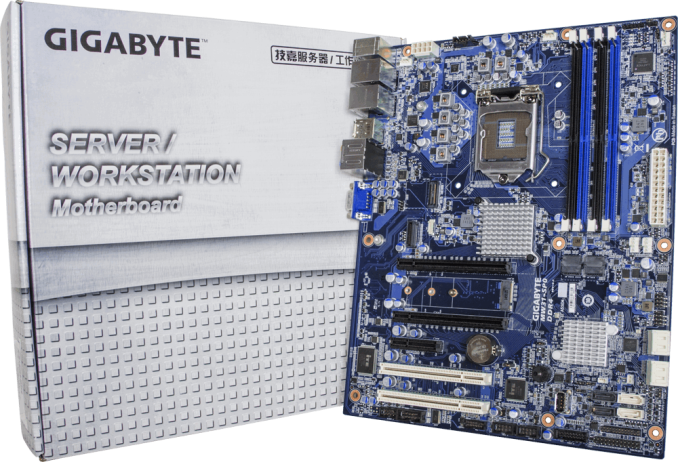
MW31-SP0 (link)
First
up is a dual graphics workstation board for SLI or Crossfire with dual
Intel network ports (I210+I219-LM), a COM port, TPM support, M.2 support
and an interesting proprietary connector between the CPU socket and the
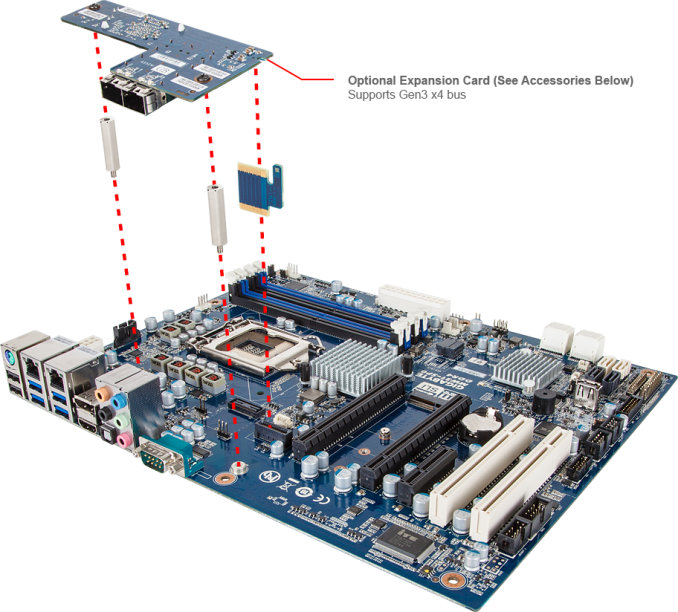
PCIe slots for expansion cards:
GIGABYTE
Server sells cards for 10 gigabit Ethernet, Thunderbolt 3 via Intel’s
Alpine Ridge controller, or additional M.2 slots as required. This
proprietary connector has bandwidth for up to four PCIe lanes, and the
range of cards that will be offered will most likely depend on the
take-up of this connector and how many customers are interested in
customizing parts of their motherboard like this.
Other
features include an on-board USB Type-A port for software license
dongles and the use of a low-end Realtek ALC887 audio codec that we
normally find on low end motherboards. Interestingly rather than take
the full eight SATA ports from the chipset, here there are four as
expected but another four from a Marvell 9230 controller, which does not
support RST but its own control storage system for RAID. The PCIe x4
slot in the middle of the motherboard is only a PCIe x2 by design, and
we also get USB 3.0 support via a VLI controller rather than the
chipset. There is no IMPI control on this motherboard either.
MW21-SE0 (link)
Moving
to micro-ATX, this model is somewhat stripped out providing a base
entry into a Skylake Xeon workstation. There is no onboard audio for
example, only a single PCIe 3.0 x16, only one Intel I219-LM network
controller, a TPM, some SATA ports and USB headers, plus four DDR4 slots
for up to 64GB of memory. Add in a COM port, VGA for the AST1400
control and that’s about it.
The
design is offers a four-phase processor arrangement, with the final
PCIe slot at x4 from the chipset. Despite the image above looking as if
the DDR4 memory is inserted sequentially, it seems that this ‘stock’
photograph is from a mockup where the slots were placed in the wrong
colors.
MX11-PC0 (link)
On
the server side, the MX11-PC0 actually looks like an interesting
mini-ITX motherboard for the rest of the ecosystem to consider. It
somewhat attempts to adhere to the thin mini-ITX standard with a
half-height rear IO, but there are a number of interesting elements to
this worth noting. The DRAM slots are positioned for server use, but the
power ports are still on the outside of the motherboard in such a way
that a couple of features stick out.
First up is the
U.2 port, where the battery is stuck to. This uses the SFF-8639
connector which we’ve seen on Intel’s SSD 750, and runs at PCIe 3.0 x4
speeds with NVMe support. We’ve seen this connector on a couple of ASUS
ROG boards so far (the
Impact and
Extreme),
but the more the merrier. Aside from the PCIe 3.0 x16 slot and SATA
ports we also get an AST2400 controller IC with an associated memory
chip, and a pair of Intel I210 network ports.
The rear of the board also gets co-locator LED buttons and power/reset/NMI buttons.
MX31-BS0 (link)
In
a similar server style, the MX31-BS0 also puts the socket/DRAM
orientation more suited for server airflow but also attempts to aim for
that low to mid-range implementation with IPMI control via an AST2400,
dual I210 network ports, an M.2 slot supporting SATA and PCIe 3.0 x1,
onboard USB 2.0 Type-A and what amusingly looks like a Realtek audio
codec onboard but the system comes without rear-panel audio jacks,
leaving the audio solely for SPDIF output.
Typically
motherboards from GIGABYTE’s Server business unit start as B2B sales
only and the more consumer focused models should end up on select
retailers over the next few months.
Source:
GIGABYTE Server
Read More ...
Intel Launches ‘Greenlow’: C236 Chipset and Skylake E3-1200 v5 Xeons
One
of the recent notable aspects about the Xeon E3 family was the lack of a
significant presence with Intel’s Broadwell architecture.
A handful of them were released under the E3 v4 nomenclature, with half of them only for embedded solutions –
we reviewed the socketed models at the time, but noted through IDF that the main direction these models were going seemed to be towards
Intel’s Valley Vista PCIe co-processors,
where three of them would be fixed to a PCIe card. For most single
socket workstation users, this means a jump from Haswell-based E3 v3 to
Skylake-based E3 v5.
In a somewhat muted launch today,
without any PR announcement or anything in the way of details direct,
Intel quietly launched details regarding their new workstation
single-processor platform based on Skylake. Through Intel’s processor
information repository,
Intel ARK,
eleven socketed models were released in the E3-1200 v5 Xeon family. As
with previous Xeons, the goal here is to supply server level features
that wouldn’t normally be on consumer grade hardware. All these parts
support DDR4 un-buffered modules in both non-ECC and ECC configurations
up to 16 GB per module, giving 64 GB maximum. Xeon platforms
historically run at base JEDEC memory configurations, so expect to see
DDR4-2133 at 15-15-15 subtimings being the norm. Similar to the Skylake
consumer parts, DDR3L up to 1600 MT/s is also supported.
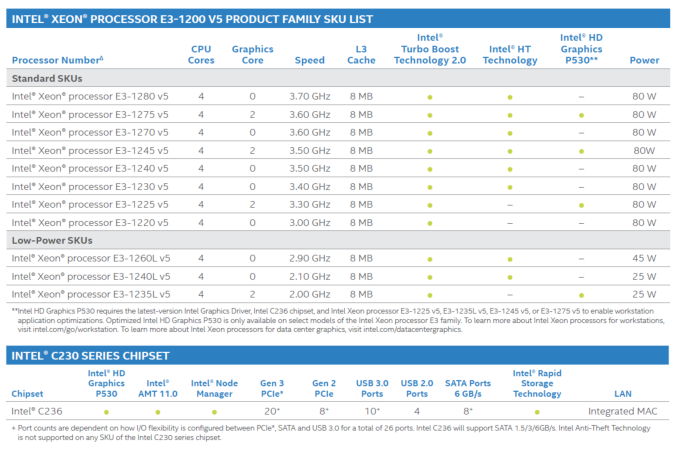
These
are all quad core parts, ranging from 25W low power models at 2.1 GHz
base clock (with hyperthreading) up to up to 80W for the fastest 3.7 GHz
model. Prices will range from $193 for the E3-1220 v5 up to $612 for
the E3-1280 v5. As shown in the table, only a select few will have
integrated graphics, and those that do will be under the HD P530
designation, which if we refer to the standard Skylake launch
corresponds to a GT2 configuration with 24 execution units. At this
point in time, there are no dual core parts.
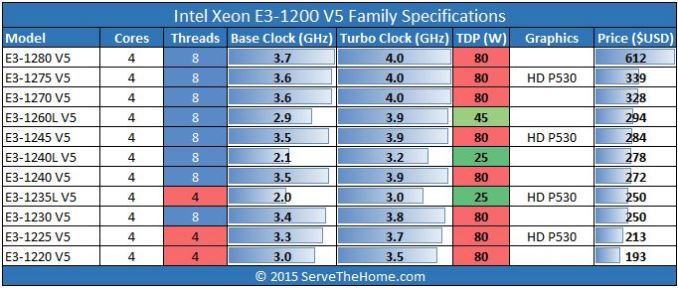 ServeTheHome’s Table of Xeon Processors is a great representation of the offerings
Several
parts clearly fly out as interesting – the E3-1275 v5 comes in at just
over half the price of the E3-1280 v5 for only a 100 MHz deficit on the
base clock. For $9 less, the E3-1270 v5 does the same as the E3-1275 v5
but without the integrated graphics. The one below that, the E3-1260L
v5, is one of the low power parts at 45W but still comes close in single
threaded frequency to those above it. One of Intel’s big comparison
points to these parts will be with Xeon D-1540, also known as
Broadwell-DE. This is a 45W part that offers eight cores at 2.0 GHz
base/2.6 GHz turbo, with similar DDR4 support but 12MB of L3 cache ‘at
$581’.
Users interested in the perennial alternative to
the Core processors, the E3-123x range, might come up empty handed this
generation. Not necessarily due to the processor itself, but multiple
sources in discussion or published at
ComputerBase
are concluding that Intel is further locking the Xeon processors down
for Skylake. This means that in order to use a Xeon processor, you need a
server based chipset, such as the C230 series, rather than the
100-series found in consumer platforms. Several companies have confirmed
that a ‘workaround’ in this case is most likely not possible.
This
new segregation tactic shows that Intel is perhaps trying to adjust any
overlap these two markets may have had for non-business users, putting
more power into the hands of the OEMs that develop pre-build systems.
While E3-1200 based server motherboards have not been difficult to
source in the past, they tend to be workstation/server focused and not
have bells and whistles that accompany consumer boards. This also
removes any thought of potential overclocking that may/may not be
overlooked in some Xeon parts in the past. That being said, we have seen
ASUS/ASRock release workstation type motherboards in the past that
still have consumer trimmings.
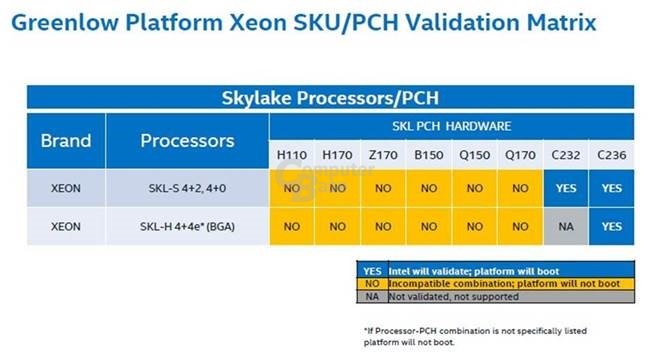
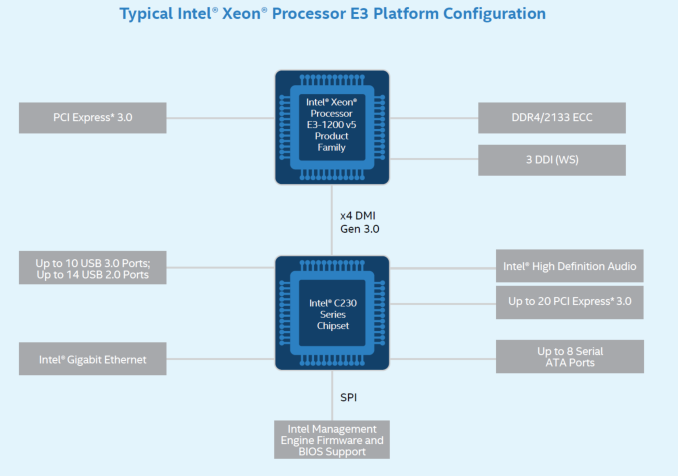
The
new Greenlow platform (E3-1200 v5 Xeon plus C232/C236 motherboards)
will look like the consumer counterparts with sixteen PCIe lanes for
co-processors, dual DDR4/DDR3L memory support, DMI Gen 3.0 to the PCH, a
mix of PCIe 3.0 lanes from the chipset, support for up to eight SATA
3.0 ports, and a myriad of possibilities through 26 lanes of HSIO.
At
this point in time the launch seems to be biased towards workstations
rather than anything 1P server related, but information is currently
patchy. At this point in time we are looking to get sampled with some of
these processors, along with appropriate motherboards as well. Some
motherboard announcements have been made from GIGABYTE Server and ASRock
Rack, and I suspect workstation OEMs will come forth in due course.
Source:
ComputerBase,
ServeTheHome,
Intel ARK
Read More ...
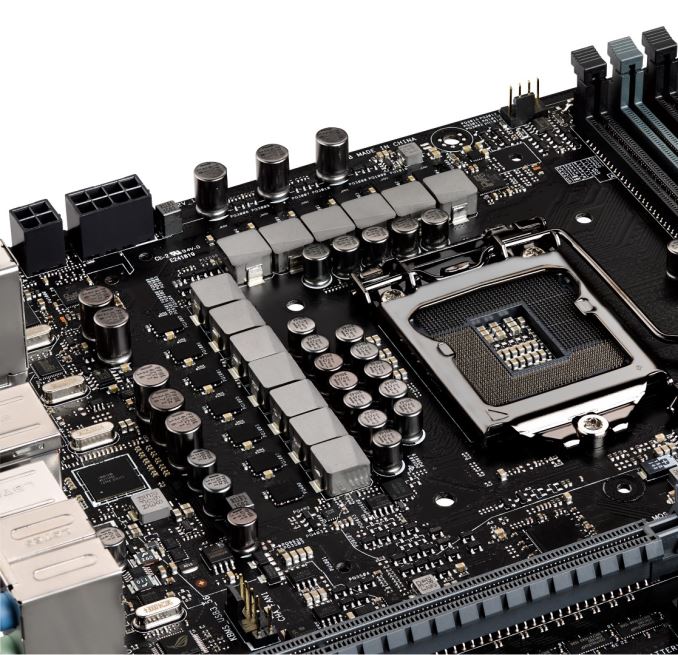
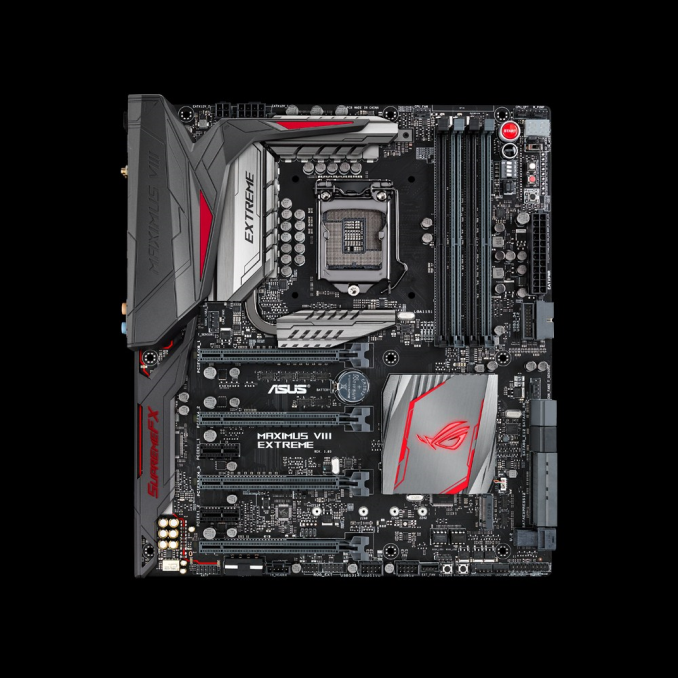
ASUS Announces the Z170-based Maximus VIII Extreme ROG Motherboard
We caught a glimpse of it very briefly in
our motherboard overview
at the time that Intel launched its 6-th Generation Skylake processors,
but at the end of last week ASUS formalized its announcement around
their flagship motherboard for this generation, the Maximus VIII
Extreme. The Extreme, despite being part of the ‘Republic of Gamers’
brand, is designed by ASUS’ in house overclocking team and the goal is
often to provide a rounded product that can do day-to-day as well as
break records. We’ve reviewed other Extremes in the past, such as the
Rampage IV Extreme, the
Rampage IV Black Edition, and the
Rampage V Extreme, and the product line aims to continue the mantra with this latest model.
As
with most elements of technology, a product can be engineered beyond
specification, almost to the point of being a little crazy. High end
halo motherboards tend to do this not only to satiate the users who will
spend $5000 and up on an extreme system, but to also showcase their
engineering talent in a mass market (no one-off chrome Aventadors here).
For overclocking this means for the M8E (Maximus VIII Extreme) power
delivery that is both quick to react and capable of holding overclocks
way beyond normal specifications, DRAM arrangements rated up to
DDR4-3866 when all memory slots are populated, enhanced base-clock
control to north of 400 MHz, a bundled OC panel with updates for Skylake
and extra onboard buttons and switches to help with BIOS selection,
updates and memory recovery.
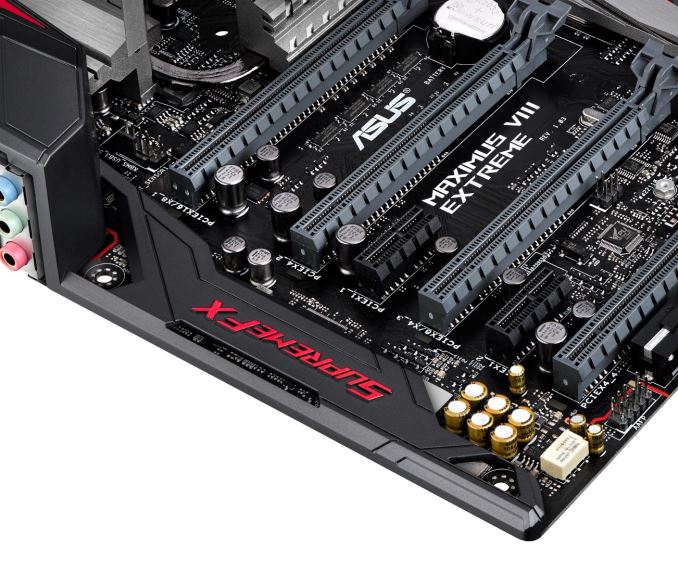
For
gamers, the M8E will house ASUS’ latest evolution of their ALC1150
audio solution dubbed SupremeFX 2015. This includes an enhanced DAC,
ultra-low-jitter, high-end capacitors and filters, headset impedance
detection up to 600 ohms, as well as software features to enhance
aspects of gameplay (noise reduction, footsteps, on-screen audio
directional locator). The M8E will support ‘quad-SLI’ and ‘quad-CFX’,
but only in certain situations – despite looking the part, it is not
equipped with a PLX 8747 PCIe switch (that would normally enable the
PCIe graphics lanes to be split for up-to x8/x8/x8/x8 operation, which
is slowly becoming rarer on mainstream motherboards as the price of this
switch has significantly increased over the last two years). Instead
ASUS is using an x8/x4/x4 arrangement with another PCIe 3.0 x4 from the
chipset, allowing for quad-CFX in x8/x4/x4/x4 mode or quad-SLI when
dual-GPU cards are used in the x8/x8 slots. ASUS also equips the M8E
with an Intel I219-V network controller with electrostatic protection
and software optimization for network traffic prioritization, as well as
a tri-stream 3T3R 802.11ac wireless solution.
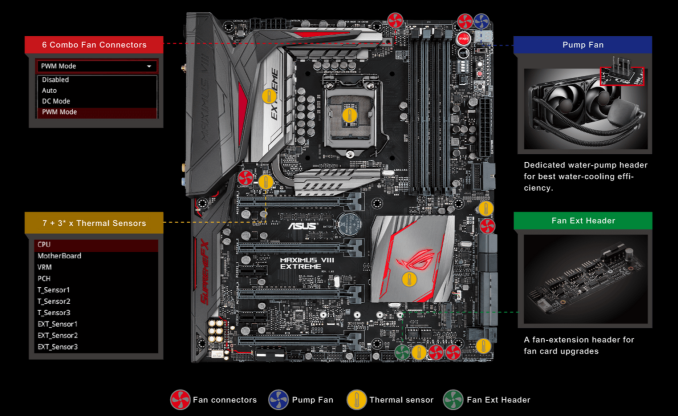
For
software, ASUS is bundling the M8E with updated iterations of RAMCache,
KeyBot II and AI Suite, but also new in the bag is Overwolf, a display
sub-system that allows for browsing, email, messaging or streaming while
in-game.
Storage
is a big part of the M8E, with U.2 support directly next to the SATA
ports for SSD 750 users, SATA Express, M.2 running at PCIe 3.0 x4, and
then we also have Thunderbolt 3 alongside USB 3.1 at 10 Gbps both in
Type-A and Type-C.
The
Thunderbolt 3 support is provided by Intel’s Alpine Ridge controller in
a Type-C connector format. This port can also run in USB 3.1 mode, with
the AR controller giving two of the USB 3.1 ports (one Type-C and one
Type-A). The other two Type-A USB 3.1 ports at 10 Gbps are given by
ASMedia’s ASM1142 controller, which we’ve seen on a number of
motherboards already.
Perhaps to be expected, the M8E will not be the cheapest board in the market. At $500, and
it should be available from today in NA,
the Extreme line remains the realm of users with a spare bit of green
and the need for a high-end system. It would be interesting to see this
paired up against the other $500 motherboard on the market, the GIGABYTE
Z170X-Gaming G1, as we already have it in for review.
Source:
ASUS
Read More ...
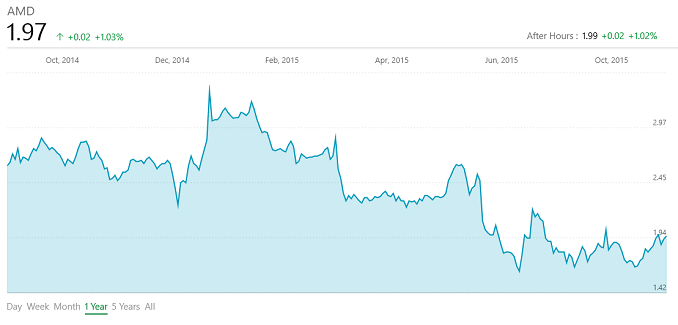
AMD Announces FY 2015 Q3 Results: Decreased Computing And Graphics Sales Hurt Bottom Line
Today
AMD has announced their third quarter earnings for fiscal year 2015.
AMD saw a 13% increase in revenue over Q2 2015, but revenues were down
almost 26% over their Q3 2014 numbers. Revenue for the quarter was $1.06
billion USD, down from $1.43 billion a year ago. AMD continues to use
GAAP and Non-GAAP earnings to help show the state of the business in
greater detail. On a GAAP basis, AMD had an operating loss of $158
million for the quarter, and a $197 million net loss, which works out to
$0.25 per share. Compared to last quarter, both losses were larger
despite the increased revenue, and the numbers are down significantly
over the $17 million net income a year ago.
| AMD Q3 2015 Financial Results (GAAP) |
|
Q3'2015 |
Q2'2015 |
Q3'2014 |
| Revenue |
$1.06B |
$942M |
$1.43B |
| Gross Margin |
23% |
25% |
35% |
| Operating Income |
-$158M |
-$137M |
$63M |
| Net Income |
-$197M |
-$181M |
$17M |
| Earnings Per Share |
-$0.25 |
-$0.23 |
$0.02 |
On a Non-GAAP basis, AMD had a $97 million
operating loss, which is once again a larger loss than last quarter, and
down 211% from the $87 million in operating income last year. Net loss
was $136 million, or $0.17 per share, compared to a $41 million net
profit and $0.05 per share last year. GAAP to Non-GAAP differences are
due to $48 million in restructuring fees and $13 million in stock based
compensation.
| AMD Q3 2015 Financial Results (Non-GAAP) |
|
Q3'2015 |
Q2'2015 |
Q3'2014 |
| Revenue |
$1.06B |
$942M |
$1.43B |
| Gross Margin |
23% |
28% |
35% |
| Operating Income |
-$97M |
-$87M |
$87M |
| Net Income |
-$136M |
-$131M |
$41M |
| Earnings Per Share |
-$0.17 |
-$0.17 |
$0.05 |
The Computing and Graphics segment continues to
struggle, although AMD did see stronger sequential growth here with the
recent launch of Carrizo. Revenue increased 12% over last quarter,
although it is still down 46% year-over-year. This segment had an
operating loss of $181 million for the quarter, up from a loss of $147
million last quarter and a loss of $17 million a year ago. Sequentially,
the loss is mostly attributed to a write-down of $65 million which AMD
is taking on older-generation products. Annually, the decrease is due to
lower overall sales. Unlike Intel, AMD processors had a decrease in
Average Selling Price (ASP) both sequentially and year-over-year, so
there was no help there from the lower sales volume. The GPU ASP was a
different story, staying flat sequentially and increasing
year-over-year. Recent launches of new AMD graphics cards have helped
here.
| AMD Q3 2015 Computing and Graphics |
|
Q3'2015 |
Q2'2015 |
Q3'2014 |
| Revenue |
$424M |
$379M |
$781M |
| Operating Income |
-$181M |
-$147M |
-$17M |
The Enterprise, Embedded, and Semi-Custom segment
had a better showing. Revenue increased 13% over last quarter, and was
down only 2% year-over-year. Semi-custom sales (read Consoles) drove the
sequential increase but lower embedded and server processor sales
caused a year-over-year decline. Operating income for this segment came
in at $84 million, up from $27 million in Q2 but down from $108 million
in Q3 2014. Q2’s numbers were skewed though by a $33 million hit on
moving to a new process node.
| AMD Q3 2015 Enterprise, Embedded and Semi-Custom |
|
Q3'2015 |
Q2'2015 |
Q3'2014 |
| Revenue |
$637M |
$563M |
$648M |
| Operating Income |
$84M |
$27M |
$108M |
All Other had an operating loss of $61 million for
the quarter, up from $17 million loss in Q2 and a $28 million loss in
Q3 2014. This is where they stick their “restructuring charges” and they
nicely align with the GAAP vs Non-GAAP values.
The bad news doesn’t stop here either. We’ve seen the departure of a couple of key people at AMD, and AMD is also spinning off
some of the company.
Revenues for Q4 are expected to decrease an additional 10%, plus or
minus 3%, compared to today’s numbers. AMD is doing more corporate
restructuring in an attempt to reduce expenses further. Perhaps the most
troubling aspect of today’s results is their gross margin is only 23%.
They really need closer to 35% for profitability and are a long way from
that today.
Source:
AMD Investor Relations
Read More ...
AMD To Spin-Off Back-End Testing & Assembly Operations Into Joint Venture For $371 Million
AMD’s
Q3 2015 earnings release just hit the wire a bit ago, and while we’re
still working on putting together that story we wanted to immediately
jump into what is the biggest news to come out of today’s release. As
part of their wave of news releases this afternoon, AMD is announcing
that they will be spinning off their back-end manufacturing operations
into a new joint venture with Nantong Fujitsu Microelectronics (NFME),
with NFME essentially buying the bulk of these operations off of AMD.
Briefly
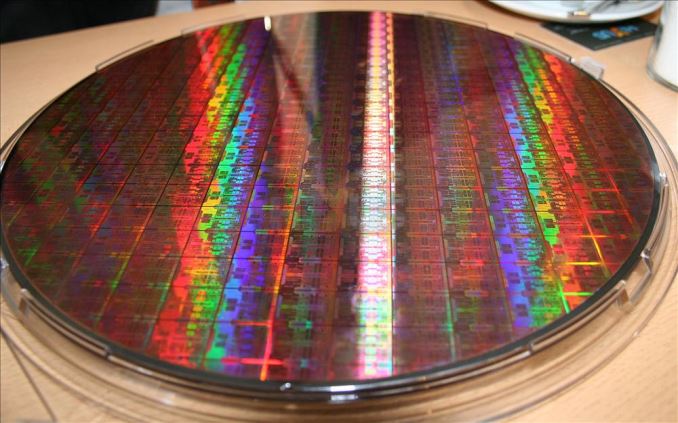
then, in the world of semiconductor manufacturing the complete process
of creating a chip is divided into two halves. There is the front-end
manufacturing step where a complete wafer of chips is fabbed, and the
back-end manufacturing step where those finished wafers are tested and
cut up into individual chips for customer use. Dubbed ATMP – for
assembly, test, mark, and pack – these back-end operations are in modern
times split up from the fabbing step for cost reasons. Consequently
capital-intensive and technologically advanced fabbing process will take
place in facilities like TSMC Taiwan, GlobalFoundries Germany, and
Intel US, while ATMP takes place at facilities in China, Malaysia, and
Vietnam.
Up until their spin-off of GlobalFoundries in
2009, AMD had a complete chip manufacturing operation, including
facilities for both the fabbing and ATMP operations. Even after the
spin-off however, AMD held on to their ATMP operations. It is these
operations that AMD is now spinning-off as well, as the company pursues
an operations strategy more befitting of a fabless semiconductor
designer.
For
the deal with NFME, AMD will be spinning-off their ATMP operations into
a new, unnamed joint venture in partnership with NFME. The joint
venture will see AMD contribute their ATMP facilities in Penang,
Malaysia and Suzhou, China, along with their roughly 1,700 person ATMP
staff. Meanwhile, though not mentioned in the release, NFME will
be contributing their own facilities and employees as well, with the
complete joint venture set to have 5,800 employees spread over five
facilities.
On the financial side of matters, NFME will
immediately be buying an 85% stake of AMD’s ATMP operations, putting
NFME in control of the overall joint venture while AMD serves as the
minority partner with their remaining 15% share. In turn, NFME will be
paying AMD approximately $371 million, and after taxes and other costs
this will be a net gain of about $320 million for AMD.
Overall
AMD is touting this as a beneficial change for the company, though they
also don’t attempt to hide their current financial state in the
announcement, stating that the joint venture and sale “further
strengthens our balance sheet with significant asset monetization.” AMD
on the whole has been struggling with a series of losses over what has
now been a number of years, and it has taken a toll on their cash
reserves. In the last few years the company has been slowly selling off
non-essential or legacy assets in order to both contain ongoing costs
and to raise much-needed cash for day-to-day operations. This, among
other things, has included
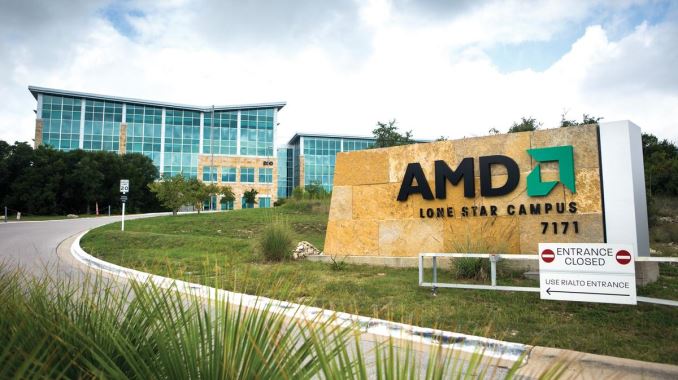
selling off and then leasing back their “Lone Star” campus in Austin, Texas.
For
AMD, the spin-off means they will be removing 1,700 employees from
their payroll, which would put their adjusted headcount at around 7,500
to 8,000 employees after the deal closes. Furthermore as ATMP is
capital-intensive, this allows AMD to further contain their spending on
capital expenditures. AMD has until now held on to their ATMP
operations, and at the time of the GlobalFoundries deal stated that they
were keeping these operations as they were specifically tailored to
AMD’s microprocessor business. However there’s no doubt that the have
been an increasing drag on AMD as the company’s revenues and chip volume
have continued to shrink. Ultimately as AMD was already fabless, it’s
rare to see a fabless company with their own back-end operations anyhow,
and AMD believes they can continue to meet their ATMP needs through
this joint venture.
As for the joint venture itself,
this gives NFME the ability to further expand into the market for
semiconductor assembly and test services (SATS). With AMD’s lower
product volumes no doubt making it harder to fully utilize their
high-volume AMTP facilities, a joint venture with NFME can bring more
work into those facilities by having them work for additional customers
beyond AMD. Furthermore NVME also gains the R&D experience that
comes with AMD’s AMTP operations, which for them is a competitive
advantage against other 3
rd party SATS providers.
Ultimately
today’s announcement of a joint venture is at best mixed news for AMD.
Containing costs is important for the company’s ongoing health and
clearly the company no longer has the resources or demand to stay in any
kind of manufacturing. On the other hand as the company continues to
sell off assets in one form or another – and all the while continues to
lose cash as happened again this quarter – it puts them in a perilous
position of having to operate off of fewer and fewer assets. So
hopefully this joint venture and accompanying sale helps the company
focus on the chip and architectural development they need to do, and
provide the funding over the next few years to accomplish it.
Read More ...
NVIDIA GeForce Experience Update: 4K GameStream & 1080p Twitch; Driver Update Changes To Come
Since
launching their GeForce Experience software utility over two years ago,
NVIDIA has continued to iterate on it in a fairly regular fashion.
Along with its software update and game settings optimization features,
NVIDIA has added a number of features over the past couple of years tied
to their NVENC hardware encoder, including GameStream, ShadowPlay, and
most recently the beta for Share and GameStream Co-Op. As one might
expect, NVIDIA is not stopping there, and in a briefing to the press
this week, NVIDIA is announcing some of their feature development plans
for GeForce Experience over the next couple of months.
To
kick things off, in a new beta release hitting NVIDIA’s servers today,
NVIDIA will be updating several of GeForce Experience’s various
NVENC-powered features to enable new features. On the GameStream front
NVIDIA will be offering new functionality specifically targeted at the
recently launched SHIELD Android TV set top box.
With the SHIELD Android TV capable of decoding 4K video content, NVIDA
is now giving GameStream the ability to encode video at that resolution,
allowing for GameStream remote gaming at full native resolution for 4K
TVs. Furthermore NVIDIA is also giving GameStream the ability to serve
up 5.1 audio.
Until
this latest release GeForce Experience had been limited to serving up
GameStream with 1080p video and stereo audio, so this marks a
significant increase in GameStream’s video and audio quality. At the
same time because of the step up in quality the system requirements to
use the new 4K mode are significantly higher as well. On the encode side
only the newest Maxwell 2 generation GPUs have an NVENC unit capable of encoding at 4Kp60,
so high-end Kepler users won’t see this functionality. Meanwhile on the
reception side, a SHIELD Android TV is needed to receive 4K video, and
NVIDIA is recommending a hardwired 100Mbps (or better) Ethernet
connection for best performance. And on a technical side note, though
not specified in NVIDIA’s presentation, as 4K support is limited to
SHIELD Android TV I’m curious whether NVIDIA is still using H.264 or if
they’re switched to HEVC, as Maxwell 2 and SHIELD Android TV support
hardware HEVC encoding and decoding respectively.

Moving
on, similar to GameStream, GeForce Experience’s video broadcasting
module is also getting new functionality and an image quality boost.
First launched with Twitch support back in late 2013, the broadcast
module is now gaining support for Google’s rival YouTube Live service as
well, allowing GeForce users to broadcast to the service of their
choice. Furthermore the broadcast module can now upload video streams at
1080p60 with a maximum bitrate of 9Mbps, supplanting the module’s
previous 720p60 limit. As even older versions of NVENC have long been
able to record at 1080p, this change primarily appears to be NVIDIA
increasing their limits now that these services are better able to
handle the high bitrates that go with 1080p streaming.
The Next Few Months: Driver Updates Shift to GeForce Experience
Finally,
in their last announcement for the day, NVIDIA is sharing a bit of
information on their plans for GeForce experience for the rest of the
year, and this is a big one.
Starting with a December
update to GeForce Experience, NVIDIA will be overhauling how they
distribute their driver updates. The company currently posts new drivers
on a regular basis to their website while also simultaneously pushing
them out via GeForce Experience. Come December, that will be changing
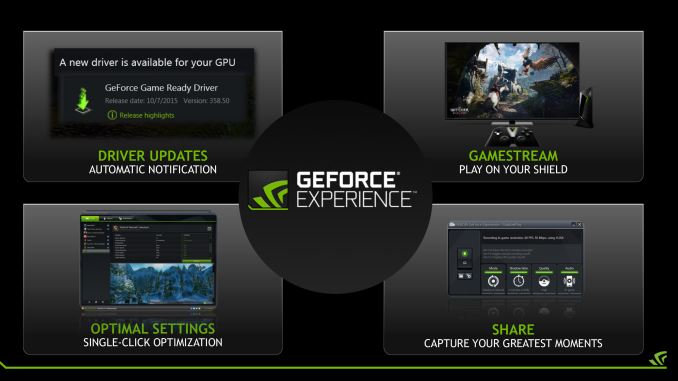
and GeForce Experience will be the preferred “first access” distribution
mechanism for NVIDIA’s frequent driver updates.
This
change comes on the heels of NVIDIA’s latest research, which finds that
90% of all driver updates are now distributed through GeForce
Experience. At this point NVIDIA is not discussing the change in great
detail – and most likely they’re still sorting out the finer details of
what they want to do – but the basic idea is to fully exploit the push
update mechanism of GeForce Experience while drawing users into what
will in time become a larger NVIDIA ecosystem. GeForce Experience will
be used to distribute the company’s regular “point release” driver
updates that the company frequently releases and typically contain bug
fixes and performance improvements for gamers – in other words the
drivers most gamers will want to be on. Meanwhile NVIDIA will still post
drivers to their website (and by extension Windows Update), but on a
reduced quarterly cadence.
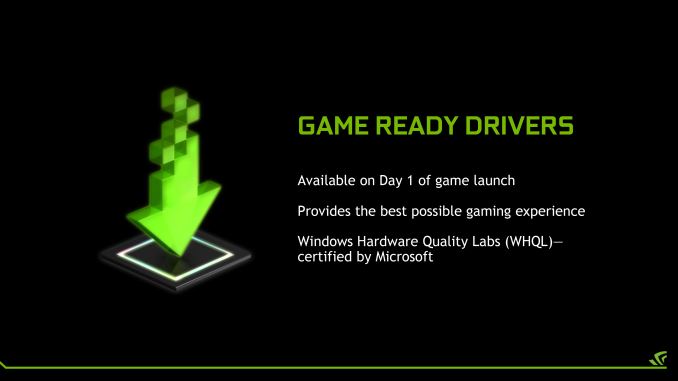
One
thing NVIDIA has made clear is that they’re sticking with their overall
Game Ready driver release system – targeting frequent driver updates to
line up with major game launches – and this includes WHQL
certification, so this won’t be NVIDIA cutting back on WHQL releases
despite the fewer updates to their website. However even with WHQL
certification, NVIDIA’s frequent driver releases (20 in just over the
last year, not counting hotfixes) have been both a curse and a blessing
for their wider user base, as non-gamers use the same drivers. I get the
impression that this change is in part driven by a desire to establish
separate “gamer” and “long term” driver release cadences where
non-gamers aren’t constantly being bombarded by Game Ready point updates
that primarily affect software they aren’t using.
At
the same time however NVIDIA is also being straightforward about this
driver change being part of a broader effort to promote GeForce
Experience from a utility to a critical part of the GeForce ecosystem
and to make it a software backend of sorts to their GPUs. The change in
driver distribution will be accompanied by a yet to be fully detailed
registration system where NVIDIA will be asking users to register their
email addresses with GeForce Experience. NVIDIA has already been toying
with this concept this year
by using GeForce Experience to distribute game codes,
so while it’s not fully clear what NVIDIA intends to do with a
registered user base this is clearly the latest step as part of building
their ecosystem.
More
broadly speaking, NVIDIA has been pushing the larger GeForce ecosystem
concept for even longer than GeForce Experience has been around –
through G-Sync, PhysX, 3D Vision, and other technologies – and the
company has made it clear for years that they see their continued
success as coming from not just offering gamers solid hardware, but
offering a wholly integrated experience. Given that PC gaming is
otherwise one of the few bright spots in a tough market for PCs –
year-over-year worldwide sales
were down 7.7% for Q3 – it makes a great deal of sense for NVIDIA to want to further bolster their hand in the PC gaming market.
I
am however curious to hear more details in the coming months about how
the registration mechanism and revised driver distribution system works
in GeForce Experience, what else NVIDIA will be doing with their growing
ecosystem, and what GeForce owners think of this. Web based driver
updates are older than the formal concept of the GPU, so NVIDIA’s plans
mark a significant change in how drivers are at least preferably
distributed. Though to NVIDIA’s credit they have clearly thought this
through – even downgrading has been considered and NVIDIA will be
building in a downgrade mechanism into the GeForce Experience driver
update module. And ultimately with NVIDIA’s 90% distribution figure, it
would appear that web downloads were already a quickly dying trend
anyhow.
Wrapping things up, NVIDIA tells us these
latest and upcoming improvements to GeForce Experience will be followed
by further improvements for GeForce Experience in 2016. NVIDIA has
stated that they have an “interesting roadmap” for the utility for the
next year, one that will no doubt further flesh out this software
ecosystem that the company is quickly assembling.
Read More ...
The Samsung Galaxy Tab S2 Review
The
first Android tablet I ever used was the original Galaxy Tab. It was a
7" Android tablet running Android Froyo, and it seemed a lot like a
large version of my Galaxy S. In hindsight, it wasn't a very good
tablet, but Samsung was one of the first Android vendors to enter the
market and they were working with a version of Android that had never
been designed with tablets in mind. As Android moved to Gingerbread and
then to the tablet exclusive release of Android Honeycomb, Samsung was
always among the group of manufacturers producing Android tablets. While
some vendors like LG and HTC have left and returned to the tablet
market, Samsung has continually producing new Galaxy Tab tablets, and
those tablets constitute a very large portion of the Android tablets
that are sold each year. Read on for the AnandTech review of Samsung's
newest tablet, the Galaxy Tab S2.
Read More ...
OCZ Announces First SATA Host Managed SSD: Saber 1000 HMS
Today
OCZ is introducing the first SATA drive featuring a technology that may
be the next big thing for enterprise SSDs. Referred to by OCZ as "Host
Managed SSD" technology (HMS) and known elsewhere in the industry by the
buzzword "Storage Intelligence", the general idea is to let the host
computer know more about what's going on inside the SSD and to have more
influence over how the SSD controller goes about its business.
Standardization
efforts have been underway for more than a year in the committees for
SAS, SATA, and NVMe, but OCZ's implementation is a pre-standard design
that may not be compatible with what is eventually ratified. To provide
some degree of forwards compatibility, OCZ is releasing an open-source
abstraction library to provide what they hope will be a
hardware-agnostic interface that can be used with future HMS devices.
OCZ's
HMS implementation provides a vendor-specific extension of the ATA
command set. A mode switch is required to access HMS features; when HMS
mode is off the drive behaves like a normal non-HMS SATA drive and all
background processing like garbage collection are managed autonomously
by the SSD. When the HMS features are enabled, the host computer can
request that the drive override normal operating procedure and disable
all background processes, or to perform them as a high-priority task. If
background processing is left disabled for too long, the drive will
re-enable the background processing when needed and suffer the immediate
performance penalty of the emergency garbage collection.
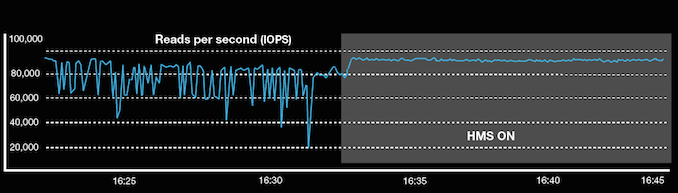
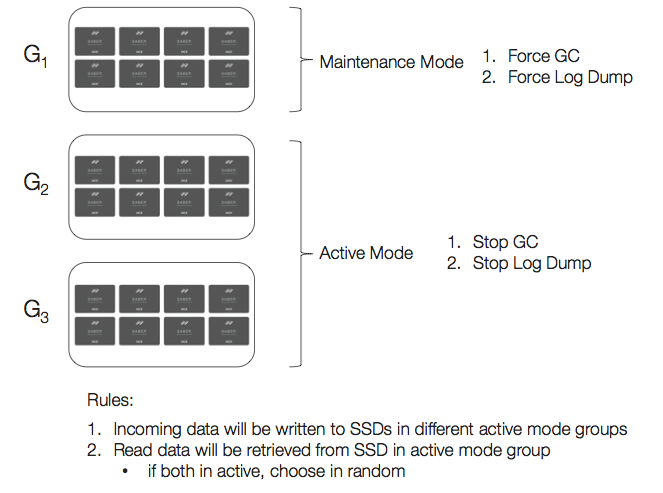
The
intention is to allow better aggregate performance from an array of
drives. An example OCZ gives is of an array divided into three pools of
drives. At any given time, two pools are actively receiving writes,
while the drives in the third pool are focusing solely on the
"background" housekeeping operations. The two pools that are in active
use defer all the background processing and operate with peak
performance and consistency. By cycling the drive pools through the two
modes, the intention is that none of the active drives will ever reach
the steady-state of having constant background processing to free up
space for the incoming writes. This provides a big improvement to
performance consistency, and can also provide a minor improvement to
overall throughput of the array.
Obviously,
the load balancing and coordination required by such a scheme is not
part of any traditional RAID setup. OCZ expects early adopters of HMS
technology to make use of it from application layer code. HMS does not
require any new operating system drivers, and OCZ will be providing
tools and reference code to facilitate using HMS. They plan to
eventually expand this to a comprehensive SDK, but for now everybody is
in the position of having to explore how to best make use of HMS for
their specific use case. For some customers, that may mean load
balancing several pools of SSDs attached to a single server, while
others may find it easier to temporarily offline an entire server for
housekeeping.
OCZ has also envisioned that future HMS
products may expand the controls from managing background processing to
also changing overprovisioning or power limits on the fly, but they have
no specific timeline for those features.
The
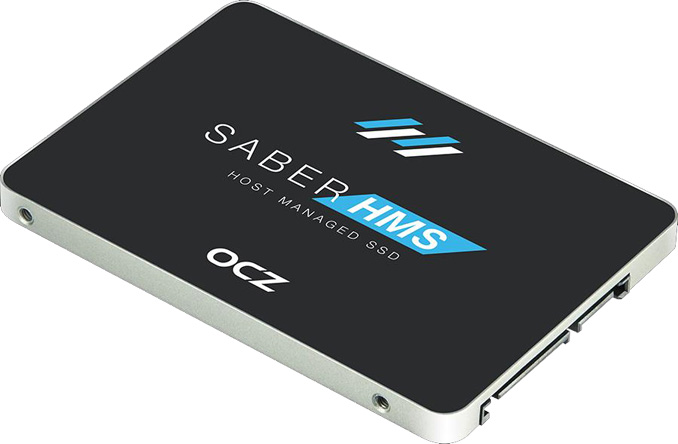
drive OCZ is introducing with HMS technology is a variant of their
existing Saber 1000 enterprise SATA SSD. The Saber 1000 HMS differs only
in the SSD controller firmware; otherwise it is still a low-cost drive
using the Barefoot 3 controller and is intended primarily for
read-oriented workloads. Pricing is the same with or without HMS
capability, though the Saber 1000 HMS is only offered in the 480GB and
960GB capacities. The warranty in either case is limited to 5 years, but
because the HMS controls can affect write amplification, the Saber HMS
write endurance rating is based on the actual Program/Erase cycle count
of the drive rather than the total amount of data written to the drive.
| OCZ Saber 1000 HMS |
| Capacity |
480GB |
960GB |
| 4kB Random Read IOPS |
90k |
91k |
| 4kB Random Write IOPS |
22k |
16k |
| Random Read Latency |
135µs |
135µs |
| Random Write Latency |
55µs |
55µs |
| Sequential Read |
550 MB/s |
550 MB/s |
| Sequential Write |
475 MB/s |
445 MB.s |
| MSRP |
$370 |
$713 |
As a read-oriented drive with relatively little
overprovisioning, the Saber 1000 has a lot to gain from HMS in terms of
write performance and consistency, and it may allow the Saber 1000 HMS
to compete in areas the Saber 1000 isn't fast enough for.
In
addition to control over the garbage collection process, the Saber 1000
HMS provides a similar set of controls for managing when the controller
saves metadata from its RAM to the flash. This is the information the
controller uses to keep track of where each piece of data is physically
stored and which blocks are free to accept new writes. Every write to
the disk adds to the metadata log, so the changes need to be
periodically evicted from RAM to flash. This is one of the key data
structures that the drive's power loss protection needs to preserve, so
the size of the in-RAM metadata log may also be limited by the drive's
capacitor budget.
To enable software to make effective
use of these controls, the Saber 1000 HMS provides an unprecedented view
in to the inner workings of the drive. Software can query the drive for
the NAND page size, erase block size, number of blocks per bank and
number of banks in the drive. The total program and erase counts are
reported separately, and information about free blocks is reported as
the total across the drive as well as the average, maximum, and minimum
per bank. The drive also provides a status summary of whether garbage
collection or metadata log dumping are active, and whether they are
needed. OCZ's reference guide provides recommendations for interpreting
all of these indicators.
The Saber 1000 HMS will be
available in early November for bulk purchases. The technical
documentation and reference code should be available online today.
Read More ...
AMD Releases Catalyst 15.10 Beta Drivers
In
a manner that appears it may be building momentum, AMD has released
another new driver update. As this is a point driver release the changes
aren't immense, but AMD has pushed through some stability fixes along
with some other improvements to prep their drivers for some forthcoming
game releases. As always these are all welcome news items.
First
off there are a few notes on Ashes of the Singularity. Along with
providing performance and quality optimizations there is also a fixed
issue with a 'Driver has stopped responding' error showing up while
playing in DirectX 12 mode. AMD does note however that there still
remains issues with the game crashing on some AMD 300 series GPUs and
Ashes of the Singularity may fail to launch on some 2GB cards.
For
Star Wars: Battlefront high performance graphics can now be used on
devices running switchable graphics. AMD is also aware of a small number
of users who are experiencing crashes with GTA V on some AMD Radeon R9
390X GPUs. Some changes have been made that should resolve the issue and
they will continue to monitor user feedback on the problem.
On
the stability front AMD has brought fixes for a couple of TDR errors
which caused a crash when toggling between minimized and maximized mode
while viewing 4K YouTube content or running the Unreal Engine 4 DirectX
benchmark. Additionally playback issues with both MPEG2 and intermittent
playback issues in Cyberlink PowerDVD when connected to a 3D display
through HDMI have both been resolved. Lastly there was a problem with
driver installation halting on some configurations that is now fixed.
Those interested in reading more or installing the drivers for AMD's desktop, mobile, and integrated GPUs can find them on
AMD's Catalyst beta download page.
Read More ...
Consumer Reports Flexes Muscle, Hits Slumping Tesla Motors Stock
Tesla
also has been struck with accusations of roughing up reporters at its
gigafactor and by suggestions that the Model X is too pricey
Read More ...
Debunked: Beneath the Lies, Nigerian "Pee Generator" Is Still Pissing Into the Wind
Hydrogen doesn't grow on trees... well not free hydrogen gas, at least
Read More ...
Quick Note: Whoops, Microsoft Pushed Unwanted Windows 10 to Some Users
"Glitch" caused checkbox to default to enabled in Windows 7/8/8.1 causing some to be given an unexpected gift of Windows 10
Read More ...
CNN Resorts to Internet Censorship to Promote Clinton Over Senator Sanders
Meanwhile Sen. Paul continues to face similar attacks from the media, which is accused of favoring Trump
Read More ...
Available Tags:
ASUS ,
HTC ,
Lenovo ,
Motherboards ,
ASRock ,
Xeon ,
Intel ,
AMD ,
NVIDIA ,
GeForce ,
Driver ,
Galaxy Tab ,
Samsung ,
Galaxy ,
OCZ ,
SATA ,
Catalyst ,
Microsoft ,
Windows ,