

Zotac Packs AMD A75 Into Mini-ITX Form Factor
ZOTAC has today released A75-ITX WiFi motherboard. Like the name suggests, this motherboard is based on AMD's A75 chipset and comes in Mini-ITX form factor. Don't let the size fool you though, A75-ITX has an impressive list of features when compared to its size.
ZOTAC A75-ITX WiFi | |
Chipset | AMD A75 |
Socket | FM1 |
Memory Slots | 2x DDR3 DIMM |
Max Memory | 8GB |
Memory Speed | Up to 1866MHz |
PCIe | One x16 slot |
SATA | 4x SATA 6Gb/s |
USB | 8x USB 3.0, 2x USB 2.0 |
Networking | Dual Gigabit Ethernet, 802.11n WiFi, Bluetooth 3.0 |
Video Outputs | DVI, HDMI, VGA |
ZOTAC isn't alone in the A75 mini-ITX market though, at least AsRock has a similar motherboard as well. We reviewed ZOTAC's Z68ITX-A-E WiFi very recently, so that might offer some early thoughts on what to expect from A75-ITX. The suggested retail price is $149 and it will be available next week.
Source: ZOTAC
Read More ...
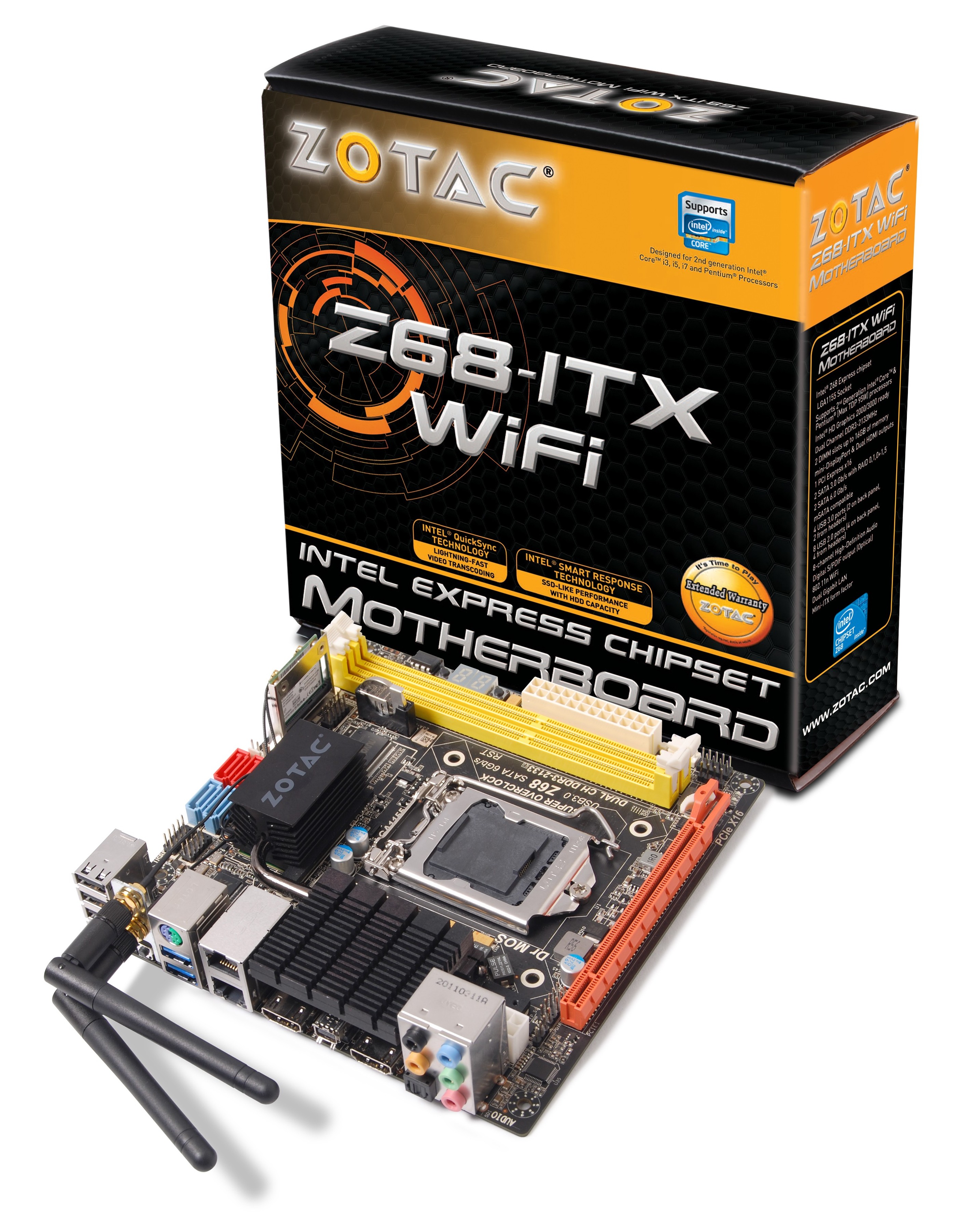
Zotac Z68ITX-A-E Wifi Review - Mini-ITX meets Z68
With every chipset, there's a call to arms in providing the package that everyone needs. Unfortunately there's never one motherboard which can cater for every possibility, but there are some that come quite close. Our review today is on the Zotac Z68ITX-A-E Wifi - a mini-ITX take on the Z68 chipset, which promises to be a winner right from the start, with dual gigabit Ethernet, USB 3.0, onboard wifi, onboard power/reset buttons, a debug LED, a lot of extras with your motherboard, and all the extras that Z68 offers. For $170, we're looking at a good contender for an award here, as long as the performance and additions compare well to its rivals. Read on for the full review!
Read More ...
Flash Player 11 in Early October, Says Adobe
Flash Player 11, the next major version of Adobe's near-ubiquitous browser plug-in, is now officially set for release in early October, the company said in a press release today. Adobe AIR (the runtime which allows Flash and other code to be run as desktop apps) will also be updated to version 3.
The press release details a few of Flash 11's new features, but there are two that are of particular interest to you, the discerning AnandTech reader: the first is GPU acceleration for 2D and 3D graphics, which is specifically designed to make Flash games run better (Flash's GPU acceleration was previously limited mostly to video). The second is 64-bit support under Windows, Mac OS X, and Linux, long a sticking point for users of 64-bit operating systems. As one of the modern Internet's most-used plug-ins, Flash carries a lot of weight, and I don't think I'm the first to link the absence of 64-bit Flash with the slow pace of 64-bit browser development and adoption.
Flash 11 promises to be an improvement over Flash 10.3 in many ways, but its competition is still stiff: the Unity Web Player is already driving 3D games in browser windows today, while the Silverlight plug-in also enables rich web content. Its most direct competition in the long run remains HTML5, which Apple (and soon, Microsoft) and others are pushing to enable rich content without the use of plug-ins
Source: Adobe
Read More ...
Internet Machines Uses Patent to Go After PCI-Express Tech and Anyone Using It
One of our contacts recently made us aware of a new round of lawsuits, which could apparently apply to every major company in the world of personal computers. The list of defendants at includes the following:
Alienware Corporation
Advanced Micro Devices, Inc.
Club 3D B.V.
Cyclone Microsystems Inc.
Dell Computer Corp.
Extreme Engineering Solutions, Inc.
Freedom USA, including AVADirect.com/AVADirect Custom Computers
GDA Technologies, Inc.
General Electric Enterprise Solutions, a division of General Electric Company
Integrated Device Technology, Inc.
Inventure, Inc.
NVIDIA Corporation
National Instruments Corp.
PLX Technology Inc.
Tigerdirect, Inc.
Vadatech, Inc.
Vrose Microsystems, Inc.
The first patent (7454552) covers a “switch with transparent and non-transparent ports” while the second (7421532) refers to “switching with transparent and non-transparent ports”. Neither description really says much, but the text below suggests what they’re covering: communication via a switch between PCI Express devices. What’s really crazy is that this sounds like Internet Machines literally managed to patent a portion of PCI Express spec.
Reading through the actual descriptions and language of the patents is like reading a document full of nonsensical jargon. Specific terms are used, but at the same time the descriptions are very nebulous. Take the final claim: “A method for switching data units, the method comprising providing a PCI Express switch having transparent and non-transparent ports associating the transparent ports with a shared address domain associating the non-transparent ports with non-shared address domains routing data units between the transparent ports, between the transparent and non-transparent ports, and between the non-transparent ports in accordance with a PCI Express interconnect standard.” It’s an example of exactly the sort of thing that shouldn’t be patentable, and yet these two patents were granted—along with thousands of others likely sitting dormant waiting for some company to see if they can get a settlement out of them.
Actually, what’s really crazy is that they’re going after system integrators, along with graphics card companies AMD and NVIDIA, and pretty much anyone else they can think of. Why Intel isn’t on the list is a mystery, or maybe Internet Machines knows it’s a bad idea to poke Intel’s legal team in the eye. Hopefully reason and common sense can win out in the legal system, because this appears to be rampant abuse of the patent system and the penchant for patents to be granted for anything and everything. Several of the companies listed should have the expertise required to kick the case to the curb, but one system integrator states that they already settled with Internet Machines a year ago, and now they’re being taken to court for a similar patent, as though their willingness to settle is an admission of guilt.
Read More ...
AT&T Tweets SGSII Availability: October 2nd For $199

Brian's hard at work on the Sprint Samsung Galaxy S II Epic 4G Touch review, we'll be eager to set it next to it's AT&T sibling for a family reunion. Link below, along with a shot of the tweet itself.

Read More ...
Microsoft Details Revamped Windows 8 Boot and Diagnostic Menus
In the latest Building Windows 8 blog post, Microsoft's Billie Sue Chafins details some of the improvements and changes made to Windows' boot and diagnostic screens to make them more touch-friendly, and also to take advantage of the UEFI technology supported by an increasing number of new PCs.
Apart from the improvements in speed, which we talked about awhile back, Windows 8 is going to replace the MS-DOS-style pre-boot screens with big clickable buttons and a simple GUI - examples shown included OS dual-booting, Windows troubleshooting, and a boot device selection screen (currently handled in an inconsistent fashion by the BIOS on most PCs). You can also use this simple GUI to choose your default operating system, specify how long the computer will wait before booting the default OS, and some other things previously accessible only to people comfortable editing their Boot.ini file in a text editor.
Microsoft's screenshots also show that the on-screen touch keyboard is available not just in the fully booted OS, but also in these pre-boot screens. To see the interface in action, you can look at Microsoft's video, and you can also check out the full post over at the Building Windows 8 blog.
Source: Building Windows 8 blog
Read More ...
A Look Into Sandy Bridge-E Overclocking
Note: Most Sandy Bridge-E information is currently under embargo, but the information below comes from Bit-tech's article detailing SNB-E overclocking.
Sandy Bridge-E release is getting closer and closer all the time, but there has been one concern: overclocking. Right now, it looks like the initial i7-lineup will consist of three CPUs: i7-3820, i7-3930K, i7-3960X. We covered most of the SB-E specs in our Additional info on Sandy Bridge-E Processors, X79 and LGA2011 article. The two latter ones, i7-3930K and i7-3960X, will have an unlocked CPU multiplier, which allows easy CPU overclocking by just changing the multiplier. However, the cheapest model, i7-3820, does not have an unlocked CPU multiplier.
With LGA 1155 based CPUs, this means you are limited to adjusting the BCLK (base clock). The BCLK is 100MHz by default but unlike in previous microarchitectures, it can only changed by a few MHz until you run into problems. This means you must buy a CPU with unlocked multiplier (i.e. a K CPU) in order to overclock effectively. There was concern that SNB-E would follow a similar path.
Fortunately, Sandy Bridge-E isn't as limited as regular Sandy Bridge. On top of BCLK and CPU multipliers, Intel has introduced something called reference clock ratio (RCR). This is a multiplier that affects the CPU and memory frequency, but does not affect things such as SATA and USB buses like the BCLK does. Hence it can be changed more dramatically than the BCLK without causing instability. This isn't an open multiplier though; Intel has limited it to 1.00x, 1.25x and 1.66x.
Compared to regular CPU multiplier overclocking, playing around with the RCR is a bit more complicated due to only two possible multipliers. You will need three equations to figure out the three values needed for accurate overclock. Lets break down the math:
Frequency / Reference clock ratio = X
X / 100 = CPU multiplier
X / CPU multiplier = BCLK
1) 4200 / 1.25 = 3360
The frequency must be entered in MHz (multiply GHz by 1000). The first step is to figure out which reference clock ratio you need to use. The 1.25 multiplier allows a maximum overclock of around 4.7GHz, so that should be enough for most people. You could, of course, use the 1.66 and simply lower the CPU multiplier enough but then you may face issues with your RAM (more on this later).
2) 3360 / 100 = 33.6 ~ 34
In the second step, you simply plug in the result you got from the previous equation and divide that by 100. You will likely end up getting some decimals, but the CPU multiplier must be a whole number, which means you must round the number. In this case, the closest integer to 33.6 is 34. Remember that your maximum CPU multiplier is 36, so if you get a higher number, you might want to use a bigger RCR.
3) 3360 / 34 = 98.82
In the final step, you need to divide the result you got from the first equation by the CPU multiplier (the rounded one) from the second equation. You will again end up with a decimal number, so round that so that you have only two decimals (BCLK can be adjusted in increments of 0.01MHz). So using the equations, for a 4.2GHz overclock you would set:
Reference clock ratio = 1.25x
CPU multiplier = 34
BCLK = 98.82MHz
1.25 * 34 * 98.82MHz = 4199.85MHz ~ 4.2GHz
And voilá, you are done! Using the above information, you can figure out the three values needed for overclocking your CPU to certain frequency. These three numbers are the ones you will be entering into the BIOS. Before applying these numbers, you can confirm them by multiplying them all together and you should end up with the frequency you entered in step 1. Of course, a voltage change will most likely be required as well but that is part of overclocking basics so we won't get into that now.
There is one bit hidden into the reference clock ratio though - it affects the memory as well. The total memory frequency is:
BCLK * reference clock ratio * memory multiplier
The problem is that we don't know what memory multipliers Intel will support in SB-E platform. Intel claims memory frequency changes in increments of 266MHz, which with 100MHz BCLK suggests at least multipliers of 13.33x, 16.00x and 18.66x. With 1.25x RCR you shouldn't get into troubles with memory, but big overclocks with 1.66x RCR may face some memory limitations, especially if there are no smaller memory multipliers. For example, if the lowest memory multiplier ends up being 13.33x, then your memory would run at 2213MHz with 100MHz BCLK and 1.66x RCR. That might be too much for a stable setup, and you'd certainly want higher quality memory.
Again, a big thanks to Bit-tech for their detailed article on SB-E overclocking!
Read More ...
Boeing CHAMP "Electronics Killer" Missile Test Flight Successful
CHAMP fries electronics with microwaves
Read More ...
Mass. Attorney General Seeks Answers from Apple After iTunes Fraud
Coakley is now looking into whether such fraud is a reportable event under the state's data breach notification law, but believes it could be a reportable offense under the Massachusetts Data Protection Law
Read More ...
VIA Seeks to Ban iPad, iPhone in U.S. for Patent Infringement
Apple could soon find itself in a similar situation to rival Samsung
Read More ...
Bing Loses Nearly $1B per Quarter for Microsoft
Bing may never turn a profit
Read More ...
Sprint to Cap Hotspot Data Plans Starting October 2
Cap is now 5GB monthly with big overage fee
Read More ...
9/22/2011 Daily Hardware Reviews
DailyTech's roundup of hardware reviews from around the web for Thursday
Read More ...
Hulu Plus Hits One Million Subscriber Mark Well Ahead of Schedule
Hulu is still investing in content
Read More ...
Rick Santorum Lashes Out at Google for Vulgar Search Results Linked to his Name
Santorum said Google would have removed the content by now if he was a Democrat instead of a Republican
Read More ...
Walmart Installs Solar Panels in 60 Additional California Locations
Once the 60 additional Walmart stores receive solar panels, the company's solar portfolio will total over 75 percent of its stores in California
Read More ...
Windows Phone Manager Leaves Company After Twitter Posts About Nokia
Engineer spilled details on upcoming phone, offering it some praise, but complaints too
Read More ...
Report: HP Ponders Firing New CEO, Just a Year After His Firing From SAP
HP CEO's decision to cut the company up has the Board reportedly considering a pink slip for their chief
Read More ...
Pandora Unleashes Completely Revamped Website, Drops 40-hour Cap
The company is even calling the site "New Pandora"
Read More ...
Report: iPhone 5 Launch Set for October 4 at Exclusive Apple Event
Fans eagerly await what "magic" their favorite Cupertino, Calif. company will deliver
Read More ...
"Nikon 1" System Debuts with J1, V1 Interchangeable Lens Cameras
V1 is the world's smallest and lightest interchangeable lens camera
Read More ...
9/21/2011 Daily Hardware Reviews
DailyTech's roundup of hardware reviews from around the web for Wednesday
Read More ...
Available Tags:Zotac , AMD , Adobe , Windows 8 , Microsoft , Windows , Sandy Bridge , Apple , VIA , iPhone , Bing , Hardware , Hulu , Google , his , Windows Phone , Twitter , Nokia , HP , SAP , iPhone 5 ,


No comments:
Post a Comment