

Apple Reports Q3 FY 2015 Results: Record Results With Strong iPhone And Mac Sales
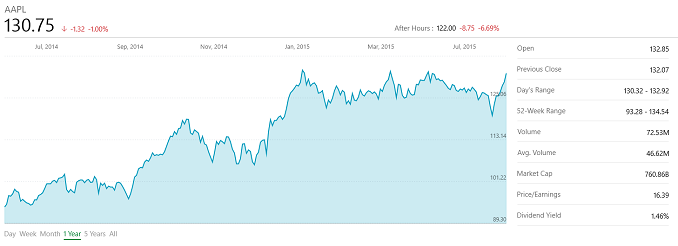
| Apple Q3 2015 Financial Results (GAAP) | |||||
| Q3'2015 | Q2'2015 | Q3'2014 | |||
| Revenue (in Billions USD) | $49.605 | >$58.010 | $37.432 | ||
| Gross Margin (in Billions USD) | $19.681 | $23.656 | $14.735 | ||
| Operating Income (in Billions USD) | $14.083 | $18.278 | $10.282 | ||
| Net Income (in Billions USD) | $10.677 | $13.569 | $7.748 | ||
| Margins | 39.7% | 40.8% | 39.4% | ||
| Earnings per Share (in USD) | $1.85 | $2.33 | $1.28 | ||
Apple’s iPhone business has been the primary factor in these record breaking quarters, and the iPhone 6 and 6+ sales continued to be strong. For the quarter, Apple sold 47.5 million iPhones, which is a gain of 35% in units. Even more impressive is that these 35% more units resulted in 59% more revenue, with iPhone sales totalling $31.4 billion for this quarter alone.
Mac sales have also been strong, and while Apple has generally outpaced the PC market in sales growth for a while, Apple saw an additional 5% in Mac unit sales for Q4 compared to Q3, and 9% from a year ago. This is at a time where the rest of the PC market is contracting, so Mac sales were an impressive 4.8 million units, with revenue of just over $6 billion for the quarter. The resurgence of the Mac has been quite the rise, with Mac revenue being eclipsed quite a bit by the iPad not very long ago. Times have changed though and Apple’s PC business is currently the only one that has seen an increase in sales according to the reports floated around in the last couple of weeks.
iPad sales though are not so rosy. The iPad sales were very strong, and while sales are not exactly terrible, the number of units being sold has been dropping for some time. Much debate has been about why this is, but certainly owners of the iPad have not felt the need to refresh their devices anywhere nearly as quickly as phones. For the quarter, there were 10.9 million iPads sold, which resulted in revenue of $4.5 billion. The number of units sold is down 13% from Q2, and down 18% year-over year.
| Apple Q4 2014 Device Sales (thousands) | |||||
| Q3'2015 | Q2'2015 | Q3'2014 | Seq Change | Year/Year Change | |
| iPhone | 47,534 | 61,170 | 35,203 | -22% | +59% |
| iPad | 10,931 | 12,623 | 13,276 | -13% | -18% |
| Mac | 4,796 | 4,563 | 4,413 | +5% | +9% |
Services, which include iTunes sales, AppleCare, Apple Pay, and will include Apple Music in the future, saw a nice jump as well with just over $5 billion in revenue for the quarter. This is up 1% from last quarter, and up 12% from last year.
“Other Products” which is Apple TV, Apple Watch, Beats, iPods, and accessories had a big quarter, and while individual numbers were not announced, it is likely due to initial sales of the Apple Watch which came out in the quarter. For Q3, this group had sales of $2.6 billion, up 56% from last quarter and up 49% year-over-year. Likely most of the increase can be attributed to the Watch, but without knowing average selling price, it would be pretty difficult to try and extrapolate unit sales without more information.
| Apple Q2 2015 Revenue by Product (billions) | |||||
| Q3'2015 | Q2'2015 | Q3'2014 | Revenue for current quarter | ||
| iPhone | $31.368 | $40.282 | $19.751 | 63.2% | |
| iPad | $4.538 | $5.428 | $5.889 | 9.1% | |
| Mac | $6.030 | $5.615 | $5.540 | 12.2% | |
| iTunes/Software/Services | $5.028 | $4.996 | $4.485 | 10.1% | |
| Other Products | $2.641 | $1.689 | $1.767 | 5.3% | |
This pipeline post is quite a bit shorter than the Microsoft earnings, but for all of the right reasons. There is less to say when things are going as well as they are for Apple right now. iPhone sales are still a huge part of their balance sheet, and seem to have no sign of slowing down. People obviously wanted a larger iPhone and sales have skyrocketed since the iPhone 6 and 6+ were launched. But I think we were all expecting this based on past performance. I think what is most interesting is how much of the PC market Apple has managed to chip away with Mac sales, which are up an amazing 9% when the rest of the market contracted.
For Q4, Apple is expecting revenue of $49 to $51 billion, with a gross margin of 38.5 to 39.5%.
Source: Apple Investor Relations
Read More ...
Microsoft Reports FY 2015 And Q4 Results: Nokia Write Down Results In $3.2B Loss For Q4
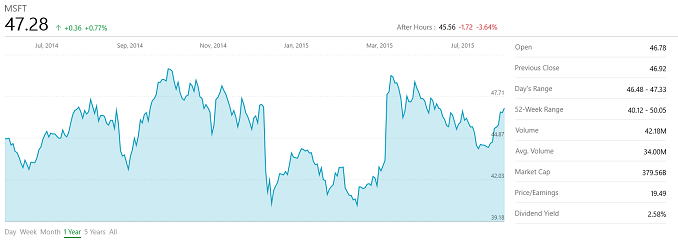
For the full fiscal year 2015, Microsoft had revenue of $93.6 billion which is up 7% over their 2014 numbers. However the cost of that revenue was up almost six billion, so their gross margin was almost flat at $60.5 billion. For the full fiscal year 2015, Microsoft incurred just over $10 billion in impairment, integration, and restructuring charges, with the majority being in Q4 with the Nokia write down, which gave them an operating income of $18.161 billion for the year, down from almost $28 billion a year ago. Net income came in at $12.2 billion for the year, down from $22.1 billion a year ago. Earnings per share for the full year were $1.48 per diluted share, down from $2.63 a year ago.
| Microsoft Q4 2015 Financial Results (GAAP) | |||||
| Q4'2015 | Q3'2015 | Q4'2014 | |||
| Revenue (in Billions USD) | $22.180 | $21.729 | $23.382 | ||
| Operating Income (in Billions USD) | -$2.053 | $6.594 | $6.482 | ||
| Gross Margin (in Billions USD) | $14.712 | $14.568 | $15.749 | ||
| Margins | 66.3% | 67% | 67.4% | ||
| Net Income (in Billions USD) | -$3.195 | $4.985 | $4.612 | ||
| Basic Earnings per Share (in USD) | -$0.40 | $0.61 | $0.55 | ||
It is going to be difficult for any company to write down over $8 billion in a quarter and still turn a profit (Apple is the only exception right now in the tech industry) but that one time charge is now off the books and they can move into 2016 with a clean slate. There will likely be some more restructuring charges with the upcoming layoffs announced a couple of weeks ago, but that should impact financials too drastically for FY 2016.
Microsoft reports its income in two over-arching units with Devices and Consumer being the one focused towards end users, and Commercial which is targeted to business and enterprise customers. Each is further broken down into various subgroups which we can take a look at in depth.
For Devices and Consumers (D&C), revenue declined 13% to $8.7 billion for the quarter. The biggest hit to the bottom line was in the D&C Licensing, with Windows OEM revenue dropping 22% following the end of the Windows XP refresh cycle. Unit inventory is also being managed ahead of the Windows 10 launch. Windows Phone licensing revenue was down 68%, but that is compared to Q4 2014 where there was a recognition of $382 million from the conclusion of the commercial agreement with Nokia, and Windows Phone revenue has taken a bit of a nosedive since it was made free to all OEMs, and with Microsoft obviously not charging itself when selling Lumia handsets. The final piece of D&C Licensing is Office Consumer, which is the full license for Office, and it is down 42% year-over-year. Japan’s PC market contributed to 19 pts of revenue decline itself, and an additional 13 pts of decline were attributed to customers moving to Office 365, which falls under D&C Other.
D&C Computing and Gaming Hardware had a strong quarter, up 44% to $1.93 billion in revenue. Surface has continued its strong growth, with revenue of $888 million, which is up 117% year-over-year. For FY 2015, Surface had $3.6 billion in revenue, up 65% from FY 2014. Xbox sales also grew 30% to 1.4 million units (this is Xbox One and Xbox 360) which is good growth, but they still have some work to do in order to get close to the PlayStation 4 numbers. Overall the D&C hardware side has made some big gains, with a gross margin of $435 million for the quarter, up 2316.7% from Q4 2014’s $18 million.
D&C Phone Hardware had more than 10% growth in Lumia sales, with 8.4 million Lumia handsets sold. The bad news is that revenue declined with the majority of the sales being in lower price point devices. That is hardly a surprise though since they have not released anything close to a high price point device in well over a year now. Microsoft is still selling Nokia feature phones, and somehow they still sold almost 20 million of those. Revenue was down 38% year-over-year to $1.23 billion, and gross margin for this division had a loss of $104 million, compared $54 million in the black a year ago. Losing money on every phone sold is not a great way of doing business, so you can certainly see why Satya Nadella make the decision to write down this acquisition and focus on less, but hopefully better, devices.
D&C Other is Microsoft’s consumer facing cloud services. This includes Bing, online advertising, Xbox Live, Office 365 Home and Personal, and first-party games. For Q4, this segment had $2.3 billion in revenue, up 31% from Q4 2014. Xbox Live sales grew 58%, online advertising revenue was up 21%, Bing US market share was up 110 basis points to 20.3%, first-party games was up 62% (mostly Minecraft), and Office 365 Consumer added almost three million customers in Q4, and is now up to 15.2 million. For the full FY 2015, Office 365 Consumer was up almost ten million subscribers. Gross margin for the division was 26% or $594 million, which is up 104% from Q4 2014.
The remainder of Microsoft’s earnings is from the Commercial segments, where they have historically made the bulk of their income with the higher margins of enterprise. For the quarter, commercial revenue was up just slightly to $13.53 billion, compared to $13.50 billion a year ago. Gross margin was down 1% to $10.88 billion. Commercial licensing revenue was down 7% for the quarter, with Office commercial down 18% due to customers moving to Office 365. Windows volume licensing revenue was down 8%, and server revenue was flat. Dynamics ERP customer adds grew 35% in the quarter. The Commercial Other segment includes Office 365 business plans, Azure, Enterprise Mobility and Dynamics CRM Online, and Other revenue grew 36% year-over-year. Commercial Cloud revenue was up 88% and now has an annualized revenue of over $8 billion. Azure revenue and compute usage had a big year, with both growing in the triple digits year-over-year. Microsoft’s CRM Online install base grew almost 250%, and Enterprise mobility added 90% more users, to over 17,000. Microsoft has been transitioning their services and software to the cloud for some time, and they have been seeing steady growth here.
| Microsoft Q4 2015 Segment Overview (in Billions USD) | |||||
| Q4'2015 | Q3'2015 | Q4'2014 | |||
| D&C Licensing Revenue | $3.23 | $3.48 | $4.90 | ||
| D&C Licensing Gross Margin | $2.97 | $3.21 | $4.52 | ||
| D&C Computing and Gaming Hardware Revenue | $1.93 | $1.80 | $1.34 | ||
| D&C Computing and Gaming Hardware Gross Margin | $0.44 | $0.41 | $0.02 | ||
| Phone Hardware Revenue | $1.23 | $1.40 | $1.98 | ||
| Phone Hardware Gross Margin | -$0.104 | -$0.061 | $0.054 | ||
| D&C Other Revenue | $2.30 | $2.28 | $1.76 | ||
| D&C Other Gross Margin | $0.59 | $0.57 | $0.29 | ||
| Commercial Revenue | $13.53 | $12.80 | $13.50 | ||
| Commercial Gross Margin | $10.88 | $10.42 | $10.99 | ||
Obviously it is a bit of a mixed bag for Q4 2015, and really for all of FY 2015, with the $8 billion or so write down of the Nokia acquisition. Microsoft posted Non-GAAP results to account for this, and without that huge hit, operating income would have been $6.4 billion. Microsoft returned $6.7 billion to shareholders, which is up 96%, with $4.2 billion of that being share repurchases and $2.5 billion paid out in dividends.
With Windows 10 right around the corner, we’ll have to see if that can help out on the D&C revenue which has been taking a beating with the reduction in sales of new PCs. With the free upgrade though, this may not make an impact immediately (if at all) so FY 2016 should be an interesting one to watch.
Source: Microsoft Investor Relations
Read More ...
Examining Microsoft Edge Browser Performance
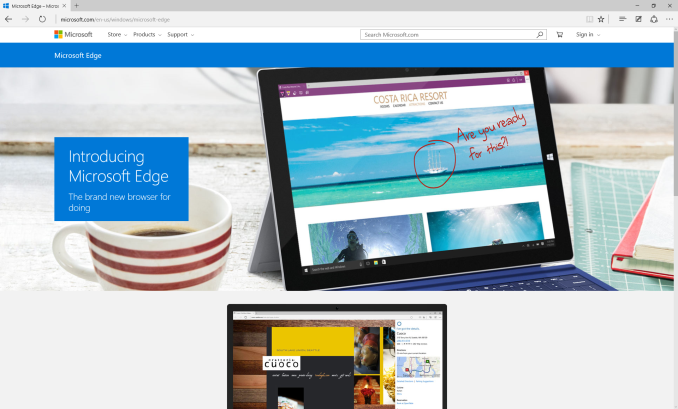
Moving forward, Project Spartan got a name in Microsoft Edge back at Build. Over the last several months, Microsoft has put out quite a bit of information on the new features they are adding to Edge over on the Microsoft Edge Dev Blog including support for the latest ECMAScript standards, asm.js, SIMD support, and much more, all in an effort to bring their browser up to par for the modern web. It is likely not a surprise to many that Internet Explorer has had a tremendously long development cycle, especially compared to browsers like Chrome, and now Firefox, which are updated almost continuously. Some of that was due to the reliance of old features which were used in businesses, and Microsoft’s strong adoption in the enterprise has certainly held them back when it comes to large scale changes to the browser. Internet Explorer will be sticking around for those who need it (for example if you need ActiveX Controls on your page) but for the rest of Windows users, Microsoft Edge will now be the new default browser out of the box.
I’ve gone over some of this in the past, but it is likely worth a refresher anyway. Edge is bringing some new features such as integrated Cortana support built right into the browser to offer contextual search within a web page, or to offer answers to questions right in the address bar. It will also have support for annotation of web pages using a pen, mouse, or touch, and annotated pages can easily be shared. It has a reading view, a reading list, and while not available next week when Windows 10 ships, it will be gaining extension support very similar to Google Chrome to add even more functionality to the browser. This, combined with better web standards support, and a much quicker update cadence (this will have to be proven by Microsoft after release, but they have committed to quicker updates of Edge through the Windows Store) should result in a much better browsing experience than was available in Internet Explorer. If you have already switched from IE to Chrome, Firefox, or another browser, it may not be enough to sway you back – especially without extension support at launch – but it is at least worth a look. I’ll get more into my takes on Edge in our Windows 10 review.
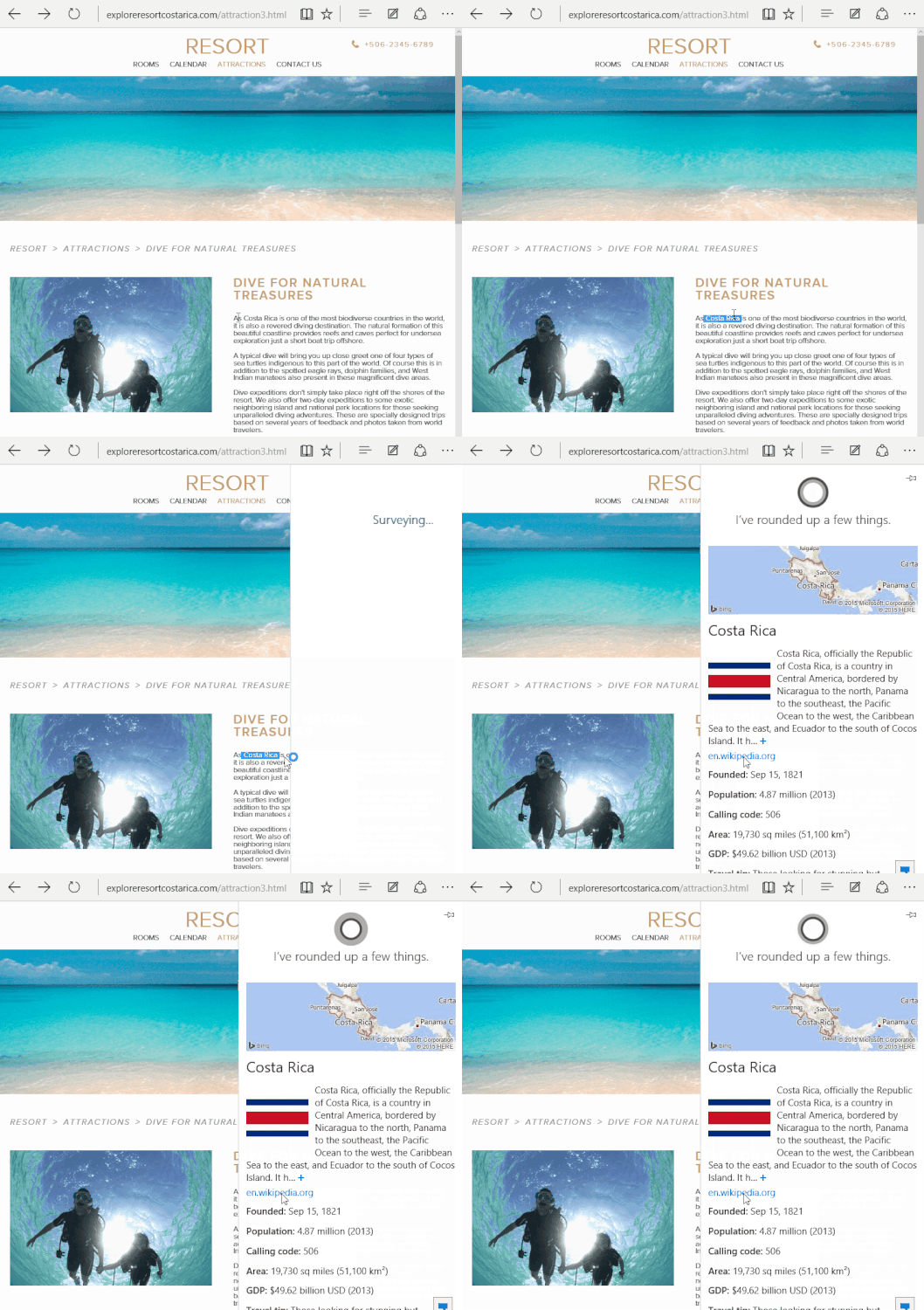
For now, what we can examine is browser performance, not only because it is important, but because Microsoft has been making a lot of statements about improved performance of Edge as recently as last week when Windows 10 Build 10240 was released. When a company says a product is “blazing fast” it is a good idea to check it out to see if it actually lives up to that performance level.
Luckily I did run numbers in January on my desktop which features an Intel Core i7-860 processor. None of the hardware has changed, so I decided to re-run the tests with the latest version of all of the browsers. I kept the original numbers for IE 11, but I did re-run the tests to verify that they did not change.
| Browser Performance - Core i7-860 | |||||||
| Benchmark | IE 11 (Jan) | Spartan (Jan) | Edge 20 (July) | Chrome 40 (Jan) | Chrome 43 (July) | Firefox 35 (Jan) | Firefox 39 (July) |
| Sunspider (lower is better) | 149.7ms | 144.6ms | 133.4ms | 260.9ms | 247.5ms | 220.1ms | 234.6ms |
| Octane 2.0 (higher is better) | 9861 | 17928 | 22278 | 17474 | 19407 | 16508 | 19012 |
| Kraken 1.1 (lower is better) | 3781.2ms | 2077.5ms | 1797.9ms | 1992.8ms | 1618.7ms | 1760.4ms | 1645.5ms |
| WebXPRT (higher is better) | 913 | 1083 | 1132 | 1251 | 1443 | 1345 | 1529 |
| Oort Online (higher is better) | 1990 | 2170 | 5470 | 5370 | 7620 | 3900 | 7670* |
| HTML5Test (higher is better) | 339 | 344 | 402 | 511 | 526 | 449 | 467 |
In every single instance, Microsoft Edge outperformed Project Spartan from back in January which is a good sign. It is the quickest browser in Google’s Octane 2.0 benchmark, and by a good margin. It is still the slowest in WebXPRT 2013 though. One of the biggest improvements though was the WebGL performance in the Oort Online benchmark, which went from terrible to good.
The other browsers have not been sitting idle though, and in that time they have also made gains in their performance. But the story is still a good one for Edge. It really is right up there with the rest of the browsers in terms of performance. It is quicker in some workloads, and slower in others, but generally performance should not be an issue. It still falls behind in the HTML5 test, but it has made big improvements there as well.
One thing that did pop out though is how much of a gain Firefox made in the WebGL test. Firefox went from middle of the pack to leading in the overall score, but if you noticed in the table I had to put an asterisk beside its score. The performance was quite good, but it achieved this performance by not rendering the scene correctly at all which contributed to its high score. In Oort Online’s benchmark, there is a snow scene, which Firefox rendered as blinking lights, and a rain scene, which was rendered as a couple of horizontal lines as seen in this screenshot.

Firefox Rain Rendering (Incorrect)

Edge Rain Rendering (Correct)
It is great to see Microsoft focusing on browser performance again, and especially not sitting idle since January, since the competition in this space has not been idle either. Only time will tell how Edge holds up over time, and if it continues to receive updates on a quicker cadence, but considering it is already at version 20.10240.16384.0, it does appear that Microsoft has jumped on the rapid release cycle with regards to their browser, which will only help them moving forward.
Read More ...
Micron M510DC (480GB) Enterprise SATA SSD Review
Most data center workloads tend to be read-intensive. It's only recently that SSDs have started to offer pricing low enough to replace hard drives in read workoads and a key factor in that has been the introduction of smaller and smaller NAND lithographies. With the M510DC, Micron is taking its proven M500DC platform and accompanying it with its latest 16nm 128Gbit MLC NAND to target the read-centric workloads with lower endurance needs. The M510DC review is also the introduction to our new 2015 Enterprise SSD Suite, so read on to see what we've been working on for the past few months!
Read More ...
Editorial: Reddit Allows Itself to be Hijacked as a Hate Platform For Racist Bigots
Inviting bigots into your business to evangelize your customer base is not free speech, it's condoning the abuse of your audience
Read More ...
Microsoft July 29 Windows 10 Launch: Freebies, Rollout, and What's Next
New hardware will come out the gates packing Windows 10, festivities will abound, and reservations will be filled on Microsoft's big day
Read More ...
Available Tags:Apple , iPhone , Mac , Microsoft , Nokia , SATA , SSD , Windows ,


No comments:
Post a Comment