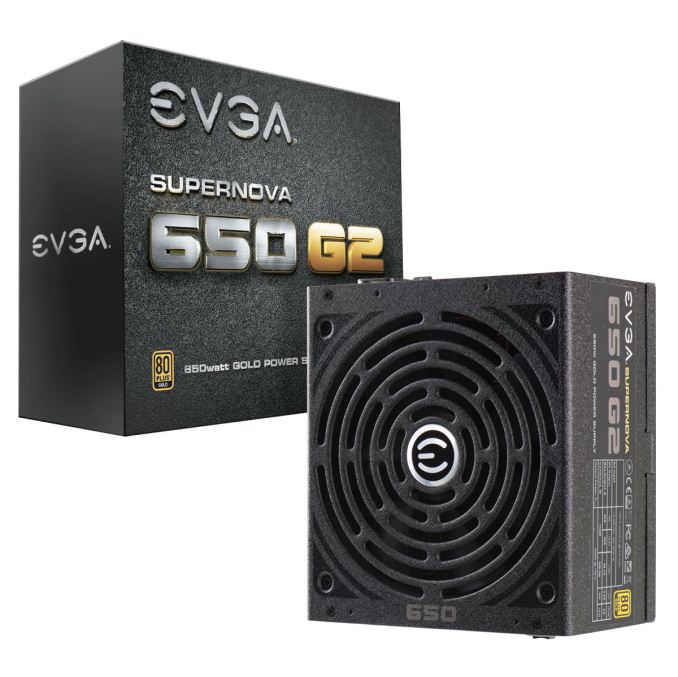
 EVGA expands the SuperNOVA G2 PSU series
As
users are becoming more and more aware of how PSUs operate and what the
real energy requirements of their systems are, sales of high wattage
units decrease in relevance to middle range units. Many manufacturers
realize that and they began marketing high performance products of
reasonable power output and pricing instead of focusing their efforts on
high output units. In that light, EVGA expanded their very popular G2
PSU series downwards, adding 550W and 650W models to it.
EVGA's
G2 series is synonymous with the excellent balance between cost,
quality and performance. We have seen their capabilities in
our review of the 850W
version. After all, there is good reason why the Super Flower Leadex
platform is so popular. The new 550W and 650W models are physically
smaller but share the same features, so it is very likely that they are
based on a Super Flower platform as well.
According to EVGA, the main features of the new 550 G2 and 650 G2 PSUs are:
- 80 PLUS Gold certified, with 90% (115VAC) / 92% (220VAC~240VAC) efficiency or higher under typical loads
- Highest quality Japanese brand capacitors ensure long-term reliability
- Fully Modular to reduce clutter and improve airflow
- NVIDIA SLI & AMD Crossfire Ready
- Heavy-duty protections, including OVP (Over Voltage Protection),
UVP (Under Voltage Protection), OCP (Over Current Protection), OPP (Over
Power Protection), and SCP (Short Circuit Protection)
- Ultra Quiet Fan with ECO Intelligent Thermal Control Fan system (Zero Fan Noise < 45°C)
- Unbeatable 7 Year Warranty and unparalleled EVGA Customer Support.
We should note that both units are rated at 50°C and have a
ridiculous number of connectors for their power output. Even the 550W
version has three PCI Express connectors (two 8 pin and one 6 pin) and
nine SATA connectors. Apparently, EVGA is very confident about the
capabilities of their new units - or of their OCP, at least.
Nevertheless, the 550W version should be able to easily power any system
with a single CPU and a single GPU, with the possible exception that
the extreme combination of an AMD FX-9590 and an R9 295X2.
The new G2 series units are available as of the 12
th of June.
Read More ...
NVIDIA Acquires Game Porting Group & Tech From Transgaming
While
NVIDIA’s core businesses and gaming have been inseparable since the
start, it’s only relatively recently that NVIDIA has become heavily
involved in game creation itself, and not just supplying the hardware
that games are played on. The launch of the company’s Tegra ARM SoCs,
their SHIELD product lineup, and the overall poor state of the Android
gaming market has led to the company investing rather significantly in
bringing higher quality games over to SHIELD and Android devices. This
has culminated in NVIDIA paying for the Android ports for a number of
games, some of the most famous including the Android ports of Valve’s
Half-Life 2 and
Portal.
Meanwhile
with the launch of the SHIELD Android TV, NVIDIA is essentially
doubling-down on Android gaming as part of their efforts to become the
premiere Android TV set top box. And now as part of those efforts, the
company has announced that they are acquiring the Graphics &
Portability Group (GPG) from game tool developer Transgaming.
Transgaming
is best known for their work developing Cider, a WINE-derived Windows
compatibility layer used to quickly port Windows games over to OS X.
With the rise of Apple’s fortunes and the move to x86, Transgaming has
been responsible for either directly porting or supplying Cider to
developers to bring a number of Windows games over to OS X. However in a
blink-and-you’ll-miss-it moment, back in March of this year the company
announced that they were also going to get in to using their technology
and expertise to port games over to architectures,
partnering with NVIDIA to bring Metal Gear Rising: Revengeance to SHIELD Android TV.
 NVIDIA's SHIELD Console: The Reason For The Acquisition
Now just 3 months later NVIDIA is acquiring the GPG outright from Transgaming.
This acquisition will see the group open a new office in Toronto,
while structurally they are folded into the NVIDIA GameWorks division.
And although NVIDIA doesn't state what precisely they intend to do with
the group and its technology beyond the fact that the “acquisition will
enrich our GameWorks effort,” it’s a safe bet that NVIDIA intends to do
more game ports for their SHIELD devices. Given their existing (if
short) relationship, the acquisition is not too surprising, however it
is a bit interesting since the bulk of the group’s experience is with
porting games among different x86 OSes, not porting games to new
architectures entirely.
As for Transgaming, having sold the GPG to
NVIDIA, the company has retained their SwiftShader (software 3D
rendering) technology and their GameTree TV business. Transgaming has
indicated that they are going to focus on providing apps for the Smart
TV market, which they see as a greater growth opportunity than porting
games.
 Games Published By Transgaming GPG On the Mac App Store
Finally,
while this acquisition will undoubtedly be a big deal for NVIDIA’s
efforts to bring more major games to SHIELD, perhaps the more profound
ramifications of this deal will be what it means for Mac gaming. Though
NVIDIA doesn’t definitively state what they will be doing with Cider,
the fact that they have their own platform to worry about certainly
gives pause for thought. There are a large number of games that have
received native Mac ports over the years, but Cider has still been used
in everything from Metal Gear Solid to EVE Online. If Cider becomes
unavailable to developers, then this may cut down on the number of
Windows games that get ported to OS X, especially those games where
marginal sales may make a native port impractical. In either case with
this acquisition NVIDIA seems to have co-opted a lot of the technology
and relationships behind Mac game porting, which should be a boon for
their SHIELD platform.
Read More ...
LIFX White 800 Smart Bulb Review
The
Internet of Things (IoT) revolution has sparked an increased interest
in home automation. Lighting is one of the major home automation
aspects. LIFX is one of the popular crowdfunded companies in this space
to have come out with a successful product. The success of their
multi-colored LED bulbs brought venture capital funding, allowing them
to introduce a new product in their lineup - the White 800. In this
review, we take a look at the White 800 platform and our usage
experience.
Read More ...
JMicron SSD Controller Roadmap: JMF680 SATA 6Gbps & JMF815 PCIe Controllers Next Year
JMicron
is getting ready to ship its new JMF670H controller to its customers
and we also have reference design samples in for testing, but in its
suite at Computex JMicron shed light to its plans for future
controllers.
We stopped by JMicron last year as well and the plans have since changed a bit.
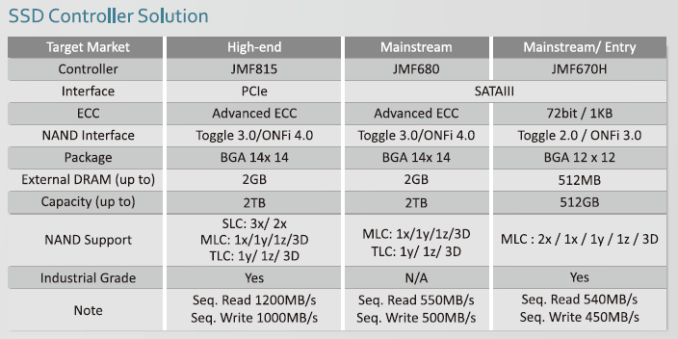
JMicron
is already working on the successor of the JMF670H, which will simply
be called JMF680. That's still a SATA 6Gbps design, but it will bring
support for TLC NAND thanks to what JMicron calls 'advanced
ECC'. JMicron is confident that its ECC implementation will be
competitive against the LDPC engines that its competitors have
and ultimately I believe that LDPC is more of a marketing gimmick at
this point because everyone's ECC algorithms and implementations are
slightly different anyway, but the market is associating strong ECC and
TLC enablement with LDPC.
Another new feature in the JMF680 is
increased capacity support that will go to up to 2TB. That is thanks to
the updated (and larger) DRAM controller, which can now support up to
2GB as modern drives typically need about 1MB of DRAM cache per 1GB of
NAND. The four NAND channels will also get an upgrade to Toggle 3.0 and
ONFi 4.0 standards to support the upcoming NAND dies with faster
interfaces. The JMF680 also supports Write Booster, which is JMicron's
SLC caching feature that debuts in the JMF670H (more on that in our
upcoming JMF670H review).
On the PCIe side JMicron has canceled
the JMF810 and JMF811 controllers, and will now be focusing solely on
the JMF815. JMicron made the decision to concentrate on the value
segment and thus the JMF815 is a PCIe 3.0 x2 design with four NAND
channels (no NVMe, unfortunately). A four-lane design would have
required moving to 28nm process node, which would have increased the
cost substantially and the packaging would have to move away from BGA to
FCBGA (used by e.g. Phison and SandForce in their upcoming PCIe
controllers) that would further increase the cost. I think it's a good
play from JMicron to focus on a segment that isn't as populated because
right now everyone is focusing solely on performance with PCIe, but
ultimately cost and power consumption will be a major factors in
widespread adoption and JMicron should have an advantage there if the
JMF815 is executed well.
First engineering samples of the JMF680
and JMF815 are expected to be ready in Q4'15 with first retail products
entering the market in early 2016.
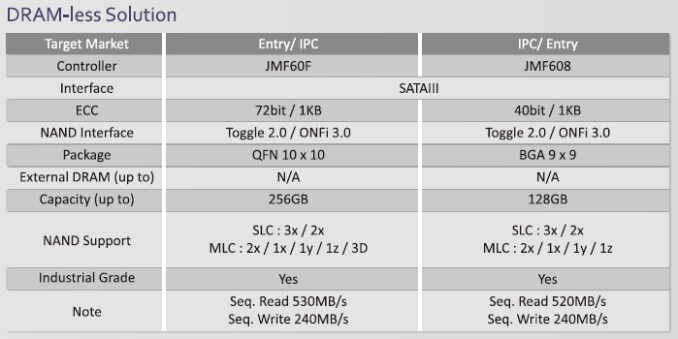
One
of the trends I saw at Computex was the move towards DRAM-less SSD
controllers. The JMF608 has been relatively popular in China given its
ultra-low cost and its successor, the JMF60F, will be available within
the next few months. It features an improved ECC engine and a larger
capacity support as well as a new, cheaper QFN packaging. Following this
trend, I wouldn't be surprised if JMicron also has plans for DRAM-less
versions of the JMF680 and JMF815.
All in all, JMicron has a
pretty solid roadmap for 2016. It's not aiming to be the performance
leader, but to offer cost efficient designs for the value segment. We
will have to wait and see how JMicron executes its PCIe controller, but
in the meantime stay tuned for our JMF670H review that will be up in the
coming weeks!
Read More ...
Oculus Rift Controllers, VR Games, And Software Features Announced
On
the eve of E3, Oculus held a livestream to announce some more details
of the upcoming Oculus Rift Virtual Reality headset. Just about a month
ago,
they announced
that they were targeting a Q1 2016 release, and with that time fast
approaching, they have given some more details on the unit itself, as
well as what kind of experiences you can expect with it. Oculus has
re-affirmed the Q1'16 launch date, and now we finally know the specs for
the retail consumer unit.
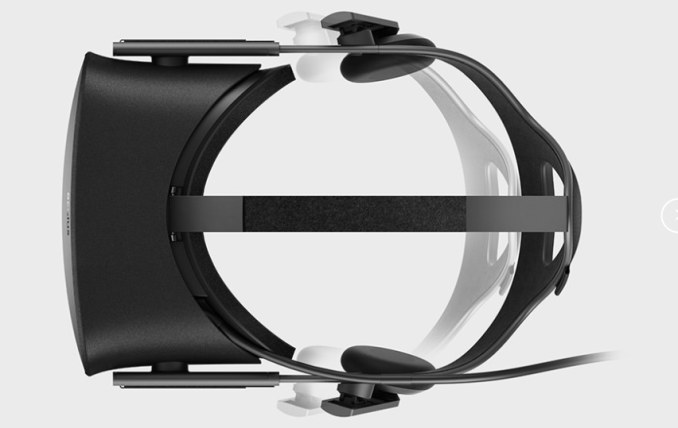
One of the key points they brought up
was that the unit itself needs to be comfortable, and part of that
comfort is weight. January seems like a long time ago when I got to try
out the
Crescent Bay version of the Rift,
but at the time I was impressed with how it felt, and I don’t recall
the weight at all which I guess is the point. The final, consumer
version of the Rift in turn is close to the Crescent Bay version, with
further enhancements for both the electronics and the overall fit itself
to bring down the weight and make it more comfortable.
Audio is
also a big part of the experience, and the included headphones on
Crescent Bay were quite good. For the consumer version Oculus is going
in a similar direction, but today they have also confirmed that you will
be able to wear your own headphones as well if you prefer that. The
directional audio is a key piece to the immersion and the Oculus team
has done a great job with that aspect.
Another
part though is the displays. When we met with Oculus’s CEO Brendan
Iribe at CES, one of the interesting things he told us was that they
have found that by interleaving a black frame in between each video
frame, it can prevent ghosting. In order to do this though, the refresh
rate needs to be pretty high with the unit we tested running at 90 Hz.
Today they announced a tiny bit about the hardware, and the Oculus Rift
will ship with two OLED panels designed for low-persistence. Oculus has
previously commented that they're running at a combined 2160x1200, and
while they don't list the individual panel size, 1080x1200 is a safe
bet. The OLED panels are behind optical lenses which help the user focus
on a screen so close to their eye without eye strain, and the
inter-pupil distance is important. There will be an adjustment dial that
you can tweak to make the Rift work best for you.
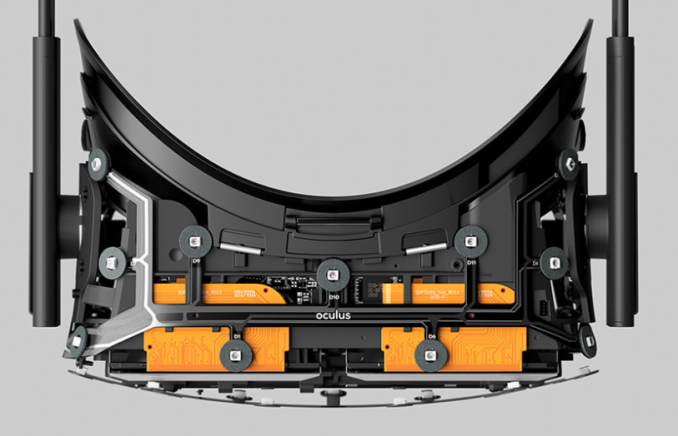
Tracking of
your head movement is done with the help of an IR LED constellation
tracking system, unlike the Hololens which does all of the tracking
itself with its own cameras. This makes installation a bit more
difficult but should be more precise and reduce the overall weight of
the head unit.
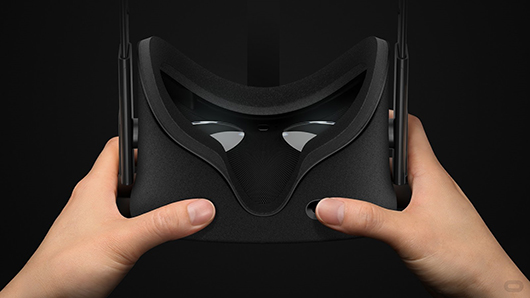
For those that wear glasses, the company has
improved the design to better allow for glasses, and they also make it
easy to replace the foam surrounding the headset.
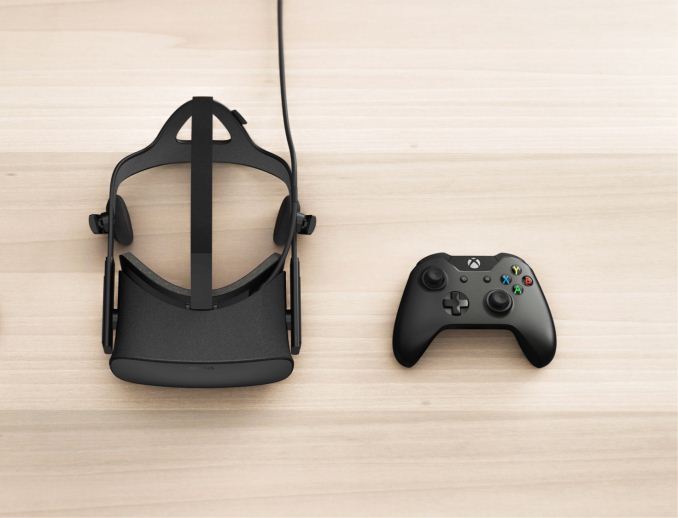
One
thing that was really not known yet was what kind of control mechanism
Oculus was going to employ. In the demos I did at CES, there was no
interaction, and you were basically a bystander. Oculus announced today
that every Rift will be shipping with an Xbox One wireless controller
and the just announced wireless adapter for Windows. This is a mutually
beneficial agreement to say the least, with Microsoft getting in on the
VR action and Oculus getting access to a mature controller design.
Oculus even stated that the controller is going to be the best way to
play a lot of VR games. However they also announced their own controller
for a new genre of VR games to give an even more immersive experience.
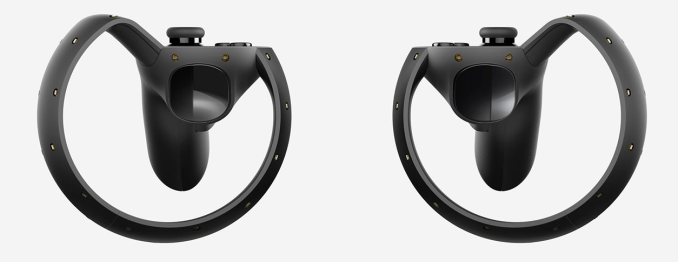
Oculus
Touch is the name of new controller system that Oculus has come up
with. Each controller has a traditional analog thumbstick, two buttons,
an analog trigger, and a “hand trigger” input mechanism. The two
controllers are mirror images of each other, with one for each hand.
They are wireless as well, and use the IR LED tracking system as well in
order to be used in space. The controllers will also offer haptic
feedback so that they can be used to simulate real world touch
experiences. They also detect some finger poses (not full finger
tracking) in order to perform whatever task is assigned to that pose.
These should be pretty cool and I can’t wait to try them out.
Hardware
is certainly part of the story, but software is going to be possibly an
even bigger part. The Rift needs to launch with quality games, and it
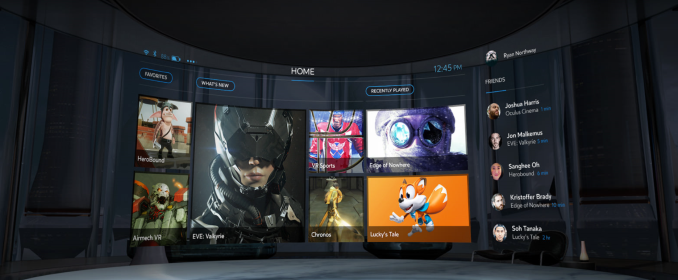
looks like Oculus has some developers on board with EVE: Valkyrie,
Chronos, and Edge of Nowhere being some of the featured games.
They
also showed off their 2D homescreen which they are projecting into the
3D rift world. There will be easy access to social networks and of
course multiplayer gaming in virtual reality.
In
addition to the Xbox controller, Oculus has also worked with Microsoft
to enable the upcoming Xbox Game Streaming into the Rift, so that you
can be fully immersed. This will not magically make Xbox games 3D VR
worlds, but instead will project the Xbox game into a big 2D screen
inside the Rift and block out all distractions.
I’ve been a bit of
a VR skeptic, but my time with the Rift was pretty cool. I can see a
lot of applications for this outside of gaming, but of course gaming is
going to be a big part of VR and Oculus looks to be lining up a pretty
nice looking launch. A big part is going to be quality titles for the
Rift and Oculus is working hard on that aspect. The hardware is now
pretty polished.
Source:
Oculus
Read More ...
Nantero Exits Stealth: Using Carbon Nanotubes for Non-Volatile Memory with DRAM Performance & Unlimited Endurance
The race for next generation non-volatile memory technology is already on at full throttle. We covered
Crossbar’s ReRAM announcement last year
and last week a very exciting company with a different non-volatile
technology exited stealth mode and shed light on its technology and
commercialization plans. The company is called Nantero and it’s been
developing its NRAM technology for well over a decade now.
Before
we talk about the technology itself, let’s briefly discuss the company
and its key persons as Nantero is probably an unfamiliar name to many
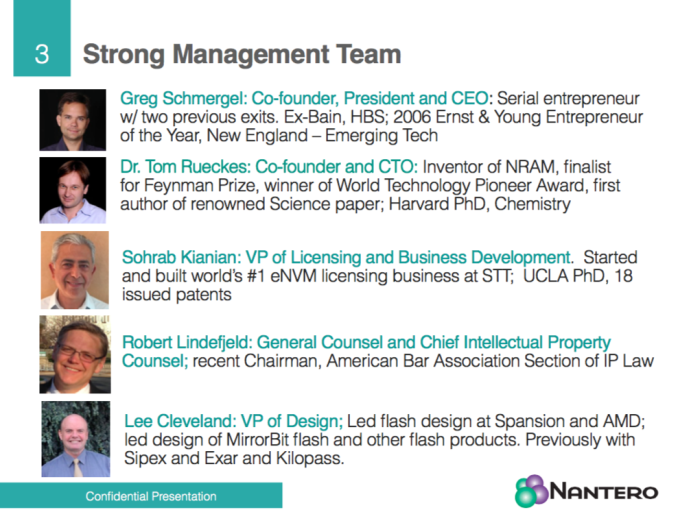
(it was for me, at least). The company was founded by Greg
Schmergel, Dr. Tom Rueckes and Dr. Brent M. Segal in 2001. Mr. Schmergel
and Dr. Rueckes are both still with the company and serve as CEO and
CTO respectively, but Dr. Segal left the company in 2008 as a part
of Nantero's Government Business Unit acquisition by Lockheed
Martin. Mr. Schmergel is a well renowned serial entrepreneur who founded
ExpertCentral that was later acquired by About.com where Mr. Schmergel
served as a Senior Vice President before co-founding Nantero. While Mr.
Schmergel brings valuable business expertise to the company, the
technology comes from Dr. Tom Rueckes who is a Harvard Ph.D in
chemistry and the inventor of NRAM technology.
The
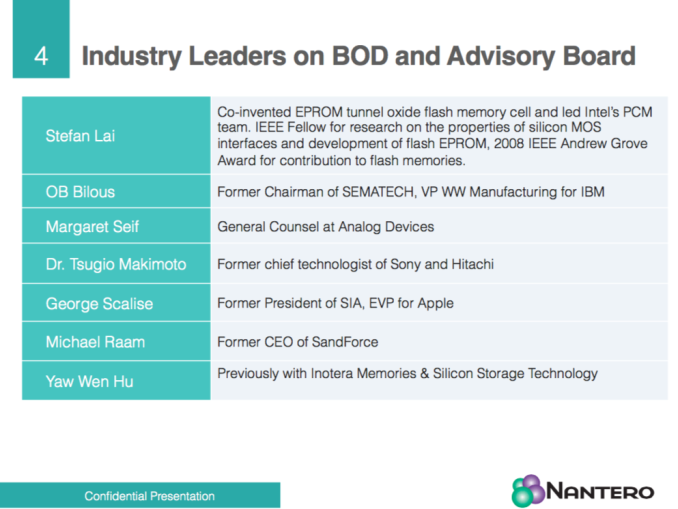
Board of Directors includes several semiconductor industry
veterans. Mr. Lai was one of the leading developers of NAND technology
at Intel and also led Intel’s Phase Change Memory (PCM) team. Dr.
Makimoto is a former Chief Technologist of Sony and Hitachi and Mr.
Scalise is actually the former President of Silicon Industry Association
(SIA) and also served as an Executive Vice President at Apple briefly
in the late 90s. Mr. Raam may too be a familiar name to some since he is
the former CEO of SandForce (the SSD controller company) that is now
owned by Seagate.
The Technology
It goes without saying
that Nantero is packed with semiconductor experience and know-how, but
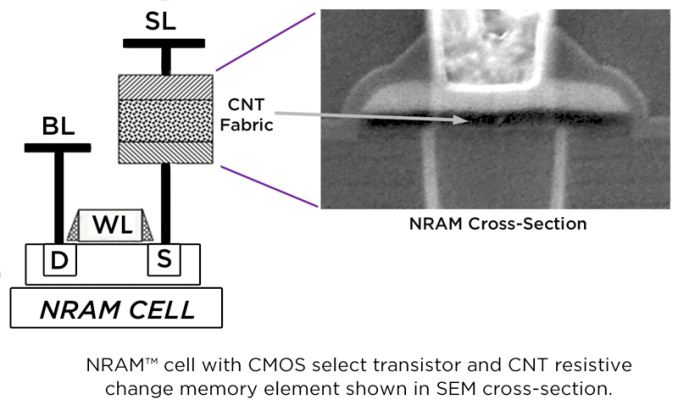
its technology isn’t any less interesting. NRAM is made out of carbon
nanotubes, which is the strongest material known to man and provides far
better thermal and electrical conductivity than any other known
material.
The
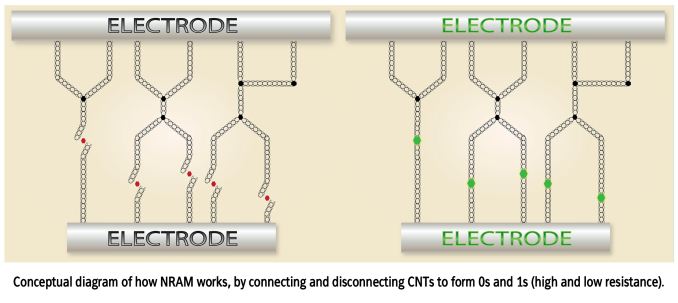
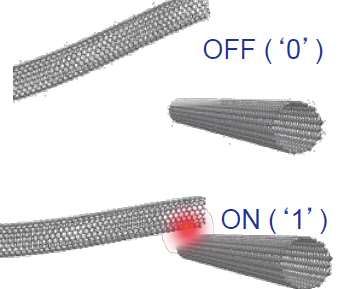
way NRAM works is in fact relatively simple. Essentially there are two
nanotubes, which have low resistance when in physical contact and high
resistance when separated. The amount of resistance then determines
whether the cell is considered to be programmed as ‘0’ or ‘1’. Program
operation (or “SET” as Nantero calls it) works by applying a voltage on
one of the nanotubes, which will then attract the other nanotube and
create a bond. The SET operation is very fast and takes only
picoseconds, which is on par with or better than DRAM latency. The bond
is kept in tact by Van der Waal's interactions and is practically
immortal with data retention terms even in 300°C is over ten years. In
an erase operation (or RESET as Nantero calls it) the voltage is simply
applied in the other direction, which will “heat up” (given the scale
it’s more like vibration) the nanotube contacts and cause them to
separate. Given that carbon nanotubes are one of the strongest materials
in the world, the write/erase endurance is practically infinite as
independent university study has shown Nantero’s NRAM technology to have
over 10
11 P/E cycles (for your information, 10
11 translates to 100 billion).
The
other great news is that carbon nanotubes are extremely small. One
nanotube can have a diameter of only 2nm and the pitch between the two
nanotubes in off-state can be an even tinier 1nm, so the technology has
potential to scale below 5nm. NRAM can also scale vertically, or go
3D, and since the cell structure and manufacturing process are both
quite simple, 3D stacking should, in theory, be much easier compared to
what 3D NAND is today with no need for high aspect ratio etching as an
example.
The Manufacturing Process
The process of making
an NRAM wafer starts by taking a normal CMOS wafer with the normal cell
select and array line circuitry, which is then spin coated with carbon
nanotubes. Carbon nanotubes are grown from iron that would normally
contaminate a clean room, thus Nantero had to develop a patented process
that creates ‘pure’ carbon nanotubes with less than one out of billion
particles being foreign (the standard for the highest quality clean
rooms). Nantero has worked hard in the past two years to bring the cost
of carbon nanotubes down and currently the company says that the
nanotubes have a negligible impact on chip cost, meaning making NRAM
isn't inherently more expensive than any other semiconductor.
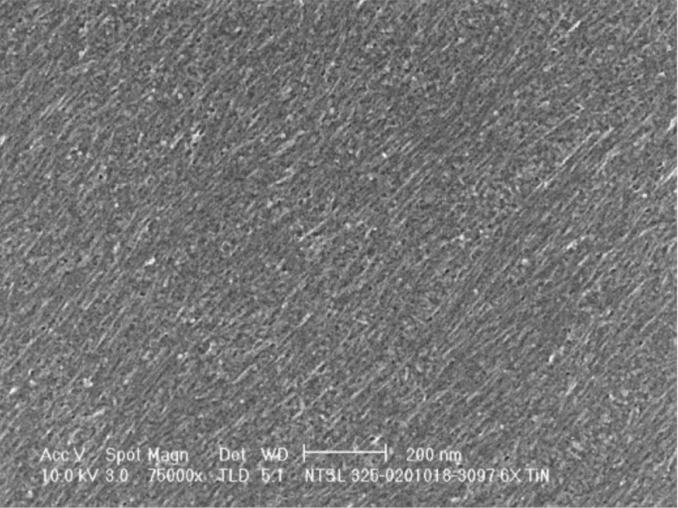
Top-down SEM of NRAM
With
the nanotubes on the wafer, the top electrode is deposited on top of
the nanotubes, followed by the photoresist, which is then patterned
using a single mask. Finally the wafer is etched to cut the nanotubes
into smaller pieces (i.e. more memory cells) and that’s it in a
nutshell. Obviously there are other general semiconductor processing
steps involved, but those are the same for all memory technologies, so
the fundamental process of manufacturing NRAM isn’t that complex. All
that is needed is a normal CMOS fab because the NRAM process requires no
special or additional tools.
Fortunately,
NRAM isn’t just a technology that exists on paper. Nantero’s NRAM
process has already been installed in seven production CMOS fabs ranging
from 20nm to 250nm and limited production
has been taking place for several years now, although
only in small few megabit capacities. As a matter of fact, Nantero
completed a successful space test with NASA on Space Shuttle Atlantis
back in 2009 where NRAM operated without any shielding throughout the
trip without any errors despite the intense radiation, because as I
mentioned earlier, the nanotube bonds are practically unbreakable and
are not affected by heat, magnetism, radiation and the like.
Nantero’s Business Plan: Bringing NRAM to Everyone
Because
Nantero is an IP licensing company, it relies solely on its partners
for production. It's a logical strategy because a decent sized fab
requires an investment in the order of billions of dollars and in the
end the company would have to compete against Intel, Samsung and the
rest of the semiconductor giants. Actual end products will be sold under
the manufacturer's brand (e.g. Intel), so you won't see any Nantero
branded products on the market.
Nantero isn't disclosing any of
its partners at this point as most of them are still developing products
that have the potential for higher volume production. While Nantero has
its own chip team that is developing high capacity (several gigabits)
dies, every partner is also doing its own work to implement NRAM at a
larger scale, which makes sense given that the big semiconductor
companies have far more resources and are familiar with high capacity
memory devices.
Aside from semiconductor companies, Nantero has
also partnered with several more consumer-facing companies to develop
concepts and products around NRAM technology. Since NRAM provides the
same level of performance as DRAM but is non-volatile, NRAM could open
the doors for products that aren't achievable (at least properly) with
today's NAND and DRAM technology. As examples Nantero mentions 3D
smartphones and commercial 3D printers (although to be frank both
already exist to some extent), but practically anything that's
handicapped by IO performance and volatility can be fixed with NRAM in
the future.
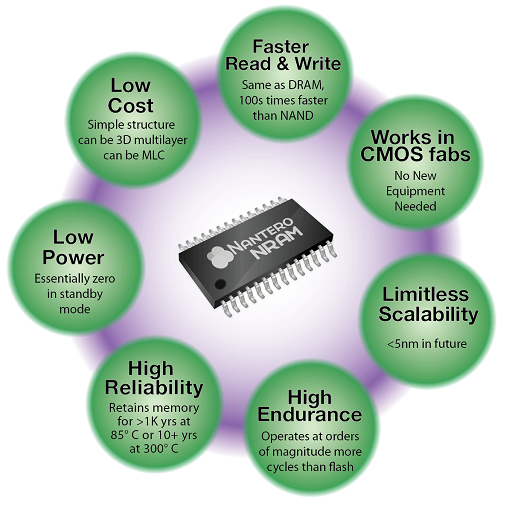
Since
it will take several years before NRAM is even close to modern NAND
capacities, Nantero has a three step strategy of bringing NRAM to the
market. In the first step Nantero is simply offering a class of memory
(both standalone and embedded) that has DRAM's performance
characteristics and NAND's non-volatility. Technically that means NRAM
is competing against current MRAM and ReRAM products for a specialized
niche market that really needs high performance and non-volatility. The
consumer market is obviously not one of those and even for the
enterprise NRAM is likely too small capacity and expensive, but the
industrial and especially space/military applications should benefit
from NRAM despite the high initial cost.
The next step is to grow
NRAM to gigabit-class capacities and offer a non-volatile alternative
to DRAM. Going to gigabit-class certainly opens the doors for NRAM as a
mainstream memory because it could be used for a variety of caching
applications that benefit from non-volatility (SSDs with their DRAM
caches for NAND mapping table are a prime example). Tape out of first
gigabit NRAM wafers is still about 18 months away, so I would expect to
see something shipping perhaps in late 2017 or 2018.
The final
step, of course, is a terabit-class die to replace NAND (FYI, Samsung is
projecting 1Tbit NAND die in 2017). Achieving that requires work on
both lithography scaling and 3D integration technologies because such a
high capacity die is only economical with either multiple layers
or advanced lithography, or both.
NRAM also has the potential to
operate in MLC mode for further density improvements, but for now
Nantero is focusing on scaling NRAM down and adding layers through 3D to
increase density. Once the work on those two is done and has been
implemented to a production fab, Nantero will start commercializing NRAM
MLC technology, but that is likely at least several years away.
Final Words
The
announcement is intriguing to say the least. From a technology
standpoint NRAM sounds very exciting because it's effectively bringing
us non-volatile DRAM performance, and better yet the cell design is
scalable whereas DRAM has major struggles going below 20nm. I like the
fact that Nantero has decided to go with IP licensing model because it
means that NRAM is a technology available to everyone. The reason why
DRAM and NAND are where they are today is because there are multiple
companies producing them, resulting in competition with billions of
R&D dollars.
I wonder if any of the big semiconductor
companies has partnered with Nantero yet. Most of them have been
tight-lipped about their post-NAND plans, but maybe Nantero's
announcement will sooner than later force the companies to talk about
their strategies. Obviously a lot depends on how far 3D NAND can
efficiently scale, but from what I have heard the transition to next
generation memory technologies should begin around 2020. The future of
memory isn't here yet, but it's certainly getting closer and it will be
interesting to see what technology ends up taking the crown.
Read More ...
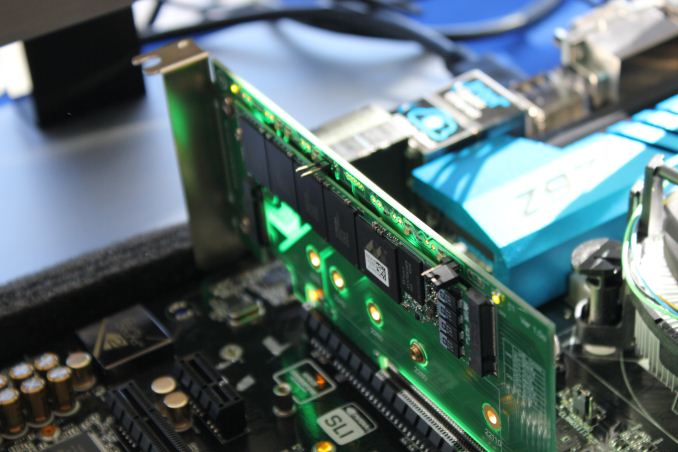
Plextor M7e PCIe SSD to Ship in Q3, M7V TLC SSD in 2016 & New Software Features
Plextor first showed off the M7e
at CES earlier this year
and at Computex we got an update on the release schedule. Plextor is
now aiming for Q3 release, meaning that we will likely hear the final
release at Flash Memory Summit in August. Specifications have not really
changed since the M7e still utilizes the same Marvell PCIe 2.0 x4 AHCI
controller with performance rated at up to 1.4GB/s read and 1GB/s write
as well as up to 125K random read and 140K write IOPS. M7e will be
available in both M.2 and PCIe card form factors with capacities range
from 256GB to 1TB, so the M7e may very well be the first M.2 2280 drive
to break the 1TB barrier.
Regarding the TLC drive M6V (or M7V as
Plextor now calls it), Plextor is taking its time to fine tune the
firmware to squeeze every megabyte of performance out of the drive and
more importantly ensure high reliability and endurance. Plextor told me
that its firmware can boost the endurance to 2,000 P/E cycles with 15nm
TLC, so it the claim holds true then I'm fine with Plextor taking a
little longer and pushing the release to 2016.
On
the software side, Plextor actually had three new items to show. The
first one is updated PlexTurbo, which now carries version number 3 and
increases the maximum cache size to 16GB. The cache size is also now
user adjustable and supports multiple disks, so one can decide what
Plextor SSD to speed up with PlexTurbo.
The first new addition to
Plextor's software suite is PlexVault, which creates a hidden partition
for storing sensitive data. The partition is completely hidden and isn't
even visible in Disk Management, so other users won't even know that
such hidden partition exists. Accessing the partition works through a
hot key, although a password can also be entered to protect the hidden
partition from accidental access. I'm not sure how useful the feature
really is, but I guess it creates another layer of security for NSFW
(not safe for the wife) content for those who may need it.

The
final piece of new software is PlexCompressor, which is an automated
compression utility. If a file is not accessed for 30 days,
PlexCompressor will automatically compress the file to increase free
space. The file will then be uncompressed when accessed, which obviously
takes a bit of the free space since the file will now be stored in
uncompressed format for another 30 days. The compression is transparent
to the user and is done fully in software (i.e. by the CPU), so it's
not SandForce-like hardware compression. There is no impact on SSD
performance, although as compression consumes some CPU cycles there may
be impact on CPU heavy workloads and especially battery life. Out of the
three pieces of software Plextor has, I think PlexCompressor is the
most potent because it results in concrete extra free space for the
end-user and with SSD prices still being relatively high (compared to
HDDs) it makes sense to get the most out of the storage one has.
Read More ...
Synology Launches RC18015xs+ / RXD1215sas High-Availability Cluster Solution
Synology
is no stranger to high-availability (HA) systems. Synology High
Availability is touted as one of the features that differentiate
Synology's NAS units from other vendors' for small business and
enterprise usage. Put simply, Synology HA allows two NAS units (same
model) to be connected to each other directly through their LAN ports,
while also being connected to the main network through their other LAN
ports. One of the NAS units is designated as the active unit, while the
other passively tracks updates made to that unit. In case of any failure
in the active unit, the other one can seamless take over without any
downtime.
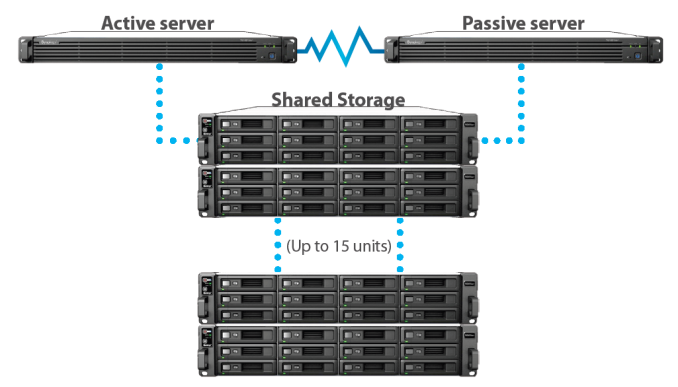
Synology is now extending this concept to a
high-availability cluster. The products being introduced today are the
RackStation RC18015xs+ compute node and the 12-bay RXD1215sas expansion
unit.
Unlike
Synology's traditional RackStation products, the compute node doesn't
come with storage bays. They are just 1U servers sporting a Xeon E3-1230
v2 (
4C / 8T Ivy Bridge running at 3.3 GHz) CPU. The specifications of the RC18015xs+ are provided below.
The
PCIe 3.0 x8 slot allows for installation of 10 GbE adapters, if
required. The compute node is priced at $4000. The expansion unit comes
with the following specifications, and it is priced at $3500.
In
order to set up a high-availability cluster, two compute nodes and at
least one expansion unit is needed (as shown in the diagram on top). The
operation of the cluster and high-availability features are similar to
Synology HA. Performance numbers are of the order of 2,300 MBps and 330K
IOPS using dual 10G adapters. All DSM (v5.2) features such as SSD
caching and virtualization certifications are available.
High-availability is also ensured with redundancy of hardware components
(PSUs / SAS connectors / fans etc.).
The other important aspect
of today's announcement is the usage of btrfs for the file system. As of
now, the only COTS NAS units with btrfs support in this market segment
have been those from Netgear and Thecus. So, it is heartening to see
Synology also adopting it. btrfs brings along many advantages, including
snapshots with minimal overhead and protection against bit-rot. The
unfortunate aspect is that it is currently only available in this
high-availability cluster solution. We hope it becomes an option for
other NAS models soon.
Coming to the pricing aspect, we see that
consumers need to buy two compute nodes and one expansion unit at the
minimum, bringing the cost of a diskless configuration to $11500. This
is pretty steep, considering that Quanta's cluster-in-a-box solutions
(with similar computing performance) can be had along with Windows
Server licenses for around half the price. Synology's products have
always carried a premium (deservedly so for the ease of setup and
maintenance), so it is not a surprise to see the pricing strategy here.
Read More ...
Phanteks Computex 2015 Booth Tour
Phanteks
had its new Enthoo EVOLV series cases in both mini-ITX and full ATX
form factors on display in its suite at Computex. The mini-ITX version
is made out of steel and available in two color schemes (white-black
& red-black). There's a single 200mm fan installed in the front
with room for two 120/140mm fans at the top and one at the back. It can
take a 330mm GPU and a 200mm CPU cooler, so you can build a fairly
powerful system. One of the more special aspects of Phanteks' cases is
the PSU cover, which essentially hides the PSU cables to create the
clean look that many desire.
The
ATX version is fully made out of 3mm thick aluminum (despite the side
window). For some reason the design and overall build remind me of the
original Mac Pro, which isn't a bad thing at all.
One
of the unique aspects in the case are fully modular hard drive bays. I
have to say I really like the concept because typically many ATX cases
easily have +5 irremovable bays, but in reality most users probably
won't use more than one or two. Phanteks includes three with the case,
but obviously the user can buy extra ones if needed.
There
are actually two hard drive bays and SSD brackets behind the main
chamber, so in most cases the user won't even need the modular HDD bays
and can thus maximize airflow by not having anything between the fans
and motherboard.
Phanteks
also had a prototype of a dual-system case that can take a full ATX
motherboard and a mini-ITX one. The interesting part is that Phanteks is
working on a power splitter, so the two systems could be powered by a
single PSU to save on space and cost. As you can see, the concept isn't
really final yet because Phanteks needs to some custom cabling in order
to be able to close the case since right now the cables come off too
much. It's a niche product for sure, but the idea of running two full
systems inside a decent size case is definitely alluring. See the
gallery for more shots of the prototype and other cases Phanteks had to
show!
Read More ...
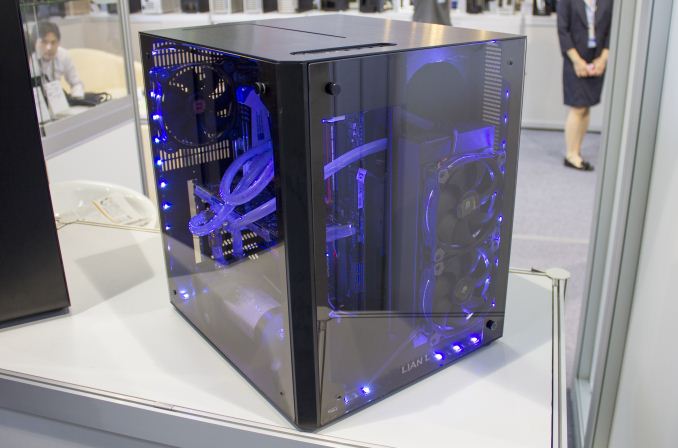
Lian Li Computex 2015 Booth Tour
Lian
Li had close to a dozen new or prototype-level cases on display at
Computex. I've added most in the gallery at the end of this post, but
I'll go through a few of the highlights here as well.
The
first one is the PC-V33A, which is a box-like case in which the
motherboard is mounted horizontally. The top cover is made out of single
piece of aluminum, but it opens up for easy installation.
The
case above is more of a conceptual prototype where Lian Li is playing
around with a taller case design. Instead of having hard drive bays next
to the motherboard, there's room for four hard drives in the top
chamber, which allows for better airflow in the main chamber.
One
of the more down to earth designs is the PC-K621, which is also Lian
Li's first non-aluminum case. Traditionally Lian Li has kept the Lancool
brand for value cases, but it seems that the company is trying to
consolidate everything under a single brand now. The PC-K621 is made out
of steel and plastic, but it does feel very sturdy and despite the fact
that the front panel is made out of plastic, it has a metal-like look
in it. Pricing will be about $70, so while it's not exactly a value case
it's still considerably cheaper than the rest of the Lian Li cases.
One
minor change Lian Li has made to its cases is changing the power button
material from plastic to aluminum. The company received many complaints
of the power button not having the same feel as the rest of the case,
so as any respectable company Lian Li listened to its customers and made
the change.
And
obviously no Lian Li booth tour is complete without the computer desk
case. Lian Li has modified the design a bit so that one can now easily
sit with legs under the table, which was one of the issues the earlier
cases had (note: that's Kip Hartwell, Lian Li's marketing rep, in the
photo, not me). The desk is still expensive, though, and Lian Li doesn't
really have any plans of making a value model, but it's a relatively
small niche anyway.
Check out the gallery above if you're interested in seeing what else Lian Li had to offer!
Read More ...
Here's the Nokia Moonraker Smartwatch Which Got Killed in Favor of Microsoft Band
Smartwatch project was scrapped after the acquisition
Read More ...
Sources: Hack on Fed. Database Lost 4.1M Social Security Numbers, Personal Info
Some seek to justify more Orwellian spying, ignoring that mass domestic spying iniatives utterly failed to stop prior attacks
Read More ...
Windows 10 Will Arrive in August, w/ New Devices in Sept.-Oct.
Leading the charge will be Lumia 940 XL, according to numerous leaks
Read More ...
BlackBerry's Redesigned Passport Leaks -- With the Exact Same Hardware Inside
Leak reveals a perplexing expenditure of effort on Canadian phonemaker's part
Read More ...
Editorial: A Note to Apple on Watch Complications -- "You Keep Using That Word..."
Complications
are about precision, craftsmanship, and complexity -- the antithesis
of how Apple is redefining the term in Watch OS
Read More ...
In-Depth: A (Semi-Complete) Guide to What's New in iOS 9
iOS
brings true multi-tasking, new "snap" style controls, new APIs, a
smarter Siri, mass transit mapping, a unified "Wallet", and more
Read More ...
Facebook Begins Mass Rollout of Free Bluetooth Business "Beacons"
Project is arguably Facebook's biggest dedicate hardware effort to date, aims to realize goal of massive localized data mining.
Read More ...
Samsung Quietly Rolls Out Slick Galaxy S6 Active, AT&T Gets Exclusivity in U.S.
Model shares much with the baseline release, but loses fingerprint scanner in lieu of hardware buttons
Read More ...
Hot Air? President Obama, G7 Pledge to Eliminate Most Fossil Fuel Use by 2100
U.S.
is unlikely to reach that commitment given that its consumption of
fossil fuels has increased by nearly a fifth in the last half decade
Read More ...
Available Tags:
EVGA ,
NVIDIA ,
SSD ,
SATA ,
Nokia ,
Microsoft ,
Hack ,
Security ,
Windows ,
Hardware ,
Apple ,
iOS ,
Facebook ,
Samsung ,
Galaxy ,










No comments:
Post a Comment