

Tim Sweeney, Johan Andersson & John Carmack @ NV Montreal - Live Blog
NVIDIA managed to bring Tim Sweeney (Founder, Epic), Johan Andersson (Frostbite Technical Director, Dice) and John Carmack (Founder, id Software) all up to Montreal to share their thoughts on G-Sync. All of these insanely bright guys and computer gaming visionaries gave their stamp of approval to G-Sync, and then decided to stick around for a panel discussion with everyone here at the event.

     |
Read More ...
NVIDIA's G-Sync: Attempting to Revolutionize Gaming via Smoothness
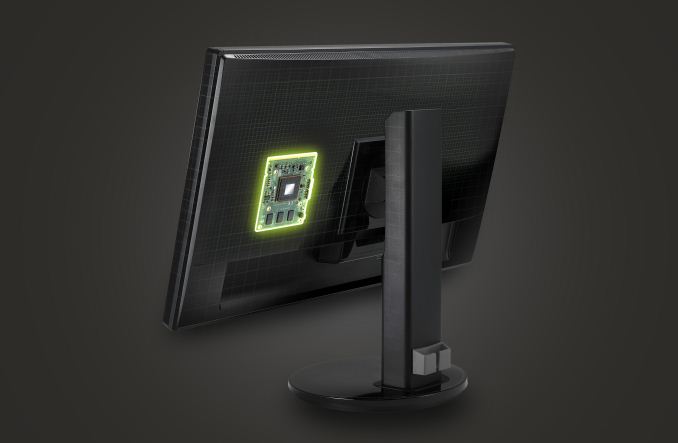
NVIDIA's G-Sync is a combination of software and hardware technologies that allows a modern GeForce GPU to control a variable display refresh rate on a monitor equipped with a G-Sync module. In traditional setups a display will refresh the screen at a fixed interval, but in a G-Sync enabled setup the display won't refresh the screen until it's given a new frame from the GPU.
NVIDIA demonstrated the technology on 144Hz ASUS panels, which obviously caps the max GPU present rate at 144 fps although that's not a limit of G-Sync. There's a lower bound of 30Hz as well, since anything below that and you'll begin to run into issues with flickering. If the frame rate drops below 30 fps, the display will present duplicates of each frame.
There's a bunch of other work done on the G-Sync module side to deal with some funny effects of LCDs when driven asynchronously. NVIDIA wouldn't go into great detail other than to say that there are considerations that need to be taken into account.
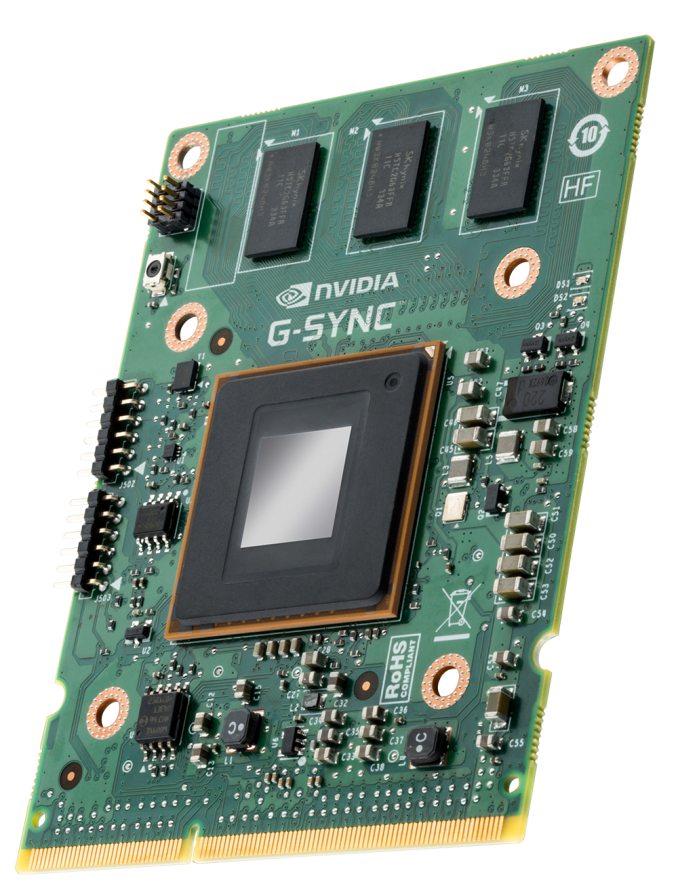
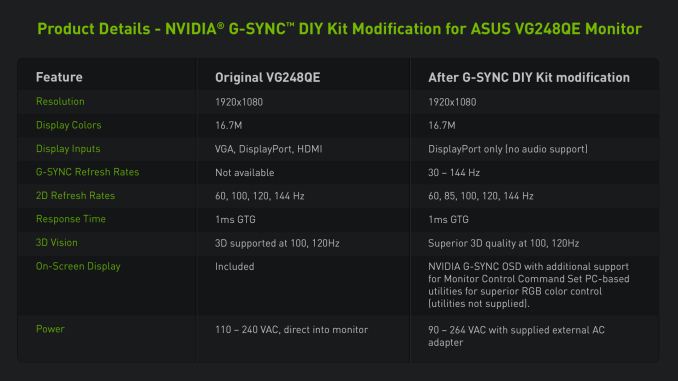
The first native G-Sync enabled monitors won't show up until Q1 next year, however NVIDIA will be releasing the G-Sync board for modding before the end of this year. Initially supporting Asus’s VG248QE monitor, end-users will be able to mod their monitor to install the board, or alternatively professional modders will be selling pre-modified monitors. Otherwise in Q1 of next year ASUS will be selling the VG248QE with the G-Sync board built in for $399, while BenQ, Philips, and ViewSonic are also committing to rolling out their own G-Sync equipped monitors next year too. I'm hearing that NVIDIA wants to try and get the module down to below $100 eventually. The G-Sync module itself looks like this:
Meanwhile we do have limited information on the interface itself; G-Sync is designed to work over DisplayPort (since it’s packet based), with NVIDIA manipulating the timing of the v-blank signal to indicate a refresh. Importantly, this indicates that NVIDIA may not be significantly modifying the DisplayPort protocol, which at least cracks open the door to other implementations on the source/video card side.
Although we only have limited information on the technology at this time, the good news is we got a bunch of cool demos of G-Sync at the event today. I'm going to have to describe most of what I saw since it's difficult to present this otherwise. NVIDIA had two identical systems configured with GeForce GTX 760s, both featured the same ASUS 144Hz displays but only one of them had NVIDIA's G-Sync module installed. NVIDIA ran through a couple of demos to show the benefits of G-Sync, and they were awesome.
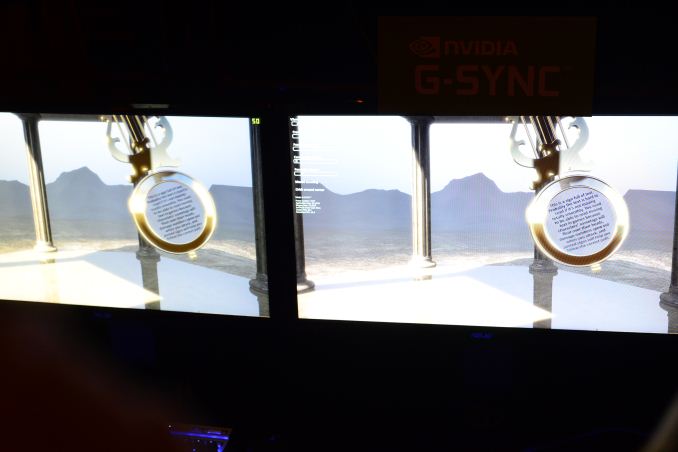
The first demo was a swinging pendulum. NVIDIA's demo harness allows you to set min/max frame times, and for the initial test case we saw both systems running at a fixed 60 fps. The performance on both systems was identical as was the visual experience. I noticed no stuttering, and since v-sync was on there was no visible tearing either. Then things got interesting.
NVIDIA then dropped the frame rate on both systems down to 50 fps, once again static. The traditional system started to exhibit stuttering as we saw the effects of having a mismatched GPU frame rate and monitor refresh rate. Since the case itself was pathological in nature (you don't always have a constant mismatch between the two), the stuttering was extremely pronounced. The same demo on the g-sync system? Flawless, smooth.
NVIDIA then dropped the frame rate even more, down to an average of around 45 fps but also introduced variability in frame times, making the demo even more realistic. Once again, the traditional setup with v-sync enabled was a stuttering mess while the G-Sync system didn't skip a beat.
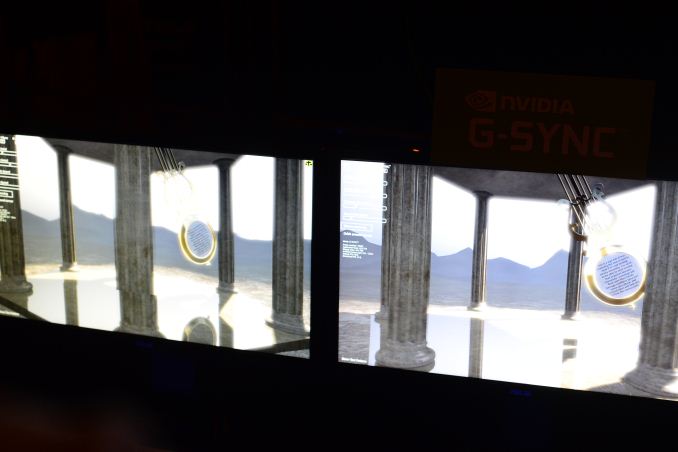
Next up was disabling v-sync with hopes of reducing stuttering, resulting in both stuttering (still refresh rate/fps mismatch) and now tearing. The G-Sync system, once again, handled the test case perfectly. It delivered the same smoothness and visual experience as if the we were looking at a game rendering perfectly at a constant 60 fps. It's sort of ridiculous and completely changes the overall user experience. Drops in frame rate no longer have to be drops in smoothness. Game devs relying on the presence of G-Sync can throw higher quality effects at a scene since they don't need to be as afraid of drops in frame rate excursions below 60 fps.
Switching gears NVIDIA also ran a real world demonstration by spinning the camera around Lara Croft in Tomb Raider. The stutter/tearing effects weren't as pronounced as in NVIDIA's test case, but they were both definitely present on the traditional system and completely absent on the G-Sync machine. I can't stress enough just how smooth the G-Sync experience was, it's a game changer.
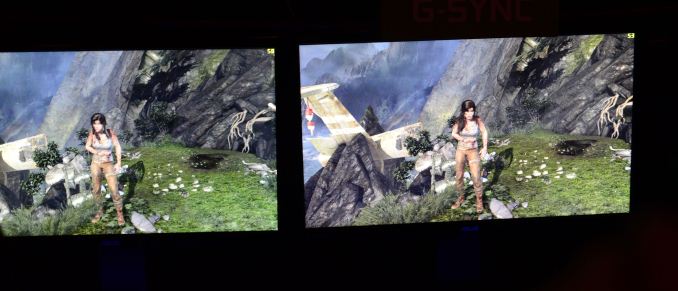
The combination of technologies like GeForce Experience, having a ton of GPU performance and G-Sync can really work together to deliver a new level of smoothness, image quality and experience in games. We've seen a resurgence of PC gaming over the past few years, but G-Sync has the potential to take the PC gaming experience to a completely new level.
Update: NVIDIA has posted a bit more information about G-Sync, including the specs of the modified Asus VG248QE monitor, and the system requirements.
| NVIDIA G-Sync System Requirements | |||||||||
| Video Card | GeForce GTX 650 Ti Boost or Higher | ||||||||
| Display | G-Sync Equipped Display | ||||||||
| Driver | R331.58 or Higher | ||||||||
| Operating System | Windows 7/8/8.1 | ||||||||

| |
Read More ...
NVIDIA Consolidates Game Streaming Tech Under GameStream Brand; Announces Shield Console Mode

With GameStream the underlying technology itself won't be changing – it’s still fundamentally about pairing up NVIIDA NVENC equipped GPUs with Tegra and other endpoint devices with a matching H.264 decoder – but with this change NVIDIA is also going to be adding additional functionality to better utilize the tech.
Chief among these is that NVIDIA’s Shield handheld game console will be getting a microconsole-like mode, dubbed “Shield Console Mode”, that will allow the handheld to be converted into a more traditional TV-connected console. In console mode Shield can be controlled with a Bluetooth controller, and in accordance with the higher resolution of TVs will accept 1080p game streaming from a suitably equipped PC, versus 720p in handheld mode. With that said 1080p streaming will require additional bandwidth, and while 720p can be done over WiFi NVIDIA will be requiring a hardline GigE connection for 1080p streaming (note that Shield doesn’t have Ethernet, so this is presumably being done over USB). Streaming aside, in console mode Shield will also support its traditional local gaming/application functionality.


| |
Read More ...
GeForce ShadowPlay Gets a Beta Date & Twitch Support

ShadowPlay, as you may recall, is NVIDIA’s hardware encoding enabled video recording utility that’s part of their GeForce Experience software utility. ShadowPlay was first announced back at the launch of the GTX 780 in May, and is intended to be NVIDIA’s take on video recording while leveraging their NVENC hardware H.264 encoder. By using their hardware encoder as opposed to software encoding as is almost always the case on existing utilities, the overhead from recording should be significantly reduced, thereby making recording a nearly free operation. NVIDIA’s goal is to support both traditional recording and a 20 minute always-on rolling window recording, to capture and save footage after the fact. Video recording in this manner has always been something of an obvious use of the technology at hand, but ultimately it’s not something that anyone has seriously attempted at implementing until now.


On a side note, as our regular readers are aware this release is months later than NVIDIA originally planned, as ShadowPlay was originally intended to be released over the summer. However the client ended up being delayed after NVIDIA realized that their initial plans to use M2TS container files would be problematic due to the fact that the container format isn’t well supported by 3rd party software, particularly Windows Media Player. As a result the company has gone back to the drawing board and changed the client to use the more ubiquitous MP4 container format, which will bring with it much greater compatibility at the cost of delaying the client in order to implement the necessary changes.

| |
Read More ...
NVIDIA Announces GeForce GTX 780 Ti; Shipping In Mid-November

As something of a bare bones announcement, at this point we don’t have any solid details on the card other than a name and a market position. The GTX 780 Ti is being positioned as NVIDIA’s new high-end gaming card, replacing the existing GTX 780 in that role. Specs, pricing, and the underlying hardware are all unknowns at the moment. Though the reasonable assumption right now is that we’re looking at something to replace the GTX 780 in its $650 slot, and that it will be another GK110 card with higher clocks and/or more SMXes enabled. Furthermore from the very brief glimpse of the card it looks like it will be using the company’s GTX Titan cooler, or a minor variation on it.
| GTX 780 Ti | GTX Titan | GTX 780 | GTX 770 | |
| Stream Processors | ? | 2688 | 2304 | 1536 |
| Texture Units | ? | 224 | 192 | 128 |
| ROPs | ? | 48 | 48 | 32 |
| Core Clock | ? | 837MHz | 863MHz | 1046MHz |
| Boost Clock | ? | 876Mhz | 900Mhz | 1085MHz |
| Memory Clock | ? | 6GHz GDDR5 | 6GHz GDDR5 | 7GHz GDDR5 |
| Memory Bus Width | ? | 384-bit | 384-bit | 256-bit |
| VRAM | ? | 6GB | 3GB | 2GB |
| FP64 | ? | 1/3 FP32 | 1/24 FP32 | 1/24 FP32 |
| TDP | ? | 250W | 250W | 230W |
| Transistor Count | ? | 7.1B | 7.1B | 3.5B |
| Manufacturing Process | ? | TSMC 28nm | TSMC 28nm | TSMC 28nm |
| Launch Price | $649? | $999 | $649 | $399 |

| |
Read More ...
NVIDIA Montreal Event - Live Blog
NVIDIA invited us up to Montreal for a big, gaming-related announcement. We're here live blogging the event!

| |
Read More ...
AMD Posts "The four core principles of AMD’s Mantle"
Penned by Ritche Corpus, AMD’s Director of ISV Gaming and Alliances, the blog post is generally a rehash of points we’ve previously covered, and at other points is little more than empty marketing speak (principle #4). Consequently we initially weren't even going to post this, however with as coy as AMD has been in official statements about the underpinnings of Mantle there were a couple of paragraphs we thought warranted further attention.
In discussing helping developers:
It’s not that Mantle is the initial language with which developers are writing their games on each platform, as some have surmised; the point of Mantle is that it’s easy to reuse, in whole or in part, the development effort expended on the next-generation consoles when bringing the same game to life on the PC. This is because Mantle allows developers to use the same features and programming techniques they are already utilizing for next-gen game consoles. And while the initial iteration of Mantle is intended specifically for PCs, it has been designed from the beginning to be extensible to other platforms as well.And later in their conclusion (emphasis ours):
In short, Mantle is a new and better way to bring the code developers are already writing for next-generation consoles to life on the PC. It achieves this by being similar to, and often compatible with, the code they are already writing for those platforms. The ultimate goal of Mantle is to give gamers the ultimate performance in compatible games, and doing that in such a way that developers are free to put forth whatever effort is required to ensure optimal performance for competing platforms.Of course we’re not going to get complete details on the API until APU13 next month, but at the very least this does agree with our earlier speculation about Mantle being heavily derived from the low level API constructs already created for the Xbox One. The big question continuing to be over just how similar Mantle is to the Xbox One's low level API constructs.
It’s interesting to note though that between this blog post and Tuesday’s tweet, AMD looks to be making a concentrated effort to try to better manage the public’s perception of Mantle, both the good and the bad perceptions. Mantle is far from the first initially ambiguous technology initiative in the PC graphics industry, but it has certainly attracted a great deal of attention from AMD’s supporters and detractors alike, with the ambiguity serving as a distraction since it can be wielded to prove and disprove a number of points. Ultimately until we have the full technical details and have final software in our hands it’s going to be far too early to properly judge Mantle, or for that matter say for certain how any of this will play out. But it's something we'll be watching closely, as wherever this eventually goes it has clearly just begun.

| |
Read More ...
NVIDIA Announces Holiday GeForce Game Bundles
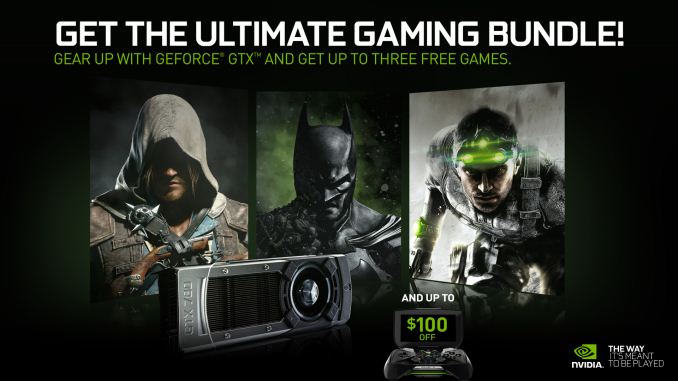
Replacing the outgoing Batman: Arkham Origins bundle will be a what NVIDIA is calling their GeForce GTX Holiday Bundle, which is a tiered system that sees NVIDIA’s most expensive GTX cards on one tier, while NVIDIA’s cheaper GTX cards will be on a lower, cheaper tier with fewer games. NVIDIA is by no means a stranger to tiers – they already did this to split between their Batman and Free-To-Play bundles – but this is the first time they’ve had fine grained tiers that separated the various GTX cards.
In any case, the top tier will be occupied by the GTX 770, GTX 780, and GTX Titan, which on a side note makes this the first appearance of Titan on any game bundle. The upper tier products will receive a 3 game bundle of Assassin’s Creed IV: Black Flag, Batman: Arkham Origins, and Splinter Cell: Blacklist (notably, a previous bundle game that had been replaced by Batman). Meanwhile the lower tier will be composed of the GTX 660 through GTX 760 (and everything in between) and will receive a lighter bundle, dropping Batman but keeping Assassin’s Creed and Splinter Cell. As the latest addition to NVIDIA’s bundles Assassin’s Creed will be NVIDIA’s new featured game, and while we won’t rattle off all of the additions, it has received the usual slate of technology/feature additions from NVIDIA under their The Way It’s Meant To Be Played program.
| NVIDIA Holiday Game Bundles | |||||
| Video Card | Bundle | Shield Discount | |||
| GeForce GTX 770/780/Titan | Assassin's Creed IV, Batman: Arkham Origins, Splinter Cell: Blacklist | $100 | |||
| GeForce GTX 660/660Ti/670/680/760 | Assassin's Creed IV, Splinter Cell: Blacklist | $50 | |||
| GeForce GTX 650 Series | $75 Free-To-Play (Continuing) | None | |||
| GeForce GT 640 (& Below) | None | None | |||
In any case, any NVIDIA customers will want to make note this specific bundle is going to be shorted lived. The bundle starts on October 28th – a week and a half from now – and ends just less than a month later on November 26th. NVIDIA typically runs bundles for longer than this, though there may be some significance to terminating the bundle right before Black Friday. Fulfillment will as always be through NVIDIA’s usual participating etail/retail partners, with partners including vouchers with qualifying products.
Finally, it’s interesting to note that with NVIDIA’s bundle additions as contrasted to AMD’s current lack of a bundle on the Radeon 200 series, we’ve reached an interesting inversion in the typical game bundle tactics the two companies have used over the last year. Now it’s NVIDIA who’s offering the bigger game bundle, and largely for the same reasons AMD did. NVIDIA has not cut the price on the GTX 770 or GTX 760 despite the spoiler situation presented by the R9 products, so it would appear NVIDIA is going the value added route to try to equalize their offerings rather than just cutting prices.


| |
Read More ...
ASUS Transformer Book T100 Review: Redefining the Entry-Level Windows Notebook
I started out our Chromebook 11 review with a reminder that we are in the midst of a netbook renaissance. Armed with better hardware, a better sense of materials/industrial design and better OSes, it’s time for the next round of entry-level, ultraportable notebooks to have their chance in the market.
Literally everything is better this time around. While using a first generation netbook made me incredibly frustrated back when I tried that experiment, the situation is completely different today. Most of our focus on this new entry-level notebook market has been on the Chromebook front. Google and its OEMs choose a different balance of OS and hardware costs in order to bring well built, well designed notebooks to market at a very competitive price point. Since the introduction of the 11.6-inch Samsung XE303 last year, I think Google has clearly succeeded on that front.
Today we meet one of the best candidates from the Wintel side of the fence. Using the traditional formula of the latest version of Windows coupled with similarly targeted silicon from Intel, ASUS put together the Transformer Book T100. Built by the very company that originally kicked off the netbook revolution, the Transformer Book T100 attempts to breathe new life into the entry-level Windows notebook market. We were very excited at the prospects of a $349 10.1-inch Windows 8.1 tablet with keyboard dock back when ASUS announced the T100 last month, but how does it hold up in its final, shipping configuration? Read on for our review.

| |
Read More ...
Nexus 5 Briefly Appears on Google Play - Starts at $349
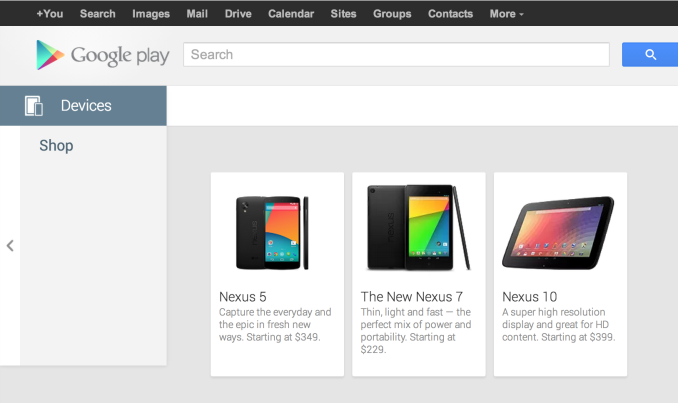
We've already seen its appearance in a Google KitKat video, later from the FCC, and finally in the leaked service manuals for the LG-D821 variant (which I believe is the EMEA banding variant, LG-D820 will be for the USA), someone also dug up a higher resolution image of the Nexus 5 confirming its appearance.

Source: @MKBHD, Android Police

| |
Read More ...
Acer Launches Iconia W4 Tablet with Windows 8.1

The display is an 8" 1280x800 IPS panel, with Zero Air Gap technology, which should be a better fit for the GPU than an ultra-high resolution display. Other features include a 5MP rear-facing camera that supports 720p60 and 1080p30 videos, and a 2MP front-facing camera. It has a microSD slot (with support for up to 32GB), a micro-HDMI port, and charging as well as other connectivity is provided via a micro-USB slot. WiFi is supported, but Acer makes no mention of what standards are available, so it’s probably an 802.11n 2.4GHz solution. Bluetooth 3.0 connectivity is present as well.
Acer also has several peripherals for the new tablet, including a Keyboard Cover, protective film, a “responsive” passive stylus, power bank, and an adapter kit with bag. Perhaps more interesting are the Crunch Keyboard and Crunch Cover. The Crunch Keyboard is a soft synthetic leather cover that folds out as well as functions as a tablet stand. It measures 0.21” thick (5.3mm) and works via Bluetooth 3.0, with recharging via micro USB, so while it doesn’t directly provide more battery life to the tablet it doesn’t require a physical connection and won’t reduce battery life. The Crunch Cover is made of durable microfibers and folds into a stand for the tablet, with several angles available it keeps all of the ports open and comes in several different colors. Acer doesn’t mention pricing on any of the accessories, so we’ll have to wait and see how much they cost.
As for the main Iconia W4 tablet, it weighs 0.91 pounds (415 grams) and is 0.42” (10.75mm) thick – Acer doesn’t list the other dimensions in their press release. Acer is going after a lower price target than we’ve seen with many Windows tablets, and the display and several other elements help in achieving that goal. Microsoft Office Home and Student 2013 is also included with the W4, adding even more value to the product. The W4 comes in two models, one with 32GB and one with 64GB. Given the rather large footprint for Windows 8.1, I’d just as soon see Acer ditch the 32GB model and work on getting pricing down on the 64GB model, but that hasn’t happened in the budget sector just yet.
The 32GB model (which should have around 12GB free after the core OS and apps take their portion) is priced at $330 while the 64GB model will cost $380. $50 extra for $5 of NAND is still pretty steep, but it’s better than the $100 price jump we’ve seen on many earlier devices. The Iconia W4 is scheduled to begin shipping later this month.


| |
Read More ...
AMD Radeon R9 290X Performance Preview: Bioshock Infinite
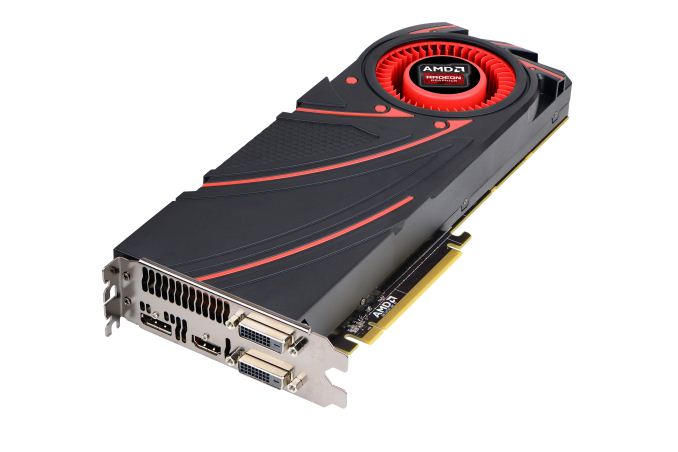
AMD has purposely kept the public details on the R9 290X sparse so far, so we know little other than that it’s a larger GPU rated for 5 TFLOPS of compute performance, and paired with 4GB of memory for a total memory bandwidth of over 300GB/sec. Like most segments of the consumer electronics industry AMD has been gearing up for 3840x2160 (4K) displays, so the Radeon 290X is AMD’s flagship card geared towards gamers using 3840x2160 or 2560x1440 monitors.
Consequently AMD is seeking to draw attention to their 4K performance with today’s benchmark reveal. AMD named the game, the cards, and the resolution – Bioshock at 4K against the GTX 780 – so this is a very limited subset of our full results. And as with all controlled benchmark releases we’d advise not reading too much into any single benchmark here, as the relative performance of NVIDIA and AMD cards changes with the game being tested, at times rather wildly..
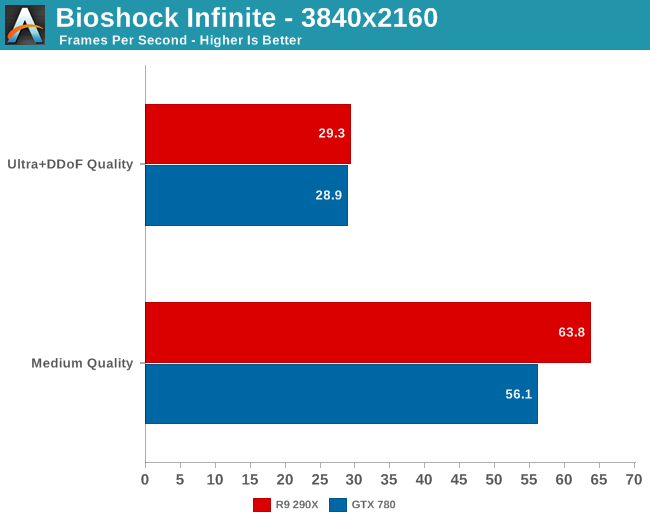
Moving on, it’s interesting to note in this case that both cards are essentially tied at Ultra quality, but when we dial down to medium the 290X takes a very decisive 14% lead. At the highest quality settings we should be shader/texture bound due to the significant use of shader effects on Bioshock’s highest quality settings, whereas at lower quality settings at least some of the bottleneck will shift to elements such as ROP throughput, memory bandwidth, and the geometry pipeline.
Wrapping this preview up, we’ll have more details on the 290X in the near future. AMD has made it clear that they are aiming high with their new flagship video card, so it will be interesting to see what they can pull off as we approach Tahiti/7970’s second birthday.


| |
Read More ...
Windows 8.1 Update Now Available
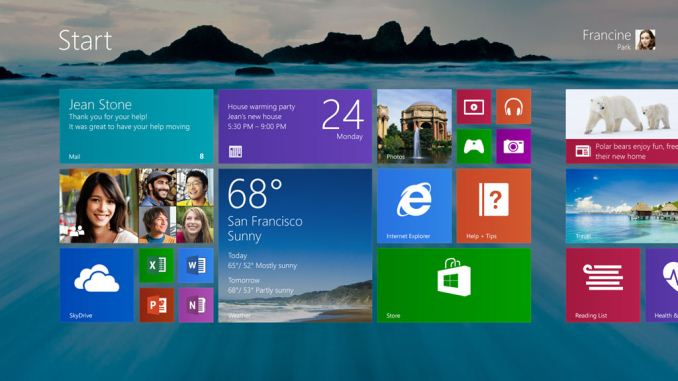
Microsoft’s service pack/update for Windows 8 is being distributed through the Windows 8 Store. Microsoft is apparently doing a staggered rollout, so it’s not visible from every copy of Windows 8 right away, but going through a link to the update from Microsoft’s website will bring up the update regardless of whether it’s visible or not. Meanwhile for users on Windows 7 Microsoft will eventually be selling an updated, retail version of the Windows 8.1 package, though that’s not available quite yet.
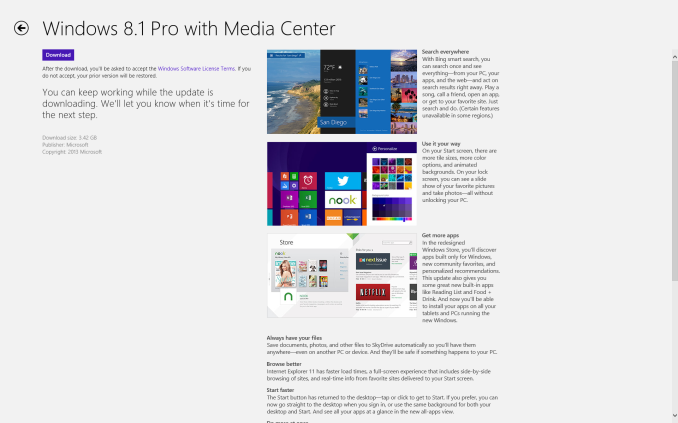
The size of the update will vary depending on the platform, but for Windows 8 Pro we're seeing 3.42GB, so it goes without saying that this will not be a light download.

| |
Read More ...
HTC Loses Another Key Executive
Losing money and staff at a rapid rate there's no easy answer for HTC

| |
Read More ...
Apple Patent on Touch Typing, Multitouch Upheld; Allows Ban on Most Androids
Surprise Apple win may force OEMs like Samsung and LG to use Windows Phone, although they'll first try to fight it

| |
Read More ...
DOE Ends Auction for $168 Million Fisker Loan
Winner hasn't been announced nor has the size of the loss for taxpayers

| |
Read More ...
Quick Note: 16 GB Google Nexus 5 Turns up on Google Play Store
Product page was quickly pulled down

| |
Read More ...
Editorial: NSA's Alexander to Retire, But is he a Villain or Obama's Fall Guy?
Cryptology expert who wants government "information dominance" is leading candidate for his replacement

| |
Read More ...
Samsung Proposes Settlement Over "3G" Patent "Abuse" Against Apple in the EU
Samsung agrees not to use SEPs to seek bans in the EU for five years

| |
Read More ...
Russia, U.S. Eye Team-up to Build Massive Nuke to Save Planet from an Asteroid
The mother of all bombs would sit in wait in an orbitary platform

| |
Read More ...
Facebook Eases Restrictions on Teen Sharing, Allows them to go Public
Teens still have the option to manually keep their posts and photos private or shared only with friends or friends of friends

| |
Read More ...
Microsoft Rolls Out Windows 8.1
It's a free download if you already have Windows 8

| |
Read More ...
Nikon Debuts 24.2MP D5300 D-SLR
New camera launches this month for under $1,400

| |
Read More ...
Acer Launches 8" Iconia W4 Tablet Running Windows 8.1
New tablet runs Windows 8.1

| |
Read More ...
Intel Beats Low Earnings Expectations, But Faces Tough Mobile Outlook
Samsung and TSMC are hindering Intel's mobile dreams

| |
Read More ...
Available Tags:Gaming , via , NVIDIA , GeForce , GTX , AMD , ASUS , Windows , Notebook , Google , Windows 8 , Acer , Tablet , Radeon , Windows 8 , HTC , Apple , Samsung , Facebook , Windows 8 , Microsoft , Nikon , Windows 8 , Intel ,


No comments:
Post a Comment