

Computex 2013: ASRock Z87 with 22 SATA Ports
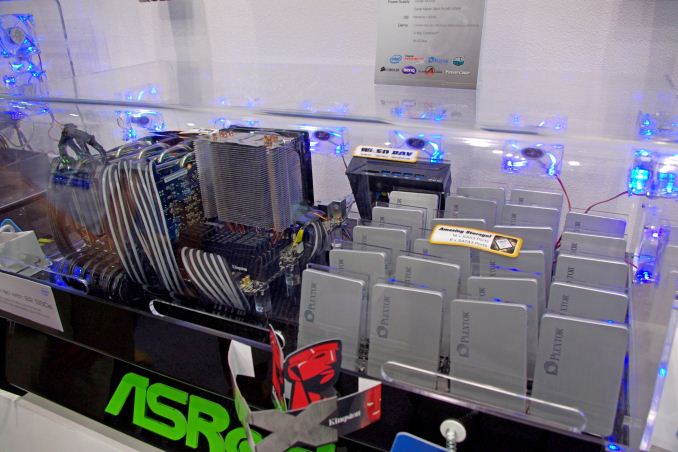
I did ask about how many PLX chips were onboard – I was told one, which would suggest 32 lanes total when used in the normal configuration. This would mean that 4-way SLI and the LSI chip would not be possible, unless used in an abnormal configuration, such as the EVGA Z77 FTW which allocated only 8 lanes to the PLX to split into 32, and then we would have the other 8 for the LSI chip.
No word on price or release date yet (it is not on their website), but I could imagine it might be hitting the $600 of the Z77 Extreme11, although that had an additional PLX chip. The extra cost of the newer LSI chip might counterbalance this.
Read More ...
Computex 2013: Spot the Desktop Kabini

ECS
The first model that caught my eye was on the ECS booth:

ASUS
We almost missed the ASUS Kabini motherboard when turning a corner into their ROG segment:


ASRock
The ASRock Kabini was specifically in the IPC section of their booth, suggesting that it might not see end-user etailers.

Other Kabini Spotted
We mentioned on Monday regarding the Kabini variants of the Gigabyte BRIX (Intel NUC variant), which might offer a more complete system barebones, and the MSI booth is due up today: I will be looking out for more.
Read More ...
AMD Continues Assembling Dream Team: Sean Pelletier from NVIDIA Tech Marketing to Join, Update: He's back at NVIDIA
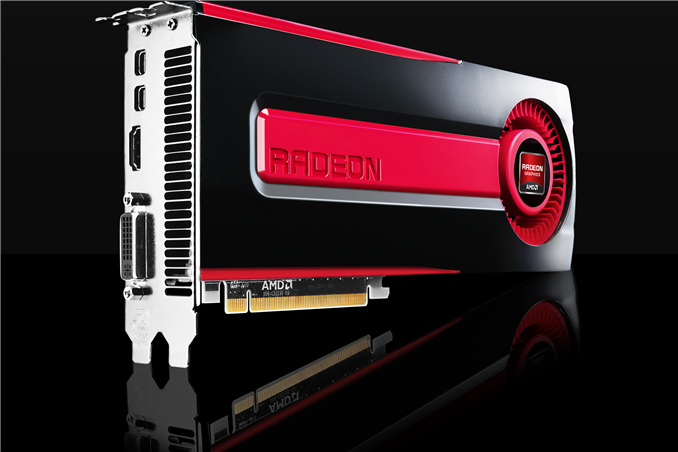
Today I just got word from a couple of very accurate and trusted sources that my old friend Sean Pelletier will be joining AMD as well. Sean will abandon his role as Senior Technical Marketing Manager at NVIDIA to assume a similar role at AMD, initially focusing on GPUs. Reporting on individual hires doesn't actually tell you a lot about talent within a company, but it can give insight into whether or not a company is viable. Not too long ago, leaving Apple, NVIDIA or pretty much any other tech company to join AMD sounded like a career death sentence. The fact that smart folks from all paths are considering AMD as an option for long term employment tells us a lot about how things have changed.
Update: I just got word that Sean ended up back at NVIDIA. He sent me a message after making the decision saying that there wasn't anything wrong with AMD, but that the fit simply didn't feel right.
Read More ...
Samsung Makes Galaxy S 4 Active Official - IP67 and Ruggedized
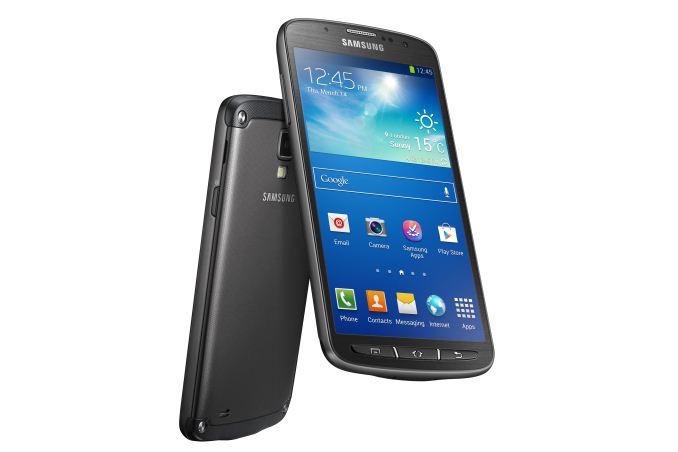
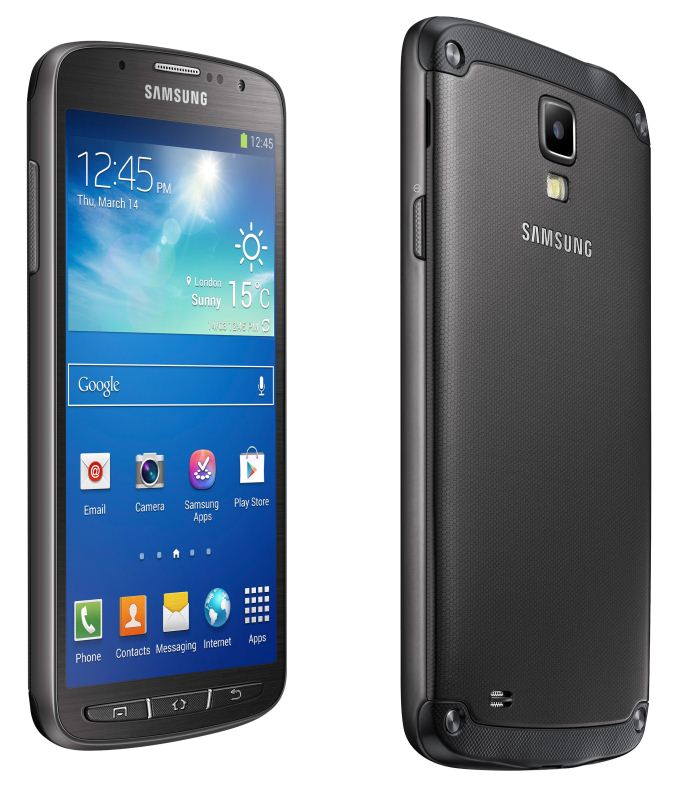
Superficially the SGS4A is almost the same as the international and other variants of SGS4, however there are a few changes to the phone beyond just a sealed design with IP67 rating. SoC remains the 1.9 GHz Snapdragon 600 (APQ8064AB) we've seen before, the major change is that camera gets a bump down to 8 MP instead of 13 MP, and there's a 1080p LCD display inside instead of Super AMOLED. Camera is likely still using 1.1 micron pixels, just the 8 MP version of the sensor for reduced z-height since LCD is a bit thicker. LCD makes sense here for cost reasons (something has to give) and brightness plus outdoor viewability reasons — AMOLED can go just as bright, but at higher power than the equivalent for LED backlit LCD. The back of the SGS4A seems to be removable given the presence of a thumb groove in the press photos, so ostensibly behind there is the microSD card slot, microSIM slot, and likely still user-replaceable battery. It's also obvious from the photos that the SGS4A includes physical menu, home, and back buttons instead of the still somewhat odd combination of both physical and capacitive on SGS4.
SGS4A vs SGS4 Comparison |
|||||
SGS4 |
SGS4 Active |
||||
Length |
136.6 mm |
139.7 mm |
|||
Width |
69.9 mm |
71.3 mm |
|||
Thickness |
7.9 mm |
9.1 mm |
|||
Weight |
130 g |
151 g |
|||
Display |
5.0-inch 1080p SAMOLED |
5.0-inch 1080p TFT LCD |
|||
Camera |
13 MP with LED Flash |
8 MP with LED Flash |
|||

Source: Samsung


Read More ...
Outlook 2013 RT Coming Free to Windows RT 8.1 Tablets Later this Year
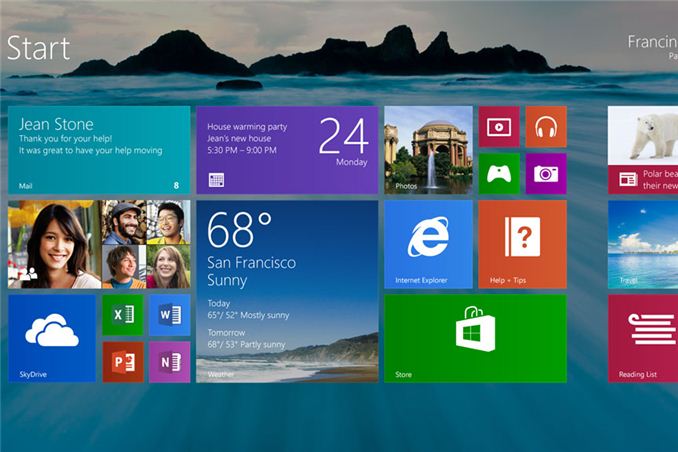
Outlook 2013 RT joins Office 2013 RT as very valuable components of the free software package that comes with all Windows RT tablets. By supplying key desktop applications for free, Microsoft not only increases the value of the platform but also drives users towards the Windows Store and modern UI apps for the rest of their needs as the basics are already met.
Despite the presence of Office 2013 on Windows RT, the ARM based platform hasn’t been embraced with tons of success. Many have blamed the lack of backwards compatibility with existing x86 applications, however I have a slightly different perspective. In my eyes, both Windows RT and Windows 8 suffered from the same issues: the OS was rushed. There was very little integration between modern and desktop UI modes and switching between the two was very jarring. Performance issues and bundled app inflexibility also plagued both OSes. With Windows 8.1, Microsoft seems to be addressing many of these items. If the list stops at what Microsoft has already announced, I suspect Windows 8.1 (and RT 8.1) will be evolutionarily better. If Microsoft can take this opportunity to address bigger problems as well (e.g. fixing high-DPI scaling in desktop mode), then Microsoft has a much bigger opportunity ahead of itself.
Windows 8.1 and RT 8.1 have the benefit of launching side much better hardware. While I complained about the performance of Tegra 3 in Surface RT, this generation we’ll see significantly better performance out of Snapdragon 800 based tablets with 8.1 (likely to also include the 2nd generation Surface RT). On the PC side, we finally have Haswell, which should make the next-gen Surface Pro significantly better (although it may take Broadwell to substantially reduce thickness depending on how aggressive Microsoft chooses to be).
As far as why Microsoft remains committed to Windows RT, I think the reasoning is obvious. PCs (and PC-like products) are under incredible pricing pressure. Microsoft’s only plays are to reduce its margins to remain competitive, or to reduce the cost of other components within the platform. Intel remains the only other big consumer of cost in a modern PC - moving to ARM helps change that. Intel does offer lower cost Atom solutions, but it’s clear at this point that Microsoft feels it needs competition in the market in order to continue to keep prices low. In that regard, ARM really is the new AMD.
Read More ...
ARM Cortex A12: Between Cortex A9 and A15 in Power & Perf, Sampling in Late 2014


The
comparison point here is the Cortex A15 and Cortex A7, but the latter
should be quite performance competitive with a Cortex A9 so the
comparison is still relevant. The Cortex A15 island in Samsung’s Exynos 5
Octa occupies 5x the die area as the A7 island, and consumes nearly 6x
the power. In exchange for 5x the area and 6x the performance, the
Cortex A15 offers under 4x the performance. It’s not exactly an area or
power efficient solution, but a great option for anyone looking to push
the performance envelope.
Today, ARM is addressing that hole with the Cortex A12.

This
announcement isn’t a deep architectural disclosure, but we do have some
high level details to share. Like AMD’s Jaguar, Intel’s Silvermont and
even ARM’s A9, the Cortex A12 is a dual-issue out-of-order architecture.
Unlike the Cortex A9, the Cortex A12 is fully out-of-order including
the NEON/FP units (NEON/FP was in-order on Cortex A9).
Pipeline
length increased a bit compared to Cortex A9 (11 stages), however ARM
told me to expect similar frequencies to what we have with the Cortex
A9.
The
execution back end has also been improved, although I don’t have many
details as to how. My guess is we should expect something a bit wider
than Cortex A9 but not nearly as wide as Cortex A15.
Memory
performance is much improved compared to Cortex A9 as well, which we’ve
already demonstrated as a significant weak point in the A9
architecture.
All
of the architectural enhancements are supposed to provide up to a 40%
increase in performance (IPC) over Cortex A9 at the same frequency and
process node. ARM isn’t talking power, other than to say that it can do
the same workload at the same power as a Cortex A9. In order words,
Cortex A12 should have higher power than Cortex A9 but faster execution
reduces total energy consumed. With a higher max power we’ll see more
dynamic range in power consumption, but just not nearly as much as with
the Cortex A15.
Cortex
A12 also adds support for 40-bit memory addressability, an intermediate
solution before we get to 64-bit ARMv8 based architectures. Finally,
Cortex A12 features the same ACE bus interface as Cortex A7/A15 and can
thus be used in big.LITTLE configurations with either core (but likely
exclusively with the A7s). Given the lower power profile of Cortex A12,
I'm not sure the complexity of doing a big.LITTLE implementation will be
worth it though.


ARM
expects the Cortex A12 to be used in mainstream smartphones and tablets
where cost and power consumption are a bit more important. The design
makes a lot of sense, the only downside is its launch timeframe. ARM
expects to be sampling Cortex A12 in late 2014 with the first devices
showing up in 2015. Update: ARM clarified that SoCs based on
Cortex A12 would be shipping to device vendors in mid-2014, with devices
shipping to consumers by late 2014 to early 2015. ARM has optimized
Cortex A12 processor packs at both Global Foundries (28nm SLP) and TSMC
(28nm HPM).
Read More ...
ARM Mali-T622 & V500 Video Block Complement Cortex A12

The Mali-T622 is a 2-core implementation of the 2nd generation Mali-T600 GPU architecture that we first learned about with the 8-core T628. Each shader core features two ALUs, an LSU and a texture unit.

On the video front, the Mali-V500 video encode/decode block is a multi-core engine used for all video acceleration. The V500 allegedly supports up to 100Mbps High Profile H.264, although details are scarce on more specifics. ARM claims support for up to 120 fps 4K video decode with an 8-core V500 implementation. Mali-V500 also features a protected video path, necessary for gaining content owner support for high-bitrate/high-resolution video decode.

The V500 also supports ARM's Frame Buffer Compression (AFBC), a lossless compression algorithm that can supposedly reduce memory bandwidth traffic by up to 50%. There's presently no frame buffer compression in Mali GPUs today, but ARM expects to eventually roll AFBC out to Mali GPUs as well.


Read More ...
Gigabyte Launching Two New Haswell Xeon Server Motherboards
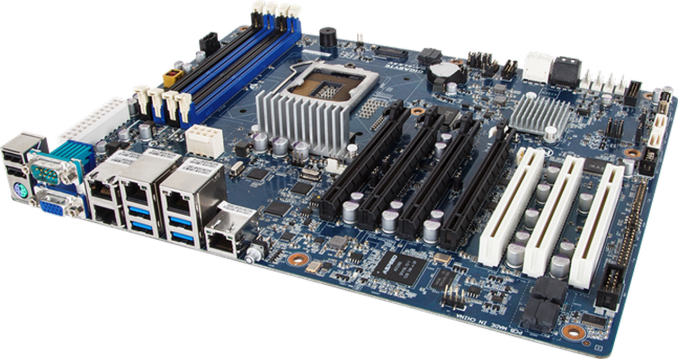
First up is the GA-6LXSV, a tower and rack capable ATX motherboard featuring Intel’s C224 chipset, support for up to 32GB of ECC/nonECC, and quad Intel gigabit Ethernet (I210).
Next up is a motherboard clearly named by a northern British designer, being called the GA-LASS. This is a micro-ATX motherboard for compact systems, again listed as both for rack and tower. By contrast to the GA-6LXSV, the connectivity is significantly reduced – a single Intel NIC, two SATA 6 Gbps, four SATA 3 Gbps and a single PCIe 3.0 x16.
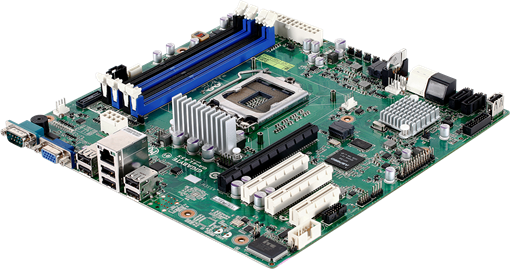
Specific launch dates and pricing are as yet unannounced. Typically Gigabyte server boards do not enter general sale, but with enough interest we might see some cropping up on official e-tailers. System integrators should get in contact with their local Gigabyte server sales team for information.
Over recent months we have had a look at a couple of Gigabyte’s motherboard server range, and I am speaking to their Server guys this week while in Computex. Is there any particular model anyone would like to see reviewed at AnandTech?
Read More ...
Intel's Haswell - An HTPC Perspective: Media Playback, 4K and QuickSync Evaluated
Over the last two years, the launch of every major desktop CPU family from both AMD and Intel has been accompanied by a dedicated HTPC-oriented article. This coverage has been complementary to Anand's extensive analysis from a general computing perspective. Haswell will be no different.
The advancements made from Llano to Trinity and from Sandy Bridge to Ivy Bridge had rendered entry level platforms good enough for casual / mainstream HTPC users. Advanced users still require discrete GPUs for using some video renderers and obtaining accurate display refresh rates. Each vendor has their own quirks when it comes to driver features and stability. This has made it difficult to declare any one solution as the perfect HTPC platform. Intel has hyped up improved GPU performance in the lead up to Haswell. Does it do enough to make the discrete GPU redundant for HTPCs? Read on to find out.
Read More ...
Federal Judge Grants Reprieve to Suspect Facing Forced Hard Drive Decryption
Child porn suspect's lawyer will have time to prepare a Fifth Amendment defense

     |
Read More ...
China Says it has "Mountains of Data" to Accuse U.S. of Cyber Attacks
However, China isn't blaming Washington for the attacks -- it's looking for better solutions to fight hacking between the U.S. and China

| |
Read More ...
Intel Unveils Thunderbolt 2, Will Land By Year's End
New standard relies on smarter controller chip to offer optimized 20 Gbps bi-directional flow

| |
Read More ...
HTC One Mini 4.3-Incher Leaked, Rumored for August Launch
HTC looks to expand on its flagship success with a cut down budget model

| |
Read More ...
Apple Looking to Expand Cupertino Staff by Nearly 50 Percent Over Next 3 Years
The hiring is in anticipation of the new Cupertino headquarters

| |
Read More ...
EBay Launching Virtual "Shoppable Windows" for Closed Storefronts
The first screen will come to New York City June 8

| |
Read More ...
Samsung Unveils Rugged, Water Resistant Galaxy S4 Active Smartphone
Samsung unveils new ruggedized member of the Galaxy S4 family

| |
Read More ...
Available Tags:ASRock , SATA , AMD , NVIDIA , NVIDIA , Samsung , Galaxy , Windows , Gigabyte , Xeon , Server , Motherboards , Intel , Thunderbolt , HTC , Apple , EBay , Smartphone ,


No comments:
Post a Comment