

Intel's WiDi 3.5: Much Faster, USB, Miracast Support and New Receivers
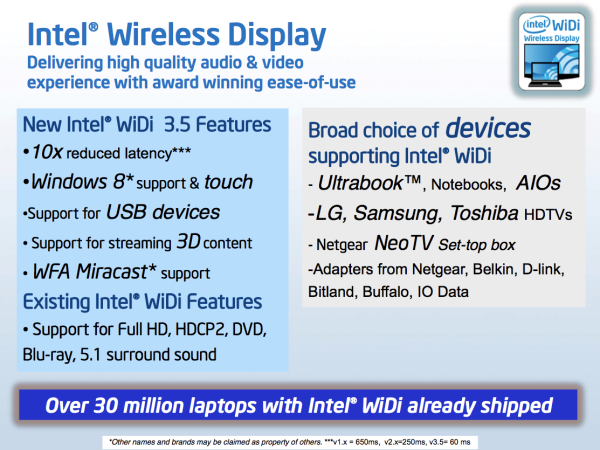
The initial version of Intel's WiDi was limited in resolution (720p only), features (no HDCP support) and performance (very high latency). Since then Intel has been regularly updating the WiDi software stack to add new features and improve performance.
Today Intel is announcing version 3.5 of its WiDi software with some significant feature and performance boosts. On the feature side there's now support for streaming USB wirelessly as well as display. The receiver has to feature USB ports, but with that in place you'll be able to get wireless access to USB HID devices such as keyboards, mice, game pads, etc...
Also on the feature side, Intel is announcing full support for the WiFi Alliance's Miracast specification. Although not all features and performance claims will apply with a Miracast receiver, you should be able to get wireless display functionality from a WiDi enabled system to a Miracast receiver.
Windows 8 and touch are both supported with this latest software update.
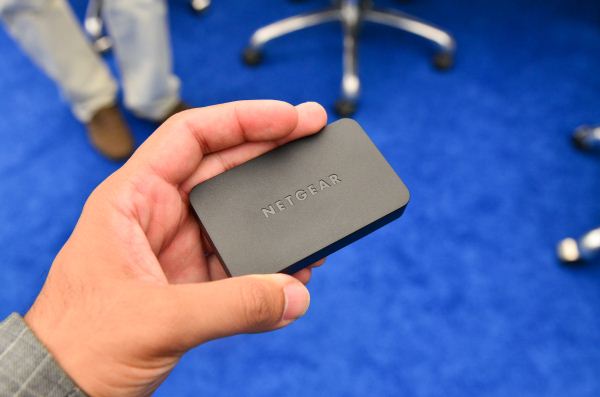
On the performance side Intel is promising 60ms latency for WiDi 3.5 when used with an Ivy Bridge based system (250ms with Sandy Bridge) and a 2nd generation (or newer) WiDi receiver. Later this year we'll see an updated Netgear Push2TV WiDi receiver that's a lot smaller with a starting price of $59.99.


 |  |
Read More ...
iPhone 5/A6 SunSpider Performance: Faster than Intel's Atom Z2460
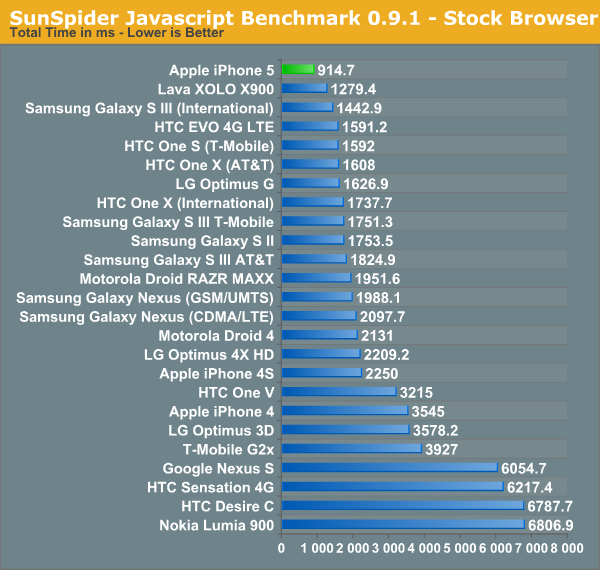
SunSpider is quickly outlasting its welcome as a smartphone benchmark, but it does do a great job of highlighting issues with the Cortex A9's memory interface. Intel originally hinted at issues in the A9's memory interface as being why Atom was able to so easily outperform other ARM based SoCs in SunSpider. As we surmised in our A6 Geekbench post, it looks like Apple specifically targeted improvements in the memory subsystem when designing the A6's CPU cores. The result is the fastest SunSpider test we've ever recorded on a smartphone - faster even than Intel's Atom Z2460.
This doesn't tell us much about the A6's architecture other than it's likely got a better cache/memory interface than ARM's Cortex A9. What we really need is for someone to port SPECint to iOS...

| |
Read More ...
ioSafe N2: A Disaster Proof NAS with Synology DSM
ioSafe used to manufacture disaster proof NAS solutions / backup appliances such as the ioSafe R4. The R4s used to cost upwards of $10K, weighed more than 120 lbs. and the hard disks, though hot-swappable, needed a proprietary coating for waterproofing prior to usage. After taking a small break from the disaster-proof NAS market, ioSafe is back today with a new version, the ioSafe N2. It addresses all the shortcomings of the R4 by bringing down the weight to a more manageable 28 lbs. Hot swapping with standard hard drives is also supported, and the price for a diskless unit is a consumer friendly $599. Based on the Synology DSM (Disk Station Manager) firmware, the N2 is a 2-bay NAS unit with a 2 GHz Marvell CPU at the core along with 512 MB of DRAM. The performance, therefore, should be similar to that of the Synology DS213.


Features:
- Local and Remote File Sharing: Between virtually any device from any location online
- Cloud Station: File syncing between multiple computers and N2 (like Dropbox)
- iTunes Server
- Surveillance Station: Video surveillance application
- Media Server: Stream videos and music
- Photo Sharing: Photo sharing with friends and family
- Mail Server: Email server
- VPN Server: Manage Virtual Private Network
- Download Station: Post files for others to download
- Audio Station: Stream audio to smartphone (iOS/Android)
- FTP Server: Remote file transfers
- Multi-platform compatibility with Mac/PC/MS Server/Linux
- Dual Redundant Disk, RAID 0/1, Up to 8TB (4TB x 2)
- 2GHz Marvel CPU and 512MB memory
- Gigabit Ethernet Port
- Additional ports for USB 3, SD Memory Card
- User replaceable drives
- Protects Data From Fire: DataCast Technology. 1550°F, 1/2 hr per ASTM E119 with no data loss.
- Protects Data From Flood: HydroSafe Technology. Full immersion, 10 ft. 3 days with no data loss.
- FloSafe Vent Technology: Active air cooling during normal operation. FloSafe Vents automatically block destructive heat during fire by water vaporization - no moving parts
- Physical theft protection (optional floor mount, door security - coming Q1 2013)
- Kensington® Lock Compatible
- 1 Year Data Recovery Service (DRS) Standard (upgrade up to 5 year)
- DRS included $2500/TB for forensic recovery costs for any reason if required
- 1 Year No-Hassle Warranty - Upgrades with DRS up to 5 years
- Operating: 0-35° C (95°F)
- Non-operating: 0-1550°F, 1/2 hr per ASTM E119
- Operating Humidity: 20% - 80% (non-condensing)
- Non-operating Humidity: 100%, Full water immersion, 10 feet, 3 days
- Size: 5.9"W x 9.0"H x 11.5"L
- Weight: 28 lbs


- Keep at least 3 complete copies of your data
- Keep them on at least 2 different devices
- 1 copy should be on taken offsite or disaster proofed in someway
- Post disaster, the user gets two chances to recover data from each drive.
- Drive failure doesn't result in losing fire/flood recovery ability
- Disaster-proofing the primary drives gives the user better recovery of the data that was in process moments before a natural disaster, giving an improved Recovery Point Objective (RPO). The SoloPRO in the first scenario might only have last nights backup depending on the user's settings.
- Getting to the disaster exposed drive is easier on the N2 because of the hot swappable nature of the drives and the lesser number of screws (Improved Recovery Time Objective (RTO))
It is exciting to see ioSafe address the market for disaster proof network attached storage. This market is not necessarily as glamorous as the one that a recent crowdfunding hit managed to raise millions of dollars for. However, most consumers don't realize the value provided by solutions such as those provided by ioSafe until it is too late. With the final version of the ioSafe N2 already being demonstrated and the solid track record of ioSafe in the disaster proof storage market, we hope ioSafe is able to successfully reach out to the consumers through this initiative.

| |
Read More ...
Motorola Hits 2GHz with Intel Powered RAZR i
Most of the first Z2460 smartphones announced simply leveraged Intel's Medfield Form Factor Reference Design (FFRD). This approach guaranteed minimal risk for the device vendor, while introducing a completely new way to address the market for Intel. If the typical device markers weren't biting at the opportunity to ship an Intel phone, Intel would simply build its own and sell it directly to carriers and others who wanted it.
The major exception was Motorola. At CES this year Motorola announced it would be building smartphones and tablets based on Intel's Atom silicon, with the first devices appearing in the second half of 2012.
We're well into the second half, and at a special event today in London the two companies announced the first fruits of their labor: the Motorola RAZR i.
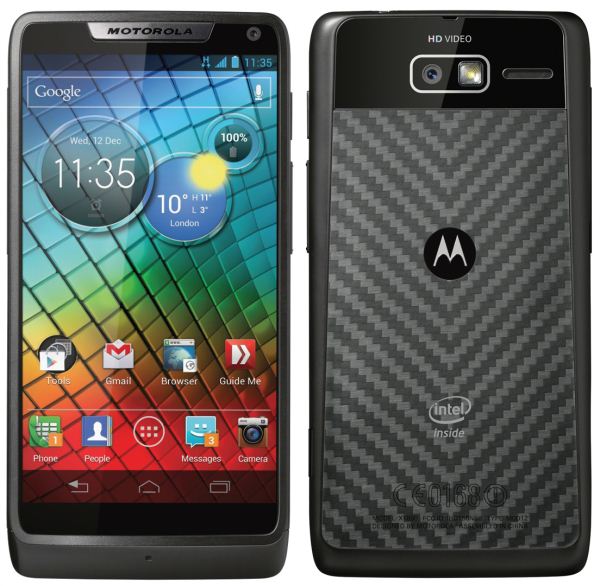
If the device pictured above looks familiar to you it's because the RAZR i is very similar to the Droid RAZR M that was just announced a couple of weeks ago in NYC. The same 4.3-inch qHD Super AMOLED Advanced display is present on the front, and you get the same Dupont Kevlar around back. What's new is the silicon inside: a combination of Intel's Atom Z2460 and XMM6260 baseband drive the RAZR i.
At Mobile World Congress Intel announced the Z2460 would be able to run its CPU core at up to 2GHz, up from the 1.6GHz announced at CES. Since then, no Intel based phones have used the new 2GHz silicon. The Motorla RAZR i is the first. I believe this also makes the RAZR i the first Android smartphone to hit 2GHz in its default configuration, without overclocking. Admittedly the Z2460's base clock remains 1.3GHz, it's only when the thermal conditions allow it that the CPU will boost up to 2GHz. Frequency isn't everything of course, but it's interesting to see Intel at the forefront of ramping it in the smartphone space.
The rest of the specs should be identical (or very similar) to the Droid RAZR M. Obviously LTE support is out given the Intel HSPA+ baseband.
The RAZR i runs Android 4.0 (Ice Cream Sandwich) although Google/Mototorla/Intel are committed to delivering 4.1 (Jelly Bean) as an upgrade at some point.
While the RAZR i isn't the flagship device Intel needs, it's another step in the right direction. The first devices will ship in October to select European and Latin American markets, including the UK, France, Germany, Argentina, Brazil and Mexico. Unlike the Droid RAZR M, the RAZR i will only be available in black.
One of these days we'll see a US-focused Intel smartphone, although I suspect that won't happen until next year.

| |
Read More ...
Available Tags:iPhone 5 , iPhone , Motorola , Intel ,


No comments:
Post a Comment