

Apple to announce cash reserve plans on Monday

Apple has announced a conference call for Monday morning, during which the company will announce plans for its staggering cash reserves.
During an incredibly profitable period, thanks largely to high margins on iOS devices, the company has built-up $100 billion (£60 billion) in cold hard cash, making Apple far wealthier than most countries.
The call, which will be hosted by Apple CEO Tim Cook, will be live streamed to iOS devices and any Mac or PC with QuickTime 6 installed. It will take place at 9am ET in the US (1pm UK time).
Yachts all round?
In a post on the Apple press website the company says: "Tim Cook, Apple's CEO, and Peter Oppenheimer, Apple's CFO, will host a conference call to announce the outcome of the Company's discussions concerning its cash balance."Apple will not be providing an update on the current quarter nor will any topics be discussed other than cash."
Will Apple pay its stockholders some huge dividends? Will it sweep up every notable start-up in Silicon Valley? Or will it do a Bill Gates and give it all to Africa?
You can tune into the conference call yourself by following this link:

 |  |
Read More ...
Panasonic Lumix GF5 breaks cover

The first picture of the Panasonic Lumix GF5 has been revealed, ironically, on iOS photo sharing site Instagram.
A snap of the purported successor to the highly-rated Lumix GF3 compact camera system was uploaded by a Hong Kong celebrity who goes by the name of Angelface.
Angelface is also a brand ambassador for Panasonic. Is that enough to convince you that this micro four thirds snapper is the real deal?
Compact size, DSLR quality?
Judging by the hand gripping the photo, Angelface either has Andre The Giant-sized paws or the GF5 is going to be a little smaller than the GF3, which had already been shrunk to a more compact-like size.If you're wondering why Panasonic might have skipped the GF4 naming convention and opted to go from GF3 to GF5, well SlashGear points out that the word "four" sounds a little like the word "death in Chinese and has been avoided.
Nothing official from Panasonic on this front yet, but it seems an announcement might be imminent.

| |
Read More ...
Digiboo launches copy-to-USB rental service

Start-up movie rental company Digiboo is offering a new movie rental solution by allowing users to copy films and TV shows to their own USB storage devices.
The company, which will be looking to wrestle some market dominance away from the Redbox disc rental service, has already placed three kiosks in airports around the US.
Travellers can browse 700 titles to rent or buy ($3.99 or $14.99) and once they've made a selection can insert their flash-drive and then take it with them on the journey for use on any plug-and-play device.
However, the memory sticks and external hard-drives must be authorised through an internet site before they can be used.
No HD or Apple support yet
Movies are only available in SD at the moment, perhaps because of the time needed to copy large HD files onto some USB devices and the content expires after two days.It's also a Windows-only service at the moment, but Digiboo says that support for Apple and Android devices is coming soon.
At present, airports in Portland, Oregon, Minneapolis-St. Paul, and Seattle have access to the touchscreen-enabled kiosks.
While, it may be difficult to imagine Digiboo challenging Redbox too much, the start-up does have one major advantage; you don't have to worry about returning them to the kiosk.

| |
Read More ...
HP reveals first Ivy Bridge laptops

HP has quietly launched its first laptops to feature Intel's Ivy Bridge processors.
The mid-range Pavilion DV4-5000, DV6-7000 and DV7-6000 are now listed on HP's website, but the costs are not listed and the device's aren't available to pre-order.
All three include the new, third-generation Intel i7 processor, known as Ivy Bridge, with varying screen sizes and storage options.
The DV4-5000 will have a 14-inch screen with a 1366 x 768 resolution, along with up to 8GB of RAM, a 1TB hard-drive and an NVIDIA GeForce GT 630M graphics card.
The 15.6-inch crew
The DV6-7000 has a 15.6-inch screen which improves resolution to 1600 x 900. It boasts the same speed processor, again with 8GB of RAM and the same graphics card. Hard drive space doubles to 2TBThe final model, the DV6-7000 also rocks a 15.6-inch screen, the same storage and RAM, but with a slightly faster version of the i7 processor (2.6GHz compared to 2.3GHz on the other pair.)
The laptops feature HP's new Mosaic design and according to a leaked press release will be available for order on April 8th with a shipping date of April 29th.
We've been hearing lots about Ivy Bridge delays in recent weeks, but it would appear that the release date may indeed be on track for April.
You can get a look at the higher-end DV6 model in the video below.

| |
Read More ...
Nokia Lumia 800 and 710 to get mobile hotspot soon

Nokia has confirmed that mobile hotspot functionality will arrive on the Lumia 800 and Lumia 710 Windows Phone handsets in a forthcoming software update.
Late last week it emerged that the base-level Lumia 610 handset will enable users to wirelessly tether their 3G signal to other connected devices.
While the feature is commonplace on most top smartphones these days, its announcement for the Lumia 610 raised eyebrows as it doesn't yet exist on the higher-end Lumia 710 and Lumia 800 models.
However, that will be rectified "soon," through a Zune update according to a Q&A session on the Nokia Connects blog.
Lumia 900 too
The feature will launch with the flagship Nokia Lumia 900 device, which is set to arrive in the United States in the next few weeks and around the world later this year.Responding to a question on whether Nokia plans to bring the 41-megapixel camera featured on the 808 Pureview device to its Lumia range, the Finns again confirmed that this is in the offing.
"We don't comment on future releases but we do expect to be leaders to imaging space and bring this innovation into future products," read the post.
For more information from the horses mouth on the Lumia 900, check out the Nokia Connects blog.

| |
Read More ...
Tutorial: 6 scintillating portrait photography ideas

Here's something you probably didn't know: regardless of what camera you have or your ability to use it, we are all portrait photographers.
While once the dominion of famous photographers like David Bailey, the digital revolution and proliferation of cheap, quality cameras has brought portrait photography from the high streets and West End studios into our very own pockets.
If you've ever grouped your family together at Christmas to take a picture, you're a portrait photographer. If you've ever snapped your mates crowded round your other passed out mate at the pub, you're a portrait photographer and a bad friend.
Portrait photography is perhaps the genre we shoot most often with our cameras, and from posing to lighting our subjects, it's also the one that can so easily go wrong.
Below is a round-up of some of the best portrait photography tips and tutorials from our friends at Digital Camera World to help you get started taking better portraits with your new digital camera.

1. The first rule of thumb: a good portrait doesn't have to be somewhere exotic. You can set up a home photo studio for minimal cost and start taking striking portraits of family and friends today.

2. Be careful of letting people know just how good you get at portrait photography. Once your friends and family realise you're a talented lensman or lenswoman, you'll be hounded to photograph everyone they know and love. Luckily for you we have these creative tips for taking better pictures of babies, toddlers and teenagers.

3. If you really want to test your skills, why not try using this in-depth guide to shooting fine art nude photography.

4. Flash is often crucial to a good portrait, but using it effectively can be one of the most challenging things you'll endeavour to do as a photographer. Learn how to get subtle lighting on your subject using this simple bounce flash photography technique.

5. That said, sometimes you don't want subtlety in your portraits. What's more, sometimes you don't realise this until after a shoot. This is where the vast arsenal of Photoshop effects can save you from wasting an afternoon of work. Learn how you can get gritty black and white portraits in Photoshop.

6. And while we're in Photoshop, once you've tweaked your images why not have a bit of fun. Try one of these 50 free photo frames to download and experiment with different looks for your images - and for the Photoshop novices, here's a quick guide on how to use free photo frames.

| |
Read More ...
In Depth: How overclocking went back to its roots

The future of overclocking
Overclocking has come a full circle. It started as a niche technical trick where shifting a jumper on the motherboard would let you run a processor's multiplier higher than it should.This soon led to Intel and AMD screaming about phantom lost sales and releasing locked processors - which stopped no one.
Probably the darkest days of overclocking were in the Pentium 4 era where idiotic design decisions produced products that could barely be overclocked at all.
Today overclocking has gone back to its roots, with high-end products designed for overclocking and designs built upon processes that are ripe for extreme amounts of overclocking.
In fact, on the Intel platform it's almost reached the situation where you'd be mad not to overclock the processor, as even the basic models are happy to accommodate a large 20 per cent increase in stock speed. Even graphics card stock drivers come with an overclocking feature built into the standard releases.

Windows-based software overclocking tools make getting more speed from the processor, graphics card and RAM so easy that it's well worth taking thirty minutes to see how much more speed your system is capable of.
With the lower initial running temperatures of the latest processor it means you're able to get more out of your overclocking kit. Excellent coolers can be picked up for as little as £20 while standard water cooling system will set you back just £50. With Intel, Nvidia and AMD embracing overclocking let's take a look at what's new.
The base of all systems starts with the processor architecture, as we'd hope you already know, Intel and its Core iX architecture has been romping away from the rest of the field… or just AMD, in pretty much every metric.
AMD has become the sad-eyed puppy dog in the pound, which if you don't take home now will get a special injection from doctor Snoozy. Both the last-gen Lynnfield and even more so, the current Sandy Bridge architectures provide a design that overclocks very well. For Lynnfield, 4GHz has become the norm, while Sandy Bridge gets close to 5GHz.
But let's not overlook AMD, its processors have always been good value for money: for instance, the Phenom II BE with its off-the-wall three and six-core models offered air-cooled overclocking that could hit 4GHz. While its latest Bulldozer architecture is making reviewers scratch their heads over its performance, the low-power design provides overclocks into the mid-4GHz range, which certainly matches the Intel's offerings.
Interestingly at this point both AMD and Intel have introduced the same type of new voltage and power regulation systems, alongside the limited core 'turbo' modes for thread-limited acceleration. Tweaking these new voltages and modes is a new element to what had become a relatively tried-and-tested system of increasing the front side bus (FSB), tweaking the CPU voltage and repeating until cooked.

Intel has its Turbo Boost technology and AMD has Turbo Core, and both effectively provide a type of restricted automatic overclocking.
AMD knows how much power is required to complete every operation based on what's in-flight over each core, the processor can evaluate the total power output of the processor.
If the TDP allows it, the AMD Bulldozer has three P-states that it can switch to: base P2, intermediate P1 and higher P0. Having the extra two states is important, as P1 is available with all cores running, while P0 kicks in only with two or more idle cores.
This leads, for example, to the FX-8150 having a base 3.6GHz clock, a 3.9GHz Turbo Core and a 4.2GHz Max Turbo Core. Overclocking the FX-8150 in any way will require a core voltage increase. All the AMD FX processors come multiplier unlocked, so they can be directly overclocked that way easily enough. Up to around 4GHz, shifting the core voltage from the stock 1.332v to 1.38v will usually surface.
To move beyond this it will be necessary to disable the Turbo Core feature, along with Over Current Protection and Thermal Protection, and setting Load Line Calibration to high. This is also accompanied by steep increases in core voltage up to 1.5v, which also means a huge decrease in power efficiency, but facilitates speeds up to and beyond 4.5GHz. Whoop!
Keep it cool

Of course, good overclocking is only possible with good cooling setup. While processor cooling hasn't changed that much it's simply gotten a whole lot more efficient.
Both Intel and AMD now push liquid-based cooling solutions for both their high-end processor options, not that they're required as such. The standard all-in-one liquid coolers, such as the Antec Kuhler H2O 620, will set you back around £50, considering some high-end air coolers can cost you that much this represents good value, as it will usually out perform them.
But you don't have to go and blow the bank to get good air-cooling. Both the Xigmatek Gaia or the Cooler Master Hyper TX3 EVO, come in at under £25 and provide efficient cooling.
If you're in the market for a cooler, we always recommend direct-contact heatpipes on the processor. The Titan Hati is an excellent option at £38 or for a bargain pick up the Xigmatek Loki for as little as £15.
Be aware that it's useless having the best cooler in the world unless it's correctly mounted with the right application of thermal paste.
Tweak my bits

A huge turn-off for many casual overclockers has been the random and awkward need to use the BIOS, and while third-party Windows tools had managed to help ease the problem they could never fully replace BIOS settings and repeated restarts became the height of tedium.
Initially, motherboard manufacturers provided overclocking tools, such as the wonderful MSI Afterburner tool. Nvidia did it early on as well, but ultimately it was AMD Overdrive and the Intel Extreme Tuning Utility that brought an official stamp of approval to the Windows overclocking game.
But just when you thought the BIOS had finally kicked the bucket like an 1980's film remake: it's back and badder than ever. The new EFI BIOS system enables a full GUI-style interface at the BIOS level. It has the ability to offer a more functional BIOS experience as well as a horribly over-engineered interface.
After a few teething troubles most manufacturers have managed to develop usable interfaces but you'd hope they could make them easier to navigate and enable scroll wheels. Besides that, a big boon is that the reboot speed is so much higher.
The extras

Memory is still open for overclocking but the state of play has changed as controllers are now onboard the processors. This has helped increase bandwidth so much over the speed of off-processor chipset-based memory controllers, which has meant overclocking memory returns far less in terms of overall system speed.
To take even more of the fun out it, the XMP memory standard effectively provides overclocked default timings for performance DIMMs. This means that by default, as long as the motherboard and memory both support XMP, as soon as you slap in your memory it'll run at its maximum speed with optimum timings without any tweaking.
That's not to say you can't overclock memory. It's easier than ever as most motherboards provide an independent memory bus clock setting, memory timings and memory voltage controls. As with the processor, once you start increasing the clock speed this extra burden on the memory can require increased voltages as power requirements go up.
The stock voltage with DDR3 is 1.5 volts. As guidance, the maximum JEDEC recommended voltage is 1.575 and modules should be able to handle 1.975 volts without permanent damage, though they don't have to function at this level. Most overclocking memory requires a 1.65 voltage and in reality there's no reason to go above 1.85 volts, while for general use 1.7 volts is a safe maximum.
On top of all of this is graphics card overclocking. For the last few years this has been made a doddle with overclocking tools included in official drivers. Once installed just a few clicks provides access to the main GPU, shader and memory clock speeds.
This is all besides fan control too and all of which together totals a complete system control from Windows - life has never been so easy.

| |
Read More ...
Tutorial: How to turn old hard drives into a secure file server

Turn old hard drives into a secure file server
Over the last year or two we've been taking advantage of the incredible price drop in traditional spinning hard drives. Until the tragic floods in Thailand, prices had dropped as low as £40 per terabyte.This had led to many of us upgrading our existing systems with new drives - leaving small piles of 160GB to 500GB drives littered around the country like digital cairns.
The obvious question that springs from this is: what to do with these drives? It's unlikely you'll just want to throw them away; it's a waste of a good drive and even less likely if it had personal data on it. Besides using it in a spare PC you're building, the solution we've struck on is to use them at the heart of a storage pool server.
The thinking behind this is based on three thoughts: First, individually these drives are too small and too slow to be of any real use even in an external drive chassis; Second, these will be older and drive failure is a real issue, after three years drives are usually living on borrowed time; Third, we all need safe, secure, trouble-free storage.
Unfortunately the most obvious solution, JBOD is the least desirable. As a storage array it's terrible, it provides no appreciable advantage for redundancy, speed or real convenience beyond being able to slap in more drives. If a drive fails all the data on the drive is lost, if striping is used all data on the JBOD as a whole is lost.
The best solution is RAID, but not RAID 0 as this uses striping and so offers no redundancy, and not RAID 1 as that provides only basic mirroring, and not even RAID 01 that's a mirror of a striped array.
RAID 5 is the preferred setup as it uses striping with distributed parity. What this means is that it breaks data up across multiple drives for accelerated reads/writes, but enables redundancy by creating a parity block that's distributed over all of the drives. Should one drive fail the array can be rebuilt and all the data recovered from the parity blocks, hurrah!
Perfection achieved?

Sounds perfect doesn't it, well we can do better. RAID is actually very old and there are now superior solutions.
Enter ZFS (Zettabyte File System) that can store some idiotic amount of data measured at the zettabyte level, that's 2 to the power 70. ZFS was released by Sun Microsystem in 2005, so is right up to date and combines file system, volume management, data integrity and snapshots alongside RAID-Z functionality.
If you're thinking that sounds horribly complicated, fear not, the best implementation for home deployment is FreeNAS from the coincidently named www.freenas.org.
This is a brilliantly light-weight FreeBSD-based operating system designed for network attached storage boxes. Support for ZFS has been integrated since around 2008 but this was much improved in early 2011.
There are a couple of specific situations we're not covering here that could crop up. The first is PATA drives, but we're assuming these are too old and too slow to be worth considering. That's not to say it's not possible, but you're limited to four devices at best and potentially two on more recent motherboards.
A more recent issue is with SSD and hybrid configurations - this is somewhat beyond this article - as ZFS enables acceleration of read-access or logging by selecting a single drive for storing this data when creating volumes. We'll mention the feature in the main walkthrough but this is aimed at dedicated performance solutions.
Splitting hairs
The important part of creating your storage pool is working out how to arrange your drives for best effect. Despite the advantages of ZFS it's not magic, it still inherits RAID 5's basic flaw of fixing overall drive size to the smallest capacity in the array.Weak sauce we hear you shout. The best option is to create a number of RAID 1 mirrors combining drives of identical or very similar size, then allow FreeNAS to stripe all of these together as a RAID 10 for four drives or RAID-Z for more. The way it's implemented is a little inelegant, as it requires creating two volumes with the same name, FreeNAS automatically stripes these together for a single storage pool.
The process can be applied to RAID-Z arrays in exactly the same way. This is useful as once a RAID-Z is created additional drives cannot be easily added, but it's easy to add an additional RAID-Z and let FreeNAS work out the complexities of striping across all of these.
Of course, if the data isn't important then you can enable ZFS striping, this will maximise storage capacity at the cost of data integrity. However if you're using it to locally store data, for file backups or data supplied from the cloud, for example local Steam games, this could be an acceptable risk for cheap and plentiful network storage.
If you do find yourself with a stack of ageing drives going spare then this could be a good way of using them until the day they die.
Part 1: A FreeNAS box
You won't need too many parts1. Hardware first

FreeNAS is designed to boot and run from a solid-state device; either a flash card or USB thumb drive, largely as it frees up a drive port but also drive space.
ZFS is demanding and you'll need at least 1GB of RAM, but ideally 4GB, and the boot device needs to be 16GB in size. FreeNAS's default file system only needs a 2GB boot device and less than 256MB of system memory.
2. Controller set up

We've already mentioned RAID a lot but for the hardware configuration RAID is unimportant, in fact in the BIOS you should configure any host controllers to run in AHCI or IDE mode, occasionally this is listed as JBOD mode if its a RAID controller.
The ZFS system is a software-based RAID solution so handles all of the striping and parity storage itself alongside other high-level operations.
3. Bunch of disks

The tricky part of connecting all of this together can create quite the mess, we'd strongly recommend implementing a good cable management system. Cable ties are the obvious solution and once fitted the power and data connection can still be reused even if a drive fails.
ZFS does support hot-swapping on AHCI compatible controllers and drives for live repair and updating.
Part 2: Creating a ZFS pool
Impress the ladies with your own shared ZFS redundant array1. Decide the split

You need to decide how the drives are going to be mounted. RAID 5 loses around 30 per cent of its storage to parity with a three-drive array, the equation for space efficiency is 1-1/R so the more drives the more efficient the setup is.
Mirrors lose 50 per cent to the mirrored drive. But both provide strong data integrity. If you're a crazy type stripe them together and keep going until one goes pop.
2. Create the volume

For this example we're striping two mirrored arrays but the same process works for RAID-Z arrays, if you want to use more drives you can easily head down that route.
From the main FreeNAS web interface select the Storage section. Click the 'Create Volume' button, make up an array name and choose the drives to be part of the first array; for mirrored arrays this has to be an even number of drives.
3. ZFS options

With the drives you want in the array selected you will need to choose the ZFS option and 'Mirror' radio button to create the array. For RAID-Z select that option.
You may notice another bank of options relating to the other drives not selected. This enables you to add specific caching drives to enhance read/write performance ideally using an SSD, this is largely for commercial arrays.
4. Create the stripe

This next part isn't very intuitive due to the relevant section of the FreeNAS interface. To add the next stripped mirror retrace step two, then add the remaining drives to create the new mirrored array.
Name this identically to that of the first mirror, once created FreeNAS automatically stripes these together. You're able to view the state of the drives in the array by clicking 'View Disks'.
5. Manage the array

The Logical Volume appears listed under this Storage tab with a number of icons that let you manage a number of its key features. The first icon with the red 'X' enables you to delete the volume and restore the raw drives. The next Scrub icon asynchronously checks and fixes the drives of any errors. The last two icons enable you to view the status of the array and the drives within it.
6. Create a share

To create a Windows share, you need to click the top 'Services' button and then activate CIFS. Click the spanner icon next to it and adjust the Workgroup and Description to your own. Next, click the Shares tab, click 'Add Windows Share' add a suitable name, click the 'Browse' button, choose the ZFS array and click 'OK'. To restrict access under Account you may want to add your own Groups and Users.
Part 3: Installing FreeNAS
Getting your favourite NAS OS onto real hardware is easy, trust us...1. ISO images

If you haven't already, download the latest FreeNAS ISO from www.freenas.org. The OS is designed to be installed or run directly from a USB stick or flash card.
The easiest way to install everything is to burn the image to a CD and install this to the target system from an optical drive. If you just want to test FreeNAS, fi re up VirtualBox and it'll happily install into a virtual environment.
2. BIOS tweaks

It's important that your target system's BIOS supports booting from external USB devices, the location varies from BIOS to BIOS. But either the dedicated Boot Menu or Advanced Settings needs to provide support for USB hard drives or similar. Any system made in the last decade should be fine, just be sure that after you've installed the OS that this has been selected.
3. Direct image write

It's also possible to burn the image directly to the target boot device, such as on your USB drive but it's more complex than we'd hope. To start you need the amd64.Full_install.xz file and not the ISO from the download page. You also need an image writer, for Linux this would be the DD command, for Windows download Image Writer that seems to do the trick well enough.
4. Burn baby

Point Image Writer at the image file and the target drive and it'll do the rest. Beyond selecting it as the boot drive the only real issue you may encounter is an incompatible network adaptor. There's little you can do about this beyond adding in a new compatible network card. FreeNAS maintains a comprehensive list of compatible hardware here.

| |
Read More ...
In Depth: Can a £300 gaming PC compare to a £3,000 one?

Introduction
Benchmark results are all very well, but can you feel the numbers? When it comes to PC performance and especially gaming grunt, that's the key question.Of course, everybody knows high-end PC components are piddle-poor value for money. You don't need us to tell you Intel's latest £800 six-core monster, the Core i7 3960X, isn't eight times as good as a £100 quad-core AMD Phenom II.
The same goes for every other component class. Whether it's graphics cards, motherboards or especially storage, your bang for buck plummets horribly at the top of the price scales. None of that, however, is the same as saying high-end clobber doesn't deliver any benefits for the cost.
There's little doubt extreme edition processors and the latest multi-billion transistor GPUs will spew out unholy benchmark numbers. The thing is, we're less sure how much impact that has on subjective gaming pleasure. Putting it another way, if we plonked you down in front of two PCs, one trimmed out with the finest kit known to man, one built down to a modest price point, and fired up your favourite games, would you actually be able to see or feel the difference?
So let's be clear about this. Our task this month isn't merely to prove that spending a shedload on the finest PC components isn't cost effective. It's to find out whether it makes the slightest difference to the way games look and feel.
To do that, we've built two very different systems, focussing on the three core components that influence performance. So that'll be the processor, graphics card and hard drive.
Our money-no-object rig weighs in at nearly £3,000 for those components alone. And our budget-oriented alternative? It's less than £300. Can a system costing just one tenth the price of another really deliver an indistinguishable gaming experience? Time to find out.
First up, let's lay out some ground rules for this intriguing contest. Critically, our main focus is gaming. That doesn't mean we'll be excluding overall system performance entirely. We'll chuck that into the mix for context. But it won't influence the overall result.
However, what will effect the outcome, and something we're contriving to be quite specific about, is the display. The first thing you'll have noticed is that we're not including it in the core set of components. The reasons for this are the frankly enormous array of possible PC monitors and the related issue of user preference.
For most gamers, if money was no object they'd probably run the most powerful possible PC. When it comes to screens, the choice isn't so obvious. Would you go for the largest possible display? Perhaps, but only if the system in question doesn't double as a multi-purpose desktop.
Then again, maybe it's maximum resolution you should be aiming for? In which case, you'll have to compromise on screen size, since the highest resolution monitors are not the largest.
Controlled viewing

With all that in mind, we've opted for a single control monitor. While there is a niche of gamers who demand the highest possible resolutions, it's debatable how much difference it makes to the visuals when you extend beyond 1080p Full HD.
Moreover, 1080p has become the de facto standard for many games. It's also a resolution that dominates regardless of screen size. The vast majority of PC monitors from 22- to 30-inch and beyond now sport a 1,920 x 1,080 pixel grid. The control screen we've gone for is a 24-inch example.
The make and model are not important. What does matter is that 1080p pixel grid. It puts a limit on the number of pixels any gaming PC is likely to have to pump out.
Immediately, that plays into the hands of the cheaper system. There's little doubt that life would be much harder for it at a resolution like 2,560 x 1,600. But our argument is that even at the high end and regardless of screen size, the most likely resolution for gaming is going to be 1,920 x 1,080. So, that's what we're sticking to.
Taking that logic and running with it a little further, we've removed another image-related stipulation. The two systems are not required to run at the same image quality settings in-game. If you think that tilts things even further in favour of the cheapo rig, you'd be absolutely right.
But we think our reasoning makes sense and that is this comparison isn't about the numbers. It's about the gaming experience - nothing more, nothing less. Our plan is to set the two systems up and put gamers in front of them in a blind comparison test.
So, what matters isn't making sure that the two systems are running exactly the same level of anti-aliasing, anisotropic filtering or shader complexity. What matters is whether gamers can tell the difference. If dialling down the eye candy doesn't make a difference that's noticeable, then that's exactly what we'll do.
Hardware hits

However, one thing you should be very clear about is that we won't be compromising the settings on the high-end rig. For each and every game we'll tune it to look as spectacular as physically possible. The challenge will be getting the low-end system right.
As ever, it's a question of playing off image quality and frame rates with the latter being particularly critical. Knock the anti-aliasing down from 8x to 4x and few, if anyone, will notice. Chop the frame rate in half and that's a different matter, especially if the result ever dips below 30 frames per second.
With all that in mind, it's clear that this entire experiment is heavy on the subjectivity. But that, frankly, is the whole point. Like we said, we all know how a benchmark fisticuffs would turn out. And it wouldn't be pretty. What we didn't know going in was exactly how the real world gaming experience compared.
So what are the hardware variables, how did we set the systems up and what games did we go for?
Component wise, our focus is on the three components that have the biggest influence on gaming performance: the processor, the graphics card and the hard drive. Obviously, there's a little more to it than that.
But beyond those three, not only do the performance implications drop off, the price delta shrinks enormously, too. Our reasoning was to allow roughly £100 each for the low end rig. We didn't put a price limit on the top-end monster, but in the end the average wasn't a millions away from a nicely symmetrical £1,000 per component.
With our systems specified, built and saddled up with a fresh copy of Windows 7, the next task was game title selection.
This is a subject ripe for hang-ups, so we elected to go with some very straightforward criteria. Elder Scrolls V: Skyrim made the cut because it's a super hot title, it looks great, it's fairly demanding and it ticks the large-levels and long-draw distance boxes.
Next up is Crysis 2. Okay, as a game to play it's pretty crappy. And its execution reeks of console-port compromises. But in many ways its graphical fidelity can be regarded as the benchmark. In parts it's absolutely stunning.
Our final candidate is DiRT 3. We wanted a driving game in the mix and there's no doubting DiRT 3 is a looker. Granted, this trio is hardly comprehensive. But obvious omissions such as, perhaps an MMORPG such as WOW don't tend to be hugely performance intensive. They're coded to support very broad user bases. So, while there will always be a few exceptions, we reckon our chosen trio gives a pretty decent picture of overall gaming performance.
Tuning the tests

Of course, choosing games is only half the solution. We next had to select image quality settings. From the outset we'd decided that running at 1080p native resolution was essential, so that bit was easy.
Configuring the high-end system was very straight forward, too. The system has performance to burn so it was simply a case of maxing everything out and then jumping in-game to make sure everything was running smoothly.
Like we said, we didn't want our budget rig getting an easy ride. It would have to compete with the very highest possible image quality settings currently available. Indeed, tuning up the cheapo machine was intriguing.
Going in, we'd expected that it would be a finely balanced process of playing off image quality settings and frame rates. One thing we were certain about was that smooth frame rates were essential. Any keen gamer is going to pick up on jerky, unresponsive performance.
Image quality, on the other hand, is a different matter. How many people, for instance, can tell the difference between 16 times anisotropic filter and eight times filtering? Likewise, for any given game, does knocking settings such as shader or shadow quality down make a big difference to perceived image quality?
We were in for a long haul. Or so we thought. It transpired, it was much easier for the simple reason that it handled the highest image quality settings much better than we expected. One reason for this is the undeniable influence that console games have on game engines. The Xbox 360 and PS3 are positively ancient but retain an iron grip over game development. That's lead to stagnation.
The bottom line is that we needed to do relatively little to get our affordable PC running smoothly. Mostly it was a case of dropping the anti-aliasing from 8x to 4x (though Crysis 2 doesn't actually offer proper AA, which is probably a big help) and tweaking just a handful of further settings. For the most part, both rigs ran with ultra settings across the board.
Blind test

The final part of the puzzle is the actual blind comparison. The key here was to keep the identities of the systems and the components included completely concealed.
In fact, we didn't even want our testers knowing what an enormous gulf in hardware specification they were experiencing. Instead, all our testers knew was that they were comparing the gaming experience on two different systems.
We also wanted to get impressions of different aspects of gaming performance including in-game frame rates, graphical quality and game load and level load times. With that in mind, the test went something like this.
Both machines were up and running at the same time on the same desk and via the same 24-inch high quality 1080p monitor. Switching between the two was a matter of the few seconds required to move the DVI cable across, allowing an almost instant comparison.
Our first test involved playing each title from an identical pre-loaded and paused game state without observing level loads or desktop performance. We wanted an unbiased assessment of the in-game experience, something that can be coloured by sitting through a lengthy level load.
Our testers were allowed around ten minutes per title to jump back and forth between machines, as often as they liked. For this comparison we didn't make any specific demands, we simply asked the testers how they thought the two systems compared.
Next was a test starting from the desktop and involving loading, first, the main game interface and then a game level, after which further game play and general impressions were taken. as well as adding storage performance into the mix, we also asked our testers more specific questions regarding performance and image quality.
Which, if either, of the two systems had better graphics? Did one or the other deliver a noticeably smoother frame rate or superior response to mouse and keyboard inputs?
Desktop test

Finally, we allowed our testers a little time to try out basic PC usage to get a feel for desktop performance: firing up a few apps, surfing the web and watching some high definition video.
Among all this there's a commonly encountered and gaming-specific issue that isn't covered and that's installation. There's absolutely no question the high-end machine with its ultra-fast SSD storage was much quicker during the installations. Without a doubt, this is something our testers would have noticed.
All of the above, of course, concerns subjective experiences. When you get right down to it, that's all that actually matters in the real world. If it feels the same, who cares if it runs 10 times faster?
That said, we also ran a suite of benchmarks to provide context and to underline the significance or insignificance of the comparative numbers. If our testers couldn't feel the performance difference, we looked at whether that reflected in the numbers. Likewise, if the gap in system performance was big enough to be picked up subjectively, was that also reflected in the benchmark numbers?
So there you have it. Two systems. one for those with money to burn. Another for those on a tight budget. Tested by keen gamers and as you'll see, the results are frankly astonishing.
The rigs
Rig one
Three thousand pounds has rarely looked so humble
This ladies and gentlemen, is what dreams are made of. You may have thought that this much cash would get you a computer core a little more sexy looking, but we're not interested in basic looks here, oh no, the beauty of this rig is very much on the inside.
The main components we've considered vital to the gaming experience are the graphics card, processor and SSD. The other components we've used could easily be replaced with similar models and aren't quite so vital.
We've gone into a little detail on those other components purely for system completeness. It's all decent kit, just not essential for the testing.
Processor

Intel Core i7 3960X
Price: £800
Intel hasn't seen a lot of competition at the high-end recently. This has left us feeling underwhelmed by this, it's latest processor. That doesn't take too much away from the fact that it's the fastest darn slice of silicon money can buy though and here there's no other choice.
That big chunk of notes gets you six physical cores to play with, capable of handling 12 threads concurrently. The basic frequency clocks in at 3.33GHz, capable of hitting 3.9GHz in Turbo mode. You also get a healthy 15MB of L3 cache and support for quad-channel DDR3 RAM.
Motherboard
AsRock X79 Extreme4Price: £175

This may not be the best example of the plethora of X79 motherboards around but it just goes to show that you don't need the most expensive board to get serious performance out of your pricey CPU purchase.
That said it won't give you the same sort of overclocking performance as the Asus pairing of RoG Rampage and Sabertooth X79 boards, but when you're spending that much on a chip do you want to shorten its life by waving the overclocking stick at it? This sub-£200 board then is a decent partner and home for your Sandy Bridge E processor.
Graphics card
AMD Radeon HD 7970Price: £454

Right now this is the fastest single-GPU graphics card on the market bar none. In fact it actually gives the dual-GPU cards a run for their money too. It may be a pricey ol' beast but it almost has the performance chops to make you forget about the price. It also does some smart power play too, keeping power draw low in down time.
But while it is definitively the fastest card right now, the performance lead over the last generation isn't great enough for us to think it's going to still be the fastest once Nvidia gets its Kepler cards out on the shelves.
Memory
Corsair Vengeance 1,866MHzPrice: £125

The jury is still out on how important an advantage the quad-channel memory of the X79 platform is, but if bandwidth is your bag then this awesome Corsair kit is a definite winning pack.
Rated at 1,866MHz out of the box, the Corsair kit is a doddle to set up, mainly thanks to the only real benefit of the latest quad-channel RAM kits. That's the latest iteration of the XMP initiative and means you don't have to go through the minutiae of your board's BIOS in order to make sure you're getting the most out of each of your modules. The XMP 1.3 technology then is a God-send.
Storage
OCZ RevoDrive 3 X2Price: £1,324

Storage technology has had a major speed bump over the last few years thanks to the advances in SSDs. Your straight SATA-based drives are quick enough, but if you want crazy speeds then a PCIe-based device like the RevoDrive is the only way to go.
OCZ's current RevoDrive uses the latest controllers from SandForce to create the ultimate in desktop storage. At 480GB it's also easily big enough to use as the main boot drive in your machine without having to worry about what applications or games you have installed on it. And boy does it make your PC react quickly.
Power supply
Corsair AX 1200Price: £210

Corsair has moved into a whole host of new markets, most recently with its excellent new peripherals. But its old school areas of expertise, that of memory and PSUs, are still very much in evidence.
The AX 1200 is one of the finest PSUs we've ever tested. It's a little chunky but is still incredibly efficient and displays minimal electrical interference at either 75 or 100 per cent loads. It can also be quite loud compared with other 1,000 watt (and above) power supplies. This is a supply yearning for a multi-GPU setup, but has enough efficiency for any load.
Rig two
We may be talking last gen but this rig still packs a punch
This machine is obviously not as technically-gifted as the previous system, but then its core components also cost around the same sort of price as the single graphics card we've opted for in Rig One. Should you buy the makings of a full PC or a Radeon HD 7970?
Again, the main focus here is the graphics card, processor and storage, in terms of gaming. The quad-core AMD chip at its heart will deliver a healthy chunk of gaming performance and when paired with a £100 HD 6850 you're looking at impressive pixel-pushing chops.
The HDD may seem a little retro, but it doesn't hold things back too much.
Processor
AMD Phenom II X4 960T Black EditionPrice: £101

As much as AMD wants you to believe that its latest Bulldozer architecture is the way forward, realistically an eight-core Phenom would have it beaten. The old Phenom II then, though not world-beating, is still a decent bargain quad and can be encouraged to hit 4GHz.
You could pick up a Sandy Bridge CPU for around the same money, but then you're looking at a dual-core CPU with zero over-clocking potential. This Phenom II X4 965 is a fully-fledged quad-core and so gives a decent balance between gaming pedigree and general computing.
Motherboard
Gigabyte GA-970A-UD3Price: £82

This AMD 970-based motherboard from Gigabyte is one of the few concessions to future-proofing that we allowed. It may not be the top-end 990 platform, but the 970 is still a capable platform and has that AM3+ socket, which means that Bulldozer or Piledriver will fit the board when it's time to upgrade.
But until then it's still a great home for the Phenom II chip and will also allow for an X6 upgrade too should you feel the need for those extra two cores. It's DDR3 compatible too, though lacking SATA 6Gbps but it does offer a decent shot at overclocking.
Graphics card
AMD Radeon HD 6850Price: £103

We aren't too proud to change our opinions on a product if subsequent changes warrant it. And AMD's HD 6850 was a card we took an immediate dislike to originally, but it's fast become a budget favourite.
When it was first released it wasn't that fast for AMD's asking price. At around £100 though you're getting a rather powerful little graphics card, capable of hurling polygons around a medium resolution screen at quite a rate. In fact, it can even do a job at full 1,920 x 1,080 resolutions too. The latest driver releases have also given it a noticeable speed boost.
Memory
G.Skill Trident DDR3Price: £36

There's a reason that only the X58 and X79 platforms use triple or quad-channel memory and that's because as essentially server components they rely on bandwidth. For the rest of us the old school dual-channel DDR3 is all the memory we need.
G.Skill has produced some of our favourite memory over the last couple of years with the RipJawsX kit being our current favourite thanks to its hefty overclocking chops. This Trident kit is cheaper and already comes rated at 2,000MHz. And we all know what faster memory means, just a plain better PC experience.
Storage
Hitachi Deskstar 7K1000Price: £80

The Hitachi Deskstar was the first 1TB HDD that we ever saw in the PCF offices, what a momentous day that was. Despite the 3TB mark being available in other drives, it's no longer an issue of capacity with storage, now it's all about speed. Or is it?
As much as having your PC turn on in 30 seconds is eminently desirable, a decently capacious SSD is frighteningly expensive. The SSD on the previous pages was half the size for around 17 times the price, for example. If you're on a tight budget, and have a little patience in your soul, then the humble hard drive will still do the job.
Read the full Hitachi Deskstar 7K1000 review
Power supply
Cooler Master Silent Pro 800WPrice: £99

As much as you might baulk at paying £100 for a power supply, if you drop a ton on this PSU you'll find yourself the proud owner of one of the finest power supplies on the market. At 800W it's far more than this system needs, but that's not a problem for the Cooler Master supply as it's still very efficient even at the lower end of its load spectrum.
The unit's Silent Pro moniker isn't just for show either, it's easily one of the quietest PSUs we've ever tested. Looking down at the more technical tests too it comes out tops with almost zero interference when running.
Read the full Cooler Master Silent Pro 800W review
Analysis
The truth about gaming hardware
Four lab rats, two very different PCs and one astonishing outcomeSetting out on this sort of feature, the outcome is always uncertain. Obviously, we had an inkling that the wallet-pillaging cost of high-end components outweighed the real world performance advantage they bequeath. But £300 versus £3,000? That was really pushing our luck, surely?
What's more, even the best possible result involves a generous helping of humble pie. After all, we've already been harsh on AMD's inability to keep with Intel's CPU performance. If it turns out that £100 worth of previous generation AMD Phenom II chippery can mix it with Intel's latest 32nm, six-core master work, well, let's just say we'll need to do a little in-house recalibration.
With all that in mind, and the results in, the outcome was even more dramatic than we could possibly have imagined. Where, then, to begin this exposition of the unbelievable but undeniable results about PC gaming hardware; this dissertation on the implausible but now proven? Let's start with a quick recap of how we set the test up and who got involved.
The rig-morale

The basic idea is to compare the gaming performance of something affordable with something impossibly exotic in purely subjective terms. It's not about benchmark results; it's about what it feels and looks like to play the game.
In super simple terms, can you tell the difference between the preposterously pricey and the relatively parsimonious? Thus, our real-world rig has an AMD Phenom II X4 960T processor, an AMD Radeon HD 6850 graphics and a 1TB magnetic hard disk courtesy of Hitachi.
Meanwhile, the tippy top system sports Intel's Core i7 3960X, AMD's Radeon HD 7970 and an OCZ RevoDrive 3 X2 480GB solid state drive. Games-wise, Elder Scrolls V: Skyrim, Crysis 2 and DiRT 3 are our on-monitor muses.
While we're on the subject of screens, the 24-inch Philips Brilliance 241P4QPYES (yes, it's a silly name) did the display duties. While it's undoubtedly an awfully nice panel thanks to AMVA LCD technology, its most significant attribute is a 1,920 x 1,080 pixel grid. That's pretty much the default resolution for modern gaming and the setting we chose for both systems.
As for image quality settings, the idea was to max out the eye candy on the high-end rig, to set the bar as high as possible and see if the cheaper, more attainable system - the one most gamers can at least aspire to own - could live with it.
Then we plopped a quartet of gamers with a broad spectrum of experience - from the casual to the professional - in front of our systems and let rip.
No hard feelings

Splitting out the influence of the three major components - CPU, graphics and storage - isn't a trivial job, especially when we're dealing with subjective experiences, not cold, hard numbers. Nevertheless, what we can say is that the issue of storage or hard drive performance is least critical to gaming performance, both subjectively and by the numbers.
In our game-level load tests, the bulk-storage 1TB Hitachi Deskstar was a long way off the pace of OCZ's exotic RevoDrive 3 X2 in percentage terms. In both Skyrim and Crysis 2, OCZ's expensive PCI Express SSD delivers load times roughly twice as rapid as the Deskstar and its portly magnetic platters.
But when you're talking seven seconds versus 15 seconds or 10 versus 20, well, how much does a few seconds really matter? Certainly, none of our test subjects rumbled the true identities of our rigs based on storage performance.
Admittedly, that was partly because the tendency was to obsess over image quality and frame rates once the game had loaded. We also made sure that each test subject's first taste of both systems didn't involve experiencing level loads as we wanted to canvas their unbiased impressions of actual gameplay.
Once they'd experienced that, focussing attentions on level loads was a little tricky. What's more, the biggest performance difference involving storage and games was something none of them got a feel for, namely installation.
The OCZ RevoDrive absolutely tore through game installs using a backup of PC Format's Steam library. The Hitachi Deskstar was a real chore. And that despite the fact that our Steam backup is itself housed on a conventional magnetic hard disk.
It's also true that both our systems were based on fresh installations of Windows 7 and therefore optimal, non-fragmented drive performance. Six months of a routine daily disk abuse would no doubt make the gap big enough to begin to impinge on gaming joy. But then, a fresh reinstall a couple of times a year is a pretty minor inconvenience.
Go go graphics

With storage sidelined, we're left with CPUs and GPUs. Traditionally, we've always put the emphasis on graphics when it comes to gaming grunt. And this experiment has done nothing to change our belief that the surest way to bork your frame rates is a crap graphics card.
Meanwhile, we've long known that the most expensive CPUs are overkill for games. What we didn't anticipate was how little difference a high-end GPU makes. At this point we've little choice but to reveal the overall result.
Most of the time, most of our subjects literally could not tell the difference. In fact, it was worse than that. It wasn't just a case of putting hands up in the air and declaring it a dead heat. Frequently, our testers actually got it the wrong way round, declaring the low-end rig to be rendering with greater fidelity or actually running faster.
We're a courteous bunch, so we'll save blushes by not naming names. However, we will reveal that expectations played a big part in perceptions. Much more so than the background or experience of the tester.
One of our more experienced testers was left almost completely in the dark. All he was told was that we had two setups to compare. We didn't say whether the hardware was different or whether it was just settings. We just asked him to play through a level in each game on both rigs and tell us how they compared.
The result was an intriguing narrative on things that weren't there - differences in lighting, anti-aliasing and texture quality settings that didn't exist. Needless to say, when the truth of the settings and the hardware were revealed, a pair of socks went sailing across the office. That's because the image quality settings on both systems we're very similar indeed.
For Crysis 2 we had to knock a few of the advanced IQ options down a notch. For Skyrim, it was a case of winding anti-aliasing back from 8x to 4x. And for DiRT3 it was even simpler - both systems ran at maximum detail.
The winner

There are plenty of caveats to the result of our experiment, but if you take away anything from this feature, it should be that budget PCs are not the second rate gaming systems they once were. Run a budget rig at the right settings, and you'll produce a quality experience. S
pend your money wisely, and you'll reap the rewards. At the same time, don't be too disparaging of high-end rigs - they definitely have their place. We're thinking particularly when it comes to high-resolution displays.

| |
Read More ...
7 Days in Cameras: Nikon D4 impresses in early testing

This week we've had the fun of tooling around town with a Nikon D4 strapped around our neck. Needless to say that we could probably cancel our gym memberships if this was a daily habit.
The good news is that the D4 has impressed well in our early tests, both judging from the lab results and our real world tests.
Elsewhere, we've been speaking to Sony and Panasonic to get updates on what they've been up to and we've had our eye on a camera gun that shoots images, not deer.
Catch up with all the week's happenings right here, each with links to the full story included:
Nikon news
Of course the headline news is that our Nikon D4 review is underway, you can already see the results from our lab data, which showed that it beats several other competitor cameras, including the Canon EOS 5D Mark II.We also found out that the D4 comes bundled with an XQD card and reader, at least for a limited time anyway.
Sony news
Sony told us that it believes the Nikon D800 is 'pushing boundaries', but didn't view it as competition for its own Sony Alpha A900.Rumours are still circulating that a new full-frame SLT camera from the company will be released soon, take a look at out our Sony a99 rumours page for more information.
Speaking of new SLT releases, Sony dropped the Sony Alpha a57 on us this week. Featuring 12fps shooting and a 16.1 million pixel sensor, we'll be keen to get the new camera in for review as soon as possible.
Sony also got talking about the Nokia 41 million pixel smart phone, pointing out that the tech inside it is nothing new - it's just a variation on what Sony has been using in its cameras.
Canon is currently the only major manufacturer without a CSC on the market, with many predicting that this will finally be the year that it decides to join the race. Sony says that Canon would be welcome, telling us that it only helps to raise the credibility of the format.
Finally this week, Sony also told us that the predictions for compact system camera growth are conservative, especially now its NEX-7 is finally available in the shops.
Panasonic news
Back in the mists of, er, January - the world got a little bit excited about the Polaroid smart camera, which is a compact camera featuring the Android operating system.Panasonic has told us that it is an 'option for the future' - so we'll be keeping an eye out for how that develops.
Meanwhile, we've also been thinking to the future and looking at all the Panasonic GF5 rumours that are currently circulating.
Panasonic is also watching the 'advanced' CSC market very closely, as competition heats up from the likes of Olympus, Sony and Fujifilm. Could we be about to see an even more serious G series camera?
Samsung news
Samsung has been a little bit quiet of late, last announcing big back in August 2011. Rumours are circulating that a Samsung NX20 could be about to make an appearance in the next few weeks.This seems to have been all but confirmed if the leaked pictures that appeared online are anything to go by. Samsung has somewhat struggled to compete with its rivals, so it will be interesting to see what it comes up with next.
Oddball news
Finally this week, we bring you the story of two American brothers who had a simple dream... to make a camera gun.That's right, the pair wants to get to market a gun that doesn't hurt any cute animals, but instead "shoots" images of them.
How kind of them. The project doesn't actually exist yet, but if you think this is something that is up your street you can send them some funds to get it started.
That's it for this week, we're off to watch some rugby and put the D4 through its paces even further, stay tuned over the next week for more updates as and when they come.
Don't forget you can follow us on Facebook or on Twitter for all the latest updates. We've even succumbed to the Pinterest temptation, so join us there too!

| |
Read More ...
Buying Guide: 5 best AirPrint printers reviewed and rated

5 best AirPrint printers reviewed and rated
AirPrint's real boon is that you don't need any extra drivers installed to print any more - you simply set up your printer on the same Wi-Fi network as your iPad, iPhone or iPod touch and use the print feature now available in many iOS apps such as Photos and Mail.Your device will automatically detect the printer on your network, and connect to it to print your photos and documents. So we've gathered together a good spread of AirPrint printers for your perusal.
Brother DCP-J525W - £77

Canon MG8250 - £256

Epson PX730WD - £126

HP Envy 110 - £199

HP Photosmart 7510 - £129

Test one: Features
All of our printers are designed with photo printing in mind, but can also scan documents as well as copy. They all have 802.11b/g/n Wi-Fi connectivity too, so you can print wirelessly from your computer as well as using the AirPrint feature to print from your iOS device.As you'll hear (or read), print quality varied largely in line with the number of ink tanks on the printer, although the five-tank HP Photosmart 7510 e-All-in-One competed well with the six-tank Epson Stylus Photo PX730WD.
Both of the HP printers have true touchscreens, as does the cheapest printer on test - the Brother DCP-J525W. The Brother's two-inch touchscreen display is a little basic, but functional.
HP has tried to add a bit of iOS magic to its printers with the machines' screens; the touch is of a decent quality, but it's nowhere near as good as on your Apple device. The Canon Pixma MG8250 and the Epson printer still have screens, but they use touch controls on the printer itself.
The HP Photosmart 7510 has the most comprehensive feature set for dealing with scanning documents, with an automatic document feeder (ADF), which means scanning or copying multi-page documents is a breeze. It's great for a home office.
If you want to spend less and you're doing document printing mostly, the Brother DCP-J525W is a great deal. Although the consumables are expensive, print speeds are absolutely fantastic.
What the HP Envy 110 All-in-One or Brother printer can't do, however, is duplex printing for double-sided documents. The other three can handle this increasingly common feature with ease.
The Canon printer can scan negatives - great for those with old analogue photos to turn digital - and what's more, it's the only printer here to have a rear paper feeder, which is especially useful for juggling plain paper and photo paper. It's just a shame it's so expensive - £256 is a lot to pay for a printer, especially when there are some great options available for over £100 less.
The mid-priced Epson Stylus Photo PX730WD and HP Photosmart 7510 also have the ability to handle two types of paper at the same time, since they include a smaller photo paper tray. However, the Brother and HP Envy 110 are the most limited for paper options, with only a single tray for paper. Even during our photo paper and plain paper testing, this became an issue. While both can be used for photo printing, there are far better options available.
At least the Brother has a low price on its side, meaning that the most disappointing printer on test for features is undoubtedly the HP Envy 110. It's quick and has snazzy specifications including a large 3.5-inch touchscreen, but the quality of the prints produced are poor for a printer set at such a haughty price point.
Test results

Test two: Print quality and value
Two printers lag behind in terms of photo print quality - the Brother lacks vibrancy and definition, and the HP Envy 110's tri-colour cartridge system gave duller colours than the rest, yet costs a huge amount more.The Canon wins for quality, but has the most expensive cartridges, costing £10 more than the Epson's full set. It's a toss-up between the HP Photosmart and Epson for quality and cost. You pay more for the HP up front, but the cartridges are cheaper, and quality is great with both.
If you need out-and-out photo quality at any price, the Canon is the one for you. If you want to print multi-page documents, the Brother is ideal. But the HP Photosmart is a better all-rounder.
Test results

Test three: Setup and AirPrint
Unlike many of Apple's other attempts at networking features, this works seamlessly in our experience - even if you've previously had a bad time with Wi-Fi printing, you shouldn't here.AirPrint is a premium feature, so hasn't yet made it into cheaper printers - mainly because they don't have Wi-Fi. Thankfully, the tech is streamlined, so AirPrint is fantastically easy to use.
We didn't have problems with getting it to work on any of our five printers with an iOS 5 iPhone 4 and original iPad, even though we've previously had problems over our home network with other Apple technologies such as iTunes Home Sharing. By the way, you'll need iOS 4.2 or later to use AirPrint.
AirPrint had no problems identifying multiple printers and let us select the one we wanted. AirPrint also warned us if a printer was low on ink or out of paper using a notification on the screen.
One thing we found problematic was paper size, and there's no set rule for how each printer manufacturer deals with this, it seems. What's more, there's no way on your device to control this (although your regional settings will dictate whether a print job will be sent as A4 or Letter size).
The HP models printed full size on whatever paper we put in the printer. A4 gave us an A4 print and 4×6-inch photo paper gave us the appropriate print for that paper size. However, Epson says that, while Mail and Safari support A4, photos will only print on 4×6-inch photo paper. This was borne out by our experiments - we couldn't get the Epson printer to print photos on A4 - it kept trying to find paper in the 4×6 tray.
The Canon and Brother printers would print on A4, but upscaled. So, if you want the option of printing photos on A4, you need one of the HPs. If you have an HP printer and need better paper control, HP suggests using the HP ePrint app instead.
Test results

And the winner is… HP Photosmart 7510 £129
An impressive feature set, reasonably priced cartridges and high-quality printing
While the Canon Pixma MG8250 is our top choice for print quality, it was ultimately let down by its high price. You get superb prints for your money, but it's a lot of money. Plus there's the nigh-on £50 cost of ink replacements.
The Epson PX730WD and HP Photosmart 7510 produce similar results and are close to the Canon, if you whack up the settings to best quality and use HP photo paper. But there are several reasons the Photosmart comes out on top.
The first is the crisp 4.3-inch touchscreen. This sets the Photosmart's controls apart from the other printers here - although it's nowhere near the quality of an Apple touchscreen, it must be said. The icon-driven interface makes it easy to use, and you can tilt the screen to a comfortable angle.
HP's mini-apps aren't really a massive value-adder, but they are interesting. Being able to access your Facebook photos will appeal to some, while eFax adds an online fax function. The printer is quick, and the ADF is excellent for scanning, archiving and faxing multi-page documents. But it lacks a second A4 tray (only the Canon had this here), direct CD/DVD disc printing and a USB stick reader.
You also sadly can't plug in a digital camera using the PictBridge standard, although it does play wonderfully with your iOS devices. Since the HP printers in our test conform to the ePrint standard, you can also print documents by emailing them to the printer.
The Photosmart 7510 makes for a terrific print companion that can deal with high quality photo printing and document handling. It's also great value for money - unlike the Envy 110. The Envy just costs too much, which is why we'd go for the Brother over it, too.
If money were no object, we'd love to have the Canon Pixma MG8250, but the cost of consumables would eventually wear us down. HP surprised us with its sensible attitude to ink pricing, and it's one of the key reasons the Photosmart won - especially over the Epson and Brother models, which have expensive consumables. There's no reason AirPrint should strain your wallet!

| |
Read More ...
Tutorial: The beginner's guide to Amazon Kindle

The beginner's guide to Amazon Kindle
The Amazon Kindle is by far the best e-reader on the market right now and, if you love reading, you want one. You might not realise it yet, but you do.In fact, we'll go one step further. If you've avoided it until now out of a totally understandable desire to hang on to traditional ink-and-paper books, you're actually the perfect candidate for one.
That may seem strange. After all, for keen readers physical books are special in a way that no digital file can ever hope to be, aren't they?
A lump of plastic can never offer the same smell, the same texture and tactile experience as traditional paper. An ebook file can surely never hold the same memories as a beloved paperback.
This is only part of the story though. What the Kindle lacks in traditional charms, it makes up for in many other ways, like convenience. It holds well over 1,000 books in a device that's more portable than the average paperback.
When you buy a book, you get it instantly, with no need to head into town or wait three days for delivery. You can even get the first chapter or so of every book in the Kindle store for free, and shop with the confidence that nobody on your commute will be able to see you're reading Twilight instead of The Brothers Karamazov. And the list goes on.
For access to books, you can't beat Kindle. And if you miss paper? Use that as well. Nobody says it has to be an either/or lifestyle.
One of the biggest misconceptions about the Kindle is the quality of its screen. It's nothing like trying to read from your monitor or a device like the Apple iPad, neither of which is much fun. Instead, it uses a technology called E Ink, which is much closer to the experience of reading ink on paper than pixels on a traditional screen.
Also unlike an LCD, it only requires energy when you change the display, giving incredible battery life. To put this in context, the iPad lasts 10 hours between charges. The Kindle can easily go for a month.

As part of this technology, there's no backlighting or glass on the Kindle - and both omissions are for the best. Only with E Ink can you can read in bed without blasting your eyes with light that will keep you awake later (or annoying a sleeping partner), as well as in typically tablet hostile environments like the beach.
The only disadvantages of these are that you do have to provide your own light to read with, and the screen is too fragile to go without a case. Amazon's own cases are good, but expensive. You can find much cheaper ones, so do shop around before handing over your cash.
The downsides

The downsides of going electronic are few and far between, but are worth noting. You can't lend or give away (most) ebooks, or borrow them from others. Your collection is also tied to one company and thus, at least in part, subject to its whims, though Amazon is a reasonably safe bet.
The final, oddest issue, is cost. Firstly, ebooks aren't recognised as 'real' books by the government, and are therefore subject to 20 per cent VAT, unlike paper books. There's also no second-hand market for data, and publishers have complete control over their pricing.
To take one recent example, the Anthony Horowitz novel The House of Silk officially costs £18.99 in hardback, but Amazon sells it for £8.36. For Kindle, it's £9.99. On price, paper - ridiculously - still often wins.
When you buy your Kindle from Amazon, it arrives pre-registered to your Amazon account. All you have to do to set it up is point it to your Wi-Fi network and enter the password. Any books that you've already purchased will be automatically downloaded to it, and you're ready to start reading.
If you were bought one as a gift, or picked one up from a store like Argos, you'll have to log in once to tell it who you are, but otherwise the process is identical. That's as technical as it gets.
You can buy books straight from the device by opening the menu and choosing 'Shop in Kindle Store', but it's easier to do it from a web browser. Every Kindle book on the Amazon storefront has two options – 'Buy Now With 1-Click' (with the option to choose a Kindle or Kindle app, though you can download it on any you've registered) and 'Send Sample Now'.
Samples vary dramatically in generosity (with non-fiction books especially having an annoying habit of only giving you the intro) but are a good way to try out new authors.
When browsing, the 'Customers Who Bought This Item Also Bought' box is a great way of finding some.
Auto-Download
Switch on your Kindle and, as long as it can connect to your network, your books should auto-download. If not, open the menu and select 'Sync & Check For Items' to give it a quick nudge.Assuming you're not on the Touch model, pressing up and down on the keypad navigates through books, pressing left gives you the option to delete them, and pressing right brings up a longer menu to file books into Collections or order the full version if you enjoyed a sample enough to want to order the full thing.
One caveat though: book purchases are one-click affairs with no 'Are you Sure?' or password check. The confirmation screen has a 'Purchased by Accident?' button, but you'll still want to be careful of letting children/careless friends play with your Kindle without supervision.
Things you didn't know your Kindle could do
Play AudiobooksAnd other audio files too! While it will sap the battery far faster than reading plain E Ink books, the Kindle Keyboard and Touch can play MP3 files, as well as full audiobooks from Audible.co.uk (which Amazon owns). In both cases though, you will need to connect the Kindle up to your computer to sync them across, using Audible's software to transfer those files.
Read your books aloud
As long as the publisher hasn't switched off the option, and you don't mind being subjected to the robot version of Jackanory, the Kindle Touch/Keyboard can read out your books using a synthesised voice. You'll find the option on the font-control screen, with a choice of male or female voice and speed of talking. Choose it and it starts automatically.
Read non-Amazon books
Kindle supports its own copy-protected files and .mobi ebook format, along with plain text, HTML and PDFs. If you have an (unprotected) book in a different format though, typically .epub, all is not lost.
Download Calibre and you can convert the file. To copy supported files on your own, such as HTML files from Project Gutenberg or similar, just connect the Kindle to your PC via USB and drag-and-drop them into the 'documents' directory.
Browse the web
It's not a great browsing experience, but it's doable. Open the 'Menu', then go to the 'Experimental' option and you'll see a web browser. If you have the 3G model, it'll work anywhere, if not, you'll need to use a Wi-Fi connection.
Read web articles
Visit www.instapaper.com, create an account, and follow its instructions to find your Kindle's email address. Now browse the internet as normal, pressing the 'Instapaper' button in your browser when you find an interesting article you don't have time for. Instapaper bundles them up and sends a Kindle-friendly version every day. Handy!
Ease collection pains

Sorting books into Collections is a tedious process on the E Ink screen. You can save some time in the future though by importing your collections between devices, ensuring you only have to do it once or twice. Alternatively, don't bother with Collections at all. Set your Kindle to show you newest first, and use Search to find old books.
Play Minesweeper
A slightly silly Easter egg, but still one that's fun to know about. If you have the Keyboard version of the Kindle, press [Alt] and [Shift] and [M] simultaneously to bring up this classic game. From the Minesweeper screen, you can also play a game of 5-in-a-Row against your Kindle. A good way to kill time on a journey if you're not in the mood for reading.
Crash
Yes, your Kindle may occasionally freeze up. If so, don't panic. Hold the power switch to the side until it resets (10-30 seconds), then flick it again if necessary to turn it on. Obviously, if this happens a lot - and it shouldn't - give Amazon a call to see if your unit is defective.
Take screenshots
On the Kindle keyboard, press [Alt] and [Shift] and [G] to take a screenshot, and on the Kindle Touch, hold the Home button for three seconds, tap the screen and release the button. The image is saved on your Kindle, and can be found by plugging it into a computer and opening the device in Explorer or Finder. Why would you want to do this? It's an easy way to copy/paste for reference or sharing.

| |
Read More ...
Review: D-Link Network Video Recorder DNR-322L

The D-Link Network Video Recorder DNR-322L is a NAS (network attached storage) device specifically for recording network video.
Although it works with other brands, it's best used with D-Link's own cameras (like the DCS-942L) via the mydlink service.
The DNR-322L doesn't come with a hard drive installed, though it supports two SATA hard drives that can be configured for RAID 0 or RAID 1. If you already have a drive you want to use, make sure you back up any files on it, as the installation process includes an option to format the drive. This can be skipped, but it's best to play it safe.
The main reason for choosing this over a standard NAS drive is ease of use, and the DNR-322L doesn't disappoint. Installation was quick and straightforward, and the device soon found our network cameras.
The browser interface will be familiar to anyone with a D-Link network camera. We could easily switch between cameras and toggle recording of their live streams. You can play recorded footage through the web interface, and choose a recording by camera, and the date and time it was taken.
The interface didn't work in Chrome - we had to fire up Internet Explorer. The major question here is: why would you buy this when a standard, cheaper NAS drive would do the job, and come with extra functionality?
There are no media servers or torrent clients with the DNR-322L, and it can't be easily mounted as a network drive.
In the end, the only thing going for it is its simplicity. It's certainly easy to set up and use, but if you have any networking experience you'd be better off getting a standard NAS drive like the Iomega StorCenter ix2-200.

| |
Read More ...
New iPad with Retina Display a boost for MLB sluggers
Major League Baseball players and coaches are eager to get their hands on Apple's new iPad, claiming the clearer Retina Display will help them 'break down the mechanics' of the game.
The verdict comes from Cincinnati Reds manager of video scouting Rob Coughlin, who says that the majority of MLB players already use an iPad to study footage of their opponents.
Coughlin says the improved detail on the new iPad's 2048 x 1536 screen will be an even bigger aid in helping hitters pick-out breaking balls, curve balls and and more.
Clubhouse favourite
He said: "Look around the clubhouse. Just about every single (player) has an iPad they can use to prepare for a game.""With the '3,' now you're going to be able to see the grip on the baseball, perhaps even the rotation of the baseball and be able to (better) break down mechanics.
"A decade ago (the latest) was VHS tapes, then the quality of video improved when everything went digital. Now, the next step is getting everything in high definition. The clearer the picture, the clearer you can see what the pitcher is trying to do."
Angels and Phillies on board too
It's not just the Reds who are on board with the iPad revolution. Los Angeles Angels senior video coordinator Diego Lopez says: "If you can detect somebody tipping a pitch or maybe doing something with their mechanics, there is an advantage."Brian Schneider, a catcher for the Philadelphia Phillies says the staff will load footage of the pitchers they'll be facing next onto iPads to view as the Phils travel to the next series.

| |
Read More ...
'Fabricated' report on Apple factory conditions retracted

A highly-critical report on the working conditions at Apple's Foxconn plant in China has been retracted after the broadcaster admitted 'significant fabrications.'
Back in January, the This American Life radio show featured a segment entitled Mr Daisey and the Apple Factory, which was narrated by theatre performer Mike Daisey.
The original 39-minute report, which was heard over a million times, featured purported insight from overworked and underpaid Foxconn employees.
The report was credited with putting the issue back in the public eye, which many would say wasn't exactly a bad thing, but the lines between truth and performance fiction were severely blurred.
Horrified
TAL's host admitted: "We have discovered that one of our most popular episodes was partially fabricated" and said it was being retracted as the show couldn't vouch for its validity.Ira Glass, who claimed he and the producers had been lied to and misled by Daisey said: "We're horrified to have let something like this onto public radio.
"Our program adheres to the same journalistic standards as the other national shows, and in this case, we did not live up to those standards."
The radio show was adapted from Daisey's own one-man theatrical performance The Agony and the Ecstasy of Steve Jobs, which is not grounded in fact.
Not Journalism
Daisey pointed out that his performance was "not journalism" and, in a statement posted to his personal website, stood by his work.He wrote: "What I do is not journalism. The tools of the theater are not the same as the tools of journalism.
"For this reason, I regret that I allowed THIS AMERICAN LIFE to air an excerpt from my monologue. THIS AMERICAN LIFE is essentially a journalistic - not a theatrical - enterprise, and as such it operates under a different set of rules and expectations.
"But this is my only regret. I am proud that my work seems to have sparked a growing storm of attention and concern over the often appalling conditions under which many of the high-tech products we love so much are assembled in China."
A one-hour "Retraction" show, featuring an interview with Daisey is scheduled to air on This American Life this Sunday.
Via: NPR, AppleInsider

| |
Read More ...
Draw Something now Facebook's most popular game

OMGPOP's Pictionary-inspired social drawing title Draw Something is now the most played game on Facebook.
According to stats from tracking service AppData, the game is racking-up 10.8m daily users, comfortably beating its closest challenger Zynga's Words With Friends, which has 8.6m every day.
Draw Something's social networking success follows its sharp rise to the top of the iOS and Android charts after hitting 20 million downloads just five weeks after it was released.
The duality of its success on mobile and Facebook has arisen largely through allowing cross-platform challenges, during which users have to guess their pals' touchscreen drawings.
Just like Words With Friends and the official Scrabble game it
pinched
took inspiration from, iPhone players can take-on Facebook friends and vise-versa.
Old ones are always the best
The exceptional success of Words With Friends and Draw Something do prove one thing; time tested games like Scrabble and Pictionary are still massive winners even though we rarely sit around and play the physical games. Hooray for the 21st century mediums keeping them alive and kicking.For Zynga, for so long the kingpin of the Facebook gaming arena, through titles like WWF, Farmville and Zynga Poker, its dethroning raises further questions about its long-term future on the social network.
The company recently announced its own gaming portal, which will go head-to-head with Facebook and also encourage third party developers to submit their own titles.

| |
Read More ...
Review: August DTV700B

The idea of watching live TV on the move has taken a back-seat recently, with on-demand services on tablets such as the new iPad and big smartphones like the Samsung Galaxy Note being the more popular way to catch up with your favourite TV shows.
But some people still want to watch TV as it happens, either because they're old fashioned, or because there's something that's worth watching live - big sports events in particular.
With 3G mobile broadband still not good enough to stream TV live in many areas, something like the August DTV700B might be the answer. In fact, the first thing that'll catch your eye is how much cheaper than a tablet this is - it's less than £80!
Of course, you don't get a lot for that - it's just a digital TV tuner and a screen, pretty much, though it does have the ability to play back videos from an SD card or USB drive. Handily, it can also record TV to these types of storage, and you can even activate a timeshifting feature.

Our review unit had already been used a fair bit by the time we saw it, so we noted with a tut that the screen had picked up a lot of scratches, but it turned out not to be that big a deal. The display is bright and clear, and you couldn't see the scratches once it was on.
The screen is actually one of the most impressive parts of the DTV700B. It's nicely detailed, it's got natural colours, and it's even got good viewing angles, with only a small colour cast as you go off-centre.

Similarly, the menu system is rather basic, but it's better than many budget Freeview set-top boxes, and it's easy to read the text. It's not very fun trying to go through the menus with the controls on the unit itself beyond basic channel changes, partly because they aren't very responsive, but they're fine for changing channels, and it comes with a remote control for the more complicated actions.

For standing it up when in use, there's a pop-out stand on the back, but it's not very sturdy, and the unit fell over a lot. The speakers were adequate, though, even if they didn't blow us away. Similarly, the battery life wasn't far off its quoted 3.5 hours, which again isn't brilliant, but isn't too bad either.

We were even surprised at how well the tiny portable aerial it came with works - it's nothing compared to a rooftop aerial, but it picked up some stations even in really difficult areas. The recording function also worked well, though the video playback of MP4 files wasn't as good, with it refusing to recognise many resolutions, and screwing up the sound when we finally got the video working.
Verdict
Whether you would actually buy a portable TV these days depends on what use you think you might have for it. If you think they're a waste of time when you've got CatchUp TV, iPlayer, 4oD and Netflix on your tablet, then fair enough.
But if you do want to watch digital TV on the go, we think the August DTV700B is a well-made, bargain priced unit, even if its design and menu operation are a little clunky.

| |
Read More ...
Review: Panasonic TX-L42ET5B

Overview
As arguably the biggest driving force behind full HD, 'active' 3D technology, you can understand why Panasonic has been so vocal with its attacks on LG's passive 3D alternative.Why on earth, has argued Panasonic, would anyone want to buy a full HD TV only to then watch 3D on it at a reduced resolution?
So it's fair to say Panasonic's TX-L42ET5 comes as something of a shock. For the fact that it ships with no less than four pairs of cheapo, unpowered 3D glasses immediately alerts us to the fact that it's a passive 3D TV rather than the expected active one.
You couldn't really get a better barometer of just how much impact LG's passive 3D technology has had in the year since its launch.
That said, while Panasonic's brave/humbling (depending on your point of view) 3D move with the L42ET5 is certainly very significant, it must be said that the ET5 series is the only passive 3D TV series in Panasonic's expansive 2012 range, sitting alongside no less than seven active 3D TV series.
Furthermore, Panasonic has the ET5s positioned very much as its entry-level 3D LCD solutions. In fact, part of the reason Panasonic has turned to passive at this level of its range is the realisation that it's very hard to get a decent active 3D performance out of a cheap LCD panel.
The addition of a passive TV to its range is also, though, surely a recognition - however begrudging - of the convenience and affordability of the passive 3D experience. So from a consumer's point of view, being able to get Panasonic technology and operating systems married to passive as well as active 3D solutions seems like a very welcome expansion of choice from the Japanese brand.
Come to think of it, it might actually be nice if LG got off its passive 3D high horse for a bit and started to offer a few active 3D TVs among its LCD range as well!
The L42ET5's passive 3D 'headliner' is joined by the latest generation of Panasonic's Viera Connect online service, backed up by integrated Wi-Fi.
Joining the TX-L42ET5 are the 32-inch TX-L32ET5, the 37-inch TX-L37ET5, the 47-inch TX-L47ET5 and the 55-inch TX-L55ET5, while Panasonic's active 3D LCD options start with the rather similarly named ET50 series. These look set to cost around £200 more for each equivalent screen. But we'll be looking at those another day. For now it's time to find out just how good a job - or otherwise - Panasonic has made of its passive 3D debut.
Features

For those of you who skipped the intro to this review (!), the single most important thing you need to know about the L42ET5 is that it uses passive 3D technology - a result in part of Panasonic apparently deciding that you just can't get a great active 3D performance out of a cheap, 100Hz LCD panel.
But also, while Panasonic might be understandably reluctant to admit it, cheapness isn't the only reason it's worthwhile having a passive 3D TV in your range. For the L42ET5 will surely also deliver on passive 3D's 'comfort' advantages.
These include being able to wear lighter-weight glasses; not having your eyes fatigued by the shuttering effect of active 3D glasses; not having to watch in near-darkness to minimise the 'flickering' issue you can get with active shutter technology; not having the picture's brightness and colour response as heavily affected by the glasses as they are with active 3D tech; suffering less crosstalk (double ghosting noise) than the majority of active 3D TVs; and finally not having to spend lots of extra cash on securing however many pairs of active shutter glasses you might need (as noted in the introduction, the L42ET5 ships with four pairs of passive 3D glasses included for free).
However, the L42ET5 will also, presumably, suffer with passive 3D's disadvantages. Namely the potential for visible horizontal line structure over 3D and even, occasionally, 2D images; a slightly softer look to HD 3D material; and the sudden appearance of scary amounts of crosstalk if you have to watch from an angle of more than 13 degrees above or below the screen.
Overall, though, there's no question that passives advantages are a strong draw to a certain, potentially large portion of the relatively casual TV marketplace. And experience with last year's passive 3D screens from LG would suggest that the L42ET5's 42-inch size is particularly well-suited to the passive format.
It probably hasn't escaped your notice that LG's name has cropped up a few times already in this review of a Panasonic TV. And we're going to do it again, as the panel at the heart of the L42ET5 is sourced from the Korean brand. Panasonic is not making its own passive 3D tech from scratch.
That said, the L42ET5 certainly tries hard to forge its own, Panasonic-inspired identity. This begins with its looks, which combine a grey, glass-finished bezel with a transparent outer trim to very attractive effect. In fact, the L42ET5 is arguably the best-looking flat TV Panasonic has ever launched.
Looking for other attractions of the L42ET5, it's well connected for an entry level 3D TV too. It's got four HDMIs for starters, but it's also a fount of multimedia support thanks to three USBs, a LAN port and, best of all, built-in Wi-Fi.
The USB ports support playback of a pretty good selection of music, video and photo file formats, and the TV can also be jacked into your network for streaming files off DLNA PCs. This being a Panasonic TV, there's additionally an SD card slot you can use for playing files directly off or for storing apps you download from Panasonic's app 'market'. More on this in a moment.
Heading into the L42ET5's menus, it's immediately clear that while the core panel might be from LG, everything else is Panasonic through and through. Highlight features include a colour management system that allows you to adjust the gain and 'cut off' of the red green and blue colour elements; five different gamma presets; optional noise reduction; and multiple 'strength' settings for Panasonic's proprietary Intelligent Frame Creation motion enhancement processing.
It's worth covering briefly the 300Hz claims made for the L42ET5's pictures - especially as these appear to fly in the face of the 'passive 3D is best on 100Hz TVs' issue discussed earlier. The reality, as with many other cheap TVs claiming very fast refresh rates, is that the '300Hz' figure is actually arrived at by combining a native 100Hz panel refresh rate with a four-times-per-second blinking backlight.

The last big feature to focus on is Panasonic's latest Viera Connect online service. After a slow start this started to show real signs of improvement towards the end of 2011, and for the most part the L42ET5 shows that Panasonic is continuing to move in the right direction.
For instance, the platform now features quite a few more video streaming sources, as the likes of AceTrax and the BBC iPlayer are joined by FetchTV, BBC News, Euronews, CNBC Real Time, iConcerts and, most importantly, NetFlix. It has to be said, though, that the appearance of this big new kid on the video streaming block does make the lack of Lovefilm on Viera Connect look very odd. Especially given that some of the new services - including Fetch TV - really don't have much quality content to their name right now.
Other notable services among the L42ET5's pre-installed apps are Skype (though you'll need to add an optional camera), Twitter, YouTube and Daily Motion.

You can also access more apps - as well as accessory hardware like keyboards, joysticks and (ironically) active 3D glasses - from Panasonic's Viera Connect Market. It's well worth looking through these 'optional' apps, actually, for there are some decent findings among them. Indeed, at the time of writing you had to track down (in the 'News' app category!) the TV's Web browser and manually install it before you can access the open Internet from the L42ET5.
Also in the market are apps for iFit and Withings, the former of which allows the TV to sync with iFit devices, while the latter allows you to feed your weight to the TV from special Wi-Fi Withings scales. More fitness applications are incoming too, such as being able to use Panasonic's latest TVs in conjunction with an optional extra treadmill that can co-ordinate with Google Earth so that you can jog down virtual streets anywhere in the world.
Panasonic is promising Disney books and MySpace for later in the year too. And actually, these future services can't come soon enough really. For while much of the content on Viera Connect is of a respectable quality, a bit more of it would certainly be nice.
It's worth adding, moreover, that the ET5 series doesn't enjoy the dual-core processors found on Panasonic's flagship TVs for 2012, meaning the set won't support app multi-tasking.
Picture quality

The L42ET5's picture quality promises to be more interesting than most thanks to the set's marriage of core LG passive 3D technology with Panasonic's own processing and presentation systems. Hopefully it will deliver the best of both worlds rather than ending up feeling like a marriage of inconvenience.
Starting with those all-important passive 3D images, the L42ET5 happily provides another mostly very positive outing for the technology. Watching a variety of 3D content, from the animated likes of the excellent Tangled to the video delights of the vastly over-rated Avatar, the L42ET5 delivers a consistently natural, unfatiguing, reasonably deep 3D picture that's largely free of crosstalk and completely free of active 3D's flickering issues, even if you watch it in broad daylight.
The passive glasses knock less brightness and colour out of 3D images than active shutter ones do too, reinforcing the sense of passive 3D's advantage if you generally find yourself watching TV in bright room conditions. The extra dynamism is particularly helpful when rendering dark scenes, especially when compared with how 3D plasmas operate.
It's also nice, of course, that a four-strong family can all watch 3D without you having to fork out extra cash for more glasses.
Video enthusiasts able to dim the lights for serious 3D viewing, though, should be aware that the L42ET5's passive 3D pictures do not look as sharp or 'HD' as those of even Panasonic's 2011 active 3D TVs. Anyone thinking of mounting their new TV up high on a wall should note as well that crosstalk levels balloon from practically none to dire the moment your vertical viewing angle gets beyond around 13 degrees.
Also potentially disturbing is the appearance over some content - mostly expanses of light colour or the edges of bright objects - of horizontal line structure, caused by the polarising filter applied to the screen's front.
Before anyone gets too discombobulated about this, though, the problem really isn't very aggressive, so long as you're watching from a sensible viewing distance. The relatively demure size of the screen helps hide the negative impact of the filter too, making it much less noticeable than it tends to be on larger passive 3D screens.
Balancing up all the pros and cons of the L42ET5's 3D performance, the good stuff definitely wins out so long as you're not the sort of AV enthusiast who expects your 3D performance to look quite as detailed and crisp as your 2D HD Blu-rays.
Talking of 2D HD, this too looks rather good on the L42ET5. Whether it's a Freeview HD feed from the built-in tuner, a Sky HD feed or a Blu-ray, the set does a very respectable job for its money of reproducing both the detailing and the colour information in the images aggressively yet accurately.
It helps in this respect that the screen is only very slightly troubled by the sort of motion blurring that's common with most brands of LCD TV. And what little blur there is can be reduced by judicious use of Panasonic's Intelligent Frame Creation processing. By judicious, we mean you should take care not to use it on its highest power setting, as while this completely eradicates blur and, especially, judder, it also causes a few distracting side effects with fast-moving footage, and generally makes film footage look more like video footage.
It's gratifying to see, too, that dark scenes don't suffer with the sort of backlight consistency issues noted with some of LG's passive 3D TVs - and many other edge LED TVs besides. In fact, so uniform do the dark parts of dark scenes look on the L42ET5 - so long as you avoid the set's Dynamic preset, at any rate - that it's easy to forget that the TV is using edge LED technology.
What's even better about this is that the TV still delivers a fair approximation of a true black colour. Sure, there's a very slight grey mist over the very darkest parts of pictures that you wouldn't get with a good plasma or direct LED TV. But this certainly doesn't prevent the picture from still looking dynamic during dark sequences, and nor is it bad enough to 'hide' the sort of shadow details that give dark scenes a sense of 'space'.
If you were being really picky, you might say that the L42ET5's colours sometimes lack a little finesse in HD mode, leaving some areas looking slightly plasticky. But overall there's not much to complain about considering the set resides fairly low down Panasonic's new range.
The L42ET5's relative affordability does become more troublingly apparent, though, when you're watching standard definition. For this tends to look rather soft compared with the upscaled images you might expect to see from some other LCD TVs.
This might have been easier to live with if the soft tone had been used to hide noise in standard def sources, but actually the L42ET5 slightly exaggerates source noise rather than 'smoothing it away'.
Even the screen's colour response takes a hit with standard definition, with the range of tones on display looking somehow less extreme than with HD sources. Odd - but a phenomenon we're familiar with from some LG TVs, funnily enough.
There's one more area where the L42ET5 suffers from its LG roots too, and that's input lag. Too long a delay between a source signal arriving at a TV's inputs and the picture appearing on the screen clearly has the potential to harm a keen gamer's performance, and the 75+ms input lag measured at times from the L42ET5 clearly constitutes a potentially problematic level of delay. Similar figures were routinely recorded from LG TVs last year, whereas Panasonic's own-built LCD TVs never went higher than a much more manageable 40ms.
Sound, value and ease of use

Ease of use
The L42ET5 keeps you on your toes in usability terms, being brilliantly simple in some areas but a little less thoughtful in others.For instance, when it comes to the Vera Connect menus, the main menu is problematic. It looks attractive enough, and is very readable. But its insistence on using very large icons means you don't get many services onscreen at once, leaving you having to delve down through multiple layers of further onscreen menus to get to all of the services available.
You can, to be fair, choose the order the service icons appear on these menu 'layers', but it's still a rather cumbersome approach that will only become more long-winded as more services come online.
The Viera Marketplace, on the other hand, is more or less exemplary in its structure, using more sensibly sized options, and providing well thought-through tools and shortcuts for streamlining your experience. The only annoyance is the tedious need to input all your personal and credit card details using the remote control so you're ready to buy apps. This kind of stuff is never going to be much fun on a TV, but we couldn't help but feel that Panasonic could have included some more text input assistants to make the process less of a ball ache.
In terms of Panasonic's standard operational menus, these look reasonably approachable thanks to the introduction of a few basic icons here and there. However, there's still no denying that the rather low-resolution look to proceedings is a country mile away from the HD delights of Samsung's latest onscreen menu system.
Turning to the L42ET5's remote, there was a time when Panasonic's remote control design was as good as it got in the TV world. But it's starting to show its age now, looking and feeling a bit cluttered, and not providing the best 'weighting' for different application buttons. Essentially it feels as if the extra functions on today's Panasonic TVs have been shoehorned onto pre-existing button layouts rather than Panasonic coming up with a new remote design that really reflects the different way people use their TVs these days.
That said, at least the remote feels nicely weighted and well built, and its buttons are large and responsive.
Sound quality
Panasonic has done a very respectable job of getting a decent audio performance out of the L42ET5 when you consider how slim and affordable it is. There's a reasonably open feeling to the midrange, which lets voices sound realistic and helps action scenes avoid sounding too harsh or thin. Detail levels are high too, and the soundstage is impressively wide.Bass feels a touch forced and doesn't really venture very low down the frequency response scale, but this is hardly rare in the flat TV world. Overall the L42ET5's sound provides a satisfying accompaniment to its 42-inch pictures.
Value
While the £998 price for which the L42ET5 is selling on Panasonic's website is a bit steep, the £750 price tag it's being sold for elsewhere seems about right all things considered.Last year's LG 42-inch LW550T passive 3D model is slightly cheaper at around £700 from most mainstream retailers, but with the new L42ET5 you're getting a more stable and friendly online platform as well as Panasonic's superior picture processing. Panasonic's TV looks a bit better too.
Verdict
As the first TV from Panasonic's 2012 range, the L42ET5 is nothing if not unexpected. As little as a year ago a passive 3D model from the brand would have been unthinkable, and the fact that the L42ET5 is an LED rather than plasma model is perhaps significant too, in that it introduces us to the idea that in 2012 Panasonic seems to be putting its LCD TVs on a more or less even footing with its plasma TVs for the first time.
Also a surprise for Panasonic is how attractive the L42ET5 looks. Design hasn't been a great area of success for the Japanese brand in recent years, but the L42ET5 is really quite pretty.
The L42ET5 offers some decent features for its money, too. For on top of the passive 3D tech, you get a full HD resolution, edge LED lighting, DLNA networking, USB file playback, and access to the latest version of Panasonic's mostly satisfying Viera Connect online platform.
Crucially the L42ET5 is a mostly good picture and sound performer too. Its 3D pictures are bright, colourful, full of depth, and very relaxing and natural to watch, while its HD 2D pictures are crisp, dynamic and bold.
Its standard definition pictures aren't the best, but provided you can stick with HD as much as possible (the set does have a Freeview HD tuner, after all) and don't mind a little lost resolution with your 3D pictures, the L42ET5 is an extremely enjoyable TV.
We liked
Unusually for a Panasonic TV the L42ET5 is a very attractive set, with a pretty but slender frame around its screen. There's also much to like about its Viera Connect online functionality, now that Panasonic has added more video streaming services and improved some aspects of its interface. The TV's 3D performance, meanwhile, is relaxing and engaging, and it's great to get four pairs of glasses included free. Finally, HD pictures are clean, sharp and dynamic.We disliked
The L42ET5's standard definition pictures are a little softer and noisier than they would ideally be. You can also sometimes see horizontal line structure over 3D images - especially if you're sat close to the screen - and crosstalk with 3D becomes excessive if your vertical viewing angle is more than around 13 degrees. Finally, a little more content on Viera Connect would be appreciated, and input lag might prove aggravating to serious gamers.Final verdict
The L42ET5 is perhaps a rather strange choice as Panasonic's debut TV of 2012. But while it might not be very representative of where Panasonic's TV heart lies, it does establish that the brand is willing to think out of its comfort zone if commercial realities and consumer choice demand it.What's more, the set has got a well developed and stable online service, and performs rather well for the majority of the time, combining a very watchable 3D performance with an impressive 2D HD experience.
Also Consider
Given that the TX-L42ET5 is built around an LG passive 3D panel, the most obvious alternative to it would be the equivalent model from LG's own passive 3D range. With LG's 2012 TVs still waiting in the wings, the closest current LG model would be the 42LW550T. This can now be found for under £600 if you shop around - a cool £150 cheaper than the best price currently available for the Panasonic L42ET5.However, the Panasonic benefits from the latest generation of the brand's image processing and online capabilities, as well as looking prettier - advantages which potentially nullify the LG's age-based price advantage.
If you would prefer an active 3D option to the L42ET5's passive proposition, your best bet would probably be Toshiba's 46TL868. Despite costing under £600 from some online retailers, this offers a 46-inch screen to go with its active 3D talents, as well as a startlingly slim bezel that helps it fit into the sort of space normally occupied by 42-inch TVs.
Its 2D picture quality is very good considering the TV's price too, but there are compromises to be aware of. First, Toshiba's online services are pretty underwhelming versus those of Panasonic's new TVs. Second, you don't get any 3D glasses included for free with the 46TL868, with each pair you need costing £50-£60. Finally, while 3D pictures are exceptionally detailed and 'HD', they do suffer with quite a lot of crosstalk ghosting noise.

| |
Read More ...
7 Days in Mobile: New iPad 3: The rumour mill examined

7 days in mobile - the future is here
YESWEKNOWWEDIDN'T DO7DAYSINMOBILELASTWEEK – what you want from us, money? Well, we have none. Onto the new week…You've seen the new iPad / iPad 3 / iPad 2S / iPad HD / iPhone Big, but in that excitement you've probably forgotten about all the 'facts' that were written about the impending device a fortnight ago.
The problem with the internet echo chamber is that while it comes up with some interesting nuggets of information from time to time, a blatant lie that gets picked up by one of the bigger blogs can instantly become true just thanks to the amount of people writing about it.
It's time the internet, and specifically, TechRadar, was taken to task for all the rumours we told you about… so we've rounded up ALL the stories we wrote on the new device to see how on the money we were with the new iPad:
iPad 3 to feature dual-core 2GHz processor by Samsung
Nope.Apple to use AMOLED screens for iPad 3
Nuh-uh.The iPad 3 will be 'iPad 2 Plus'
Swing and a miss.iPad 3 to launch in Autumn 2011
Negatory.iPad 3 will feature a 3D screen
That's a no.iPad 3 will have a Retina Display
YES! YES! WE GOT ONE RIGHT!iPad 3 to launch in February 2012
Come on, we were close.iPad 3 to pack 4G connection
Yes – on a comeback.Thicker iPad next in line
We're nailing these now.iPad 3 to have early 2012 release date
That one was a little obvious.iPad 3 to be called iPad 2S
Damn it.iPad 3 launch set for February again
Didn't get any more right.iPad 3 to have quad core processor
Well, it seemed likely…New iPad to have 8MP camera
Looking back, it's obviously pointless.iPad 3 to launch on 7 March
Yeah – bang on the money.iPad 3 to be called iPad HD
Should have been, in our opinion.iPad 3 to launch in March
Back of the net.iPad to feature next-gen haptic technology
We told you that was just rubbish.It will be called the iPad 3
We can't believe it wasn't either.So that's 13 stories that we got wrong, and six we got right. We're only realising now how stupid it may be to tell you to disregard us as a font of all truth, but hey, we're an honest bunch here.
By the way, if you want all the news about the forthcoming Samsung Galaxy S3, check out our round up for all the facts.
Real fing on YouTube
We're continuing with a theme here – it's our new iPad 3 queue video update review round up whatsit:Funnier fing on YouTube
It's a kitten watching the Nyan Cat on an iPad. We're always on message here:We're off to pitch James Cameron about a movie where a boat turns into a blue mechanoid on a spaceship from the future. In the meantime, if you need us, head on over to @TR_Phones and @TR_tablets. We'll be there all weekend – try the veal.

| |
Read More ...
News in Brief: One More Thing: CIA to tap into smart homes

One More Thing: CIA to tap into smart homes
Stop worrying gadget fans, the wait is over and what you have been looking forward to for like forever has arrived.No, not the new iPad silly – One More Thing is here to not only brighten up your Friday and get you ready for the freakin' weekend but also to prove that good things don't have to come in a 2048x1536 resolution.
And what an issue this is – yes, it's an issue and we are compiling the whole set for an annual to be released later in the year.
We have 31 words on the Tron dance, 86 on the CIA spying on you through you smarter-than-the-average home and a whopping 52 words describing the brilliance of an electrifying rendition of Duelling Banjos. Oh and the bit on Jurassic Park is 65 words in the making. All of this plus six more nuggets of tech titillation…
CI, eh? – Not content with bugging your car and spying on you through dark glasses, the CIA has been caught rubbing its hands together in glee at the fact that our homes of the future will make it a lot easier to spy on people. This is all because of that strange phenomena called 'The Internet of Things'. With objects like lights, fridges and washing machines all to be web-savvy, CIA chief David Petraeus believes that smart homes of the future are primed for a bit of spy action. [Wired]
Light fantastic – Just when we thought Tron couldn't get any cooler, someone comes along and invents the Tron dance. The only thing that could top this would be a Daft Punk workout video. [Wired]
Alan would be proud – Jurassic Park is to get a 3D makeover and will be re-released in cinemas in 2013. We had kind of hoped that by next year everyone would have pretended 3D was just a bad dream, like that episode in Lost where they revealed exactly how Jack got his tattoos but it would seem that Spielberg et al want to keep the 3D dream alive. Gits. [Ain't It Cool]
If you like it, then you should have put Turing on it – Judea Pearl, an expert on all things AI and the pioneer of the technology behind Siri and Google's driverless cars, has been given the coveted 2011 ACM Turing Award. In short: if the events in The Terminator were to become true, there's a good chance Pearl was behind it. [Tech Eye]
Sound of silence – Do you want to win an iPad 3? Of course you do, well one of the more exciting ways to do this is through the Silent Film Director app. Simply create your very own The Artist, upload it to http://www.macphun.com/sfdcontest and cross your fingers. See Apple fans, sometimes not talking about your shiny gadgets can be a good thing! [MacPhun]
Facebook's a load of rap – Rapper Adam Tensta has come up with an ingenious way to combat pirates, by putting his song behind an app wall. Essentially, the only way to listen to his music is by installing his app first. That way, only one copy of his song exists and those perilous pirates can't half-inch his work. Good work. [Facebook]
Sonic boom – The new episode of Sonic 4 will be available to play across both Xbox and Windows Phone, so if you start it on your phone you can continue it on your Xbox and so forth. Just don't get the two missed up – holding an Xbox up to your ear is not a cool look, even if the hipsters in Shoreditch tell you it is. [The Verge]
Electric dreams – For most people, the tune Duelling Banjos will conjure up images which would put anyone off eating bacon for life. Lucky then, someone has created a Tesla coil version of the much which brings the piece kicking and screaming into the 21st Century. And it does so without any man rape. Bonus! [YouTube]
People in glass houses – Intel hosted an interesting experiment this week, putting its ultrabooks behind glass casing and seeing what the general public would do when they were given a hammer to break the glass. Yes, it's marketing madness but it can also be seen as a neat psychological look into the nature of man. Or something… [SlashGear]
Apple founder queues like everyone else – Steve Wozniak, or Woz to give him his full Muppet name, queued to get a new iPad like the rest of the great unwashed. This is something he does every year, apparently. Personally, if we were a co-creator of Apple we would have gotten Siri, our robot butler, to queue up for us. [Mashable]
Obligatory TechRadar YouTube video of the day - Speaking of iPad queues, you really must check out our video of the iPad queue in Covent Garden. It's rather special.

| |
Read More ...
Updated: Nikon D400/D500 rumours: what you need to know
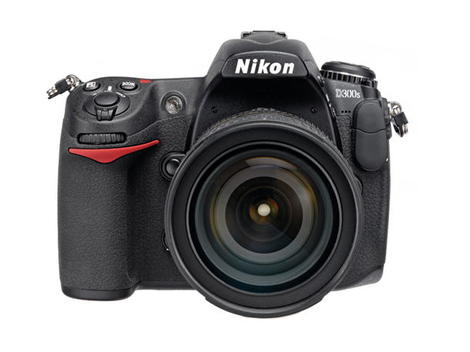
With the Nikon D4 and Nikon D800 released and out of the way, it's time for us to turn our attention to what is likely to be the next release from the company.
We already know that Nikon has big plans for the year ahead, especially with the Olympics almost upon us, so it seems fairly likely that another DSLR release could be on the cards.
The D300s has also been discontinued in Japan, following the country's new battery laws, so a new camera would seem to be an obvious outcome.
Nikon D400/D500 release date
As usual, we can only look to previous release cycles to take an educated guess as to when a new camera will be announced.The D300s was announced almost three years ago, first making its appearance in July 2009, while its predecessor, the Nikon D300 came out just two years previously, in August 2007.
That would seem to suggest that we are well overdue a replacement, but perhaps hints towards a summer time release for the camera.
Nikon D400/D500 specs
As the D300s is a FX (APS-C crop factor) camera, it is some respects it is beaten by its lower valued brother, the D7000.Therefore, it's possible that the D400 will take on a full-frame sensor, making it more like a 'mini' D4, and setting it well apart from the D7000. One rumour has suggested that this could be the case and that the pixel count will be 16 million.
If Nikon does decide to stick with the APS-C route, it would seem likely that a high resolution would be on the cards, given the recent introduction of the 36 million pixel D800. Maybe 24 million pixels, as seen on the Sony a77 (who is known to manufacture Nikon sensors) will be the magic number.
Other rumoured specs include 6fps shooting and 95% viewfinder coverage. A suggestion has also arisen that it will only use a single CF card slot, once again rejecting the XQD format found in the D4.
Nikon D400/D500 price
Again, we can only guess at the price based on previous releases, but it would need to be competitively priced to make it a worthwhile proposition.A D7000 can be picked up for around £1200 at the moment, while the D800 currently retails at about £2400. It's likely, that a D400 price would sit somewhere between these two figures.
Nikon D400/D500 name
For months, if not years, the speculation is that the D300s replacement would be the D400, however, recently the suggestion has been that it would skip straight ahead to the D500.Perhaps this will be to set it further apart from the D300, especially if it is going to be using a full-frame sensor.
Stay tuned for more details as and when they emerge.

| |
Read More ...
Updated: New iPad: where can I get it?

UPDATE: Check out our new iPad 3 review
The new iPad has been announced, and we've been in contact with all the UK networks to see who is stocking it.
Detail is thin on the ground at the moment, but check back as we'll be getting more information on the new iPad release date and UK price on contract.
Apple
Obviously Apple is selling the new iPad in its shops (where else would the ridiculously long queues come from?) and has given a UK release date of 16 March.We've no idea on price as yet, but based on last year's efforts, we expect the following: 32GB Wi-Fi only at £479, 64GB Wi-Fi only at £559, 16GB Wi-Fi + 3G at £499 and 32GB Wi-Fi + 3G at £579.
Orange
Orange is offering the new iPad on a £25 per month, 24 month contract with an upfront charge. You'll get 1GB of anytime data, 1GB of quiet time data (Midnight-4am) and 'unlimited' (max 10GB per month) data using BT Openzone Wi-Fi hotspots.There's good news if you're already an Orange customer as you'll receive a discount on the upfront cost of the new iPad.
Available in 16GB, 32GB and 64GB variants existing Orange customers will need to shell out £199, £249 or £349 up front respectively; with new customers being charged £229, £279 or £379 depending on storage size.

O2
O2 will not be selling the new iPad (which is hardly a surprise seeing as it rarely does such a thing) but will be chucking out the SIM cards apparently."We are making SIM cards available for the new iPad, which offer a full integrated iPad experience enabling you to top up directly from the device."
Vodafone
Vodafone is offering the new iPad from £199 on a 24-month agreement for £27 per month including a 2GB UK data allowance with 1GB of BT Openzone included.If you don't fancy being locked into a 2 year contract you can opt for a 30 day SIM only plan, with usage alerts to your iPad for £15.00 per month offering a 2GB UK data allowance with 1GB of BT Openzone included.
Vodafone say its "network in conjunction with the new iPad offers theoretical speeds of up to 28.8Mbps in major cities and up to 21.1Mbps in major towns and cities."

T-Mobile
T-Mobile is offering the 16GB (£229) and 32GB (£279) versions of the new iPad. Both are available on a £25 per month, 24 month contract with 1GB of anytime data and 1GB of quiet time data (midnight-10am). Existing customers can save £30 on the up-front price of the tablet and theHead over to http://www.t-mobile.co.uk/shop/new-ipad/ for all the details.
Three
Three says it has "invested significantly over the past year upgrading its network to the latest 3G technology – HSPA+" which it says "will deliver the fastest speeds yet for customers buying the new iPad".Here are the full Three new iPad tariffs.

The Carphone Warehouse
The Carphone Warehouse has announced it will be stocking the new iPad, plus you can trade in your old model (between £105 and £205 for the iPad 1 and £245 and £355 for the iPad 2)
| |
Read More ...
Groupon promises changes after breaking laws

The Office of Fair Trading has completed an investigation into Groupon's daily dealings and found that the company had broken several consumer protection laws.
The site was found to have breached a number of regulations, specifically those relating to pricing, advertising, refunds and unfair terms.
But Groupon, which cooperated with the trading body throughout, has agreed to make a number of changes to ensure it is meeting the guidelines and not ripping anybody off.
Have your cake, eat it
These include creating new terms and conditions, ensuring that pricing of its deals are clear and transparent, and making clear all limitations to any deal before purchase.It is also required to ensure that any company offering a deal through the site is realistically able to fulfil the offer after a number of small businesses, like the Berkshire baker who was left with an order sheet of over 100,000 cupcakes after offering a discount deal on Groupon.
Groupon doesn't sound too remorseful for the problems though, with the UK MD of the company, Tobias Tschötsch, saying, "I am sorry for every complaint but the vast majority of customers are happy with the service we provide. We hope to get that to 100%."

| |
Read More ...
First Windows 8 tablet could be from Lenovo
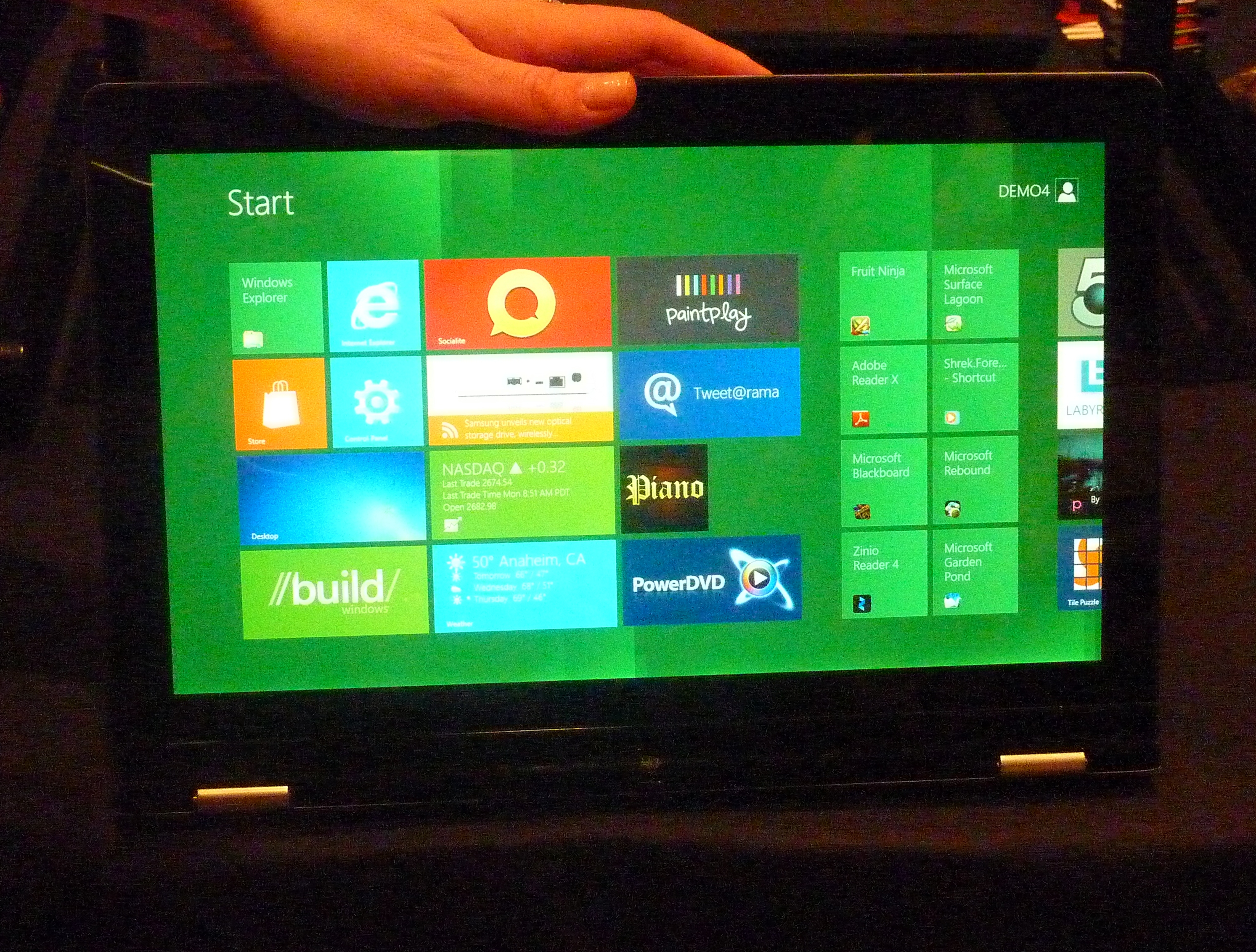
Lenovo could be the first company to put a Windows 8 tablet on the market, according to a source who predicts an October launch for the device.
A source for The Verge said that Lenovo will be "first to market" with its Windows 8 tablet, beating off competition from the likes of Dell, HP, Nokia and Asus.
The source did not disclose any details on the new slate, apart from confirming Lenovo would be sticking an Intel processor inside.
Tablet Royale
We may have already seen this fabled tablet, as the 13.1-inch Lenovo IdeaPad Yoga was shown off at CES 2012, running Windows 8 – but also sporting a 360 degree folding keyboard.It may not be so simple for Lenovo however, as Dell CEO Michael Dell has gone on record to say that his company will launch its own Windows 8 tablet "on the exact day" the new operating system hits the market.
Dell is looking to break out of its PC company roots and a flagship Windows 8 tablet could help, as long as it does a better job than it did with the Dell Streak, which failed to set the market alight.

| |
Read More ...
Available Tags:Apple , Panasonic , Ivy Bridge , HP , Nokia , server , gaming , Nikon , Amazon , Kindle , iPad , iPad 3 , Windows 8 , Windows , tablet , Lenovo ,


No comments:
Post a Comment