

Unofficial HTC Super Tool Roots, Unlocks and de-Senses

Brian covered HTC's web-based bootloader unlocking tool previously, and while their efforts are commendable, the limited phone seleciton was frustrating. Frustrating enough that xda developers user frigid opted to try things his own way. The resulting app (Windows only) allows users to obtain root, unlock the bootloader and remove most of the Sense skin on a wide variety of HTC devices. The price? Your warranty. While HTC's official tool keeps your warranty intact, the Super Tool leaves you flying with no net. So, foul up a flash, and no one will be there to heal your bricked device. Still, if you're feeling brave enough, and are lucky enough to have one of the supported phones, hit-up the source link and give it a try (at your own risk).
Read More ...
LG Lays Out Android 4.0 Timeline

LG has had far more success in Asia than in the US, though their stable of phones has been growing among the big four US carriers. The unnamed LG skin used on their phones contributes to the development time for these updates, and it remains possible that further delay will be caused by carrier testing and validation. It'll be interesting to see which companies meet their timelines, and what impact, if any, that has on their sales performance. In the meanwhile, stay tuned for our Galaxy Nexii review.
Read More ...
Intel's Atom N2600, N2800 & D2700: Cedar Trail, The Heart of the 2012 Netbook
Netbooks aren't dead, but they're not quite the hip topic of discussion they were a few years ago. The focus on cost conscious computing hasn't changed since the introduction of the first netbook, but the maturity of tablets has. Intel still sees the netbook segment as a profitable one (for itself) through 2012, although I'm fully expecting the line between netbook and convertible tablet to blur after the launch of Windows 8.
Atom has been at the heart of nearly all netbooks since the segment's inception. We've seen only one major platform shift since then: from the original 2008 Atom platform to Pine Trail. Pine Trail integrated the GPU and memory controller without significantly changing the Atom architecture. Today Intel is officially announcing its next major netbook platform shift: Cedar Trail.

There are three Atom CPUs being offered as a part of Cedar Trail: the N2600, N2800 and D2700. Just as before, the N-series are for netbooks while the D-series are for desktops. All of the Cedar Trail Atoms are dual-core parts, but they all slot into the same power envelope as the old single-core Pine Trial platforms (5 - 8W). The only exception is the D2700 which is a 10W platform. Note that this is the total TDP for the Atom SoC + the NM10 Express chipset (providing USB, LAN, PCIe, etc...).
The spec breakdown is below:
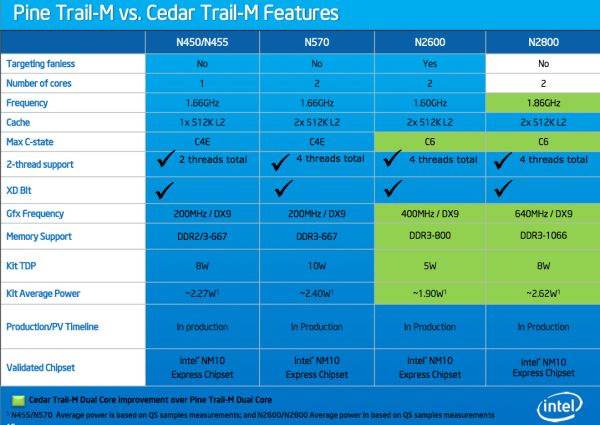
Cedar Trail now supports DDR3-800 and 1066 (up from 667MHz max data rates before). The bigger change is the GPU. The GMA 3150 used in Pine Trail was an Intel Gen graphics derivative (45nm GMA 3100), however Cedar Trail now features a PowerVR SGX 545 sourced from Imagination Technologies. At 640MHz in the N2800, we've never seen the SGX 545 run at anywhere near this clock speed before so it'll be interesting to see how well it performs. Intel is claiming a > 2x GPU performance improvement compared to the GMA 3150 in Pine Trail in 3DMark 06. The big question is Windows driver maturity, but we'll find out soon enough as systems based on Cedar Trail are in production now and are expected to ship in early 2012. Expect to see Cedar Trail netbooks from ASUS, Acer, HP, Lenovo, Samsung and Toshiba for starters.


Overall the addition of HD video decode support and lower power consumption are both nice features to have, but I'm skeptical as to whether this will be enough to carry Intel based netbooks throughout the majority of 2012. Atom is in dire need of an architecture update (something we'll get in 2013) and the netbook as a platform is in need of a refresh. I do hope to see some manufacturers taking risks with slim, fanless Cedar Trail based designs next year but we'll have to wait and see if they're any good.
Read More ...
OCZ Octane 128GB SSD Review
Earlier this year OCZ acquired Indilinx, one of the first SSD controller makers to really make a splash in the enthusiast community. Ever since OCZ entered the SSD business it wanted to guarantee its independence by securing exclusive rights to a controller. OCZ initially did so by buying up all available inventory, first of Indilinx controllers, then of SandForce controllers. That strategy would only work for a (relatively) short period of time as the controller vendors sought to expand their market by selling chips to OCZ's competitors. A few slip ups on the roadmap and Indilinx was ripe for acquisition. OCZ stepped up to the plate and sealed the deal. Several months later, OCZ debuted its first drive based on an unreleased, exclusive Indilinx design: Octane.
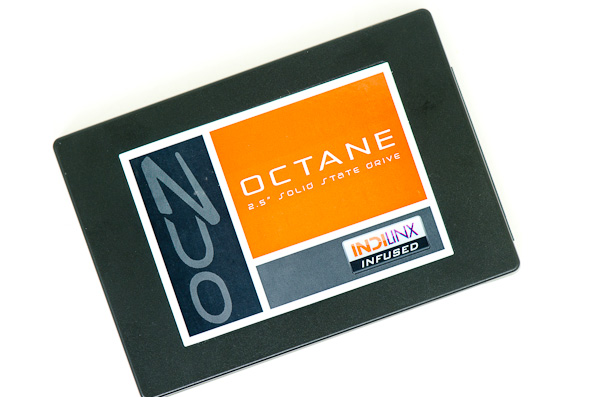
OCZ finally sent out a 128GB Octane, which I promptly put through our standard test suite.
Read More ...
Intel "Medfield" Details Leak -- Powerful, But a "Battery Guzzler"
This might be a good chip for tablets, but not so much for smartphones
Read More ...
Hyundai Takes iPhone Driving App to NYC Streets
iPhone users can play the Hyundai driving app on a huge screen in Times Square
Read More ...
Quick Note: AT&T Job Postings Hint at 2012 LTE For Michigan, Minnesota
Posting call for an experience LTE engineer to operate locally
Read More ...
Microsoft to Follow Windows Phone Mango With Tango, Apollo in 2012
Leaked roadmap shows two major Windows Phone releases coming shortly
Read More ...
Hackers Could Disrupt Rail Services by Attacking Switches
No trains would crash, but disruptions could last a long time
Read More ...
LCD Price Fixing Settlement Totals $553M
LCD companies still dispute claims
Read More ...
Sprint Will Offer LTE Devices in Mid-2012
Full-fledged LTE rollout will be completed in 2013
Read More ...
Anonymous Hack on Stratfor Produces Over 50,000 Credit Card Numbers
Identity Finder LLC has released an analysis of the information obtained and posted by hacking group Anonymous after it attacked Stratfor
Read More ...
Quick Note: Samsung Predicts 15 Percent Jump in 2012 Handset Sales
Samsung is planning to sell 374 million handsets next year
Read More ...
Nearly 7M Android and iOS Devices Activated on Christmas Day
Numbers more than double last year's X-mas figures, shatter single-day activations record
Read More ...
Netflix Falls Well Behind Amazon in Holiday Customer Satisfaction Report For First Time
Netflix, who was always tied with, ahead of, or gaining on Amazon by a point or two, fell way behind this year for the first time with a score of 79
Read More ...
Third Generation Electric Smart ForTwo Delayed
Battery production cited as reason for the delay
Read More ...
Available Tags:HTC , LG , Android , Netbook , OCZ , SSD , Intel , iPhone , Windows Phone , Microsoft , Windows , Hack , Samsung , iOS , Amazon ,


No comments:
Post a Comment