

Sony Updates Vaio Z: Light Peak and An External GPU
Sony has announced an updated Vaio Z lineup today. Vaio Z is Sony’s premium 13” laptop series which essentially packs performance of a 15” laptop into a smaller form factor. As expected, the updated lineup includes new Sandy Bridge CPUs but what really makes it interesting is the support for Light Peak and a BTO option for external Power Media Dock with a discrete GPU.
Sony Vaio Z specifications | ||
Standard | Built-to-order options | |
Screen | 13.1" (anti-glare) | N/A |
Resolution | 1600x900 | 1920x1080 |
Processor | Intel Core i5-2410M (2.3GHz, 3MB L3) | i5-2540M (2.6GHz, 3MB L3), i7-2620M (2.7GHz, 4MB L3) |
Graphics | Intel HD 3000 | Power Media Dock with AMD 6650M |
Storage (SSD) | 128GB | 256GB, 512GB; 128GB, 256GB, 512GB (SATA 6Gb/s) |
Memory | 4GB 1333MHz DDR3 | 8GB 1333MHz DDR3 |
Connectivity | WiFi (802.11a/b/g/n), 3G, Bluetooth | Wireless WAN |
Ports | USB 2.0, docking station/USB 3.0, HDMI out | N/A |
Battery | Up to 7 hours | Up to 14 hours (external) |
Dimensions(DxHxW) | 8.3" x 0.66" x 13.0" | N/A |
Weight | 2.6lb | N/A |
Price | £1195 (~$1914) | Varies |
Unfortunately Sony has yet to update their USA page to include the updated Vaio Z. The European page has already been updated, thus the usage of pounds in the table. The Dollar pricing is an exact transfer of the VAT-less UK price but it gives us a hint that the standard Vaio could be around $1900 in the US. Sony's UK page says ships in 3-4 weeks so expect late July availability.
The new Vaio Z is significantly thinner and lighter than the old Vaio Z: It weighs in just 2.6lbs and has height of 0.66” compared to its 3.04lbs and 1.3” predecessor. It’s actually slightly thinner than the MacBook Air (0.66” vs 0.68”). MacBook Air’s design is slanted though so at its thinnest point, it’s much thinner than the new Vaio Z. Vaio Z is also quite noticeably lighter than 13” MacBook Air or Samsung 9 Series, which weigh 2.9lbs and 2.88lbs respectively.
The main reason why the new Vaio Z is so much lighter and thinner than its predecessor is the lack of a discrete GPU. It comes with Intel HD 3000 which is integrated into the CPU die, whereas the old Vaio Z came with a discrete NVIDIA GT 330M. However, Sony has provided an interesting solution to this. They have announced a Power Media Dock (PMD) which is basically a souped up external optical drive. The external dock has an AMD Radeon HD 6650M with 1GB of DDR3 in it as well. The AMD 6650M allows you to connect up to two displays to the PMD so you can have a total four displays: two attached to the PMD, one attached to the laptop’s HDMI port and obviously the laptop’s integrated LCD.
AMD 6650M specifications | |
Shaders | 480 |
GPU frequency | 600MHz |
Memory | 1GB DDR3 |
Memory frequency | 900MHz |
Memory bus width | 128-bit |
The Power Media Dock comes in three flavors. The cheapest one is a normal DVD drive. The second option is a Blu-Ray player. The most expensive option is a Blu-Ray writer as you might have guessed. PMDs with Blu-Ray are only available from Sony’s online store whereas the DVD PMD will be available through resellers as well. The PMD supports up to two external monitors: one via HDMI and one via VGA. There is also a Gigabit Ethernet port, two USB 2.0 ports and one USB 3.0 port.
One issue with the PMD is its price. The cheapest one is £400 which translates to $640. Take away UK’s VAT which is 20% and we get $512, so the cheapest PMD will most likely retail for $500. That sounds pretty expensive, considering that AMD 6650M is an underclocked AMD 6570 (our review) which goes for around $70. Combine that with $20 DVD drive and you get what Sony calls Power Media Dock.
Then there's the concern about performance. Sony must be running PCIe over Light Peak, but you only get a maximum of 1.25GB/s of bandwidth to/from the GPU - assuming no additional overhead. While the 6650M is likely much faster than Sandy Bridge's intergrated GPU, it's potentially slower than an on-board 6650M would have been because of the Light Peak bottleneck.
Conclusions
Vaio Z is definitely the most portable of the current 13" ultraportables and it packs in a nice amount of power. However, its pricing makes it too expensive compared to most of its competitiors. 13" MacBook Air starts at $1199 so the cheapest Vaio Z will be at least $700 more expensive if UK's pricing is comparable to US's. Even the Lenovo X1 starts at $1199 nowadays and it features exactly the same CPUs. The biggest market for Vaio Z seems to be in the high-end ultraportable market. No other brand offers 512GB SSD or 1080p screen at the moment for example.
Power Media Dock sounds interesting but the price tag is everything else but attractive. For the same amount of money, you could grab for instance NVIDIA GTX 580, which is the fastest single chip GPU as of today. With PMD, you will be limited to AMD 6650M which isn't exactly a great GPU for gaming in the first place. At $500, you would hope for something much, much better than a DVD+GPU combo that struggles to play games at decent quality. We have seen external GPUs before but they have always failed miserably. Sony's attempt doesn't seem too promising either but at least we now have a port that is capable of external GPUs: Thunderbolt/Light Peak. There is hope that third parties will release cheaper and faster solutions, the most promising being Sonnet's Echo Express, which supports full size PCIe cards (though no word on GPU support).
As the world becomes increasingly more mobile, external GPUs may be a solution to the problem of balancing portability with performance. Light Peak is a great way to get data out of a system however we may need to see a next-generation version of the interface, with higher bandwidth to really make sense for high performance external GPU solutions.
Read More ...
OCZ RevoDrive 3 X2 (480GB) Preview: 200K IOPS & 1.5GB/s for $1699?
Although consumer SSDs are far from a mature technology, PCIe SSDs are even further behind on the growth curve. The upside is huge. As SandForce has already demonstrated with the right dataset a single SSD can nearly saturate the 6Gbps SATA bus. Rather than force OEMs into putting yet another very high bandwidth bus on the motherboard, SSD vendors everywhere (Intel included) turn their attention to PCIe as a solution to the problem.
The holy grail is a native PCIe solution. Recently Micron announced such a thing: the P320h. However the estimated price tag on the P320h could be in the $5000 - $10000 range depending on capacity.
Manufacturers in the consumer SSD space are attracted to PCIe solutions simply because margins are higher. For the most part, client storage is a commodity and if you don't make the NAND and controller going into an SSD you're not making a ton of money selling drives to end users. Sell to an enterprise customer and all of the sudden a couple thousand dollars per drive seems like a bargain.
OCZ started making PCIe SSDs the simplest way possible. Take a couple of SSDs, put them on a single PCB behind an on-board RAID controller and you're good to go. The single card performance was decent but of course there were issues. A single controller failure would take out the whole drive and things like TRIM weren't supported either.
Recently OCZ has been trying very hard to be more than just a rebrander of components. The acquisition of Indilinx puts a wedge between OCZ and a lot of its former peers in the memory business, but it's still a far cry from Intel or Samsung. Its latest PCIe SSD is another step in the maturing of the company. This is the RevoDrive 3 X2:
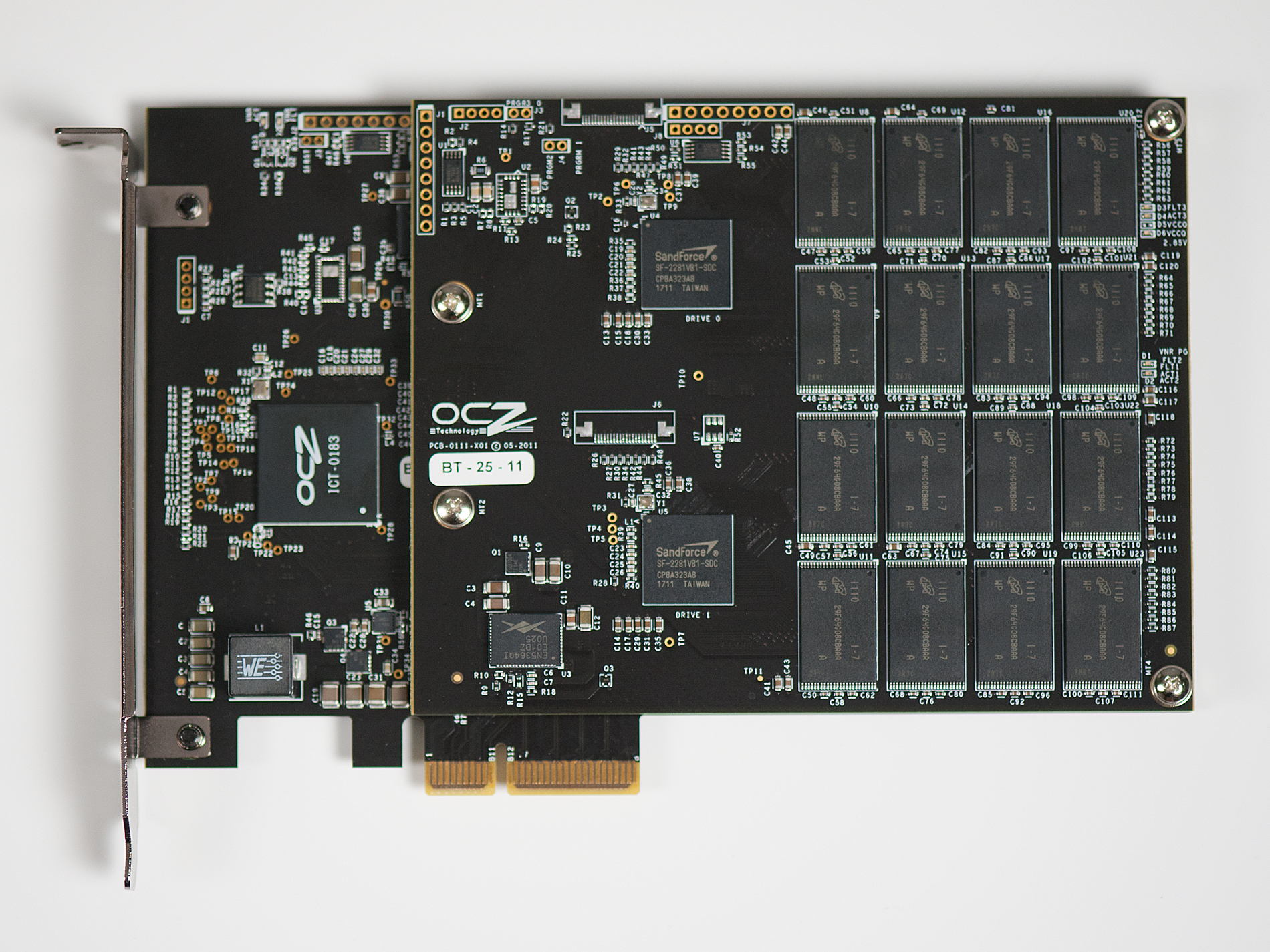
Read on for our preview!
Read More ...
EDITORIAL: France Bravely Pushes Nuclear, America Can't Find the Courage
European giant shows it's committed to being a tech superpower, in the face of public fear and ignorance
Read More ...
Google Faces French Suit Alleging Anticompetitive Practices
Suit seeks 295 million euro damage claim
Read More ...
Sprint Pulls Out Nuclear Option to Block AT&T/T-Mobile Purchase
Hesse feels he is fighting for Sprint's survival and the industry
Read More ...
Fifteen Metric Tons of Radioactive Water Leaks from Fukushima Daiichi Plant
Tepco has fixed the problem and is cleaning the water, but is still investigating what caused the leak
Read More ...
Office 365 Officially Launches, Priced from $6 to $27 Monthly Per User
Office 365 or Google Apps, which is right for you
Read More ...
6/28/2011 Daily Hardware Reviews
DailyTech's roundup of hardware reviews from around the web for Tuesday
Read More ...
Available Tags:Light Peak , Sony , Vaio , GPU , OCZ , Google , Hardware ,


No comments:
Post a Comment