

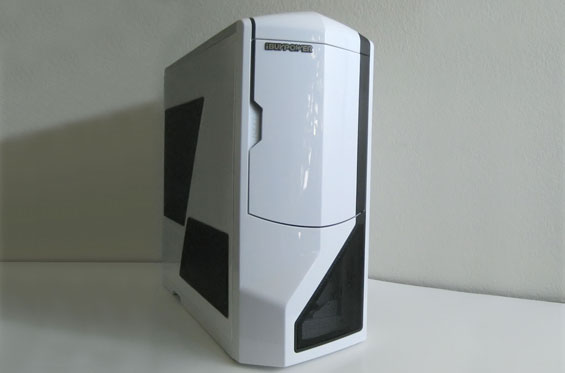
iBUYPOWER Paladin XLC: Enthusiast Class
Our readership is composed largely of people who prefer to roll their own, but recently we've had the opportunity to take a look at some interesting desktop machines from big name manufacturers. Now we tread on much more challenging terrain: can a hardware boutique like iBUYPOWER make a convincing case for buying a custom built machine instead of learning to build one yourself? That's what we aim to find out in our review of iBUYPOWER's new flagship, the Paladin XLC.
Read More ...
Sandy Bridge Graphics Update
Last week we published our preview of Intel's 2011 Core microarchitecture update, codenamed Sandy Bridge. In the preview we presented a conservative estimate of what shipping Sandy Bridge performance will look like in Q1 2011. I call it conservative because we were dealing with an early platform, with turbo disabled, compared to fairly well established competitors with their turbo modes enabled.
It shouldn't come as a surprise to you that this performance preview, ~5 months before launch, wasn't officially sanctioned or supported by Intel. All companies like to control the manner in which information about their products is released, regardless of whether the outcome is good or bad. We acquired the chip on our own, ran the benchmarks on our own and published the article, on our own.
As a result a number of questions remained unanswered. I measured significantly lower L3 cache latencies on SB vs. Westmere/Nehalem, I just have no idea why they were lower. I suspect many of these questions will be answered at IDF, but the point is that we were flying blind on this one.
A big unknown was the state of Sandy Bridge graphics. As I mentioned in the preview, there will be two types of integrated graphics enabled on Sandy Bridge parts: 1 core and 2 core parts. Intel refers to them as GT1 and GT2, respectively. The GT1 parts have 6 execution units (EUs), while the GT2 parts have 12.
While some desktop parts will feature GT2, all notebook parts (at launch) will feature GT2. Based on the information I had while running our tests, it looked like the Sandy Bridge sample was a GT1 part. With no official support from Intel and no way to tell how many EUs the sample had, I had no way to confirm. Since publication I've received more information that points to our sample being a GT2 part. It's not enough for me to 100% confirm that it's GT2, but that's what it looks to be at this point.
If it is indeed a GT2 part, the integrated graphics performance in our preview is indicative of the upper end of what you can expect for desktops and in the range of what we'd expect from SB notebooks (graphics turbo may move numbers up a bit but it's tough to tell at this point since our sample didn't have turbo enabled). As soon as I got this information I made updates to the articles indicating our uncertainty. I never like publishing something I'm not 100% sure of and for that, I owe you an apology. We trusted that our sources on the GT1/6EU information were accurate and in this case they may not have been. We all strive to be as accurate as possible on AnandTech and when any of us fail to live up to that standard, regardless of reasoning, it hurts. Thankfully the CPU and GPU performance data are both accurate, although we're simply unsure if the GPU performance will apply to the i5 2400 or not (it should be indicative of notebook SB GPU performance and some desktop SB GPU performance).
The desktop Sandy Bridge GPU rollout is less clear. I've heard that the enthusiast K-SKUs will have GT2 graphics while the more mainstream parts will have GT1. I'm not sure this makes sense, but we'll have to wait and see.
Many of you have been drawing the comparison to Llano and how it will do vs. Sandy Bridge. Llano is supposed to be based on a modified version of the current generation Phenom II architecture. Clock for clock, I'd expect that to be slower than Sandy Bridge. But clock for clock isn't what matters, it's performance per dollar and performance per watt that are most important. AMD has already made it clear that it can compete in the former and it's too early to tell what Llano perf per watt will be. On the CPU side I feel it's probably easy to say that Intel will have the higher absolute performance, but AMD may be competitive at certain price points (similar to how it is today). Intel likes to maintain certain profit margins and AMD doesn't mind dropping below them to maintain competitive, it's why competition is good.
Llano's GPU performance is arguably the more interesting comparison. While Intel had to do a lot of work to get Sandy Bridge to where it is today, AMD has an easier time on the graphics side (given ATI's experience). The assumption is that Llano's GPU will be more powerful than what Intel has in Sandy Bridge. If that's the case, then we're really going to have an awesome set of entry level desktops/notebooks next year.
Read More ...
T-Mobile G2 to Pack Android 2.2 Froyo, Qualcomm "Scorpion" CPU
Unfortunately this Scorpion doesn't pack much sting
Read More ...
FCC Expected to Delay Net Neutrality Ruling Until After Elections
No proposals expected until after November
Read More ...
Steve Jobs Accuses Google of Lying About Android Activations
Jobs: "We think we are ahead of everyone"; Google says CEO of Apple's claims are inaccurate
Read More ...
Chevrolet Volt Production Kicks Off November 11
Dealers will find out how many they will get on November 17
Read More ...
Samsung Galaxy Tab Android Tablet Gets Official
Another MID competitor offers Apple's iPad a run for its money
Read More ...
New Microfluidic Device Helps to Understand Human Immune System
Device aimed to help researchers understand the immune system's response to injury
Read More ...
Windows Phone 7 Hits RTM
Windows Phone 7 reaches critical milestone
Read More ...
More of the Gulf is Reopened for Fishing as Oil Spill Disperses
Commercial fisherman are back to work
Read More ...
Windows 7 Family Pack Makes a Return
$150 Windows 7 Family Pack returns -- for a limited time
Read More ...
Youth in Asian Countries Forgetting How to Write
"Character Amnesia" result of computer-culture surge.
Read More ...
Sprint Adds 4G Coverage in Three Cities, T-Mobile Adds 3.5G to Nine Cities
Next gen coverage is reaching more users
Read More ...
Apple Announces $99 Tiny Apple TV, 99¢ TV Show Rentals, iTunes Social Network Ping
Steve Jobs has plenty to say, hopes to convert new customers and help TV studios "see the light"
Read More ...
Apple Introduces New iPods
Apple updates its popular media player lineup
Read More ...
9/01/2010 Daily Hardware Reviews
DailyTech's roundup of hardware reviews from around the web for Wednesday
Read More ...
Report: New iPhone 4 Hardware to Ship September 30 With Fixed Antenna
A Mexican carrier may have just let Apple's big iPhone secret slip
Read More ...


No comments:
Post a Comment