

Windows 10 Build 10547 Brings Some Nice Changes For Insiders
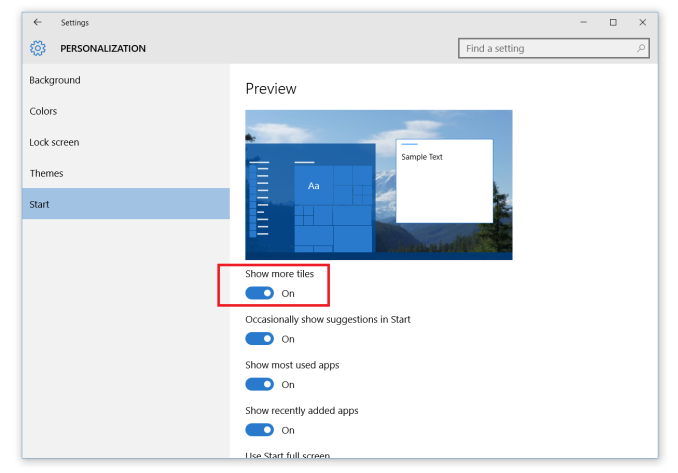
One thing that bothered me was that the Start Menu would not allow you to create groups more than three “medium” tiles wide, and with this update, users can select “Show more tiles” in the personalization settings which allows a fourth column of tiles. It’s nice for the desktop, but this should be very beneficial to tablet mode which I felt was wasting a lot of space with just the three column width. Having four columns also allows for two wide or large tiles to be on the same row, which is a much better solution than having to plug holes with smaller tiles even if you don’t really want them. Hopefully the wording changes on the setting, since Show more tiles is not really what the setting is doing, and it is of course a fall back to the Windows 8.1 setting with the same name which actually did allow you to put more tiles on the Start Screen.
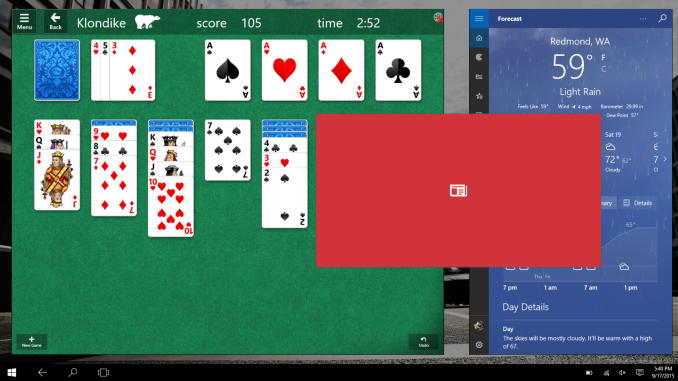
Tablet mode also gets some tweaks. I felt that Windows 10 actually lost a step compared to Windows 8.1 in just touch usage. Microsoft appears to be trying to bring back some of the good tablet features that Windows 8 had. A small change which should actually be a nice change is that when you have two apps snapped in tablet mode, you can now snap another app over one of those, just like in Windows 8.1. Microsoft has a graphic that shows the app teeter from side to side to show you which side it is going to replace. It’s a small change, but welcome. Windows 8.1 was pretty solid as a tablet operating system so it’s great to see Windows 10 adding some of those features back.
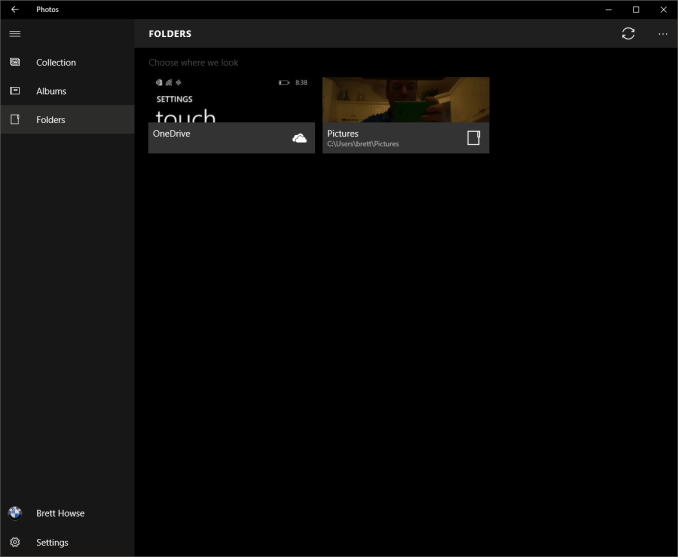
The core apps are also being updated constantly, and we’ve seen some good changes to things like Mail getting an option to disable conversation view, and the photos app keeps getting iterated to make it a better experience. It has been updated again to make it more obvious which photos are on your PC and which are in the cloud. Other core apps like Xbox app are getting updated, and the Xbox app is gaining a Beta program too much like the Xbox itself has.
The Start Menu has gotten some fixes, and with this build the 512 app limit in the Start Menu has been increased to 2048 apps. While there should not really be a limit here, 2048 should be enough for pretty much anyone as far as installed apps.
Cortana, which before required a Microsoft Account, is now usable with a local account. I’ll have to test to see exactly what this means. In the original version of Windows 10, enabling Cortana with a local account would force the system to switch the account login to a Microsoft Account. It’s not clear from the release notes if you can just log in to Cortana with a Microsoft Account now instead of switching the login, or if it is actually usable with just a local account.
There are, as usual, a few known issues as well including Store Apps may not update automatically, so please check out the known issues before installing in case one of them will directly affect you.
Source: Windows Blog
Read More ...
Google Launches Android Pay On Google Play

Android Pay will work on any smartphone running Android 4.4 KitKat or newer so long as the phone has NFC hardware. At launch the service will only be available in the United States, and will support a variety of credit and debit cards from various US banks and credit unions. There will also be support for gift cards and loyalty cards from retailers.
Google's Android Pay website details a number of stores that support Android Pay, but since the service uses NFC it will work at any store that has tap to pay support. It will also work in Android applications that have partnered with Google to support Android Pay payments, and you can view a list of those applications along with a list of supported banks and credit unions on the Android Pay site.
Source Google Play via Engadget
Read More ...
Jim Keller Leaves AMD

Jim Keller has worked at AMD before, most notably developing the K7 and K8 processors that formed the basis of much of AMD’s success at the turn of the century. This includes assisting in the generation of the x86-64 instruction set that would form the basis of many of the x86 based computers people used today. At other points in time Jim has also spent several years each at Apple helping design their A4 and A5 SoCs as well as at DEC on Alpha processors, giving him a wide degree of experience in CPU development that AMD has been tapping during his latest tenure there.
As a re-hire at the top of the CPU chain, Keller's latest project at AMD was to develop the next generation of high performance processors for AMD and to build a team around the concept of PC performance. This was announced as a rapid departure from the module design of Bulldozer-based cores sharing parts of a processor and towards a new base architecture called Zen. Other projects in the pipeline at AMD CPU group include ARM-based AMD processors (K12), an ARM counterpart of sorts for Zen that is set to launch later on.

As for the big question, the state of Zen, along with confirming that Keller is leaving the company today, AMD is also officially reiterating that their roadmaps are still on course, with Zen set to come to market in the latter half of 2016 and a first full preiod of revenue to be reported in 2017. Given the long (4+ year) design cycles for a modern high-performance CPU, at this point in time all of the "heavy lifting" on Zen development should be done. With only a year or so to go before launch, the rest of Keller's team at AMD will be focusing on fixing bugs and bringing products to manufacturing.
As a result while the loss of Keller is certainly a significant one for AMD, Keller's architecture work on Zen should already be complete, which is likely why we are seeing him leave at this time. And as a quick aside to give you an idea of CPU development timelines, by comparison, Jim's work on K8 was done over 3 years before K8 shipped in 2003. Consequently the biggest loss for AMD here shouldn't be Zen-related, but rather that they won't have Keller's talents to call upon for further refinements of Zen or for a post-Zen architecture.
Meanwhile leadership of the CPU architecture team in Keller's absence will be turned over to CTO Mark Papermaster, who will be leading the group as they wrap up work on Zen. AMD is calling Mark the "acting leader" of the group, so this is likely an interim posting while AMD looks to find or promote someone to lead the CPU architecture group on a permanent basis. Otherwise as we're approaching the end of the fiscal quarter, AMD is in their quiet period, so AMD is limited in what they can say at this time. I suspect we'll hear a bit more on the plan for the final year of Zen development in the company's Q3 earnings release, which will be on October 14th.
Finally, it will be interesting to see if and when Keller will pop up next in the industry. Given his history of switching jobs to work on new CPU projects and his high level of skill which has allowed him to so freely move between companies, we may yet see Keller show up on another CPU project in the future. On the other hand after having worked for AMD twice and Apple, Keller has certainly earned an early retirement. In the meantime with the launch of Zen closing in for AMD, all eyes will be on just what Keller and his team have put together for AMD's next generation CPU.
Source: AMD
Top image (from left): Mark Papermaster (CTO), Dr. Lisa Su (CEO), Simon Segars (CEO of ARM), Jim Keller
Read More ...
Amazon Releases New Fire TV (2015)
Today
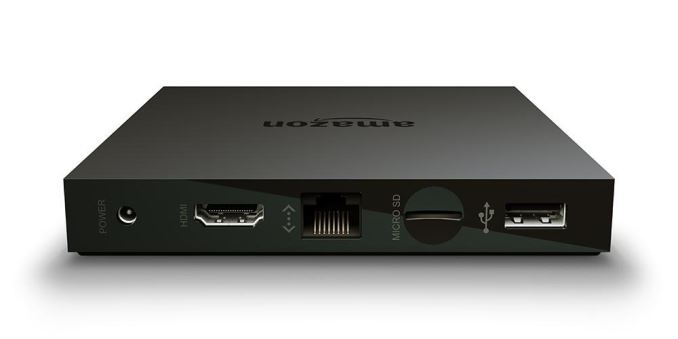
Amazon released a refresh of its Fire TV media player and mini-console.
The original device was unveiled in April 2014 and the 2015 version
sees some upgrades in the internal components and connectivity.
The biggest change is the upgrade from the original Snapdragon 600 to MediaTek's new MT8173 SoC. The MT8173 was originally announced at MWC
this year and surprised a lot of people as the Taiwanese semiconductor
vendor was the first to show off working prototypes with ARM's new
Cortex A72 CPU core, and it seems the Fire TV is the first device to
ship with the new SoC and CPU architecture.
| Fire TV (2014) | Fire TV (2015) | |
| SoC | Qualcomm APQ8064 Snapdragon 600 4x Krait 300 @ 1.7GHz Adreno 320 @ 400MHz |
MediaTek MT8173C 2x Cortex A72 @ 1989MHz 2x Cortex A53 @ 1573MHz Power VR GX6250 600MHz |
| RAM | 2GB | |
| Storage | 8GB | 8GB + microSD |
| Connectivity | 5.5 mm DC Jack Type A HDMI 1.4b output, w/HDCP Optical Audio (TOSLINK) 10/100 Ethernet USB 2.0 Type A 802.11a/b/g/n 2x2 MIMO |
5.5 mm DC Jack Type A HDMI 2.0 output, w/HDCP 2.2 microSD 10/100 Ethernet USB 2.0 Type A 802.11a/b/g/n/ac 2x2 MIMO |
| Launch OS | Fire OS 3.0 | Fire OS 5.0 |
The new SoC is a 2x2 big.LITTLE configuration with 2 A72 cores clocked in at 1989MHz and 2 A53 cores at 1573MHz. The new CPUs should give a significant performance boost over the Krait 300 found in the 2014 variant.
The new SoC also allows for hardware HEVC decoding and Amazon is touting this as the main feature of the new SKU as it allows for halving of the required bandwidth to stream 1080p content or allows for 4Kp30 content playback. Alas it seems 4Kp60 decoding is not supported and thus makes new Fire TV not quite as future proof as one would have hoped. The new unit comes with a new HDMI 2.0 port sporting HDCP 2.2 compatibility and allows connecting a TV or monitor at up to 2160p at 24/25/30/50/60Hz.
An important change in the connectivity is the dropping of the TOSLINK optical audio out connector in favour of a microSD slot. Also added is 802.11ac Wi-Fi connectivity, still sporting a 2x2 MIMO antenna configuration.

As an accessory to the Fire TV, Amazon also released a new gaming controller, aptly named the Amazon Fire Game Controller. The controller is equipped with the same voice-control functionality that the Fire Voice Remote comes with, thus being able to use replace it as the main controller/remote.
The new Fire TV starts shipping on the 5th of October for $99.99 without the controller or $139.99 for the Gaming Edition which contains both the media play and the controller. Amazon also now releases the original Fire TV Stick with the Voice Remote for $59.99.
Read More ...
The Death of Intel’s Broadwell Has Been Greatly Exaggerated - Socketed Broadwell Continues
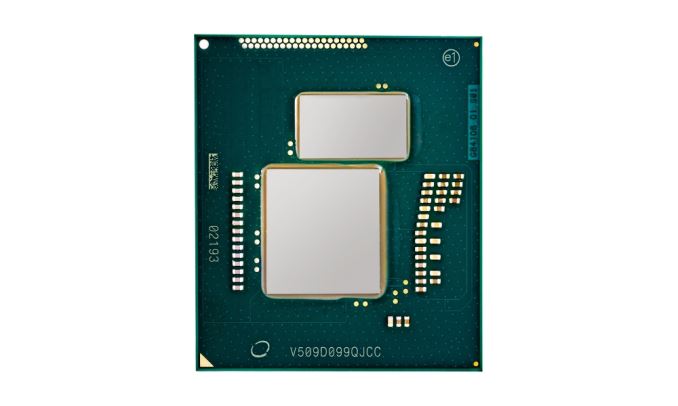
The idea that these processors were discontinued came as quite a shock with us, and after asking Intel for more details, the company quickly responded. Intel has made it very clear to us that these processors have not been discontinued, and that the company continues to manufacture and sell the processors as part of their current Broadwell lineup.
While the company doesn’t have an immediate explaination for the confusion at this time, we believe it may stem from a mix up over Intel’s plans for GT3e/GT4e Skylake parts on the desktop. In short, the company does not have any socketed GT3e/GT4e Core family parts on their roadmap for Skylake, so these Broadwell parts will not be seeing a Skylake refresh. That said, it should also be noted that Intel has not yet begun to ship GT3e/GT4e Skylake chips in other form factors (e.g. the 45W mobile H series), so Intel’s current Broadwell SKUs remain as their top-of-the-line SKUs for graphics across all segments, and it’s likely that will remain the case until 2016 when the Skylake 4+4e parts launch for mobile.
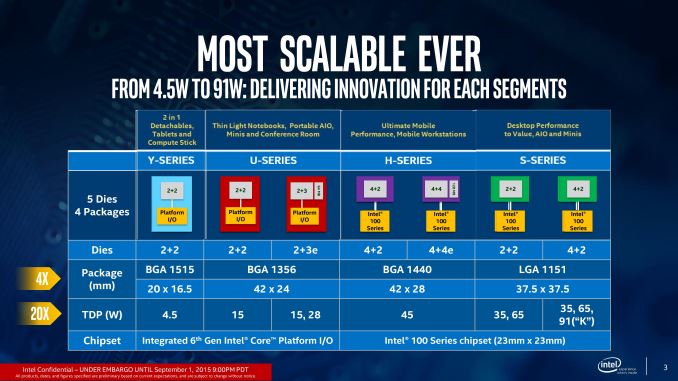
Intel's Skylake Roadmap
Part of the confusion may also stem from a lack of good supply for these processors in the US. Though we’ve seen evidence that the supply is ample in Europe and Asia, retailers such as Newegg have regularly been out of stock of these two processors since their launch in June. Intel’s last comment on the matter, made to the Tech Report back in August, is that the overall supply situation should pick up through Q3, which at this point is the rest of September. After which these SKUs will remain available and Intel’s top desktop graphics SKUs throughout the run of Skylake.
Read More ...
Corsair Partners with MSI, Enters High-End Video Card Market With The Hydro GFX
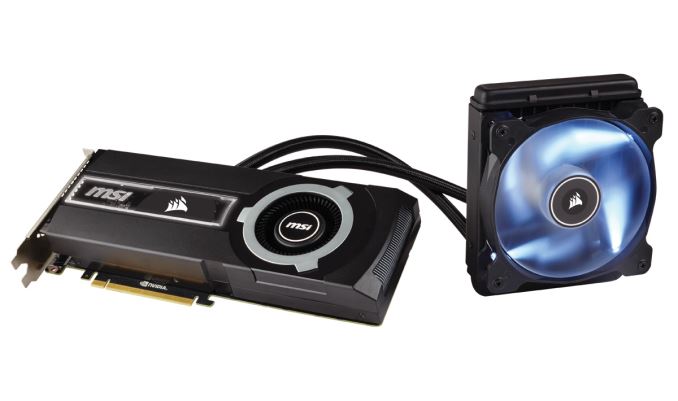
Not surprisingly then, high-end CLLC-equipped video cards is a bright spot in an otherwise tepid video card market, offering an avenue of growth when other areas of the market are in decline. The potential for growth in turn attracts new competitors to the market, and that is particularly the case today for Corsair.
This evening the venerable PC components and cooling company is announcing that they are entering the high-end video card market. However rather than going into full video card manufacturing ala the traditional board partners, Corsair will be entering just the high-end segment of the market, and will be partnering with MSI to do so. The two companies will be combining their strengths – MSI’s board development expertise and Corsair’s cooler expertise – to develop high-end closed loop liquid cooled video cards to be sold under the Corsair brand.
| GeForce GTX 980 Ti Specifications | ||||
| Corsair Hydro GFX | Reference GTX 980 Ti | |||
| CUDA Cores | 2816 | 2816 | ||
| Core Clock | 1190MHz | 1000MHz | ||
| Boost Clock | 1291MHz | 1075MHz | ||
| Memory Clock | 7.096GHz GDDR5 | 7.01GHz GDDR5 | ||
| Memory Bus Width | 384-bit | 384-bit | ||
| VRAM | 6GB | 6GB | ||
| TDP | 250W | 250W | ||
| GPU | GM200 | GM200 | ||
| Length | 10.5 Inches | 10.5 Inches | ||
| Width | Double-Slot + 120mm Radiator |
Double-Slot | ||
| Warranty | 3 Years | Varies | ||
| Launch Date | 10/2015 | 06/01/2015 | ||
| Launch Price | $739 | $649 | ||
The first video card developed under this partnership is the simply named Corsair Hydro GFX. The card is a CLLC-equipped GeForce GTX 980 Ti, combining an MSI card design with Corsair’s Hydro series 120mm H55 CLLC. Along with the integrated CLLC Corsair will also be shipping the card with a factory overclock – running the GPU at 1190MHz base clock and 1291MHz boost clock – in order to further boost the performance of the card. Overall Corsair estimates that the Hydro GFX should outperform the reference GTX 980 Ti by 15% by virtue of the CLLC eliminating thermal throttling combined with their factory overclock.
Meanwhile judging from the pictures and the specifications provided to us by Corsair, it looks like this card is a reference or near-reference board supplied by MSI, with the H55 and accompanying video card shroud taking the place of a normal cooler. This is notable since it means the card retains NVIDIA’s standard 250W power limit. Out of the box performance then is going to be limited to what Corsair and MSI can squeeze out of 250W – which is where the 15% number comes from – however with a CLLC attached there is clearly of potential for significant unofficial overclocking through BIOS modifications. I suspect having MSI handle the board will be helpful in that respect.
For Corsair getting into the high-end video card market is an interesting and initially unexpected move, though one that makes sense looking at their product portfolio. The company sells cases, coolers, and PSUs; everything needed to house and power a video card. And with the company increasingly focusing on small footprint cases such as the Bulldog, ensuring that there are suitable high-performance video cards to install in their cases makes all the more sense. Ultimately this move allows Corsair to dip their toes into a profitable segment of the video card market while ensuring that there is a supply of suitable cards for their small footprint cases, and of course that customers can buy it from Corsair along with their case and CPU cooler.

Meanwhile in the long term while the Hydro GFX is so far Corsair’s first and only card, the deal does leave the door open to further products from Corsair. I suspect that if the Hydro GFX is successful we’ll see further cards from Corsair and MSI once the next generation of cards lands later next year.
Finally, as for the Hydro GFX, Corsair will be releasing the card in October through their website. The MSRP will be $739, which is essentially a $90 mark up over a reference GTX 980 Ti in exchange for the factory overclock and integrated CLLC. Meanwhile Corsair is not the first vendor to get into selling CLLC-equipped GeForce cards, so the Hydro GFX will be going up against cards from vendors such as EVGA who are already shipping similar products.
Update: While this announcement originally came from Corsair, who only mentioned that they'd be selling the card as the Hydro GFX, we're now hearing that MSI will be selling the card as well. In MSI's lineup it will be known as the Sea Hawk, with the same specification and price.
Read More ...
Microsoft Quietly Rolls Out Windows RT Update To Enable Windows 10 Style Start Menu
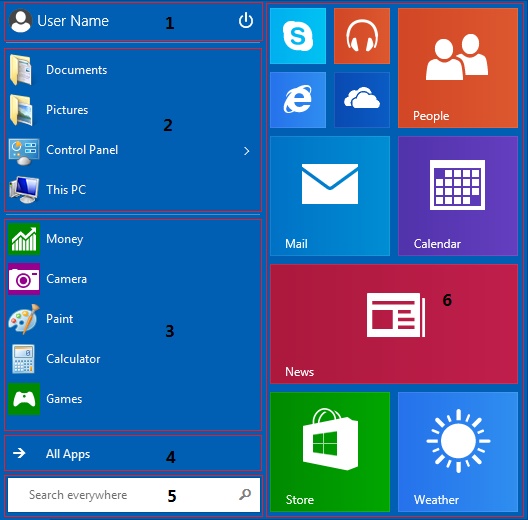
- Header. This is where the user account picture and power button appear.
- Pinned List. Apps that are pinned for easy access appear here.
- Most Frequently Used applications list (MFU). Apps that are frequently used but not pinned anywhere else will appear here.
- All Apps button. Selecting this button displays the All Apps list.
- Search text box. Typing here begins a search.
- App grid. Both Immersive and Win32 apps can be pinned, unpinned, and resized in this area.
For those with a Windows RT device, this update should come automatically through Windows Update. Since Windows RT is mainly on tablet style devices, the Start Menu may actually not be that useful, so you can enable or disable the Start Menu through the taskbar properties on the desktop.
It functions much like the Windows 10 style one, including pinning apps and such, but the actual design of it appears to be closer to what was available on older versions of Windows 10 during the preview period.
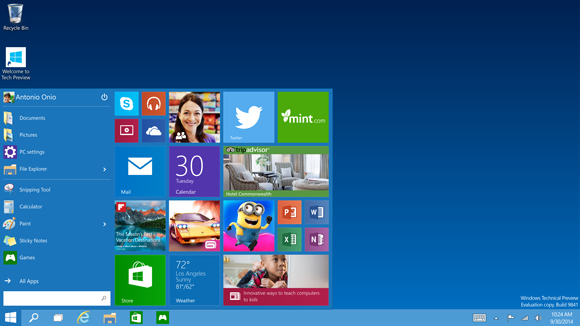
Windows 10 Start Menu in early preview is very similar
The other Windows 10 feature coming is circular frames for user account pictures. Unlike the Start Menu though, there is no method to enable or disable this, it is just going to be there.
Much like Windows Phone 7.8, Windows RT is now a dead platform and Microsoft has given it the smallest of upgrades to end its life. Since it is not running the Windows 10 kernel, Windows RT will never have access to the Windows 10 store, nor the Universal Windows App platform which launched with Windows 10. It instead will forever stay on the older WinRT framework which debuted with Windows 8.
I would have liked to include screenshots from my own Surface RT for this post, but it stopped working a couple of months ago, and clearly there is no need to replace it.
Source: Microsoft Support via ZDNet
Read More ...
Apple Delays Release Of watchOS 2 Due To Unspecified Bug
“We
have discovered a bug in development of watchOS 2 that is taking a bit
longer to fix than we expected. We will not release watchOS 2 today but
will shortly.”
Apple has had issues with updates in recent times, such as the iOS 8.0.1 update that affected Touch ID and calling functionality on the iPhone 6 and 6 Plus. Because the Apple Watch is managed from your iPhone and has no way to be connected to iTunes by a user for a restore it's extremely important that Apple ensures the stability of updates before shipping them. It's not clear exactly what "shortly" means, but it's likely that Apple will not want to delay their planned launch for any longer than necessary.
Read More ...
The Apple iOS 9 Review
2015 has been a pretty big year for Apple as a company. Product launches this year included the Apple Watch, the iPhone 6s and 6s Plus, the iPad Mini 4, the iPad Pro, and the new Apple TV. This month is a big month for their software launches, with today marking the release of iOS 9 as well as watchOS 2, and OS X El Capitan launching at the very end of the month. I hope to do some sort of review of the new features in watchOS 2, but today's article focuses strictly on iOS 9 and everything new that Apple is bringing to their biggest operating system for both users and developers. Read on for the AnandTech review of iOS 9.
Read More ...
Display and Battery Life in the Razer Blade 14" 1080p (2015)
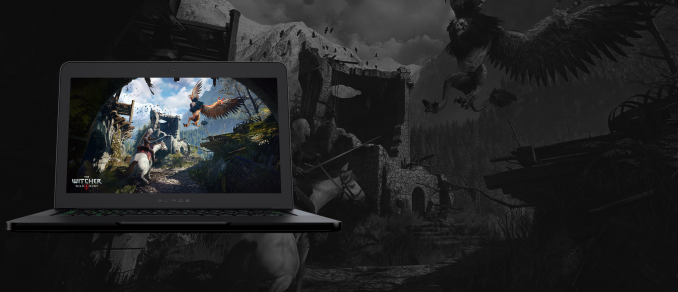
While advantages in battery life could be interesting, the most important part to look at first is the display itself. In order to test this, we use SpectraCal’s CalMAN 5 with a custom workflow, along with X-Rite’s i1Pro2 spectrophotometer and i1DisplayPro colorimeter.
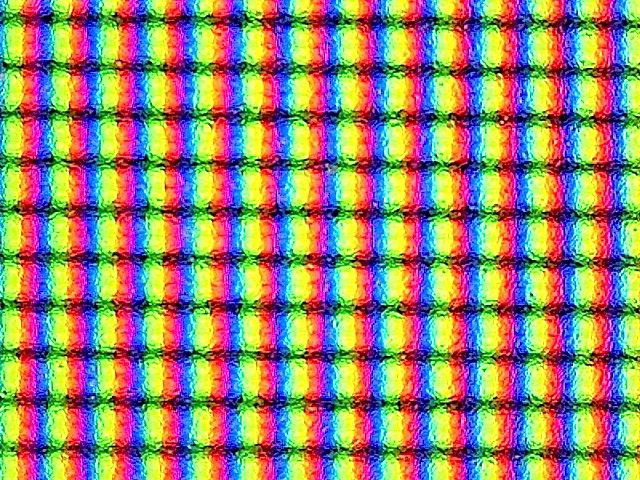
In the case of the Razer Blade 14” 1080p, it seems that Razer has elected to fit this variant with LG’s LP140WF3-SPD1 IPS display. Unlike the Sharp QHD+ panel, this LG IPS display uses traditional a-Si (amorphous silicon) to create the thin film transistors that control the liquid crystals in the display. This means that electron mobility is relatively low compared to IGZO, which means power efficiency on a per-transistor basis will be lower.
Unlike the QHD+ panel, this 1080p also has a matte display. For those that are unfamiliar with the difference that this creates, matte displays attempt to reduce specular reflections which create the mirror effect that glossy displays can have. However, the price of this generally reduced clarity and ultimately since matte coatings don’t do any sort of interference to eliminate reflections diffuse reflections are still present which can wash out the display.
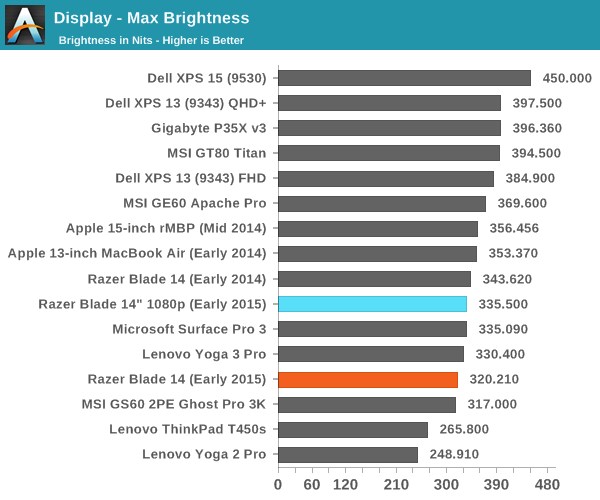
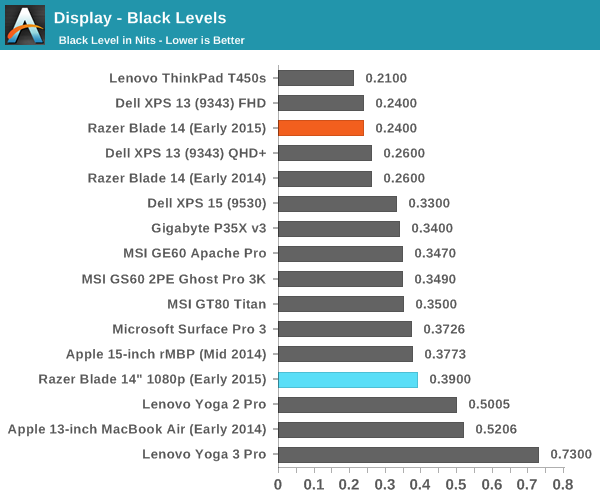
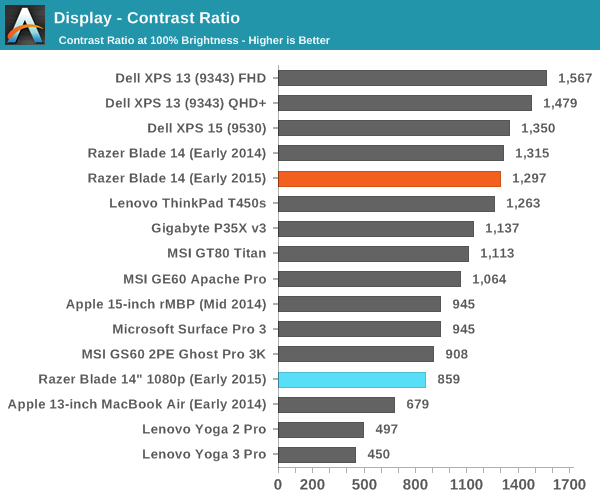
If we look at some of the basic tests of brightness and contrast, the panel is roughly equivalent to the QHD+ variant of the Razer Blade, but black levels are higher which makes contrast lower. This is likely due to the lower Ion/Ioff ratio of a-Si compared to IGZO TFTs. It’s worth noting here that minimum brightness on the Blade 1080p is below 20 nits relative to the 80-90 nits that the QHD+ gets, so night time use should feel less like staring into the face of the sun.
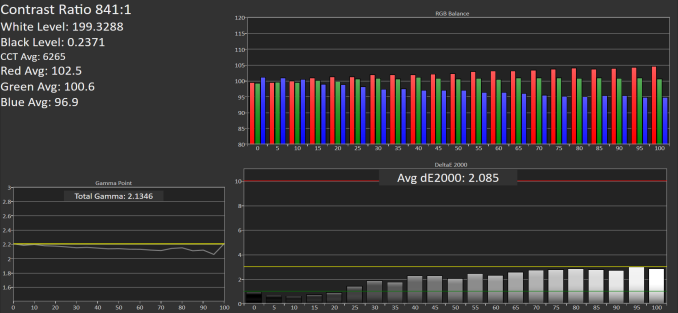
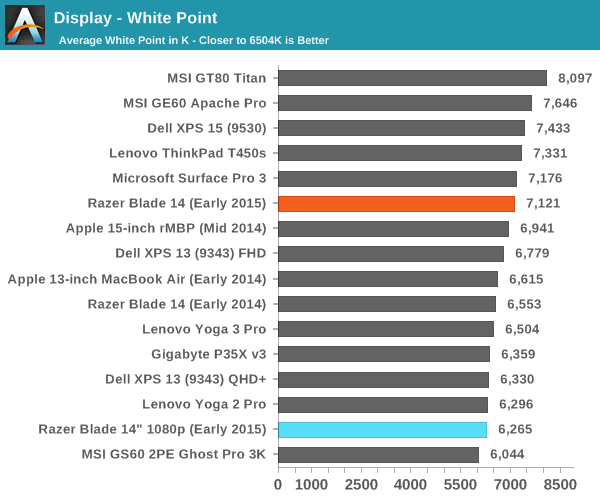
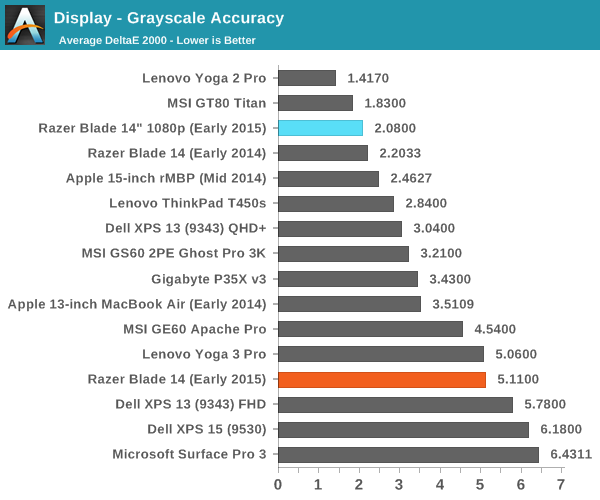
Out of the box for grayscale, it’s clear that Razer is taking calibration at least somewhat seriously judging by the presence of their own color profile for the display in the color management settings. This is set by default, and with it grayscale calibration is already quite acceptable for work that needs color accuracy. The display does end up a bit warm but the difference from neutral shouldn’t be too noticeable.
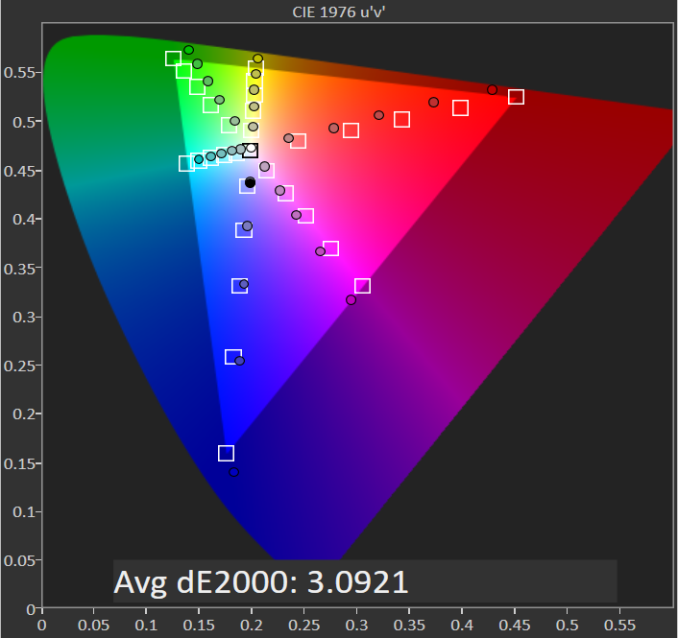
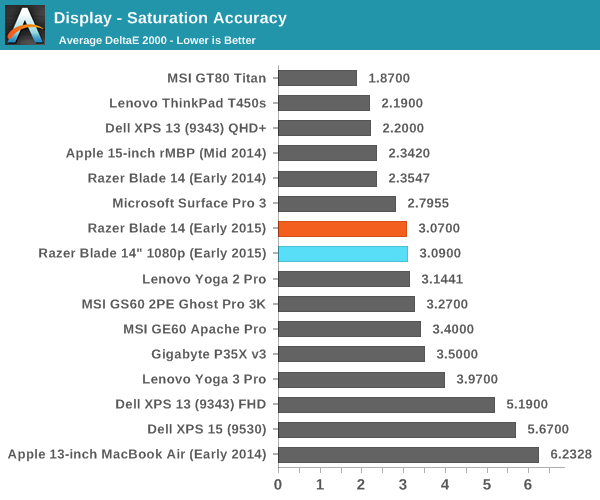
Moving on to the saturation sweep, it’s apparent that the gamut of the display isn’t quite right at roughly 90% sRGB, and as a result colors won’t be 100% accurate. The deviations aren’t enormous, but they’re there for green and red and will affect color-critical work. It’s likely that this should help with power efficiency for what it’s worth.
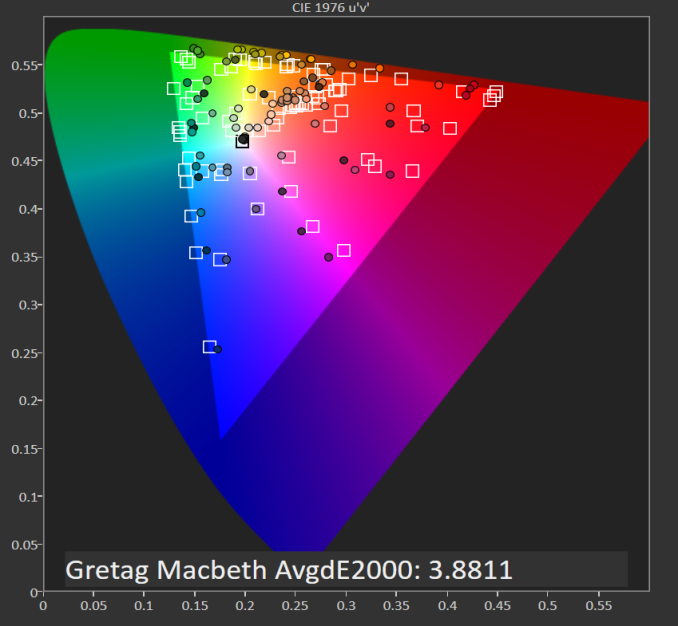
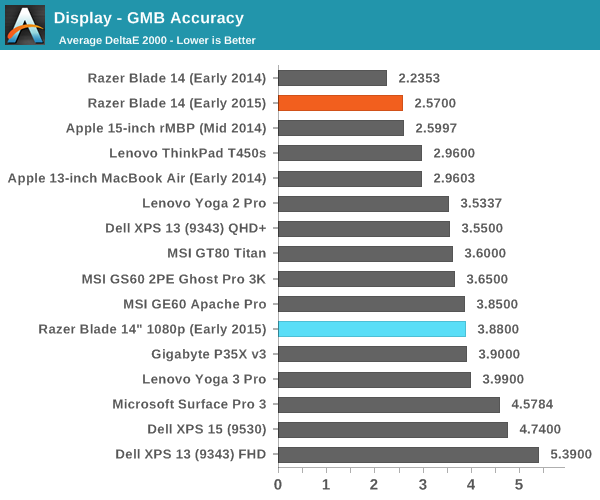
In the GMB ColorChecker, overall accuracy ends up behind the QHD+ variant due to the difference in gamut. It isn’t much, but it’s worth noting.
In order to test calibrated accuracy, we calibrate the display using our custom workflow and the i1Pro2 before running the same tests again, with all calibration done at 200 nits.
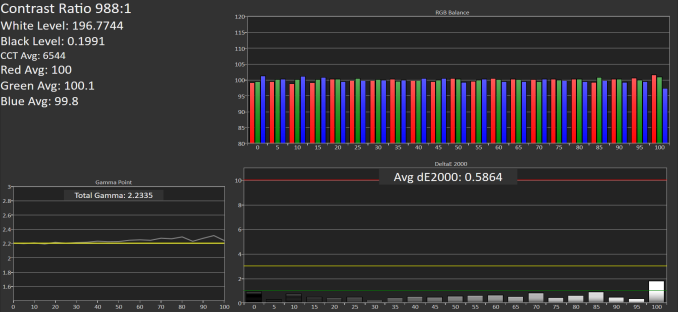
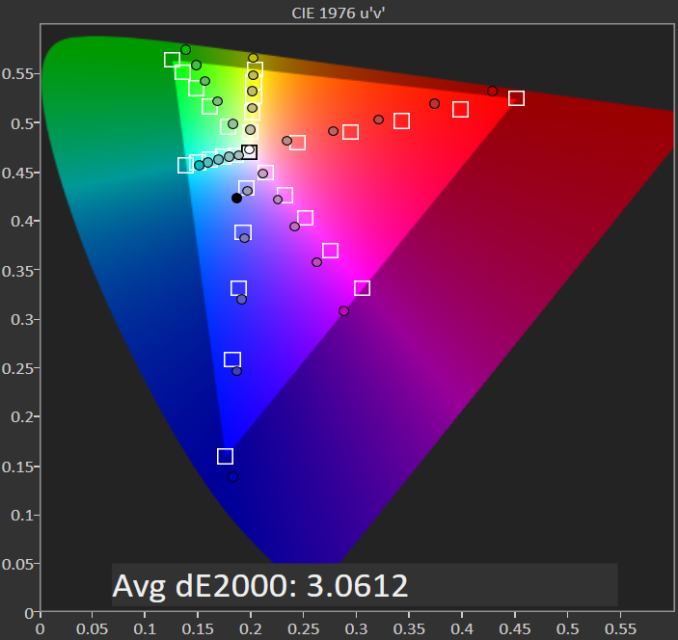
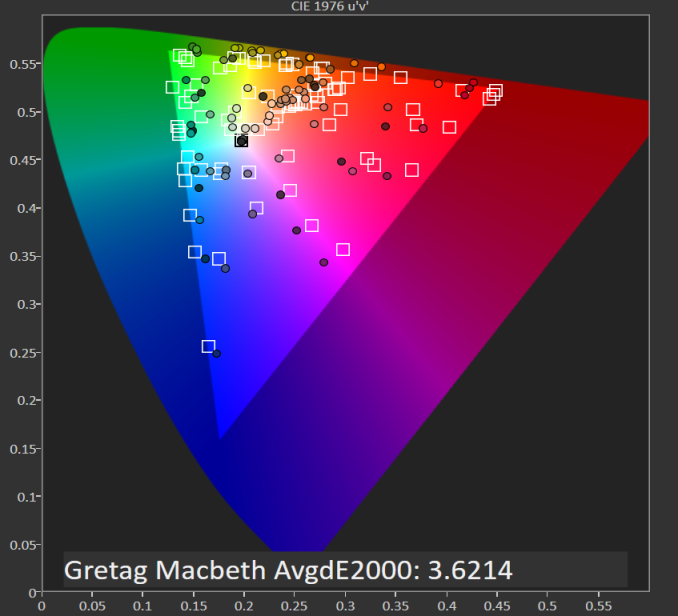
Overall, the display does see some improvement in grayscale but because the display has a gamut problem there’s basically not much that can be done here to improve color accuracy. Accuracy is good enough for just about anyone that will use this laptop, but people that are looking for a display that is almost perfectly covering sRGB should look towards the QHD+ variant.
The next area of interest in this variant of the Razer Blade is definitely battery life. As pretty much everything else can be held constant, the main difference between the 1080p and QHD+ variants this time around can be solely attributed to the display in these tests, as something like RAM isn’t going to have an enormous effect on battery life. In order to test this, we run our standard battery life tests in which the display of the laptop is set to 200 nits brightness, with Power Saver mode enabled with some standardization of advanced power settings within the mode. We then run a loop of certain workloads timing the device from when it’s first unplugged until the laptop dies.
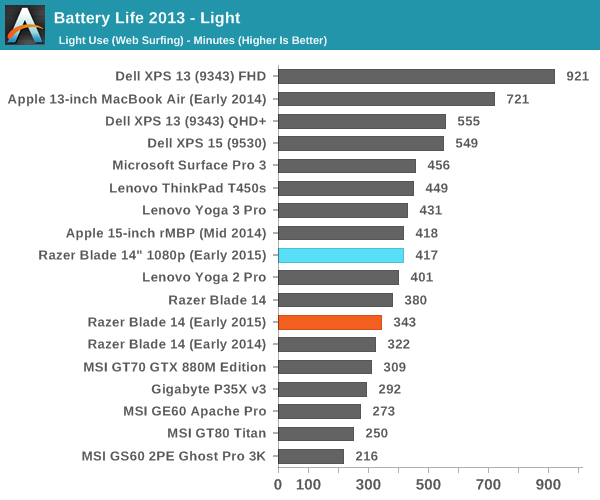
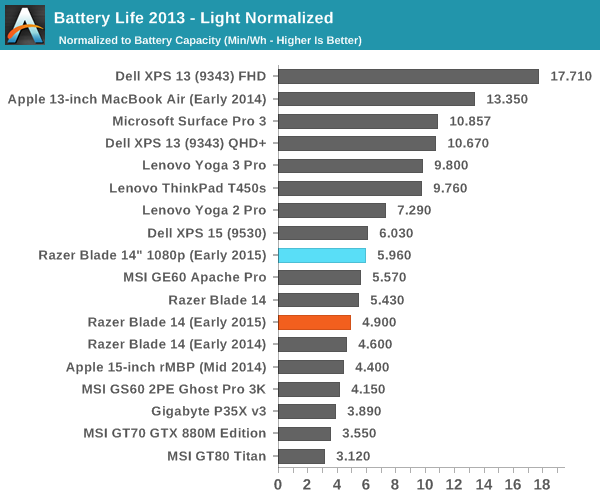
Our first test, which is simply light web browsing, we can immediately see the trade-off that results from the higher resolution of the QHD+ display despite the use of more power-efficient IGZO TFTs. The 1080p Razer Blade gets roughly 22% better battery life in this scenario which is all in the form of higher power efficiency. The 1080p Blade averages roughly 10W throughout this test assuming nominal battery capacity, while the QHD+ Blade averages roughly 12W in this test. Given that this is basically all simple 2D GPU work, I suspect most of the delta here is from display power rather than the GPU increasing clock speed to keep up with the higher resolution.
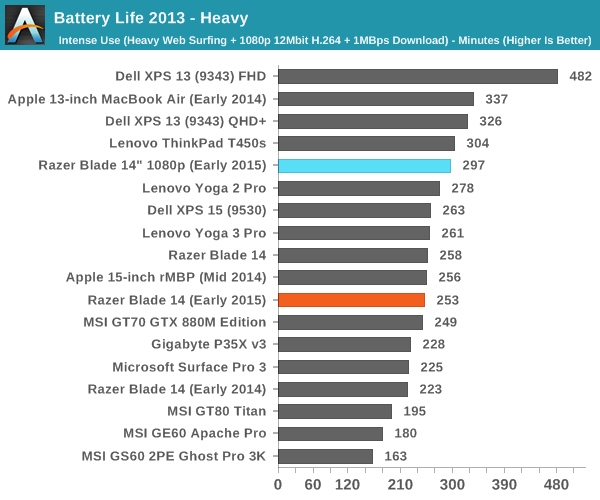
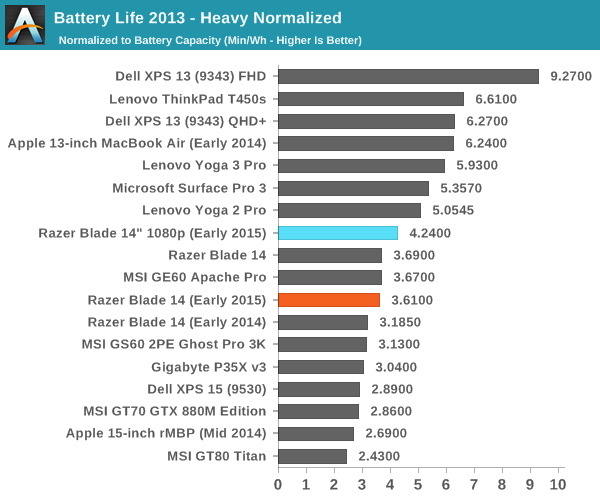
In the heavy test, we can see that the same result plays out, but the gap between the two systems shrinks slightly to 17% instead of 22%, which is because the rest of the system becomes much more dominant in regards to battery life. Here, the Blade 1080p is using about 14W average throughout the test while the Blade QHD+ is using roughly 16.5W. Given that the difference is effectively constant, it’s probably a pretty safe bet that the delta in display power is mostly intrinsic to the display itself.
Overall, for those that are still wondering whether the 1080p or QHD+ Blade is the right way to go here, it’s a tough call. The QHD+ Blade unquestionably has the better display, as someone that has spent over a year using the Blade 14” (2014) as their primary PC. However, the 1080p Blade’s display is still quite good, with decent color accuracy and resolution.
In terms of tradeoffs between the two, on a personal level the matte display is annoying to me because I strongly prioritize display clarity. On the other hand, the 1080p Blade has significantly more battery life, on the order of a 2W reduction at the same brightness level. This may not make a difference when you’re dissipating an average of 80W+ in a gaming scenario, but in any light use scenario like simple web browsing battery life will definitely be a noticeable jump up. The 1080p Blade is also cheaper, but with 8GB of RAM running VMs and other RAM-hungry applications like Chrome will necessitate avoiding excessive multitasking to avoid commit charges well north of 8GB.
Regardless, if battery life is critical I would go with the 1080p variant. On the other hand if you value multitasking or display quality more strongly than extra hour or so the 1080p version will get you, I would still go with the QHD+ variant.
Read More ...
Ghost in the Machine: Apple, Developers Unwittingly Aid App Store Malware
Tens, if not hundreds of thousands of non-jailbroken devices are believed infected after a Trojan compiler malware struck in China
Read More ...
Available Tags:Windows , Google , Android , Google , AMD , Amazon , TV , Microsoft , Apple , iOS ,


No comments:
Post a Comment