

G.Skill Announces DDR4-4000 and DRAM in Dual Channel Kits
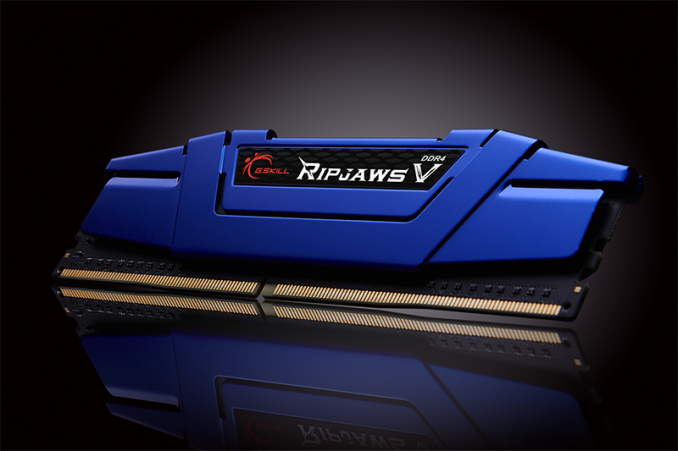
Despite this, G.Skill is today announcing its upcoming memory kits – specifically ‘designed for 6th Gen Intel Core Processors and Z170 motherboards’, or what the rest of us calls ‘Skylake’. These new kits fall into two series called ‘Trident Z’ and ‘Ripjaws V’, with the Trident line being typically faster than Ripjaws although there will be crossover. Memory companies usually do this in order to enable users who prefer one style over the other but still want a certain speed.

These new kits, not only being announced seemingly early, also seem to break DRAM speed barriers for kits in the market. The new Skylake platform is expected to have a memory rating equivalent for the JEDEC specifications for DDR4, which is DDR4-2133 at subtimings of 15-15-15. One of the new kits pushes through to DDR4-4000, almost doubling the frequency of the JEDEC standard, although with a slightly slower sub-timings of 19-25-25.

These will be available only in 2x4 GB form, with pricing not announced. All Trident Z modules will run at the higher DDR4 voltage standard of 1.35 volts except this DDR4-4000 kit, which will require 1.35-1.40 volts. It would seem that the ICs used here are hand picked and tested, and thus each kit might have slightly different voltage requirements and thus uniquely programmed.

The other design is the Ripjaws V, which will cover most frequencies from DDR4-2133 but also in the higher capacity configurations. I am told that G.Skill is ready to deploy a number of kits with 16GB modules, affording 2x16 and 4x16 kits giving 32GB and 64GB of DRAM respectively.

Ripjaws V will be available in red, blue, silver, gray and black. The 16GB modules are specifically using Samsung ICs, and will be available up to DDR4-3200.
The Trident Z line is a lot less spiky than the previous Trident modules for good reason - personally I obtained injuries using it over the years because it was simply sharp. The new line avoids this, but also enables G.Skill to add its name to the top of the module, allowing modders to indicate exactly what modules are being used.
Given this press release today, and what we’ve heard on the grapevine, it seems that Skylake is promising to be a super platform for DRAM in terms of both capacity and speed. Needless to say, pricing and specific release dates were not provided. I suspect other companies will follow with their dual channel kit announcements soon given this release today.
Source: G.Skill


Read More ...
Windows 10 Launch Day GPU Support Summary
In the meantime we wanted to quickly cover the state of driver support for Windows 10 and DirectX 12, as matters have evolved slightly differently than we were expecting. Around the time of DirectX 12’s announcement, it was announced that AMD’s GCN GPUs, Intel’s Haswell (Gen 7.5) and newer, and NVIDIA’s Fermi and newer GPUs would all support the technology. And while those plans have not changed, we’ve learned this morning that schedules have shifted slightly, and as a result not every GPU slated to get DirectX 12 support will have that support available today.
| DirectX 12 Support Status | ||||
| Current Status | Supported At Launch | |||
| AMD GCN 1.2 (285/380/Fury Series) | Working | Yes | ||
| AMD GCN 1.1 (290/260/390/360 Series) | Working | Yes | ||
| AMD GCN 1.0 (7000/200/370 Series) | Working | Yes | ||
| NVIDIA Maxwell 2 (900 Series) | Working | Yes | ||
| NVIDIA Maxwell 1 (750 Series) | Working | Yes | ||
| NVIDIA Kepler (600/700 Series) | Working | Yes | ||
| NVIDIA Fermi (400/500 Series) | Not Available | Delayed | ||
| Intel Haswell (4th Gen Core) | Working | Yes | ||
| Intel Broadwell (5th Gen Core) | Working | Yes | ||
Earlier this morning NVIDIA posted a knowledge base article entitled “Windows 10 will not load the NVIDIA display driver for my older graphics card in my PC that has multiple graphics cards”, which addresses the use of mixed generations of GPUs in a single system. In the article NVIDIA notes that WDDM 2.0 drivers – being necessary for DirectX 12 support – are not currently available for their Fermi GPUs. Instead Fermi cards are still using WDDM 1.3 drivers, or in other words the driver base for Windows 8.1.
The article itself is focused on the compatibility issues that can occur mixing WDDM 2.0 and WDDM 1.3 products – basically, you can only have one or the other active at once within a single driver since both modes can’t be used at the same time – however the more important outcome of this article is that it confirms that Fermi DirectX 12 support is behind schedule. NVIDIA is still committed to bringing DirectX 12 support to Fermi, however it will not be available for today’s Windows 10 launch, and NVIDIA has not announced a specific availability date (though if I had to take a guess, I’m thinking the next driver branch).
Ultimately what this means is that only NVIDIA’s Kepler and Maxwell GPUs (the 600 series and newer) will support DirectX 12 as of today’s launch. Meanwhile in committing to supporting Fermi, NVIDIA will be offering DirectX 12 for GPUs about a year and a half older than anything AMD or Intel are supporting, so it’s hard to be too cross with them, but it is at least a minor disappointment that NVIDIA hasn’t been able to adhere to their original schedule. From a gaming perspective NVIDIA still has a few months before any retail games are available, so NVIDIA still has time, though in the meantime this means we’re going to have to wait a bit longer to see what DirectX 12 can do for NVIDIA’s oldest lineup of GPUs.
Finally, support for Intel and AMD GPUs has rolled out as expected. AMD’s Catalyst 15.7 driver offers working DirectX 12 support for all GCN 1.0, 1.1, and 1.2 GPUs, including the newly launched Fury series. And Intel’s latest driver sets for Haswell and Broadwell respectively also enable the necessary driver functionality.
Update (7/29)
Speaking of GPUs, all three vendors have released new driver versions today to coincide with the launch of Windows 10. So without further adu:
AMD: Catalyst 15.7.1
Intel: 15.40.4.64.4256
NVIDIA: Release 353.62
Windows Update should also be distributing these drivers directly.
Read More ...
The ASUS Republic of Gamers G751 Review: G-SYNC Comes To The Notebook Computer
At Computex 2015, NVIDIA announced what will almost certainly be one of their marquee features on gaming notebooks going forward, with NVIDIA’S G-SYNC variable display refresh rate technology coming to notebooks. One of those system builders was ASUS, and NVIDIA shipped me the ASUS G751JY model with G-SYNC to take a look at. The G751 was first introduced in October 2014. It is a 17.3-inch laptop targeted towards gamers under ASUS’s Republic of Gamers (ROG) branding.
Read More ...
Exclusive: If Intel and Micron's "Xpoint" is 3D Phase Change Memory, Boy Did They Patent It
Flash successor technology may be the one Intel's been cooking up under the names "Purley" and "Apache Pass"
Read More ...
Available Tags:Windows , GPU , ASUS , Gamers , Notebook , Intel , 3D ,


No comments:
Post a Comment