

Microsoft Surface Hub Availability And Specifications Announced
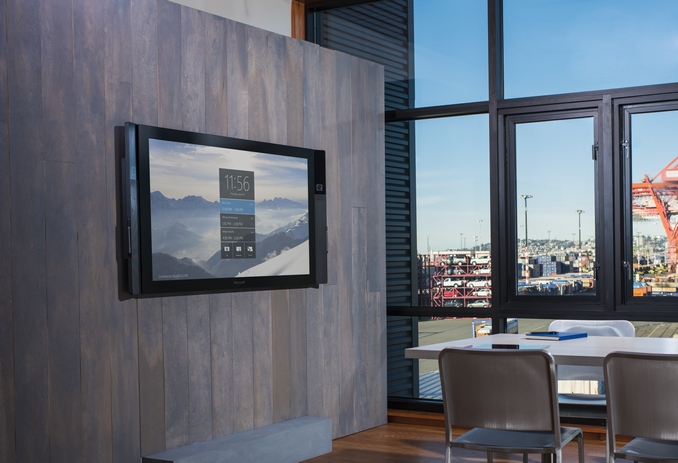
The first bit of news though is that the Surface Hub will be available for pre-order starting on July 1st, and shipments will begin in September. It will initially be available in twenty four markets, with the United States, Canada, Australia, Austria, Belgium, Denmark, France, Finland, Germany, Ireland, Italy, Japan, Luxembourg, the Netherlands, New Zealand, Norway, Portugal, Qatar, Singapore, Spain, Sweden, Switzerland, United Arab Emirates and the United Kingdom all getting first dibs on this new device. The prices will seem steep to anyone who does not often furnish a conference room, with the smaller 55-inch model being offered for $6999, and the 84-inch model will sell for $19,999.

That is not inexpensive at all, but it should actually be less expensive that some of the other conference room solutions, and yet pack in technology that they can’t offer. Here is a table of the listed specifications:
| Microsoft Surface Hub | ||||||
| Surface Hub 55" | Surface Hub 84" | |||||
| Dimensions | H: 31.75" (806.4 mm) W: 59.62" (1514.3 mm) D: 3.38" (85.8 mm) |
H: 46.12" (1171.5 mm) W: 86.7" (2202.9 mm) D: 4.15" (105.4 mm) |
||||
| Weight | 105 lbs (48 kg) | 280 lbs (127 kg) | ||||
| CPU | Intel Haswell (4th Gen) Core i5 | Intel Haswell (4th Gen) Core i7 | ||||
| GPU | Intel HD 4600 | NVIDIA Quadro K2200 640 CUDA Cores | ||||
| RAM | 8 GB | 8 GB | ||||
| Storage | 128 GB SSD | 128 GB SSD | ||||
| Display | 55" 1920x1080 @ 120 Hz 1300:1 Contrast Ratio 100-point Multi-touch Three Simultaneous Active Pens Projective Capacitance optically bonded sensor |
84" 3840x2160 @ 120 Hz 1400:1 Contrast Ratio 100-point Multi-touch Three Simultaneous Active Pens Projective Capacitance optically bonded sensor |
||||
| Networking | Wired 1 Gbps Wireless 802.11ac Bluetooth 4.0 LE NFC Reader Miracast Enabled |
|||||
| Ports | Internal PC (1) USB 3.0 (bottom) + (1) USB 3.0 (side access) (2) USB 2.0 Ethernet 1000 Base-T DisplayPort Video Output 3.5mm Stereo Out RS232 Serial Port RJ11 Connector for system level control Alternate PC (2) USB 2.0 type B output, connection for: Camera Sensors Microphone Speakers Touchback™ (1) DisplayPort Video Input Guest PC DisplayPort Video Input HDMI Video Input VGA Video Input 3.5mm Stereo Input (1) USB 2.0 type B Touchback™ Output |
|||||
| Sensors | (2) Passive Infrared Presence Sensors Ambient Light Sensors |
|||||
| Speakers | (2) Front Facing Speakers | |||||
| Microphone | High Performance, 4 Element Array | |||||
| Cameras | (2) 1080p @ 30fps | |||||
| Price | $6,999 | $19,999 | ||||
The first notable aspect is the displays, which both feature optically bonded projective capacitance sensors to minimize reflections. Both models also can support an insane 100 points of concurrent multi-touch, and three simultaneous pen inputs. The 55-inch model is a 1920x1080 panel, and the 84-inch is a 3840x2160 resolution, and both have a refresh rate of 120Hz. The touch digitizer is also 120Hz, and according to Microsoft it makes the experience much more akin to an analog counterpart.
These will not be just displays to project to either. Powering the Surface Hub is a custom version of Windows 10, which is run on a Haswell Core i5 on the smaller model and a Core i7 on the larger one. The 84-inch model also jumps from integrated graphics to the NVIDIA Quadro K2200, which is a Maxwell based GM107 GPU with 640 CUDA Cores. Both Hubs come with 128 GB of SSD storage and 8 GB of RAM, as well as Gigabit Ethernet and 802.11ac, with Bluetooth 4.0 LE, NFC, and Miracast available.
They will also feature two front-facing stereo speakers, a four element microphone, two 1080p cameras each, as well as passive infrared presence sensors and ambient light sensors.

I think the steep price is going to keep these devices closely locked to their target audience of conference and meeting rooms. It would be very cool to have an 84-inch Windows 10 powered Smart TV, but for $20,000 it would be a tough sell.
I’ve asked a couple of questions to Microsoft to get some more details about this device though, including its ability to handle HDMI 2.0 inputs and a few other things, so once I hear back I’ll update the post.
Source: Microsoft
Read More ...
Futuremark Announces VRMark: A Benchmark For Virtual Reality Systems
Because virtual reality systems have many aspects that all need to be functioning properly to provide a good experience, the process of benchmarking them is different from how you would test a computer or a smartphone. VRMark will evaluate a system's ability to provide a high and consistent frame rate, as with virtual reality it's important to both have a high frame rate, as well as to ensure that the timing between those frames is consistent.
In addition to measurements of the hardware's ability to render and display frames in a timely and smooth manner, VRMark will evaluate the sensors located in a VR head-mounted display. Lowering sensor latency has been a big part of the development process for VR headsets, and VRMark will help companies and reviewers evaluate this aspect of VR system performance.
There's currently no word on when VRMark will be released, apart from the promise that it will launch in 2015. Virtual Reality benchmarks like VRMark will certainly be a useful tool to see how the various VR headsets currently being developed compare to one another.
Read More ...
Apple’s Metal API Comes to OS X Desktops

Metal, despite being the 3rd such low-level API to be introduced, was the first to reach production status. Microsoft’s DirectX 12 is arguably not there yet (Windows 10 is still in testing), and Khronos’s Vulkan was still in its primordial Mantle form at this point in 2014. What this means is that out of all of the vendors, it’s arguably Apple who has the lead time advantage in low-level API development. Which is why for the last year we have been wondering if Metal would stay on iOS, or make the jump to OS X.

Yesterday we got our answer, with the announcement from Apple that Metal would be coming to OS X “10.11” El Capitan, and that it would be part of a larger investment into Metal for the company. Along with bringing Metal to OS X, Apple is going to be releasing new API kits that interface with Metal to simplify development, and internally Apple is now using Metal (when available) for parts of the desktop composition rendering chain. At this point it’s fair to say that Apple has gone all-in on Metal.
Consequently the fact that Metal is now over on OS X is not unexpected, but whether it has been planned for or not, it means that we now have 3 low-level APIs on the desktop as well as mobile. OS X’s Metal will be going head-to-head with Microsoft’s DirectX 12 and Khronos’s Vulkan, and this is the first time in a very long that we have seen a viable and competitive 3rd graphics API on the desktop, as DirectX and OpenGL have been the reigning APIs since the turn of the millennium.

As for what this means for Mac users, in the short run it’s a good thing. With Vulkan still in development, had Apple not implemented Metal on OS X, OS X would have needed to stick with classic OpenGL for another year until OS X 10.12. Going with their own API, as was the case with mobile, gets a low-level API on OS X sooner. Furthermore because it’s been on iOS for the last year, Apple gets to leverage all of the developer experience and code already written for Metal, and bring that over to OS X. Which is why developers like Epic are able to show off engines using Metal on OS X so early.
In the long run however there are some big unknowns left to answer, which could have a big impact on how things play out. Apple has not yet released the complete documentation for the newest version of Metal – specifically, we don’t have feature lists – so how the Mac and iOS versions compare feature-wise remains to be seen. My biggest concern here is that Apple will put OS X and iOS at parity, essentially limiting the features available to the lowest common denominator of iOS, leading to Macs in general being behind the curve in graphics features. The other big question is whether Apple will support Vulkan next year once it’s done, or whether they will stick with Metal, essentially turning OS X’s graphics stack proprietary. Which for users could lead to a reduction in game ports to the Mac if developers have to go write against a Mac-specific graphics API.
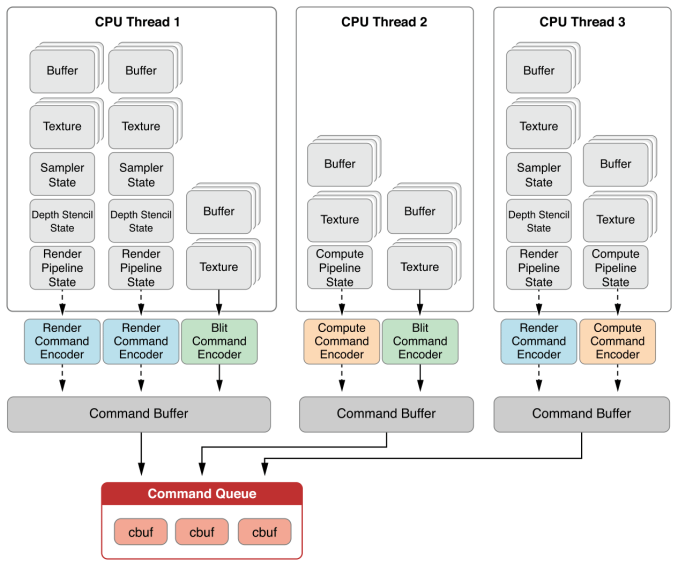
Apple iOS Metal Thread Model
One thing that is a pretty sure bet at this point is the GPUs that will support Metal. In short, don’t expect to see anything that can’t support Vulkan support Metal due to a lack of necessary features. So I’m expecting Metal compatibility to start with Intel’s Haswell (Gen 7.5) iGPUs, AMD’s GCN dGPUs, and NVIDIA’s Fermi/Kepler dGPUs. El Capitan works on a much wider range of machines of course, so this means only a fraction of those machines get to experience Metal. Though this was the same situation on mobile as well.
As for developers, things will be interesting. As I mentioned before Apple seems to be going all-in on Metal, starting with the fact that they will have Metal back-ends for their Core Graphics and Core Animation frameworks. And actually I’m a bit surprised by this, as basic compositing is not something that is draw call limited. Apple is claiming upwards of 50% performance increases here, so I’m curious just how this works out, but I suspect these are based on low-level benchmarks. Draw call performance is not the only benefit of Metal, but it is the most immediate, so Apple may be leveraging the harder to get GPU benefits here, or just wringing every last Joule of power out by getting to an API that isn't doing high-level state checking.
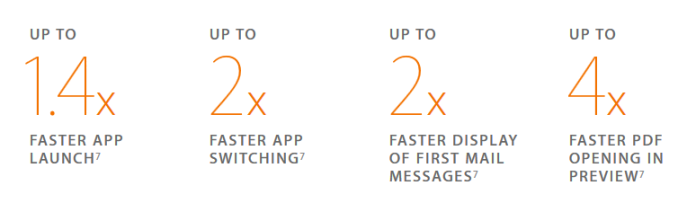
OS X Metal Performance Improvements: From Apple's Promotional Materials
In any case, by building Core frameworks off of Metal, Apple is in a position where they have to ensure Metal drivers are working well, which is to the benefit of developers. Meanwhile Apple is going one step past Metal on iOS 8 with the release of MetalKit, which is a set of utility functions for Metal to help speed Metal development. As we’ve mentioned before one of the few real pitfalls of low-level APIs is that to best utilize them you need guru-level programmers – after all, the API doesn’t have high-level safety nets to keep developers out of trouble – and with MetalKit Apple is at least partially resolving this issue by providing some base functionality for programmers.
Wrapping things up, though not an unexpected move from Apple, it will none the less be interesting to see how their efforts with Metal go. As a tightly integrated vendor they have the advantage of being able to move quickly when they choose to, which is why we’re seeing Metal come to OS X so soon and to get used by Core OS components so soon. Metal is just a graphics API, but due to Apple’s timing OS X will be the real test for low-level APIs on the desktop, and not just for gaming. Apple is in an interesting position to take advantage of these new APIs like no one else can, so in several ways they are going to be the pathfinder on just what can be done with these APIs.
Read More ...
be quiet! Showcases New Silent Base 600 Case & SilentWings 3 Fans


The other new product be quiet! showcased is the third generation SilentWings fan. be quiet! modified the shape of the blades to produce higher airflow without increasing the noise level and SilentWings 3 is also the only consumer-oriented fan with a 6-pole motor. Both PWM and non-PWM models will be available in October with the Euro MSRPs being about 20€.


Read More ...
IBM Pairs Xilinx FPGAs to POWER8 to Create an Education Cloud Service
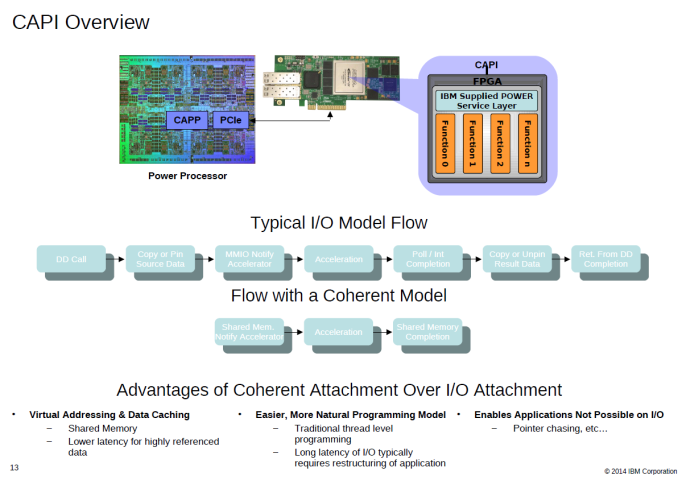
Xilinx is delighted to have been chosen as the provider of FPGA accelerators for the IBM SuperVessel cloud. FPGA-based compute acceleration is a critical part of the OpenPOWER Foundation vision to handle demanding workloads in the most cost and power-efficient way. For this reason, a CAPI-enabled Xilinx FPGA is attached to every IBM POWER8 node in the SuperVessel cloud. The research and development being done in the SuperVessel is helping to define the future of heterogeneous computing.”
FPGAs, or field-programmable gate arrays are traditionally used to perform a specific algorithm in hardware. The result is a bulky and expensive chip (produced in low quantities) that runs a certain algorithms at very high speed and low latency.
Offloading some processing tasks to a specialized chip is certainly nothing new. APUs are CPUs that offload some of their tasks to integrated GPUs. But quite a few parallel algorithms run fast but pretty inefficiently on GPUs. In many cases, an FPGA uses a lot less power.
Intel has been delivering "customized" Xeons to large customers such as Amazon en Facebook, and has been promising that it will integrate Altera FPGAs inside certain Xeons. Intel recently bought Altera for $16.7 Billion.
But IBM seems to have beaten Intel to the FPGA punch with CAPI, the POWER8's Coherent Accelerator Processor Interface. IBM does not integrate FPGA inside the POWER8 package (yet), but communicates coherently over the PCI express interface.
The most interesting fact about "Supervessel" that is IBM has managed to make a cloud service that makes ample us of - traditionally expensive - FPGAs, and that the necessary software is in place to make it relatively easy to make use of those FPGAs. What software did IBM implement to make offload some of the processing work to the Xilinx FPGAs? Unfortunately, so far we only saw the press release and it is very light on technical details. Nevertheless, it is interesting to note that the OpenPOWER Foundation is making a lot of progress in very little time - it was founded only at the end of 2013.
Read More ...
SFF-8639 Connector Renamed as U.2
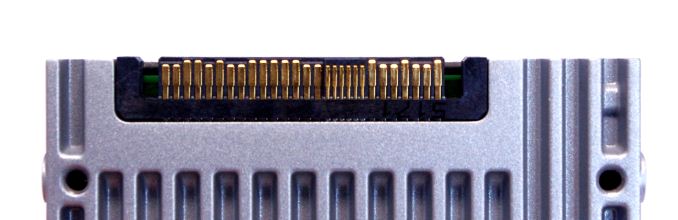

Whether U.2 and 2.5" PCIe SSDs take off in the client space remains to be seen, though. The biggest hurdle is the expensive cabling because unlike normal SATA and SATA Express cables, the U.2 cable consists of several small, shielded cables that increase the cost. From what I have heard that is the reason why the industry came up with SATA Express in the first place because the OEMs wanted to keep the cabling cost equivalent to existing SATA cables.
I believe M.2 will be the main connector / form factor in the client space, but there is still a market for high performance and capacity 2.5" PCIe SSDs as M.2 has more physical limitations that restrict the capacities and thermals. I can see U.2 in high-end motherboards where the connector and cable costs aren't that big of an issue, but we'll see what happens over the next year or two.
Source: Hardwarezone via PC Perspective
Read More ...
Seagate Announces SandForce SF3500 SSD Controller Series: Mass Production Expected in Q4'15
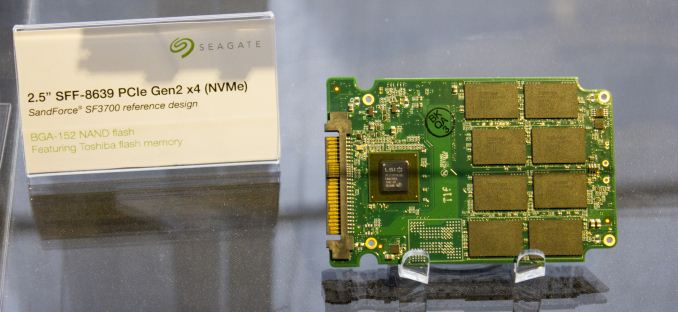

The SF3500 package is considerably smaller than the SF3700
The original paper launch back in late 2013 only included the SF3700 lineup, which was first supposed to cater all markets from entry-level client to enterprise. Last week Seagate announced that the SF3000 series has now been split into two: SF3500 for the client and SF3700 for the enterprise market. The reasoning behind the differentiation doesn't only lie in marketing as the SF3500 and SF3700 are separate dies with the SF3500 having four NAND channels whereas the SF3700 keeps the 9-channel design as announced previously. It makes a lot of sense to build a separate die for the client space and honestly I was a little skeptical about cost efficiency because it's practically impossible to build a silicon that is feature rich enough for the enterprise with a consumer friendly price tag. We've seen the client space moving towards 4-channel controller designs anyway, so I suspect introducing a smaller 4-channel controller was the only way SandForce could remain price competitive against Silicon Motion, which has taken a large share of SandForce's old clients.
| Seagate SandForce SF3000 Series Specifications | |||||
| Series | SF3500 | SF3700 | |||
| SKU | SF3514 | SF3504 | SF3524 | SF3739 | SF3759 |
| # of NAND Channels | 4 (400MT/s each) | 9 (400MT/s each) | |||
| Controller Frequency | 275MHz | 275MHz | 300MHz | N/A | N/A |
| Interface | SATA 6Gbps | PCIe 2.0 x2 (NVMe) | SATA 6Gbps + PCIe 2.0 x2 (NVMe) | SATA 6Gbps + PCIe 2.0 x4 (NVMe) | |
| Max Capacity | 1TB | 2TB | |||
| NAND Support | MLC, TLC | MLC, TLC | SLC, eMLC, MLC, TLC | ||
| Sequential Read | 550MB/s | 900MB/s | 900MB/s | 1600MB/s | 1600MB/s |
| Sequential Write | 450MB/s | 525MB/s | 525MB/s | 670MB/s | 670MB/s |
| 4KB Random Read | 100K IOPS | 130K IOPS | 130K IOPS | 130K IOPS | 130K IOPS |
| 4KB Random Write | 80K IOPS | 120K IOPS | 120K IOPS | 80K IOPS | 80K IOPS |
| Mixed 70R/30W Random | 80K IOPS | 120K IOPS | 120K IOPS | 100K IOPS | 100K IOPS |
| Encryption | AES-256, TCG Opal 2.0 & IEEE-1667 (eDrive) | AES-256 | AES-256 & TCG Entrerprise | ||
The SF3500 series includes three SKUs and similar to the SF3700 silicon the controller supports both SATA 6Gbps and PCIe 2.0 (although only two lanes, whereas the SF3700 features four). The SF3514 and SF3504 are SATA and PCIe respectively, but the SF3524 has a switch that allows it to operate in both SATA and PCIe modes similar to the SF3700 SKUs. Unfortunately the switch isn't user-accessible as it has to be toggled by the manufacturer, so it's merely a feature that helps the OEMs with inventory management. The SF3524, being the high-end model, also has more supported firmware features, but Seagate isn't disclosing any at this stage, although I was told they are more back-end related rather than concrete features that are visible to the end-user.

Inherently the SF3500 is just a 4-channel version of the SF3700 and supports all SandForce technologies (DuraWrite, SHIELD, RAISE etc), but with one twist. The SF3500 is the first time SandForce is relying on external DRAM for caching the NAND mapping table, whereas the SF3700 and all older SandForce controllers only use the integrated SRAM. No user data is stored in the DRAM, so its function is purely to increase performance as well as reduce power up time when waking the system from sleep.

Another separating feature is the RAISE support. Because the SF3500 is client-oriented, it only supports level-1 RAISE, which uses one NAND die for protection against single page/block failures (in small capacity drives fractional RAISE can be used as it requires less than a full die). The SF3700 has full RAISE support and can operate in either level 1 or 2 mode with level-2 protecting against a full die failure (the 9th channel is there for that reason).

SandForce's focus in the SF3000 series has been mixed performance from day one. While most modern drives boast excellent peak read and write performance, nearly every drive experiences notable loss in performance under mixed read/write workloads. We've been testing mixed performance as a part of our 2015 Client SSD Suite and I certainly agree with SandForce that it's an area where improvement is needed, which is what the SF3000 series is promised to do. Seagate's/SandForce's internal tests put the SF3700 at much higher performance efficiency than the competing NVMe drive that Seagate couldn't officially disclose (hint: the manufacturer starts with an I).


All in all, Seagate seems to be making progress with the SF3000 series. It's inevitably late from the original launch schedule, but on the other hand there are only a handful of client PCIe drives on the market right now, so if the new schedule sticks and the SF3000 is as good as Seagate is showing it to be, SandForce will definitely be back in the game. The Computex announcement was relatively high-level, but Seagate hinted that they will have a truckload of new details to share within the next two months, so we will stay tuned for more.
Read More ...
The Corsair CS450M PSU Review
Top tier PSUs certainly are technologically interesting, yet the mainstream products undoubtedly cover the vast bulk of the market. Today we are having a look at the Corsair CS450M, a reasonably priced 450W high quality PSU targeted right at the bulk of home/office PC users.
Read More ...
BitFenix Shows Massive Atlas Case & LED Light Stripes
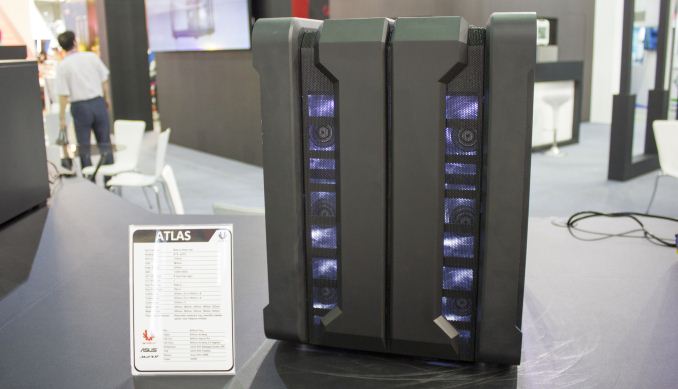


I've added more shots of the Atlas in the gallery above. One interesting detail is the screw-less hard drive bays, although in a case this huge only four bays is a little limiting. Personally I feel that Atlas mostly wastes a lot of space by focusing solely on creating a cleaner look. Nowadays there are many cases that hide the PSU fairly well and with good cable management you can achieve a clean look without twice the size. I guess the Atlas could still have a niche for users who really need a lot of space for e.g. radiators, but I feel like it's more of a concept at this point rather than a final product.

While nothing new, BitFenix also had its Pandora mATX and ATX cases on display.

BitFenix had its own LED light stripes inside every case, which light the system up and give the user the ability to properly see the components inside. You only need two stripes for lighting the innards and obviously the stripes are available in multiple colors to fit everyone's preference. I asked about an RGB version, but I was told that and RGB version couldn't produce as pure colors and producing white light (which is one of the most popular models) wouldn't be possible at all. In addition, RGB would add unnecessary cost due to a controller requirement, so at least for now BitFenix is only shipping single-color stripes.
Read More ...
HTC Pushing A Small Update To The HTC One M9 Today

Camera
- Greater auto-exposure balance to improve overexposure, so images look less washed out
- Reduction of noise and blur in low light, so images are clearer and detail is more apparent
- Reduction of yellow/green hue to photos taken in extreme lighting conditions, so colors appear truer to their actual hue
Battery Life
-
Reduced power consumption by YouTube and Facebook, so you can stay on
these sites longer or know that your battery will last longer if your
site use doesn’t change
Heat Management
- Smart charging thermal improvement, which means your phone will stay cooler when it’s being charged
While this update is still Android Lollipop 5.0.2 instead of Lollipop 5.1, the improvements to battery life and camera processing will definitely be appreciated by users.
Read More ...
Microsoft Launches Updated Xbox One, Controller, and PC Adapter
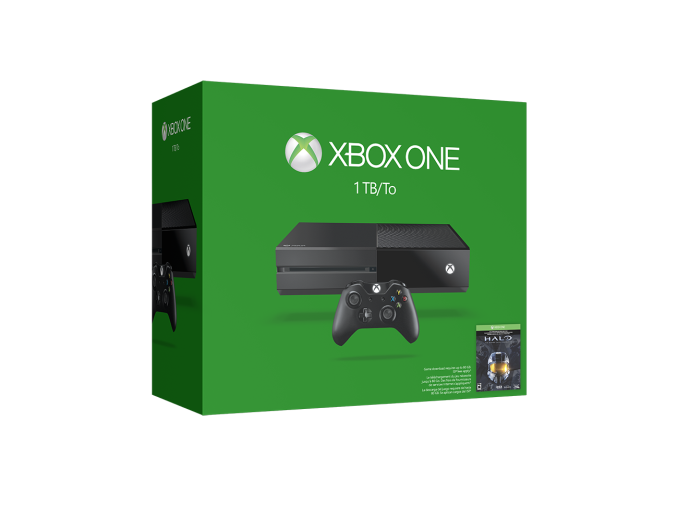

Also being announced today, and being bundled with the new Xbox, is an updated version of the wireless controller. The big change is that Microsoft has finally ditched the proprietary headset connector, and has now moved to the normal 3.5mm jack. More subtle, but certainly notable, is that the bumpers have been tweaked, and the new controllers can now be updated wirelessly. The first gen controllers could also be updated, however they had to be connected to the Xbox One with a USB cable, so this should make it a lot easier to keep the controller firmware up to date. I have only updated my controllers one time because it’s a bit of a pain to do so, but when Microsoft drastically reduced the connection time when powering on the controllers, it was worth my time to find a cable and do that. With the new ones, even less hassle is necessary which is always a good thing. There is also a new camouflage design in silver and black available for those that want something different.

The final bit of Xbox news today is that Microsoft is finally releasing a wireless adapter for Windows PCs, letting you use the Xbox One controllers on your PC with no cable necessary. The adapter is just $25, or bundled with a controller for $80, and should come in very handy for anyone who wants to do PC gaming with a controller, or more importantly for those that want to use the upcoming game streaming from their Xbox One to their PC, which is something I got to try first hand at Build. The wireless adapter is coming this fall.

The new 1 TB model of the Xbox One will be bundled with the Halo Master Chief Collection and available starting on June 16th for $399, with the 500 GB model being permanently moved to $349.
Source: Major Nelson Blog
Read More ...
Silicon Motion Displays Upcoming SM2260 PCIe 3.0 x4 NVMe Controller
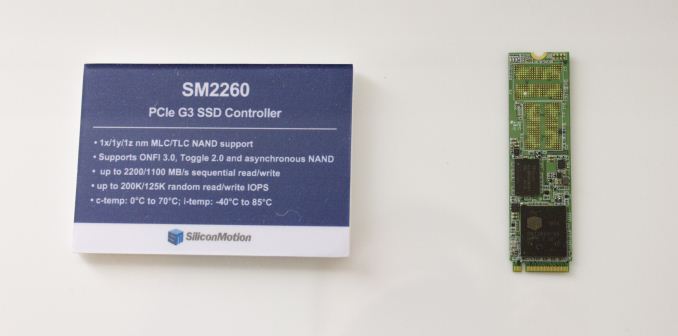
Silicon Motion is still fairly early in development and the SM2260 won't be available until sometime next year. For now the company is keeping the additional details close to its chest, but we'll hear more once Silicon Motion has something concrete to show.

In addition to the SM2260, Silicon Motion showcased its new SM2256 controller that will be shipping in the next couple of months. It's the first commercially available controller & firmware solution with TLC support and as a part of Computex Silicon Motion announced that it now supports Micron's 16nm TLC NAND as well, along with all other available TLC NAND dies. ADATA already displayed its SP550 with the SM2256 inside and it will be among the first drives to ship with the new SMI controller. We have some preliminary benchmarks of a 500GB SM2256 reference design sample in our Bench section, so head there if you're interested in taking an early look.

Another product Silicon Motion had on display was the SM2246XT, which is a DRAM-less version of the popular SM2246EN. There is a slight performance impact from the lack of DRAM cache as only parts of the NAND mapping table can be stored in the controller's internal SRAM cache, but in return the SM2246XT offers lower cost due to a smaller die (no need for DRAM controller). Obviously the drive requires no separate DRAM either, which further reduces the cost for the assembler of the drive. SM2246XT is already used by SanDisk in the SSD PLUS and Z400s that was released a couple of weeks ago. I believe we will see the low-end market shift more towards DRAM-less designs in the next year as the race to the bottom gets tougher and with more sophisticated controllers it's possible to have decent performance even without the DRAM cache. Currently Silicon Motion has no plans for an XT version of the SM2256, although I would personally see TLC NAND and DRAM-less controller as the ultimate value play.
Read More ...
Cougar Computex 2015 Booth Tour: $60 Hybrid Mechanical Keyboard
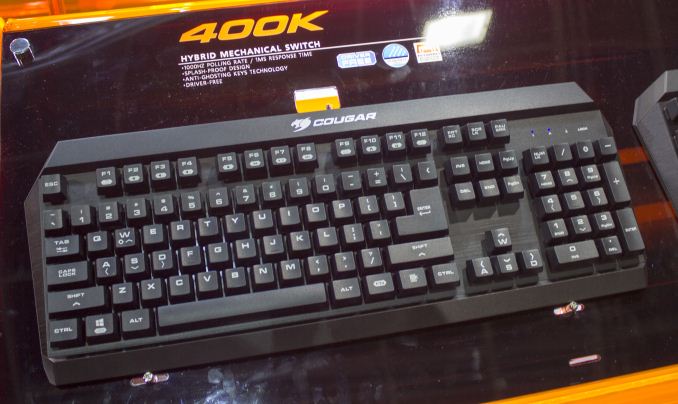
What makes the 400K and 450K hybrid is the fact that the keys are ultimately membrane based, but have a mechanical-like feedback (I will save an in-depth analysis to E.). I played around with the 400K for a few minutes and I have to say I really liked the feeling of the key feedback was very close to a real mechanical keyboard, although we certainly need a longer time with the keyboard before drawing a final verdict.
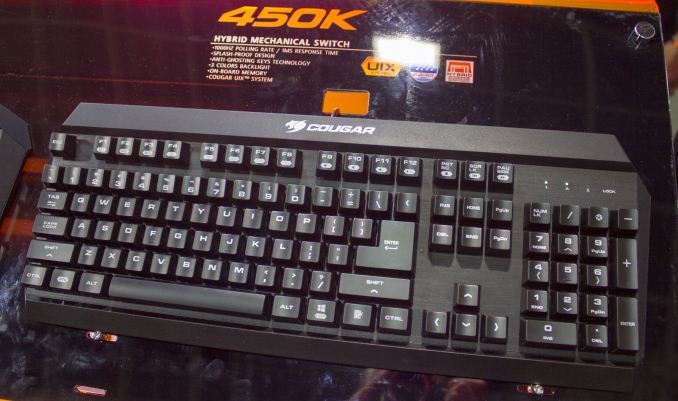
The 450K differs from the 400K by offering 3-color backlight as well as support for Cougar UIX software for custom key mapping. With such a short testing time it's hard to say whether the 400K and 450K can truly replace a mechanical keyboard, but nevertheless Cougar at least offers a viable option to those whose budget can't afford a proper mechanical keyboard. The 400K and 450K will be available in the next two months and we are eagerly looking forward to getting one in for review.
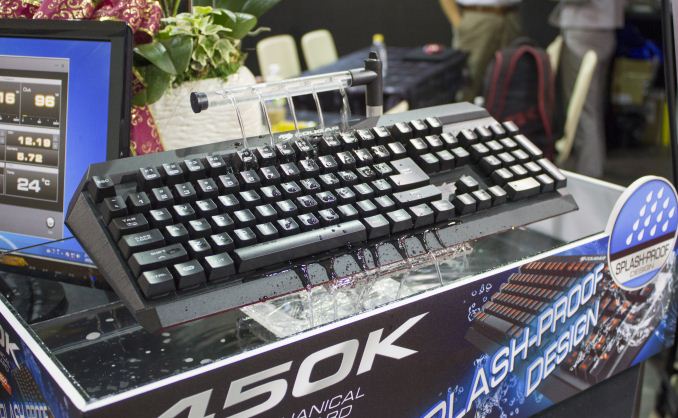
Another interesting aspect of the 400K and 450K is the splash-proof design. Since there's a membrane between the key and PCB, the keyboard can stand a splash of liquid unlike most mechanical keyboards. That's useful specifically for Internet cafes and other public computers, but it's certainly a nice feature to have in home environment as well.
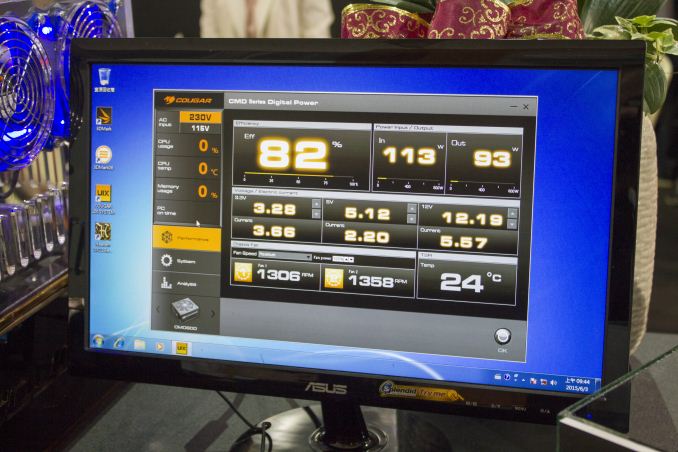
Moving on to power supplies, Cougar demonstrated its CMD Series with Digital Power feature. Basically the end-user can play around with the PSU voltages using Cougar's software, which is a niche feature but for overclockers and others who like to tinker with their systems it can be handy. Note that the software only allows ~5% changes as per Intel's guidelines as larger changes could potentially damage hardware in case the end-user isn't fully aware of his doings.
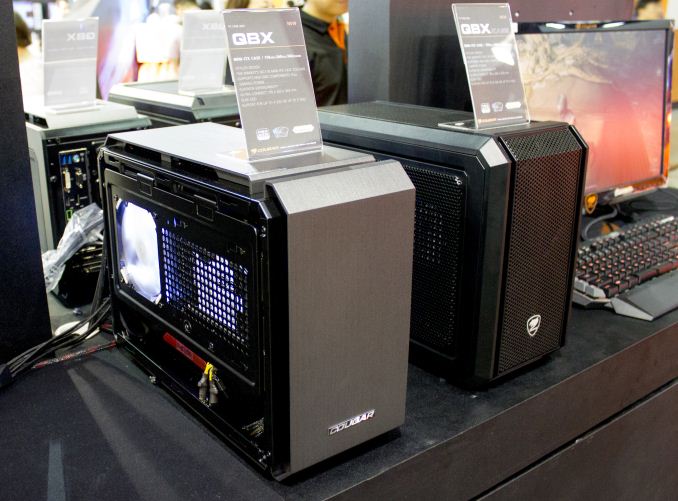
Cougar also announced a new mini-ITX case called QBX. The design is fairly neutral and stylish to my eye compared to some of the more enthusiast cases and it can fit a full size GPU for high detail gaming.


Check out the gallery for more products. We will also have a review of the 600K mechanical keyboard and 600M gaming mouse out in a short while, so stay tuned!
Read More ...
G.Skill Shows Phison E7 Based Phoenix Blade X PCIe 3.0 x4 SSD
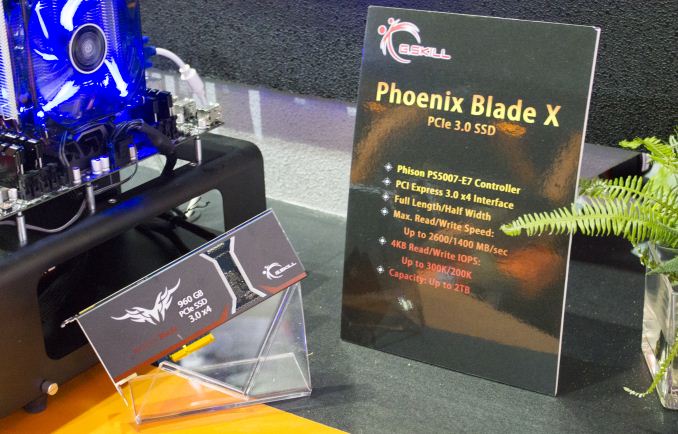
Phoenix Blade X uses Phison's PS5007-E7 controller, which is a PCIe 3.0 x4 design that supports both AHCI and NVMe. G.Skill will be offering the drive as an add-in card in full-length/half-width form factor with capacities of up to 2TB.

G.Skill had a live demo at its booth, but as Phison is still developing the firmware the performance is quite far from the preliminary specifications. G.Skill didn't disclose availability, but given Phison's schedule I would expect the Phoenix Blade X to ship some time in H2'15, likely late Q3. Pricing is TBA too, although I was told that the drive should be cheaper than its predecessor.
Read More ...
Thermaltake Computex 2015 Booth Tour
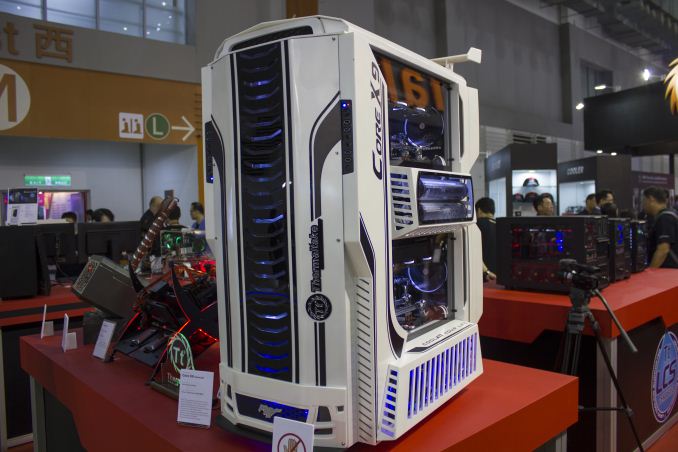
Winner of Thermaltake's modding contest
As E., our case, cooling and peripheral editor, wasn't at Computex this year, I had the opportunity of meeting with most of the companies to see what's new. My first stop was Thermaltake, which had several new and upcoming products to show.

To start off with external storage, Thermaltake had a USB 3.1 Type-C enclosure on display, which will be available later this year.

The enclosure is accompanied by a USB 3.1 Type-C hard drive dock, which allows easy hot-swap capability for those who deal with several drives.

For liquid cooling Thermaltake showed off a prototype of a CPU block with an integrated pump. The design above is obviously not a final design, but the concept is certainly interesting since mounting the pump on top of the CPU saves space and allows for smaller form factors. Thermaltake also displayed a DRAM kit with pre-installed liquid cooling block.

The focus of Thermaltake's cases was definitely in modding as the WP200 has room for two complete builds, one on each side. There is also going to be a lighter W200 model that isn't as huge as the WP200 is.

The W100 is the mode desktop-like version that is made for a single system. The top part of the case is fully modular and can be placed either on the top of bottom of the main case, where it can house the radiators or other components.

For customization Thermaltake offers a variety of different fans with LED lights and as a new product Thermaltake is introducing an RGB version of the Riing series with 256 colors.

One of the most interesting products I saw at the Thermaltake booth was the company's new Poseidon Z Touch keyboard. Basically all the keys act as a touchpad and by using Thermaltake's bundled software the user can set up custom gestures, which can be handy in some games that require a large number of macros. Pricing will be about $180, which has a premium in it but I wouldn't consider it to be too bad for a relatively unique product.


To keep things short, I've only included the highlights here and made a gallery of all photos I took, so head to the gallery above if you're interested in seeing more products that Thermaltake had on display!
Read More ...
The Microsoft Lumia 640 Review
The group that was once Nokia's mobile division has gone through a great number of changes in the past few years. After declining sales of Symbian devices, the company decided to go all in with Microsoft's Windows Phone platform. In a very short time, Nokia became the number one vendor of Windows Phone smartphones in the world. Despite this, the move to Windows Phone failed to revitalize the company. In August of last year, Microsoft purchased Nokia's mobile devices business in a 7.2 billion dollar acquisition. Less than a month later, Microsoft launched the Nokia Lumia 830, and the Nokia Lumia 735. These were the last two Lumia smartphones that would be branded as Nokia devices. With Nokia's phone division absorbed into Microsoft, future Lumia devices would fall under the Microsoft brand.
Today's review focuses on the Microsoft Lumia 640. This phone was announced alongside the Lumia 640 XL at MWC in February, and it's one of the first new Lumia devices released under the Microsoft brand. At $129, the Lumia 640 occupies a fairly low price point as far as smartphones are concerned, and it serves as an entry model to the Lumia smartphone line. To see how it compares to the competition, and to its fellow Lumia devices, read on for the full review.
Read More ...
Apple Announces watchOS 2
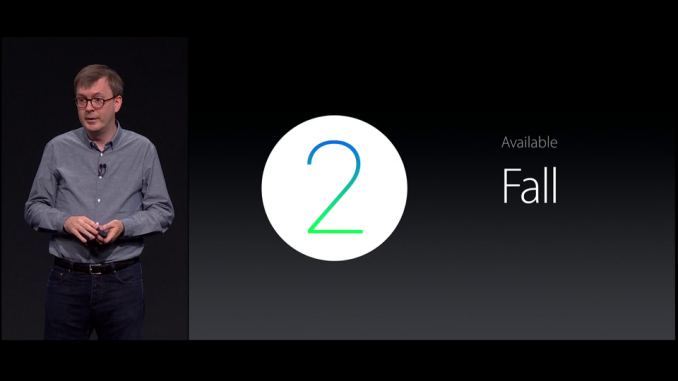
During the WWDC keynote, Apple's VP of Technology Kevin Lynch highlighted a number of major improvements in the second iteration of watchOS. The first improvement is the addition of new watch faces. A new Photo Face has been added, where users can set a personal photo as their background. There's also a photo gallery option, as well as a selection of timelapse watch faces that Apple has taken in cities and parks.

The next improvement in watchOS 2 is a feature called Time Travel. This makes use of the digital crown, and it allows the user to move their watch face forward and backward in time to view information and events from the past or the future. This reminds me a lot of how the interface on the new Pebble Time is designed, but with a different implementation. Unfortunately, Apple hasn't yet found a way to make the forward in time function work with stocks.
Next up are improvements to communication. watchOS 2 enables FaceTime Audio support on the Apple Watch, so users can call other people with Macs, iPhones, iPads, and Apple Watches. Users can also reply to email using Siri for dictation, and they can use now use multiple colors in the drawings that they send to other Apple Watch users.

Since the Apple Watch will only last around a day, Apple has created a new clock mode for when the watch is laying on its side and charging. Essentially, this allows the watch to act as an alarm clock when it's charging. Hopefully Apple has considered the potential issues with persistently displaying a clock on an OLED display.
Apple is also bringing watchOS the improvements made in iOS 9. The new transit views and directions in the maps app are available, and the improvements to Apple Pay with the new Wallet app and loyalty card support will also be included.

The last, and possibly most important improvement in watchOS 2 is the ability for developers to create native apps for Apple Watch. Apple Watch currently relies heavily on the iPhone that it's paired to. Although it has apps, the logic for those apps is run on the iPhone rather than the Apple Watch. This makes the Apple Watch something like a remote display into an app that is really running on your phone. With watchOS 2, developers will be able to create apps that run natively on the Apple Watch. Apple is also giving developers significantly more access to the Apple Watch's hardware, with APIs for the microphone, the digital crown, WiFi, the taptic engine, and more.
In order to put these new tools in the hands of developers as quickly as possible, Apple is making a developer beta of watchOS 2 available today. Apple has moved quickly to include new features and enable native application support, and it's looks like watchOS may be set on the same yearly upgrade cycle as iOS and OS X. watchOS 2 will be available officially this fall.
Read More ...
Available Tags:Microsoft , IBM , Seagate , SSD , HTC , HTC , Xbox , Motion , Keyboard , Thermaltake , Apple ,


No comments:
Post a Comment