

ASRock Rack Announces EP2C612D24 and 4L: Dual Socket Haswell-EP with 24 DDR4 Slots


The Haswell-EP/Xeon E5 v3 DDR4 memory controllers are designed for up to three DIMMs per channel, similarly to Ivy Bridge-EP (E5 v2) and Sandy Bridge-EP (E5), although in all cases it is usually reserved for more niche systems. With 16GB UDIMMs, this allows for a maximum of 384GB, although moving up to RDIMM, LRDIMMs or 64GB NVDIMMs pushes the max to 1.5TB in a dual socket motherboard. Only those with deep pockets, big budgets or stringent requirements need apply, as the major cost here will be the DRAM.

The motherboard uses a staggered processor arrangement with narrow ILM versions of the LGA2011-3 socket. Combined with the 24 DRAM slots means there is little room for anything else. We get three PCIe 3.0 x8 slots which are open ended, allowing for x16 sized cards to come in, although one slot will be limited to reduced width cards as some of the DRAM slots would encroach a super long co-processor. The ten onboard SATA ports are supported by an M.2 PCIe 3.0 x4 slot and an onboard USB 3.0 Type-A port for in-chassis licensing dongles or Live-USB OSes. One downside to mention, according to the specifications for Haswell-EP, is that when fully populated, the memory should reduce down in speed, from 2133 to 1600 MHz.
Network connectivity is provided by an Intel i350 which gives four gigabit ports on the 4L model, but only two on the regular SKU, but we also get another network port for the AST2400 which provides IPMI 2.0 network management. ASRock Rack is targeting the usual suspects when it comes to large DRAM packages – intensive compute tasks, big data analysis, Hadoop and cloud computing.
Source: ASRock


Read More ...
2015 15-inch Retina MacBook Pro’s dGPU (R9 M370X) Is Cape Verde

At the time of the rMBP’s launch, we suspected that it was an AMD Cape Verde GPU, based on the fact that this GPU is also in the M375, which is the next part above M370X. With the new laptop shipping immediately, M370X models have already begun arriving in buyers’ hands, finally giving us a chance to confirm the GPU inside.

Thanks to Reddit user ootan, who posted a screenshot of the rMBP’s System Profiler, we can now confirm that the GPU in the rMBP is in fact AMD’s Cape Verde GPU. AMD has previously used the 6821 device ID on other mobile Cape Verde parts, so 6821 is already a known quantity.
| AMD M300 Series GPU Specification Comparison | |||||
| R9 M375 | R9 M370X (rMBP) | R7 M360 | |||
| Was | Variant of R9 M270/M260 | Variant of R9 M270X | Variant of R7 M270/M260 | ||
| Stream Processors | 640 | 640 | 384 | ||
| Texture Units | 40 | 40 | 24 | ||
| ROPs | 16 | 16 | 4? | ||
| Boost Clock | <=1015MHz | 800MHz | <=1015MHz | ||
| Memory Clock | 2.2GHz DDR3 | 4.5GHz GDDR5 | 2GHz DDR3 | ||
| Memory Bus Width | 128-bit | 128-bit | 64-bit | ||
| VRAM | <=4GB | 2GB | <=4GB | ||
| GPU | Cape Verde | Cape Verde | Oland | ||
| Manufacturing Process | TSMC 28nm | TSMC 28nm | TSMC 28nm | ||
| Architecture | GCN 1.0 | GCN 1.0 | GCN 1.0 | ||
As for Cape Verde itself, as our regular readers may already know, it’s one of AMD’s first-generation GCN 1.0 GPUs, launched back in 2012. Compared to the GK107 GPU found in the GT 750M, it is a larger, more powerful (and at least in the desktop, more power-hungry) GPU, designed for more powerful devices than GK107 was. As for why Apple opted to switch now and to this GPU, we’ll leave that to Apple, AMD, and NVIDIA, though it’s by no means surprising that after having run GK107 for a couple of years, they would want to upgrade to a more powerful GPU.
Meanwhile, though we don’t have M370X on-hand at the moment, at least in the desktop, where GPU performance is unrestricted by thermals, Cape Verde fares very well. The rMBP on the other hand does have thermal constraints to deal with, so performance won’t be the same, but I expect it to fare reasonably well as well. Though at the same time I’m also curious if the use of a higher performance part has impacted the rMBP’s battery life when the dGPU is active; AMD and NVIDIA both do heavy binning, so a simple extrapolation won’t work here.
Update: And no sooner do I post this then someone sends me a screenshot of GPU-Z from a 15" rMBP running Boot Camp.

GPU-Z, for those unfamiliar with it, uses register poking to identify GPUs, so if the device ID wasn't enough, this settles it. This also confirms the clockspeeds - 800MHz core, 4.5GHz VRAM - and that the M370X is using GDDR5, unlike it's M375 counterpart. Thank you DMDrew812.
Read More ...
AMD Teases Upcoming Video Card
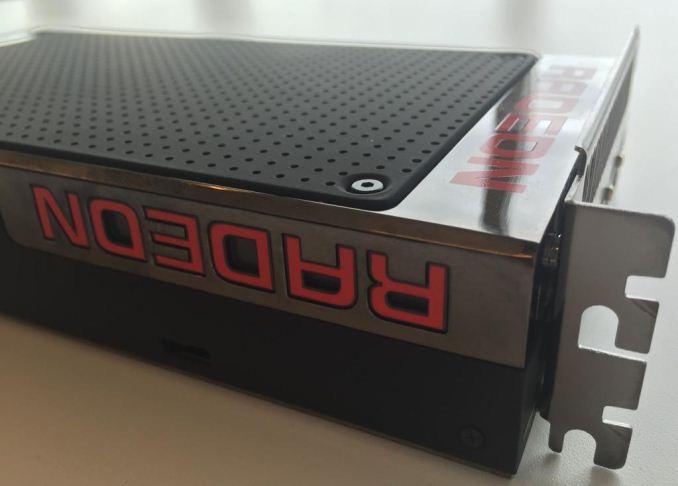
This new island is one seriously impressive and sweet GPU. wow & thanks @AMDRadeon ! They will be put to good use :) pic.twitter.com/S5hyD6vxNh
— Johan Andersson (@repi) May 22, 2015
With both Computex and the AMD-sponsored PC Gaming Show taking place next month, June should be a busy time in the PC hardware industry.
Read More ...
Available Tags:ASRock , DDR4 , MacBook , AMD ,


No comments:
Post a Comment