

Logitech G303 Daedalus Apex Capsule Review
Logitech has been making mice for about as far back as most PC users can recall, enhancing and refining the input peripheral over the years. Their new G303 Daedalus Apex is an advanced lightweight gaming mouse that builds off the foundation of previous offerings, and it’s launching today. How’s it fare in practice? Read on for our review.
Read More ...
NVIDIA Announces GeForce GTX Titan X

In order to capitalize on the large audience of the Unreal session while not spoiling too much ahead of NVIDIA’s own event in 2 weeks – the NVIDIA GPU Technology Conference – NVIDIA is playing coy with details on the product, but they have released a handful of details along with a product image.
| NVIDIA Titan Specification Comparison | |||||
| GTX Titan X | GTX Titan Black | GTX Titan | |||
| Stream Processors | ? | 2880 | 2688 | ||
| Texture Units | ? | 240 | 224 | ||
| ROPs | 96? | 48 | 48 | ||
| Core Clock | ? | 889MHz | 837MHz | ||
| Boost Clock | ? | 980MHz | 876MHz | ||
| Memory Clock | ? | 7GHz GDDR5 | 6GHz GDDR5 | ||
| Memory Bus Width | 384-bit? | 384-bit | 384-bit | ||
| VRAM | 12GB | 6GB | 6GB | ||
| FP64 | ? | 1/3 FP32 | 1/3 FP32 | ||
| TDP | ? | 250W | 250W | ||
| Transistor Count | 8B | 7.1B | 7.1B | ||
| Architecture | Maxwell | Kepler | Kepler | ||
| Manufacturing Process | TSMC 28nm? | TSMC 28nm | TSMC 28nm | ||
| Launch Date | Soon | 2/18/14 | 02/21/13 | ||
| Launch Price | A Large Number | $999 | $999 | ||
The GPU underlying GTX Titan X is 8 billion transistors, which similar to the original GTX Titan’s launch means we’re almost certainly looking at Big Maxwell. NVIDIA will be pairing it with 12GB VRAM – indicating a 384-bit memory bus – and it will once again be using NVIDIA’s excellent metal cooler and shroud, originally introduced on the original GTX Titan.
No further details are being provided at this time, and we’re expecting to hear more about it at GTC. Meanwhile Epic’s master engine programmer Tim Sweeney was gifted the first GTX Titan X card, in recognition of NVIDIA and Epic’s long development partnership and the fact that Epic guys are always looking for more powerful video cards to push the envelope on Unreal Engine 4.
Read More ...
Testing the HTC (Re) Vive with Steam VR: Better than Oculus…?
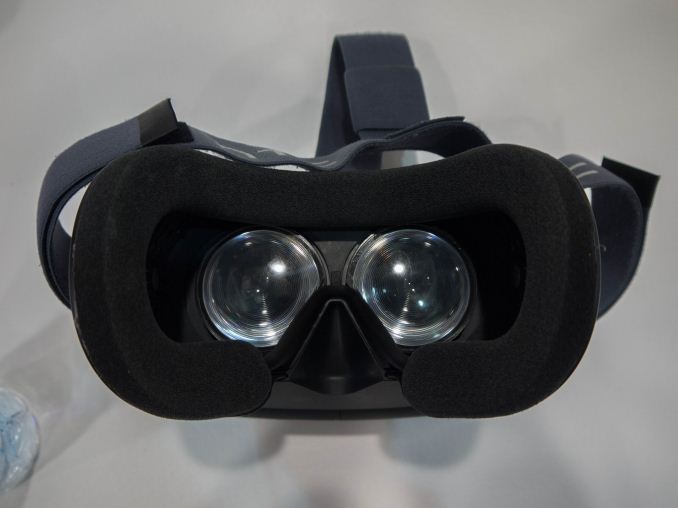
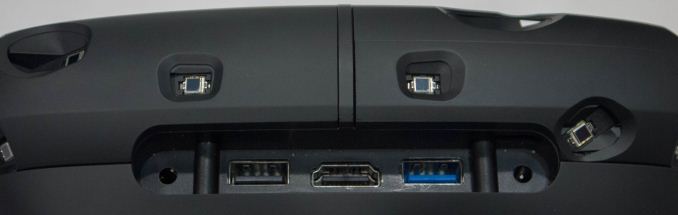
At this point in time, HTC is releasing next to no specifications about their developer kit, and the embargo placed today was purely for experiential testing. We were only able to take pictures of the device, and not the room in which it was being tested. Thus the following is purely from my perspective of using the kit and the pre-programmed demos that were provided. Overall each person was allowed 20 minutes to cycle through the demos, similar to that from Oculus at CES.

Functionally I was lead into a near empty room several meters square, put on the headset, and a HTC employee placed a set of headphones over my ears. When the demo started up, the guide held up two controllers, one for each hand. Within the headset, I saw the controllers represented on the screen and reached out to them. The headset and controllers both had a number of wires coming from them, but I was told that the end goal is to make the controllers wireless, and the headset would in the final version have only a single mini-HDMI cable to provide the bandwidth for the display.
The two controllers were designed such that one is for each particular hand with a depressed pad on each (kind of like the initial Steam box controller renders), along with a rear trigger and two grip buttons. Within the first demo, depressing the left trigger caused a balloon to appear from the controller, which I could then let go and punch away with either controller. After a few balloons the main demo began.
The first scene was a basic white field to describe the motions of the set up. I could move my head, walk about 2 meters in each direction before hitting an invisible wall (or an actual wall), as well as duck to get a different perspective from close to the ground. The white field was filled with columns moving up and down to get a sense of perspective.

The next scene was interactive – I was in a kitchen in front of a chopping board with vegetables, with a pot on the hob to my right and a robot helper ahead. With some mild instruction, I used the controllers and the triggers to pick up some of the objects. I put some bread into the pot and threw the rolling pin at the robot helper (to which I was thanked). I also dropped a steak accidentally on the floor, and without hesitation I bent down and picked it up, then threw it across the room. (Pretty much what happens back when I’m in charge of the kitchen anyway.) Turning to my left, I walked towards a fridge which opened automatically with more ingredients inside. I took out a steak, turned to the left again, and using my other controller moved towards a button on the microwave. The door swung open, I placed the steak inside, then I also grabbed a bottle of wine from next to the microwave and put it in as well, before shutting the microwave door how I would normally do so at home. Next to the microwave was a chopping board with a knife and an onion, and when I picked up the knife to cut the onion, it shattered. I couldn’t pick up the pieces of the knife (a safety feature I was told), but I was able to place the onion on a plate and interact with a bell to get the plate taken away.
The second scene put me onto the deck of a sunken ship, surrounded by rotting wood and schools of fish. When I moved around I could see how far down the ship went, but when a fish swam into my face I tried to swat it away, knocking the controller into the headset. After a couple of moments a big whale swam by with the detail on the whale being quite clear. The movement was also smooth, perhaps indicative of 60-90 Hz, but it was not 120 Hz.

The third demo was an example of how the hardware and software can be used in a creative context (I mean more creative than microwaving wine). This was essentially a paint program but allowed the artist to draw in 3D. The right hand was the brush, while using a combination of controls on the left hand allowed the left to act like a palette. I was able to do a full RGB selection similar to most imaging programs, as well as change the type of brush from something more normal to oil paints or a rainbow. I was able to move around in 3D as well, drawing from different perspectives. There was an obligatory drawing of something rude, but then I examined how accurate the software was. It seemed that I could draw with a granularity of about 15mm, especially when drawing long lines. But software like this could be used by developers interested in making and viewing 3D models with immersion and getting a feeling for the size of whatever is being created.
The next demo was best described as a table top game coming to life. I started standing in the middle of the table, watching a faction in a castle fighting off some invaders. In true table-top style everything looked a bit small. But I was able to walk around the scene viewing it from different angles both outside and in the table itself. I was also able to peer inside the 3D models, to get perspectives that would not otherwise be available in the real world.


The final demo was somewhat of a treat. In true Valve fashion I was thrust into a Portal based room with GLaDOS issuing commands over a loud speaker. The artistry was pure Portal through and through, with Portal 2 based figurines. GLaDOS issued commands to open drawers, which the game allowed you to open the wrong drawer twice before opening the right drawer. In the second incorrect drawer was a piece of really old cake, but there were experiments to run and research to be done – thankfully I was still alive so I continued with the demo and opened the right drawer which housed a small Portal stick figure community. Unfortunately GLaDOS told me that looking into the drawer would cause the community to worship me as a god and in the end we had to close the drawer and there was the sound of something burning. I then walked over to the other side of the room and was instructed to open a door via a lever, causing a damaged Portal 2 robot to stumble into the room and be attached to a harness. GLaDOS instructed me to repair the robot by pulling a few parts before giving some incomprehensible instruction that caused the robot to disintegrate. The robot parts were cleared and the walls dismantled to show GLaDOS who expressed disappointment - 'Oh, it's you...'. At this point I was on a small segment of floor while I could see far and wide into the Portal underground moving bits around, before the walls around me were quickly rebuilt into what looked like the start of a Portal level. There was even a companion cube.
Thus ended the demo.

The interactivity in each of the demos was great, and it felt natural. Aside from the commands from the HTC guide coming through the headset explaining what was going on (it was a two way conversation, I asked about the hardware), I felt immersed. I could just about see the pixels in the set, but the two controller method for some of the tasks felt like the right thing to do. The PC hardware used for the demo was a single GPU system (I was told a current generation high end card), indicating that no massive tri-SLI system is needed at this point. For a couple of the demos (such as the table top), the scene was a little blurry but I have experienced this before on VR demos – on the large scale everything seems great, but some of the low resolution demos on small models can cause some defocusing. That being said, the Portal demo was filled with detail and I had no issues there, even though there were some intricate detail within the models.
It was difficult to ascertain what kind of technology the display was using due to the lack of consistent black areas, but there was no discernable backlight bleed during gameplay. Unlike Oculus, although I didn’t specifically think about it during the demo there seemed to be a lack of directional audio, as in computation based on hard direction, but I may be mistaken. I felt I was in the moment, and although there was not some massive movement scene similar to the Oculus demo, the package did feel like it could compete.

The headline for this piece ‘Better than Oculus’ is supplanted by a question mark. It is difficult to pick between the two, but if I was forced at gunpoint to spend my own money, I feel it is the HTC model with Steam VR that would get my notes. If not from the hardware perspective, but then the future potential if Valve gets properly onboard with a major title at launch. HTC currently creating units for developers, and is aiming for a 2015 launch. There is talk with regards to several SKUs with the high end one relying on sensors mounted to the wall and perhaps a lower one with gyroscopes. As always with these VR demos, when the devices come to market a key element is going to revolve around content. Here Valve can do serious damage if a big title or two was released along with the headset. The obvious lines are Half-Life 3 and Portal 3, but there was no indication from HTC that anything was going to be mentioned.
The key difference between the HTC and Oculus demos was immersion combined with interactivity. The Oculus demo was technically great, but the interactive elements from HTC along with the Valve input made the experience feel more natural. There are clear hurdles for both implementations, particularly for Oculus on content. Even though Oculus is working with lots of developers, I also inquired about the interoperability between software created for the HTC headset and the Oculus one but the comments pointed towards locking in the software to each device. The HTC/Valve implementation will have to have some bundled content when it goes on general sale and Valve already has the distribution ecosystem in place as well as the gaming franchises to make the world implode.
Read More ...
SanDisk Steps Into Storage Arrays: Launches InfiniFlash Series with Up to 512TB in 3U at <$1/GB
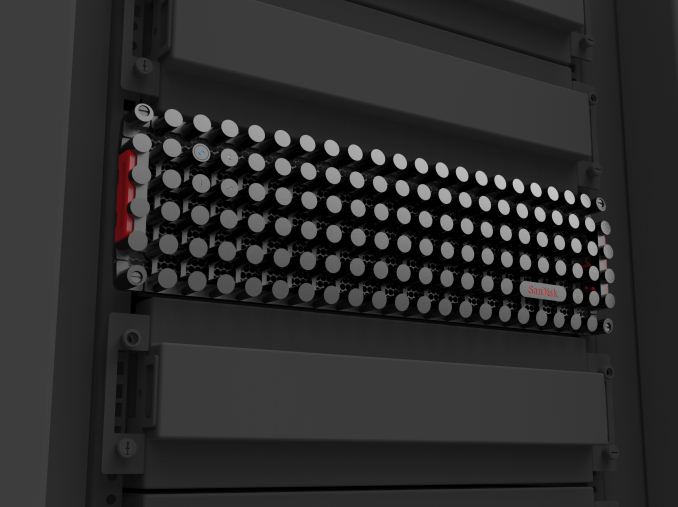
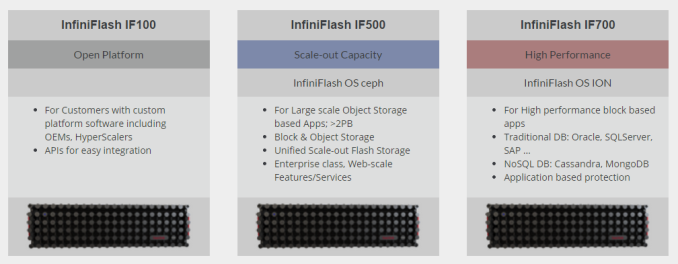
The InfiniFlash comes in three different flavors. The IF100 is an open platform that is designed for OEMs and hyperscale customers with their own software platforms, although it does include a Software Development Kit (SDK) for monitoring purposes. The IF500 is aimed specifically for object storage using ceph (an open source object storage system), which allows very high capacity clusters to be built efficiently. I admit that I need to dig in a bit deeper to fully understand the way object storage works and its benefits, but it requires less metadata than traditional file and block based storage systems do and the overhead of metadata managing is also lower, which practically enables unlimited scale out opportunities. Finally, the IF700 focuses on performance and is built upon Fusion-io's ION platform with database (Oracle, SAP, etc.) workloads in mind. In a nut shell, the key difference is that the IF100 is hardware only, whereas the IF500 and IF700 come with InfiniFlash OS (I was told it's Ubuntu 14.04 based). Hence the IF100 is also cheaper at less than $1 per GB, while the IF500 and IF700 will be priced somewhere between $1 and $2 per GB. For an all-flash array that's a killer price for raw storage (i.e. before compression and de-duplication) as it's not uncommon for vendors to still charge over $20 per raw gigabyte.
| SanDisk InfiniFlash Specifications | |
| Form Factor | 3U |
| Raw Capacity | 256TB & 512TB |
| Usable Capacity | 245TB & 480TB |
| Performance (IOPS) | >780K IOPS |
| Performance (Throughput) | 7GB/s |
| Power Consumption | 250W (idle) / 750W (active) |
| Connectivity | 8x SAS 2.0 (6Gbps) |
SanDisk offers two capacity configurations: 256TB and 512TB, of which 245TB and 480TB are usable. The ~7% over-provisioning is used mostly for garbage collection with the goal of increasing sustained performance. In terms of performance, SanDisk claims over 780K IOPS, although the presentation showed up to 1 million IOPS at <1ms latency for 4KB random reads with two nodes. The endurance is 75PB of writes, which results in ~4-year lifespan with 90/10 read/write ratio at 6GB/s. For connectivity the InfiniFlash offers eight SAS 6Gbps ports, which can be upgraded to SAS 12Gbps in the future without any downtime.
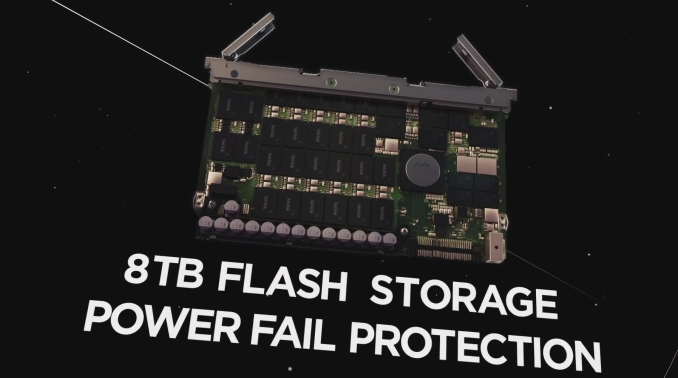
Architecturally the InifiniFlash is made out of 64 custom 8TB cards. The cards are SAS 6Gbps based, although as usual SanDisk wouldn't disclose the underlying controller platform. However, judging by the photo it appears to be a Marvell design (see the hint of a Marvell logo on the chip), which honestly wouldn't surprise me since SanDisk has relied heavily on Marvell for controllers, including SAS ones (e.g. Optimus Eco uses the 88SS9185 SAS 6Gbps controller). As for the NAND, SanDisk is using its own 1Ynm 64Gbit MLC (i.e. second generation 19nm) and each card consists of 64 eight-die NAND packages (this actually sums up to only 4TB, so I'm waiting to hear back if there's a typo somewhere in the equation -- maybe it's a 128Gbit die after all). SanDisk will also be using different types of NAND in the future ones new nodes become available in volume.
The InfiniFlash will be sold through the usual channel (i.e. through OEMs, SIs & VARs), but SanDisk is also selling it directly to some of its key hyperscale customers that insisted on working directly with SanDisk. While it may seem like SanDisk is stepping into its partners area with direct sales, the big hyperscale customers are known to built their own designs, so in most cases they wouldn't be buying from the OEMs, SIs or VARs anyway. Besides, the InfiniFlash doesn't include any computing resources, meaning that the partners can differentiate by integrating InfiniFlash to servers for an all-in-one approach, whereas the units SanDisk is selling are just a bunch of raw flash.
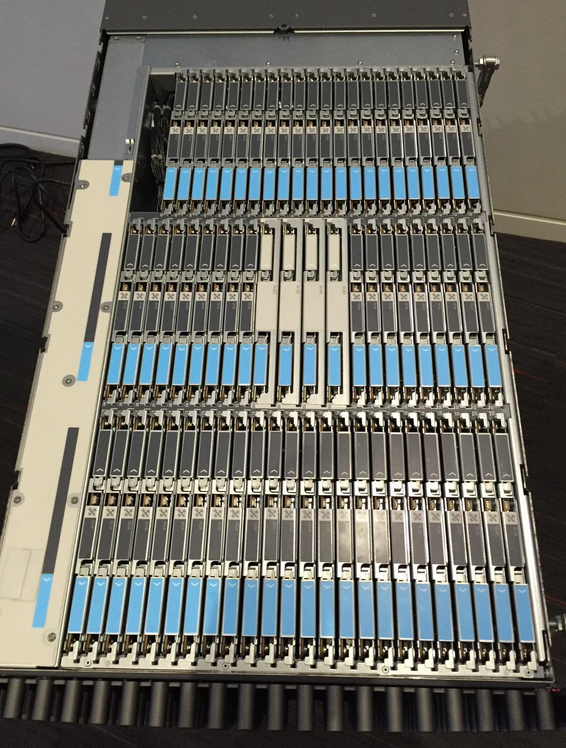
While the InfitiFlash as a product is certainly exciting and unique, it's not as interesting as the implications of this strategical move. In the past the SSD OEMs have kept their fingers away from the storage array market and have simply focused on building the drives that power the arrays. This strategy originates from the hard drive era where the separation was clear: companies X made the hard drives and companies Y integrated them to arrays. Since there wasn't really a way to customize a hard drive in terms of form factor and features, there was no use of merging X and Y given that the two had completely different expertise.
With flash that's totally different thanks to the versatility of NAND. Only the sky is the limit when it comes to form factors as NAND can easily scale from a tiny eMMC package to 2.5" drive and most importantly to any custom form factor that is desired. SanDisk's biggest advantage in the storage array business is without a doubt its NAND expertise. Integrating NAND properly takes much more knowhow and effort than hard drives because ultimately you have to abandon the traditional form factors and go custom. It's not a surprise that the InfiniFlash is the densest all-flash array on the planet because as a NAND manufacturer SanDisk has the supply and engineering talent to put 8TB behind a single controller with a very space efficient design. The majority of storage array vendors simply source their drives from the likes of SanDisk, Intel and Samsung, so they are limited by the constraining form factors that are available on the open market.
The big question is how will the market react and will this become a trend among other SSD vendors as well. The storage array market is certainly changing and the companies that used to rule the space are starting to lose market share to smaller, yet innovative companies. As the all-flash array market matures, it seems logical for the SSD vendors to step in and eliminate the middle-man for increased vertical integration. The future remains to be seen, but I wouldn't be surprised to see others following SanDisk's lead. The bar has definitely been set high, though.
Read More ...
Western Digital My Cloud DL4100 Business NAS Review
Western Digital is a comparatively recent entrant to the fast-growing NAS market. Despite having had a Windows Storage Server-based product for business users for some time now, a custom embedded-Linux based SMB-targeted model was lacking. Avoiding Windows in the NAS helps bring down the cost of the unit and also makes the units easier to manage for small businesses without dedicated IT staff. Last week, they officially launched the My Cloud EX2100 (2-bay) and EX4100 (4-bay) NAS units to target this market. We have been evaluating the EX4100 for the last two weeks. Read on to see how the unit stacks up against the competitors in this space.
Read More ...
NVIDIA Announces SHIELD Console: Tegra X1 Android TV Box Shipping In May
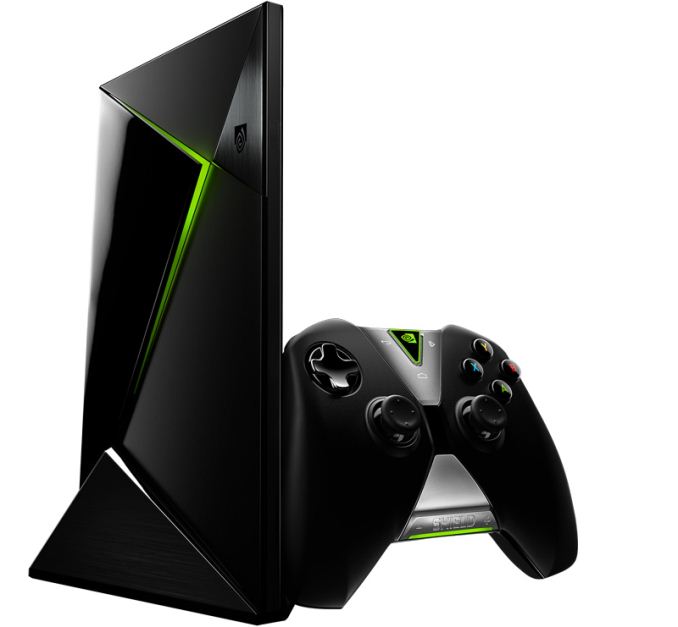
Like NVIDIA’s previous SHIELD devices, the SHIELD Console is perhaps first and foremost their showcase device for their Tegra SoC. Having already built a gaming handheld (SHIELD Portable) for Tegra 4 and an 8” tablet (SHIELD Tablet) for Tegra K1, NVIDIA has moved on to the microconsole/set-top box market with the SHIELD Console. In doing so the company is forging a slightly different direction, skipping the mobility plays that were the previous devices and instead focusing on the TV and fixed-position gaming with the SHIELD Console.
| NVIDIA SHIELD Family | ||
| NVIDIA SHIELD Tablet | NVIDIA SHIELD Console | |
| SoC | Tegra K1 (2.2 GHz 4x Cortex A15r3, Kepler 1 SMX GPU) | Tegra X1 (4x Cortex A57, Maxwell 2 SMM GPU) |
| RAM/NAND | 2 GB DDR3L-1866, 16/32GB NAND + microSD | 3 GB RAM, 16GB NAND + microSD + USB |
| Display | 8” 1920x1200 IPS LCD | N/A, HDMI 2.0 4Kp60 Output |
| Dimensions | 221 x 126 x 9.2mm, 390 grams | 210 x 130 x 25mm, 654 grams |
| Camera | 5MP rear camera, 1.4 µm pixels, 1/4" CMOS size. 5MP FFC | N/A |
| Battery | 5197 mAh, 3.8V chemistry (19.75 Whr) | N/A, 40W Power Adapter |
| OS | Android 4.4.2 | Android TV |
| Connectivity | 2x2 802.11a/b/g/n + BT 4.0, USB2.0, GPS/GLONASS, mini HDMI 1.4a | 2x2 802.11a/b/g/n/ac + BT 4.1/BLE, USB 3.0 + 2.0, HDMI 2.0, IR Receiver, Gigabit Ethernet |
| Launch Price | $299 (16GB/WiFi) + $59 (optional controller) | $199, Includes 1 SHIELD Controller |
From a hardware perspective the SHIELD Console itself is built somewhere in between a microconsole and a full-blown console. The underlying SoC and the use of Android TV make it closer to a microconsole, while in terms of physical size and NVIDIA’s performance ambitions are closer to a console. In any case, anchored by the Tegra X1 SoC, the console also packs in 3GB of RAM, 16GB of NAND, 2x2 802.11ac wireless, and a large I/O collection, including USB 3.0, Gigabit Ethernet, and an HDMI 2.0 port.
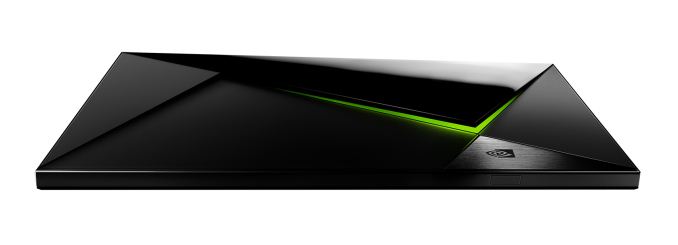

On the software side, the SHIELD Console is running Android TV, Google’s TV-centric branch of the Android operating system. The use of Android TV gives the device the OS’s accompanying 10ft UI along with suitable access to media through the Google Play Store, giving NVIDIA the kind of wide access to media they need to help drive adoption of the console. For more local tastes, local media playback will also be supported through the included PLEX application. Meanwhile because of its Tegra X1 backing, the console will be the first Android TV device to support 4K playback, capable of decoding and displaying 4Kp60 content, including up-and-coming HEVC content.

NVIDIA’s second pillar for the device – and arguably the device’s primary purpose – is local gameplay through the console’s ability to run Android games. Games will be sold through a SHIELD Store, similar to how SHIELD Portable/Tablet users can currently buy Android games through NVIDIA’s application. Meanwhile the powerful Maxwell GPU backing the Tegra X1 should prove to be very capable at driving these games.
From a performance perspective NVIDIA is targeting performance ahead of the Xbox 360, while many of the console’s marquee games are from that console generation. With Xbox 360 turning 10 this year, this is roughly in-line with the tendency for SoC/mobile devices to trail PCs (and high performance consoles) in performance by about a decade.

The games we’ve seen in the store so far are frequently ports of last-generation (or older) console games, with NVIDIA including a mix of existing ports along with partnering for new ones. Upcoming ports include the releases of games such as Borderlands: The Pre-Sequel and Crysis 3 (yes, Crysis) for SHIELD. Right now NVIDIA is very keen to show off the SHIELD console’s ability to perform similarly to the last-gen consoles, given that they were very popular devices with similarly long shelf lives.
Given NVIDIA’s hardware background and the capabilities of the Tegra X1 SoC, this makes a lot of sense for the company in the short run. However in the long run it will be interesting to see whether the service sees very many “new” or recent AAA games, as game development for the last-gen consoles winds down. Meanwhile original Android games are also on the store, though from NVIDIA’s standpoint these must be difficult to count on as Android native games rarely push the envelope graphically and have a high tendency to be free-to-play games, the antithesis to the AAA console game market NVIDIA is chasing down.

Ultimately however NVIDIA can’t rely on native Android games and ports of older games alone to move their console, and for that reason the final pillar of the device is based around the GRID game streaming service. Currently in beta for NVIDIA’s existing SHIELD devices and scheduled to go commercial alongside the release of the SHIELD console, the GRID streaming service will plug the remaining game gap by giving SHIELD console owners access to newer PC games that are streamed to the console rather than run locally.
The GRID service has and continues to be ambitious; NVIDIA’s GRID server cards actually make the execution model pretty simple, however whether consumers are willing to put up with the latency and reduced image quality is a question that hasn’t been adequately answered so far. NVIDIA’s GRID service has seen quite a bit of activity with its current beta, though that is for a free service. The addition of a price tag – either for subscriptions for older games or buying the newest games individually at full price – may change this dynamic. However the alternative of not having the ability to run recent AAA PC games at all would have made the SHIELD Console a much harder sale.
For their part, NVIDIA has laid down the groundwork for the service in developing the technology and ramping up servers, and now they are working on bringing developers on-board. Essentially any game that can work on a PC with a game controller can in theory be offered via GRID, though so far the game selection has been very Steam-centric. For the console’s launch, Capcom, Konami, and CD Projekt Red were all brought on stage to showcase some of their games running via GRID. NVIDIA ultimately expects to have 50+ titles available on the service by the time it and the SHIELD Console launch in May.

As for users looking for game streaming on a more local level, NVIDIA has confirmed that the SHIELD Console will also support the company’s GameStream technology, which allows for games to be streamed from a suitably equipped GeForce PC. Also present in the specification sheets is “NVIDIA Share”, which is NVIDIA’s name for their ability to broadcast gameplay via Twitch.
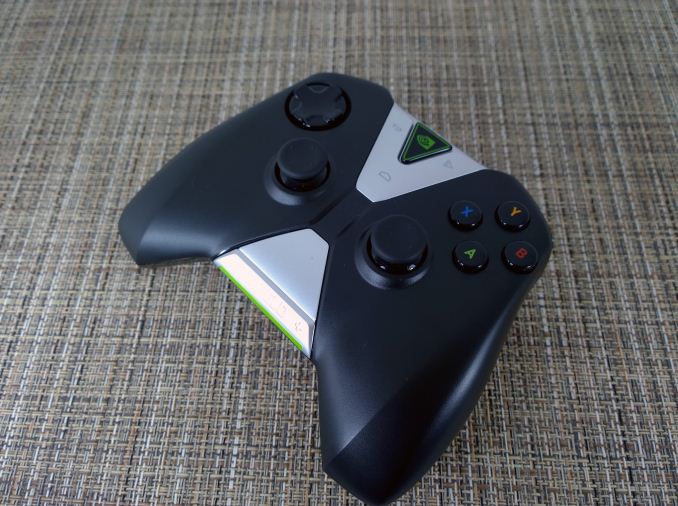
Moving on, the base package will come with the console and a SHIELD Controller for $199. NVIDIA previously launched the SHIELD Controller for the SHIELD Tablet last year, and thankfully unlike the tablet the controller is a standard part of the package for the console. However NVIDIA has also put together a second controller for the console that will be sold as an accessory, and that is the SHIELD Remote. Unlike the Controller, the Remote is geared towards taking advantage of the console’s media capabilities, particularly Google’s voice search capabilities. The remote itself contains only a few buttons, with voice intended to be its primary means of control. The remote also contains a headphone jack for local audio playback, and though not announced by NVIDIA at the time, as a Bluetooth device it will also work with the SHIELD Tablet and SHIELD Portable.

Wrapping things up, while we had been expecting a microconsole from NVIDIA going into their GDC presentation, the fact that they are so heavily backing it has come as a bit of a surprise. The microconsole market has been fairly treacherous so far – one only needs to look at the Tegra 3 based Ouya to see that first-hand – which makes NVIDIA’s “premium” positioning so unusual. Microconsoles have typically been sub-$100 devices, whereas at $199 this is more than half-way to a full console.
For the moment at least from a hardware perspective NVIDIA has put together a solid piece of kit, something that has been a recent strength for the company. As far as Tegra launch vehicles go the SHIELD products have always been flashy and powerful, and the SHIELD Console is no exception. What remains to be seen then is whether the market is ready to embrace NVIDIA’s vision of 4K media, game ports, and game streaming on a $199 console.

Read More ...
NVIDIA GRID Game Streaming Service To Become Commercial Service
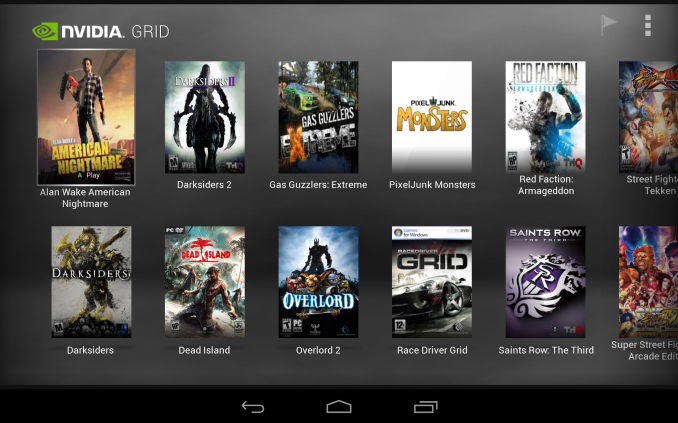
First introduced back in 2013 as a beta project for NVIDIA’s SHIELD Portable to demonstrate the streaming capabilities of the combined Kepler + Tegra ecosystem, the GRID gaming service has been slowly built up over the years. Later in 2013 NVIDIA added console mode, extended the service to the SHIELD Tablet, and most recently the company has greatly expanded the number of games and server locations the still-in-beta service offered. All signs as of late have pointed to NVIDIA seeking to bring the service out of beta – particularly the June 30th expiration date – and tonight’s announcement reflects exactly that.

The commercial version of the service will launch in May alongside the SHIELD Console, and while maintaining the overall design and feel of the current beta service, NVIDIA will be making changes to accommodate its switch from a purely free service. First and foremost the service will see 2 tiers introduced: basic and premium. Both tiers come with free games, similar to the current GRID beta, with the premium tier getting additional (and likely more recent) games. NVIDIA has not yet announced a price for either tier, however NVIDIA has been careful to call both tiers “subscription” tiers, and with subscription running orthogonal to free, there’s reason to believe that both will be paid services.
As for the newest and greatest games (that NVIDIA presumably can’t get service-wide licenses to), NVIDIA will also offer a game purchasing service to allow users to buy individual games. This functionality does not exist in the current GRID beta, but of the few preview screens we’ve seen it looks like pricing will be in-line with retail PC game purchases.

Meanwhile for non-SHIELD owners hoping to take advantage of GRID, it’s looking like you will be out of luck. NVIDIA is currently only talking about GRID for SHIELD device owners, which is consistent with their use over the last few years of value add features to drive hardware sales. GRID exists to sell SHIELD consoles, not for NVIDIA to get into the business of running a game streaming service.
In fact the launch of a commercial version of the GRID service is something of a change in direction for the company. NVIDIA’s original plans for GRID involved partnering with game streaming start-up Gaikai, a plan that came to a halt when Sony bought Gaikai and used them to build Playstation Now. Since then we haven’t seen any other serious contenders in the PC game streaming space, and NVIDIA for their part has opted to go it alone.
Meanwhile from a technical perspective, the GRID service has not substantially changed since beta. Now that NVIDIA has expanded beyond San Jose, the actual server locations are being backed via Amazon’s AWS, which is already a large customer of NVIDIA GPUs. NVIDIA’s target to beat on lag is 150ms, a number the company believes is fast enough to be reasonably playable, but also because that’s the number the company has previously stated they believe they need to be at to be competitive with consoles – especially games that only update at 30Hz.

NVIDIA On GRID Latency in 2012
Wrapping things up, NVIIDA tells us that when the commercial service launches in May, the company will offer 50+ games, with that expanding to 100 by the end of the year. In the meantime we will be keeping our eyes peeled to see what the subscription price of the service will be and how many server sites will part of the commercial launch.

Read More ...
Microsoft Launches Budget Lumia 640/640 XL; No High-End Devices Until This Fall
Windows fans will have to wait for the release of Windows 10 to get high-end phone product
Read More ...
Available Tags:Logitech , NVIDIA , GeForce , GTX , HTC , Steam , Western Digital , Android , TV , Microsoft ,


No comments:
Post a Comment