

Clevo P750ZM: GTX 980M Overclocking Investigated
We posted our full review of the Eurocom P5 Pro (Clevo P750ZM) last week and mentioned that we were investigating overclocking potential. Armed with an updated VBIOS and running NVIDIA’s older 344.75 drivers (as the current NVIDIA drivers lock out overclocking), just how far can you push the GTX 980M? We’ve run some additional tests to find out how much headroom exists and what happens to thermals in the process.
Read More ...
Microsoft Hints at Windows 10 IoT SKUs
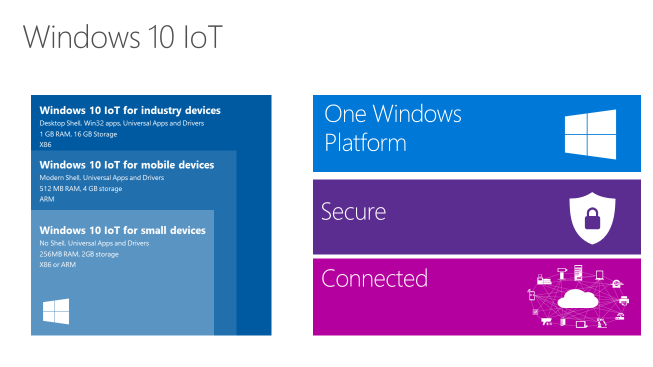
The primary information provided by Microsoft is that there will be an entirely new edition of Windows 10, "Windows 10 IoT", using a similar postfix notation as the ill-fated "Windows 8 RT". However, within Windows 10 IoT there are three classes: industry devices, mobile devices, and small devices. This could be the eventual official names of Stock Keeping Units (SKUs) for Windows 10 IoT, but Microsoft was careful not to use the SKU term yet.
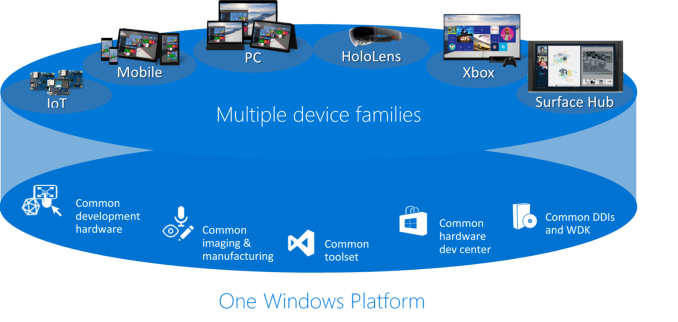
All three classes of Windows 10 IoT support universal apps and drivers. This extends the deployment options of a single app from desktops, laptops, tablets, game consoles, TVs and augmented reality (Holo Lens), all the way to IoT devices. The idea of a single app running on all these targets is quite impressive if it can be done well. While one app might not need to be on every type of device, it at least implies the development experience for each target is similar therefore lowering the barrier to entry.
Windows 10 IoT for industry devices has identical requirements to traditional 32-bit Windows 10: x86 processor, 16 GB storage and 1 GB RAM. Therefore it will be interesting to see what software tweaks are provided in Windows 10 IoT for industry devices that differentiate it from traditional Windows 10. Microsoft has not yet provided any details about this, but alludes to deeper integration with cloud services, security, and machine to machine connectivity. Microsoft mentions targeting medical devices, robotics, and other smart machine applications. From my own perspective, many of these devices already run Linux or real-time operating systems such as VxWorks so this could be an uphill battle.
Windows 10 IoT for mobile devices is a subset of functionality. It excludes the desktop shell but keeps the all modern interface introduced in Windows 8, then further reduces storage needs to 4 GB and an memory to 512 MB. Microsoft also limits it to only ARM processors, which is quite surprising considering that Windows 10 for small devices works on ARM or x86 processors. Also, the overlap with Windows Phone is considerable, and considering the rumors of x86 support in Windows 10 for phones, Windows 10 IoT for mobile devices is quite an enigma at the moment.
Finally, Windows 10 IoT for small devices drops the shell entirely but maintains universal app compatibility. This might imply that there is no way to interact with the operating system while running an app, such as a kiosk experience for Point of Sale (PoS) or media center devices. Microsoft's own documentation states "To keep storage and memory costs low, this edition of Windows 10 does not include a Windows start experience or in-box apps. Instead, the device maker builds the device experience as a Windows universal app and configures the device to launch that app at boot, giving the device developer complete control over the device experience." Requirements drop down to 256 MB of RAM and 2 GB of storage. As mentioned above, x86 and ARM processors are supported.
Microsoft also announced that Windows 10 IoT for small devices will be free for makers and commercial device builders. The language used is quite specific and it appears to rule out deploying Windows 10 IoT for small devices internally within a company.
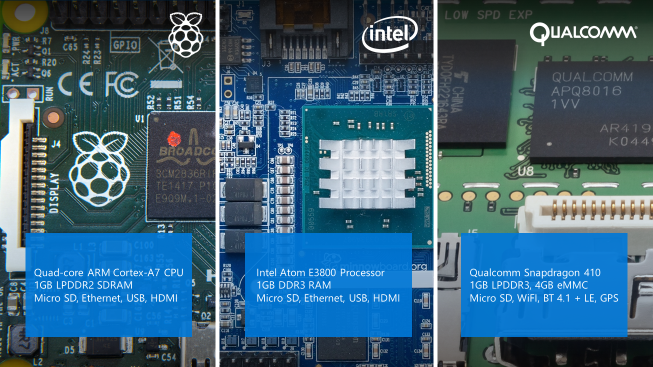
Finally, Microsoft's supplied graphic highlighting three compatible small devices includes the Raspberry Pi 2, an Intel Atom development board, and the Qualcomm DragonBoard 410c. The processors in each are ARMv7, x86, and ARMv8 respectively.
Unfortunately many questions remain. We look forward to Microsoft providing more details and evaluation units in the future.
Read More ...
Cher Wang Replaces Peter Chou as CEO of HTC

This move may seem unprecedented, but in practice it seems that Cher has increased responsibilities in terms of running HTC from day to day as Peter became more focused on product development and R&D. Given the change in focus in HTC from smartphones to connected devices, it seems that this has become one of the organizational changes that was deemed necessary to expand into new segments of the industry. In the near term, it seems that it's unlikely that anything will be noticeably different, but in the near future we may see a distinct shift in how HTC works.
Read More ...
Microsoft Launches The Ultra Low Cost Lumia 430

It is all fairly pedestrian in the specifications department, as we will see below, but the real story is just how inexpensive this device is. Pricing will vary by market, but Microsoft is estimating the Lumia 430 Dual-SIM smartphone to be priced around $70 USD before any subsidies are applied.

To hit these kinds of price points, some sacrifices have to be made of course, but all in all it is still a typical low end Lumia. Before Microsoft bought the Lumia line from Nokia, we had similar low end phones launched that would be missing key features. The Lumia 635 is a great example of this. Although it was a decent device, the lack of a proximity sensor and ambient light sensor made it difficult to use in real life, and the limited 512 MB of RAM meant it could not access the entire Windows Phone catalog of apps.
Microsoft has taken a different approach, and all of the low end devices that they have launched with the Microsoft logo have included the standard features needed to enjoy a smartphone experience, and the $70 Lumia 430 is no exception. It comes with the Qualcomm Snapdragon 200 SoC, with dual 1.2 GHz Cortex A7 cores, so it will not be the speediest device ever launched, but Windows Phone has always been good on low end devices and avoids the stutter and chop which has plagued Android. RAM is a healthy 1 GB, which means that the Lumia 430 does have access to the entire Windows Phone store. Other key features such as the ambient light and proximity sensor are included, even for this budget price, so obvious features such as automatic brightness will work.
Speaking of brightness, the LCD will also likely be a very low end model, but it is a 4” 800x480 LCD, although it is not listed whether this is an IPS display (hopefully it is) but the display enhancement technologies such as ClearBlack are not available. I have also found with the low end Lumia phones that the display coating is also either very thin or not available, and this could continue that trend due to the price.
Storage is also something that Microsoft has bumped up, with Nokia opting for 4 GB on the very low end models, but Microsoft has equipped even this low end device with 8 GB of internal NAND. MicroSD support will give an additional 128 GB more space, and Windows Phone supports MicroSD very well so this will not be an issue.
The battery is just a 1500 mAh, with the older 3.7 V chemistry, which works out to just 5.55 Wh of capacity.
| Nokia Lumia 430 | |
| SoC | MSM8212 dual-core 1.2 GHz Snapdragon 200 |
| RAM/NAND | 1 GB RAM, 8 GB NAND + microSD |
| Display | 4.0” 800x480 LCD |
| Network | GSM/GPRS/EDGE/UMTS/HSPA+ up to 42.2 Mbps |
| Dimensions | 120.5 x 63.2 x 10.6 (mm) |
| Weight | 127.9 grams |
| Camera | 2MP rear camera Fixed Focus 1/5" Sensor No Flash, VGA FFC |
| Battery | 1500 mAh (5.55 Whr) |
| OS | Windows Phone 8.1 with Denim Firmware |
| Connectivity | 802.11 b/g/n + BT 4.0, USB2.0, MPT, DLNA, FM Radio |
| Location Technologies | Cellular and Wi-Fi network positioning, A-GPS, A-GLONASS |
| SIM Size | Smart Dual MicroSIM |
The camera is the main area where costs were saved. The Lumia 430 comes with just a 2 MP fixed focus camera on the rear, however the front camera is the same resolution as the $1299 Apple MacBook, with a 0.3 MP VGA sensor which is clearly for cost savings, and will not be very good for anything other than the occasional video chat.

Microsoft’s strategy seems to be to release a new low end smartphone every couple of weeks, and even as someone who follows the space it is getting awfully confusing. However most of these are aimed at specific markets, and the Lumia 430 is no exception. The Lumia 430 will be available in April in the Asia-Pacific, India, the Middle East, Africa, Russia, Kazakhstan, Ukraine and Belarus.
Source: Lumia Conversations
Read More ...
The AMD FreeSync Review
After a long wait, AMD’s FreeSync has finally arrived. Promising adaptive refresh rates using open standards and with no royalty fees, there are only two remaining questions: does is work, and how much will it cost? With the first publicly available FreeSync drivers in hand and using LG’s 34UM67 UltraWide display, we put FreeSync to the test.
Read More ...
NVIDIA Announces Quadro M6000 & Quadro VCA (2015)
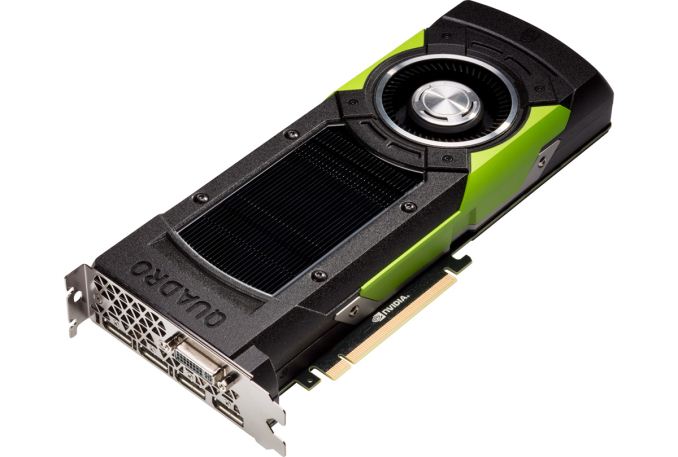
Like Titan, 6000 is NVIDIA’s flagship Quadro card and today’s launch sees the new GM200 based Quadro M6000 take its place at the top of the Quadro graphics stack. What makes this launch interesting is that NVIDIA has never launched a flagship Quadro card so close to a flagship GeForce card in this manner. Quadro cards usually launch months down the line, not days. The end result being that professional users are getting much earlier access to NVIDIA’s best hardware.
| NVIDIA Quadro Specification Comparison | ||||||
| M6000 | K6000 | K5200 | 6000 | |||
| CUDA Cores | 3072 | 2880 | 2304 | 448 | ||
| Texture Units | 192 | 240 | 192 | 56 | ||
| ROPs | 96 | 48 | 32 | 48 | ||
| Core Clock | N/A | 900MHz | 650MHz | 574MHz | ||
| Boost Clock | ~1140MHz | N/A | N/A | N/A | ||
| Memory Clock | 6.6GHz GDDR5 | 6GHz GDDR5 | 6GHz GDDR5 | 3GHz GDDR5 | ||
| Memory Bus Width | 384-bit | 384-bit | 256-bit | 384-bit | ||
| VRAM | 12GB | 12GB | 8GB | 6GB | ||
| FP64 | 1/32 FP32 | 1/3 FP32 | 1/3 FP32 | 1/2 FP32 | ||
| TDP | 250W | 225W | 150W | 204W | ||
| GPU | GM200 | GK110 | GK110 | GF110 | ||
| Architecture | Maxwell 2 | Kepler | Kepler | Fermi | ||
| Transistor Count | 8B | 7.1B | 7.1B | 3B | ||
| Manufacturing Process | TSMC 28nm | TSMC 28nm | TSMC 28nm | TSMC 40nm | ||
So just what is Quadro M6000? Packing a fully enabled GPU, this is GM200 at its best. All 3072 CUDA cores are enabled, and with a maximum clockspeed of 1.14GHz the card is capable of pushing 7 TFLOPs of single precision performance. Coupled with the card is GM200’s double-sized ROP clusters, giving M6000 96 ROPs and better than 2x the pixel throughput of the outgoing K6000.
Meanwhile it’s interesting to note that NVIDIA’s GPU Boost technology has finally come to the Quadro lineup via the M6000. The M6000 supports 10 different boost states, the fastest of which is the 1.14GHz state that gives the card its 7 TFLOPS of performance. As with GeForce and Tesla cards, GPU Boost allows NVIDIA to raise their shipping clockspeeds for better performance without violating the card’s cooling or power delivery restrictions.
Paired with the GM200 is 12GB of GDDR5 memory, which is as much as the K6000 and still the most one can pack on a memory bus of this size. M6000 clocks its memory at 6.6GHz, which is good for 317GB/sec of memory bandwidth. Furthermore, as with past high-end Quadro cards ECC protection is available for the memory (and only the memory, no cache), which trades off some memory bandwidth for better protection against memory errors.
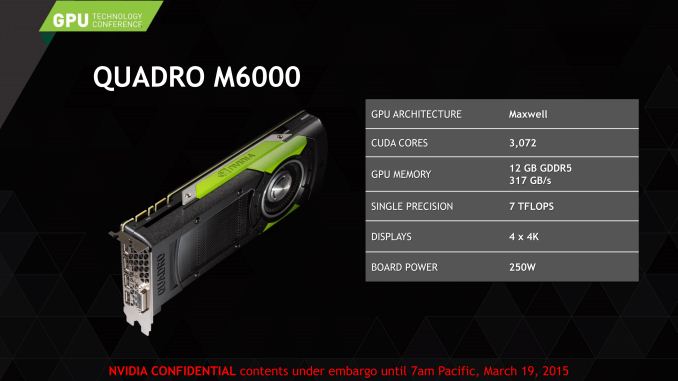
On the overall performance front, Quadro M6000 is expected to offer a significant performance boost over K6000, similar to what we’ve seen on the consumer side with GTX Titan X. Along with the greater clockspeed and the slight increase in the number of CUDA cores, M6000 brings with it the Maxwell 2 family architecture and its efficiency improvements. Actual performance will depend on the application, but 50% or more is possible, especally in exotic scenarios that stress the ROPs. To that end NVIDIA gave Lucasfilm some of the first M6000 cards, and they reported a better than expected performance increase:
To create the most immersive and visually exciting imagery imaginable, Lucasfilm artists and developers need optimal graphics performance and GPU power," said Lutz Latta, Principal Engineer at Lucasfilm. "With the NVIDIA Quadro M6000 GPU, we saw overall gains of 55% in heavy a compute and memory access ray-tracing application using layered shadow maps. This kind of performance boost gives our artists a necessary edge to realize their creative vision.
(Emphasis ours)
Along with Maxwell 2’s architectural efficiency improvements, Maxwell 2 also brings with it a series of feature improvements that make their debut in the Quadro family on the M6000. On the display side, M6000 is the first Quadro capable of driving four 4K displays (previous gen Quadros were limited to two such displays) thanks to the updated display controller. Meanwhile Quadro also gains the latest NVENC video encoder, which though unlikely to be used at this early stage, opens the door up to real-time HEVC encoding on Quadro.
As for the card’s construction and power requirements, both have changed compared to K6000. M6000’s TDP is 250W, up from 225W on K6000. The increased TDP allows for higher clockspeeds than the Quadro family’s historically conservative clockspeeds, and is at this point equivalent to the consumer GTX Titan X’s power requirements. Interestingly despite this increase, M6000 only requires 1 8-pin PCIe power connector (located on the far side of the card, as in past Quadro designs); this technically puts the M6000 out of spec on PCIe since 250W is more than what the slot + 8-pin connector can provide (225W). We asked NVIDIA about this, and they have told us that the card is pulling the extra power from the 8-pin connector, and though not officially in spec, the kind of systems expected to house the M6000 are expected to have no problem delivering the extra amperage necessary.
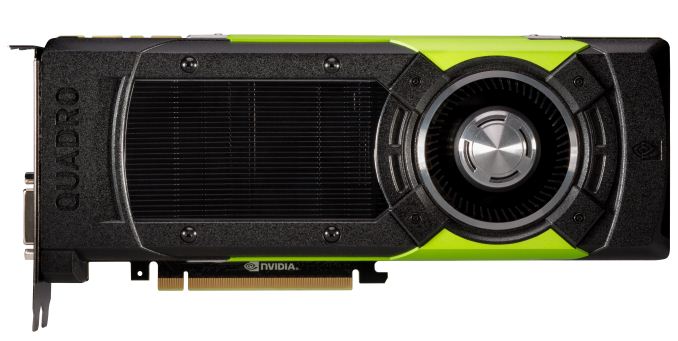
Meanwhile the card’s construction has seen the K6000’s plastic shroud and cooling apparatus replaced with the metal GTX Titan shroud and cooler, similar to the GTX Titan X. This change is largely driven by the power increase, as the GTX Titan cooler is already qualified to handle 250W designs. To set it apart from the GTX Titan X, the M6000 gets a black & green paint job rather than the Titan’s all-black paintjob. Otherwise the change in coolers has no effect on the card’s dimensions, with the card still being a double-slot 10.5” long card, just like the K6000.
Moving on, while M6000 will be a graphics monster, as it’s using the GM200 GPU this means that it will also inherit GM200’s compute capabilities, including the GPU’s highly limited double precision (FP64) performance. On the more recent Quadro 6000 cards, NVIDIA has used GPUs with high FP64 throughput (largely an artifact of also using these GPUs in Tesla compute cards) and left FP64 throughput unrestricted on Quadro cards. This made the Quadro K6000 a sort of jack of all trades, offering NVIDIA’s best pro graphics performance along with their full compute performance.
However GM200 and the Quadro M6000 change that. With Quadro M6000 having a native FP64 rate of 1/32 FP32, M6000 will only have minimal FP64 capabilities. In our GTX Titan X article we discuss the development rationale for this, but NVIDIA has essentially opted to build the best graphics and FP32 compute GPU they can, and not waste space on FP64 resources. Consequently this is the first Quadro 6000 series card in some time to have such poor FP64 performance. However as FP64 compute is not widely used in graphics, this is not something NVIDIA believes will be an issue. In the far more common scenario of FP32 compute (e.g. most ray-tracing engines), M6000 will be far more performant than its predecessors.
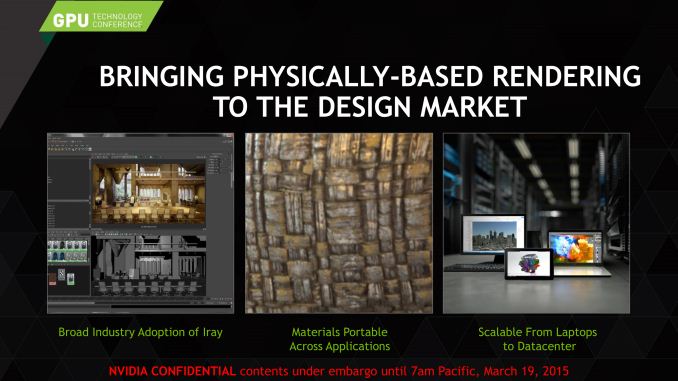
Finally, as far as use cases go, NVIDIA is aiming the M6000 at a cross-section of possible markets. There is of course the traditional pro visualization market, the high-end of which is always in need of greater GPU performance, something the M6000 can provide in spades. However the company is also pushing the use of Physically Based Rendering (PBR), a compute-intensive rendering solution that uses far more accurate rendering algorithms to accurately model the physical characteristic of a material, in essence properly capturing how light will interact with that material and reflect off of it rather than using a rough approximation. We’ll have more on PBR a bit later this week when we talk about Quadro developments at GDC.
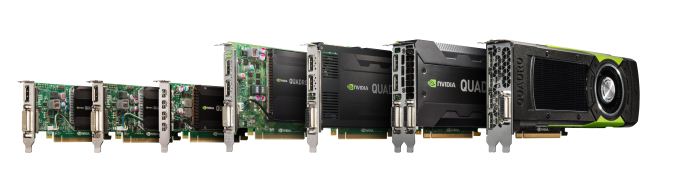
Wrapping things up, NVIDIA tells us that Quadro M6000 will be available soon in complete systems through the company’s regular OEM partners, and as individual cards via the typical retail channels. As is company for NVIDIA, they have not announced a launch price for the M6000, but we would expect to see it launch at $5000+, as has been the case with past Quadro 6000 series cards.
Quadro VCA (2015)
Meanwhile with the launch of the Quadro M6000, NVIDIA is also using this opportunity to refresh their Iray Visual Computing Appliance (VCA), the company’s high-end network-attached render server. The VCA specializes in very high performance remote rendering jobs, packing in multiple GPUs into a single server box, with further scale-out capabilities to multiple VCA boxes via 10GigE and Infiniband.
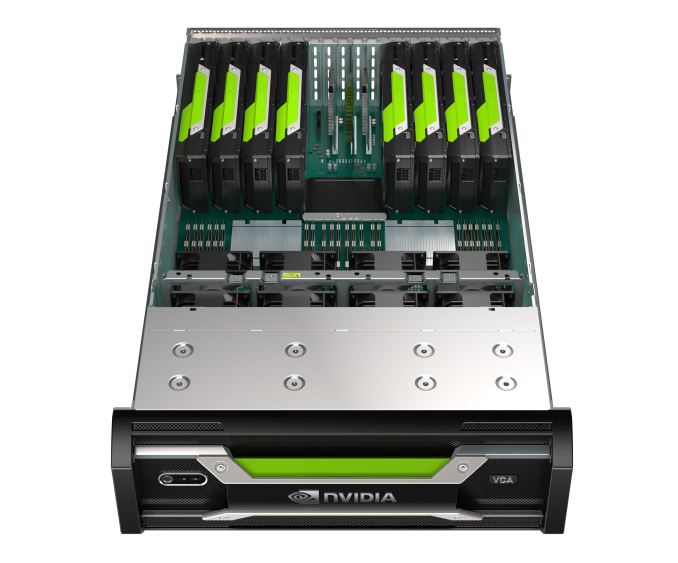
Now dubbed the Quadro VCA, this updated VCA packs in 8 of NVIDIA’s high-end Quadro cards. The cards themselves are GM200 based but are technically not M6000 – NVIDIA is quick to note that they have a different BIOS that has them clocked slightly differently – but should perform similar to the aforementioned M6000. These cards have 12GB per GPU and are fully enabled, giving the entire VCA some 96GB of VRAM and 24,576 CUDA cores.
Driving the Quadro cards will be a pair of 10-core Xeon processors (we don’t have the specific model at this time, but believe it to be from the Xeon E5 V3 family), 256GB of system memory, and 2TB of solid state storage. Other than the change in processors and the updated Quadro cards, the rest of these specs are identical to the previous generation VCA.
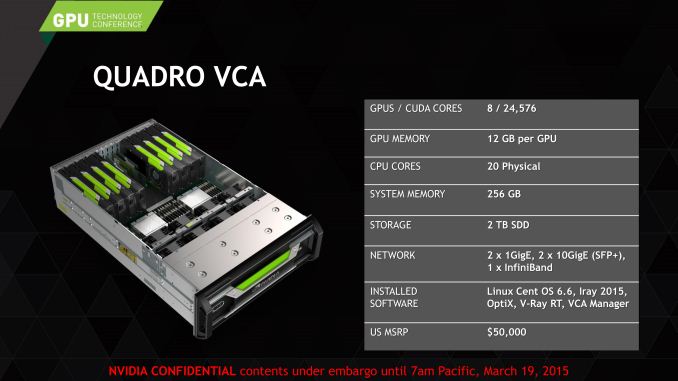
On the software side, the new Quadro VCA runs CentOS 6.6. It will also come with Iray 2015 and Chaos’s V-Ray RT pre-installed to make setup easier, however it should be noted that the VCA does not include the licenses for those software packages and those must be purchased separately.
The Quadro VCA will be available soon through NVIDIA's VCA partners for $50,000.


Read More ...
FAA Grants Amazon Prime Air an "Experimental Airworthiness Certificate"
However Amazon still faces strict restrictions, like the demand that it only operates drones with a clear line of sight
Read More ...
Small Consolation: Lawyers Score Massive Payday in $16M+ Target Settlement
Plaintiffs who suffered identity theft/credit damage can collect up to $10K each, but experts say few will qualify for a payout
Read More ...
Windows 10 Build 10041 Rolls Out: What's New in Pictures Pt. 1
Microsoft abruptly made good on its overdue promise to roll out a new public preview build
Read More ...
Available Tags:GTX , Microsoft , Windows , CEO , HTC , AMD , NVIDIA , Amazon ,


No comments:
Post a Comment