

Intel Xeon D Launched: 14nm Broadwell SoC for Enterprise
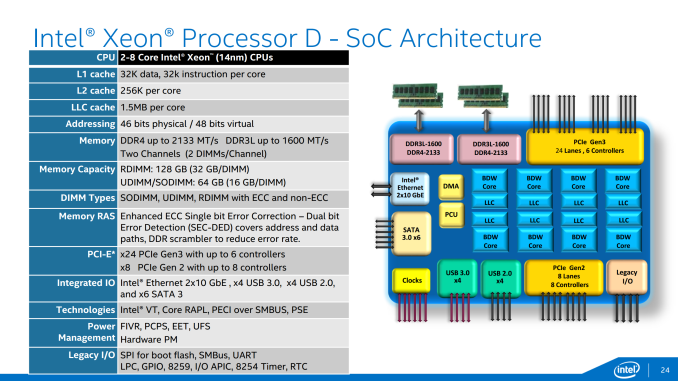
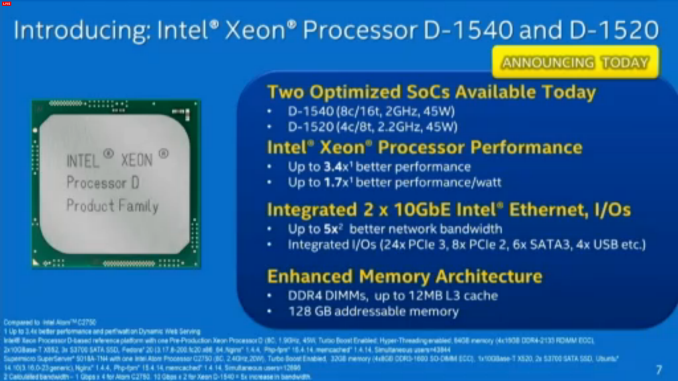
This is the slide currently doing the rounds from Intel’s pre-briefings on Xeon D. This is showing the current top of the line Xeon D-1540, giving eight Broadwell cores for a total of sixteen threads. Each core has access to 32KB/32KB of L1 cache, similar to Xeon E3 v3, as well as 256KB of L2 and 1.5 MB of L3 per core. The SoC supports both DDR3L and DDR4 controllers, with memory compatibility listed as 64GB in UDIMM and 128GB in RDIMM – both ECC and non-ECC is supported.
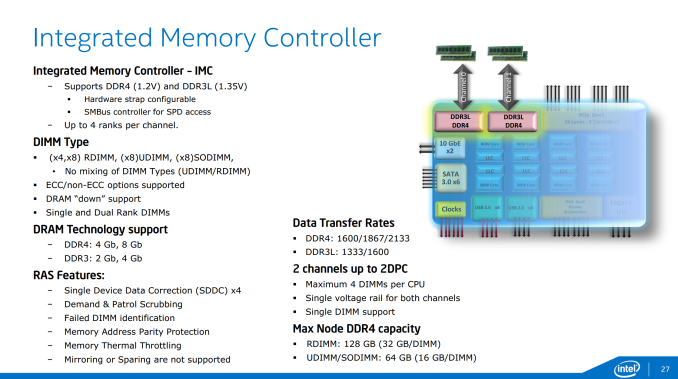
Note that the DRAM is limited to four DIMMs per CPU, which means two channels at 2 DIMMs per channel, rather than anything quad channel which remains the realm of the Xeon E5 v3 line. Also the limitations of 64GB/128GB in UDIMM/RDIMM are for DDR4 only – I might expect the DDR3L limits to be half that unless Intel has fixed the issue with supporting 16GB DDR3 UDIMMs on non-Atom platforms.
The core arrangement will be in a ring rather than a crossbar, as this tends to be where Intel’s strengths lie when it comes to processor design:
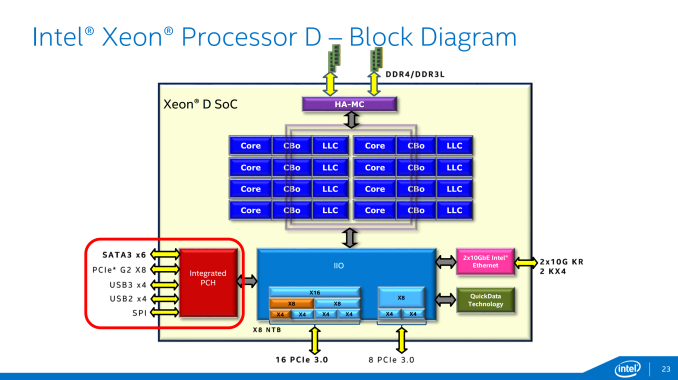
The SoC will have 24 PCIe lanes, up from 16 on the Xeon E3 v3 range. This is normally supported as x16/x8, although can be split into x4/x4/x4/x4/x4/x4 depending on the features required on the platform. The integrated IO hub also has bandwidth for eight lanes of PCIe 2.0 which will support eight separate x1 devices, such as ASPEED controllers, Ethernet or more storage.
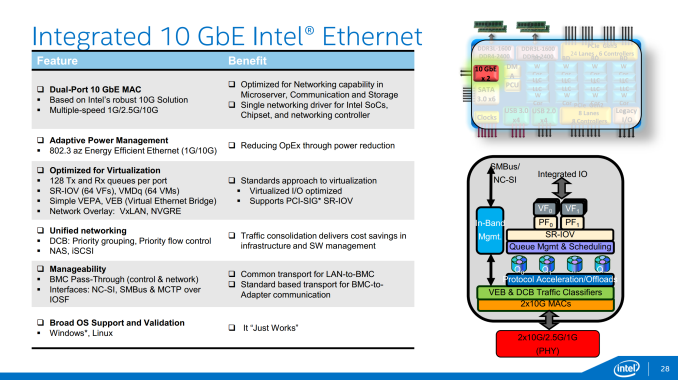
Speaking of networking, the SoC will have bandwidth for two 10GbE connections direct, which will work both in 1G and 2.5G modes. These are optimized for virtualization, allowing 128 Tx and Rx queues per port as well as SR-IOV and VMDq enhancements. With the integration on board, driver support should also be easier to manage rather than external controller solutions.
Adding in the Ethernet onto the SoC is rather interesting because the SoC is rated at a 45W TDP. Normally a server chipset is rated for around 13W, with 10G Ethernet at 7-13W. Thus even the additions of storage and networking can come to 20W, leaving 25W for the cores themselves. As a result, the cores are clocked at 2.0 GHz base for the 8-core D-1540, and 2.2 GHz for the 4-core D-1520. Both SKUs will turbo up to 2.5 GHz when needed.
The SoC also supports the more common server and enterprise aspects normally associated with this product range – virtualization, separate external system control and RAS (reliability, availability and serviceability).
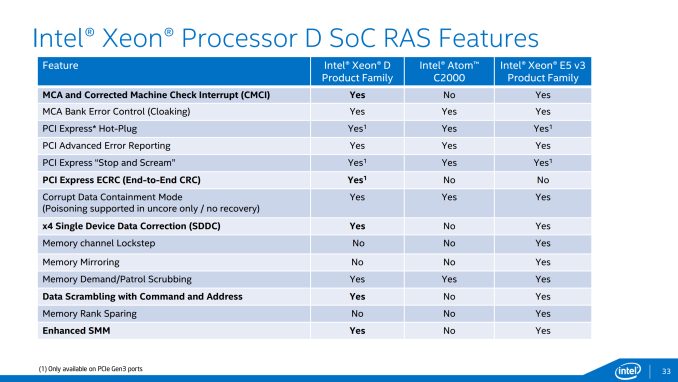
The RAS features are a big jump up from the Atom C2000 range, although there are one or two missing relating to memory from the Xeon E5 v3 counterparts.
Intel is placing some interesting claims on performance, specifically 3.4x better performance of the high end SKU compared to the Atom C2750 (eight core Silvermont) and 1.7x better performance per watt. Breaking down these comparisons, we have Silvermont against Broadwell which has a significant difference in architecture, and then an eight-core/eight-thread C2750 against the eight-core/sixteen-thread D-1540, which should improve the performance when software can take advantage of the threading. The performance per watt should have been expected moving from 22nm Silvermont to 14nm Broadwell. Bundle these in together, and the 3.4x / 1.7x numbers seem a reasonable comparison. The more poignant number perhaps is the 5.5% IPC increase over Haswell due to microarchitecture improvements:
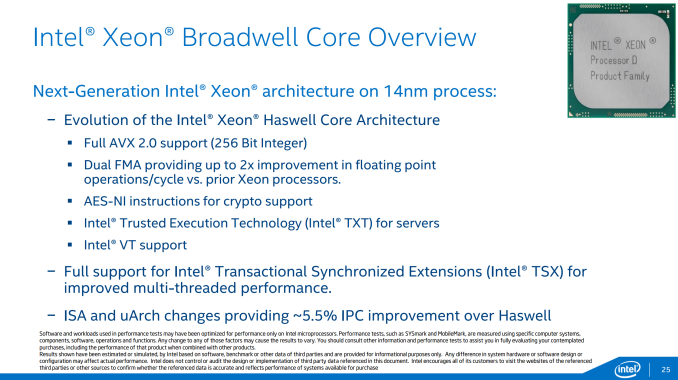
What Xeon D also brings to the table is the fixed silicon for Transactional Synchronized Extensions (TSX) that were disabled due to an obscure bug found in the middle of last year. This is combined with full AVX 2.0 support, dual FMA and AES-NI instructions.
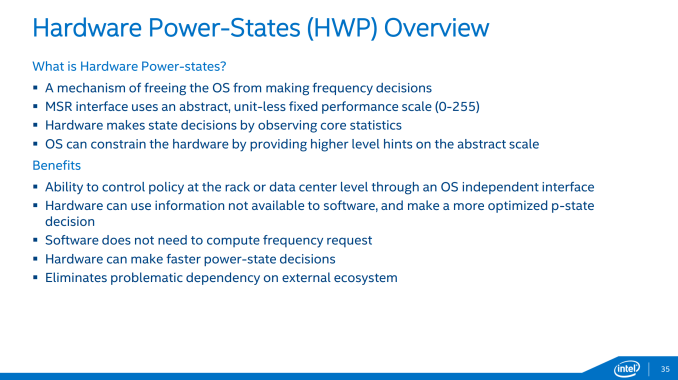
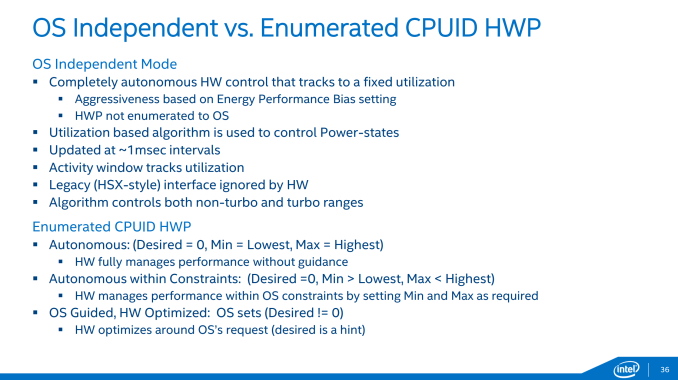
The other element of the equation is power, with Xeon D implementing Hardware Power States – a function that allows the hardware to adjust performance depending on core metrics independent of the operating system functionality. This allows for quicker load-to-idle times by probing the CPU at a level that might not be possible in software, as well as varying the function depending on loading and power consumption to a higher rate of granularity on the fly.
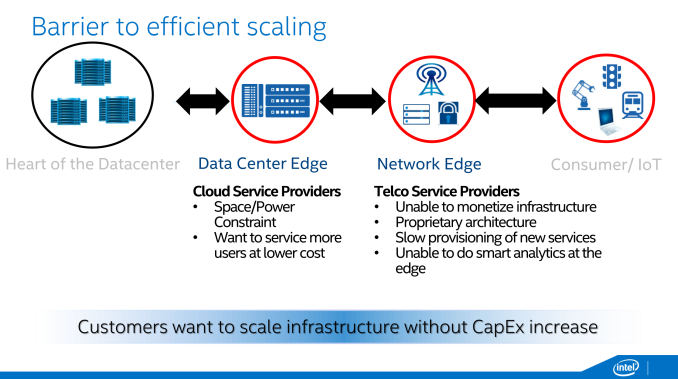
Xeon D is aimed at the ‘Data Center Edge’ for the start of 2015, moving into the ‘Networking Edge’ during the second half of the year. These edge-case scenarios are meant to tackle a region where sometimes the C2750 line was not powerful enough, or the Xeon E3 line was not as cost effective as could be – Xeon D aims to satisfy both sides of the equation.
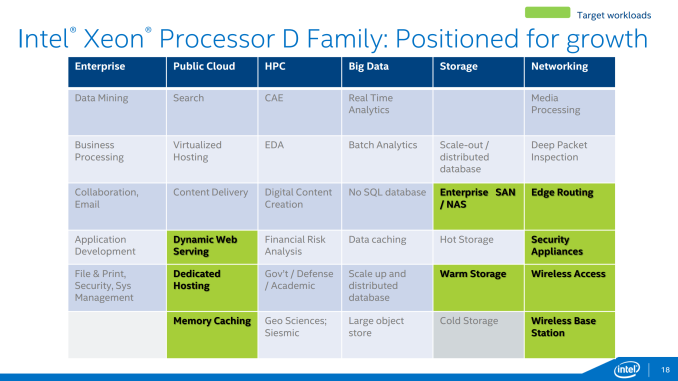
IoT related implementations are being considered, again for the second half of the year. We probed Intel on the likelihood of seeing any consumer oriented implementations of such a platform, and although they recognized that there might be some niche situations they had not considered where Xeon D might be appropriate, they were being bullish on actually aiming anything at the consumer. Xeon D is purely an enterprise play. That being said, so was the Atom C2750, but it made its way into the hands of the consumer via products such as ASRock Rack’s C2750D4I which we reviewed last year.
Current indications of products coming to market are by way of ASRock and also Supermicro. Patrick at ServeTheHome caught these two in his sights:
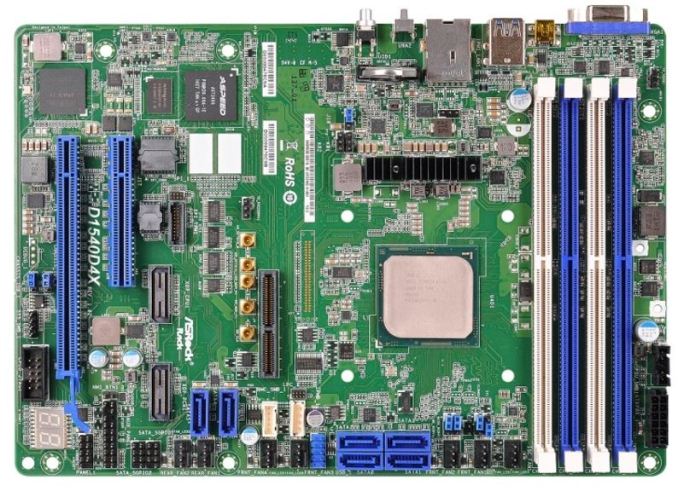
The ASRock Rack D1540D4X is a server build, as shown by the limited power delivery as well as the storage and PCIe arrangement. Networking is via a selected PHY card, supporting either dual 10GBase-T or SFP+. ASRock Rack is showing this setup at CeBIT, hopefully in action.
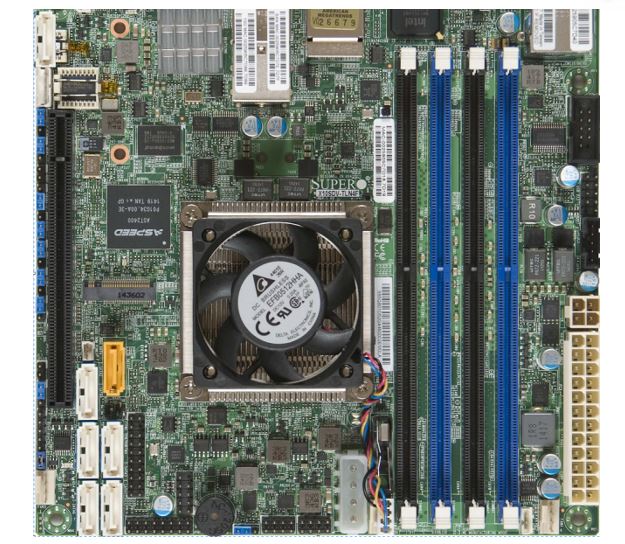
The SuperMicro X10SDV-TLN4F comes in a regular mini-ITX form factor, supporting dual 10GBase-T along with two I350-AM2 GbE ports and IPMI 2.0 with KVM. The PCIe lanes of Xeon D come into effect here, giving a PCIe 3.0 x4 M.2 slot for 2242 and 2280 sized M.2 storage cards.
Estimated prices for the motherboards put them in the $800-$1000 bracket with the CPU, perhaps matching or besting the equivalent Avoton platform + X540-T2 bundling. Interestingly Patrick also caught wind that Tyan is not going to play in this market, with no products planned.
Despite the official launch today, we are more likely to see product available in volume in April, although a few select partners might be able to ask their regular distributors about testing today. Both Johan and I are looking into sampling a few of these for AnandTech reviews, so stay tuned for those. We have some deeper information on the architecture to pour through between now and then which we will go into for the reviews. Johan recently compared the Xeon E3 v3, Atom C2000 and X-Gene 1 platforms, to which Xeon D is another piece of the puzzle.
Source: Intel, ServeTheHome
Read More ...
Apple Watch Hands-On

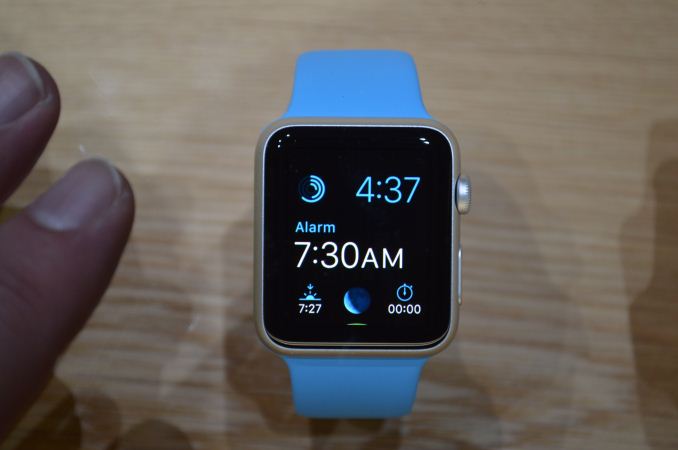
As a quick reminder, Apple is selling the watch in 2 sizes, 3 styles per size. The 38mm and 42mm sizes are essentially men’s and women’s sizes, with the 42mm carrying a general price premium of $50; and while Apple doesn’t officially mention it, we know from previous leaks of their developer guidelines that the watches have different resolutions, with the 38mm coming in at 272x340, and the 42mm at 312x390. Meanwhile the 3 oddly named styles of the watch are the entry level Apple Watch Sport, the mid-level suffix-less Apple Watch, and the luxury Apple Watch Edition. Each version of the watch moves up in material, from brushed aluminum, to polished stainless steel, to 18kt gold.
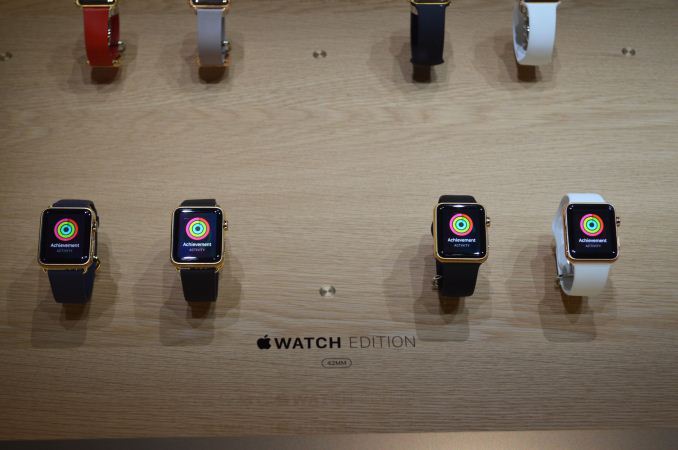
Having a chance to try the Sport edition, I’m still not entirely sure what to make of it. The Apple Watch is essentially a wrist-mounted extension for your iPhone plus a sensor suite. That gives it a lot of flexibility – Apple’s still waiting to see what developers can do with it – but it’s also clearly a first-gen Apple product looking to find its place in the world. Apple has some ideas, but long term it’s going to be developers that make or break it and they are keenly aware of that.
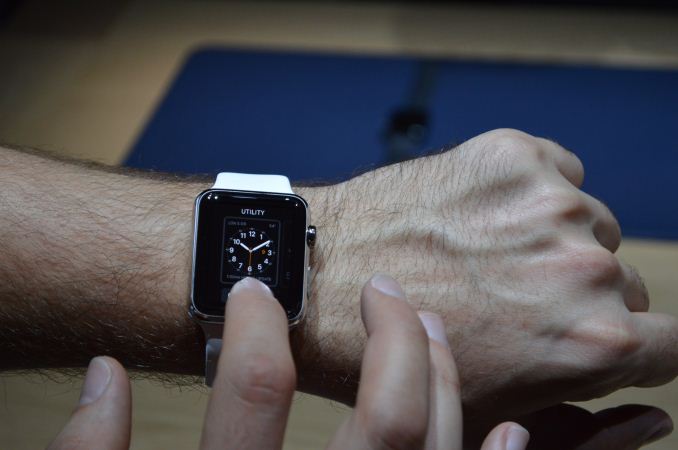
In-hand (or rather on-wrist), the size feels right, at least for someone used to wearing a sizable sports watch in the first place. Though the Sport bands Apple had on-hand did not come in a size-Ryan. Interacting with it is definitely going to be a learned art; the only physical controls are the side button and the crown, so most interaction comes from touch interactions with a fairly small screen. The Apple Watch combines traditional touch gestures with pressure gestures from their new Force Touch technology, so interactions can come from swipes or touches of various pressure.
For today’s hands-on, the apps themselves are more proof of concept than real-world, as they were only setup to run through Apple’s demo material. The Watch offers an interesting selection of apps iPhone-tethered apps, shifting from a second screen for you iPhone to running scaled down versions of iPhone apps. Notifications, emails, etc can all be accessed from the Watch for communication purposes. You can also make calls from the watch, though in the admittedly crowded demo room it seemed to be a poor idea. Other apps included scaled down versions of Uber, and a scaled down version of iTunes for playing music through the Watch.
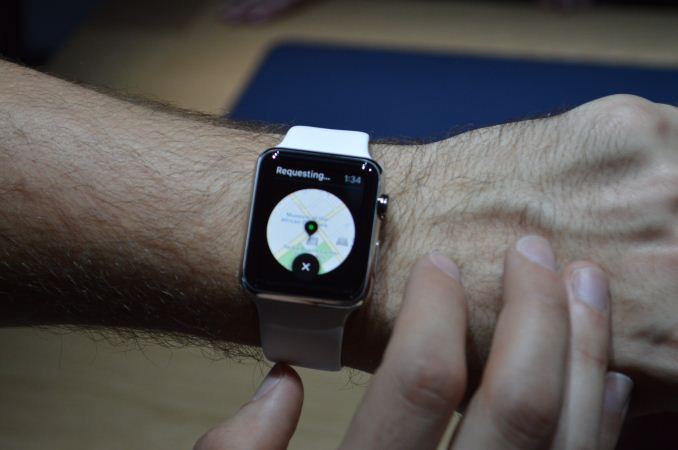
The other half of the Watch’s applications are focused on “native” functionality. This includes the actual watch face application – selectable and further customizable faces/skins of course – and applications that take advantage of the Watch’s sensor suite. The bulk of the sensor apps focus on fitness in one way or another, and this I suspect is largely due to the fact that the most “novel” sensor on the Watch is the heartrate monitor (otherwise accel/gyro are already on the iPhone). Fitbit, MS Band, and other fitness tracker users should have a good feel for what to do with this, while new users will take some guidance. Though since the interface is almost entirely iconographic, there will be a learning curve for everyone just to learn what the various icons mean and do.
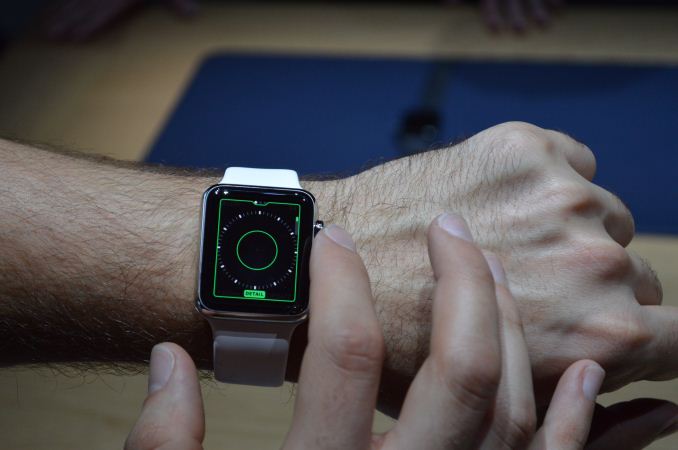
The Watch appears to be running a heavily scaled down version of iOS, and in terms of performance it’s perhaps not surprising that performance feels like it’s yearning for a full Apple A-class SoC at times. Apps other than the clock – which is essentially part of the home screen – have a short but distinct loading time. Once you’re in an app most move smoothly as you’d expect, though flipping through one of the Apple fitness applications saw noticeable stuttering. Whether the load times and stuttering I saw is a limit of the SoC or the NAND I’m unsure, though as this is a pre-release device it’s entirely likely that Apple still has some performance tuning to go. What we’re seeing right now is generally going to be performant enough, but it’s not iPhone 6 level smoothness.
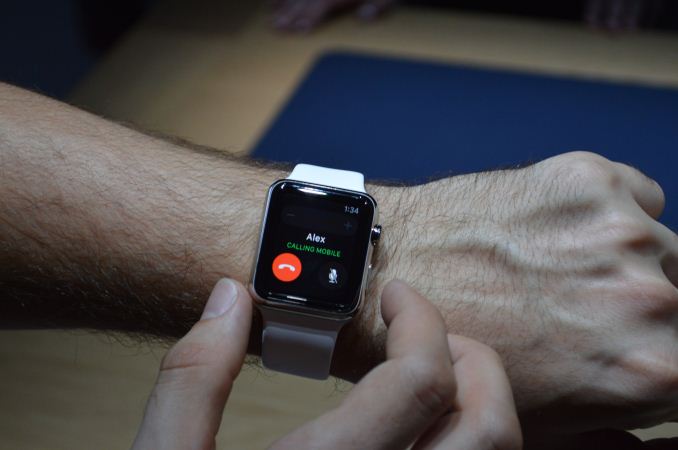
The million dollar (well, $10K+) question right now is this: is it worth it? That’s a question I don’t think a hands-on test in a closed environment can answer. I think it’s going to be a geek product before it goes mainstream – and this has been the case for Apple’s previous mobile products as well – as the novelty is certainly going to help get it off the ground. Whether such a watch is useful as opposed to just taking your iPhone out of your pocket is another matter; more than a few people I know gave up watches because their phone was convenient enough for a time piece, so getting them to buy back into watches is not a given, particularly since the Watch only has very limited functionality without an iPhone by its side to provide it with data (locally you have the sensor based applications, but not much more). Which isn’t to say that I’m for or again the Watch right now, only that I would need to test it at my own pace to figure out if and where it can fit into my life.
Anyhow, the Apple Watch hits retail on April 24th. So we’ll be back next month with a more comprehensive look at Apple’s latest foray into mobile.
Read More ...
Google Releases Android 5.1

The first feature is official support for multiple SIM cards. This feature is likely to appeal to Android users in emerging markets, and will definitely help Google's Android One initiative. Another new feature is support for HD voice calls on compatible networks and devices, with both T-Mobile and Verizon supporting the feature on the Nexus 6. Google has also added the ability to join WiFi networks and pair Bluetooth devices right from the quick settings menu.
In addition to the above improvements, Android 5.1 has one more notable feature, it's called Device Protection. Similar to Apple's Activation Lock, Device Protection means that a device will remain locked until the owner signs in with their Google account. This lock persists even after a factory reset, which should hopefully make stealing Android smartphones a pointless endeavor for thieves. Police departments in some US cities reported significant reductions in iPhone theft after the release of Activation Lock, and it would be great to see the same thing happen with Android devices.
Android 5.1 Lollipop will be rolling out to Nexus and Google Play edition devices in the near future.
Read More ...
Apple Reveals Apple Watch Details And Availability

While Apple showed off some of the Apple Watch's abilities at their earlier event, their demos from today went more in depth. Apple made note of the fact that the watch is accurate to within 50ms of UTC, which is probably a higher level of accuracy than most people will ever need, but it may increase appeal to those who value the accuracy of their watch. Apple also demonstrated its communication abilities, and showed how users can communicate using pictures drawn on the watch, voice dictated messages, audio recordings, and their heartbeat.
The role of third party developers in expanding the abilities of Apple Watch was also highly emphasized. Apple demoed an app from CNN that reports headlines to users, and also made note of the availability of an Uber application.

There have also been several questions unrelated to the Apple Watch's software and abilities. The biggest area of concern up until this point has been battery life. The battery capacity for wearable devices is almost always constrained due to the limited space available. There has been a great deal of speculation about whether or not the Apple Watch will last through an entire day, and whether it will need to be charged every night like a smartphone is. At the event, Apple revealed that the expected battery life for the Apple Watch will be somewhere in the realm of 18 hours. This means that it should last a user through the day, but that charging every night will be a necessity unless the watch has hardly been used.
| Apple Watch Pricing | ||||||
| Pricing | Apple Watch Sport | Apple Watch | Apple Watch Edition | |||
| 38mm Low | $349 | $549 | $10,000 | |||
| 38mm High | $349 | $1040 | $17,000 | |||
| 42mm Low | $399 | $599 | $12,000 | |||
| 42mm High | $399 | $1099 | $15,000 | |||
The second big question was about pricing. Apple Watch is by far Apple's most customizable product to date, and the number of combinations of bands and models and sizes is enormous. Because of this, Apple only provided price ranges for each model. At the October event the starting price for the Sport model was revealed to be $349, and this has not changed. That price is for the 38mm size, while the 42mm size bumps the price up to $399. The steel and sapphire Apple Watch will start at $549, and go all the way to $1099 for the most expensive model which is the 42mm body and the link bracelet. Finally, the Apple Watch Edition starts at $10,000, and goes up to $17,000 for the models with the red leather band and gold buckle. All of the bands are also available for purchase separately, and so users can outfit the Apple Watch Sport with a nicer band than the fluoroelastomer one it comes with. The pricing for the bands ranges from $50 to $500, and you can take a look at all of them on Apple's website.
The final question is obviously about availability. The Apple Watch will be available for pre-order on April 10 in Australia, Canada, China, France, Germany, Hong Kong, Japan, the UK and the US. Users can also make appointments at select Apple Stores to preview and try on the watch.
Read More ...
Apple Announces The New MacBook (2015)
| The New MacBook | |
| Dimensions | 28.05 x 19.65 x 0.35–1.31cm |
| Weight | 920g |
| CPU | Intel Core M-5Y70 or M-5Y71 |
| L3 Cache | 4MB |
| Base CPU Clock | 1.1GHz or 1.2GHz |
| Max CPU Turbo | 2.9GHz |
| GPU | Intel HD Graphics 5300 |
| System Memory | 8GB 1600MHz LPDDR3 |
| Storage | 256GB or 512GB PCI-E SSD |
| Display | 12" 2304x1440 IPS LCD |
| Battery | 39.7Wh |
| Ports | 1 x USB Type-C, 3.5mm combo jack |
| Connectivity | 2x2 802.11a/b/g/n/ac + BT 4.0 |
| Price | $1299 or $1599 |
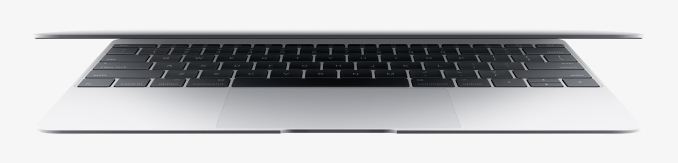
This new MacBook was recently rumored, and there have been many different reactions from Apple fans and tech press alike. It's certainly a departure from even the existing MacBook Air, and in many ways it seems more fitting of the Air name than the current Air does. Apple's goal was clearly to make something thin, light, and almost appliance like. They've certainly succeeded, but in order to get there the MacBook makes some big changes to what is currently thought of as a notebook.
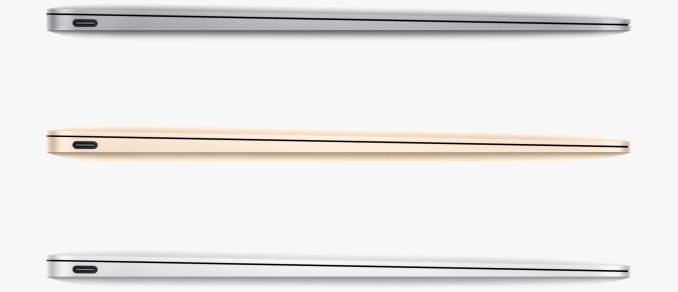
The biggest change is to physical connectivity. Macs currently come with a couple of USB ports, a couple of Thunderbolt 2 ports, a 3.5mm jack for audio, and some connector for power. The new MacBook goes in a completely different direction, ditching every single legacy port with the exception of the 3.5mm jack. Instead, the MacBook has a single USB Type-C port on the left side, and this port is the only method of connecting with other devices, as well as charging. It's a huge departure from the current MacBooks and laptops in general, and only time will tell how well consumers respond to this change.
Apple's pursuit of thinness also necessitated changes to the input devices when compared to other MacBooks. With a slimmer chassis comes less space for the key switches underneath the key caps. In order to make the keyboard on the new MacBook, Apple designed a new type of key switch which they are calling a Butterfly Switch. This new switch is 40% thinner than the scissor switches used on older MacBooks, and it eliminates the wobble that occurs when pressing on the edges of scissor switches. The trackpad has also been redesigned to use Apple's Force Touch technology from the Apple Watch. which allows the user to press anywhere on the trackpad to click, and gives a haptic response to presses. It can also determine the force of a press to perform gestures or other actions. Both of these changes are interesting, but they do make large changes to the feel of the keyboard and trackpad. Key travel distance has certainly been reduced, and the new trackpad won't have the clickiness of the old ones. It will be interesting to see how consumers react to these changes.
Apple's other goal seems to have been making the new MacBook fanless. In order to do so, the new MacBook utilizes Intel's new Core M processors. The starting configuration at $1299 uses Core M-5Y70 which has a base frequency of 1.1GHz and a turbo frequency of 2.9GHz. The 1.2GHz Core M-5Y71 is available in the $1599 model, and a 1.3GHz version is available as a build to order option on Apple's online store. All models come with 8GB of LPDDR3 memory standard.
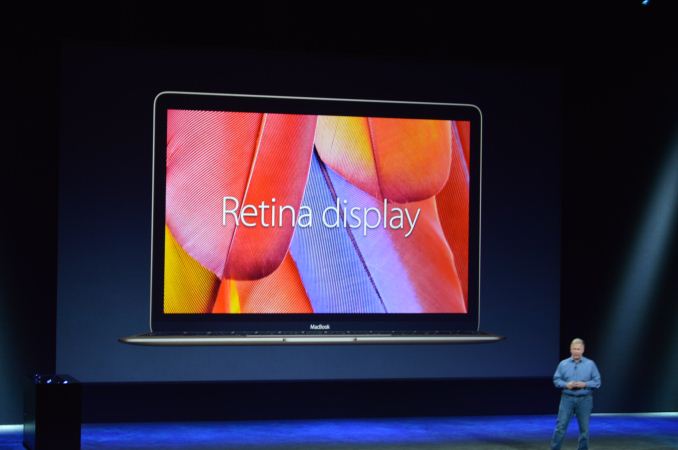
Like all of Apple's recent products, the new MacBook comes with a Retina display. This is a 12" 2304x1440 IPS display, which equates to 226 pixels per inch. While this new MacBook is not a MacBook Air, it's good to see the thin and light laptop in Apple's line finally moving both to a high resolution display as well as to an IPS panel. Assuming that Apple does the same 2x scaling that they've used in all of their other products, users will be given a desktop with the same area as a 1152x720 display which is actually slightly lower than the 11" MacBook Air. Apple specifies that the scaled resolutions available are 1440x900, 1280x800, and 1024x600, although it remains to be seen how well Intel's HD 5300 will keep up when rendering at 2880x1800 offscreen for the 1440x900 scaled mode.
This new MacBook reminds me a lot of the iPad. It has a port for charging and for interfacing with other devices via adapters, and a port for your headphones. Everything else is meant to be done wirelessly, and there's certainly no room for user upgrades or repairs. It's very much an appliance-like computer, and it's something very different from any laptop Apple has ever done before. I naturally want to feel skeptical about it, but the MacBook Air was an equally dramatic shift from the norm when it was first introduced, and it eventually replaced the original MacBook line entirely. Whether or not the changes in the new MacBook become common among future laptops is up to consumers. If you want to be one of the first people to enter uncharted territory with this new MacBook, it'll be available in just over a month, on April 10.
Read More ...
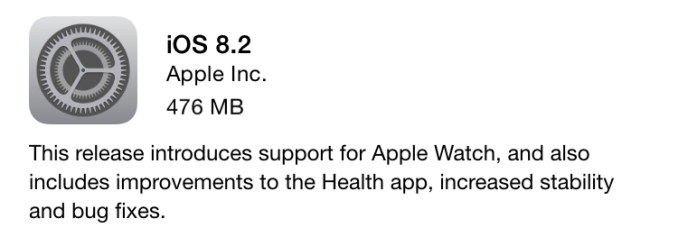
Apple Releases iOS 8.2 With Apple Watch Support


The Apple Watch application can't do very much at the moment, but what I found interesting was the fact that the pairing process for the Apple Watch involves the use of the camera. The explore button on the bottom leads to videos and images about the Apple Watch, while the App Store section is currently a placeholder until the Apple Watch actually ships and applications begin to be put on the App Store.
In addition to the new Apple Watch features, the update also fixes several bugs and improves the stability of several applications. Below is the list of major changes provided by Apple, although one should note that there are often many small bug fixes and improvements that don't make their way onto these changelogs.
Apple Watch support
- New Apple Watch app to pair and sync with iPhone, and to customize watch settings
- New Activity app for viewing fitness data and achievements from Apple Watch; appears when Apple Watch is paired
- Available on iPhone 5 and later
Health app improvements
- Adds the ability to select the unit of measurement for distance, body temperature, height, weight and blood glucose
- Improves stability when dealing with large amounts of data
- Includes the ability to add and visualize workout sessions from 3rd-party apps
- Addresses an issue that may have prevented users from adding a photo in Medical ID
- Fixes units for vitamins and minerals
- Fixes an issue where Health data wouldn’t refresh after changing data source order
- Fixes an issue where some graphs showed no data values
- Adds a privacy setting that enables turning off tracking of steps, distance and flights climbed
Stability enhancements
- Increases stability of Mail
- Improves stability of Flyover in Maps
- Improves stability of Music
- Improves VoiceOver reliability
- Improves connectivity with Made for iPhone Hearing Aids
Bug fixes
- Fixes an issue in Maps that prevented navigating to some favorite locations
- Addresses an issue where the last word in a quick reply message wasn't autocorrected
- Fixes an issue where duplicate iTunes purchased content could prevent iCloud restore from completing
- Resolves an issue where some music or playlists didn’t sync from iTunes to the Music app
- Fixes an issue where deleted audiobooks sometimes remained on device
- Resolves an issue that could prevent call audio from routing to car speakers while using Siri Eyes Free
- Fixes a Bluetooth calling issue where no audio is heard until the call is answered
- Fixes a timezone issue where Calendar events appear in GMT
- Addresses an issue that caused certain events in a custom recurring meeting to drop from an Exchange calendar
- Fixes a certificate error that prevented configuring an Exchange account behind a third-party gateway
- Fixes an issue that could cause an organizer’s Exchange meeting notes to be overwritten
- Resolves an issue that prevented some Calendar events from automatically showing as 'Busy' after accepting an invite
As you can see, there are a fair number of improvements in this release. The size of the update will depend on your device. On an iPhone 6, the OTA update came in at 476MB, while the release for the iPad Air 2 was only 391MB due to the fact that it doesn't include the new Apple Watch application.
Read More ...
X-Gene 1, Atom C2000 and Xeon E3: Exploring the Scale-Out Server World
Most of our attention with servers has gone to the midrange (Xeon E5, Opteron 6300) and high-end (Xeon E7) platforms. But the low-end and micro server market is where most of the competition, innovation and excitement is. It's time for some much needed analyses, based on solid real-world benchmarks.
Read More ...
Apple "Spring Forward" 2015 Live Blog
Read More ...
MediaTek at MWC 2015: A72 In Silicon, Multi-Standard Wireless Charging & More
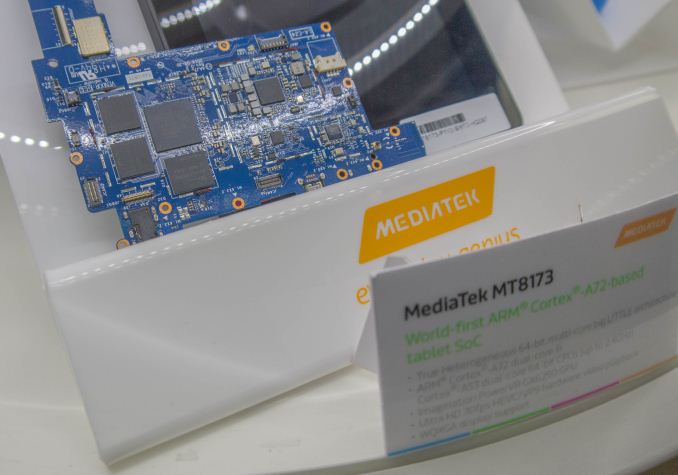
What was far the biggest surprise for us was the showing off of MT8173 hardware, a mid-range tablet SoC employing ARM's new Cortex A72. It's only been a few weeks since ARM officially announced the ARM Cortex A72, and while we still don't know much about the micro-architectural nuances of the core, having MediaTek already displaying silicon is a severe departure from ARM's usual announcement-to-release cadence. This puts the number A72 licensees with announced products already at two, with Qualcomm being the other one in the form of the Snapdragon 618 and 620.

The MT8173 employs two Cortex A72 CPUs at up to 2.4GHz and two Cortex A53 CPUs in a big.LITTLE configuration. On the GPU side we find a PowerVR GX6250 GPU, which if MediaTek's clocking strategy continues should run north of 700MHz. The SoC is still powered by LPDDR3 as the preferred memory interface, undoubtedly a cost decision as we're only starting to see LPDDR4 in flagship devices. On the multimedia side there's MediaTek's new display pipeline capable of 120Hz operation, 4K H.264/HEVC(10-bit)/VP9 video decoders and an ISP capable of 20MP sensors.

As part of the MWC announcements was also a (re)branding of MediaTek's SoC lineup. Beginning with the MT6795 which is now denominated the Helio X10, MediaTek will in the future begin naming their new chips after the Helio (After the Greek word for sun, "helios") brand. We'll be seeing the P-line targeting the premium performance segment while the X-line targets the high-end and the best MediaTek has to offer.
MT3188: PMA, WPC and A4WP Wireless Charging Solution In 1
As part of the booth demos, MediaTek showed off the MT3188 wireless charging IC solution which supports all three currently available standards, PMA, WPC and the newly emerged A4WP standard. While we've had the IC announced early last year, it is still impressive to see the real thing in hardware.

WPC (Wireless Power Consortium) is by far the currently most widely available standard in the form of Qi, which has seen large adoption in the mobile space. PMA (Power Matters Alliance) remains as the competitor standard but which hasn't seen as wide of an adoption rate with its Powermat/Duracell chargers. Both WPC and PMA rely on inductive charging which limit the spatial freedom between the transmitter and receiver coils to a few mm.
A4WP on the other hand is the new standard which is based on resonance charging, giving devices the freedom in x, y and z directions around the emitter coil. The charging area can be much larger than in the inductive charging technologies and also allows for one charger to simultaneously charge multiple devices. The advantage of inductive charging over resonance charging remains in the efficiency and EMI aspects.
The demonstration of the A4WP standard was impressive as it allows for an enormous amount of flexibility in terms of integrating charging pads into furniture. Among multi-device charging bases, we also saw charging through relatively thick wooden tables where the charger was hidden underneath, instead of having to integrate them into the table of having a mat on lying on top.
The MT3188 joins other unified charging solutions such as Broadcomm's BCM59350 which we also saw demonsrated at MWC this year.
MiraVision Display Pipeline Processing
Another interesting demo was the showing off of MiraVision integrated in MediaTek's SoCs. Basically MiraVision is a fixed-function post-processor which sits on the display pipeline which has full control of the image data being sent to the display. The use-cases which MediaTek demonstrated were colour gamut manipulation on one side, something which is already for example done in products such as the Meizu MX4 with the MT6595. What was impressive to me was the dynamic analysis of image content in dark environments and subsequent adjusting of back-light and pixel data to allow for better visibility. Think of it as a dynamic gamma-curve adjustment.
There were a few demos, including a third-person shooter one where the effect was considerable to the viewing experience. We've seen Samsung employ similar technology in their Exynos and television SoCs called mDNIe (Mobile digital natural image enhancement) which used among other things to change between display profiles on Galaxy devices. MediaTek's solution seems to one-up that as it allows for more dynamic settings as opposed to simply just having fixed programmed profiles.

MediaTek also demonstrated a frame-interpolation function for video playback through MiraVision. The result is similar to what SVP achieves in the PC space via software, but here it's again implemented through fixed-function hardware to achieve high performance at very low power. Video content that is sourced at 24fps is interpolated to 60fps on the screen. The result is remarkable on a small screen as it suffers less from the "fake motion" that one associates with such techniques (Or MediaTek's implementation is just really good?).
The demo unit was again a Meizu MX4, so it means the hardware and products are already out there but just merely need to be officially adopted by the vendors in software.
MediaTek's Modem Progression
Modems are an important part of MediaTek's strategy and we've had more or less a status-update on how things are progressing. The LTE products from MediaTek are still far and few in-between that seems to be changing in the future as we're seeing quick progression from the current Cat. 4 modem IP to Cat. 6 solutions in 2015 and Cat. 10 in 2016.


An interesting addition is the adoption and field testing of C2K, or better known as CDMA2000. Other vendors such as Intel and Samsung chose not to adopt the technology as in the future we'll see it being phased out in favour of LTE-only networks. For MediaTek to adopt it even though long-term it makes no sense, puts them in a unique position against Qualcomm in markets such as the US and China.
Read More ...
The Price of Gold: Apple Watch Gold Edition Starts at $10K, Tops Out at Insane $17K
Watch features a markup of roughly 20x on the high end over material costs; but will it appeal to luxury watch enthusiasts?
Read More ...
ResearchKit is Apple's Bid to Make iPhone, iPad as Medical Research Instruments
New open-source SDK expands the previous HealthKit into the academic space
Read More ...
Apple: 700 Million iPhones Sold, iPhone 6/6+ Have "99 Percent" Satisfaction Rate
Apple offers up some fresh details on the health of its smartphone platform
Read More ...
Apple-Exclusive "HBO Now" Debuts at $14.99/Month; Apple TV Price Cut to $69
Android gets snubbed by HBO execs, but it sounds like there is PC access for the new streaming service
Read More ...
Apple's Retail Footprint Has Grown Nearly 50 Percent Since 2011
Apple now greets over 120 million customers over the busy holiday quarter
Read More ...
Windows 10 Design Touches Show up in Overhaul of Microsoft's Homepage
New Windows 10 icons form new menu bar beneath hero image
Read More ...
Isaac Asimov's Blueprint for Alien "Life Not as We Know It" is Illuminated
Cornell University Chemical Engineers and Astronomers map out the possibility for non-water based life chemistry
Read More ...
Available Tags:Intel , Xeon , Apple , Google , Android , MacBook , iOS , Server , Wireless , iPad , iPhone 6 , iPhone , Apple TV , TV , Windows ,


No comments:
Post a Comment