

TRENDnet's Networking Solutions at CES 2015

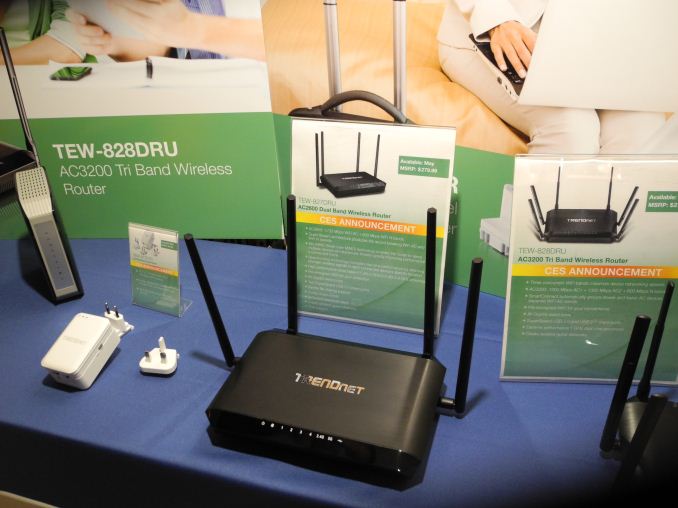
TRENDnet has also decided to join the Broadcom XStream bandwagon with a AC3200 router, but, similar to TP-LINK's situation, the usage of that model as a flagship should be quite short-lived.
On the powerline front, TRENDnet has opted for QCA's HomePlug AV2 solution for the Powerline 1200 family. This has two members, the TPL-420E2K and TPL-421E2K. The latter has pass-through outlets.
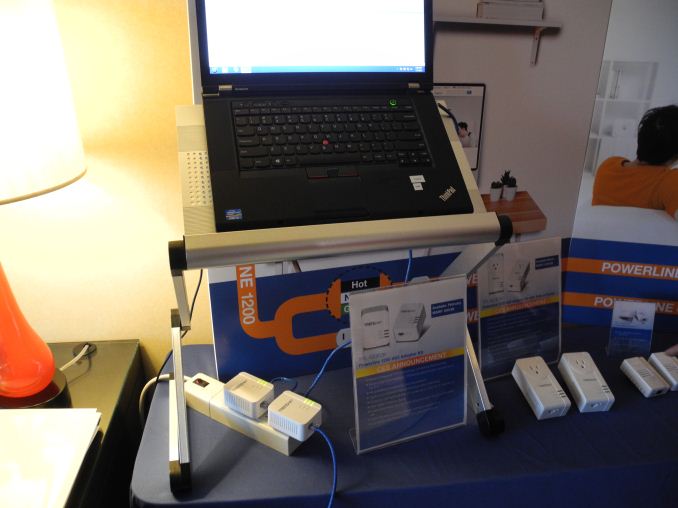
The product line I came away most impressed with was the home control portfolio. In early December 2014, TRENDnet had launched the THA-101, a smart switch that could also act as a 300 Mbps 802.11n wireless extender (a differentiation point compared to the D-Link Smart Plug and Belkin WeMo). It is currently available for $55 on Amazon.
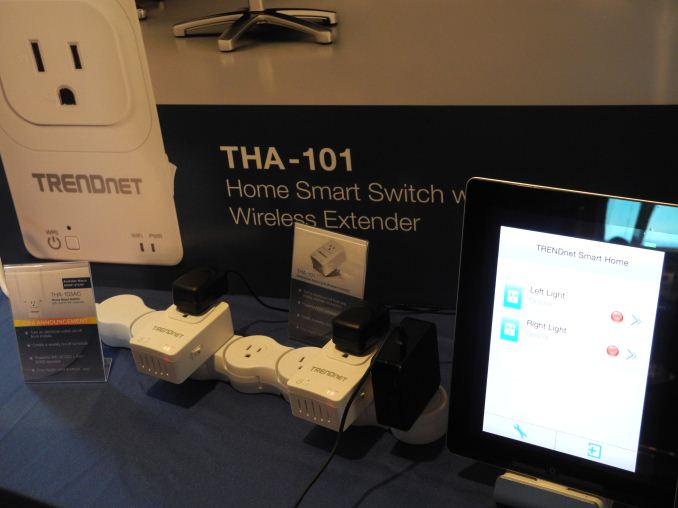
At CES, the added two new smart outlets - one communicating via powerline and the other having the ability to act as an extender for 802.11ac networks (single spatial stream only). The former is the THA-102PLK - a kit which also includes a powerline adapter for connecting to a router on one end. It will reach the market in April with a MSRP of $105. The AC extender / smart switch is the THA-103AC which will come to market in March 2015 for $80.
All the smart switches are controllable via free mobile apps (iOS / Android). It is also possible to set basic schedules and monitor power / energy consumption. One of the key selling points, in my opinion, is the fact that it can be fully controlled via a web browser. My understanding is that it is a open product. Though no public APIs are available, it shouldn't be too difficult to control the unit via custom scripts, given that it can be controlled via a web browser. We are planning to request TRENDnet for a sample in order to see how it compares to the UFO Power Center and the Ubiquiti Networks mPower Wi-Fi power strip.
Read More ...
SteelSeries CES: APEX M800 QS1 Mechanical Switch and Sentry Eye Tracker

At CES, SteelSeries was showing off a new mechanical switch that they worked with Kailh to design. They're calling this the Linear QS1 switch, and it's completely different from existing mechanical switches as far as I can tell. It features 3mm travel with a 1.5mm actuation point, 45cN force, and it's rated for 60 million actuations. That's nothing particularly new for mechanical switches, but what sets the QS1 apart from other switches is the feel. Basically, SteelSeries set out to create a new switch that would feel more like a membrane switch, but it would keep the longevity and durability properties of a mechanical switch. That switch is the Linear QS1, and it will be showing up in the new APEX M800 keyboard.

The switch also features full RGB LED lighting and the M800 will have per-key programmable lighting and effects available via software. Unlike some other companies (e.g. Monoprice and Rosewill), SteelSeries already has a lot of experience with creating software for controlling keyboard backlighting, macros, etc. so this is a natural fit for them. The M800 has macro support as well as anti-ghosting with 256-key rollover. (Why 256 when there are only 110 or so keys? Probably because they used eight bits for monitoring the rollover state as there was no benefit to only using seven bits.)
As far as the performance of the QS1 switch, SteelSeries says it's "built for speed" and will target gamers. I'm probably not skilled enough at any games these days to notice the difference, but typing on the keyboard felt good. Keyboards are inherently highly subjective, so it's impossible to declare one type of switch as being universally superior, which means the QS1 is really just one more option – albeit a SteelSeries exclusive. Pricing is currently targeting $199 MSRP, with availability sometime in the coming months.

The other product SteelSeries was demonstrating is their Sentry Eye Tracker that mounts to the bottom of your display. With their software the Sentry allows is the creation of an overlay in game streaming that shows where the user is looking on the screen. They had some recorded videos showing some top professional gamers using Sentry, and it was interesting to see exactly where on the screen they were looking during a match. SteelSeries also mentioned that the Sentry tracks statistics for supported games – e.g. how much time the user spent looking at the mini-map in DOTA2 or StarCraft II – and that some of the pro-gamers have used that to improve how they play, working to train themselves to not waste time looking at their cool-down bar but instead getting a better sense for how long it takes for an ability to recharge.
Anyway, it's not something I would use, but when watching a game stream it does actually create a more interesting feed (assuming it's used properly). The Sentry Eye Tracker is available already with an MSRP of $199, so it doesn't come cheap, but it could be used in other ways as well – e.g. controlling the mouse cursor with your eyes (which is really where the technology came from in the first place).


Read More ...
Microsoft Launches Two Additional Low Cost Lumia Smartphones
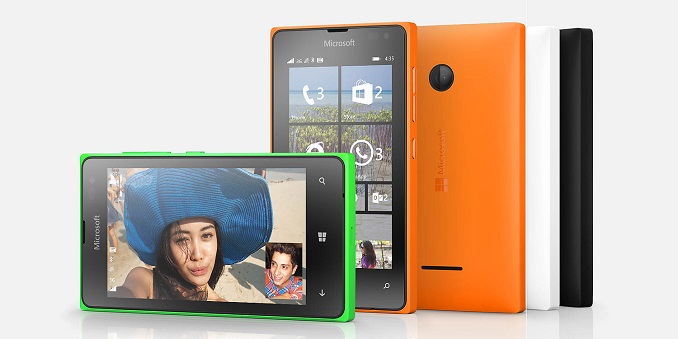
 Lumia 435
The first device is the 4” Lumia 435. This is the first Lumia device with a dual-core processor since the Snapdragon S4 powered devices in 2012/2013. In this case, it is the Snapdragon 200 with dual Cortex A7 processors at 1.2 GHz. The goal of this new device seems to be to hit an even lower price point than the 5xx series of phones, so the even lower powered SoC is not a surprise. Graphics are likely the same as the 5xx series with Adreno 302 to drive the 800x480 display. The 435 does come with 1 GB of memory now, so it appears that at least for Lumia phones, 512 MB options will no longer be released which is a good thing. Storage is 8 GB of NAND, plus microSD expansion up to an additional 128 GB. The camera is especially poor on this phone though, with just a 2 MP fixed focus 1/5 inch sensor with f/2.7 aperture. It does come with a front facing camera, although it is a mere 0.3 MP VGA sensor. Although the battery is small at 1560 mAh, it does have 3.8 V chemistry and a claimed battery life of 9.4 hours of Wi-Fi browsing. The 435 comes in green, orange, white, or black with a MSRP of 69 euros. Availability will be in February in “select” countries in Europe, Asia-Pacific, India, the Middle East, and Africa.
| Nokia Lumia 435 | |
| SoC | MSM8210 1.2 GHz dual-core Cortex A7 Snapdragon 200 |
| RAM/NAND | 1 GB LPDDR2, 8 GB NAND + microSD |
| Display | 4.0” 800x480 LCD |
| Network | GSM/WCDMA up to 42.2 Mbps |
| Dimensions | 118.1 x 64.7 x 11.7 (mm) |
| Weight | 134.1 grams |
| Camera | 2MP rear camera, fixed focus, 1/5" CMOS size, F/2.7 No Flash, VGA FFC |
| Battery | 1560 mAh 3.8 V (5.928 Whr) |
| OS | Windows Phone 8.1 with Denim Firmware |
| Connectivity | 802.11 b/g/n + BT 4.0, USB2.0, MPT, DLNA, FM Radio |
| Location Technologies | Cellular and Wi-Fi network positioning, A-GPS |
| SIM Size | MicroSIM (Dual SIM Optional) |
 Lumia 532
The next variant is the Lumia 532, which also has a 4” display and the same resolution at 800x480. This is a spec bump over the original 530, with the same quad-core Snapdragon 200 (4xCortex A7 @ 1.2 GHz) but with 1 GB of memory and 8 GB of NAND with microSD expansion up to 128 GB. The original 530 came with just 512 MB of RAM and 4 GB of NAND, both of which are fairly inadequate. The 532 comes with a 5.0 MP fixed focus 1/4 inch camera with f/2.4 aperture. The front facing camera is the same 0.3 MP unit as the 435 with VGA resolution video. The interesting thing on the 532 though is the inclusion of the Glance screen, which is easily my favorite feature on Lumia phones, and has been mostly absent from this year’s lineup with just the Lumia 830 sporting glance for any of the phones released in the last year. This makes it an easy win over the Lumia 530. Colors are once again, orange, green, white, and black, and prices start at 79 euros MSRP and similar availability to the 435.
| Nokia Lumia 532 | |
| SoC | MSM8212 1.2 GHz quad-core Cortex A7 Snapdragon 200 |
| RAM/NAND | 1 GB LPDDR2, 8 GB NAND + microSD |
| Display | 4.0” 800x480 LCD with Glance Screen |
| Network | GSM/WCDMA up to 42.2 Mbps |
| Dimensions | 118.9 x 65.5 x 11.6 (mm) |
| Weight | 136.3 grams |
| Camera | 5MP rear camera, fixed focus, 1/4" CMOS size, F/2.4 No Flash, VGA FFC |
| Battery | 1560 mAh 3.8 V (5.928 Whr) |
| OS | Windows Phone 8.1 with Denim Firmware |
| Connectivity | 802.11 b/g/n + BT 4.0, USB2.0, MPT, DLNA, FM Radio |
| Location Technologies | Cellular and Wi-Fi network positioning, A-GPS, A-GLONASS |
| SIM Size | MicroSIM (Dual SIM Optional) |
While neither of these phones are especially exciting, Microsoft has clearly seen some traction at the low end of the market and they continue to create devices for each market price and segment they are competing in.
The biggest problem though is that they now have a huge number of devices offered, and unfortunately, a very strange feature list. It seems almost random at this point which phone will have which features, and there is no progression through the product range where lower models are a subset of features of their higher priced brethren. Take for example the Lumia 930, which is the current flagship, but has no Glance screen support, but the Lumia 830 and 532 do have Glance support. The Lumia 730/735 have a higher resolution front facing camera, as does the Lumia 535, but the Lumia 830 has a standard front facing camera. The Lumia 630 is missing things like 1 GB of RAM and an ambient light sensor that less expensive models do have.
While I appreciate that Microsoft is creating models for each market they are going after, they seem to be losing some sort of coherency to their naming standards and feature lists. To avoid customer confusion, this is something that is fairly important.
The Lumia brand is new to Microsoft, so we are not sure which of these models were in the Nokia pipeline and have been altered, so it may take a year or so to sort out the basic feature sets. But for now, it is getting a bit confusing.
For those waiting for a higher end Lumia to finally come out of Microsoft, perhaps we may have to wait for Mobile World Congress to get any ideas about that. Stay tuned!
Source: Windows Blog
Read More ...
Monoprice at CES: 30-inch IPS with "Guaranteed" 120Hz and a Mechanical RGB Keyboard

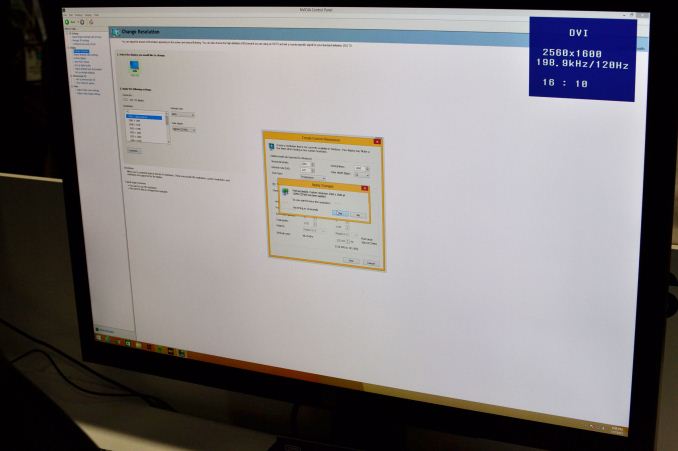
Now, just refreshing at 120Hz doesn't solve all the issues you might encounter – e.g. image persistence between frames – but given these IPS panels are supposed to have a 6ms response time (which is more marketing than fact) driving them at up to 167Hz is possible. Even if there's a bit of smearing between frames, I still think having a 120Hz display is a much better experience than the 60Hz we've had to accept for years now. It will also be interesting to see how well the display actually works with a variety of GPUs – I suspect some GPUs might struggle to send a clear signal but we'll see. There's no specific release date yet, but Monoprice says the display should be out in the next couple of months.
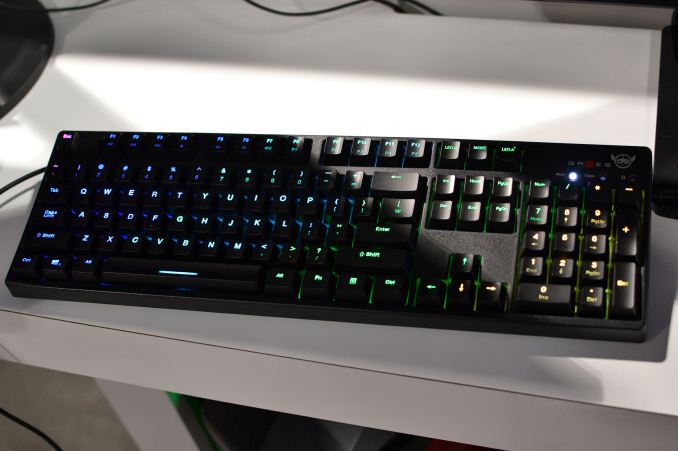
Monoprice had plenty of other items on display, but most of those (speakers, power banks, cables, etc.) aren't something we cover much at AnandTech. However, they did have a mechanical keyboard with the new Kailh RGB switches, with programmable per-key backlighting. Or at least, that's the end goal – I'm not sure the software support for programming the backlighting is there yet. Anyway, the effects that you can make with these per-key RGB LED keyboards are really cool initially, but I don't know how practical they'll be for everyday use. I suspect most users will just settle for a uniform color, but enthusiasts will enjoy the customization options. I saw several other keyboards with Kailh RGB LED switches at CES, most with software that's nearly ready for release, so it will be interesting to see how pricing and features pan out.


Read More ...
Antec CES Suite Tour


Starting with cases, Antec had several designs on display. First and most impressive is the P380, their latest halo product. It has thick (4mm) aluminum wrapped around the front and top of the case, with noise reduction foam on the side panels, tool-less drive bays, a fan hub, support for multiple radiators (up to 3x120mm on the front and top), and basically every other high-end feature you care to name. It drops most support for optical drives, though there is room for a slim ODD option. It includes three 120mm fans with mounts for four more. This is intended to carry the torch from the P180, which is still well regarded years after launch, with a price to match. It should retail for $249 with availability expected in March.
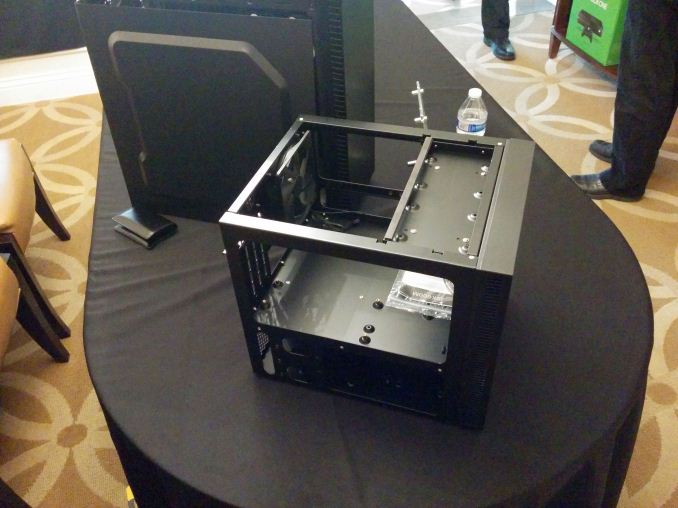
Next up is the ISK600M, a recently launched Micro-ATX/Mini-ITX "cubic" case that's basically the upsized version of the Mini-ITX ISK600. It comes with top and bottom internal compartments to separate the PSU and drives from the motherboard and expansion cards. The power supply goes on the bottom and the case has support for three 3.5" drives, three 2.5" drives, and there's a slim ODD bay as well at the top (which could also be used as a fourth 2.5" bay). The top portion houses the motherboard and expansion cards with four expansion slots. Cooling is provided by up to four fans (120mm on the rear, an optional 80mm on the rear, a 140mm intake at the front, or the front fan can be replaced with an optional 2x120mm configuration). The case measures 273mm x 340mm x 290mm (WxDxH), with clean and minimalist styling that should stand the test of time. I've seen reviews of the case mostly from European sites and I can't seem to find any major resellers in the US, but hopefully that will change in the near future. I expect the price to be around $80-$90, or about $20 more than the ISK600 (which is available for $60 online).
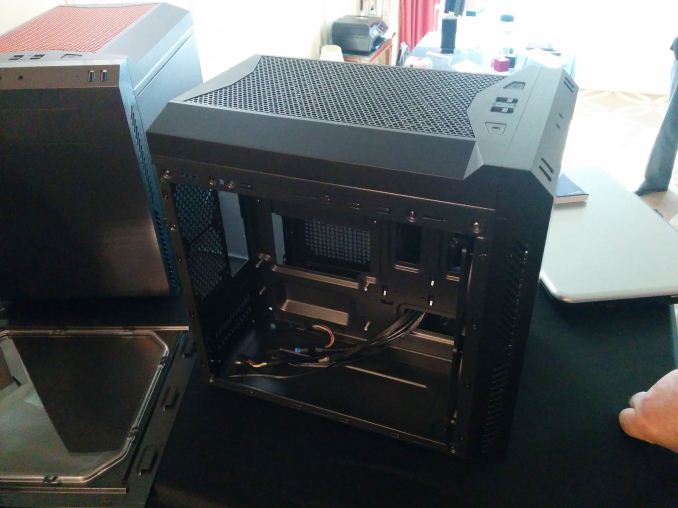
Next up, the P50 is similar in some ways to the ISK600M but with vertically split compartments – or if you prefer, it looks a lot like the Corsair Carbide Air 240. This is designed to be more of a budget-friendly Micro-ATX/Mini-ITX case and it uses slightly downgraded materials (e.g. plastic front fascia and thinner metal sides). It can fit two 2.5" drives, three 3.5" drives, and a 5.25" external bay is available. The P50 includes three 120mm fans and has eight total fan mounts, with room for two 2x120mm radiators.

Moving on, P70 has nothing really in common with the P50; where the P50 is like a budget friendly version of the ISK600M, the P70 is a standard ATX tower. It has support for up to ten drives total; there are 2 x 5.25" and 1 x 3.5" external bays and 4 x 3.5" and 1 x 2.5" internal bays; I believe you can put four 2.5" drives in place of the two 5.25" bays. The case is designed to reduce noise with polycarbonate layers on the side panels, and it includes three 120mm fans with two optional 120mm fan mounts available. Liquid cooling and radiators are also supported on the top and back, and the price point of $70 targets the mainstream market.
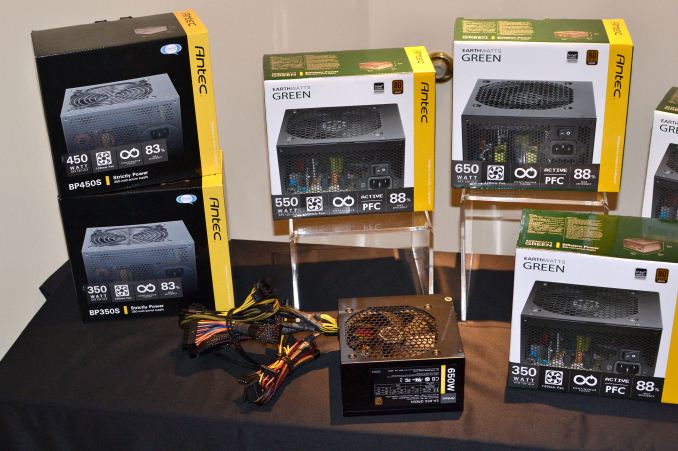
Moving on to power supplies, there wasn't too much to discuss. Their EarthWatts series has done well, as has the BP series (Basic Power), and they've found that they can essentially keep the efficiency and even improve some of the components while dropping the price. To that end, there will be new BPxxxS models coming out at the lower end of the pricing spectrum. At the high end, the Edge line is their top performing PSU with 80 Plus Gold and much higher price points.

Finally, Antec was showing their Xbox One cooler, conveniently named the X-1 Cooler, with an integrated LED display showing the intake and exhaust temperatures. Note that the green lighting effects in the pictures are not part of the retail product, thankfully, as it's a bit bright. The X-1 is already available at Antec's store, with a price of $29.99, and it reportedly cools the Xbox One by up to 30%. It also senses the temperature of the Xbox One and only turns on the fan when the temperatures are above 30C.


Read More ...
QNAP Releases Haswell-based TVS-x71 and Cortex-A15-based TS-x31+ NAS Lineups
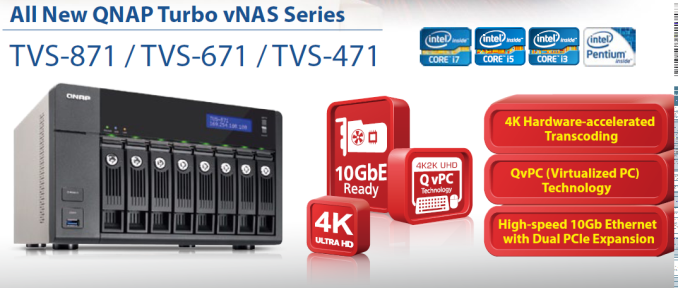
- Thunder Cloud - Haswell Pentium/Core-based TVS-x71 Series
- Edge Cloud - Haswell Core/Xeon-based TVS-ECx80 Series
In addition to the above two, QNAP also launched the TS-x31+ series, based on an Annapurna Labs SoC. Without further digression, let us get into the details of each of the lineups.
TVS-x71
COTS NAS vendors usually try to keep the breadth of hardware offerings to a minimum. We often see a lineup differentiating only on the basis of number of bays, with the core platform remaining a constant. On the x86 front, particularly, vendors usually have an Atom-based model. The next step up is usually a Pentium or a Core i3-based unit. Consumers wanting a bit more CPU horsepower have no option but to shell out for a Xeon-based unit beyond that.
QNAP is aiming to fill this glaring hole in the market (not only in their own product stack, but also every other COTS NAS vendor) by populating the TVS-x71 series with processors ranging from a Pentium G3250 to a Core i7-4790S. The table below summarizes the various models in the lineup.
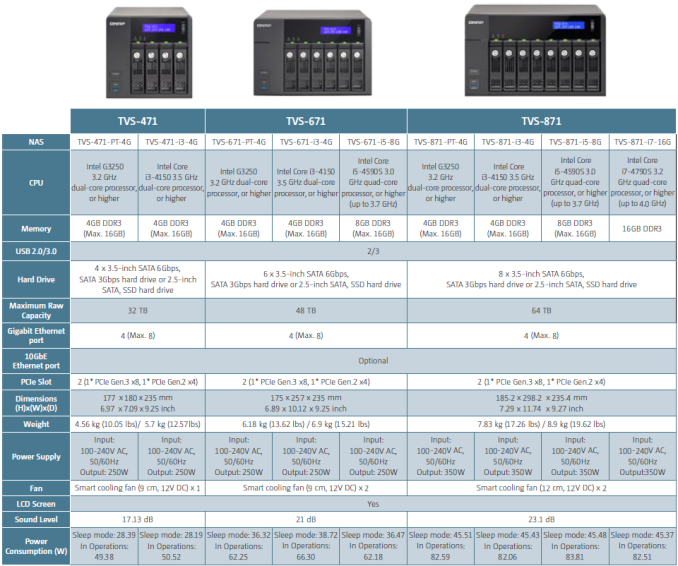
I am particularly excited by the 8-bay models with powerful quad-core processors. I am currently putting the QNAP TS-853 Pro through long term testing by running two virtual machines on it while using it as a media file server. Often, I have seen heavy activity in the VMs choke up the media serving capabilities (partially my fault for allocating two cores to each of the VMs, leaving very few CPU cycles for the primary functionality). Using a 4C/8T processor such as the Core i7-4790S ought to make scenarios such as the one I am testing out a walk in the park for the relevant unit.
All the Haswell models used in the TVS-x71 have an integrated Quick Sync engine and support VT-x. Full 4K decode and display is supported. All the Core-series CPUs used in the lineup also support AES-NI. So, other than the Pentium-based models, we should have hardware acceleration for encrypted volumes. Real-time transcoding for media serving is also available, as are the other QTS features that made the TS-x51 and TS-x53 Pro lineups stand out of the crowd. We don't have any official pricing information for the TVS-x71 series yet, but hope that the highest end model can come in at less than $2000.
TVS-ECx80
QNAP had the 10-bay version (TVS-EC1080+) on display at their suite. The unit comes with a Xeon E3-1245 v3 processor and has 32 GB of ECC DDR3 memory. There are two mSATA ports populated with 128 GB mSATA modules for use with QTS's SSD caching feature. This leaves all 10 bays available for primary storage. A PCIe card with two 10GbE ports is preinstalled and there are four native GbE ports on the motherboard. This tower unit targets enterprise customers and is priced at $3300.
The non '+' models don't have a pre-installed 10G PCIe card, and they come in 8- and 10-bay varieties with either the same Xeon processor or a Core i3-processor.
TS-x31+
I tweeted right after getting back from CES that Annapurna Labs was the surprise package of CES for those following the NAS platform vendors. Marvell seems to be taking things a bit too easy, opening up the doors for the startup to force its way into the market. Readers looking for information on Annapurna Labs would do well to peruse the Platform Details section in our piece covering the launch of the Synology DS2015xs.
Unlike Synology, QNAP has decided to use an Annapurna Labs SoC without the integrated 10G ports. We have two Cortex-A15 cores running at 1.4 GHz in the 28nm SoC that is part of the TS-231+ and TS-431+. The SoC also has two native GbE ports with enough performance for full-scale link aggregation.
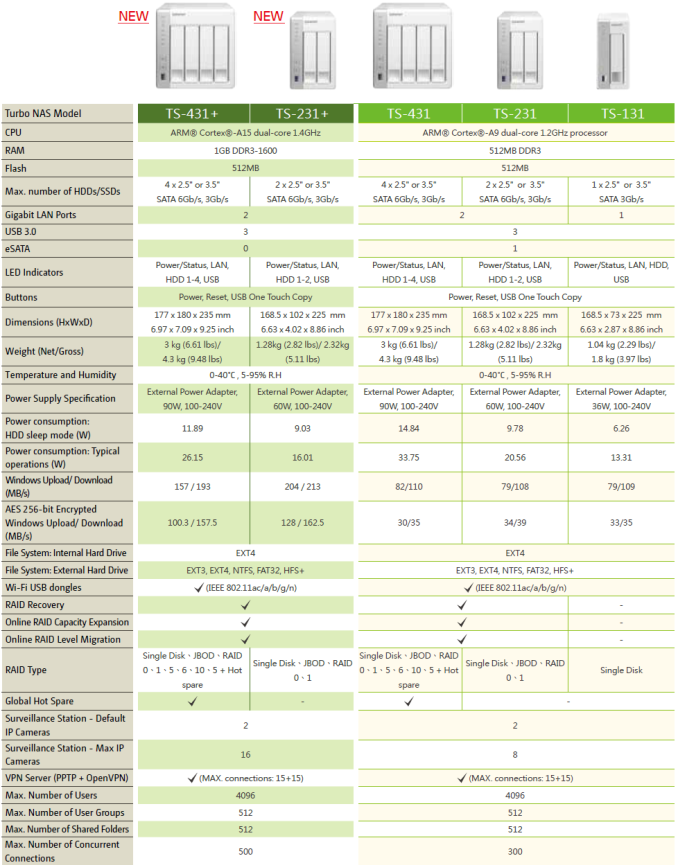
QNAP quotes transfer rates in the 200 MBps range for the TS-x31+ models. Marvell now seems relegated to the very low-end models such as the TS-x12P. Even Freescale has overtaken them with a dual-core Cortex-A9 platform in the TS-x31 series.
At the CES suite, QNAP also talked about an upcoming low-cost Bay Trail-based two-bay model without hot-swap support. We believe it will be used to address cost-sensitive markets and is unlikely to make it to the USA and EU. QNAP also updated us on their home automation initiative. Other than the publicly announced partners, QNAP is also attempting to act as a hub / one-stop interface for the multitude of home automation / security devices out in the market. Obviously, a good and consistent experience with any QPKG in this domain relies heavily on the said devices having open APIs and willing to be controlled locally. QNAP hopes to have something more concrete for announcement sometime in the later half of this year.
All in all, QNAP had a very busy CES, and, to be frank, we were overwhelmed (in a good way) by the number of announcements. In terms of sheer number of features available, QTS is well ahead of the rest of the COTS NAS OSs - they have the lead in hardware-accelerated media transcoding and creating a stable front-end for QEMU with the Virtualization Station package. However, the overall QTS user experience could do with some improvement. In addition, the challenge for QNAP will be to maintain a cohesive strategy moving forward and keep up with the need to maintain and support a wide variety of hardware platforms.
Read More ...
The AnandTech Podcast: Episode 30 - CES 2015 Show

We kick things off with Intel's just-launched Broadwell-U family of CPUs before switching sides to AMD and looking at their FreeSync adaptive-synchronization technology and forthcoming Carrizo APUs. Then it’s all about vendors, including Asus and their new ZenFones and Windows 8 Chi 2-in-1s, MSI and their latest GT80 and GS30 laptops, and Lenovo with the shockingly light Lavie laptop. Not to be outdone, Dell also has their new XPS 13 and Alienware machines on display, all the while Occulus once again steals the show with their impressive “Crescent Bay” headset prototype. Finally in the home stretch we take a look at all things mobile, including Microsoft’s latest Lumia devices, the Snapdragon 810 powered LG Flex 2, and NVIDIA’s Tegra X1.
The AnandTech Podcast - Episode 30
Featuring
- Dr. Ian Cutress: Host, Editor for Motherboards and Processors
- Ryan Smith: Editor in Chief, Editor for Graphics
- Jarred Walton: Editor for Notebooks
- Joshua Ho: Editor for Smartphones
- Brett Howse: Windows on Smartphones, Notebooks
- Brandon Chester: Smartphones and Software
iTunes
RSS - mp3, m4a
Direct Links - mp3, m4a
Total Time: 1 hour 15 minutes 26 seconds
Outline h:mm
00:00 - Start and Introductions
00:49 - Intel Broadwell-U
05:49 - Intel Cherry Trail
07:42 - AMD FreeSync
14:42 - AMD Carrizo
16:19 - ASUS Zenfones
19:37 - ASUS Transformer
21:44 - MSI Laptops - GT80 Titan
25:05 - MSI Laptops - GS30 Shadow
27:40 - MSI USB 3.1
31:34 - Lenovo Lavie
Sidenotes:
- 1.7lb is 771g,
- Magnesium is 12th in periodic table (weighted non-radioactive isotope atomic weight 24.305)
- Lithium is 3rd (weighted non-radioactive isotope atomic weight 6.94)
36:09 - Dell XPS 13
37:08 - Dell Venue 8 7000
38:38 - Dell Alienware
40:28 - Oculus Crescent Bay
48:16 - Microsoft Lumia
51:09 - LG Flex 2
57:56 - Tegra X1
1:08:06 - GTX 965M
1:09:21 - Best of CES
37:08 - Dell Venue 8 7000
38:38 - Dell Alienware
40:28 - Oculus Crescent Bay
48:16 - Microsoft Lumia
51:09 - LG Flex 2
57:56 - Tegra X1
1:08:06 - GTX 965M
1:09:21 - Best of CES
Read More ...
be quiet! CES Suite Tour


Starting with what is perhaps the most interesting of their new releases, the Silent Base 800 is be quiet!'s first PC case. It's a full-size ATX tower case, measuring 266mm x 559mm x 495mm (W x H x D) – 230mm x 542mm x 495mm without the stand. Keeping components cool without generating a lot of noise is often easier to do with a larger case, so it's not too surprising that be quiet! went with a larger chassis. The design is clean and generally conservative in appearance, though the case is available with three accent colors – black (no accents, really), silver, or orange. MSRP is $139, and you can find the orange and silver cases on Newegg right now. be quiet! also mentioned that they're trying to get more of their products to the US via other outlets (e.g. Amazon), which would certainly help with increasing brand recognition and pricing in the US.

The other new products are both CPU coolers, expanding the already large selection of be quiet! offerings. First is a top-down alternative of an existing cooler, the Dark Rock TF (TF = Top Flow). Of course, being top-down cooling instead of a tower with a side fan changes the appearance quite a bit, so other than name there's not a lot in common between the two. The Dark Rock TF has six heat pipes, two 135mm SilentWings fans with fluid dynamic bearings, and it's rated to cool up to 220W TDP, which means it's enough for all the current CPUs from AMD and Intel.
The second CPU cooler is a low profile offering, the Shadow Rock LP. This cooler has four heat pipes, a Pure Wings 2 120mm PWM fan with rifle bearings, and a maximum TDP rating of 130W. It's rated at a maximum of 25.5 dB(A) for noise, making this a great option for a compact and quiet build.
Both the Dark Rock TF and Shadow Rock LP should be available in the near future, but be quiet! was not able to provide pricing at this time. You can view the other products on display in the gallery below.


Read More ...
Samsung Launches SM951 M.2 PCIe 3.0 x4 SSD for OEMs/SIs

Similar to the XP941, the SM951 will come in M.2 2280 form factor with capacities ranging from 128GB to 512GB. In terms of the interface the SM951 moves to PCIe 3.0 x4, which doubles the available bandwidth from the XP941, and Samsung is claiming read speeds of up to 2,150MB/s with writes coming in at 1,550MB/s. Random performance isn't as impressive but the SM951 is still capable of up to 130K random read and 85K random write IOPS.
In addition to increased performance, the SM951 also brings power savings. The drive includes support for L1.2 low power standby mode and according to Samsung the idle power consumption is under 2mW (i.e. within the DevSleep spec). The XP941, in turn, uses about 50mW as per Samsung's data sheet, so it's a fairly significant increase in power efficiency.
But now the bad news: the drive does not support NVMe nor does it come with 3D V-NAND. Back in July Samsung's own presentation mentioned that the SM951 would be the world's first client SSD with NVMe support, but those plans has then changed. Currently Samsung has no plans to bring NVMe to the SM951, which leads me to believe that the hardware is not NVMe compatible in the first place. Why that is the case, I don't know for sure, but what I do know is that the current Haswell/Broadwell platforms aren't really designed for PCIe/NVMe SSDs, which is why everyone is looking forward to Skylake before releasing their drives to the market. There are workarounds to get PCIe/NVMe SSDs to work on existing systems, but apparently Samsung decided to stay with AHCI for one more generation for increased compatibility (it's an OEM drive after all, so I'm sure the PC OEMs have had their say about NVMe).
As for the NAND, the SM951 uses 128Gbit 19nm MLC. That's planar NAND, unfortunately, even though Samsung has been adopting V-NAND to nearly all of its other SSDs. I suspect that the reason behind the choice of planar NAND is PC OEMs and their unwillingness to pay the premium for V-NAND because the truth is that V-NAND is still not as cost efficient as modern planar NAND. Another reason might be the newness of 3D NAND as PC OEMs tend to prefer proven technologies to maximize reliability.
Since the SM951 is an OEM drive, it won't be available through the usual retail channels, but at least RamCity (the first XP941 retailer) will be carrying the drive. Stock should arrive around March time and I've also heard that there will be a TLC based version called the PM951. All in all, while the SM951 didn't exactly meet my expectations on the specification frontier, I'm eagerly waiting for a review sample to see how the transition to PCIe 3.0 increases performance. We will be getting our review sample as soon as RamCity receives the first units, so look back for the review in about two months.
Read More ...
Corsair HX750i Power Supply Review
Today we will look at the latest revision of Corsair's HX series, the HX750i PSU. Corsair came a long way since their first PSU, the HX520W, with the HX750i now boasting 80 Plus Platinum efficiency levels, a digital interface, and numerous other features. Is it a worthy successor of Corsair's first and most reputable PSU series? Read on for our full review.
Read More ...
ioSafe Updates Disaster-Resistant Storage Lineup at CES 2015
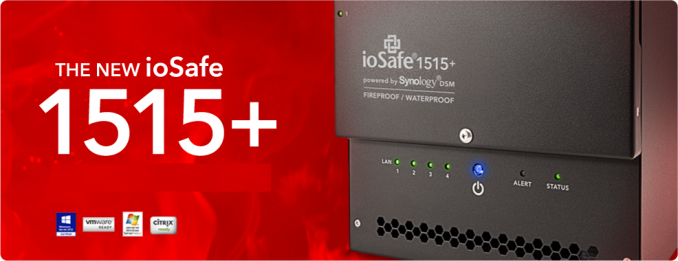
From ioSafe's perspective, the main challenge was in the chassis design. The ioSafe N2 / 214 and the ioSafe 1513+ helped them perfect the chassis for 2- and 5-bay NAS units. It must not have been difficult to swap out the motherboard in the ioSafe 1513+ for one from the DS1515+. Therefore, the turnaround time from the launch of the Synology DS1515+ to the launch of the ioSafe 1515+ was only a few months


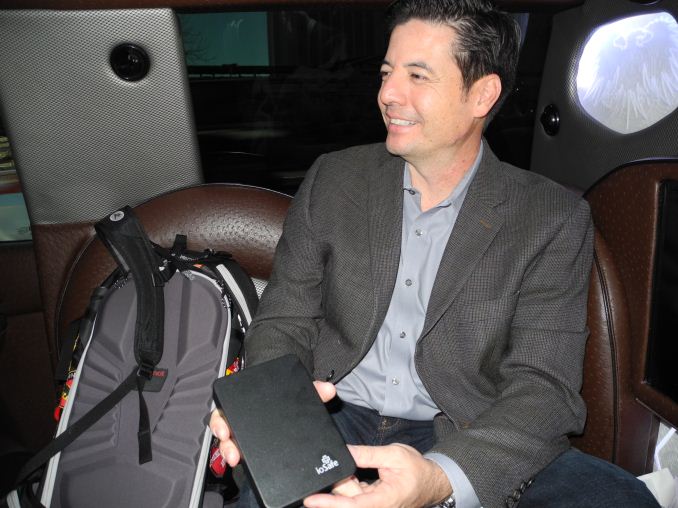
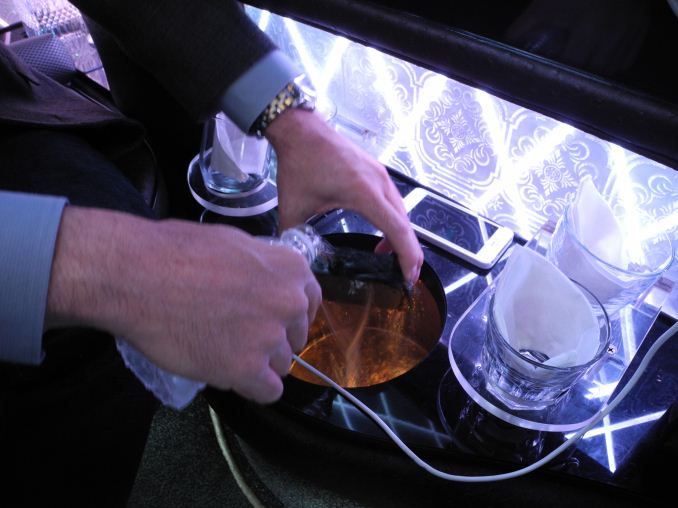
Robb Moore, the CEO of ioSafe, also demonstrated the Rugged Portable, a 1 TB Samsung SSD 840 in a rugged waterproof aluminum enclosure. Water was poured into the connector area. In order to demonstrate the waterproofing behind the micro-USB connector, he connected the unit to a notebook (after cursorily wiping off the connector area) and showed that the data was intact.
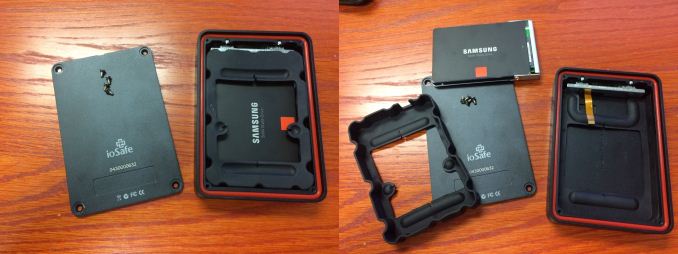
The most interesting aspect of the Rugged Portable is that it is possible for the end-user to take out the SSD, if needed. The various waterproofing aids as well as the connector assembly can be seen in the picture below.
The Rugged Portable comes with a IP68 rating (compared to the IP54 rating that most of the competition advertises) and is priced at $1200.
We also discussed the data recovery service provided by ioSafe, and Robb introduced me to DriveSavers, their data recovery partner. I hope to visit the DriveSavers facility sometime in the near future and pen a separate piece on that later.
Read More ...
IOGEAR Updates A/V & Digital Home Solutions for 4K


IOGEAR GUD342 - DisplayLink USB 3.0 Dock
There were two USB 3.0 external video card for sending out 4K signals, one over Display Port (GUC34DP - $100) and the other over HDMI (GUC34HD - $120)
IOGEAR was particularly proud of their long range wireless 5x2 HDMI Matrix PRO. It even allows for multi-casting from one source to five different locations. It comes with an IR remote and supports 1080p60 / 3D / 5.1 channel audio. For the $600 price point (which includes a couple of receivers in addition to the matrix switch), we would actually like control over IP. In any case, this is targeted mainly towards custom installers who don't want the trouble of punching through drywall to lay out HDMI cables.

There were also a few wired HDMI switches with support for 4K and RS232 - again, targeting the custom installers. Yet another interesting product was the HDMI Cat 5e / Cat 6 extender with full HDCP support.
On the gaming front, IOGEAR is launching Keymander, a controller emulator for use with gaming consoles. It allws for the traditional gaming keyboards and mice to be used with the PlayStations and the Xboxes. The GKM602R wireless keyboard / mouse combo (the latter being the 7-button variety with adjustable DPI settings of 1000, 1500 and 2000) was also on display.
Read More ...
G-Technology's Evolution Series Goes Rugged
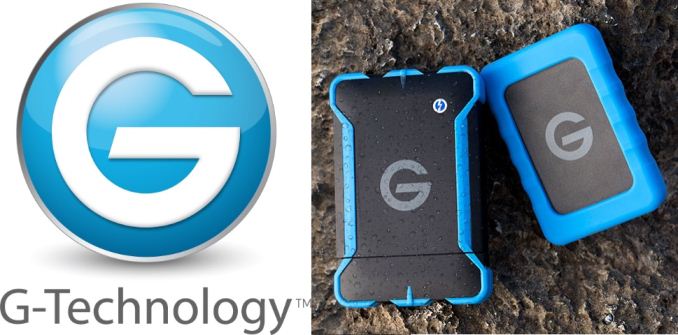
In order to create a well-rounded product lineup, G-Technology introduced a set of rugged solutions at CES 2015. Before going into the details of the new products, it is important to see how G-Technology tries to differentiate itself from LaCie. The two-bay docking solution in the form of the Evolution Series comes into the picture. The G-DOCK ev is a 2-bay Thunderbolt enclosure capable of accepting 2.5" USB 3.0 drives (either the G-DRIVE ev or the G-DRIVE ev SSD). For the rugged line, G-Technology has chosen to add three new products to the ev lineup.
G-DRIVE ev RaW
This is a 2.5" G-DRIVE ev along with a USB 3.0 cable. It comes in either 500 GB ($100) or 1 TB ($130) versions. It has a blue bumper for protection against accidental drops of up to 1.5m.

G-DRIVE ev ATC (USB 3.0)
It is an all-terrain solution which uses the G-DRIVE ev RaW inside a watertight compartment (that also floats in water). There is also protection against pressure, shock, dust and drops up to 2m. A 1 TB version will retail for $180. Users who already possess a G-DRIVE ev (SSD or HDD) can get the USB 3.0 ATC case for $80 when it becomes available next month.

G-DRIVE ev ATC (Thunderbolt)
This is similar to the USB 3.0 ATC, with the computer interface being the only difference. This Thunderbolt peripheral (1 TB) will retail for $230. The Thunderbolt case can be purchased standalone for $130.

On one hand, LaCie has an interesting solution in the form of a single rugged enclosure for both USB 3.0 and Thunderbolt (without sacrificing the higher speeds possible through Thunderbolt). They also recently launched a portable rugged RAID solution. On the other, G-Technology is creating a package deal with the G-DOCK ev as a desktop storage solution that uses easily swappable components. From the design, it appears that the Thunderbolt version would be unlikely to perform better than the USB 3.0 version. Since most of the G-DRIVE products (including those launched at CES) are hard-drive based, it is unlikely to be a big issue. From an end-user perspective, it is great to have both choices and one can let the usage model dictate the suitable solution.
Read More ...
Editorial: Coach Who Sent Teen Girls "Wank Video" Deserves No Sympathy
Don't add minors as friends on snapchat or other services you use for sexual messaging -- it's common sense
Read More ...
HTC One M8 and Samsung Galaxy S5 Get Android Lollipop Loving
Two of the most popular Android smartphones from 2014 are finally getting the bump to Google's latest and greatest OS
Read More ...
Samsung Finally Launches a Tizen Smartphone With the India-Aimed "Z1"
It's half a year late and comes in a bit different package, but Tizen is finally in the smartphone game
Read More ...
Available Tags:Microsoft , Keyboard , AnandTech , Samsung , SSD , HTC , Galaxy , Android , Smartphone ,


No comments:
Post a Comment