

Diamond Multimedia Updates Networking and DisplayLink Products Portfolio

At CES 2015, Diamond Multimedia demonstrated a Microsoft Surface Pro driving a 4K display using a DisplayLink-based USB 3.0 to 4K Display Port adapter. This adapter allows any PC / tablet with a USB 3.0 port to drive a 4K monitor (even if the internal GPU is not capable of 4K video output). The DisplayLink docking solution also got an upgrade with the DS3900 Ultra Dock with Dual Video Display.

On the networking side, Diamond Multimedia is testing the 802.11ac market with a 2x2 AC1200 router and a AC750 range extender. There is also a USB 2.0 AC600 USB adapter as well as a USB 3.0 AC1200 USB adapter. 500 Mbps powerline kits as well as an IP camera with in-built PLC (power line communication capabilities) - HP500CK - round up the wireless / networking product stack.
On the TV / game capture side, the WPCTV3000 connects to a HDTV / display and allows screen mirroring from PCs or Macs from multiple users. The GC2000 1080p HD capture box is for console gamers wanting to record their gameplay and either stream it over the network / Internet or store it in a SD card in the box.


The BVU5500 4K display adapter (USB 3.0 to Display Port) was the most interesting product on display. The advent of USB 3.1 should make for some interesting DisplayLink products, not only due to the increased available bandwidth, but also the power delivery aspect. It will take a couple of more generations for DisplayLink to get there, but, in the meanwhile, manufacturers such as Diamond Multimedia continue to bring out business-focused products using their current chipsets.
Read More ...
Mushkin Releases New Striker SSD, Displays an Upcoming M.2 PCIe 3.0 x4 NVMe SSD
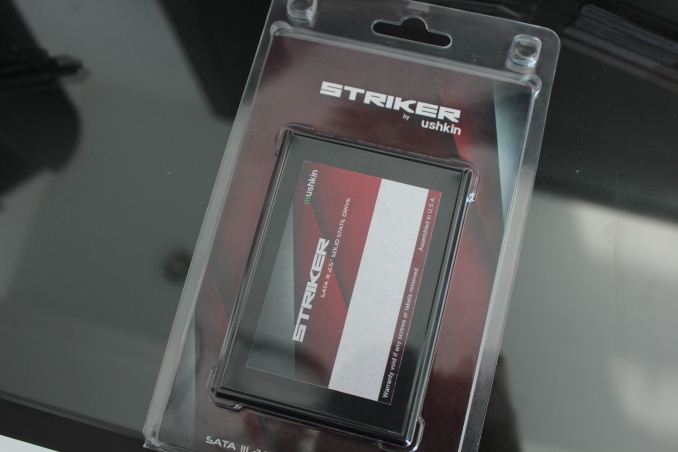

Availability will be in Q1'15, so expect to find the Striker on the shelves in the next two months or so. Pricing is to be announced.

Mushkin also had the 1TB Reactor on display. It's an SM2246EN based drive with Micron's 16nm 128Gbit MLC NAND and what makes it truly interesting is its $360 price tag (that's $0.36 per GB!). I got a sample right before the holidays and have been testing it since I got back from CES, so stay tuned for an in-depth review within the next couple of weeks.

Moving on to very interesting upcoming products, Mushkin showed off the Hyperion PCIe SSD. It's based on Phison's E7 controller, which is a PCIe 3.0 x4 design with NVMe support. Performance is up to 2.8GB/s for reads and 1.2GB/s for writes and random performance is also very competitive at over 300K IOPS. The controller is still in development and so far there hasn't even been a live demo yet, but I was told that the Hyperion should hit the market during the first half of this year.

For current generation PCIe, Mushkin was showing the XC PCIe drive. Like the most PCIe drives on the market today, the XC is simply four SandForce SF-2281 controller in RAID 0 and as you can see, the drive consists of two modules with each having two daughterboards (i.e. one PCB per controller).

Mushkin also has a version with four SM2246EN controllers in development. The Silicon Motion controller will enable consistent performance with all data types and in addition it supports up to 1TB per controller, hence upping the maximum capacity to 4TB.

And like everyone else, Mushkin had an SF3700 prototype on display. Mushkin will be ready to release a drive as soon as Seagate/SandForce is ready with the controller and firmware, which should be in early Q3'15 from what I have heard.

And no lineup is complete without some DDR4. The DIMMs Mushkin had on display were DDR4-2133 and DDR4-2400, which to be honest is nothing exciting but Mushkin has always been more of a value brand instead of being the first choice of overclockers.
Read More ...
AMD Executive Shakeup: Byrne, LaForce, and Naik Leave AMD
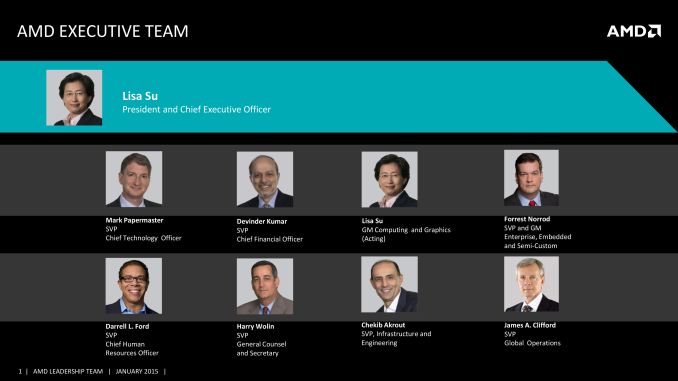

Starting from the top then, the highest profile departure – and the only one mentioned in AMD’s 8-K – is John Byrne. Byrne was promoted from Chief Sales Officer to SVP and GM of Computing and Graphics Business Group only 7 months ago, so his tenure as GM has been a surprisingly short one. Byrne is said to be leaving AMD to pursue other opportunities, and unlike Byrne’s original promotion that saw the GM position filled from within, AMD tells us that they will be conducting an external search for the new GM. In the meantime Dr. Su will be filling his position as interim GM.

Second on the list of departing executives is Colette LaForce. Colette has been AMD’s Chief Marketing Officer since 2012, when she joined AMD at that level after leaving as Dell’s CMO. Like Byrne, LaForce is said to be leaving the company, though AMD has offered no further details. Finally, unlike Byrne’s GM position, no interim CMO is being announced.

The last executive departing today is Rajan Naik, AMD’s Chief Strategy Officer. Naik was hired for the CSO position in 2012, joining the company from McKinsey & Company. Like Byrne and LaForce, Naik is said to be leaving the company with no further details available.
In announcing these departures, AMD included a short statement: “These changes, including the additions of Forrest Norrod and James Clifford to our management team last quarter, collectively are part of implementing an optimal organization design and leadership team to further sharpen our execution and position AMD for growth.“
Whether this is Lisa Su merely cleaning house after being promoted to CEO or part of a greater shakeup for the company remains to be seen, and certainly this is the biggest question to come from today’s departures given the unusual mass departure. 2014 has been another rough year for AMD as they continue to seek balance as a semi-custom IP and chip designer, and while they did manage to turn a tiny profit in Q3, we’re still waiting to see how AMD closed out the year with Q4. To that end, AMD will be announcing their Q4 results on Tuesday the 20th, at which point we should have a better idea of what these departures mean for the company and what AMD’s plans are like for the rest of 2015.
Read More ...
MSI Goes USB 3.1 at CES 2015: The MSI Component Suite Tour
Back at Computex we reported that MSI was showing a potential mock-up of USB 3.1 on one of their motherboards. Fast forward a few months and this is slowly becoming a reality, with working silicon and demos on hand, almost ready to ship. MSI also had a few neat custom builds as well as a wide variety of colored GPUs, some with a different fan design.
Read More ...
ADATA CES Suite Tour: PCIe & TLC SSDs, Power-Loss Protection Demo, 256GB SD Cards, USB 3.1 And More

The SP320 will be ADATA's first TLC NAND based SSD and will be available sometime in the first half of 2015. It's based on Silicon Motion's new SM2256 controller, which supports LDPC error correction that increases the endurance (basically, LDPC can deal with a lot higher error rate compared to traditional BCH error correction). Capacities will range from 120GB to all the way to up to 960GB, but the exact specifications are unknown at this point.

Moving on to PCIe, ADATA was showcasing industrial SSDs based on JMicron's JMF811 and JMF810 controllers. The JMF811 is the full-fledged version with four PCIe 2.0 lanes, whereas the JMF810 is capped to two lanes. Capacities go up to 1TB in M.2 2280 form factor and I was told that the drive is already shipping to ADATA's industrial partners. Obviously, the drive is not a retail version (hence the awkward name), but I wouldn't be surprised to see a client version with the same controller showing up later.

Similar to Computex, ADATA was also demoing the SandForce SF3700 based SR1020. To be honest, I don't really have anything new to share on the SF3700. The live demo ADATA was showing in the suite was just sequential writes, which we have already seen before for a few times. Timing wise Seagate/SandForce is now aiming for Computex 2015, so expect to see a ton of new SSD announcements and releases around June time.

In addition to products, ADATA was showing a neat power-loss protection test platform. The platform consists of a custom PCB that plugs into a USB port along with a special software that interrupts power delivery. The purpose of the demo was to show off ADATA's enterprise SR1010 SSD with full power-loss protection, but ADATA also promised to send us the test platform for use in future reviews.

ADATA was also showcasing a couple of USB 3.0 drives with unique security features. The first one was the UE720, which is otherwise a typical USB 3.0 drive but features a fingerprint scanner to provide an extra layer of security.

The other one was the UC520, which uses Bluetooth 4.0 for security. I'm not sure how exactly the encryption works with Bluetooth, but I assume the drive needs to create a Bluetooth connection with a known computer/tablet/smartphone before the contents can be accessed.

For SD cards ADATA has a new UHS-II type XPG SDXC card with capacity of up to 256GB. The card offers read speeds of up to 150MB/s and is capable of 4K2K recording.

ADATA was also displaying a USB 3.1 compatible SE700 external drive with dual SSDs inside. Sequential performance goes above 800MB/s and the drive will be ready to ship once USB 3.1 platforms are available later this year.

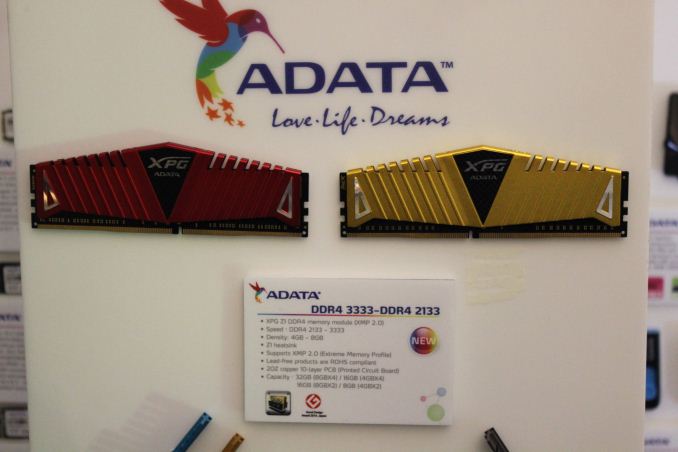
ADATA was one of Intel's original DDR4 launch partners and since the launch ADATA has been able to up the speeds to DDR4-3333.
Read More ...
Intel Updates the NUC at CES 2015 with Broadwell-U
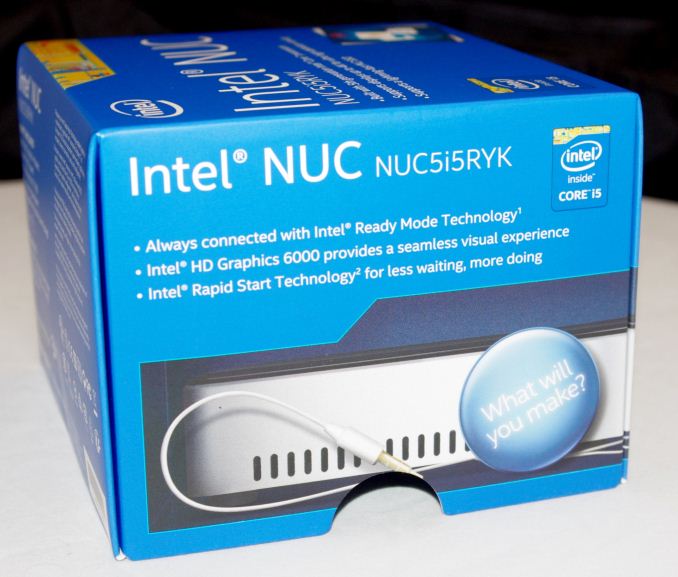

15W is not really suitable for fanless without increasing size, so the NUC comes with a fan in the i3, i5 and i7 configurations, supporting up to HD 6000 graphics (48 EUs). Connectivity will come as a gigabit Ethernet port, two USB 3.0 ports, a micro-HDMI and a mini-DisplayPort, offering a full 4K implementation.

The double sided PCB gives space for an M.2 2242, 2260 or 2280 drive, along with a mini-PCIe WiFi card and two modules of memory. Users can add a 2.5-inch to the device through that SATA port as well.


In this i5 model packaging, the dual band dual stream AC-7265 is bundled onboard as a pre-soldered M.2 1216 package, with the module itself offering lower power consumption than the AC-7260 which is what we have seen in the desktop space for the past year.

The unit also gives a fast charging USB 3.0 port in yellow. We asked about USB 3.1 support on future NUCs, but in true Intel style they were not giving anything away. For the NUC team to move into USB 3.1, it would make more sense when the standard moves onto the chipset of the SoC, which might be a couple of generations away.

Also for release is this Bay Trail-T system with Windows on a stick. It directly attaches to a TV or monitor through the HDMI and uses a separate USB cable from the device to the monitor for power. Under the hood is 2GB of DRAM and 32GB of eMMC which equates to a full system in a form factor barely bigger than your thumb.

Our recent Bay Trail coverage with the HP Stream 11 at $199 and the J1800N motherboard puts an expectation of price level for these new systems, especially in terms of expectation of performance against what is possible. With this new device Intel is aiming for the $149 price point, which compared to the HP Stream 11 with a keyboard, screen and Miracast might seem like an average deal for home use, Intel is aiming to market this at the digital signage and the point-of-sale markets.


Read More ...
New at CES 2015: CoolChip Technologies and Cooler Master Join Forces

Fast forward two years and a company called CoolChip Technologies (or CoolChip or short) has licensed the latest version of this technology from Sandia Corporation (a subsidiary of Lockheed Martin) and are bringing it to market with the aid of Cooler Master.
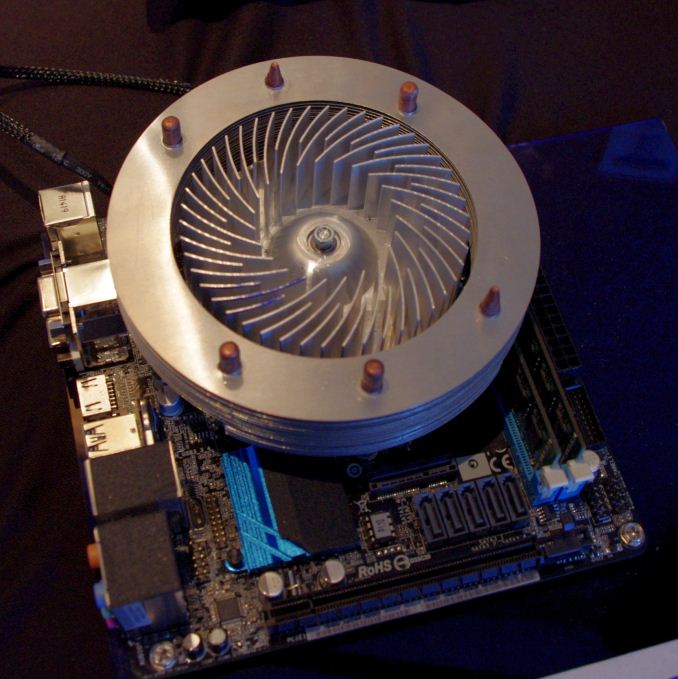
I spent some time with the CEO of CoolChip Technologies, Dr William Sanchez, who was on hand to answer questions. At this stage they are still talking with Cooler Master about prototyping, size, market share and vectors of attack when it comes to creating and marketing their designs. As shown above it is more than just a simple rotating central element, and large static heatsinks can be built around it. One particular question I had was about angle of use, as almost all demonstrations of the technology were parallel to the desk. He confirmed that the technology works both upright and upside down, which is good to hear.

The system here, designed to compare a 1U rotating heatsink against a 1U blower, showed that at the same RPM the new design makes less noise and expels air in all directions, helping cool adjacent components. Dr Sanchez remarked that the heatsink was relatively safe to touch, and in true AnandTech style I managed to almost break it when touching it in motion. I postulated that a small frame, similar to a fan guard, might be an easy way to stop prying fingers like mine which might break it.
There is plenty of potential in this technology. The air cooling market has been stagnant for a number of years for something truly revolutionary, at there is potential here for both Coolchip and CoolerMaster to break the age old barrier. If we can get hold of pre-production samples for testing, we will let you know the results. As of yet, due to the early stage of the design, we do not know when that will be.
Read More ...
Samsung Announces the Galaxy A7

| Samsung Galaxy A7 | ||||||
| SoC | Exynos 5430 or Qualcomm Snapdragon 615 | |||||
| Memory and Storage | 16GB NAND + MicroSDXC, 2GB LPDDR3 | |||||
| Display | 5.5” HD SAMOLED | |||||
| Cellular Connectivity | 2G / 3G / 4G LTE (Ericsson M7450 or MDM9x25) | |||||
| Dimensions | 151 x 76.2 x 6.3 mm, 141g | |||||
| Camera | 13 MP Rear Facing, 5MP Front Facing | |||||
| Battery | 2600 mAh (9.88 Whr) | |||||
| Other Connectivity | 802.11 a/b/g/n + BT 4.0, USB2.0, GPS/GNSS, NFC | |||||
| SIM Size | Nano SIM (Dual SIM SKU available) | |||||
| Operating System | Android 4.4 KitKat | |||||
As you can see, the Galaxy A7 is still a mid-range smartphone like the A3 and A5. However, we get some impressive specifications for a mid-range device. The Galaxy A7 comes with one of two similar processors depending on which SKU you buy. The single-SIM LTE model comes with Samsung's Exynos 5430 which has a 1.8GHz 4 x Cortex-A15 cluster and a 1.3GHz 4 x Cortex-A7 cluster. This model uses Ericsson's M7450 Cat4 LTE modem. The dual-SIM LTE/3G model uses Qualcomm's Snapdragon 615 MSM9839 which has a 1.5GHz 4 x Cortex-A53 cluster and a 1.0GHz 4 x Cortex-A53 cluster.
Beyond the SoC, we see what looks to be standard specs for a 2015 mid-range phone. The Galaxy A7 is actually very similar to the Desire 826. It has a 2600mAh (9.88Wh) battery, a 13MP rear-facing camera, 2GB of LPDDR3 RAM, 16GB of NAND, and a MicroSD slot. The Galaxy A7 bests the Desire 826 with its size though. It's smaller, lighter, and much thinner. In fact, with a thickness of only 6.3mm, it's thinner than Apple's flagship iPhone 6 and 6 Plus.

The one listed specification that concerns me is the display. It is described as a 5.5" HD SAMOLED panel, and based on Samsung distinguishing between HD and FHD in previous spec sheets, it's like that the Galaxy A7 uses a 1280x720 display. At 5.5", this would put it at 267ppi which will have visible aliasing and PenTile artifacting. However, if it turns out to be a 1920x1080 display then this will be less of an issue, and we will have to wait until further info is released or the device is in the hands of users before we can make a definite conclusion here.
On the software side, Samsung is advertising many of its camera features such as voice or gesture activated selfie capture, and multi-window app support. Something to note is that the Galaxy A7 will ship with Android 4.4 KitKat despite 5.0 Lollipop being available. This means that the Snapdragon 615 model will have to operate in 32bit mode, at least until Samsung provides an update to Lollipop. Like the Galaxy A3 and A5, the A7 will come in white, black, and gold colors at launch. There's currently no word on price or when the device will ship to specific markets.
Read More ...
Cooler Master at CES 2015: Reorganization with a Surprise

The main element of the adjustment is to place all the product lines that were kept into three different market segments, with a special fourth model for cases.

These segments are Essential, Mainstream and Performance, covering low, medium and high end models. Cases also get Ultra, pointing at the extreme consumer. Each of their product ranges is split as follows:
| Keyboards (Small Form) at Cooler Master | ||
| Users | Model | MSRP |
| PERFORMANCE | NovaTouch TKL | $150-$200 |
| MAINSTREAM | QuickFire TK QuickFire Rapid-i |
$100-$150 |
| ESSENTIAL | QuickFire Rapid | $30-$90 |
| Keyboards (Full Size) at Cooler Master | ||
| Users | Model | MSRP |
| PERFORMANCE | Trigger-Z | $150-$200 |
| MAINSTREAM | QuickFire Ultimate | $100-$150 |
| ESSENTIAL | QuickFire XT | $30-$90 |
| Mice at Cooler Master | ||
| Users | Model | MSRP |
| PERFORMANCE | Reaper | $70-$90 |
| MAINSTREAM | Mizar | $50-$70 |
| ESSENTIAL | Xornet v2 | $30-$50 |

| Power Supplies at Cooler Master | ||||||
| Users | Model | Connector | Warranty | Efficiency | MSRP | |
| PERFORMANCE | V-Series | Fully Modular | 7 Years | 1200W @ Plat 1000W @ Gold 850W @ Gold |
$190-$300 | |
| MAINSTREAM | VSM | Modular | 5 Years | 750W @ Gold 650W @ Gold 550W @ Gold |
$100-$120 | |
| ESSENTIAL | GM | Modular | 5 Years | 750W @ Bronze 650W @ Bronze 550W @ Bronze |
$80-$100 | |
| Headsets at Cooler Master | ||
| Users | Model | MSRP |
| PERFORMANCE | Sirus C | $90-$130 |
| MAINSTREAM | Ceres 500 | $50-$90 |
| ESSENTIAL | Ceres 300 | $30-$50 |
| Cases at Cooler Master | |||
| Users | Model | Size | MSRP |
| ULTRA | Cosmos II | Ultra | $300+ |
| PERFORMANCE | Stryker | Full | $160-$200 |
| MAINSTREAM | Silencio 652S | Mid | $80-$130 |
| ESSENTIAL | HAF 912 | Mid | $50-$70 |
| Air Cooling (Top Down) at Cooler Master | |||
| Users | Model | Fan Size | MSRP |
| PERFORMANCE | Gemini S524 V2 | 120 mm, fits 140 mm | $45+ |
| MAINSTREAM | Gemini M4 | 120 mm Slim | $30-$40 |
| ESSENTIAL | Vortex Plus | 92 mm | $20-$30 |
| Air Cooling (Tower) at Cooler Master | |||
| Users | Model | Fan Size | MSRP |
| PERFORMANCE | V8 GTS | 140 mm x2 | $80-$100 |
| MAINSTREAM | Hyper 612 v2 Hyper D92 Hyper 212 EVO |
140 mm 92 mm x2 120 mm |
$35-$50 |
| ESSENTIAL | Hyper T4 Hyper TX3 Hyper T2 |
120 mm 92 mm 92 mm |
$18-$30 |
| AIO Liquid Cooling at Cooler Master | |||
| Users | Model | Size | MSRP |
| PERFORMANCE | Nepton | 280/140 mm | $100-$130 |
| MAINSTREAM | Nepton | 240/120 mm | $100-$130 |
| ESSENTIAL | Seidon | 120 mm | $50-$70 |
The new element to the product line is a product in development that sounds like a dream power supply for reviewers. Cooler Master are working on a system with an SoC (some ARM variant) with built in Bluetooth to connect to an app on a phone/tablet to be able to measure and/or diagnose a power supply when the PC is either on or off.

From the reviewer perspective, the best bit is the application. Here is a nice looking interface that shows the power consumption to two significant figures, with Cooler Master promising a future feature to be able to track power consumption over time, both from the wall and going through the power supply given losses or the power factor.

The app currently has a segment which, with the right price per kWh, will let you know how much money is being used on electricity.

Cooler Master has said that this is still a very early prototype right now, but it will be a premium feature for their high end (1000W plus models). Ideally I would like something around the 500W Platinum mark or less for testing, and the opportunity to track multiple power supplies given that I usually have three test beds on the go. Nevertheless, it is something slightly different to the other power supply manufacturers, and has potential uses in office environments in order to diagnose faults if enough functionality is built into the app.
There is no clear expectations about when this product would hit the shelves (Q4 ?), or the extra pricing on the top. Hopefully we will see an update at Computex in June.


Read More ...
Asustor's 5 Series Packs Intel Bay Trail Celerons
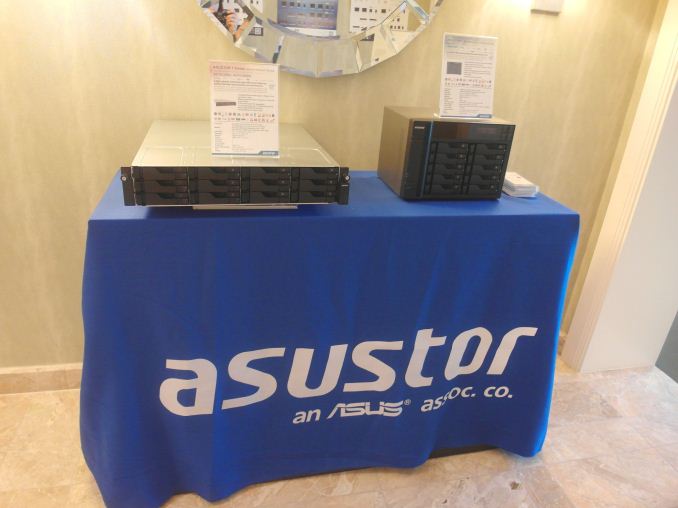

The affordable Haswell-based NAS units (Core i3-packing 70 series) were launched before the 50T series. The 70T series packs two network ports, but does have a PCIe expansion slot for 10G cards. The 70R rackmount series comes in two varieties, the Core i3-packing RD ones and the Xeon E3-packing RDX ones. Both of them are targeted towards enterprise users and come in 9- and 12-bay variants. The RDX variant supports ECC RAM.

As I have mentioned in our previous coverage of Asustor, the company is doing quite well in terms of hardware offerings. It is in the software department that they need to play catch-up with the QNAPs and Synologys in this market segment. Naturally, most of our focus during the CES visit was on the upcoming / newly released firmware features.
Asustor claims to be one of the first NAS vendors to support S3 sleep mode for aggressively driving down power consumption in the long run. ADM 2.3 finally brings about Windows ACL support. The mobile apps ecosystem was also shown in detail - the features are pretty standard if one is coming from a QNAP / Synology background. Asustor made specific mention of the hardware-accelerated transcoding feature in their Evansport NAS - both for offline as well as real-time operations via its mobile apps. Ideally, we would like it extended to their 70T series (using the Quick Sync engine).
The demo which pleased me the most was the QEMU front-end that is currently a package under beta-testing. Taking a cue from QNAP's Virtualization Station feature, Asustor is developing a package to enable ADM to act as a host OS. We saw multiple flavours of Windows running on top of a Asustor 70 series NAS. The UI is a bit basic compared to Virtualization Station, but, given the beta nature, it can definitely be excused.
Asustor has always been competitive on the hardware side of things. However, by virtue of being a late entry into the market, they have perennially been in catch-up mode with respect to firmware features. That was the story from the last two CES shows, and this year was no different. That said, it is heartening to see Asustor accelerating the development on the software side, while also being quick to react to new firmware features / packages that the competition is bringing to the market. That is definitely good news for consumers in this market.
Read More ...
Quantenna Maintains 802.11ac Technology Lead as Broadcom and Marvell Launch New Chipsets
Quantenna
At CES 2015, we had the opportunity to meet up with Quantenna at their suite and look at the demonstration of their 8x8 160 MHz MU-MIMO 10G Wi-Fi platform announced last year. Unfortunately, photography wasn't permitted, but the demo was very similar to the first generation 802.11ac demonstration by Buffalo Technologies. One of the most important advantages of the new 10G platform is the integration of the 2.4 GHz radios (for 802.11n support) in the same package. This ensures that vendors don't need to hunt elsewhere for the 2.4 GHz support. For example, Asus went with a Broadcom SoC / 2.4 GHz radios while Netgear went with a Qualcomm SoC / 2.4 GHz radios for their QSR1000 solutions. On the WLAN PHY rates side, we have upwards of 6.9 Gbps for the 5 GHz band (since this is a true 8x8 solution). The PHY rates of the 2.4 GHz band along with the proprietary extensions (additional QAM-rates support for both bands that is outside the official specifications) take the peak WLAN PHY rates upwards of 9 Gbps. Quantenna is marketing the system as a 10G solution. It is on track for shipping later this year, but Quantenna wouldn't commit on a more specific time-frame.
The other interesting announcements included a reference design with Lantiq for mid-range 4x4 routers. Using the QSR1000 platform along with a Lantiq GRX300 processor, this enables vendors to have a quick turnaround for their router platforms. The QSR1000 provides 4x4 MU-MIMO 802.11ac (5 GHz) support, while a Lantiq GRX300 SoC provides the 802.11n / 2.4 GHz support. Also on display was the MAUI platform aimed at providing enterprise vendors and service providers a way to optimize the Wi-Fi performance and troubleshoot issues at the customers' end using cloud-based analytics.
Broadcom
Broadcom launched a number of products in their 802.11ac lineup in order to update their portfolio with Wave 2 features. The BCM4366 is the 4x4 MU-MIMO capable radio for high-end systems. For gateways and routers, this can work in tandem with a BCM47094 network processor SoC (which has two Cortex-A9 cores running at 1.4 GHz). It has support for 160 MHz channels (contiguous 80 MHz + 80 MHz, as well as two discontiguous 80 MHz channels). The BCM4366 also includes a NitroQAM feature (QAM-1024). This is outside the 802.11ac specifications (Broadcom-proprietary), and is expected to provide significant performance benefits for clients with Broadcom chipsets. The network processor SoC also integrates USB 3.0 support.
Broadcoms PR doesn't talk about peak WLAN PHY rates, but it looks from D-Link's DIR-895L product page that we don't get the expected 3.4 Gbps+ from a 4x4 MU-MIMO solution capable of connecting to other 4x4 MU-MIMO clients. The cap seems to be at 2.165 Gbps.
Other updates to the lineup include the BCM53573 and the BCM47189 which are 2x2 802.11ac SoCs integrating the CPU, Ethernet switch as well as the radios in a single chip.
Marvell
Marvell also announced a Wave 2 802.11ac solution in the Avastar 88W8964. The target market is access points, service provider gateways and STBs. Similar to the other solutions described above, we have 160 MHz channel support. The main advantage is the integration of a dual core Cortex-A9 with offloading for many WLAN functions. This frees up the host CPU for other functions.
Even though a true 4x4 160 MHz solution can support upwards of 3.6 Gbps, the Avastar 88W8964 has MU-MIMO support for three 1x1 or a mix of 2x2 and 1x1 client devices. The cap on the WLAN PHY rate is at 2.6 Gbps.
Summary
Despite Qualcomm Atheros announcing their MU-MIMO chipsets early last year, solutions such as the TP-LINK AC2600 got announced only at CES 2015. Shipment is also slated for Spring 2015. The solution doesn't have 160 MHz support either. On the other hand, Broadcom has just announced their 160 MHz Wave 2 solution, but customers such as D-Link are expecting to bring routers based on it to the market in the same time-frame as the QCA 9980 solutions. In any case, all the solutions other than Quantenna's seem to missing one key feature or the other. As a end-user, if one wants to upgrade their Wi-Fi router / access point by the end of the year, a Quantenna 10G-based solution is probably the best bet. That said, solutions such as the D-Link DIR-895L that adopt the XStream platform (two sets of 5 GHz radios) along with the latest MU-MIMO solution from Broadcom are also very attractive for use-cases where channel interference is not much of a concern (rules out dense apartment complexes) and the presence of non-MU-MIMO clients prevent the MU-MIMO solutions from providing full benefit.
Read More ...
AMD Enters NAS Market with QNAP's 10G-Ready TVS-x63
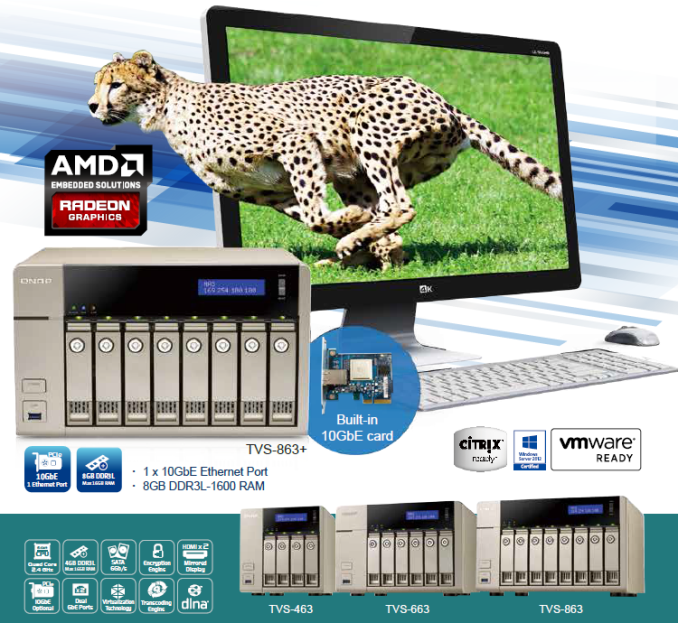
The NAS market has been dominated by Intel's x86 platform at the mid- to high-end, and ARM-based SoCs at the lower end of the market. Things are shaking up this year, with the launch of a 2x 10GbE equipped ARM-based model from Synology, the DS2015xs. On the x86 front, I had often wondered why AMD never had a product in the market. Considering the fact that the HP ProLiant microservers based on the AMD Turion platform were quite popular in the DIY market, it was surprising to find the COTS NAS vendors ignoring it completely. With the launch of the TVS-x63 lineup, QNAP has become the first vendor to bring an AMD-based x86 NAS to the market.
The TVS-x63 lineup has 4-, 6- and 8-bay models. Each of them come with either 4 or 8 GB of RAM. Higher amounts of RAM are necessary for applications where the Virtualization Station package will find use. In addition, the 8-bay model also comes with a '+' SKU. This version has a 10GBASE-T NIC pre-installed in the spare PCIe slot. The '+' version comes with either 8 or 16 GB of RAM. We will summarize the specifications of the various models in the TVS-x63 towards the end of the article. Prior to that, we will take a look at the AMD embedded G-series SoC that powers these NAS units.
QNAP specifies the CPU in the TVS-x63 models as 'AMD quad-core 2.4 GHz with Radeon Graphics' in their marketing material. At the suite, we pulled up the System Information tab, which revealed the AMD SoC to be GX-424CC.
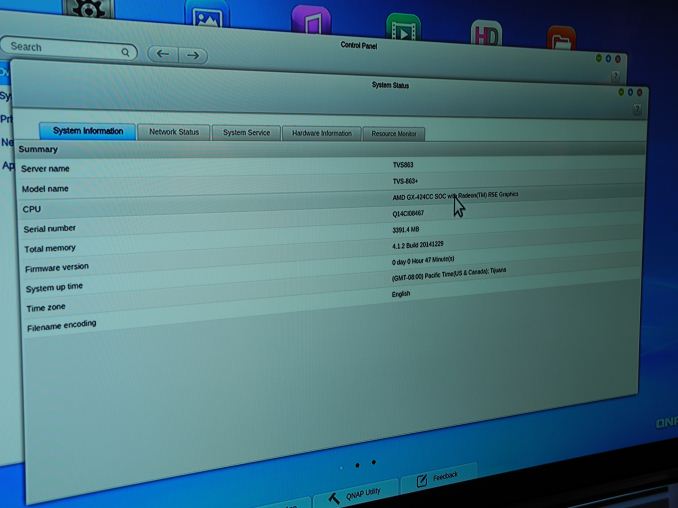
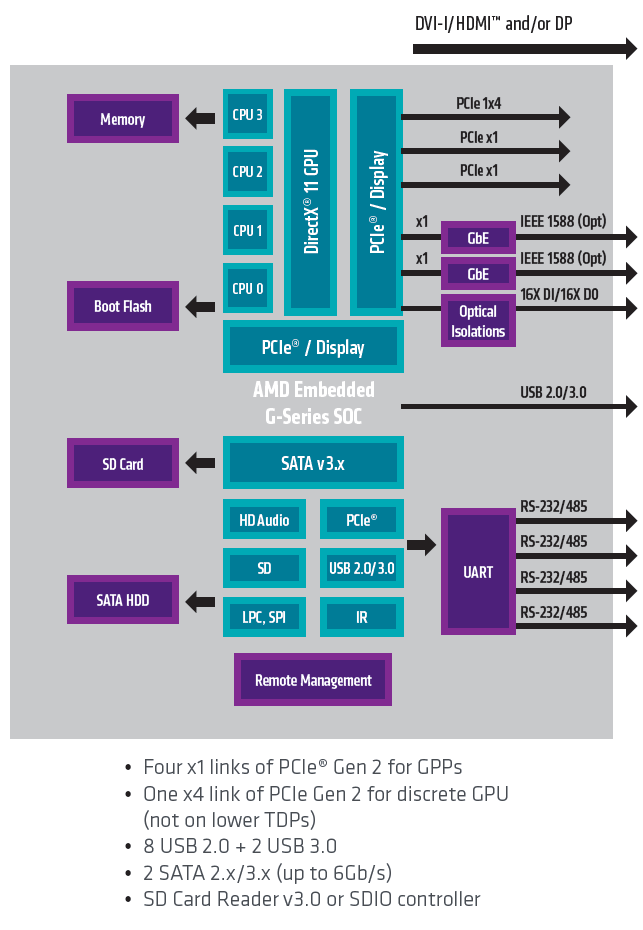
The GX-424CC is a 4C/4T Steppe Eagle configuration (based on the Puma / Jaguar+ microarchitecture). It has a TDP of 25 W. The L2 cache is 2 MB in size and the cores run at 2.4 GHz. The integrated Radeon GPU runs at 497 MHz. The unit can support DDR3 memory at 1866 MHz. Puma is the successor to Jaguar. It supports out-of-order execution. Performance-wise, it is expected to be similar to that of the Silvermont cores in the Bay Trail SoCs.
The block diagram of a typical AMD G-Series embedded SoC based on the Puma cores is produced below. It is a first-generation APU SoC design. The I/O ports mentioned at the bottom of the block diagram are important in determining how the QNAP TVS-x63 NAS units balance the I/O amongst the various necessary ports.
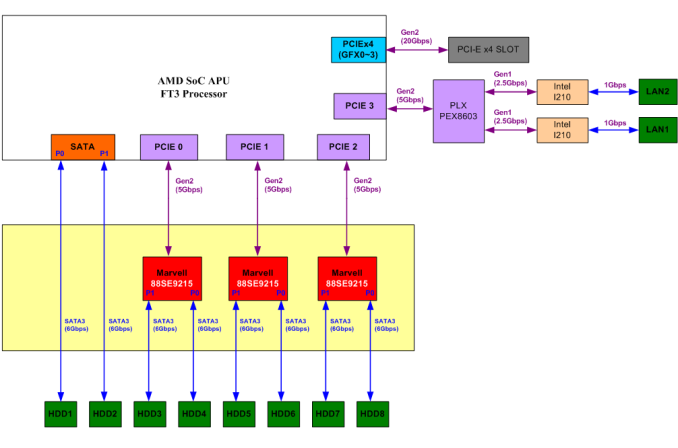
Considering the 8-bay TVS-863 for further analysis, we find the various I/Os distributed as shown below. It must be noted that the first two bays are directly connected to the SATA ports of the SoC. QNAP strongly suggests that those two ports be used for SSD caching. Typically, SoCs targeting the NAS market have native Ethernet ports, but the AMD SoC needs a PCIe bridge chip. We will have to see what effect this has in the performance department.
On the multimedia side of things, the TVS-x63 has two HDMI outputs. It supports true 4K output for the UI as well as QvPC side of things. However, video playback will be restricted to 1080p. The VCE engine is supported by the firmware, enabling hardware-accelerated transcoding similar to what we saw with the TS-x51 and TS-x53 Pro units that used Quick Sync.
The extract below summarizes the specifications of the various models in the TVS-x63 lineup.
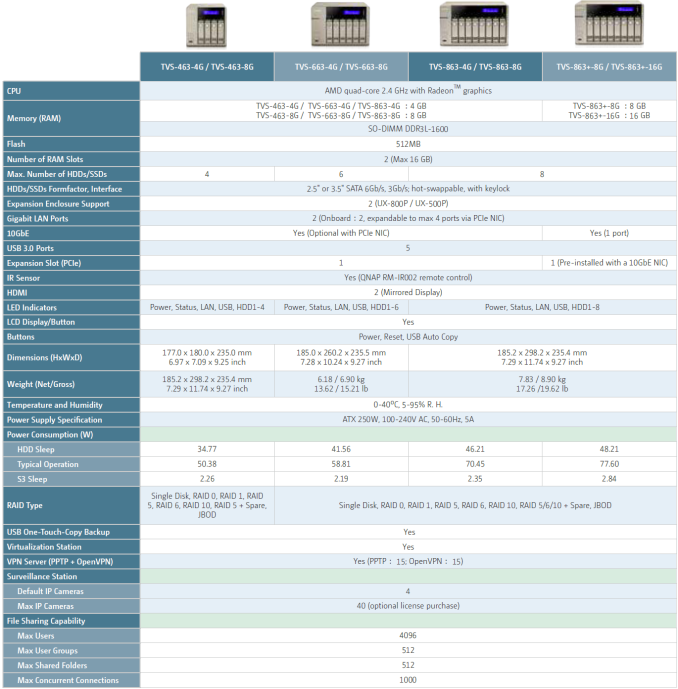
QNAP has sprung a surprise by going the AMD-route for a high performance NAS. We can probably expect the Intel-based NAS units to go down in price over the next few months. I am assuming it also provides some leverage for NAS vendors to negotiate with Intel on the pricing. On the whole, this development is a good one for consumers. In terms of pricing, the TVS-863+-8G is expected to retail for $1400. This is cheap considering the 10G port is pre-installed. The vanilla models come in at $1200 for the TVS-863-4G, $1000 for the TVS-663-4G and $800 for the TVS-463-4G.
Read More ...
OCZ Suite Tour: Vector 180, JetExpress PCIe NVMe Controller & Z-Drive 6000

Aside from the new NAND, OCZ is also adding a new 960GB capacity. We have seen many OEMs upping their capacities to 960GB/1TB in the past six months or so and the Vector 180 marks as OCZ's first client-level SATA SSD with 1TB-class capacity. The Vector 180 also features partial power-loss protection (or Power Failure Management Plus as OCZ calls it), which is not a full implementation like in enterprise drives, but there are capacitors to ensure that data at rest is safe. In other words, all user data in the DRAM buffer will still be lost in the case of sudden power loss, but the capacitors ensure that all metadata is safe and that the drive will continue to operate normally after a power loss (i.e. the NAND mapping table won't be lost, which can brick the drive or at least slow down the next boot up as the drive has to go through recovery process).

The rest of the specs remain pretty much unchanged from the Vector 150. The drive is rated at 50GB of writes per day and carries a 5-year ShieldPlus warranty (no purchase receipt required and all defective drives will be replaced with brand new units). Given that the controller and the underlying firmware remain unchaged I would expect the performance to be very similar to the Vector 150.
Unfortunately, the Barefoot 3 platform still doesn't support low-power states, so the main market for the Vector 180 will be in desktop systems. This is a problem in the silicon itself (it is two years old, after all) and to fix that the silicon would require a redesign, so instead of spending resources on that OCZ has decided to focus on the next generation JetExpress controller.
Originally OCZ's plan was to release the Vector 180 here at CES, but the company decided to spend a bit more time validating the drive to ensure that everything is okay (which, as some of you may remember, is quite different from what OCZ used to do a few years ago). Availability should be in the coming weeks, though, and I would expect pricing to be close to the Vector 150 or perhaps a bit lower given the new, more cost efficient NAND.
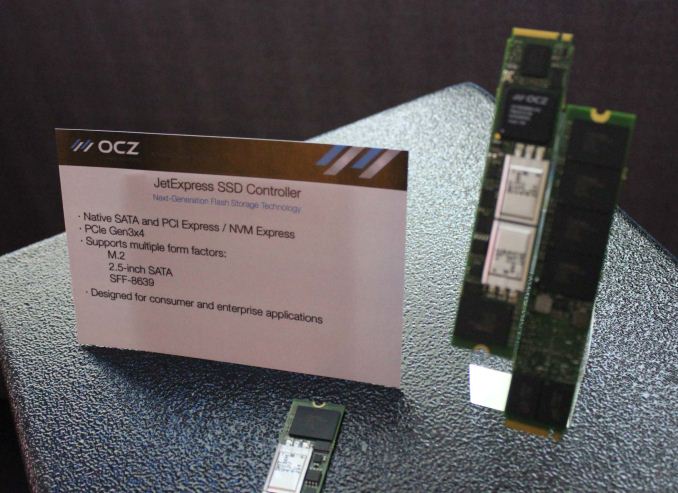
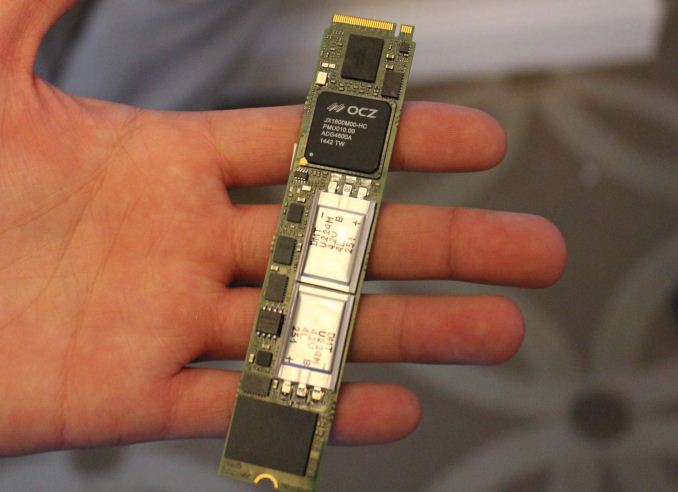
The big and obviously interesting news is OCZ's JetExpress controller. It's a native PCIe 3.0 x4 controller with NVMe support and SATA/AHCI are also included for legacy support (SATA isn't going anywhere anytime soon anyway). In terms of features the JetExpress has pretty much all the bells and whistles. DevSleep, TCG Opal 2.0, eDrive, LDPC error correction and TLC NAND are all supported. The controller itself is small enough to fit in M.2 as seen above, unlike the FPGA designs that we have seen in drives like the Samsung XS1715.
Architecturally the JetExpress sports the same Aragon cores as the Barefoot 3, but the core count is much higher (I'm hearing seven cores) with each core having its own specific purpose. The chip consists of several power islands, which can be shut down individually for increased power efficiency. The DRAM controller is massive and supports up to 32GB of DDR3, which enables very high capacities (I was told that even 10TB is achievable, although in most cases the problem is the form factor and its physical limitations, not the controller itself).
OCZ will start by shipping the JetExpress to enterprise customers in the first half of 2015 and a client release will follow in H2'15 -- most likely right around the time Intel releases its Skylake platform with proper PCIe and NVMe support.
OCZ's ECC engine is also quite interesting. The controller supports both BCH and LDPC error correction and there are three different modes (high performance, high endurance and hybrid) available. Basically, high performance mode means that only BCH ECC is used, which has less overhead than LDPC but isn't as powerful and thus results in lower endurance. The high endurance mode, on the other hand, has LDPC enabled, which increases the endurance by about 3x from what I've heard. The hybrid mode basically has BCH enabled at first, but as the NAND is cycled and starts to require more ECC, LDPC will kick in to boost the endurance. The reason why OCZ is offering all three modes is that LDPC adds some latency, so once it kicks in there is some performance loss and typically enterprise customers want a device that has predictable performance throughout its life (or at least an option to choose a mode like that). Similarly, some customers value performance more than endurance (online transaction processing is a good example since the more transactions you can do the more money you will make), so OCZ is offering the customer the opportunity to select what mode is the best for their usage.

In addition to the upcoming JetExpress drive OCZ was showing off their upcoming Z-Drive 6000 for enterprises with NVMe support. The drive comes in 2.5" 15mm form factor with the SFF-8639 connector (basically the enterprise version of SATA Express) and utilizes PCIe 3.0 x4 interface. The Z-Drive features the same PMC controller as Samsung's XS1715 but obviously the firmware is à la OCZ. Performance comes in at up to 3GB/s for sequential reads and 2GB/s for writes and random performance is up to 700K IOPS for reads and 175K for writes. Capacities go all the way up to 3.2TB, although OCZ was very confident that the company can build a 6.4TB version as well. OCZ is currently sampling a handful of key OEMs and volume availability should be in the coming months.
I spent a good hour talking with OCZ's CEO, Ralph Schmitt, about how OCZ is doing under Toshiba and what is the direction of the company, so watch out for a deeper dive after CES.
Read More ...
A Quick Look at Keyssa: Contactless USB 3.0


In addition to the immense bandwidth, Keyssa’s connectors are relatively small and are around a millimeter thick, with a length and width similar to a microUSB 3.0 connector. It seems that this technology takes advantage of USB-IF’s media-agnostic USB standard, as in a demonstration of a prototype SSD with Keyssa’s connector the SSD appeared to be a USB drive on to a laptop with a pad for the SSD. Company representatives stated that there will be products shipping with this connector this year, and it should be interesting to see how this affects mobile devices if this technology gains traction.
Read More ...
LG G Flex 2: Hands-on Impressions
| LG G Flex 2 | |
| SoC | MSM8994 2.0/1.5 GHz 4x A57/ 4x A53 Snapdragon 810 |
| RAM/NAND | 2/3 GB LPDDR4, 16/32GB NAND + microSD |
| Display | 5.5” 1080p LG P-OLED |
| Network | 2G / 3G / 4G LTE (Qualcomm MDM9x45 UE Category 9 LTE) |
| Dimensions | 149.1 x 75.3 x 7.1-9.4mm, 152 grams |
| Camera | 13MP rear camera, 1.12 µm pixels, 1/3.06" CMOS size, F/2.4. 2.1MP F/2.0 FFC |
| Battery | 3000 mAh (11.4 Whr) |
| OS | Android 5.0 with LG UI |
| Connectivity | 802.11a/b/g/n/ac + BT 4.1, USB2.0, GPS/GNSS, Slimport, NFC |
| SIM Size | MicroSIM |
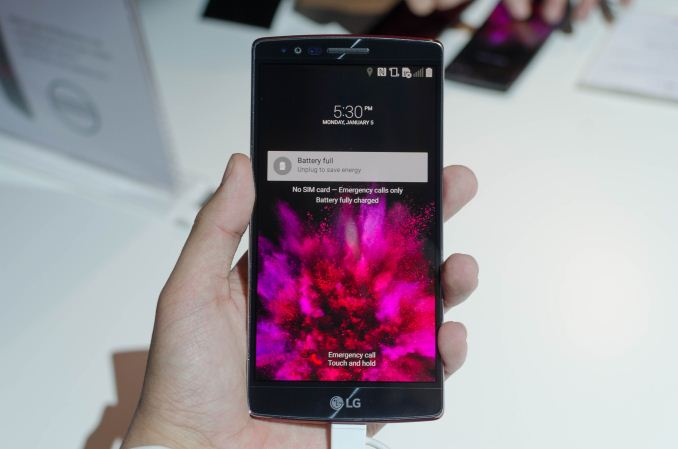
As one can see, while there are a lot of elements shared with the LG G3, there are a number of areas where we see notable improvements that differentiate the G Flex 2 from the G3. The size of the phone has also decreased, as LG claims that people didn’t like the sheer size of the previous LG G Flex.
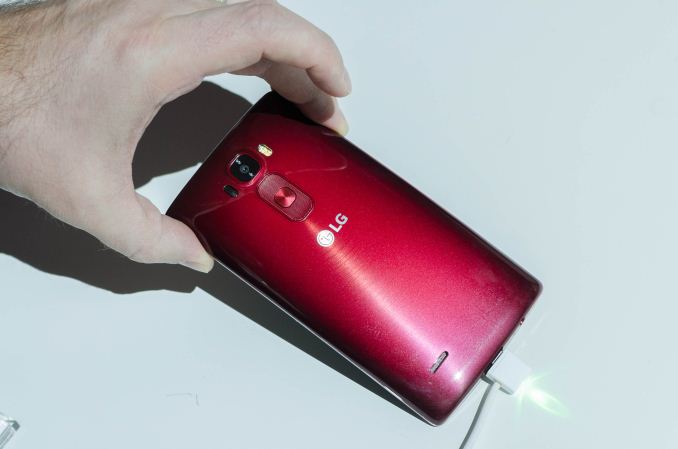
LG has also changed the design of the G Flex 2 to be more similar to the LG G3 with its brushed metal finish, although the self-healing polymer dictated a glossy finish with a brushed design beneath the finish. The self-healing polymer itself has been notably improved, healing over seconds instead of minutes like the original LG G Flex. LG has also introduced Dura-Guard glass, which is said to improve drop resistance when compared to Corning Gorilla Glass.
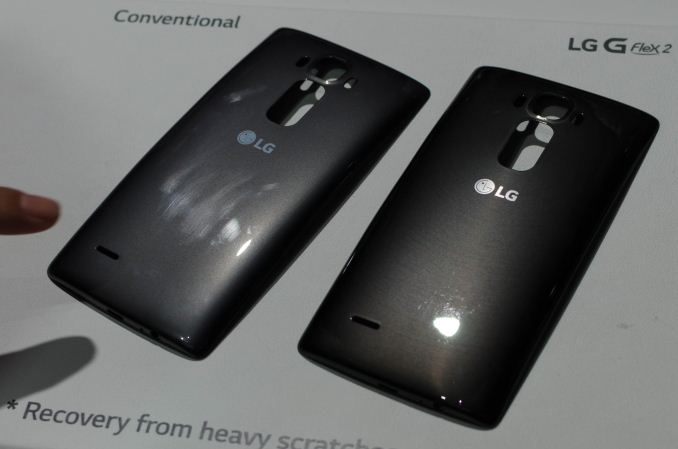
In practice, this combines to make the LG G Flex 2 into a rather interesting phone. Unfortunately, it seems that all of the phones available for demonstration were running non-final software. This meant that it wasn’t possible for us to properly benchmark the device, and there seemed to be more lag in the UI than the LG G3 or Nexus 5. In addition, these demo phones were running in poor conditions for benchmarks, as maximum brightness was constantly reduced due to thermal throttling.
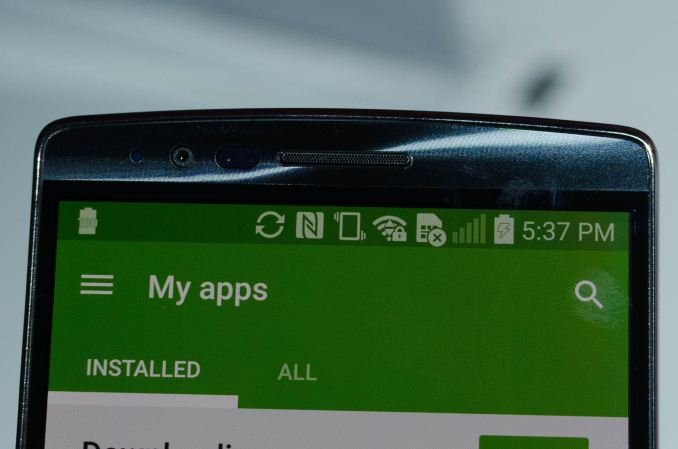
Despite these issues, the G Flex 2 was still an interesting device to try. While I haven’t used the original LG G Flex extensively, I noticed that the 1080p display on the G Flex 2 behaved differently from the 1080p display on the Galaxy S5. Although the G Flex 2 doesn’t have the odd ghosting effects present on the Galaxy S5, the G Flex 2 does have noticeable mura or some sort of texture to the display. Given the demo conditions, it’s difficult to discern whether or not the display is RGB stripe or some form of PenTile.
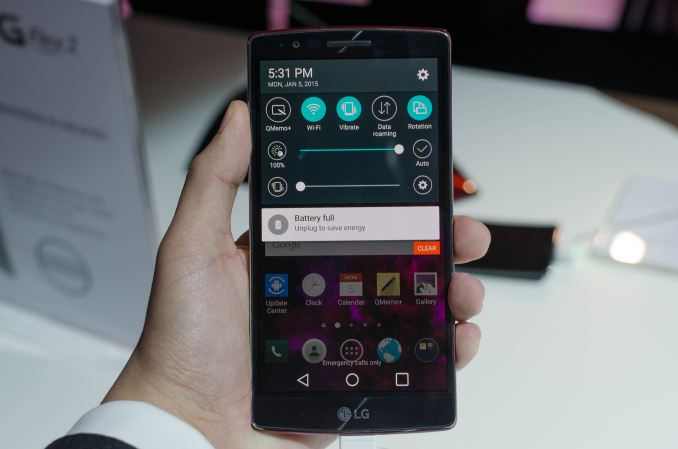
Outside of the display, the UI brought our first experiences with LG’s UI when layered on top of Android 5.0. Unfortunately, the UI seems to be quite similar to the G3’s UI on Android 4.4, even though there are noticeable changes in areas like the notification drawer and multitasking menu. It may be that we will be left waiting until the LG G4 to see a redesign of the UI to fit with the new design guidelines. At any rate, the camera remains identical to the LG G3, with the same Sony IMX135 sensor, optics, laser AF, and OIS+. The UI remains largely similar here as well, and it seems that there remains a noticeable amount of shutter lag similar to the LG G3. On the bright side, the G Flex 2’s camera remains quick to focus and the OIS is incredibly stable when compared to most solutions I’ve tried. Overall, despite some issues the LG G Flex 2 seems to be a promising device.
Read More ...
Microsoft Demonstrates Updated Lumia Camera App At CES
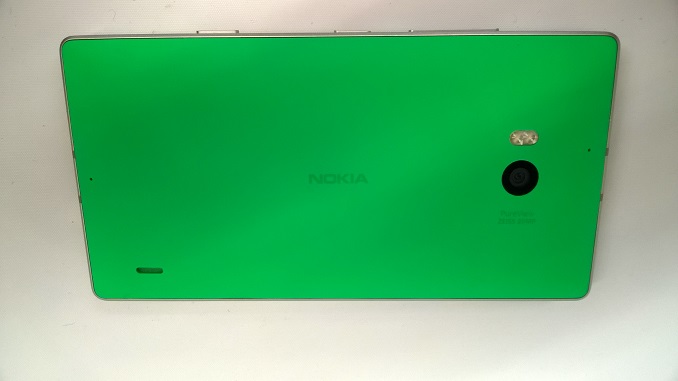
The first major change is the camera startup time. When Windows Phone was first launched, one of the features touted was “pocket to picture” with the dedicated camera button. As time has gone on, the camera button is no longer a requirement, so this has fallen off a bit to the detriment of the platform. But an even larger issue on the Nokia Camera app was how long it would take to be ready to take a picture. For example, with the Lumia 735, launching the Lumia Camera app takes about 4 seconds or so to load and be ready to take a photograph. Juha discussed how Microsoft has worked to create a camera app that can load almost instantly. On the updated Lumia 930 with Denim, launching the camera app now takes around a second. I don’t have my equipment in Vegas to do a time lapse and get the exact amount of time, but pressing the camera button on the phone has the camera app ready to do almost instantly. I cannot imagine that these changes will not be made available to all of the Lumia phones, as any more efficient code is going to be even more pronounced on the slower processors of those devices.
Microsoft also reworked the algorithms on the image quality side, as they tend to do. Although I do not have an older 930 to test with anymore, they did have some side by side comparisons with the old algorithms and the new ones, and the image quality is even better than before.
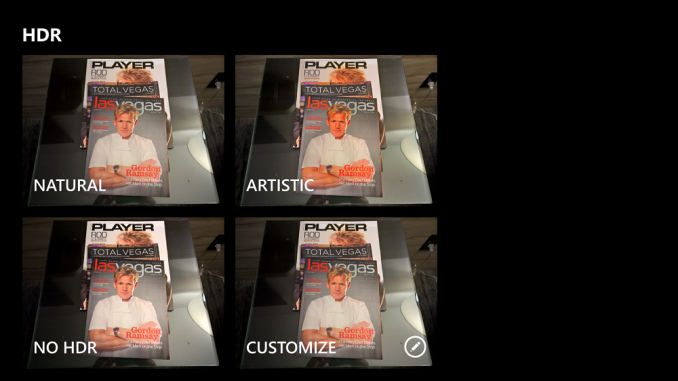
Another area where Microsoft has and Nokia have both been missing a major feature compared to their rivals is in the area of High Dynamic Range (HDR). HDR has been an option on Android and iOS for a long time, and with the relatively limited dynamic range of smartphone camera sensors, many people really like the extra pop that HDR can bring to an image. The HDR on the Lumia is not just a standard HDR though. Microsoft is calling their implementation “Rich Capture” and it covers a couple of features in addition to HDR. But the basic implementation is that like any other HDR setting, it takes several bracketing photos at different exposures and then merges them together to create a single image. The Lumia Camera implementation will allow you to customize the exposure after the fact by keeping all of the photos together, and you can adjust how much HDR you want to add to the image when you are done. It is a slick implementation, and the added customization is always welcome.


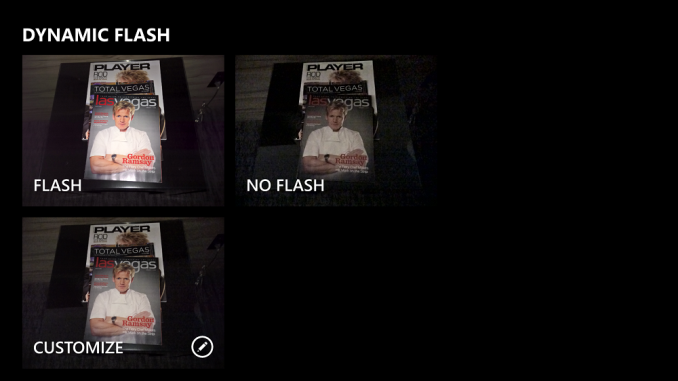
Likely the most impressive addition to Rich Capture though is a new feature that I believe is unique to Lumia called Dynamic Flash. With smartphones, the flash is almost necessary due to the small sensor size for any sort of low light imaging. With OIS and larger sensors and pixels on some of the phones, you can get away sometimes without using the flash except in the most extreme circumstances. Apple’s solution was to implement a dual flash, which adjust based on the scene. This requires a specific flash in the device though. The Lumia solution is that the camera takes two photos – one with the flash and one without the flash. It then blends them together to keep the shot from being blown out by the harsh LED flash. And the Dynamic name comes in because you can adjust the amount of flash in the image after the fact. Juha discussed how he likes to keep the flash on even for daytime shots now, just so that he can add a bit of sparkle to the eyes in his images. This is a fantastic addition and is really amazing to see for the first time.


Another area where the Lumia camera fell short was in shot to shot time. Once again, I do not have all of my test equipment here so I will see how much of a difference they have made, but now they have changed the app to allow you to take a new photo while the last image is still being processed. Shot to shot is still not up there with an iPhone, but it does seem better overall. When I get back home I will test the new camera against the numbers from our 930 review and see what the increase is.
However, there is another solution to shot to shot time that has been added as well. The new Lumia Camera app now supports 4K video at 30 frames per second. 4K is about an eight megapixel image, so the app is now set up so that if you hold the shutter button, it will start recording at 4K. When you release the button, the recording stops. You can then open the video, and you have the option to choose the best frame from the video to use as a standalone image. The demonstration we were given was a skateboarder jumping over a person on a bench, and you could freeze the moment when the jumper was right at the peak of his jump. It is useful, although you are limited to the eight megapixel image even though it is a twenty megapixel sensor. Hopefully a future update supports full burst mode.
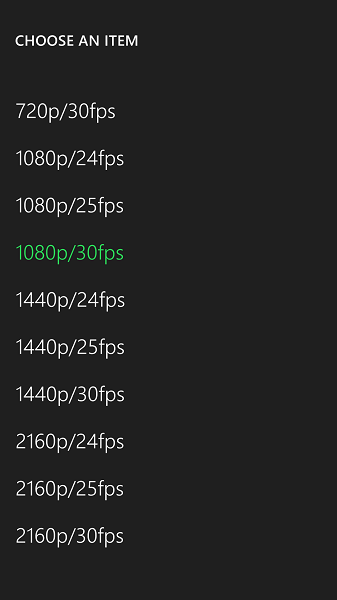
And although I have already given this away, the final update to Lumia Camera is the 4K video support. Initially, Microsoft had stated that this would be limited to 24 FPS but that appears to have changed and now it is offered in 24, 25, or 30 FPS. You can also choose 720p, 1080p, or 1440p in any of those framerates. In addition, the Lumia Camera app still supports 5.1 Dolby Digital surround sound recording for video with the 4 HAAC microphones.
This is a fantastic update to the Lumia Camera, and one that was much needed. Some of the features will not be possible on the lower tier phones due to the ISP included, but hopefully the new processing algorithms and especially the startup time can be added. And just because people want to know, no, there was no discussion yet of a Lumia 1020 update.
Read More ...
Crucial Announces MX200, BX100 SSDs & SSD Toolbox

The MX200 is essentially the branded version of Micron's M600 that we reviewed earlier. The notable change compared to the MX100 is that the MX200 features Dynamic Write Acceleration (DWA), which is Micron's/Crucial's SLC cache implementation. I covered the feature in detail in our M600 review, but in short the SLC cache size is adaptive and changes depending on how much data the user is storing in the drive (unlike e.g. Samsung's and SanDisk's implementations where the SLC cache size is fixed). I wasn't very impressed by the performance of the M600 and DWA, but what DWA does provide is higher endurance since SLC is significantly more durable. Crucial is rating the 250GB version at 80TB, 500GB at 160TB and 1TB at 320TB, which is a notable increase over the 72TB that the MX100 had.
Otherwise the MX200 is very similar to the MX100. It's a Marvell 88SS9189 based design with Micron's 16nm 128Gbit NAND and as usual the MX200 features DevSleep, TCG Opal 2.0 and eDrive encryption. MSRPs are $140 for 250GB, $250 for 500GB and $470 for 1TB, which is certainly a bit more compared to the MX100. M.2 and mSATA models are also available, though the capacities only go to up to 500GB. Availability will be later in this quarter and we are expected to get samples in the next couple of weeks.

The other SSD that Crucial is launching is more interesting. The BX100 will be Crucial's entry-level drive (the B stands for budget) and the intriguing part is that Crucial is using Silicon Motion's 2246EN controller with 16nm 128Gbit NAND, which is change from Crucial's usual Marvell designs. Actually, the BX100 is the first drive from a NAND OEM to ship with a Silicon Motion controller, so that is certainly a big design win for the company. I've been pretty pleased with the 2246EN and it has done well in our tests, so I can see why Crucial chose to go with that one.
Feature wise the BX100 drops all the M-class features, so there is no hardware-accelerated encryption or SLC caching. Pricing is $70 for 120GB, $110 for 250GB, $200 for 500GB and $400 for 1TB, so it's very competitively priced like the MX100, although given the lack of features I would have like to see a bit lower pricing since the MX100 currently retails for about the same prices. Availability is also Q1'15 and we will be getting samples soon.
Finally, after a long period of waiting, Crucial is launching its own toolbox for SSDs, called the Crucial Storage Executive. The 1.0 version is a fairly basic toolbox with support for firmware updates, drive monitoring, secure erase and PSID revert, although Crucial has plans to add more features in the future. Supported drives are currently the M500, M550, MX100, MX200 and BX100 and the software is already available for download from Crucial's website.
Crucial MX200 Product Page
Crucial BX100 Product Page
Crucial Storage Executive
Read More ...
NVIDIA Launches GeForce GTX 965M
Given the quiet nature of the launch, you can already guess that this isn’t a new GPU core. Basically we’re getting another GPU for laptops based on GM204, and it’s one step down from GTX 970M placing it somewhere around the level of the GTX 870M but with updated features courtesy of GM204. In terms of specifications, the GTX 965M is has 1024 CUDA cores clocked at 944MHz, plus boost clocks, and the GDDR5 memory uses a 128-bit bus and is clocked at 5GHz. By way of comparison, GTX 970M has 1280 cores clocked at 924MHz (plus boost) with a 192-bit GDDR5 5GHz interface. This effectively puts performance at roughly half the speed of the desktop GTX 980, or around 2/3 the performance of the GTX 980M (depending on memory bandwidth use).
NVIDIA unfortunately doesn’t disclose any information on TDP or pricing with their notebook GPUs, and it’s not clear if the GTX 965M will come with 2GB or 4GB of VRAM (or perhaps both configurations will be available). That said, it’s a safe bet that GTX 965M will use less power than GTX 970M, which in turn uses less power than the GTX 980M (around 100W). We will hopefully see some notebooks with GTX 965M in the near future for testing, and considering the number of notebooks we saw sporting the new GPUs we expect that to occur sooner rather than later.
Read More ...
Samsung Announces Galaxy A7, Promises "Competitive Price"
New device falls on the high-end of mid-range, packs Snapdragon 615
Read More ...
LG G Flex 2 Packs Snapdragon 810, Hits Preorder for ~$699 in Europe
Second-gen model is cheaper, more durable, and packs a much better spec
Read More ...
Microsoft Accuses Google of Irresponsible Disclosure of Windows Bugs
Google published exploitable security hole two days before it would have been patched despite Microsoft asking not to
Read More ...
iPhone 6 Drives Apple Market Share to New Highs in U.S., Europe
Android remains strong, though, in the lead in nearly all markets and decisively in control in China
Read More ...
Belfie Stick Fills Gaping Hole in Selfie Market by Snapping Selfies of Your Butt
You can be a star... for only $80
Read More ...
Available Tags:SSD , AMD , AMD , MSI , USB , MSI , Intel , Cooler Master , Samsung , Galaxy , Cooler Master , OCZ , USB 3.0 , LG , Microsoft , NVIDIA , GeForce , GTX , Google , Windows , iPhone 6 , Market Share , iPhone , Apple ,


No comments:
Post a Comment