

January 2015 Xbox Games With Gold Free Games Preview
2015 looks to be off to a decent start. Personally I’m still hoping to see some of the bigger launch titles made available soon, since they are now being bundled with new systems or offered for steep discounts. Perhaps later in the year. For now, let us take a look at January’s Games with Gold offers.
Xbox One
D4: Dark Dreams Don’t Die

D4: Dark Dreams Don’t Die is a game I have been eyeing up as something that looks pretty interesting. You play the game as David Young, who is a private investigator, however your wire has been murdered. Access Games is the developer for this episodic detective story, and D4 was originally intended to be used with Kinect, but luckily controller support was added. Reviews have been mixed on D4, with some very high scores and some not so high scores. Metacritic has D4 as a 77 Metascore, and 7.2 User score. D4: Dark Dreams Don’t Die was released as a Xbox One exclusive in September 2014, and normally retails for $14.99.
“D4 is the brainchild of legendary Japanese designer Swery (real name: Hidetaka Suehiro), the mind behind the fantastic Deadly Premonition. You play David Young, a detective whose wife has been murdered. David suffers from a strange syndrome as a result of the murder: He can’t remember the past, but he can travel through time. He uses this ability to go back and find out the truth behind his wife’s death so he can try to prevent it. But, along the way, his bizarre powers get augmented (and sometimes impeded) by an equally bizarre cast of characters. The puzzles will leave you scratching your head (in a good way) for a while, but the story and unique cel-shaded graphics will keep you glued to the screen.”
Xbox 360
MX vs ATV Alive

The first game for the Xbox 360 is from THQ Digital Phoenix, and was originally launched in May 2011 on both the Xbox 360 and PS3. MX vs ATV Alive is the fourth title in the off-road racing series. Reviews were not overly high, with many citing the obvious promotion of DLC paid content, and only scored a 63 Metascore and 7.5 User Score on metacritic. MX vs ATV Alive will be available January 1st to 15th on the Xbox 360, and normally retails for $19.99.
“Own the competition as you wrestle for position with tightly contested racing in the fifth iteration of the MX vs ATV franchise. Feel the realism of the revolutionary real-world physics engine which has defined the racing genre. Live the sport as Alive captures the spectacle of motocross and the essence of competitive racing while providing the best riders and gear from the latest manufacturers.”
The Witcher 2: Assassins of Kings

The biggest game available for January is the critically acclaimed action RPG The Witcher 2: Assassins of Kings. Players assume the role of Geralt of Rivia, who is a witcher skilled in the destruction of monsters. The game is based on The Witcher fantasty novels, and has a great story and excellent gameplay. The Witcher 2 came in with an 88 Metascore and 8.4 User Score on metacritic, and is a game any RPG fan will want to check out. The Witcher 2: Assassins of Kings will be available January 16th to 31st and normally retails for $29.99.
“The Witcher 2: Assassins of Kings features a thoroughly engrossing, mature storyline that defines a new standard for realistic,non-linear game narration. In addition to an epic story, the game features a complex combat system that uniquely combines deep tactical elements with dynamic action.”
We are still waiting for the big game to come to the Xbox One Games with Gold program, but D4 is at least a different type of game than we have seen for the last several months. The Xbox 360 has a big name title in the Witcher 2, and right in time to let people get through the second instalment before The Witcher 3: Wild Hunt arrives in May 2015.
Read More ...
ASUS X99-A Motherboard Review
X99 and Haswell-E, due to the price, the performance and the feature set, ends up being very expensive compared to the mainstream. It is an odd state of affairs in the self-build arena when a reviewer states that the budget end of a spectrum is sub-$300. In this space we find the ASUS X99-A at $275 MSRP. This motherboard is the topic of our review today.
Read More ...
Understanding Brightness in AMOLED and LCD Displays
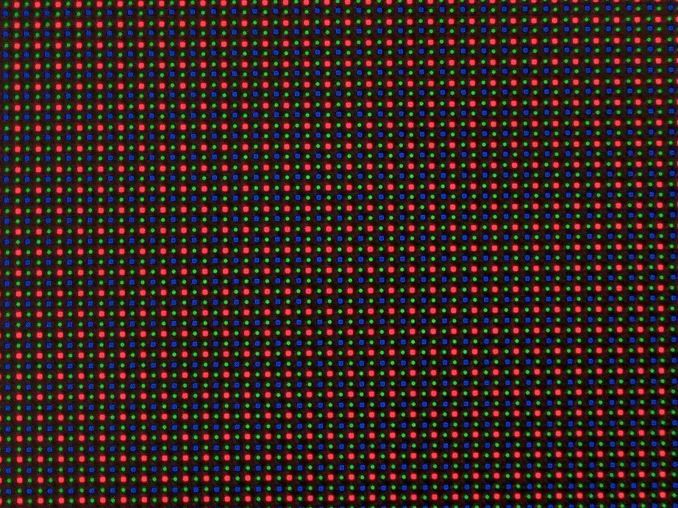
One might immediately assume that one measurement is right, and the other is false. In truth, both measurements are achievable, as we’ll soon see. Before we get into any discussion of testing methodology though, we must first understand how AMOLED and LCD displays work. Fundamentally, LCD and OLED displays are almost completely different from one another, but face similar issues and limitations. LCD is the older of the two technologies, and is fundamentally quite simple, although not quite as simple as OLED. In short, we can view an LCD display as made of a backlight, and a color filtering array which has liquid crystals that control the passage of light, along with polarizers to make sure that the filtering system works correctly.

To break this system down further, we can look at the backlight. In the case of mobile devices, the only acceptable backlight system for thickness and power efficiency reasons is the edge-lit LED, which places a line of LEDs along an edge of the display, which is then diffused through a sheet of transparent material with strategically-placed bumps in the material to create points of light via total internal reflection. For the most part, LEDs in use today are blue LEDs with yellow phosphors in order to increase efficiency, although this means that the natural white point of such a backlight is higher than 6504k and requires filtering in order to reach a calibrated white point.

Schematic diagram IPS LC display / BBCLCD
While the backlight is relatively simple, the actual color filtering is a bit more complicated, although we will avoid extensive depth in this case. In the case of IPS, the structure is generally quite simple in nature, with two electrodes in plane with each other, which is used to generate an electric field that rotates the orientation of the liquid crystals in plane with the display to dynamically alter the polarization of the light that can pass through the liquid crystal array. With a set of fixed polarizers before and after the liquid crystal array, by using the controlling TFTs to alter the voltage applied on the electrodes one can adjust individual color output on a per-pixel basis.

AMOLED is a fundamentally different approach to the problem, which uses organic emitters deposited upon a substrate. These emitters are designed to emit red, green, or blue when voltage is applied across two electrodes. Similarly, TFTs are needed to control each pixel. As one can see, AMOLED is a simpler solution, but in practice the issues with such an implementation can be quite complex.
In order to determine what picture content to use for a measurement of maximum brightness, we must turn to a measurement known as Average Picture Level (APL). This is best explained as the percentage of the display that is lit up compared to a full white display, so a display that is completely red, green, or blue would be 33% APL.
As one might already be able to guess, with AMOLED power consumption is highly dependent upon the content displayed. With a pure white image, every pixel must be lit, while with a pure black image every pixel is off. As the display typically has a maximum power use set for a mobile device, this opens up the capability for AMOLED displays to allocate more power per pixel (i.e. higher maximum luminance) when not displaying a full-white image. This is in contrast with the edge-lit LCDs used in mobile displays, which have relatively limited local-dimming capabilities. As a result, the maximum brightness of an LCD is relatively fixed, regardless of the displayed content.
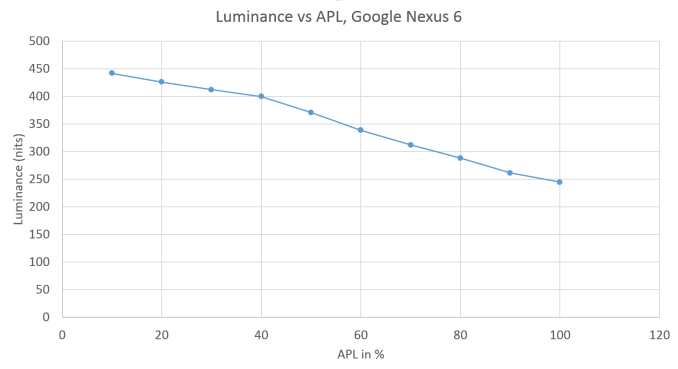
In the case of the Nexus 6, we can clearly see dimishing returns after 40% APL as there is efficiency droop on AMOLED displays that are similar in nature to LED backlights. While now it’s easy to understand why it is that AMOLED can vary in maximum brightness, the question is which brightness is “correct”. While an AMOLED display can technically have a maximum brightness of 750 nits, it’s unlikely that people will look at images effectively equivalent to 1% of the display lit up with white.
In practice, it turns out that with Lollipop and almost all web pages, the average picture level is quite high. It’s increasingly rare to see cases where displayed content is below 50% APL. According to Motorola, 80% APL represents an average APL for light UIs and in light of this, it seems appropriate to test at similarly real-world APLs. Taking a look at some commonly used applications in Lollipop, we see that the APL is regularly at or above even Motorola's 80% figure. I opened some of the applications on my Nexus 6's homescreen to take screenshots of whatever they had open when they came up, and I've tabulated the results below.
| APL in % | |
| Messenger | 86 |
| Calculator | 49 |
| Settings | 84 |
| Calendar | 80 |
| Phone | 89 |
| Reddit Is Fun (Light) | 77 |
| Reddit Is Fun (Dark) | 23 |
| Chrome New Tab | 86 |
| Wikipedia | 83 |
| AnandTech | 52 |
| AnandTech Article | 81 |
| 76 |


As you can see, many of the screens in Android's interface as well as web pages and third party apps have a high APL. There are exceptions, like the Calculator application and any application with a dark theme, but the overall trend is clear. Google's new interface style also means that applications are more likely to adopt interfaces with large amounts of white than in the past.
As a result of this, we test at 100% APL in order to get an idea of perceived brightness. While there may be some need for lower APL testing, it’s important to also consider cases such as OLED aging which will lower peak brightness over time. It's also important to consider that the delta between 80% APL and 100% APL in this case is around 44 nits. This makes for about an 18% delta in brightness, which ends up being around the noticeable difference in most cases. While our testing is subject to change, in the case of brightness we currently do not see much need to dramatically alter our methodology.
Read More ...
Miyamoto: Nintendo is Prepping Successor to Troubled Wii U
Video game legend Shigeru Miyamoto also talks about upcoming Wii U Star Fox and Zelda titles
Read More ...
Campbell's Monkeys Found to Use Different Dialects to Describe Local Threats
Linguistic differences arose out of threats facing particular populations
Read More ...
Airbus A350 XWB Passenger Jet Takes Off, First Unit Delivered to Qatar Airlines
Orders have begun shipping after an 8-year-development cycle and some delays of the carbon-fiber aircraft
Read More ...
Amazon's Kindle Fire HDX 8.9 Drops to $299 (30 Percent Off) for a Day
At 30 percent of Amazon's regular rate, tablet offers plenty of bang for your buck
Read More ...
Mississippi AG Drops Anti-Google Subpoena After Dirty MPAA Ties Are Revealed
Lazy mistake revealed filings from the AG's office were really written up by big media lawyers
Read More ...
Available Tags:Xbox , ASUS , Nintendo , Kindle ,


No comments:
Post a Comment