

Apple Q4 FY 2014 Fiscal Results - 21% Mac Growth And Strong iPhone Sales
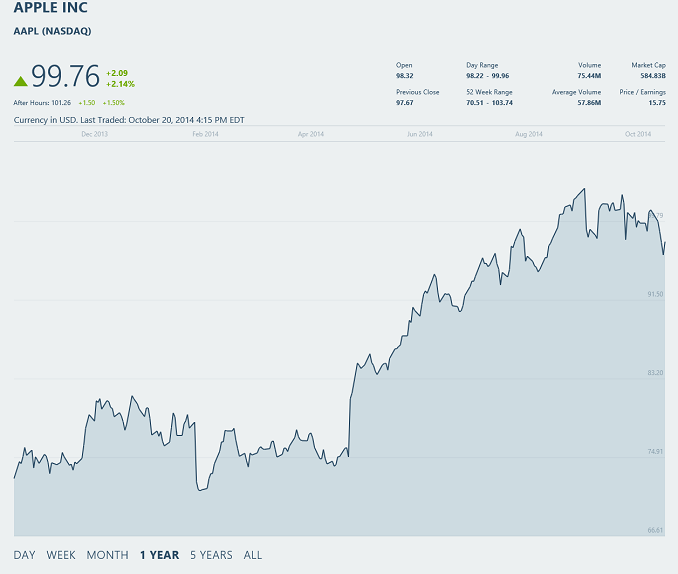
Apple declared a cash dividend of $0.47 per share which will be paid out to all shareholders of record as of November 10th, on November 13th. Over $20 billion was returned to shareholders in Q4 as part of the share buyback program and other market transactions.
| Apple Q4 2014 Financial Results (GAAP) | |||||
| Q4'2014 | Q3'2014 | Q4'2013 | |||
| Revenue (in Billions USD) | $42.123 | $37.432 | $37.472 | ||
| Operating Income (in Billions USD) | $11.165 | $10.282 | $10.030 | ||
| Gross Margin (in Billions USD) | $16.009 | $14.735 | $13.871 | ||
| Net Income (in Billions USD) | $8.467 | $7.748 | $7.512 | ||
| Margins | 38.0% | 39.4% | 37.0% | ||
| Earnings per Share (in USD) | $1.43 | $1.28 | $1.19 | ||
As is the norm, the iPhone was the star of the show. In September, Apple of course launched two new iPhone models which brought the total volume of devices sold to 39.272 million for the quarter, which is up 11.5% from the previous quarter and 16.2% from the same quarter a year ago. The iPhone 6 and 6+ are apparently selling very well, with Apple selling all of the units they are making at the moment. iPhones accounted for 56% of Apple’s revenue this quarter. With the iPhone 6 only being available for a couple of weeks this quarter, expect the units to jump significantly for Q1 2015, which began September 28.
The surprise for this quarter was Mac sales, which grew an astonishing 21% year-over-year, and 25% sequentially. It is even more amazing when you consider that the MacBook Pro line only got a slight refresh last quarter, and the iMac, Mac Mini, and MacBook Air got no significant updates at all. Apple said that they “won back to school” and they certainly did as a percentage increase. Overall Mac sales were 5.52 million, as compared to 4.413 million last quarter and 4.574 million at the same time last year. With this increase, Apple stated that they have the highest PC sales percentage since 1995. Revenue for the Mac was also big, as would be expected with the gain in sales. Mac revenue is now back to number two overall for the company with $6.625 billion for Q4.
| Apple Q4 2014 Device Sales (thousands) | |||||
| Q4'2014 | Q3'2014 | Q4'2013 | Seq Change | Year/Year Change | |
| iPhone | 39,272 | 35,203 | 33,797 | +12% | +16% |
| iPad | 12,316 | 13,276 | 14,079 | -7% | -13% |
| Mac | 5,520 | 4,413 | 4,574 | +25% | +21% |
| iPod | 2,641 | 2,926 | 3,498 | -10% | -24% |
iPad sales continue to be the thorn in Apple’s side these days, with a sales decrease for the third consecutive quarter. iPad sales fell to just 12.3 million, down from 14.1 million last year, which is a 13% drop. Clearly they are not giving up on the market, and the two new devices launched last week as well as the holiday season should put an end to the decline in sales for Q1. Apple said that iPad sales were ahead of iPhone sales over the same initial four years, so they are happy with where it is at, but still three straight quarters of sales decline is not what they would have been hoping for.
The venerable iPod likely got the final unit and revenue breakdown, with the iPod going to be rolled into the new Other category, with the iPod being joined by Accessories, Beats, Apple TV, and other products in the new reporting category such as watches when they are released. iPod sales fell 24% from last year, with 2.6 million devices sold. Revenue came in at just $410 million (just!) for the quarter.
Finally, iTunes/Software/Services was up 8% year-over-year with $4.6 billion for the quarter, with the App Store continuing to drive revenues for the Apple ecosystem.
| Apple Q4 2014 Revenue by Product (billions) | |||||
| Q4'2014 | Q3'2014 | Q4'2013 | Revenue for current quarter | ||
| iPhone | $23.678 | $19.751 | $19.510 | 56.2% | |
| iPad | $5.316 | $5.889 | $6.186 | 12.6% | |
| Mac | $6.625 | $5.540 | $5.624 | 15.7% | |
| iPod | $0.410 | $0.442 | $0.573 | 1% | |
| iTunes/Software/Services | $4.608 | $4.485 | $4.260 | 10.9% | |
| Accessories | $1.486 | $1.325 | $1.319 | 3.5% | |
Outlook for Q1 2015 is a big boost for the holiday season. Revenue is expected to come between $63.5 and $66.5 billion with margins between 37.5 and 38.5 percent. Q1 will of course include more sales of the new iPhone, but also new product launches such as the iPads, and the Mac refresh we saw last week. Also new to the quarter will the Apple Pay, which was not available for Q4 2014. Apple divulged on the earnings call that it will not be charging anything to retailers or consumers for using the new pay system, but that they do have a financial arrangement with the financial institutions to earn money through the system. Details of those arrangements were kept confidential. In the end, if someone is paying, it will of course be the consumer even if it is just through product markups. We do not know though if the cost of the system will be any higher than the credit cards already charge, so it may amount to a zero anyway.
Apple has been a company which has been printing money for a long time, and with the latest product launches that does not seem to be ending anytime soon. The one key here is Mac sales, which were very high, especially when compared to the PC industry as a whole which has recovered somewhat, but is possibly still at small decline overall for the year.
Update: The story originally stated Software and Other would be a single category, but there will be two categories for Software and Other.
Source: Apple Investor Relations
Read More ...
GlobalFoundries Acquires IBM’s Semiconductor Manufacturing Business; IBM Bows Out

Today IBM has announced a remarkable, though not entirely unexpected deal. The company is announcing that they are transferring the bulk of their semiconductor business over to GlobalFoundries, essentially divesting themselves of the business entirely and getting out of chip fabricating altogether. But in a deal that is all too indicative of just how brutal the semiconductor manufacturing business is, IBM is not selling the business to GlobalFoundries or even giving it away for free; today’s deal will see IBM pay GlobalFoundries to take the business, with IBM handing over $1.5 billion in cash and working capital to GlobalFoundries in order to entice them to take over the business.
A deal of some time in the making, IBM’s divestment of its semiconductor manufacturing business comes as a result of the business’s continued technological and financial troubles. The business has lost money for quite some time now as IBM has struggled to attract business to keep their fabs at capacity, as IBM’s POWER chip manufacturing volume isn’t enough to sustain the business on its own. Compounding matters, IBM has been behind the curve in process technology development, which has seen competitors and partners alike such as TSMC and Samsung take the lead in rolling out new manufacturing nodes and securing the lucrative contracts that come with being the leader.

IBM East Fishkill (Image Courtesy Dutchess County Economic Development Corporation)
By divesting themselves of their semiconductor manufacturing business, IBM is cutting loose a business that is losing them money, but it is also a necessary step to enable the consolidation of manufacturing rather than a dissolution of the business entirely. Though in better shape than IBM’s business, GlobalFoundries has their own struggles with technology and volume, so taking on IBM’s business will allow the two businesses to be consolidated and ideally a larger, stronger semiconductor manufacturer to emerge.
Overall then, the deal sees GlobalFoundries taking on everything related to semiconductor manufacturing from IBM except for IBM’s semiconductor R&D division, which IBM will hold on to. This means GlobalFoundries is acquiring IBM’s existing fabs in Fishkill and Essex Junction, IBM’s engineers and other technical experts outside of their retained R&D division, IBM’s extensive semiconductor patent pool, and their commercial microelectronics (contract manufacturing) business. The importance of IBM’s manufacturing expertise in particular should not be understated, as while IBM hasn’t been a cutting-edge foundry, their expertise will be an important factor in helping GlobalFoundries narrow the gap with its competition and prosper. Meanwhile to cap things off, GlobalFoundries will also be acquiring IBM’s foundry patronage, with IBM signing up to use GlobalFoundries for their 22nm, 14nm, and 10nm chips for the next 10 years.
Finally, this acquisition also calls into question the future of the Common Platform alliance, the manufacturing alliance between IBM, GlobalFoundries, and Samsung. With IBM essentially bowing out of everything other than R&D and GlobalFoundries licensing Samsung’s 14nm process rather than licensing IBM’s or developing their own, Samsung is now the strongest member in a party of 2. How GlobalFoundries and Samsung continue this relationship – and more importantly GlobalFoundries’ role as a developer versus a customer/licensee – remains to be seen.
Read More ...
SteelSeries Apex Gaming Keyboard Capsule Review
RGB variants of mechanical keyboards are very popular nowadays, but what about those users that want to stick with a classic membrane keyboard and gamers on a budget? SteelSeries' Apex Gaming keyboard might be what they are looking for, as this membrane-based keyboard comes with a fully programmable layout, numerous macro keys and RGB backlighting.
Read More ...
Apple Releases iOS 8.1 With Bug Fixes and New Features

The first such change is the re-addition of the camera roll. The camera roll was part of iOS since its early releases, and with iOS 8 it was removed in favor of a recently added photos album. This solution was more accurately named than the camera roll which was really an album that held every photo on the device, but it was not as familiar to users and did not display every single photo. Users have been very vocal about their dislike of this change and with iOS 8.1 the camera roll returns with the same behaviour as previous versions.
The update also brings features that were shown early this year at WWDC but not included with the initial iOS 8 release. iCloud Photo Library is finally available for all users, albeit as a public beta. SMS Relay is finally enabled, which allows users with supported Macs and iPads to send and receive SMS messages using the phone number associated with their iPhone.
The last major feature included with 8.1 is Apple Pay on the iPhone 6 and 6 Plus. Apple's new payment solution makes use of NFC and Touch ID for making and authorizing credit card purchases using their iPhone. While Apple Pay with the iPhone 6 and 6 Plus can be used to make purchases in stores, on the recently launched iPad Air 2 and iPad Mini 3 it is limited to online purchases due to the omission of NFC.
In addition to new features, iOS 8.1 includes fixes issues with connections to Bluetooth hands-free devices, poor WiFi performance with certain routers, and various other bug fixes, security fixes, and small changes. A list of security patches in the update can be found here on Apple's support website. The update is rolling out now to the iPad 2 and later, iPhone 4s and later, and the iPod Touch 5. The size of the OTA update will vary based on your device but on an iPhone 6 running iOS 8.0.2 it weighs in at 126MB.
Read More ...
Buoyed by Strong iPhone Sales, Apple Reports Revenue of $42.1B, $8.5B in Profit for Fiscal Q4
iPhones shine, iPads lag... again
Read More ...
Windows 8.1 + Android "Sell Mini PC" w/ Bay Trail Creates New PC Form Factor
Tiny computer just may be the perfect streaming stick as it's upgradeable to Windows 10 and can use the Android Play Store
Read More ...
OnePlus to Open Pre-orders on October 27
But the silliness continues with a “Prepare My Pre-Order” option
Read More ...
Apple Releases iOS 8.1; Adds Apple Pay Support, SMS Relay, Instant Hotspot
iOS 8.1 brings some quick fixes and added functionality to iOS devices
Read More ...
Chinese Government Declares Digital War Against America's Top Tech Firms
iPhone and Windows Phone are crippled by attacks on cloud; even two-factor authentication may also be compromised
Read More ...
Quick Note: Android Gmail App to Gain Yahoo, Outlook Account Support
Google's refreshed Gmail account offers more flexibility
Read More ...
Forbes: Microsoft's Smartwatch to Launch Next Month
Microsoft will join the growing wearables market
Read More ...
Available Tags:Apple , Mac , iPhone , IBM , Gaming , Keyboard , iOS , Windows 8 , Windows , Android , Gmail ,


No comments:
Post a Comment