

Huawei Honor 6 Review
While Huawei's flagship banner was traditionally carried by its Ascend P-series, the P7 didn't ship with a high end SoC that was able to compete with other devices in the same category. With the Honor 6, Huawei takes a departure from its usual lineup and introduces their first big.LITTLE and high-performance SoC, the HiSilicon Kirin 920, which will be a key area of examination.
The Honor 6 sports the same 5" form factor as its cousin the Ascend P7, but with different build materials and design. We take a in-depth look into how this new player competes in terms of performance and power consumption. Read on to see where its surprise strengths and faults lie.
Read More ...
Promise Pegasus2 M4 (4x1TB) Thunderbolt 2 DAS Review
Typically multi-bay external storage devices tend to utilize 3.5" drives due to the lower cost and higher capacities. The downside, however, is that 3.5" drives are physically larger and heavier, which makes a multi-bay enclosure rather difficult to move around on a regular basis. To fix this, Promise is offering a 4-bay 2.5" RAID solution called the M4. Read on for our full review of this compact DAS.
Read More ...
SanDisk Launches Extreme PRO SD Cards: Up to 512GB

SanDisk Extreme PRO SDXC UHS-I Memory Card Specifications |
|||||||||
Capacities |
128GB, 256GB & 512GB |
||||||||
Read Speed |
Up to 95MB/s |
||||||||
Write Speed |
Up to 90MB/s |
||||||||
Warranty |
Lifetime Limited |
||||||||

EDIT: As some of you mentioned in the comments, it seems to be two 16-die stacks instead of a single 32-die stack. SD cards definitely have the room for two die stacks and the photo also shows two 16-die stacks instead of a single 32-die stack. Either way it is impressive since nothing else comes close to the capacity SanDisk offers.
All capacities are available now and the MSRP for the 512GB model is $800, which is certainly high since 512GB SSDs retail for close to $200. However, the Extreme PRO is the only SD card that is available in such a high capacity, so I would say the premium is justified. Stacking more dies on top of each other will always have a negative impact on yield as the wires have to be longer and there are more wires to connect, so the room for errors increases and thus the manufacturing cost goes up as well.
Read More ...
IDF 2014: Affordable 4K Panels and AIOs

The PLS panels have great viewing angles. Importantly, they also support full 60 Hz refresh rates even at the maximum resolution (UHD). Consumers worried about the usage of TN panels and lower refresh rates to hit the advertised price point have nothing to fear. Since Intel is pushing this effort, it makes sense that they first concentrate on the All-in-One (AIO) market which helps them sell their CPUs. The AIO models should go on sale soon, and Intel expects that Samsung will push these 23.6" panels into monitors very soon.


Read More ...
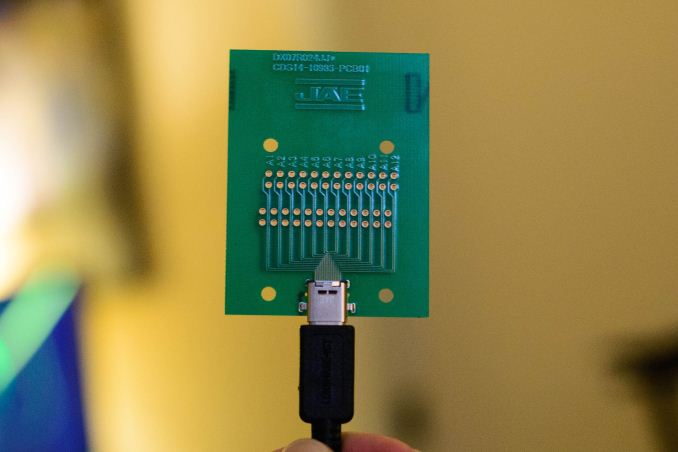
Hands On with USB Type C: Reversible USB Connectors


Read More ...
Corsair AX1500i Power Supply Review
For those that do will not settle for anything less than the best, Corsair has their gigantic AX1500i power supply. This is their new 1500W flagship behemoth, and it's also one of the first 80 Plus Titanium certified units worldwide. It has a massive list of features, including Corsair Link compatibility. However, could it possibly be worth the absurd $449.99 retail price? Read on to find out.
Read More ...
Apple Introduces iCloud Drive Lower Cost Storage
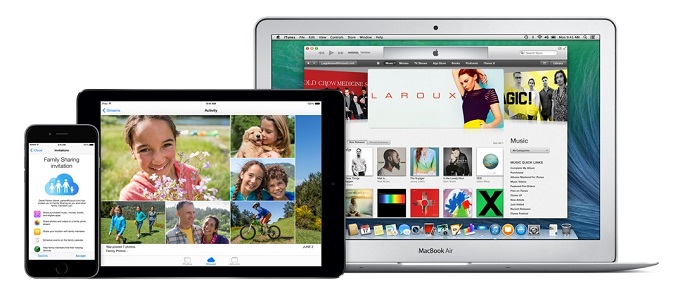
Apple has now announced the full pricing structure for iCloud Drive which is more competitive than before. Just a few months ago, Apple only offered up to 50 GB in iCloud, and charged $100 USD per year for it. Google Drive at the time offered 100 GB for only $24 USD per year, so clearly some price adjustments needed to be done.
Apple iCloud Comparison |
||||||
iCloud |
iCloud Drive |
|||||
Free Storage |
5 GB |
5 GB |
||||
Lowest Tier (USD/year) |
10 GB / $20 |
20 GB / $12 |
||||
Second Tier (USD/year) |
20 GB / $40 |
200 GB / $48 |
||||
Third Tier (USD/year) |
50 GB / $100 |
500 GB / $120 |
||||
Fourth Tier (USD/year) |
N/A |
1 TB / $240 |
||||
Lowest Cost/GB |
$2 / GB |
$0.24 / GB |
||||

It would seem Apple is hoping that users of its products will be willing to pay more for iCloud Drive to keep the experience all within the Apple ecosystem, and it might not be the wrong move. They have shown in the past that their customers are willing to spend more for the Apple products than competitors can accomplish, and Apple has traditionally not competed much on price so this may work out well for them, but it must be said, all of the consumer cloud offerings do support the Mac already, and several are available and popular on iOS as well, so it may be difficult to come to the game this late with a higher price than the competition.
Read More ...
Microsoft Updates OneDrive File Size And Features
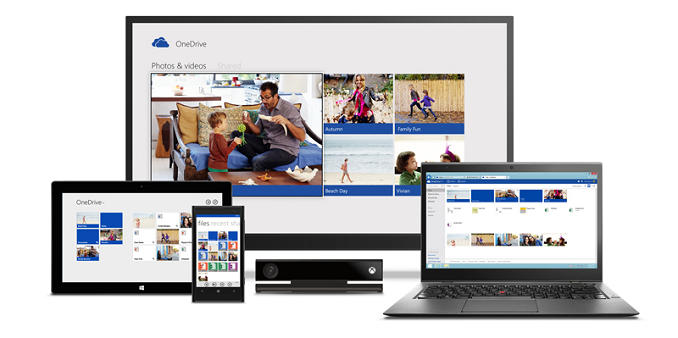
One of the limitations of OneDrive has been the maximum file size of 2 GB. That is being bumped up today to 10 GB per file. That will certainly help with most files bumping into the limit, but is certainly not class leading. Dropbox also has a 10 GB upload limit, but that is only on the web interface, with files uploaded via the desktop application or mobile apps have no file size limit. Google Drive has a 5 TB limit on an individual file. It is good to see OneDrive increase this limit, but it seems shortsighted to set it so low especially when they have upgraded all Office 365 plans (personal and business) to 1 TB of storage per user. This feature is available today for OneDrive, and will be coming soon for OneDrive for Business.
Consumer Cloud Offerings |
||||||
OneDrive |
Google Drive |
iCloud |
DropBox |
Box |
Amazon Cloud Drive |
|
Free Storage |
15 GB |
15 GB |
5 GB |
2 GB |
10 GB |
5 GB |
Paid Storage (USD/year) |
100 GB - $24 200 GB - $48 1 TB (Office 365 Personal) - $70 5 x 1 TB (Office 365 Home) - $100 |
100 GB - $24 1 TB - $120 10 TB - $1200 20 TB - $2400 30 TB - $3600 |
20 GB - $12 200 GB - $48 500 GB - $120 1 TB - $240 |
1 TB - $100 |
100 GB - $120 |
20 GB - $10 50 GB - $25 100 GB - $50 200 GB - $100 500 GB - $250 1 TB - $500 |
Versioning |
Office files (30 days) |
Yes (30 days) |
No |
Yes (30 days) Unlimited with PackRat addon |
No (Personal Tier) |
No |
File Restore |
Yes (30 days) |
Yes (30 days) |
No |
Yes (30 days) Unlimited with PackRat addon |
Yes (30 days) |
Yes |
Operating System Support |
Windows OS X Android iOS Windows Phone |
Windows OS X Chrome OS Android iOS |
Windows OS X iOS |
Windows OS X Linux Android iOS BlackBerry Kindle Fire |
Windows OS X Android iOS Windows Phone BlackBerry |
Windows OS X Android iOS Kindle Fire |
A missing feature that I have personally bumped into many times is the inability to share OneDrive files from within Windows Explorer. This is also changing beginning with Windows 7 and Windows 8 clients. Right clicking in the shell will now offer the ability to share a link, or give more options if you would rather share by account name. This feature is a part of the Modern version of OneDrive, so it is good to see it coming to the desktop as well, and continues the trend of de-emphasizing the Start Screen experience. Windows 7 and 8 clients have begun rollout of this new feature, and Windows 8.1 and Mac should be available soon.

Read More ...
T-Mobile Announces Uncarrier 7.0: Personal CellSpot, WiFi Unleashed

On the Personal CellSpot side, T-Mobile will give a free Asus 802.11ac WiFi router with 25 USD refundable deposit to Simple Choice customers starting on September 17th, which also acts as a femtocell and will provide signal to improve capacity and coverage of the network.
Overall, this seems to only extend the lead that T-Mobile already has with their extensive focus upon disrupting how mobile network operators do business in the US, and it'll be interesting to see what's in the Personal CellSpot.
Read More ...
Quick Look at Core M 5Y70 and Llama Mountain
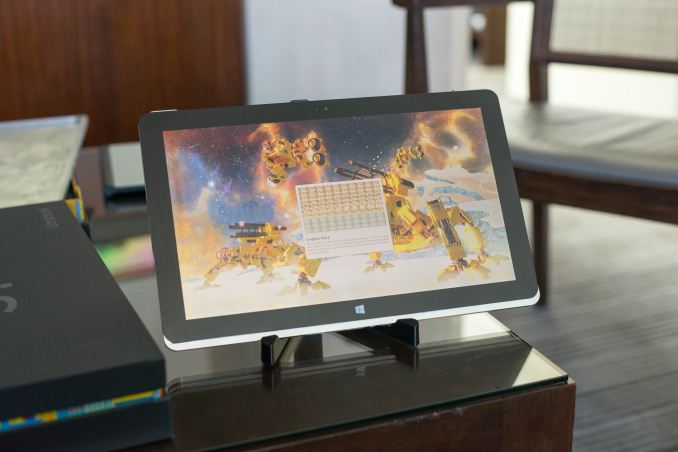
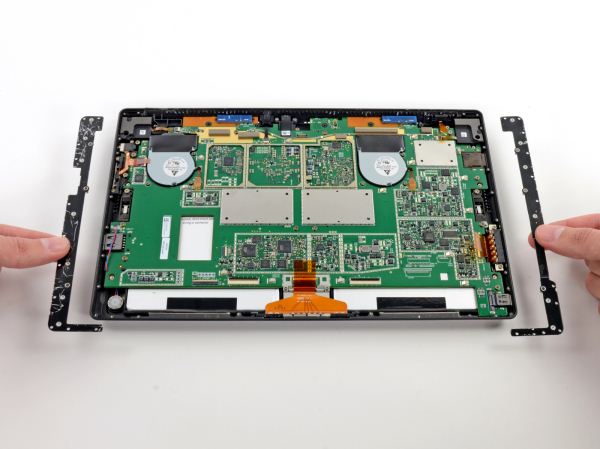
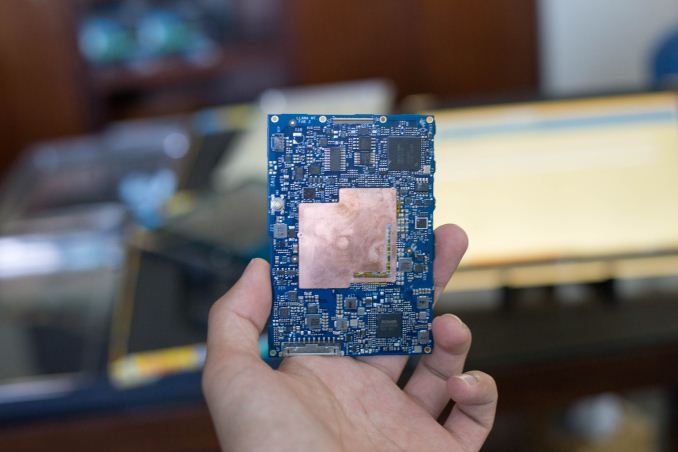


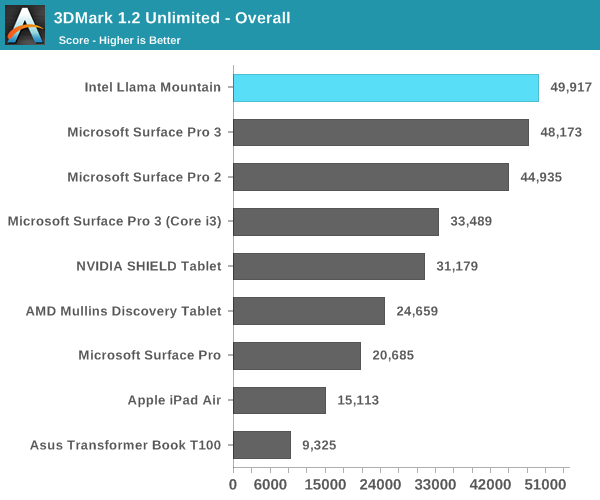
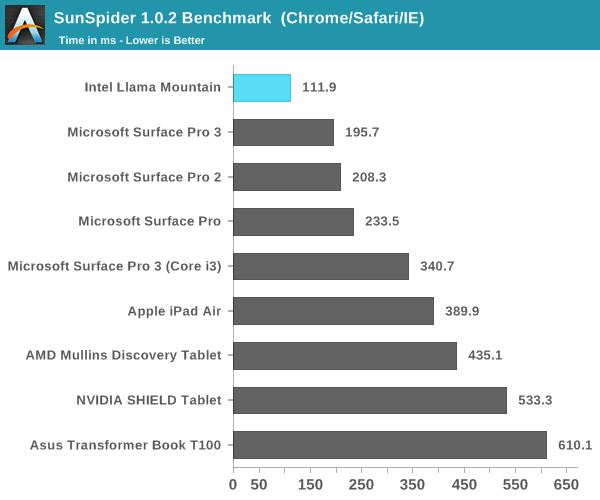
Read More ...
SwiftKey to be Available at iOS 8 Launch
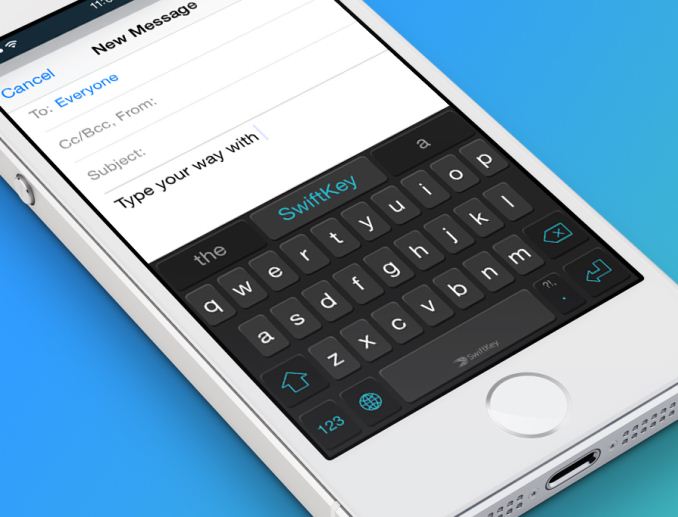


Read More ...
AMD Radeon R9 285 Review: Feat. Sapphire R9 285 Dual-X OC
Last month AMD held their 30 years of graphics celebration, during which they announced their next Radeon video card, the Radeon R9 285. Designed to be AMD’s new $249 midrange enthusiast card, the R9 285 would be launching on September 2nd. In the process the R9 285 would be a partial refresh of their R9 280 series lineup, supplying it with a new part that would serve to replace their nearly 3 year old Tahiti GPU.
The R9 285 is something of a lateral move for AMD, which is something we very rarely see in this industry. The R9 285’s immediate predecessor, the R9 280 (vanilla) has been on the market with an MSRP of $249 for nearly 4 months now. Meanwhile the R9 285 is not designed to be meaningfully faster than the R9 280 – in fact if you looked at the raw specifications, you’d rightfully guess it would be slower. Instead the R9 285 is intended to serve as a sort of second-generation feature update to R9 280, replacing it with a card at the same price with roughly the same performance level, but with 3 years’ worth of amassed feature updates and optimizations.
Read More ...
LaCie d2 Thunderbolt 2 DAS Review
Seagate's premium storage brand, LaCie, has been introducing a wide variety of Thunderbolt 2 products since late last year. Today, we are seeing the launch of a hybrid direct-attached storage (DAS) unit with both USB 3.0 and Thunderbolt 2 connections in the d2 Thunderbolt 2. The differentiating aspect is the availability of a full-speed PCIe SSD add-on which adds another storage module at the expense of the USB 3.0 port. We took the unit for a spin using our Windows-based Thunderbolt 2 setup. Read on to see how the unit performs.
Read More ...
Acer Announces Two Frameless Monitors: the UHD 27" S277HK and WQHD 25" H257HU

The S277HK is the first 4K monitor with a frameless design according to Acer. In addition to the 3840x2160 resolution for the IPS panel, the 27” model also has DTS surround sound though Acer does not go into specifics on how the audio is achieved. With an asymmetric stand and aluminum bezel, the S277HK certainly looks as premium as the specs would indicate. Connectivity is DVI, HDMI 2.0, and DisplayPort 1.2.
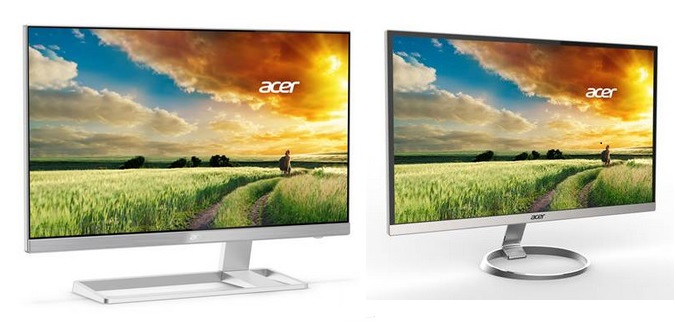 S277HK (left) and H257HU (right),
images courtesy of TechPowerUp
'Frameless' is a little bit of a misnomer, as typically all monitors will have some sort of edge bezel. In the smallest bezel monitors on sale, sub-6mm is quite common although specialist models exist that might go smaller. The H257HU, from the sole small image we have found access to, looks like it has a larger screen-distance, despite the 'frameless' moniker keeping the edge distance small.
The IPS panels on these devices also include features to assist with eye strain including a Flicker-less technology to reduce screen flicker, a blue light filter which Acer claims helps with long term eye damage, and a Low Dimming technology to allow the backlight to be set as low as 15% for low light environments. Both monitors also include “ComfyView” to assist with screen reflections.
Both models will be available starting in Q4 2014, with global availability. Neither refresh rates, color accuracy nor prices have not been announced at this time.
Source: Acer
Read More ...
Analyzing Apple’s A8 SoC: PowerVR GX6650 & More

To that end we have compiled a short analysis of the A8 SoC based on these documents and other sources. And we believe that at this point we have a solid idea of the configuration of Apple's latest SoC.
Apple SoC Specifications |
||||||
Apple A6 |
Apple A7 |
Apple A8 |
||||
CPU |
Swift @ 1.3GHz(x2) |
Cyclone @ 1.3GHz (x2) |
Enhanced Cyclone @ 1.4GHz (x2)? |
|||
GPU |
PVR SGX543MP3 |
PVR G6430 |
PVR GX6650 |
|||
RAM |
1GB LPDDR2 |
1GB LPDDR3 |
1GB LPDDR3? |
|||
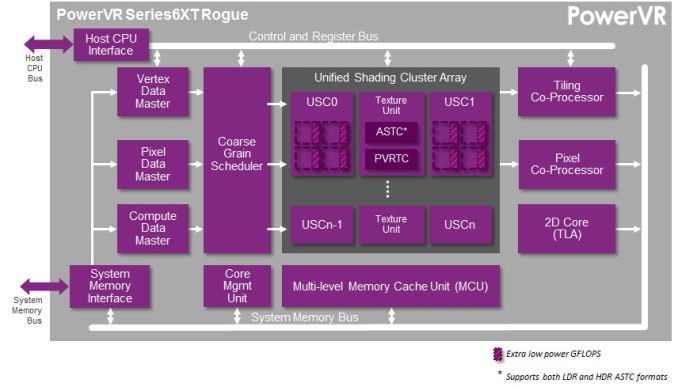
A8’s GPU: Imagination PowerVR Series6XT GX6650
On the GPU front this year appears to be especially bountiful. After being tipped to an update for Apple’s Metal Programming Guide, we can now infer with near certainty that we know what the A8 GPU is.New to this edition of the Metal Programming Guide is a so-called iOS_GPUFamily2, which joins the existing iOS_GPUFamily1. We already know that the iOS_GPUFamily1 is based around Imagination’s PowerVR Series 6 G6430 GPU, so the real question is what does iOS_GPUFamily2 do that requires a separate family? The answer as it turns out is ASTC, the next generation texture compression format is being adopted by GPU vendors over the next year or so.

This leaves the question of which of Imagination’s 4 Series6XT Apple is using. Imagination offers a pair of 2 core designs, a 4 core design (GX6450), and a 6 core design (GX6650). Considering that Apple was already using a 4 core design in A7, we can safely rule out the 2 core designs. That leaves us with GX6450 and GX6650, and to further select between those options we turn to Apple’s A8 performance estimates.
Apple SoC Evolution |
|||||
CPU Perf |
GPU Perf |
Die Size |
Transistors |
Process |
|
A5 |
~13x |
~20x |
122m2 |
<1B |
45nm |
A6 |
~26x |
~34x |
97mm2 |
<1B |
32nm |
A7 |
40x |
56x |
102mm2 |
>1B |
28nm |
A8 |
50x |
84x |
89mm2 |
~2B |
20nm |
A8’s CPU: A Tweaked Cyclone?
Though we typically avoid rumors and leaks due to their high unreliability, after today’s presentation by Apple we have just enough information on A8’s CPU performance to go through the leak pile and start picking at leak. From that pile there is one leak in particular that catches our eye due to the fact that it matches Apple’s own statements.On Monday night a supposed Geekbench 3 score of the iPhone 6 was posted. In this leak the iPhone 6 was listed as having a single-core score of 1633 points and a multi-core score of 2920 points. Curiously, these values are almost exactly 25% greater than the Geekbench 3 scores for the iPhone 5S (A7), which are 1305 points and 2347 points respectively.


In which case we can infer a couple of points about the A8’s CPU, starting with the clockspeed. Given no other reason to doubt this data at the moment and given Apple’s preference for low clocked SoCs, the 1.4GHz reading appears legitimate. In which case this would be a 100MHz increase over the 1.3GHz A7 found in the iPhone 5S.
However the fact that it’s a 100MHz increase also means that clockspeeds alone cannot account for the full 25% performance gain that Apple is promoting and that these Geekbench results are reporting, as 1.4GHz is only a roughly 8% clockspeed increase over 1.3GHz. This in turn means that there must be more going on under the hood to improve the A8’s CPU performance other than clockspeed alone, which rules out a straight-up reuse of Apple’s Cyclone CPU.
Since Apple already had a solid ARMv8 architecture with Cyclone, there’s no reason to believe that they have thrown out Cyclone so soon. However this does strongly suggest that Apple has made some unknown revisions to Cyclone to further boost its single-threaded (Instruction Level Parallelism) performance. What those tweaks are remain to be seen as we would need to be able to benchmark the A8 in depth to even try to determine what Apple has changed, but for the moment it looks like we’re looking at an enhanced or otherwise significantly optimized version of Cyclone. And given Apple’s already high ILP, squeezing out another 16% or so would be a significant accomplishment at this time, especially for only a year’s turnaround.
1GB of RAM
Last but not least, the apparent validity of the Geekbench 3 leak means that one last piece of information on the A8 can apparently be confirmed: the earlier rumors about it being paired with 1GB of RAM are true. Unfortunately Apple’s official product image of the A8 is of no help here – it’s clearly a doctored version of the A7 image based on the product numbers attached – but this information is consistentwith earlier rumors based on leaked images of the real A8, which had also suggested the SoC contained 1GB of RAM. Again this is based on what we believe is a sound assumption that the Geekbench 3 leak is accurate since it so closely matches Apple’s own CPU performance estimates, but at this point we don’t have any substantial reason to doubt the data.The good news is that this is going to be the easiest aspect of the iPhone 6 to confirm, since diagnostic apps will be able to query the phone for the RAM amount. So one way or another we should know for sure come September 19th.

Read More ...
NPD: PC Gamers Tend to Earn More Than Console Gamers
We're sensing a pattern here
Read More ...
Black Celebration: J.J. Abrams and Disney Take X-Wing to the Dark Side
Mysterious new black-painted X-Wing pops up on the film set in the UK, Millenium Falcon also seen
Read More ...
Despite Massive Failure of Apple Store Website, "Record Number" of iPhone 6 Pre-orders Received
The website glitches didn't stop Apple from breaking new sales records for its larger iPhones
Read More ...
Quick Note: Motorola Set to Release Unlocked, “Pure Edition” of Second Gen Moto X
The bloat stops here!
Read More ...
Grand Theft Auto V for Xbox One, PS4 Launches Nov 18; PC Version Lands Jan 27
PC gamers will have to wait until next year for GTAV
Read More ...
Windows 9's Latest Metro Start Menu Leaks, German Site Accidentally Outs Leaker
The Swiss Style still dominates Modern UI's creep onto the desktop, but new UI promises return to Windows' basics
Read More ...
Quick Note: Kia Soul EV Priced from $33,700
Kia's Soul EV won't match the "bargain" pricing of the Nissan Leaf
Read More ...
T-Mobile Launches Un-carrier 7.0, Beefs Up Wi-Fi Calling
T-Mobile will give out "free" Wireless routers to customers
Read More ...
Russian Hackers Compile List of 10+ Million Stolen Gmail, Yandex, Mailru
Passwords were first posted to Russian Bitcoin forum, many appear to be defunct/invalid
Read More ...
Dell Announces "World's Thinnest" Tablet: The Venue 8 7000 Series
Dell Venue 8 7000 Series is just 6mm thick
Read More ...
HTC Preps Nexus 9 With Nvidia K1 64-Bit "Denver" SoC, Android L Onboard
HTC's recovery should get a boost from prestigious contract; NVIDIA scores a much-needed win over Qualcomm
Read More ...
And Dr. Dre Says: Nothing Because Philips Beat Beats to Lightning Headphones
New headphones take advantage of new high-speed connector to deliver rich audio
Read More ...
With Plethora of Product at IFA Microsoft is a Hot Smartphone Challenger
Third party support is pouring in for Windows Phone, as Android OEMs get curioous
Read More ...
Quick Note: Microsoft to Ditch Windows Phone, Nokia Branding
Microsoft is not ditching the mobile operating system, just the name
Read More ...
Quick Note: Qualcomm to Replace Snapdragon 200 with LTE-Capable Snapdragon 210
Even low-cost smartphones will be granted LTE status
Read More ...
Apple Watch Battery Life: To Be Determined
.Apple is keeping quiet on battery life details for the Apple Watch
Read More ...
Available Tags:Thunderbolt , USB , USB , Apple , Microsoft , iOS , AMD , Radeon , Sapphire , Acer , Gamers , Gamers , iPhone 6 , iPhone , Motorola , Xbox , PS4 , Windows , Kia , Dell , HTC , Nvidia , Android , Philips , Smartphone , Windows Phone , Nokia ,


No comments:
Post a Comment