

Microsoft Revamps OneDrive Storage Tiers
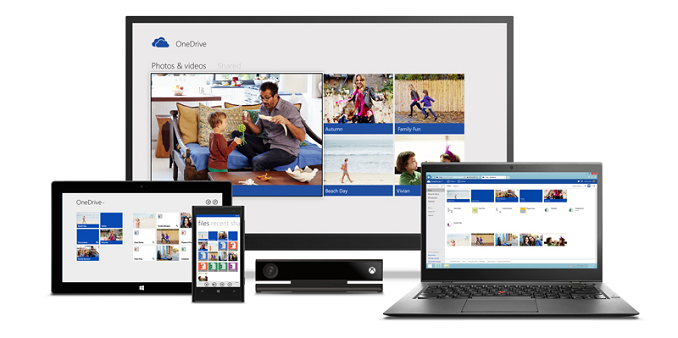
Times have changed though, and responding to the recent free storage increases and paid storage price drops implemented by Google, Microsoft has now increased the free storage pool to 15 GB. According to Microsoft’s internal data, 75% of users have less than 15 GB in their OneDrive at the moment, with the remainder likely being on some sort of paid tier. This is certainly a bonus to anyone who is using OneDrive or thinking of using it, but the big news comes attached to a subscription service.
On April 28th, OneDrive for Business announced a file storage increased from 25 GB per user to 1 TB per user coming in the next couple of months, and now that same 1 TB per user is coming to all subscribers of Office 365. Office 365 Home, Personal, and University subscriptions will all include the 1 TB of storage starting in July. Let’s go over what each tier gives you and their pricing:
Office 365 Consumer Versions |
||||||
University |
Personal |
Home |
||||
Number of Users |
1 |
1 |
5 |
|||
Number of Devices |
2 PCs, Macs, or Tablets |
1 PC or Mac, and 1 Tablet |
5 PCs or Macs, and 5 Tablets |
|||
Included Applications |
Word, Excel, PowerPoint, OneNote, Outlook, Publisher, Access |
|||||
Skype Minutes |
60 Skype world minutes per month |
|||||
OneDrive Storage |
1 TB |
1 TB x 5 Users (5 TB total) |
||||
Pricing |
$79.99/4 years |
$6.99/month $69.99/year |
$9.99/month $99.99/year |
|||
But what if you don’t need Office? OneDrive has also had its price slashed for just storage tiers by 70% to be competitive with Google Drive:
Consumer Cloud Offerings |
||||||
OneDrive |
Google Drive |
iCloud |
DropBox |
Box |
Amazon Cloud Drive |
|
Free Storage |
15 GB |
15 GB |
5 GB |
2 GB |
10 GB |
5 GB |
Paid Storage (USD/year) |
100 GB - $24 200 GB - $48 1 TB - $70 (With Office 365 Personal) 5 TB - $100 (5 x 1 TB w/Office 365 Home) |
100 GB - $24 1 TB - $120 10 TB - $1200 20 TB - $2400 30 TB - $3600 |
20 GB - $12 200 GB - $50 Tiers up to 1 TB not priced yet |
100 GB - $99 200 GB - $199 500 GB - $499 |
100 GB - $120 |
20 GB - $10 50 GB - $25 100 GB - $50 200 GB - $100 500 GB - $250 1 TB - $500 |
Versioning |
Office files (30 days) |
Yes (30 days) |
No |
Yes (30 days) Unlimited with PackRat addon |
No (Personal Tier) |
No |
File Restore |
Yes (30 days) |
Yes (30 days) |
No |
Yes (30 days) Unlimited with PackRat addon |
Yes (30 days) |
Yes |
Operating System Support |
Windows OS X Android iOS Windows Phone |
Windows OS X Chrome OS Android iOS |
Windows OS X iOS |
Windows OS X Linux Android iOS BlackBerry Kindle Fire |
Windows OS X Android iOS Windows Phone BlackBerry |
Windows OS X Android iOS Kindle Fire |
Read More ...
Sprint and Samsung Unveil the Galaxy S5 Sport
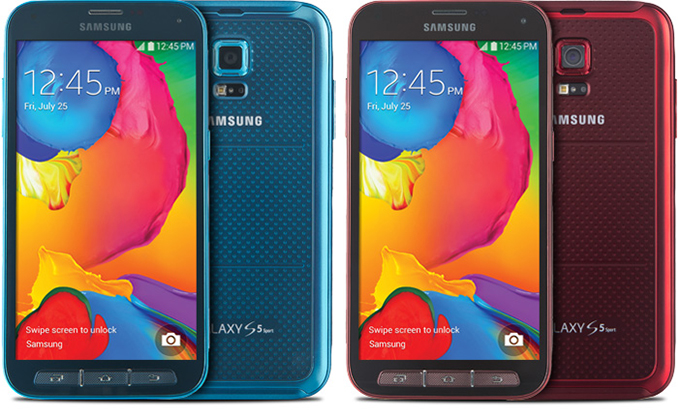
In terms of specifications the new Galaxy S5 Sport is essentially identical to the Galaxy S5. It sports the same 5.1" 1920x1080 Super AMOLED display and a 2.5GHz quad core Krait 400 based Snapdragon 801 CPU paired with an Adreno 330 GPU and 2GB of LPDDR3 RAM. On the back there's Samsung's 16MP sensor with ISOCELL technology to reduce crosstalk between pixels, along with the LED flash and the heart rate monitor. The front of the device has the same 2MP camera, but you'll notice that Samsung has replaced the capacitive navigation buttons with physical keys which will function more reliably with fingers that are wet or sweaty from exercise. At 144mm x 74mm x 8.9mm in size with a mass of 158g it is also slightly larger and heavier than the normal Galaxy S5. Like all Galaxy S5 variants, the Galaxy S5 Sport has IP67 certification for dust and water resistance.
Connectivity is similar to the Galaxy S5 with support for 2x2 802.11ac, Bluetooth 4.0, USB3.0, GPS/GNSS, MHL, DLNA, and NFC. Being a Sprint device, the Galaxy S5 Sport has support for Sprint's EV-DO network as well as LTE with Sprint advertising the device as supporting their Sprint Spark tri-band LTE network on bands 25, 26, and 41.
The big difference from the original Galaxy S5 is in the software. The Galaxy S5 Sport still comes with Android 4.4.2 and Samsung's Touchwiz UI but Sprint is including some preloaded software to appeal to those who are interested in keeping fit. The device is acting as the launch vehicle for a new service Sprint is creating called Sprint Fit Live which they are billing as a complete mobile health and fitness package. Below are some of the features included in this service for those purchasing the Galaxy S5 Sport.
Track, monitor, and share workout activity with 12 months of free MapMyFitness MVP, which includes premium content such as customized audio coaching, training plans, live tracking and more. MapMyFitness is a wholly-owned subsidiary of Under Armour, a leading performance and innovation brand.
Access Spotify Workout playlists with free Spotify premium for six months for customers who are on Sprint Framily plans or three months for other Sprint customers.
Live the Healthy Lifestyle by receiving updated smart, contextual health and fitness content.
Customize the look and feel of fitness tracking, education, music and healthy living content displayed on the wallpaper or full screen experience.
The Samsung Galaxy S5 Sport will be available on Sprint in Electric Blue and Cherry Red on July 25. The phone will be available for $0 with 24 monthly payments of $27.09.
Source: Sprint, Sprint
Read More ...
Google I/O: Qualcomm Celebrates Launch of Adreno 420 GPU for Android Gaming

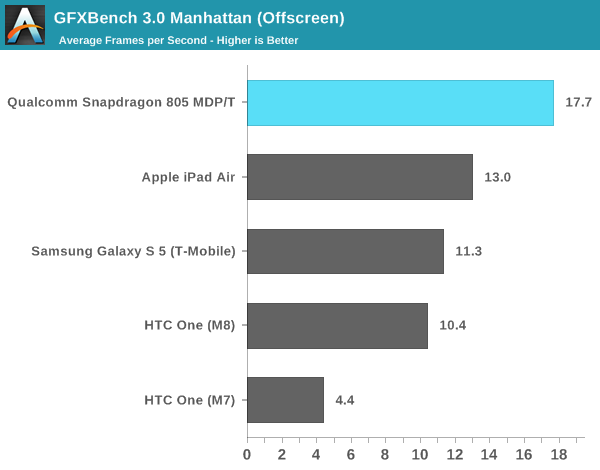
Adreno 420 is the first member of Qualcomm’s next-generation SoC GPU family to make it out the door and in to a finished product, bringing with it OpenGL ES 3.1 and Direct3D 11 functionality. First announced last year as part of the Snapdragon 805 SoC, Snapdragon 805 and by extension Adreno 420 is now shipping in Samsung’s just-announced Galaxy S5 Broadband LTE-A. The S5B marks the first Adreno 420 product to reach consumer hands, and for as much as an SoC can have a formal launch this would be it, with Qualcomm celebrating its launch coinciding with this year’s Google I/O conference.

As we have already covered Adreno 420 in some depth last month we won’t spend too much time going over it now, though admittedly this is also partially due to the fact that Qualcomm is remaining tight lipped about the Adreno 400 architecture beyond a high-level feature standpoint. In brief the Adreno 400 architecture (and Adreno 420) is a full Direct3D FL 11_2 implementation, utilizing a unified shader architecture along with the appropriate feature additions. New to the Adreno 400 architecture is support for tessellation, including the necessary hull and domain shader stages, and as a Direct3D 11 product this would also include with it other Direct3D 11 features such as compute shaders and draw indirect support.

For Google I/O we are expecting Qualcomm to be heavily promoting the Android gaming possibilities of the Adreno 420 and the Snapdragon 805. The low power nature of mobile devices and the SoCs that power them means that while Qualcomm can’t match the performance of the larger desktop GPUs, Adreno 420 will be a big step up from the performance offered by the older Adreno 330 GPU. But more importantly for Qualcomm, they can do something that hasn’t been done before by bringing desktop-level features to Android devices.
In a sense this will be a repeat of the launch of Direct3D 11 on the desktop, except now with Qualcomm (and eventually other vendors) promoting the advanced features offered by these devices, throwing out examples and tools at developers to entice them to write games for this latest generation of hardware, and to otherwise put it to good use. Even without being able to match desktop processors, there are a number of effects that are made available (or at least more practical) via these new features, and can be used effective on mobile hardware. From a practical perspective Qualcomm should be able to offer Android developers the base graphics functionality of the current generation consoles at performance levels similar to the previous generation consoles.
Read More ...
AMD Announces FirePro W8100
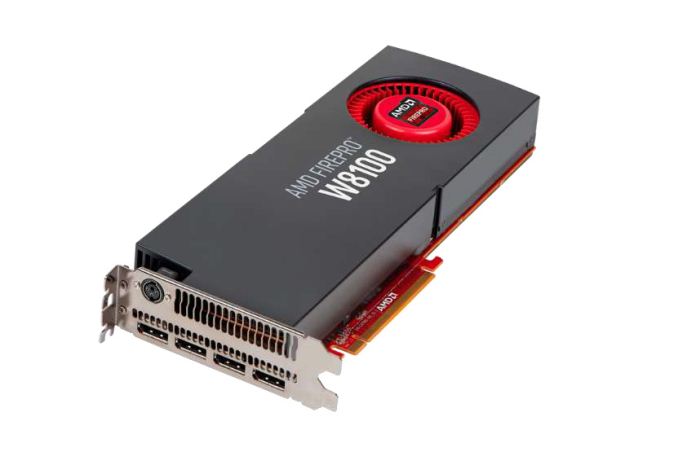
Like the W9100 earlier this year, the W8100 is designed to be a follow-up to AMD’s existing Tahiti based FirePro products, in this case the FirePro W8000. Based on a pared down version of AMD’s Hawaii GPU – making this the obligatory second-tier part – the W8100 is intended to refresh AMD’s professional lineup by improving performance while also improving AMD’s feature set through the power and capabilities of the company’s Hawaii GPU.
AMD FirePro W Series Specification Comparison |
||||||
AMD FirePro W9100 |
AMD FirePro W8100 |
AMD FirePro W9000 |
AMD FirePro W8000 |
|||
Stream Processors |
2816 |
2560 |
2048 |
1792 |
||
Texture Units |
176 |
160 |
128 |
112 |
||
ROPs |
64 |
64 |
32 |
32 |
||
Core Clock |
930MHz |
824MHz |
975MHz |
900MHz |
||
Memory Clock |
5GHz GDDR5 |
5GHz GDDR5 |
5.5GHz GDDR5 |
5.5GHz GDDR5 |
||
Memory Bus Width |
512-bit |
512-bit |
384-bit |
256-bit |
||
VRAM |
16GB |
8GB |
6GB |
4GB |
||
Double Precision |
1/2 |
1/2 |
1/4 |
1/4 |
||
Transistor Count |
6.2B |
6.2B |
4.31B |
4.31B |
||
TDP |
275W |
220W |
274W |
189W |
||
Manufacturing Process |
TSMC 28nm |
TSMC 28nm |
TSMC 28nm |
TSMC 28nm |
||
Architecture |
GCN 1.1 |
GCN 1.1 |
GCN 1.0 |
GCN 1.0 |
||
Warranty |
3-Year |
3-Year |
3-Year |
3-Year |
||
Launch Price (List) |
$3999 |
$2499 |
$3999 |
$1599 |
||
Clockspeeds are down from the W9100, dropping from 930MHz to 824MHz. Between the clockspeed reduction and the reduction in stream processors, this puts theoretical compute performance at 4.2 TFLOPS single precision or 2.1 TFLOPS double precision, with W8100 retaining Hawaii’s native ½ rate double precision execution speed. These reductions have also brought power usage down from W9100’s 275W to just 220W, allowing W8100 to be used in more constrained workstations that can only handle a 225W (6pin + 6pin) video card. Ultimately compared to the older W8000, the W8100 ends up consuming around 31W more power, but it also significantly improves over W8000’s performance, especially in memory bandwidth constrained scenarios and in double precision operations (where theoretical performance has more than doubled).

As with the W9100, AMD is strongly targeting the mixed graphics/compute workload market with the W8100, banking on the Hawaii GPU’s ability to efficiently handle both tasks. This includes a strong emphasis on CAD and CAE, along with GPU compute-accelerated media creation and processing. To that end the W8100 will also be a part of AMD’s Ultra Workstation initiative, allowing either W8100s or W9100s to be used in Ultra Workstation branded machines.

Finally, given their intention to directly compete with the K5000 AMD will be pricing W8100 similarly, which would put the list price at $2499 and retail prices at around $2000. AMD tells us that W8100 cards are already shipping to channel partners now, and should be available in the channel in the middle of July.
Read More ...
Microsoft Surface Pro 3 Review
I can't believe it's only been sixteen months since I published our review of the original Microsoft Surface Pro. It feels like longer but that's likely because Surface RT made its sale debut a few months prior to that, and both devices were announced in the Summer of 2012. As far as an end user is concerned however, in February 2013 Microsoft released Surface Pro and proceeded to deliver two more iterations of the hardware in sixteen months. That's three Surface Pros in less than two years. Read on for our review of Surface Pro 3.
Read More ...
ISC 2014: NVIDIA Tesla Cards Add ARM64 Host Compatibility

NVIDIA will be taking to the ISC show floor to announce that their Tesla products will be adding ARM64 host compatibility, enabling them to be used in ARM64 systems. NVIDIA has been a supporter of the ARM ecosystem for some time through the use ARM cores in their Tegra SoCs and by enabling CUDA on ARM processors. Adding 64bit ARMv8 (ARM64) support then is a logical extension of this by bringing their hardware and toolkit forward to the new generation of 64bit ARM processors.
However while NVIDIA’s previous ARM works have been focused on consumer uses, today’s Tesla ARM64 announcement is focused on the professional computing side and hence the use of ISC as a backdrop for this announcement. With today’s announcement NVIDIA is expanding their Tesla and HPC efforts into the ARM ecosystem, intending to bootstrap and support the growing use of ARM CPUs as the core processors in HPC setups. ARM CPUs have already made some headway into the micro server space for tasks that require many low performance threads, however it’s not until ARMv8 that ARM processors have gained the ability to address enough memory and have gained enough in performance to be useful in HPC applications. With the increased capabilities of ARM64 processors, HPC system builders can now design systems around ARM, with NVIDIA taking up their now well-defined position as a GPU supplier to provide their highly parallel processors to complete these systems.

To that end, along with today’s announcement of ARM64 compatibility NVIDIA is also announcing the first Tesla ARM64 development platforms. In July, Cirrascale will be shipping their RM1905D 1U development platform, which contains a pair of Applied Micro X-Gene CPUs along with a pair of Tesla K20 accelerator cards. Meanwhile E4 will be shipping their EK003 system, a 3U system with two X-Gene CPUs and two Tesla K20s.
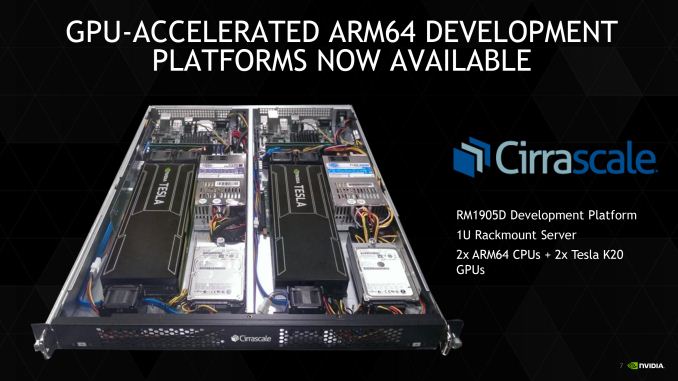
Finally, being released in conjunction with these platforms will be the CUDA 6.5 toolkit, which will be introducing ARM64 support on the CUDA side. NVIDIA has not announced a release date for CUDA 6.5, and at this point it’s safe to assume it’s a development release alongside these ARM64 development platforms.
Read More ...
QNAP TS-x51 NAS Series: Intel Quick Sync Gets its Killer App
At Computex 2014, we visited QNAP and came away with a lot of information (some of which had already been demonstrated at CES). After Computex, QNAP got in touch with me to better explain the various features of the newly introduced TS-x51 series (which was not at CES). And, boy, was I floored?! Usually, you don't see me getting very excited over a product announcement. However, I believe that QNAP's TS-x51 family has the capability to revolutionize the NAS market for home users and media enthusiasts, particularly in the way it utilizes Intel Quick Sync technology. Read on to for our analysis of where that market segment is headed, and why the TS-x51's unique feature set may be the start of interesting things to come.
Read More ...
Sprint Follows T-Mobile's Lead, Offers 30-day Test Drive of Its Network
Sprint offers a 30-day free trial of its network
Read More ...
Chicago Installs Big Data Sensors to Watch Citizens, Promises Privacy
Will the city's new sensors be harmless or Big Brother tools? Depends on who you ask...
Read More ...
Microsoft Offers Up to $650 Store Credit to Trade in a MacBook Air for Surface 3
Microsoft really wants folks to trade in their MacBook Airs
Read More ...
NASA Targets Asteroid "2011 MD" for Capture, Exploration
The space agency will decide by the end of the year if this is the chosen asteroid
Read More ...
Isle of Jersey Eyes Bitcoin, But Will it be Perverted for Tax Evasion?
Tiny UK island wants to take advantage of increasingly popular cryptocurrency
Read More ...
Report: Kobe Bryant, Other Famous Athletes Lined Up for iWatch Fitness Testing
Pro athletes have recently been spotted at Apple's Cupertino campus
Read More ...
Microsoft Boosts Free OneDrive Storage to 15GB, Office 365 Users to Get 1TB
Microsoft gets incredibly generous with its cloud storage options
Read More ...
Google, Nest Labs Acquire Dropcam for $555M
The "all seeing" Google picks up another set of eyes
Read More ...
Unmanned Aerial Vehicles Banned from All U.S. National Parks
The National Park Service, however, can still use UAVs if it wishes
Read More ...
Report: Google’s Latest Nexus Tablet to Receive 8.9” Display, NVIDIA Tegra K1 Power
The Nexus 9 is being manufacturers by HTC and features an aluminum body
Read More ...
Available Tags:Microsoft , Samsung , Galaxy , Google , GPU , Android , Gaming , AMD , FirePro , NVIDIA , Intel , MacBook , NASA , Other , Tablet ,


No comments:
Post a Comment