

Z97 Motherboards Listed: Now in USA, Taiwan, and EU
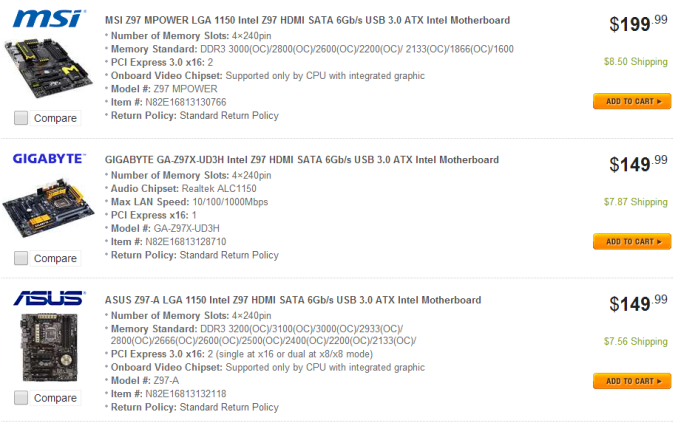
Currently at Newegg, we have the following available:
USD $260: MSI Z97 MPower Max AC
USD $250: ASUS Sabertooth Z97
USD $200: MSI MPower
USD $190: MSI Z97-Gaming 7
USD $160: MSI Z97-Gaming 5
USD $150: GIGABYTE Z97X-UD3H
USD $150: ASUS Z97-A
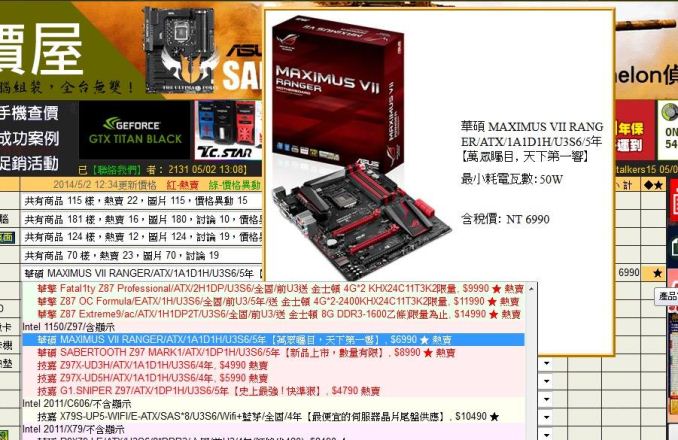
NTD $8990 (~ USD $300): ASUS Sabertooth Z97 Mark1
NTD $6990 (~ USD $231): ASUS Maximus VII Ranger
NTD $5990 (~ USD $198): GIGABYTE Z97X-UD5H
NTD $4990 (~ USD $165): GIGABYTE Z97X-UD3H
NTD $4790 (~ USD $160): GIGABYTE G1.Sniper Z97
£350.23: Gigabyte Z97-Gaming G1 Wifi BK
£265.09: Gigabyte Z97-Gaming G1
£228.19: Gigabyte Z97-Gaming GT
£201.25: Gigabyte Z97X-UD7-TH
£175.42: Gigabyte Z97X-UD5H-BK
£157.99: Gigabyte Z97X-SOC
£149.28: Gigabyte Z97X-UD5H
£140.05: Gigabyte Z97X-UD3H-BK
£139.96: Gigabyte Z97X-Gaming 7
£127.73: Gigabyte G1.Sniper Z97
£122.44: Gigabyte Z97N-Gaming 5
£119.03: Gigabyte Z97X-Gaming 5
£118.91: Gigabyte Z97MX-Gaming 5
£113.64: Gigabyte Z97X-UD3H
£110.11: Gigabyte Z97X-Gaming 3
£105.92: Gigabyte Z97X-SLI
£104.81: Gigabyte Z97N-WIFI
£96.01: Gigabyte Z97-D3H
£83.68: Gigabyte Z97M-D3H
£74.87: Gigabyte Z97M-DS3H
£70.31: Gigabyte Z97P-D3
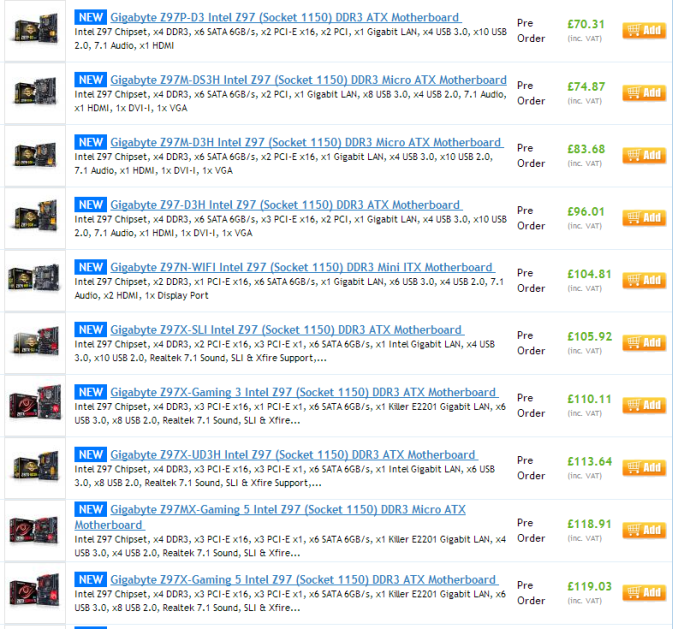
It would be interesting to see if the retailers will actually ship today if you ordered. Those specifically with ‘pre-order’ mentioned might wait until the launch date, but some seem to be freely listing ‘in-stock’. I have a feeling that other retailers in each of these regions might start listing their stock in response.
Source: hwbot.org
Additional: It would seem that motherboard manufacturers are also starting to list all their specifications on their websites. Users can see the whole range for ASUS today, and no doubt GIGABYTE, ASRock and MSI will follow suit.
Read More ...
AMD Mantle Developer Private Beta Begins

At this point AMD tells us that they have 40 developers pre-registered – AMD has been taking registrations for the past six months since the summit – and that they’re still taking additional developers. The beta, though much wider than the earlier alpha, is still a private beta, so developers still need to register with AMD for access. AMD tells us that “There are no objective criteria for being selected, as we are interested in talking to developers of all shapes and sizes. Past development experience is encouraged, however.”
Meanwhile AMD’s Mantle developer portal is up and running. Instructions for joining the developer beta can be found on the page, however all further access is password restricted.
Read More ...
Steelseries Sensei Wireless Gaming Mouse Review
SteelSeries is a manufacturer of gaming-related peripherals and hardware with a very large selection of products. Today, we have their most advanced (and expensive) mouse, the Sensei Wireless. Can a $160 mouse possibly offer enough to justify that price? Read on for our review.
Read More ...
A quick look at Google’s new Google Docs and Sheets mobile apps
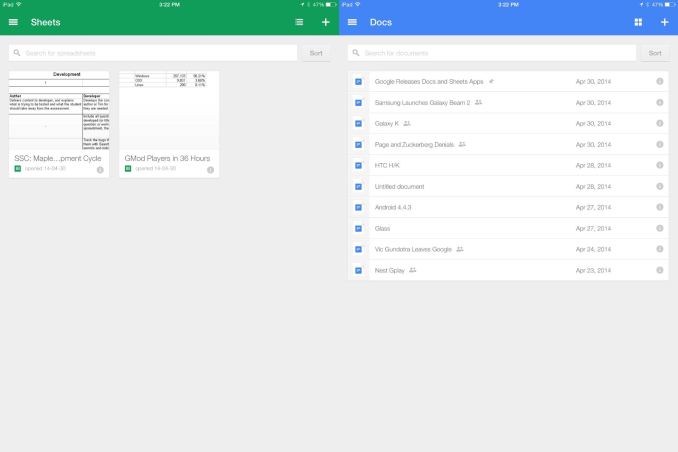
Today
Google released two new applications on Google Play and the iOS App
Store. The new apps are called Google Sheets and Google Docs and they
are essentially standalone versions of the editing tools built into the
Google Drive application.
Immediately
it can be seen that they greatly resemble the Google Drive app but each
with their own color theme. Docs is blue, Sheets is green, and Slides
will be yellow when it launches in the future. The apps have the ability
to view documents in a grid with previews or as a list of names. Google
has stated that the Google Drive app will eventually notify users to
download these separate applications when they edit documents on their
mobile devices. While users may be upset at Google’s decision to break
what could be accomplished in a single app into separate apps, there
will be benefits to this decision down the road.
For
instance, when Google wants to add functionality that is specific to a
certain document type they can add it to the application designed for
editing those documents. The separate apps also recognize which
documents in your Google Drive storage they are meant for editing which
adds a layer of automated organization. Google is really just moving
toward what every office suite does which is having separate
applications for different tasks which share common functionality and
design but have specific features tailored for the documents they work
with.
After spending some time with
the apps I’m happily surprised by their performance. There wasn’t a
stutter to be found even when opening large spreadsheets. In the past I
have felt that on iOS Google’s applications have had areas of middling
performance but it is clear that those days are long past. In fact, had
the apps launched two weeks ago before Apple’s iWork 2.2 update I would
have stated that they were substantially smoother than Apple’s own apps
on their own platform. The applications are equally as performant on any
modern Android device. Even on an aging Galaxy Nexus running Android
4.3 they’re a joy to use.
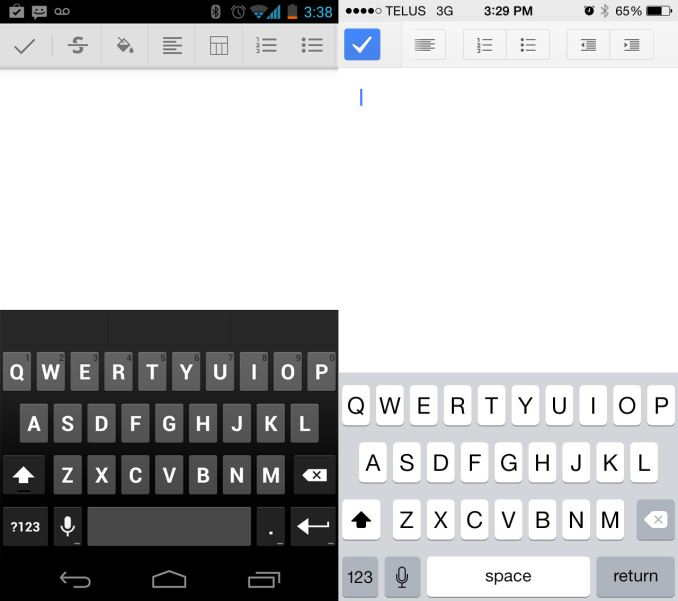
The iOS app is missing some features of the Android version
The
biggest improvement I hope to see in both the applications is the
ability to insert pictures into documents from the photos application.
Improvements I hope to see in the iOS apps mainly relate to feature
parity with their Android counterparts. Many of the text formatting
options like strikethrough and font color are not available on iOS. The
iOS app is also unable to create and edit charts like the Android app;
you are only able to view them in the preview mode.
In
addition to the new mobile apps, after returning home I noticed that
the Google Drive for Desktop tool had placed icons on my desktop for
Sheets, Docs, and Slides. Putting aside my feeling of discontent about
icons being placed without asking, this shows that the push for separate
branding of Google’s document editing tools is going to go beyond
Google’s apps in the mobile space. It’s exciting to see a market that
was once heavily dominated by a single office suite evolve with free and
functional tools from companies like Google. Along with future updates
to these new apps it will be interesting to see what this move means for
Google’s other office suite, Quickoffice.
Read More ...
Logic Supply Core-ML320 Fanless Industrial NUC Review
Computers with completely passive cooling systems are advantageous in many respects. These aspects turn out to be very important for many industrial applications. The low power nature of the popular Intel NUC platforms make them perfect candidates for passive industrial PCs. We have reviewed an Atom-based passive industrial PCs from Logic Supply before. Today, we present results from the evaluation of their fanless version of the Haswell i5-based NUC.
Read More ...
Best Video Cards: April 2014

Compared to the February/March time period and the flurry of activity coinciding with the launch of NVIDIA’s Maxwell architecture, April has been a much quieter month. We have still seen some big events this month, but for the most part the makeup of the video card market for April looks very similar to March.
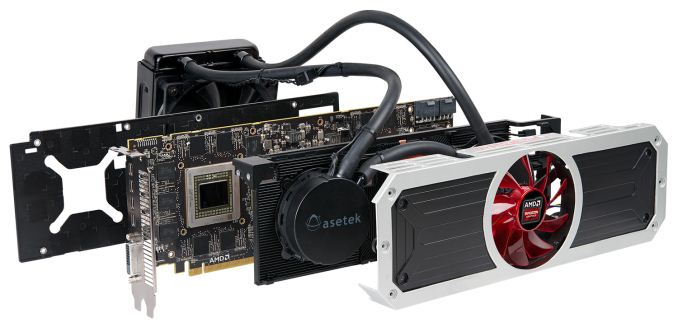
The big product launch for April was of course AMD’s new flagship dual GPU card, the Radeon R9 295X2. Packing a pair of Hawaii GPUs, AMD went above and beyond the norm for their latest dual GPU card. By utilizing a closed loop liquid cooler – a novel enhancement to video card cooling – AMD was able to use their powerful (and power hungry) Hawaii GPUs without any compromises, shipping the card at a blistering 1019MHz with both GPUs fully enabled. From a performance perspective the R9 295X2 is for all intents and purposes equivalent to a set of R9 290X Ubers in CrossFire, but taking up less space and more importantly achieving that level of performance with greatly reduced noise levels. However R9 295X2 is also a hungry card, and will set back buyers $1500 and 500W in load power consumption, so it goes without saying that it’s decidedly in the luxury category and will only be affordable to a small number of buyers.
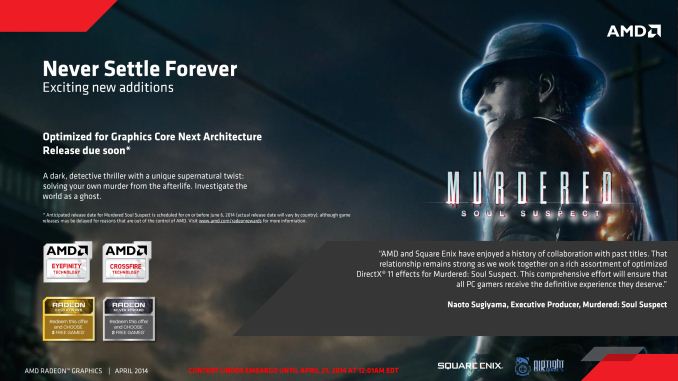
NVIDIA did however update their desktop GeForce video game bundle this week; in fact over the last two weeks both NVIDIA and AMD refreshed their bundles ahead of the next couple of months. For the GTX 660/760 and higher NVIDIA has replaced their Daylight bundle with Ubisoft’s forthcoming open world techno thriller Watch Dogs, which is scheduled to launch at the end of May. Meanwhile AMD instituted a massive overhaul of their Never Settle Forever program, which had otherwise been winding down this year. Never Settle Forever now covers virtually all of AMD’s Radeon 200 cards, and while most of the games in the collection are essentially budget/classic titles, at the silver and gold tiers AMD is anchoring the collection around the recent and forthcoming AAA titles Thief and Murdered: Soul Suspect.

Anyhow, market summaries behind us, let’s look at individual recommendations. As always, we’ve laid out our ideas of price/performance bands and recommendations in our table below, with our full explanations and alternative options to follow. As always, in the case of the sub-$200 market it’s worth pointing out that there’s a video card for roughly every $10, so picking a good video card is as much about budgets as it is finding an especially strong card.
April 2014 GPU Performance Guide |
||||
Performance Band |
Price Range |
Recommendation |
||
1080p (Low) |
$99-$149 |
AMD Radeon R7 250X |
||
1080p (Med) |
$149-$199
|
|||
1080p (High) |
$199-$299
|
|||
1440p (Med) |
$299-$399
|
|||
1440p (High) |
$399-$679
|
|||
1440p (Max) |
$679+
|
|||
4K/Multi-Monitor (High) |
$1200+
|
|||
Meanwhile for gamers looking for high quality 1080p gaming or better, that will start at $199. Going above that will find cards that are good for 1440p, 4K, and multi-monitor, while going below that will find cards that will require some quality sacrifices to stay at 1080p.
Budget (<$100): AMD Radeon R7 250X
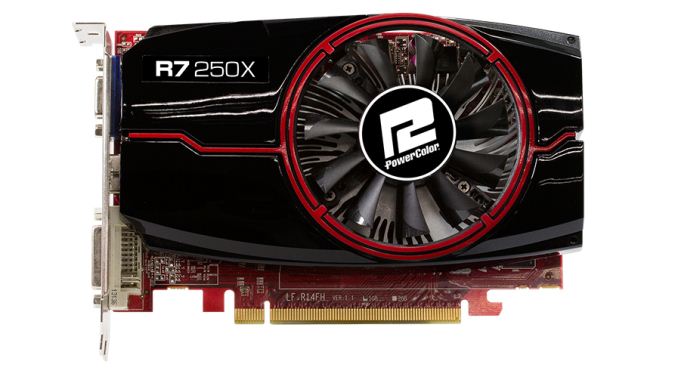
From a performance perspective the R7 250X isn’t going to quite hit the sweet spot we outlined earlier, but for those gamers on a strict budget it will get the job done. In the long run it should be able to run most games even at 1080p with medium-to-low settings, along with keeping texture quality down a notch to account for its 1GB of VRAM. Battlefield, GRID 2, and even Total War: Rome 2 can easily hum along on this card at decent settings at 1080p.
Mainstream Sweet Spot ($149): AMD Radeon R7 265
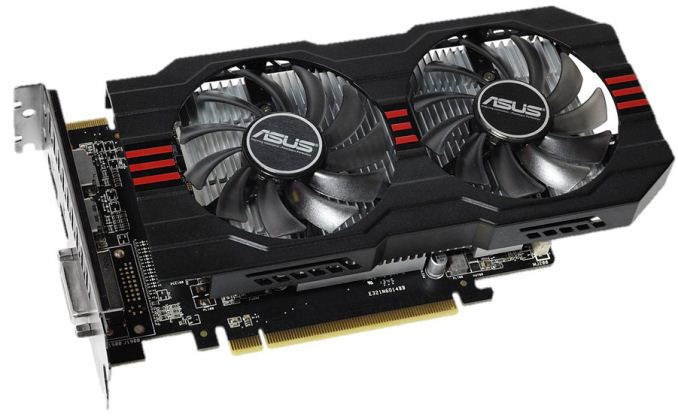
From a performance standpoint the R7 265 not going to be able to play every game at 1080p at high settings, but it will be fast enough for medium-to-high depending on the game, which will be a couple of notches higher than what the $99 cards can do. Meanwhile the 2GB of VRAM will mean that future games shouldn’t bog down the card quite as badly; higher graphical fidelity games will slow it down like any other card, but there’s enough VRAM to keep up with the demands of higher resolution textures and heavier use of intermediate buffers.
Runner Up: NVIDIA GeForce GTX 750 Ti
Since our guide is written on the assumption that most buyers are looking for the best performance at a given price, our performance recommendations are going to favor AMD, as they’re more willing to throw out larger, more powerful cards at these sub-$200 price bands. NVIDIA on the other hand isn’t going to be able to directly compete with AMD on price/performance, but they do have an interesting technological advantage for gamers who are looking for a different set of tradeoffs.
Thanks to NVIDIA’s new Maxwell architecture, at $149 they’re able to offer the GeForce GTX 750 Ti, a card that offers performance approaching the R7 265 with much lower power consumption. The GTX 750 Ti is a sub-75W card – no external PCIe power connector required – allowing it to work in cases and systems where the near-150W R7 265 cannot, while also offering the improved acoustics that come with lower power consumption. So for OEM upgrades, or buyers just looking for something even quieter, the GTX 750 Ti is an interesting alternative. Just keep in mind that from a performance standpoint it trails the R7 265 by about 16%.
There are also a pair of options between here and the R7 250X that bear mentioning. The R7 260X resides at $119 and goes up against the GTX 750, with AMD holding a performance advantage similar to R7 265 vs. GTX 750 Ti. We’re fans of stepping up to the greater performance of the $149 cards, but it does offer something between $99 and $149.
1080p Gaming ($199): AMD Radeon R9 270X
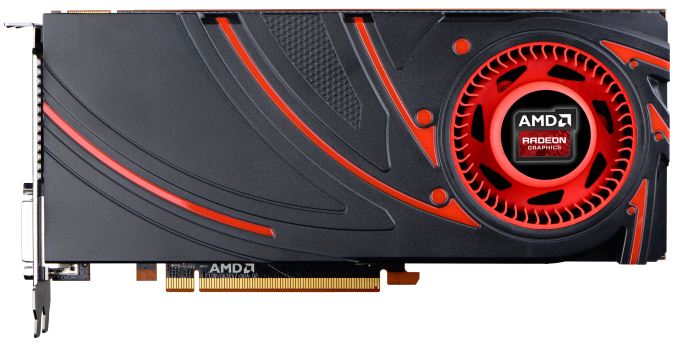
To that end there is no better card at this price than AMD’s Radeon R9 270X. Based on a fully enabled Pitcairn GPU, 270X easily offers the most bang for the buck, keeping its distance from NVIDIA’s GTX 660 while getting rather close to NVIDIA’s more expensive GeForce GTX 760.
Runner Up: NVIDIA GeForce GTX 760: The GeForce GTX 760 offers a small but respectable performance lead over the Radeon R9 270X. On a pure price/performance basis it doesn’t make sense, and at $239 sits in an odd gap between the $199 270X and the more capable $300 cards, but for buyers looking for an NVIDIA option for 1080p gaming around $199, it’s as close as one can get.
Reaching For 1440p ($299): AMD Radeon R9 280X
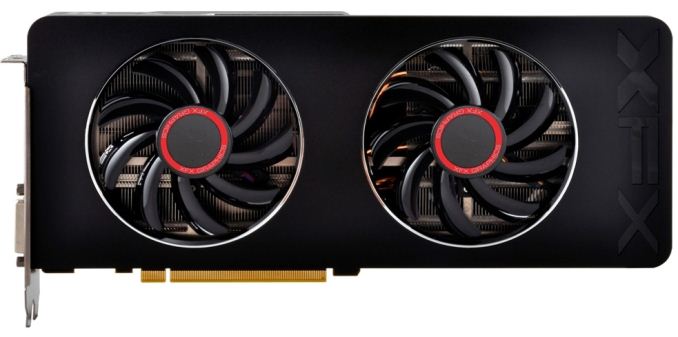
For the 280X we’re looking at a card that will straddle 1080p and 1440p. It’s not quite fast enough to work in every game at 1440p with high quality settings, but it’s fast enough for many of them. Alternatively, it’s fast enough at 1080p that it has no problem at that resolution with everything cranked up, including high levels of MSAA and even SSAA in some games. Plus the 3GB of VRAM will give it some leg room if future games demand more VRAM.
On a competitive basis the R9 280X performs very similarly to NVIDIA’s GeForce GTX 770, generally trailing by a few percent. However with AMD making the conscientious decision to undercut NVIDIA on pricing here, it gets our nod for this bracket.
Runner Up: NVIDIA GeForce GTX 770
NVIDIA’s counterpart to the R9 280X, the GeForce GTX 770, has recently fallen a bit in price in response to the 280X’s price coming back down to MSRP. With the cheaper cards now available for around $319 it still holds a price premium over AMD, but less than it once was. The GTX 770 is ever so slightly faster than the 280X – leading by a few percent on average – which generally isn’t enough to offset the price difference, but it goes without saying that it leaves the two cards close. The GTX 770 is a perfectly practical alternative to the 280X in this case, trading a slightly higher price tag for entry into NVIDIA’s ecosystem, something that may become more important as G-Sync monitors are scheduled to become available later this year.
Extreme Performance for Cheap ($399): AMD Radeon R9 290
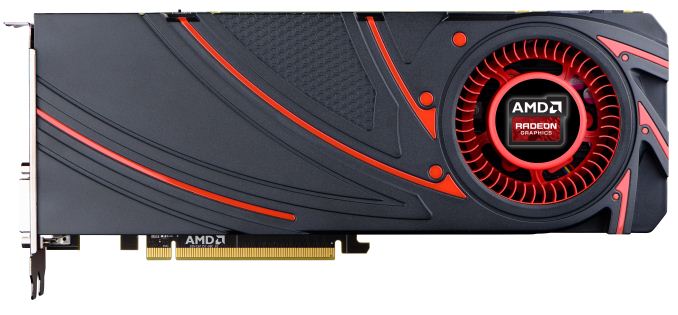
The cheapest R9 290 cards are based on AMD’s reference design, which is not a design we hold a favorable opinion of. Thankfully there is a decent selection of semi-custom and fully-custom cards at $399, offering all of the fantastic performance of the 290 without the noise or throttling drawbacks of the reference 290. Just keep in mind that all of these cards will be open air cooled cards that will want a case environment that can dissipate the additional 250W-300W of heat.
Extreme Performance with Refinement ($499): NVIDIA GeForce GTX 780
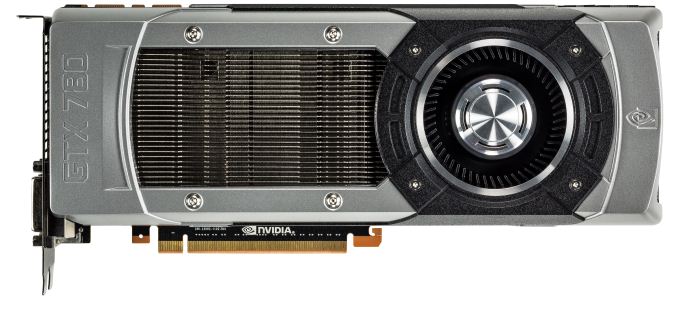
As an added bonus, even at the $499 base price this gets access to NVIDIA’s amazing metal cooler, which in our tests is enough to keep noise levels under 50dB. So for gamers looking for a balance between performance and noise, the GTX 780 is a star. Meanwhile for gamers looking at open air coolers, GTX 780 cards with alternative coolers such as EVGA’s ACX cooler will find that the GTX 780 can be even quieter for the usual tradeoff between a blower and an open air cooler.
Runner Up: Radeon R9 290X
Given the identical GPU and semi/fully custom coolers available to the 290X as compared to the 290, from a hardware standpoint AMD’s single-GPU flagship card is a solid choice and would normally give the GTX 780 a run for its money. However with most of the non-reference designs being higher priced factory overclocked models (something that’s common for flagship cards) the number of cards actually available at the $549 MSRP is slim, and the majority of those are the reference design. Realistically speaking you need to be willing to spend $570-$600 to get to a reasonable selection of non-reference cards, which pushes the 290X off of its sweet spot. As a result it’s not our first choice for this performance bracket, but as it’s several percent faster than the GTX 780 it’s a solid alternative to NVIDIA’s card.
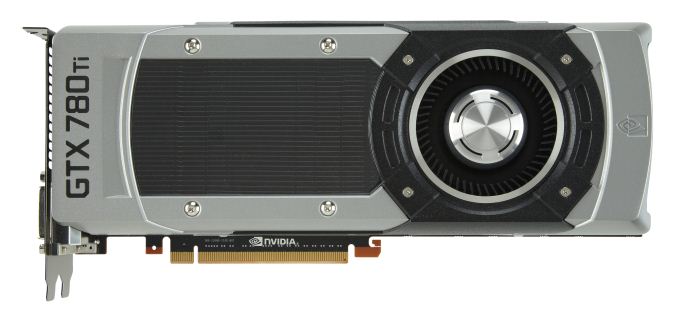
Taking the Single-GPU Crown For Gaming ($679): NVIDIA GeForce GTX 780 Ti
4K for Me ($1100+): 2x AMD Radeon R9 290X
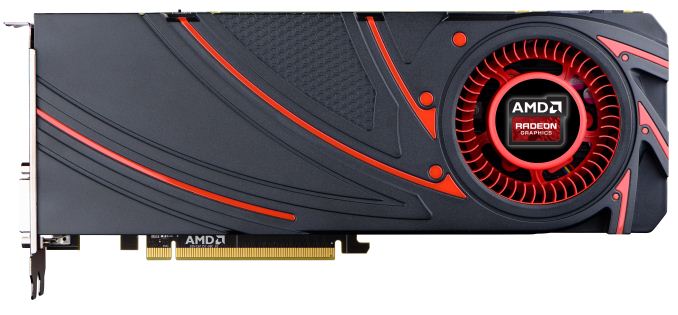
Of course the Radeon R9 295X2 deserves a mention here. As we discussed in our recap of April, AMD’s recently launched dual-GPU flagship card offers all of the performance of the 290X in Crossfire with much better acoustics and in a smaller package. Since our guide is based first and foremost on price/performance our primary recommendation for this bracket is going to be the 290X CF, but if you can make the steep climb to $1500 the 295X2 and its liquid cooler is a very impressive product whose vastly improved acoustics make 295X2 a superior option to 290X CF.
Meanwhile the GTX 780 Ti in SLI is also going to be a viable alternative here. From a performance perspective it will trail the AMD setups by 5% or so at 4K, so while it can’t match the AMD setups hit-for-hit it doesn’t significantly fall behind, making it practical to get similar performance in the NVIDIA ecosystem. The catch is that at $1360 for the dual card setup it’s closer to the 295X2 than the 290X CF in price, so it doesn’t have a distinct sweet spot on price or acoustics like either AMD configuration.
Read More ...
Acer Announces Aspire Switch 10
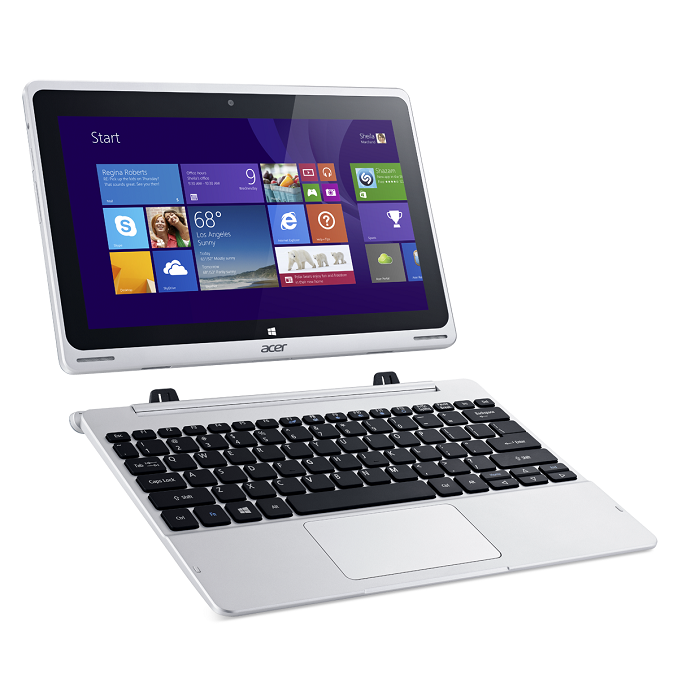
Acer claims four modes for the tablet. First, there is Notebook mode, where the keyboard is attached the normal way, and Pad mode, which is just the tablet. That’s all fairly standard in a two in one Windows tablet. The other two modes are based on the fact that the magnetic latching system on the keyboard is actually reversible – there is a Display mode where the display is simply turned around, and a tent mode where the display is turned around and the keyboard slightly folded up to give the same effect as a Surface with kickstand.
None of this is new to the Windows tablet scene of course– the Asus Transformer Book T100 offers a detachable keyboard, and Lenovo has several devices such as the Yoga and Flex lines which offer the four device modes, but Acer has done a unique take on it with the combination of reversible and detachable keyboard.


Specification wise, it’s a pretty standard tablet. The device has a Bay Trail-T quad core processor (actual model number not disclosed), 2 GB of RAM, up to 64 GB of storage, and a 1366x768 10.1” IPS touch display. Where Acer seems to have focused their efforts was in dimensions and mass, where they are claiming a 8.9 mm thick chassis (20.2 mm with keyboard) and 0.59 kg (1.29 lb) weight for the tablet alone, and 1.17 kg (2.58 lb) for the combination.
Two in One Computers |
||||||
Acer Aspire Switch 10 |
Asus Transformer Book T100 |
Microsoft Surface 2 |
||||
Dimensions |
H: 0.35" (8.9mm) W: N/A D: N/A |
H: 0.41" (10.5mm) W: 10.35" (263mm) D: 6.73" (171mm) |
H: 0.35" (8.9mm) W: 10.81" (274mm) D: 6.79" (172mm) |
|||
Weight |
1.29lbs (590g) |
1.21lbs (550g) |
1.49lbs (676g) |
|||
CPU |
Intel Bay Trail-T |
Intel Bay Trail-T Z3740 |
NVIDIA Tegra 4 T40 |
|||
GPU |
Intel HD Graphics |
Intel HD Graphics |
NVIDIA Tegra 4 T40 |
|||
RAM |
2 GB LPDDR3 |
2 GB LPDDR3 |
2 GB LPDDR3 |
|||
Storage |
32-64 GB |
32-64 GB |
32-64 GB |
|||
Display Size and Resolution |
10.1" 1366x768 |
10.1" 1366x768 |
10.6" 1920x1080 |
|||
Battery |
N/A |
31 Wh |
31.5 Wh |
|||
Price |
$379 with keyboard |
$349 with keyboard |
$449 without keyboard |
|||
Also, there's an optional keyboard dock with 500 GB of internal storage - no other specs of this accessory were announced.
Overall, the Aspire Switch 10 looks like a nice two in one, with an aluminum rear cover with a cross brush pattern. Prices start at US $379 with availability in late May.
Read More ...
NVIDIA Adds Watch Dogs to GeForce Game Bundles

Effective immediately, Ubisoft’s upcoming open world techno thriller Watch Dogs is being bundled with the GTX 660 and above. This replaces NVIDIA’s previous Daylight bundle for these cards, which started last month and we had previously been expecting to run through May.
Ubisoft is of course one of NVIDIA’s closest partners, and while NVIDIA hasn’t bundled all of Ubisoft’s high profile games they have bundled a number of them over the years, including games from the Splinter Cell and Assassin’s Creed series. Watch Dogs in turn is not an unexpected bundle choice (if a bit early) and for video card buyers it represents a step up in value, replacing the budget priced Daylight with a AAA priced game. Meanwhile as NVIDIA’s new flagship game under The Way It’s Meant To Be Played program, Watch Dogs will be packing a few enhancements from NVIDIA’s GameWorks libraries, including TXAA anti-aliasing and HBAO+.
NVIDIA Spring 2014 Game Bundles |
||||
Video Card |
Bundle |
|||
GeForce GTX 760/770/780/780Ti/Titan 660/660Ti/670/680/690 |
Watch Dogs |
|||
GeForce GTX 650/650Ti/750/750Ti |
$150 Free-To-Play (Warface, Heroes of Newerth, Path of Exile) |
|||
Select GTX 700M/800M-based Notebooks |
$150 Free-To-Play (Warface, Heroes of Newerth, Path of Exile) |
|||
GeForce GT 640 (& Below) |
None |
|||
Finally, as always, these bundles are being distributed in voucher from, with retailers and etailers providing vouchers with qualifying purchases. So buyers will want to double check whether their purchase includes a voucher for either of the above deals. Checking NVIDIA’s terms and conditions, the codes from this bundle are only good through June 30th, so it looks like this bundle is only scheduled to run for a couple of months.
Read More ...
Apple Updates MacBook Air for 2014: Faster Haswell Parts & $100 Price Drop

Apple 2014 MacBook Air CPU Comparison |
|||||
1.4GHz dual-core |
1.7GHz dual-core |
||||
Standard On |
11 & 13-inch MBA |
Optional on Both |
|||
Intel Model |
Core i5-4260U |
Core i7-4650U |
|||
Base Clock Speed |
1.4GHz |
1.7GHz |
|||
Max SC Turbo |
2.7GHz |
3.3GHz |
|||
Max DC Turbo |
2.4GHz |
2.9GHz |
|||
L3 Cache |
3MB |
4MB |
|||
TSX-NI |
No |
Yes |
|||
TXT |
No |
Yes |
|||
AES-NI |
Yes |
Yes |
|||
VT-x/VT-x EPT |
Yes |
Yes |
|||
VT-d |
Yes |
Yes |
|||
TDP |
15W |
15W |
|||
Processor Graphics |
Intel HD 5000 |
Intel HD 5000 |
|||
GPU Clock (Base/Max) |
200/1000MHz |
200/1100MHz |
|||
2014 MacBook Air Refresh |
||||||
11.6-inch |
11.6-inch (high-end) |
13.3-inch |
13.3-inch (high-end) |
|||
Dimensions |
H: 0.11-0.68" (0.3-1.7cm)
W: 11.8" (30cm) D: 7.56" (19.2cm) |
H: 0.11-0.68" (0.3-1.7cm)
W: 12.8" (32.5cm) D: 8.94" (22.7cm) |
||||
Weight |
2.38 lbs (1.08kg) |
2.96 lbs (1.35kg) |
||||
CPU |
1.4GHz dual-core Core i5 |
1.4GHz dual-core Core i5 |
||||
GPU |
Intel HD 5000 |
|||||
RAM |
4GB LPDDR3-1600 |
|||||
SSD |
128GB PCIe SSD |
256GB PCIe SSD |
128GB PCIe SSD |
256GB PCIe SSD |
||
Display Resolution |
1366 x 768 |
1440 x 900 |
||||
Ports |
Thunderbolt, 2x USB 3.0, headphone jack |
Thunderbolt, 2x USB 3.0, SD card slot, headphone jack |
||||
Networking |
2x2:2 802.11ac |
2x2:2 802.11ac |
||||
Battery |
38 Wh |
54 Wh |
||||
Price |
$899 |
$1099 |
$999 |
$1199 |
||
Read More ...
ASRock Rack C2750D4I Review: A Storage Motherboard with Management
One of the purposes of Intel’s Avoton CPUs is cold storage. ASRock produced the C2750D4I for that need – a mini-ITX motherboard with a 25W eight core CPU, support for 64GB of DRAM, external server management and twelve SATA ports. In order to achieve twelve SATA ports, ASRock has equipped the motherboard with additional Marvell controllers. SilverstoneTek has built the DS380 case with this motherboard in mind. Despite the high price tag for the motherboard ($398), there seems to be a buzz around this setup, so ASRock provided one of its C2750D4I 1U servers for review. SilverstoneTek is also in on the action, asking for our opinion of its DS380 case which we will include in this review.
Read More ...
Synology Launches Entry Level Four-Bay DS414j
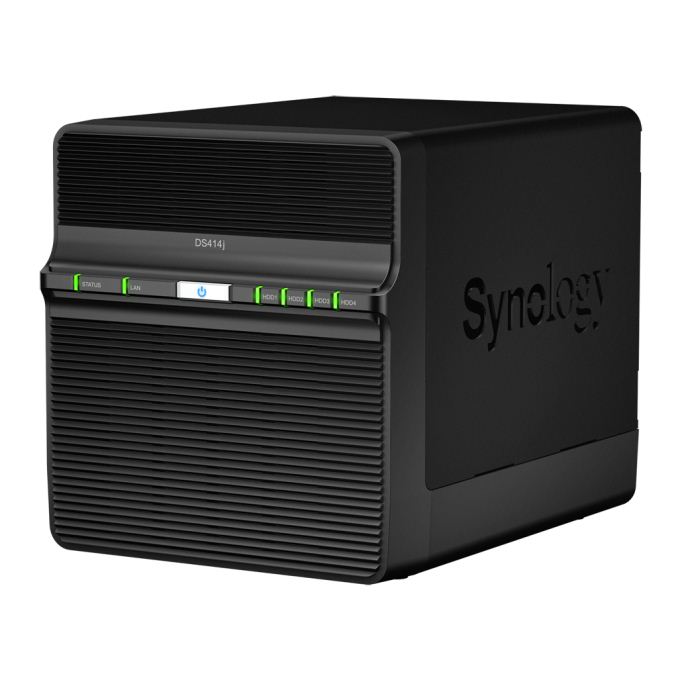
Entry-level 4-bay NAS units are important for any NAS vendor, evidenced in part by Western Digital's decision to launch the 4-bay WD EX4 ahead of the 2-bay WD EX2. The ix4-300d is also a popular member of LenovoEMC's ix-series. Synology is updating its entry in this price range market with the launch of the DS414j today, and appears to be an interesting alternative to the EX4 / ix4-300d.
The DS414j sports the Mindspeed Comcerto C2200 dual-core communications processor. It has two Cortex-A9 cores running at 1.2 GHz. There are plenty of hardware acceleration engines in the SoC.


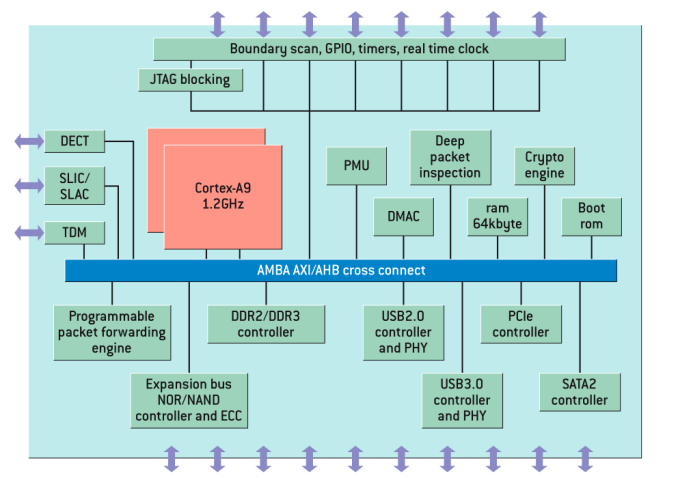
Mindspeed Comcerto C2200
The block diagram above doesn't provide full details of the peripheral I/O. Fortunately, we do have some documentation (PDF)
which indicate that the C2200 sports two SATA II ports, two PCIe 2.0
lanes, one USB 3.0 and one USB 2.0 port. This looks like a good platform
choice, since the two additional SATA bays should get full bandwidth
through the SATA - PCIe bridge (if implemented that way on the board). A
look at the gallery above shows that the unit has only one USB 2.0 and
one USB 3.0 port, pointing to the likely fact that there is no USB 3.0 -
PCIe bridge in the equation. The SoC does have support for up to three
GbE ports, but the 414j uses only one. Even though we have seen dual LAN
ports making their way into a few ARM-based units, it looks like the
j-series will tend to stress its entry-level credentials by sporting a
single network interface only.The DS414j brings in all the exciting features of DSM 5.0 (along with its acclaimed apps for quick and easy remote access, private cloud features and backups) to the entry-level market. The unit is now shipping globally with a retail MSRP of $390.
Read More ...
AMD Beema/Mullins Architecture & Performance Preview
When AMD launched its Kabini and Temash APUs last year it delivered a compelling cost/performance story, but its power story wasn’t all that impressive. Despite being built out of relatively low power components, nearly all of AMD’s entry level APUs carried 15W TDPs, with a couple weighing in at 8 - 9W and only a single 1GHz dual-core part dropping down to 3.9W. By comparison, Intel was shipping full blown Haswell Ultrabook parts at 15W - offering substantially better CPU performance, in a similar thermal envelope (although at a higher cost). The real disruption for AMD was Intel’s Bay Trail, which showed up with a similar looking micro architecture running at substantially higher clock speeds and TDPs below 8W.
AMD seemed to have all of the right pieces to build a power efficient mobile SoC, but for some reason we weren’t seeing it. Today that begins to change with the the successors to Kabini and Temash.
Read More ...
Jury Finds Apple and Samsung Both Guilty in Second Trial, Samsung to Pay $119.6M
Trial outcome is a relative win for Samsung, particularly after the devastation of the last trial
Read More ...
Achilles Heel Might Destroy Michelangelo's Massive Marble David Statue
Cracks are believed to be caused by displaying the statue on an angle for nearly 400 years
Read More ...
Pics of Supposed LG G3 Leak
New phone gets dual-LED, moves rim buttons to a single cluster in the back
Read More ...
Second Flight of SpaceX's Falcon 9-R Soars to 3,280ft; Makes Controlled, Powered Landing
Elon Musk continues his quest to be a major player in space
Read More ...
Report: Mac OS X 10.10 to Take Design Cues from iOS 7
If you don't like iOS 7, you really won't like OS X 10.10
Read More ...
New York City Revives Dream of Free Public WiFi
City thinks it could actually profit from free services, via advertising, following in Google, et al.'s line
Read More ...
"Vigilante" Florida Highway Cell Phone Jammer Smacked with $48K FCC Fine
60-year-old jammed signals for two years to try to "keep drivers safe" by preventing cell phone use
Read More ...
Despite Declaring End of XP Support, Microsoft Issues Patch to Fix Zero-Day IE Exploit
Microsoft extends an olive branch to XP users
Read More ...
Quick Note: New Renders of Amazon’s Upcoming Smartphone Hit the Internet
Amazon's new smartphone will feature a 3D interface and "Prime Data"
Read More ...
T-Mobile is Fastest Growing U.S. Carrier, Adds Record-Shattering 2.4M Customers
T-Mobile closes in on third place, charges customers less than half what Verizon does, on average
Read More ...
Microsoft to Give Away Free Windows Phones This Weekend
Each store will give away at least 8 devices
Read More ...
PayPal Prepares Polished Brand Image with New Marketing Push
Marketing push is to remind people what PayPal offers
Read More ...
Amazon Expands Same Day Delivery to Dallas, San Francisco
Amazon is also extended the order cutoff time in some cities
Read More ...
Quick Note: Video Shows Mockup of Purported 4.7” iPhone 6
The iPhone 6 will reportedly be available in 4.7" and 5.5" models
Read More ...
Report: AT&T Eyeing $40B DirecTV Purchase
Deal would likely face regulatory scrutiny
Read More ...
T-Sprintle: Bid to Merge T-Mobile and Sprint Gets Financing
The players behind the scenes are Deutsche Telekom and Softbank; T-Mobile would likely be put in charge
Read More ...
Hulu to Offer Shows for Free on Mobile Devices This Summer
New ads will allow you to purchase a pizza in-stream then get back to your show
Read More ...
Facebook to Allow "Anonymous Login" for Third-party Apps
Facebook is looking to give you back a "little" bit of privacy
Read More ...
Student Gmail Accounts No Longer Scanned for Targeted Ads
Google wasn't placing ads in Education apps, but was scanning messages anyway
Read More ...
Samsung Galaxy K zoom Smartphone Gets Official, Offers 10x Optical Zoom
10x optical zoom and lots more
Read More ...
Surface Tablets: Still a Money-loser for Microsoft
For the past 9 months, Microsoft has lost $300 million on Surface
Read More ...
Sprint is Almost Out of the Red, But Still Bleeding a Few Customers
Analysts react with enthusiasm at loss, which less than half the average expected size
Read More ...
Samsung's Strong Smartphone, Tablet Sales Drive Q1 Profits
Growth slowed, but strong mobile performance helped to make up for weak component demand by mobile partners
Read More ...
"Star Wars: Episode VII" Cast Announced
Episode VII will hit theaters on December 18, 2015
Read More ...
Quick Note: Microsoft Brings Printing Support to Office for iPad
Just a month after launch, Microsoft is adding some much-needed functionality to Office for iPad
Read More ...
Microsoft IE Has Serious Flaw, Someone Has Been Exploiting it for a Year
No fix will come for most Windows XP users
Read More ...
4/29/2014 Hardware Reviews: AMD Beema and Mullins Preview Edition
DailyTech's roundup reviews from around the web for Tuesday
Read More ...
Nokia Devices Revenue Dropped 30 Percent Ahead of Microsoft Sale; New CEO Inbound
With the Devices and Services division gone, Nokia can focus on three core units
Read More ...
AT&T to Launch Its Own In-flight Internet Service in 2015
AT&T to challenge GoGo for in-flight Wi-Fi dominance
Read More ...
Quick Note: Apple's MacBook Airs Get Slight Speed Boost, $100 Price Cut
The price cut was unexpected
Read More ...
Available Tags:Motherboards , AMD , Wireless , Gaming , Google , Acer , NVIDIA , GeForce , Apple , MacBook , ASRock , Samsung , Samsung , LG , Mac , iOS , Microsoft , IE , Smartphone , Windows Phone , Windows , PayPal , Amazon , iPhone 6 , iPhone , Hulu , Facebook , Gmail , Galaxy , Smartphone , Tablet , Profits , iPad , Hardware , Nokia , CEO ,


No comments:
Post a Comment