

DigitalStorm Slade Pro Workstation PC Review
While system integrators are often best known for their high performance gaming PCs, they can also carve out a niche with customized workstation systems.
Read More ...
VESA and MIPI Announce Display Stream Compression Standard

In order to address these concerns the PC and mobile device industries – through their respective VESA and MIPI associations – have been working together to create new technologies and standards to handle the expected bandwidth requirements. The focus of that work has been on the VESA's Display Stream Compression (DSC) standard, a descriptively named standard for image compression that has been in development at the VESA since late 2012. With that in mind, the VESA and MIPI have announced today that DSC development has been completed and version 1.0 of the DSC standard has been ratified, with both organizations adopting it for future display interface standards.
As alluded to by the name, DSC is an image compression standard designed to reduce the amount of data that needs to be transmitted. With DisplayPort 1.2 already pushing 20Gbps and 1.3 set to increase that to over 30Gbps, display interfaces are already the highest bandwidth interfaces in a modern computer, creating practical limits on how much further they can be improved. With limited headroom for increasing interface bandwidth, DSC tackles the issue from the other end of the problem by reducing the amount of bandwidth required in the first place through compression.
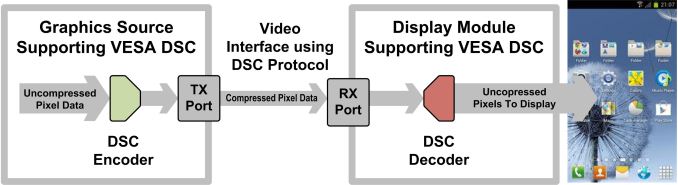
In terms of design and implementation DSC is a fixed rate codec, an obvious choice to ensure that the bandwidth requirements for a display stream are equally fixed and a link is never faced with the possibility of running out of bandwidth. Hand-in-hand with the fixed rate requirement, the VESA’s standard calls for visually lossless compression with as little as 8 bits/pixel, which would represent a 66% bandwidth savings over today’s uncompressed 24 bits/pixel display streams. And while 24bit color is the most common format for consumer devices, DSC is also intended work with higher color depths, including 30bit and 36bit (presumably at higher DSC bitrates), allowing it to be used even with deep color displays.
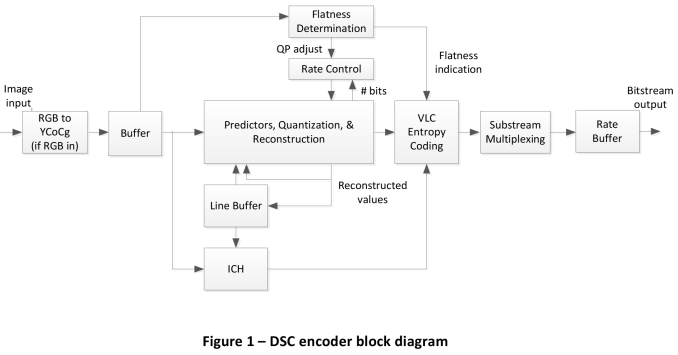
We won’t get too much into the workings of the DSC algorithm itself – the VESA has a brief but insightful whitepaper on the subject – but it’s interesting to point out the unusual requirements the VESA has needed to meet with DSC. Image and video compression is a well-researched field, but most codecs (like JPEG and H.264) are designed around offline encoding for distribution, rather than real-time encoding as part of a display standard. DSC on the other hand needed to be computationally cheap (to make implementation cheap) and low latency, all the while still offering significant compression ratios and doing so with minimal image quality losses. The end result is an interesting algorithm that uses a combination of delta pulse code modulation and indexed color history to achieve the fast compression and decompression required.
With the above in mind, it’s interesting how both groups ended up at the same standard despite their significant differences in goals. The VESA is primarily concerned with driving ultra high resolutions such as 8K@60Hz, which would require over 50Gbps of uncompressed video and something not even DisplayPort 1.3 would be able to achieve. MIPI on the other hand is not concerned about resolutions as much as they are concerned about power and cost requirements; a DisplayPort-like interface could supply mobile devices with plenty of bandwidth, but high bitrate interfaces are expensive to implement and are typically very power hungry, both on an absolute basis and a per-bit basis.
Display Bandwidth Requirements, 24bpp (Uncompressed) |
|||||||||||
Resolution |
Bandwidth |
Minimum DisplayPort Version |
|||||||||
1920x1080@60Hz |
3.5Gbps |
1.1 |
|||||||||
2560x1440@60Hz |
6.3Gbps |
1.1 |
|||||||||
3840x2160@60Hz (4K) |
14Gbps |
1.2 |
|||||||||
7680x4320@60Hz (8K) |
>50Gbps |
1.3 + DSC |
|||||||||
Wrapping things up, while DSC enabled devices are still some time off – the fact that the standard was just ratified means new display controllers still need to be designed and built – DSC is something we’re going to have to watch closely. Display compression is not something to be taken lightly due to the potential compromises to both image quality and latency, and while it’s unlikely the average consumer will notice it’s definitely going to catch the eyes of enthusiasts. The VESA and MIPI are going in the right direction by targeting visually lossless compression rather than accepting a significant image quality tradeoff for better bandwidth savings, but it remains to be seen just how lossless/lossy DSC really is. At a fundamental level DSC can never beat the quality of uncompressed display streams, but that doesn’t rule out other tradeoffs that will make compression worth the cost.
Read More ...
Apple Releases iOS 7.1.1 Update: Addresses Touch ID and Keyboard Issues
iOS 7 was launched in October of last year and received both praise directed at its shift away from the aging design of the previous version, as well as criticism directed at its seemingly rushed release and significant software issues. In March of this year Apple released its first major update which added new features like support for Apple's new CarPlay system for vehicles with built-in displays. It also improved performance across Apple's device lineup and fixed many of the bugs that persisted since the initial release of iOS 7. The update brought with it a substantial reduction in memory related crashes on 64-bit iOS devices as well as an improvement to UI rendering issues present on those devices since their launch.
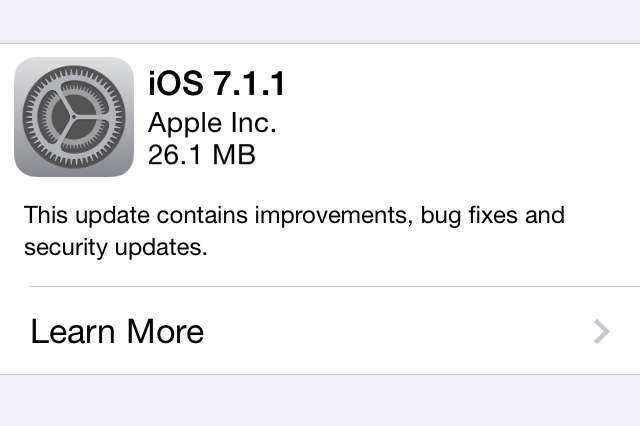
iOS 7.1.1 hopes to fix outstanding issues that still exist after the release of iOS 7.1. The details for the update states that it further improves Touch ID recognition on the iPhone 5s, fixes a bug that could impact keyboard responsiveness, and fixes issues while using Bluetooth keyboards with VoiceOver enabled. The update is available for all devices that run iOS 7 and varies between 15 and 30MB in size depending on which device you are using.
An overview of the changes and bug fixes in iOS 7.1.1 can be found here on Apple's support website. A link to Apple's support page detailing the security content of the update is provided along with the change log but it appears that the section for this latest update is not yet live.
Read More ...
Micron M500DC (480GB & 800GB) Review
While the client SSD space has become rather uninteresting lately, the same cannot be said of the enterprise segment. The types of workloads in the enterprise world can require virtually unlimited storage requirements, which creates a large market for various kinds of drives. Today we take a look at Micron's new entry-level enterprise drive, the M500DC, which is derived from the consumer M500. Read on to find out how it performs as well as what our new enterprise test suite looks like!
Read More ...
ASUS A88X-Pro Review: Kaveri, Kaveri, Quite Contrary
Pricing for motherboards varies wildly. While the performance platforms command a premium, those based on significant integrated graphics performance are considerably cheaper. In fact in 2014 it seems relatively odd to find a mainstream AMD motherboard for more than $150. For example the ASUS A88X-Pro sits at the top of ASUS’ AMD product stack and is only $124. Read on for the full review.
Read More ...
G.Skill Launches 32GB DDR3L-2133 1.35V SO-DIMM Memory Kit

This week G.Skill is releasing a 4x8GB SO-DIMM kit, under their Ripjaws branding, capable of 2133 MHz at CL11 (while remaining within the 1.35V specification of DDR3L). The aim for this kit is mostly in the high end gaming laptops that support XMP, such as MSI’s GT70 range.

G.Skill is not stating an MSRP, however it should be roughly double the price of the two module kit version, making the 32GB kit around $360.
As we have mentioned in previous articles, buying all the modules you need in a single kit ensures they will work with each other. Buying two identical kits (e.g. two 2x8 kits) does not guarantee compatibility due to the strain on some memory controllers with the tighter secondary and tertiary sub-timings on kits with fewer modules.
Read More ...
Controversy Erupts Over Rejection of Powdered Alcohol in U.S.
Alcohol powders have been a long time coming to the U.S. market, but still have yet to arrive in physical form
Read More ...
Dotcom Bomb: U.S. Case Against Megaupload is Crumbling
MPAA and RIAA appear to be caught in framing attempt; Judge orders Mr. Dotcom's assets returned to him
Read More ...
U.S. Wants to Reduce Tension Over Internet Net Neutrality
The confusion of net neutrality will be an issue that multiple nations try to clearly identify during a two-day meeting later this week.
Read More ...
DoD Shifts Spending Focus, Prepares for Technologies of the Future
Major budget cuts could have ramifications for all US military branches in the years to come.
Read More ...
Ford Says C-Max Hybrid Sales Dropped After It Was Forced to Reduce MPG Ratings
Ford pays the price for overstating C-Max fuel economy
Read More ...
Mercedes U.S. Head Steve Cannon Criticizes Tesla, Says Long-term Outlook is Poor
Cannon says Tesla wont be alone in the premium EV space forever
Read More ...
AT&T Announces Plans to Expand Ultra-Fast Fiber Internet Network to 100 Cities
Expansion will start with 21 new cities
Read More ...
AT&T Takes First Steps in Launching Its Own Online Video Service
AT&T and The Chernin Group are investing in online video, trying to cash in on a lucrative market.
Read More ...
Netflix Opposes Comcast/Time Warner Deal, Says It's Anti-Competitive
Comcast says Netflix is free to express opinions, but the opinions should be based in fact
Read More ...
Quick Note: Apple Invites Companies to “Copy” Its Environmental Record
Apple is proud of its "green" record
Read More ...
Available Tags:Apple , iOS , Keyboard , ASUS , Ford ,


No comments:
Post a Comment