

NVIDIA SHIELD Price Cuts and Portal
NVIDIA has a couple big SHIELD-related announcements today. The first is a “limited time” price cut to $199. The original price was $299, which then dropped to $249 – and there was an additional $50 rebate if you purchased an NVIDIA GTX GPU. Now the price is a flat $199, with no rebate for GTX GPU purchasers. This reduced pricing will be in effect at least through the end of April, though personally I think we might see the price stay there. There are additional incentives to go along with the April price cut, of course.
First, in the way of software updates NVIDIA will be providing both a welcome update to Android 4.4.2 “KitKat”, and there will be other enhancements including modifications to the Gamepad Mapper, Bluetooth mouse and keyboard support in Console Mode, and other tweaks and changes. It’s great to see continued support for SHIELD with OS updates like this, as I’ve had several other Android tablets that basically got kicked to the curb after one or two updates. Naturally, with NVIDIA using SHIELD as more than just a standard tablet, it’s important to keep it up to date and relevant.
Along with the upgrade to KitKat, NVIDIA will be updating the GameStream client with a new addition: Remote GameStream. The current GameStream is designed to work over your local WiFi network (5GHz dual-stream preferred/required), which limits its use to within your own home. On the other side of the equation, they’ve had the GRID Streaming Beta running for a while with remote access to games rendered on a GRID computing farm and streamed to your SHIELD device. Now the two aspects are being combined with remote streaming from your home PC to your SHIELD device, anywhere you have a (presumably “good”) WiFi connection – or if you have a good LTE connection on your smartphone, you can enable tethering and potentially use that as well.
I think this is a much bigger deal than GameStream – if I’m in my home, I’m usually happier sitting at a PC with a keyboard and mouse (though admittedly gaming on an HDTV is one potential use case that’s still appealing). Now, running the GameStream client on your home PC with an appropriate (GTX 600 or later) desktop GPU gives you remote access to any of those games. What’s more, since SHIELD isn’t really doing much computational work, battery life will still be very good. The latest GameStream will also extend support to select laptop GPUs now: GTX 800M, GTX 700M, and select GTX 600M (Kepler GTX 600M, basically) will also support GameStream. Another GameStream addition is support for multiple-PC pairings, so you can choose to stream from different desktops/laptops (e.g. if one of your desktops is already running a game, you could use a secondary system).
Returning to Console Mode, the addition of Bluetooth mouse and keyboard support allows you to connect your SHIELD to an HDTV and then sit on the couch with a Bluetooth keyboard and mouse. Basically, you get a “portable PC” that you can connect to any appropriate large screen. It’s not clear if Console Mode also supports Remote GameStream, but that would seem to make sense. NVIDIA notes that three of the top five games among current GeForce Experience users are mouse-and-keyboard-only (League of Legends, Civilization V, and Diablo III are specifically mentioned), so Console Mode extends gaming support to additional titles, albeit in a roundabout way. Seriously: PC streaming to SHIELD connected to HDTV controlled by Bluetooth keyboard and mouse – am I the only one that feels it’s perhaps a bit too involved?

Read More ...
Facebook To Acquire Oculus VR Inc for $2 Billion

The news today comes as a shock (to me at least) – Facebook has announced today that it has reached a definitive agreement to acquire Oculus VR Inc at a $2 billion dollar value. This includes $400 million in cash and 23.1 million shares of Facebook stock (~$1.6 billion on last 20 day average).
Oculus will keep their headquarters in Irvine, CA and continue development on the Rift. With Facebook moving to the help (it is unclear at this point just how much of a role they will play), the focus may shift towards a more social scenario and future for the device, alongside the anticipated action game genre.
The deal is expected to be completed during Q2, and we are awaiting further information as to the depth of the acquisition and how each firm will operate under the new structure. Facebook should have a lot of money from its IPO in order to help drive Oculus investment, perhaps accelerating the process.
Source: PRNewswire
"We are excited to work with Mark and the Facebook team to deliver the very best virtual reality platform in the world," said Brendan Iribe, co-founder and CEO of Oculus VR. "We believe virtual reality will be heavily defined by social experiences that connect people in magical, new ways. It is a transformative and disruptive technology, that enables the world to experience the impossible, and it's only just the beginning."
Read More ...
NVIDIA Announces GeForce GTX Titan Z: Dual-GPU GK110 For $3000
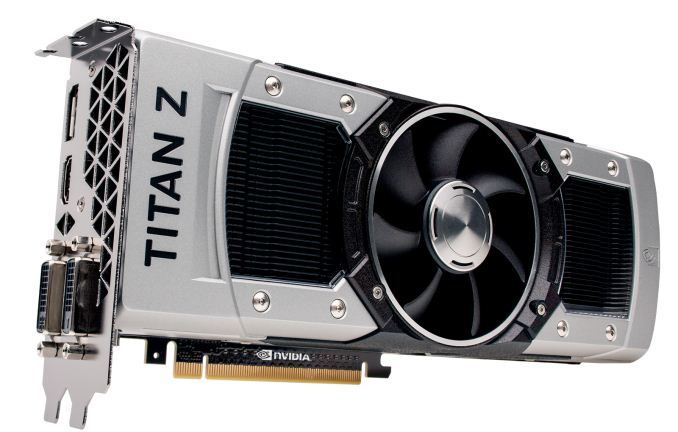
While NVIDIA has not released the complete details about the product – in particular we don’t know precise clockspeeds or TDPs – we have been given some information on core configuration, memory, pricing, and availability.
GTX Titan Z |
GTX Titan Black |
GTX 780 Ti |
GTX Titan |
|
Stream Processors |
2 x 2880 |
2880 |
2880 |
2688 |
Texture Units |
2 x 240 |
240 |
240 |
224 |
ROPs |
2 x 48 |
48 |
48 |
48 |
Core Clock |
700MHz? |
889MHz |
875MHz |
837MHz |
Boost Clock |
? |
980MHz |
928MHz |
876MHz |
Memory Clock |
7GHz GDDR5 |
7GHz GDDR5 |
7GHz GDDR5 |
6GHz GDDR5 |
Memory Bus Width |
2 x 384-bit |
384-bit |
384-bit |
384-bit |
VRAM |
2 x 6GB |
6GB |
3GB |
6GB |
FP64 |
1/3 FP32 |
1/3 FP32 |
1/24 FP32 |
1/3 FP32 |
TDP |
? |
250W |
250W |
250W |
Transistor Count |
2 x 7.1B |
7.1B |
7.1B |
7.1B |
Manufacturing Process |
TSMC 28nm |
TSMC 28nm |
TSMC 28nm |
TSMC 28nm |
Launch Date |
04/XX/14 |
02/18/14 |
11/07/13 |
02/21/13 |
Launch Price |
$2999 |
$999 |
$699 |
$999 |
On the memory front GTX Titan Z is configured with 12GB of VRAM, 6GB per GPU. NVIDIA’s consumer arm has also released the memory clockspeed specifications, telling us that the card won’t be making any compromises there, operating at the same 7GHz memory clockspeed of the GTX Titan Black. This being something of a big accomplishment given the minimal routing space a dual-GPU card provides.
In terms of build the GTX Titan Z shares a lot of similarities to NVIDIA’s previous generation dual-GPU card, the GTX 690. NVIDIA is keeping the split blower design, with a single axial fan pushing out air via both the front and the back of the card, essentially exhausting half the hot air and sending the other half back into the case. We haven’t had any hands-on time with the card, but NVIDIA is clearly staying with the black metal styling of the GTX Titan Black.
The other major unknown right now is power consumption. GTX Titan Black is rated for 250W, and meanwhile NVIDIA was able to get a pair of roughly 200W GTX 680s into the 300W GTX 690 (with reduced clockspeeds). So it’s not implausible that GTX Titan Z is a 375W card, but we’ll have to wait and see.
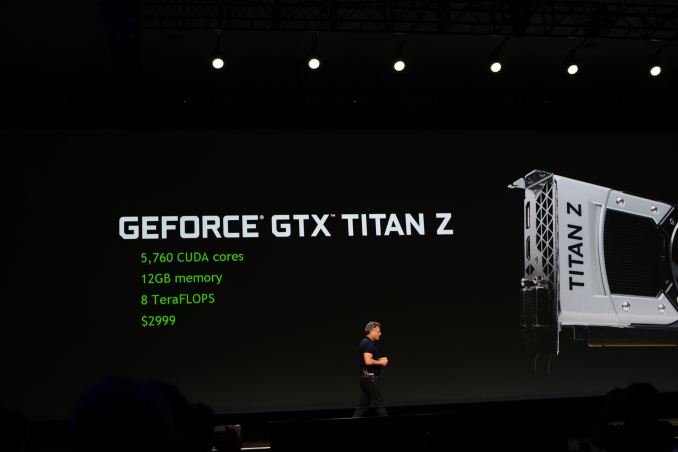
It goes without saying then that GTX Titan Z is aimed at an even more limited audience than the GTX Titan and GTX Titan Black. To be sure, NVIDIA is still targeting both gamers and compute users with this card, and since it is a GeForce card it will use the standard GeForce driver stack, but the $3000 price tag is much more within the realm of compute users than gamers. For gamers this may as well be a specialty card, like an Asus ARES.
Now for compute users this will still be an expensive card, but potentially very captivating. Per FLOP GTX Titan Black is still a better deal, but with compute users there is a far greater emphasis on density. Meanwhile the GTX Titan brand has by all accounts been a success for NVIDIA, selling more cards to compute users than they had ever expected, so a product like GTX Titan Z is more directly targeted at those users. I have no doubt that there are compute users who will be happy with it – like the original GTX Titan it’s far cheaper per FP64 FLOP than any Tesla card, maintaining its “budget compute” status – but I do wonder if part of the $3000 pricing is in reaction to GTX Titan undercutting Tesla sales.
Anyhow, we should have more details next month. NVIDIA tells us that they’re expecting to launch the card in April, so we would expect to hear more about it in the next few weeks.
Read More ...
NVIDIA GTC 2014 Keynote Live Blog
We're live from NVIDIA's 2014 GPU Technology Conference. Jen-Hsun's keynote will begin at 9:00AM PT/12:00PM ET, check back here for live updates!
Read More ...
Camera Used by Astronauts on Moon "Pulls $940 Gs" at Auction
Apollo relic was one of a kind due to later weight policies
Read More ...
Facebook Purchases Oculus VR For $2 Billion USD
Facebook plans to do more than just gaming
Read More ...
Quick Note: China Crashes Party for 1,530 People Involved in Mobile Phone Spam
More than 2,600 fake base stations have been shut down
Read More ...
New Legislative Proposal Seeks to End NSA's Bulk Data Collection of Phone Records
Phone companies will be the only ones to hold these records unless court ordered to hand them over
Read More ...
HTC CEO: "The HTC One (M8) is the Best Phone We Have Ever Launched"
New 3D camera is onboard; gorgeous metal body phone bests Samsung's GS5 in some features
Read More ...
Sony Says It Will Stick with Its Own Platform for Smartwatches
Sony won't use Android Wear
Read More ...
Microsoft Wants Quick Death for Office 2003, Leads Users to Office 365
Support for Office 2003 ends April 8 along with Windows XP
Read More ...
Northrop Grumman, U.S. Navy Complete Initial Flight Tests on MQ-4C Triton Drone
Initial flight tests clear the way for new tests for Triton
Read More ...
Available Tags:NVIDIA , Portal , Facebook , GeForce , GTX , Dual-GPU , HTC , HTC , Sony , Microsoft ,


No comments:
Post a Comment