

Evaluating AMD's TrueAudio and Mantle Technologies with Thief
Scheduled for release today is the 1.3/AMD patch for Thief, Square Enix’s recently released stealth action game. Following last month’s Battlefield 4 patch, Thief is the second big push for AMD’s recent Radeon technology initiative, becoming the second game to support Mantle and the first game to support TrueAudio Technology.
Thief has been something of a miss from a Metacritic perspective, but from a technology perspective it’s still a very big deal for AMD and Radeon owners. As a Mantle enabled title it’s the second game to support Mantle and the first single-player game to support it. Furthermore for AMD it showcases that they have Mantle support from more developers than just EA and other Frostbite 3 users, with Square Enix joying the fray. Finally it’s the first Unreal Engine based game to support Mantle, which can be particularly important since Unreal Engine 3 is so widely used and we expect much the same for the forthcoming Unreal Engine 4.
But more excitingly the release of this patch heralds the public release of AMD’s TrueAudio technology. Where Battlefield 4 was the launch title for Mantle Thief is the launch title for TrueAudio, being the first game to receive TrueAudio support. At the same time it also marks the start of AMD enabling TrueAudio in their drivers, and the start of their TrueAudio promotional campaign. So along with Thief AMD is also going to be distributing demos to showcase the capabilities of TrueAudio, but more on that latter.
Read More ...
Intel Xeon E5-2697 v2 and Xeon E5-2687W v2 Review: 12 and 8 Cores
Intel’s roadmap goes through all the power and market segments, from ultra-low-power, smartphones, tablets, notebooks, desktops, mainstream desktops, enthusiast desktops and enterprise. Enterprise differs from the rest of the market, requiring absolute stability, uptime and support should anything go wrong. High-end enterprise CPUs are therefore expensive, and because buyers are willing to pay top dollar for the best, Intel can push core counts, frequency and thus price much higher than in the consumer space. Today we look at two CPUs from this segment – the twelve core Xeon E5-2697 v2 and the eight core Xeon E5-2687W v2.
Read More ...
Khronos Announces OpenGL ES 3.1
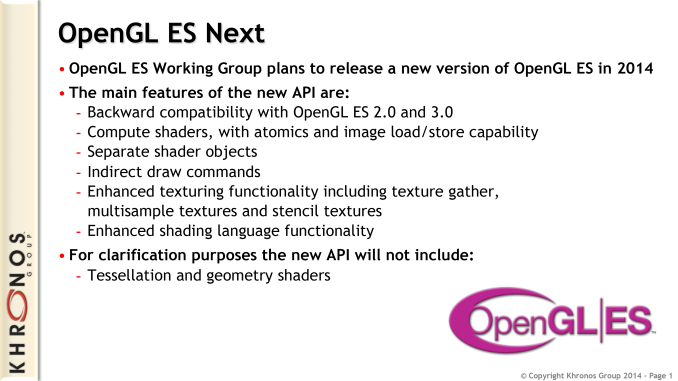
Version numbers aside, with OpenGL ES 3.1 Khronos has finally built out OpenGL ES to a point where it can be considered a subset of OpenGL 4.x. While OpenGL ES 3.0 was almost entirely constructed from OpenGL 3.x features, OpenGL ES 3.1’s near-exclusive borrowing of OpenGL 4.x features means that a several pieces of important functionality found in OpenGL 4.x are now available in OpenGL ES. Though at the end of the day it’s still a subset of OpenGL that’s lacking other important features.
Anyhow, as it turns out the early OpenGL ES Next announcement was surprisingly thorough. Khronos’s January announcement actually contained the full list of major new features for OpenGL ES 3.1, just without any descriptions to go with them. As such there aren’t any previously unannounced features here, but we do finally have a better idea of where Khronos is aiming with these features, and what kind of hardware it will take to drive them.
Compute Shaders
Compute shader functionality is without a doubt the marquee feature of OpenGL ES 3.1. Compute shader functionality was first introduced in mainline OpenGL 4.3, and at a high level is a much more flexible shader style that is further decoupled from the idiosyncrasies of graphics rendering, allowing developers to write programs that either weren’t possible using pixel shaders, or at best aren’t as efficient. Compute shaders in turn can be used for general purpose (non-graphical) programming tasks, however they’re more frequently used in conjunction with graphics tasks to more efficiently implement certain algorithms. In the gaming space ambient occlusion is a frequent example of a task that compute shaders can speed up, while in the mobile space photography is another oft-cited task that can benefit from compute shaders.The increased flexibility is ultimately only as useful as software developers can make it, but of all of the features being released in OpenGL ES 3.1, this is the one that has the potential for the most profound increase in graphics quality on mobile devices. Furthermore compute shaders are based on GLSL ES, so they can be a fairly easy shader type for developers to adopt.
Separate Shader Objects & Shading Language Improvements
Speaking of shaders, there are also some smaller shader improvements coming in OpenGL ES 3.1. Developers can now more freely mix and match vertex shader and pixel shader programs thanks to separate shader object functionality, breaking up some of the pipelining imposed by earlier versions of OpenGL ES 3.0. Meanwhile 3.1 also introduces new bitfield and arithmetic operations, which should make desktop GPU programmers feel a bit more at home.Indirect Draw Commands
Even with the tightly coupled nature of SoCs, SoC-class GPUs generally aren’t much better off than desktop GPUs when it comes to CPU bottlenecking. Consequently there’s performance (and quite possibly battery life) to be had by making the GPU more self-sufficient, which brings up indirect draw commands. Indirect commands allow the GPU to issue its own work rather than requiring the CPU to submit work, thereby freeing up the CPU. Khronos gives a specific example of having a GPU draw out the results of a physics simulation, though there are a number of cases where this can be used.Enhanced Texture Functionality
Finally, OpenGL ES 3.1 will also be introducing new texture functionality into OpenGL ES. Texture multisampling is now in – a technology useful for using anti-aliasing in conjunction with off-screen rendering techniques – as is stencil textures. Texture gather support also makes an appearance, which allows sampling a texture in a 2x2 array of textures and is useful for texture filtering.Moving on, for today’s release Khronos also laid out their plans for conformance testing for OpenGL ES 3.1. OpenGL ES 3.1 has already been finalized – this isn’t a draft specification – so the specification is done, however the conformance tests are still a work in progress. Conformance testing is largely an OEM concern, but from a consumer perspective it’s notable since it means that OEMs and chip/IP vendors technically can’t label their parts as OpenGL ES 3.1 compliant until they pass the necessary tests. Khronos tells us that conformance tests are expected to be available within 3 months, so we should see conformance validation shortly after that.
Finally on the hardware side, again not unlike mainline OpenGL, OpenGL ES 3.1 is designed to be implemented on existing hardware, with many aspects of the standard just providing a formal API to functionality that the hardware can already achieve. To that end, Khronos tells us that a number of existing SoC GPUs will be OpenGL ES 3.1 capable; so OpenGL ES 3.1 can be rolled out to the public without new hardware in those cases.
Unfortunately we don’t have a list of what GPUs will be ES 3.1 capable – the lack of conformance tests being something of a roadblock. But in Khronos’s full press release both NVIDIA and Imagination Technologies note that they expect to fully support OpenGL ES 3.1 in their Kepler and Rogue architectures respectively. No doubt we’ll hear more about this in the coming weeks and months as the other SoC GPU vendors cement their OpenGL ES 3.1 plans and pass their conformance tests.
Read More ...
Quick Note: Steve Jobs on Smart TV in 2010: "TV is a Terrible Business"
Apple chief resisted idea of Apple smart TV
Read More ...
OneNote Goes Freemium for Windows and Mac, Office Lens Debuts
Microsoft is also opening the floodgates to third parties to use OneNote via APIs
Read More ...
Duke Turns Plastic Pyramid Into Acoustic Cloaking Device
So is a flying pyramid/saucer in the works for the CIA and USAF?
Read More ...
Apple Design SVP Jony Ive: We're Surrounded by Anonymous, Poorly Made Objects
But he says Apple's products aren't in that category
Read More ...
Tesla CEO Elon Musk Attacks New Jersey Gov. After Direct Auto Sales Ban
Elon Musk threw mafia and Bridgegate references out there
Read More ...
Microsoft Launches $679 Surface 2 with (AT&T) 4G LTE
Microsoft officially launches its 64GB, LTE Surface 2
Read More ...
Man Finds He Is On "Most Wanted" List in California from Google Search
Man allegedly fired his gun into the ground near people he was arguing with
Read More ...
Sony Increases PlayStation 4 Price in Canada by $50
Sony blames "market conditions" for price increase
Read More ...
Report: Apple Looks to Boost Disappointing iPhone 5C Sales with 8GB Model
Apple hopes to lower the price of entry with the iPhone 5C by adding an 8GB variant
Read More ...
Available Tags:Intel , Xeon , Xeon , TV , Windows , Apple , CEO , Microsoft , 4G , Google , Sony , iPhone 5 , iPhone ,


No comments:
Post a Comment