

GIGABYTE BRIX Pro: A First Look at the Intel i7-4770R with Iris Pro HD 5200
Intel's high-end Crystal Well, the Core i7-4770R, has remained out of reach for consumers despite being introduced back in June 2013. While Apple's notebooks use the mobile Crystal Well parts, the 2013 iMac restricts itself to the Core i5-4570R. Users wanting to stay out of the Apple ecosystem have been left in the cold. Gigabyte is coming to the rescue with the launch of the BRIX Pro in the NUC form factor. The higher end SKU is equipped with the 65W TDP i7-4770R. Read on for our first look at the BRIX Pro along with some quick benchmark numbers.

     |
Read More ...
USB-IF Updates Us on Type C Connector, Demonstrates USB SuperSpeed 3.1 Transfers
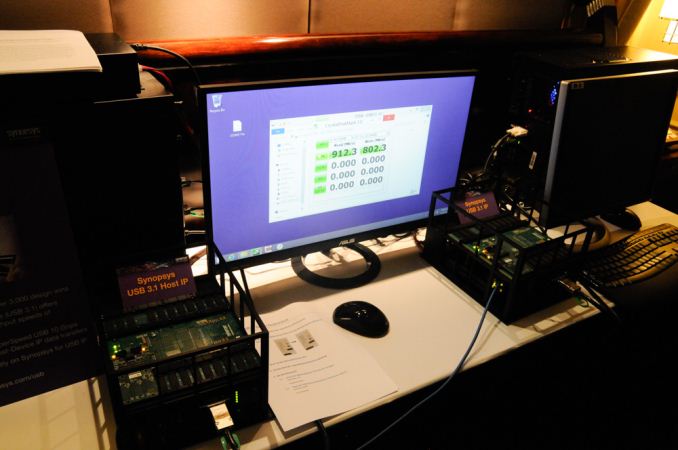
The type C connector is still in development, and there aren't any current renderings or drawings, but what has been laid out are the design goals for the new connector design. The connector will be reversible, and able to negotiation which end is host or client (direction-agnostic) with type c connectorization at both ends, although cables will still come in type-A to type-C combinations for use with power adapters and current generation hosts. In addition it will be around the same size as the current USB 2.0 Micro-B connector and catered toward enabling the kinds of thin and sleek industrial designs smartphone, tablet, and even notebook OEMs desire. Type C will work with USB 3.1 and the power delivery specification, in addition to including some extra pins for growth and building out the standard in the future, the goal is to make this the connector for the next 10 years. In addition, the standard will define an intermediary adapter for going from current 2.0 or 3.0 micro-B connectors to the new type C connector. I'm told to expect the Type C connector to have drawings and be better understood probably before the next IDF.


| |
Read More ...
AnandTech Mobile Show at CES 2014 Today
A couple of months ago Brian and I did a mobile show on video live from IDF where we discussed a lot of what was going on in mobile at the time. Intel was a huge help to us back then by providing support in the filming and production of the whole thing. It went over so well that Intel offered to help us out at CES this year to do the very same.
This evening (at 6PM PT) Brian and I will be at Intel's booth at the Las Vegas Convention Center (Central Hall, Booth #7252) filming the second on-location AnandTech Mobile Show. We'll be discussing all of the mobile announcements at CES thus far, including the Tegra K1 that was just announced earlier this week. If you're at CES, feel free to drop by Intel's booth to check out the show as it's being filmed. We'll post the show to our YouTube channel immediately afterwards so look for it tomorrow evening.
Update: It looks like we may get Intel's Hermann Eul (VP and GM of the Mobile & Comms group) to stop by for a candid interview on the show. This is going to be an exciting one. If there's anything you guys want us to discuss on the show let us know in the comments!

| |
Read More ...
Ambarella Shows off Wearable A7LW Camera Platform for Google Helpouts
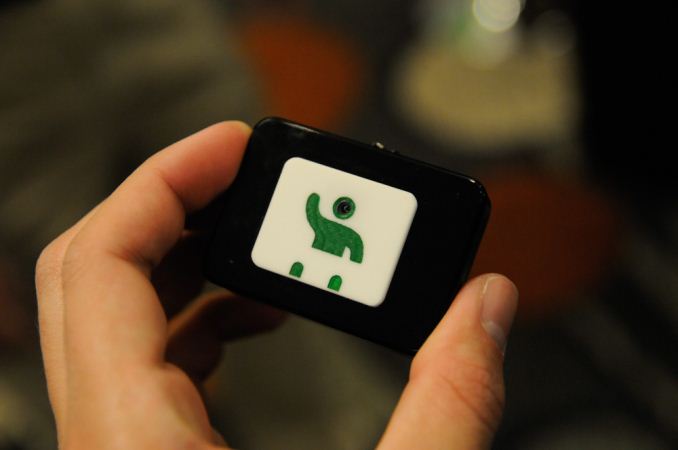


Ambarella also noted that the A9 SoC which will enable 4Kp30 (UHD) encode and decode that we saw at CES 2013 (and again in a more final form at this CES playing back some new 4Kp30 content at 35 Mbps H.264) is now in production and that devices will arrive this year with it inside.
Source: Ambarella


| |
Read More ...
Corsair Showcase a Technology Smörgåsbord at CES 2014

| |
Read More ...
NVIDIA GeForce 332.21 WHQL Drivers Now Available

As another iteration of the R331 series drivers, 332.21 is chiefly a bug fix and profile update driver. New SLI profiles have been added for Assetto Corsa, EVE Online (DX11), Plants vs. Zombies Garden Warfare, and Thief. Meanwhile this driver fixes several bugs, including a ShadowPlay resolution issue, browser crashes/freezes on Fermi GPUs, and issues with Microsoft Flight, Shadow Warrior, and Splinter Cell: Blacklist.
As usual, you can grab the drivers for all current desktop and mobile NVIDIA GPUs over at NVIDIA’s driver download page.

| |
Read More ...
AMD/TI's DockPort Adopted As Official Extension to DisplayPort Standard

The end result was that a few different ideas were floated as potential Thunderbolt competitors. AMD’s Lightning Bolt proposal ended up being the frontrunner in this field, proposing a very Thunderbolt-like connection that would have USB 3.0 and power routed alongside DisplayPort, rather than Thunderbolt’s PCI-Express plus DisplayPort. However since AMD’s concept demo two years ago at CES 2012 we’ve heard very little about Lightning Bolt. Until today, that is.

AMD's CES 2012 Lightning Bolt Concept
With DockPort the VESA is initially targeting a slightly different series of use cases than what Intel and Apple have done with Thunderbolt, both for technical and pragmatic reasons. Whereas Thunderbolt is being used to supersede USB 3.0 in some cases, as DockPort is based on USB 3.0 there’s little need to supersede USB 3.0 as far as data connectivity is concerned. Rather DockPort will be focused on single-cable connectivity – and as implied by the DockPort name – as a docking interface for tablets and laptops. The latter in particular owing to the fact that DockPort carries power alongside its data and display components.
As we’ve already seen with Thunderbolt products such as Apple’s Thunderbolt Display, there are definitely some good arguments to be had for offering a single combined data/display interface, as the continued shift from desktops to laptops has made monitors as docking stations an increasingly attractive option. Furthermore because DockPort provides power as well data, it should be possible to surpass Thunderbolt here and go truly single-cable on tablets and laptops, with the DockPort providing everything a laptop needs. However it remains unclear just how much power the standard will be able to provide to host devices, and consequently how big of a device can be powered through DockPort.

DockPort's potential: monitors as laptop docks
From a functionality perspective, due of the muxing of DisplayPort and USB the amount of bandwidth available to data devices will depend on in part the amount of bandwidth leftover after connected displays have consumed their share. Practically speaking this means that we expect AMD’s earlier claims to remain true, and that DockPort won’t be able to quite keep up with a native USB 3.0 connection. Meanwhile because this is USB based, this also means that manufacturers will be able to include just about any type of USB peripheral in their docks/monitors, including USB audio controllers, USB based NICs, and USB hubs, for all the benefits and drawbacks USB provides.
Meanwhile in an interesting twist, due to the drawn out development of DockPort, the first DockPort controller is already out ahead of the specification itself. TI’s HD3SS2521 controller was unveiled back in 2013 when AMD and TI were still going it alone on DockPort, and is being used as the basis of the final standard. Until the standard is in hand it’s not clear quite how quickly DockPort devices will be available, but with TI already having a controller on the market the turnaround time should be much shorter than most other VESA standards (where the specification has come first and the silicon second).

On the other hand, having an open standard opens the doors to ultimately having multiple vendors with competing DockPort controllers, which offers the potential to keep controller costs closely in check. All the while the aforementioned passive cabling will bring down total costs even further. The use of USB instead of PCI-Express should also make DockPort more Windows-friendly than Thunderbolt, as USB is already hot-plug friendly as opposed to Thunderbolt requiring an additional layer of drivers to make PCI-Express behave properly with hot-plugging.
Wrapping things up, AMD and TI will be showing off their initial work on DockPort at CES 2014, showcasing a version of the AMD Discovery concept tablet with DockPort functionality. Otherwise we should have more launch details on DockPort once the specification is finalized next quarter.

| |
Read More ...
CES 2014: EVGA Announces Its First Gaming Mouse Complete with Real Carbon Fiber Trim
EVGA gets into the gaming mouse market

| |
Read More ...
CES 2014: Sony Announces Z1S, Z1 Compact
New devices impress, but leave something to be desired in each case

| |
Read More ...
CES 2014: "PlayStation Now" Cloud Service Brings Old PS Games to Various Devices
The closed beta will begin at the end of January, and the full release is expected this summer

| |
Read More ...
CES 2014: Mushkin Adds 480GB USB SSD to Ventura Ultra Line
There was no mention of price

| |
Read More ...
CES 2014: TrackR Helps You Find Those Lost Keys
Smartphone apps help you solve a common problem

| |
Read More ...
CES 2014: Next Generation Audi TT’s “Virtual Cockpit” Pictured
Audi's new virtual cockpit is full of win

| |
Read More ...
Quick Note: Apple Grabs $10 Billion in 2013 App Store Downloads
$1 billion of that came from December alone

| |
Read More ...
CES 2014: Buffalo Rolls Out 1TB MiniStation Air, Wirelessly Streams Media to 8 Devices
Buffalo's MiniStation Air can also serve as a portable battery and a Wi-Fi hotspot

| |
Read More ...
Analysts: Samsung Smartphone Sales for 2014 May be Slowed by Apple
Apple's new contract with China Mobile and the release of iPhones with larger screens could hit Samsung's sales

| |
Read More ...
CES 2014: Mophie Space Pack Brings Built-in Battery, Storage for iPhone 5/5s
Mophie Space Pack is available in 16GB or 32GB sizes

| |
Read More ...
Gaming Console Ban Temporarily Lifted in China
It's not clear for how long

| |
Read More ...
Gartner: 1.1 Billion Android Smartphones, Tablets Expected to Ship in 2014
This represents a 26 percent boost from 2013's total

| |
Read More ...
CES 2014: Toshiba's New Dual Camera Module Allows You to Refocus After Taking a Pic
Samples of the TCM9518MD are available now in the U.S. only for $50 a pop

| |
Read More ...
CES 2014: Intel Changing McAfee Name to "Intel Security"
The company is also offering certain McAfee Security components for free on Android and iOS

| |
Read More ...
Samsung Outs 12.2" Galaxy NotePRO and TabPRO Tablets at CES
Samsung unveils new tablets at CES

| |
Read More ...
Available Tags:GIGABYTE , Intel , USB , AnandTech , Google , NVIDIA , GeForce , WHQL , EVGA , Gaming , Sony , SSD , Audi , Apple , Samsung , Smartphone , iPhone 5 , iPhone , Android , McAfee , Galaxy ,


No comments:
Post a Comment