

AMD 2014 Mobile APU Update: Beema and Mullins
We looked at Kabini earlier this year, but while sales of laptops and tablets with the Kabini/Temash APUs have reportedly been quite good, we haven’t had the chance to test any retail laptops. With Intel’s Bay Trail set to give Atom a much-needed kick in the pants as far as performance is concerned, AMD hasn’t been standing still and their next generation of “small core” APUs looks ready to give Silvermont some stiff competition. Here’s what we know right now.
First and foremost, these are actually new cores as opposed to mere tweaks of existing designs. Temash and Kabini used “Jaguar” cores, built on a 28nm process node; Mullins and Beema will also use 28nm technology, with “Puma” cores, but along with improvements to the design to reduce the power use, AMD is also incorporating an ARM Cortex-A5 core with TrustZone technology to help with security. Here’s the quick overview of the current and roadmap:
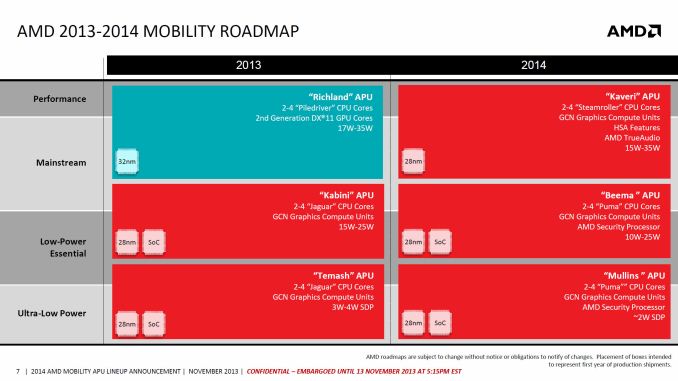
First, we have Beema replacing Kabini, and with the change we get the AMD Security Processor (ARM Cortex-A5) and a reduction in TDP on some parts, with 10W being the minimum. Mullins does the same for Temash, only AMD uses SDP (Scenario Design Power) rather than TDP (Thermal Design Power), and the new APUs are ~2W compared to 3-4W for Temash. Apparently the TDP for Temash is 8W and the TDP for Mullins is 4.5W, and that’s what AMD uses for their performance per watt calculations.
While a “2X increase” sounds good, there are many ways to get there. Simply dropping the power use by half but maintaining performance would be one way, or doubling performance at the same power use would yield the same 2X increase. Thankfully, AMD provided details of their performance testing for the old and new APUs as well, which I’ve summarized in the table below, and we can see that performance has increased quite a bit along with the drop in TDP.
| AMD APU Performance Results | ||||||
| Temash A6-1450 (8W) | Mullins (4.5W) | %Increase | Kabini A6-5200 (25W) | Beema (15W) | %Increase | |
| PCMark 8 Home | 1343 | 1809 | 35% | 1861 | 2312 | 24% |
| 3DMark 11 | 468 | 570 | 22% | 685 | 823 | 20% |
AMD hasn’t disclosed clock speeds or anything else for the upcoming APUs, but given A6-1450 is clocked at 1000-1400MHz with the GPU core running at 300-400MHz, it is possible AMD was able to arrive at the above performance increases simply with higher clock speeds. Also possible is that similar to the Bobcat to Jaguar transition, AMD tweaked other elements of the Puma core (e.g. the scheduler could have more entries).
Core counts on the CPU side have remained the same: 2-4 cores. With the lower SDP of Mullins, AMD also notes that fanless quad-core tablets and laptops will now be possible, which definitely opens some additional doors. When we looked at Kabini performance (granted in a 15W TDP), we found the CPU performance was typically well ahead of Atom at the time, and even Silvermont/Bay Trail are only moderately ahead (and in some cases still slower). How things shake out with Mullins in the 2W market will be something to watch.
While we don’t know if the iGPU has added any additional cores, it remains GCN based and very likely uses the same cores as before, only with higher clocks. Consider that AMD’s GCN architecture breaks things down into Compute Units (CUs) with 64-cores per CU. The existing Kabini/Temash APUs have two CUs and 128 cores, while Hawaii as an example includes a staggering 44 active CUs in the R9 290X; Kaveri goes for the middle ground with up to 8 CUs (512 cores). In order to increase the number of cores in Beema/Mullins, AMD would have to make the jump from 2 to 3 CUs, a 50% increase; given the ~20% performance increases above, it’s far more likely these come from the same number of cores/CUs running at higher clocks than more cores running at lower clocks.
Wrapping things up, there are a few other items we wanted to quickly touch on. First is Kaveri for notebooks, which as noted above will be shipping in H1’14. Kaveri is a GCN 1.1 part, similar to Hawaii only with fewer cores, and it also supports HSA features and AMD’s new TrueAudio. Again, notice that neither of those elements are listed for Mullins/Beema, indicating they’re using the same basic GCN 1.0 GPU design as Temash/Kabini. Kaveri will also be making the transition to 28nm from Trinity/Richland’s 32nm, and we could see a fairly decent bump in performance – but AMD isn’t saying much on the subject of mobile Kaveri performance just yet.
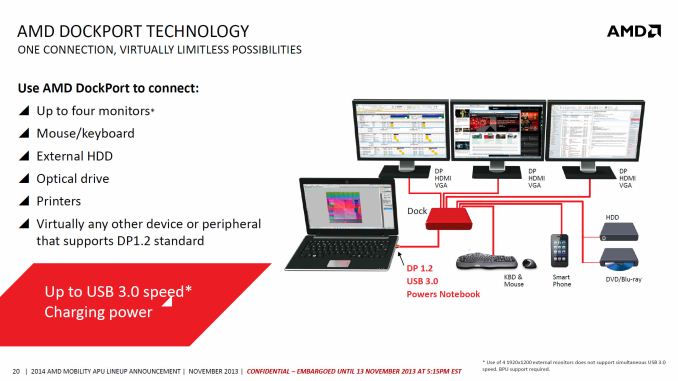
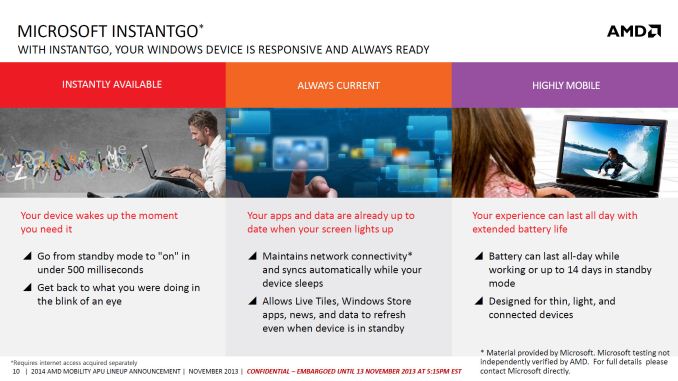
The other items we wanted to quickly discuss (and you can see these and a few other pieces of information in the slide gallery below) are some of the other additions AMD is making with Mullins/Beema. There are three points to discuss: AMD DockPort, Microsoft InstantGo, and the Platform Security Processor.
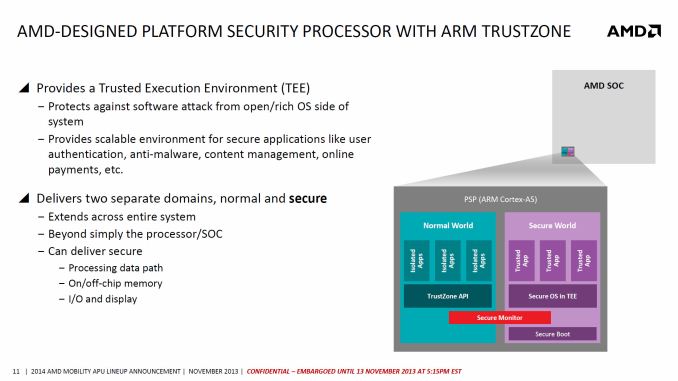
Wrapping things up, Mullins and Beema will be coming out in 2014, but AMD hasn’t given a precise time frame. We have a date for desktop Kaveri (January 14, 2014), but everything else is “first half of 2014”. Given the added pressure AMD is facing from Intel’s Bay Trail, hopefully the Mullins/Beema APUs will arrive sooner rather than later, but that may simply be wishful thinking on my part. As usual, the real challenge is in getting the APUs into a compelling product – one that offers the right features at the right price point. With tablets and Chromebooks taking over the sub-$300 market, creating something that clearly stands out from the crowd is becoming difficult.


     |
Read More ...
PS4 Spec Update: Audio DSP Is Based On AMD’s TrueAudio
Continuing our coverage of AMD’s APU13 conference, one of this morning’s keynotes has been from Sony’s VP of Research & Development in North America, Dominic Mallinson. Most of Dominic’s presentation was a recap of the PS4 thus far – including some detail in why Sony went with an AMD APU for the console – but Dominic did throw in one more piece of information on the PS4’s specifications that we haven’t heard before. Specifically, the PS4’s audio DSP is based on AMD’s TrueAudio technology.

But from a PC perspective however, this is going to be more important and unexpected news. At this time we don’t know what the underlying API is like – AMD hasn’t even released the TrueAudio PC API yet – but the shared hardware is going to be a big deal for both AMD’s CPUs and APUs. One of the challenges we discussed as facing TrueAudio is developer adoption; AMD has to convince developers to take the time to program for TrueAudio along with more traditional CPU sound engines. AMD has been working with audio middleware developers to help bootstrap TrueAudio adoption, but today’s announcement would take that one step further.

That said, AMD isn’t promoting TrueAudio as a console porting solution right now like they have been Mantle, but the potential is there if AMD and developers seek to exploit it. Which if nothing else makes TrueAudio all the more worth keeping an eye on over the next year, as solving the bootstrap/adoption issue will be a critical factor in the technology’s success. On that note, according to AMD’s latest schedule Thief is still expected to be the PC TrueAudio launch title, so we should be getting to see the first fruits of AMD’s labor here in February.


| |
Read More ...
Motorola's Affordable Moto G: $179 Off-Contract
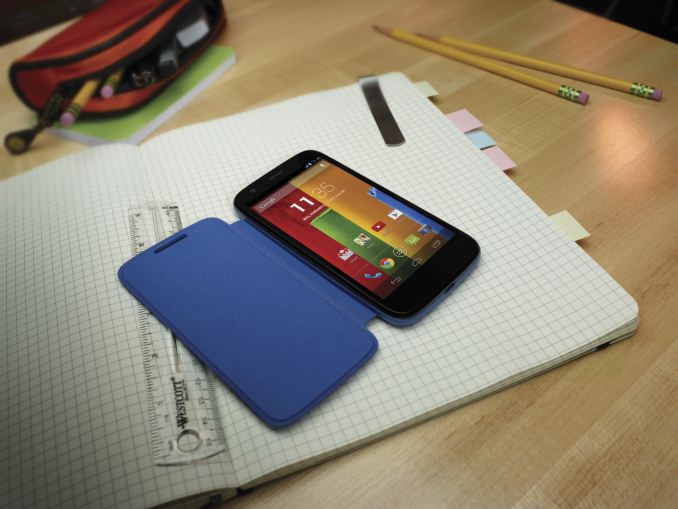
To hit significantly lower price points than the Moto X, we see a number of changes. First and foremost is the adoption of Qualcomm's MSM8x26 SoC, branded as Snapdragon 400. The S400 implementation in the Moto G features four ARM Cortex A7 cores running at up to 1.2GHz and Qualcomm's Adreno 305 GPU. As Brian quickly pointed out after the announcement, Motorola is now in the unique position of shipping a quad-core SoC in its lower end phone and a dual-core SoC in its flagship. Obviously the other members of Motorola's X8 system (NLP & Contextual processors) are absent from the Moto G as well. In practice this means features like Motorola's active display and always on voice commands aren't present on the Moto G.
On the connectivity side, Moto G is listed as supporting GSM/GRPS/EDGE/UMTS/HSPA+ (21Mbps) or CDMA/EVDO Rev.A. There's no LTE support, at least on the version being launched today. Brian suspects that the US delay may be to move to Qualcomm's MSM8926 with integrated category 4 LTE modem, but we'll have to wait until January to find out.
With the Moto G we see a reduction in memory size from 2GB down to 1GB compared to the Moto X, as well as less NAND on-board (8/16GB vs. 16/32GB). Motorola also drops 802.11ac and 5GHz WiFi support. The front and rear facing cameras also see a downgrade compared to the Moto X, but that's to be expected as Motorola's 10MP clear pixel camera was quite costly to implement. The Moto G features a 4.5-inch 720p display, likely LCD based as there's no AMOLED requirement thanks to the absence of Motorola's Active Display.

The Moto G's chassis is clearly Moto X inspired, although slightly taller/wider and thicker. Customization is still a theme of the Moto lineup, but with the Moto G that customization comes through removable back covers. Motorola offers a total of 19 customization options: Motorola Shells that replace the back cover, Grip Shells that have a thicker, rubberized frame for better protection and Flip Shells that include a magnetic flip cover for the display.
| Moto G | Moto X | |
| SoC | Qualcomm Snapdragon 400 (MSM8x26) 1.2GHz Quad-Core Cortex A7 + Adreno 305 | Qualcomm Snapdragon S4 Pro (MSM8960Pro) 1.7 GHz Motorola X8 System (SoC+NLP Processor+Contextual Processor) |
| Display | 4.5-inch 1280x720 | 4.7-inch AMOLED (RGB) 1280x720 |
| RAM | 1GB | 2GB LPDDR2 |
| WiFi | 802.11b/g/n, BT 4.0 | 802.11a/b/g/n/ac, BT 4.0 |
| Storage | 8 GB/16 GB, 2 years 50 GB Google Drive | 16 GB standard, 32 GB online, 2 years 50 GB Google Drive |
| I/O | microUSB 2.0, 3.5mm headphone | microUSB 2.0, 3.5mm headphone, NFC, Miracast |
| OS at Launch | Android 4.3 | Android 4.2.2 |
| Battery | 2070 mAh | 2200 mAh, 3.8V, 8.36 Whr |
| Size / Mass | 65.9 x 129.9 x 6.0-11.6 mm, 143 grams | 65.3 x 129.3 x 5.6-10.4 mm, 130 grams |
| Camera | 5 MP Rear Facing 1.3 MP Front Facing | 10 MP Clear Pixel (RGBC) with 1.4µm pixels Rear Facing 2 MP 1080p Front Facing |
| Price | $179 (8 GB), $199 (16 GB) off-contract | $199 (16 GB), $249 (32 GB) on 2 year contract |


| |
Read More ...
The AMD Radeon R9 270X & R9 270 Review: Feat. Asus & HIS
Launching today is the latest member of AMD's Radeon 200 series family, the R9 270. Today we'll be looking at it alongside AMD's first 270 series card, the R9 270X.

| |
Read More ...
AMD Announces New Game Bundles For Radeon R7 260X & Above

First and foremost, the R7 260X will be joining AMD’s Never Settle Forever Silver tier. This means the 260X gets 2 games from that tier (from a selection of 9 games), just as the 7800 series does today. Furthermore the tier itself is also being updated to coincide with today’s bundle launches; Eidos’s upcoming Thief game will be joining the Silver tier, giving 260X buyers (and all other Silver tier holders) the option of grabbing that game if they don’t mind a wait until February of 2014.

Battlefield 4 of course needs no introduction, being the latest game in EA’s popular line of military shooters. For AMD this means they’ve snagged one of the highest profile PC games of the year, and it means the pump will be primed for December when the BF4 becomes the first game to be Mantle enabled.
Unfortunately there does look to be one bit of bad news here, and that is that this bundle will not be retroactive in any way. Normally we wouldn’t expect this anyhow, but with the bundle coming just a week after the launch of the Radeon R9 290, the timing is unfortunate on AMD’s part since it means the 290 was on sale bundle-less for all of 8 days. But with that said, BF4 is something of an odd title to work with anyhow from a co-branding/marketing perspective. It’s not at all clear if EA would even allow their cash cow to be given away for “free” any closer to its launch, seeing as how it only launched a few weeks ago.


| |
Read More ...
Big City Blues: Verizon Owns up to LTE Service Issues in NYC, Chicago, San Fran
Numerous users are congesting Verizon's overworked network and bumping some down to turtle-slow 3G

| |
Read More ...
Microsoft May Use Fuel Cells at Rack Level for Greener, Cheaper Data Centers
Microsoft is in the early stages of researching this concept

| |
Read More ...
Quick Note: LG "G Flex" Curved Smartphone Self-Heals
The phone can also be flattened without damage

| |
Read More ...
Owner of Lavabit Faces $10K Fine For Protecting His Users From Federal Spying
Protecting your customers may lead to big penalties in today's police state

| |
Read More ...
Motorola Introduces $179 Moto G; Cuts Moto X Price from $200 to $100
The Moto X has had disappointing sales

| |
Read More ...
Acer Travelmate X313 Convertible 11.6-Inch Ultrabook Debuts
X313 has an Intel Ivy Bridge CPU

| |
Read More ...
"Google Play for Education" Launches for Android Tablets, Targets K-12
Google looks to take on Apple in the education sector

| |
Read More ...
GM Will Offer Internet Access in Most 2015 Year Model Vehicles
Pricing not yet announced for the service which is provided by AT&T

| |
Read More ...
Tesla CEO Elon Musk on Model S Fires: There Won't be a Recall
Musk added that a lot of the media has delivered "inaccurate" and "unreasonable" reports in regards to the Model S fires

| |
Read More ...
Available Tags:AMD , APU , PS4 , Radeon , Asus , HIS , Microsoft , LG , Smartphone , Motorola , Acer , Android , GM , CEO ,


No comments:
Post a Comment