

AnandTech Mobile: Pinch to Zoom & Pipeline FP Now Supported

Yesterday, with the help of our friends over at Box, we launched the first responsive version of AnandTech. To recap, our single site design will now present you with one of four different views depending on your browser's reported resolution (not user agent string). You'll get a smartphone portrait, smartphone landscape, tablet or desktop view depending on what resolution your browser supports.
Based on your feedback from Monday our developer John has added a couple of additional frequently requested features:
1) Support for Pinch to Zoom is now enabled in the mobile view.
2) The most recent 8 Pipeline stories are now integrated on the front page (all other front pages had them integrated already).
Next on the list are higher res icons :)


Read More ...
Micron Announces 16nm 128Gb MLC NAND, SSDs in 2014

Micron NAND Evolution |
||||||||||||
50nm |
34nm |
25nm |
20nm |
20nm |
16nm |
|||||||
Single Die Max Capacity |
16Gbit |
32Gbit |
64Gbit |
64Gbit |
128Gbit |
128Gbit |
||||||
Page Size |
4KB |
4KB |
8KB |
8KB |
16KB |
16KB |
||||||
Pages per Block |
128 |
128 |
256 |
256 |
512 |
512 |
||||||
Read Page (max) |
- |
- |
75 µs |
100 µs |
115 µs |
? |
||||||
Program Page (typical) |
900 µs |
1200 µs |
1300 µs |
1300 µs |
1600 µs |
? |
||||||
Erase Block (typical) |
- |
- |
3 ms |
3 ms |
3.8 ms |
? |
||||||
Die Size |
- |
172mm2 |
167mm2 |
118mm2 |
202mm2 |
? |
||||||
Gbit per mm2 |
- |
0.186 |
0.383 |
0.542 |
0.634 |
? |
||||||
Rated Program/Erase Cycles |
10000 |
5000 |
3000 |
3000 |
3000 |
~3000 |
||||||
Micron is targeting 3000 program/erase cycles for its 16nm NAND device. Micron's 16nm NAND is sampling now, and will be in production in the Q4 of this year. Micron expects to ship SSDs based on its 16nm NAND in 2014. If the 20nm ramp is any indication, we should expect 16nm NAND in drives in around a year from now.


Read More ...
Razer Hammerhead Pro Audio Impressions
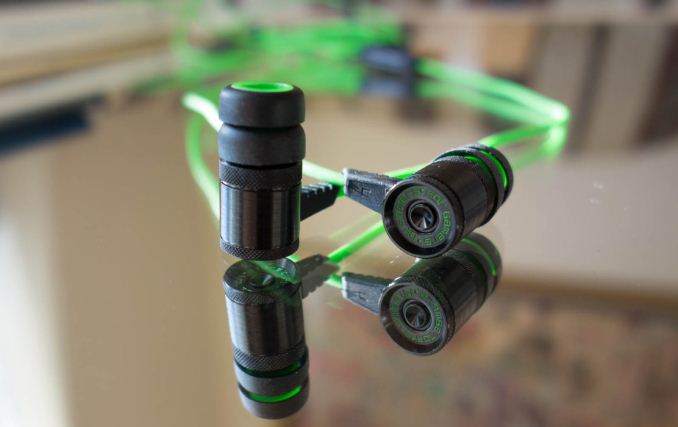
So when Razer told me they had come up with a pair of earbuds that emphasized audio quality, I scoffed. A couple of days later, a set of Hammerhead Pros showed up on my doorstep and I got to test them for myself. The Hammerhead is an in-ear-monitor (IEM) with 9mm Neodymium magnet dynamic drivers priced at $49.95, while the Pro adds an inline microphone for an extra $20. Design and build quality are pretty stellar, with all of the connected pieces being machined from aluminum. There’s some great detailing throughout the design, including knurled aluminum accents and the Razer motto “For gamers, by gamers” stamped into the back of each earbud. Between the black brushed finish of the aluminum and the neon green of the cable, you’re left with a pretty eye-catching set of IEMs.
Given Razer’s recent efforts in the mobile computing space, their motivation in creating a more portable audio solution is pretty clear. It’s a pretty interesting price point, at the intersection of the low end of the audiophile-grade IEMs and the “fashion” earbuds, popularized by the House That Dre Built amongst others. The Hammerheads are certainly styled well enough to compete with the latter, but my interest was looking at them relative to the best budget IEMs. This includes the Klipsch S4, the Etymotic MC5, and my personal pick for best $50 IEM at the moment, the Logitech Ultimate Ears 600, of which I just so happen to own a set.
The Hammerhead sound signature is definitely bass-heavy and tonally warm, though the mids are a bit muddled and instruments aren’t particularly well detailed at the top end. This isn’t really an issue if you’re listening to pop, as the bass-heavy nature of the tracks tends to suit the response of the dynamic driver, but for instrumentally-heavy songs, it certainly isn’t ideal. When compared to the UE 600, a very detailed and responsive set of IEMs, the mids and highs really lack a lot of clarity. The UE 600 is interesting because it’s one of the only balanced armature IEMs you can get at this price point, a feature typically reserved for premium IEMs. Balanced armature drivers tend to respond faster and thus have more accurate, if less bassy, sound profiles. In comparison, the Hammerhead’s overall sound signature ends up feeling not particularly refined, though the bass response is quite nice. It’s neither as crisp nor as balanced, though depending on your music selection it can certainly sound better than the at-times mid-heavy UE 600. Run through a Jay-Z/Kanye West playlist, and the UE 600 just sounds thin, while the warmth of the Hammerhead really shines through. Of course, it should go without saying that audio quality is very subjective, and personal preferences may vary when it comes to sound signature.
Comparing against the UE 600 is probably a bit unfair, because that’s legitimately one of the single best in-ear audio experiences you can get for a street price of $50, with an original MSRP of double that. It’s a legitimately premium set of monitors that’s available on the cheap. Relative to urBeats and most other fashion earbuds, the Hammerheads are a distinct step up, and of course, like any set of half-decent headphones, they’re a huge improvement from OEM-bundled headsets like Apple’s EarPod and the HTC One’s surprisingly not-awful earbuds. I come away pleasantly surprised, because I certainly wasn’t expecting Razer to deliver a competitive audio experience at this price point. For anyone whose primary usage will be music, I would still recommend a set of audio-centric IEMs in this price range, primarily the UE 600s or possibly Klipsch S4s, but the Hammerheads are worth a look. They’re visually impactful and well put together, sound decent (if a bit bass-heavy), and aren’t badly priced, either. For the style conscious, it’s an IEM that could certainly strike the right balance.
Read More ...
South Korean Researchers Turn Rice Husks Into Silicon Battery Anodes
Process could help to turn 80 million tons of trash into a valuable commodity

     |
Read More ...
Microsoft Wants You to Let it Watch Your House in "Near-Real Time"
Is "Lab of Things" big science or big brother? The answer remains to be seen

| |
Read More ...
7/16/2013 Daily Hardware Reviews
DailyTech's roundup of reviews from around the internet for Tuesday

| |
Read More ...
Apple Looks to Scoop up Israeli Firm That Manufactures Xbox Kinect Sensor
Sensors could be put in a Smart TV offering

| |
Read More ...
South Korea Installs Special Smartphone App to Help Prevent Military Leaks
All military personnel will eventually be forced to install the smartphone application

| |
Read More ...
Nissan Struggles with Leaf EV Shortage as Sales Surge
Leaf EV sales market is expanding

| |
Read More ...
Artificial Intelligence System "ConceptNet 4" Has IQ of 4-Year-Old
Enduring an IQ test for children showed that it lacked commonsense

| |
Read More ...
AT&T Launching "Next" Phone Upgrade Plan Starting July 26, Verizon to Announce "VZ Edge" Plan
Both are similar to T-Mobile's new "Jump!" plan in that they allow customers to upgrade their devices sooner

| |
Read More ...
Acer Ditches Thunderbolt for USB 3.0
Thunderbolt is too expensive for anything other than "premium" machines

| |
Read More ...
Available Tags:AnandTech , Microsoft , Hardware , Apple , Xbox , Kinect , Smartphone , Nissan , USB 3.0 , Acer , Thunderbolt , USB ,


No comments:
Post a Comment