

Hit the Road, Jack: Intel’s Mobile Quad-Core Haswell SKUs
Intel 4th Gen Core i7 M-Series Mobile Processors |
|||||
Model |
Core i7-4930MX |
Core i7-4900MQ |
Core i7-4800MQ |
Core i7-4702MQ |
Core i7-4700MQ |
Cores/Threads |
4/8 |
4/8 |
4/8 |
4/8 |
4/8 |
CPU Base Freq |
3.0 |
2.8 |
2.7 |
2.2 |
2.4 |
Max SC Turbo |
3.9 |
3.8 |
3.7 |
3.2 |
3.4 |
Max DC Turbo |
3.8 |
3.7 |
3.6 |
3.1 |
3.3 |
Max QC Turbo |
3.7 |
3.6 |
3.5 |
2.9 |
3.2 |
TDP |
57W |
47W |
47W |
37W |
47W |
HD Graphics |
4600 |
4600 |
4600 |
4600 |
4600 |
GPU Clock |
400-1350 |
400-1300 |
400-1300 |
400-1150 |
400-1150 |
L3 Cache |
8MB |
8MB |
6MB |
6MB |
6MB |
DDR3/DDR3L |
1600 |
1600 |
1600 |
1600 |
1600 |
vPro/TXT/VT-d |
Yes |
Yes |
Yes |
No |
No |
Intel SBA |
No |
No |
No |
Yes |
Yes |
Price |
$1096 |
$568 |
$378 |
||
Along with the traditional Extreme part at the top of the hierarchy, we now get a 4900MQ, 4800MQ, and 4700MQ in place of the previous 3820QM, 3720QM, and 3610QM that we saw with Ivy Bridge. The 4800MQ, 4702MQ, and 4700MQ are 6MB L3 cache parts, so only the 4900MQ and 4930MX get the full 8MB L3. Other than the clock speed variations and the lack of vPro/TXT/VT-d on the 470x chips (which at the same time also get the distinction of being part of the Intel Small Business Advantage platform—basically, for non-managed networks), the parts all have HD 4600 Graphics. That means slightly better iGPU performance than HD 4000, but these are GT2 (20 EUs) rather than GT3/GT3e (40 EUs).
TDPs are up 2W relative to Ivy/Sandy Bridge models, but how that will actually play out in practice remains to be seen. Considering the max TDP is rarely hit under mobile workloads, we don’t expect any major changes, and Haswell is introducing a host of other improvements all aimed at delivering better battery life. Dustin has at least one Haswell notebook in for review, with a high-end CPU and dGPU. It won’t be a great representation of battery life, but at least we can get some idea of how much things have changed relative to the 3rd Generation Core i7 processors.
Intel 4th Gen Core i7 H-Series Mobile Processors |
|||||
Model |
Core i7-4950HQ |
Core i7-4850HQ |
Core i7-4750HQ |
Core i7-4702HQ |
Core i7-4700HQ |
Cores/Threads |
4/8 |
4/8 |
4/8 |
4/8 |
4/8 |
CPU Base Freq |
2.4 |
2.3 |
2.0 |
2.2 |
2.4 |
Max SC Turbo |
3.6 |
3.5 |
3.2 |
3.2 |
3.4 |
Max DC Turbo |
3.5 |
3.4 |
3.1 |
3.1 |
3.3 |
Max QC Turbo |
3.4 |
3.3 |
3.0 |
2.9 |
3.2 |
TDP |
47W |
47W |
47W |
37W |
47W |
HD Graphics |
Iris Pro 5200 |
Iris Pro 5200 |
Iris Pro 5200 |
4600 |
4600 |
GPU Clock |
200-1300 |
200-1300 |
200-1200 |
400-1150 |
400-1150 |
L3 Cache |
6MB |
6MB |
6MB |
6MB |
6MB |
DDR3/DDR3L |
1600 |
1600 |
1600 |
1600 |
1600 |
vPro/TXT/VT-d |
Yes |
Yes |
No |
No |
No |
Intel SBA |
No |
No |
Yes |
Yes |
Yes |
Price |
$657 |
$468 |
|||
Intel has targeted roughly the level of performance offered by NVIDIA’s GT 650M with their Iris Pro 5200 graphics, or roughly a two-fold increase in performance over HD 4000, and that should be enough for everything short of high-quality, high-resolution gaming. What’s even more interesting is that there’s the potential for a reasonable gaming experience with the CPU and iGPU combined still drawing less than 47W of power; GT 650M may still be a better gaming chip, but the combined CPU + dGPU power draw is quite a bit higher than 47W. Of course, even on a 90Wh battery a load of 45W means you’d still get less than two hours of battery life. We’ll see about testing this as soon as we get more time with the hardware.
What I’m not quite getting is the role the 4702HQ and 4700HQ are supposed to fill; they’re still equipped with HD 4600 graphics, just like their MQ relatives, so we’ve asked Intel for clarification. Best guess right now: the MQ and HQ parts are different packages, so the 470xHQ chips are lower-echelon offerings for OEMs/users that don’t necessarily need/want Iris Pro 5200. It’s a way for an OEM to have one laptop that can support a range of processors, rather than locking all the HQ parts into higher-cost CPUs. Maybe down the road, we’ll even see some Core i5 H-Series CPUs, but we don’t have any concrete information on that yet.
For those interested in the desktop side of things, we’ve broken out those parts into a separate Pipeline article.
Read More ...
Gigabyte's 8-Series Haswell Motherboard Tour [video]
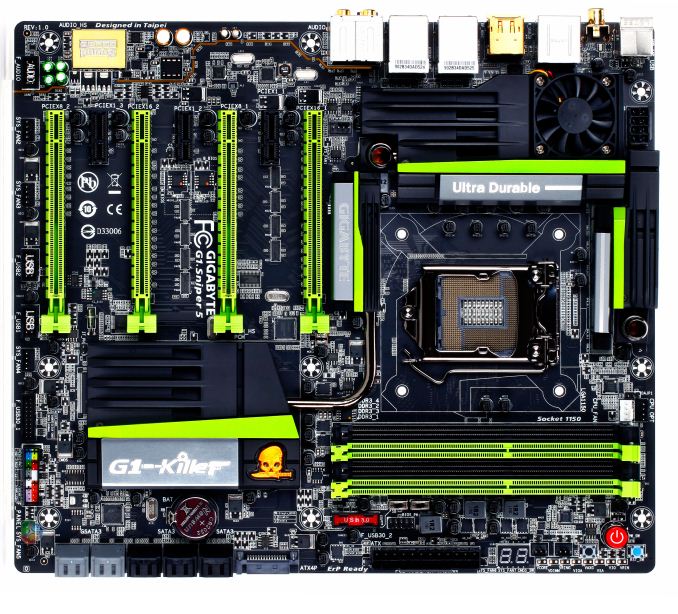
With Haswell the name of the game from the motherboard makers is really polish. With the exception of FIVR (Fully Integrated Voltage Regulator), the 8-series platform is very similar to those that came before it. This gave the motherboard makers time and encouragement to focus on improving user experience as much as possible. As a result we saw tons of attention paid to improving things like UEFI, software utilities and ease of use. Check out the video below to see what Gigabyte did this round.
Read More ...
Intel’s Haswell: Quad-Core Desktop Processor SKUs
Intel 4th Gen Core i7 Desktop Processors |
||||||
Model |
Core i7-4770K |
Core i7-4770 |
Core i7-4770S |
Core i7-4770T |
Core i7-4770R |
Core i7-4765T |
Cores/Threads |
4/8 |
4/8 |
4/8 |
4/8 |
4/8 |
4/8 |
CPU Base Freq |
3.5 |
3.4 |
3.1 |
2.5 |
3.2 |
2.0 |
Max Turbo |
3.9 (Unlocked) |
3.9 |
3.9 |
3.7 |
3.9 |
3.0 |
Test TDP |
84W |
84W |
65W |
45W |
65W |
35W |
HD Graphics |
4600 |
4600 |
4600 |
4600 |
Iris Pro 5200 |
4600 |
GPU Max Clock |
1250 |
1200 |
1200 |
1200 |
1300 |
1200 |
L3 Cache |
8MB |
8MB |
8MB |
8MB |
6MB |
8MB |
DDR3 Support |
1333/1600 |
1333/1600 |
1333/1600 |
1333/1600 |
1333/1600 |
1333/1600 |
vPro/TXT/VT-d/SIPP |
No |
Yes |
Yes |
Yes |
No |
Yes |
Package |
LGA-1150 |
LGA-1150 |
LGA-1150 |
LGA-1150 |
BGA |
LGA-1150 |
Price |
$339 |
$303 |
$303 |
$303 |
$303 |
|
It’s worth pointing out that the highest “Test TDP” values are up slightly relative to the last generation Ivy Bridge equivalents—84W instead of 77W. Whether that reflects a change in how they determine TDP or if it’s simply to give more headroom to the top performing parts isn’t clear. On the desktop, this is probably not particularly important—7W in TDP could often end up being just 1-2W in practice—so we’re not really concerned. Mobile TDPs are a different matter, and as we’ll discuss elsewhere they’re all 2W higher, but that could also be thanks in part to the higher performance iGPU.
Nearly all of these are GT2 graphics configurations (20 EUs), so they should be slightly faster than the last generation HD 4000 in graphics workloads. The one exception is the i7-4770R, which is also the only chip that comes in a BGA package. The reasoning here is simple, if flawed: if you want the fastest iGPU configuration (GT3e with 40 EUs and embedded DRAM), you’re probably not going to have a discrete GPU and will most likely be purchasing an OEM desktop. Interestingly, the 4770R also drops the L3 cache down to 6MB, and it’s not clear whether this is due to it having no real benefit (i.e. the eDRAM functions as an even larger L4 cache), or if it’s to reduce power use slightly, or Intel may have a separate die for this particular configuration. Then again, maybe Intel is just busily creating a bit of extra market segmentation.
Not included in the above table are all the common features to the entire Core i7 line: AVX instructions, Quick Sync, AES-NI, PCIe 3.0, and Virtualization Technology. As we’ve seen in the past, the K-series parts (and now the R-series as well) omit support for vPro, TXT, VT-d, and SIPP from the list. The 4770K is an enthusiast part with overclocking support, so that makes some sense, but the 4770R doesn’t really have the same qualification. Presumably it’s intended for the consumer market, as businesses are less likely to need the Iris Pro graphics.
Intel 4th Gen Core i5 Desktop Processors |
||||||
Model |
Core i5-4670K |
Core i5-4670 |
Core i5-4670S |
Core i5-4670T |
Core i5-4570 |
Core i5-4570S |
Cores/Threads |
4/4 |
4/4 |
4/4 |
4/4 |
4/4 |
4/4 |
CPU Base Freq |
3.4 |
3.4 |
3.1 |
2.3 |
3.2 |
2.9 |
Max Turbo |
3.8 (Unlocked) |
3.8 |
3.8 |
3.3 |
3.6 |
3.6 |
Test TDP |
84W |
84W |
65W |
45W |
84W |
65W |
HD Graphics |
4600 |
4600 |
4600 |
4600 |
4600 |
4600 |
GPU Max Clock |
1200 |
1200 |
1200 |
1200 |
1150 |
1150 |
L3 Cache |
6MB |
6MB |
6MB |
6MB |
6MB |
6MB |
DDR3 Support |
1333/1600 |
1333/1600 |
1333/1600 |
1333/1600 |
1333/1600 |
1333/1600 |
vPro/TXT/VT-d/SIPP |
No |
Yes |
Yes |
Yes |
Yes |
Yes |
Package |
LGA-1150 |
LGA-1150 |
LGA-1150 |
LGA-1150 |
LGA-1150 |
LGA-1150 |
Price |
$242 |
$213 |
$213 |
$213 |
$192 |
$192 |
Obviously we’re still missing all of the Core i3 parts, which are likely to be dual-core once more, along with some dual-core i5 parts as well. These are probably going to come in another quarter, or at least a month or two out, as there’s no real need for Intel to launch their lower cost parts right now. Similarly, we don’t have any Celeron or Pentium Haswell derivatives launching yet, and judging by the Ivy Bridge rollout I suspect it may be a couple quarters before Intel pushes out ultra-budget Haswell chips. For now, the Ivy Bridge Celeron/Pentium parts are likely as low as Intel wants to go down the food chain for their “big core” architectures.
For those interested in the mobile side of things, we’ve broken out those parts into a separate Pipeline article.
Read More ...
Intel Iris Pro 5200 Graphics Review: Core i7-4950HQ Tested
We review what's quite possibly the most exciting Haswell SKU available at launch: the Core i7-4950HQ equipped with Intel's new Iris Pro 5200 graphics.
Read More ...
The Haswell Review: Intel Core i7-4770K & i5-4670K Tested
This is a very volatile time for Intel. In an ARM-less vacuum, Intel’s Haswell architecture would likely be the most amazing thing to happen to the tech industry in years. In mobile Haswell is slated to bring about the single largest improvement in battery life in Intel history. In graphics, Haswell completely redefines the expectations for processor graphics. There are even some versions that come with an on-package 128MB L4 cache. And on the desktop, Haswell is the epitome of polish and evolution of the Core microprocessor architecture. Everything is better, faster and more efficient.
Read More ...
Available Tags:Intel ,


No comments:
Post a Comment