

Explained: System on a Chip: what you need to know about SoCs

The Raspberry Pi is powered by a Broadcom BCM2835 System on a Chip. But there are millions of other devices, all powered by similar means.
Here we'll explain what an SoC is, what it does, and why they exist.
In very broad terms, a System on Chip is a microchip that has all the components required to power a computer. In the case of the Raspberry Pi, the Broadcom chip contains a 700MHz ARM processor and a Videocore 4 GPU.
Q. Are all SoCs so low on processing power?
A. Not at all. The RPi has different priorities than other devices that use SoCs. In fact, newer SoCs sport multi-core processors and GPUs.
Q. But so does my motherboard. How are SoCs any different?
A. First, there's the fact that on a motherboard the different components are housed in separate chips. So there's a CPU, there's a graphics processor, there's memory, and so on. On the other hand, a System on a Chip has all these components on a single chip, and is hardly any bigger than the traditional CPU.
Q. Ah! Is this the reason why the RPi is so puny?
A. Absolutely! A computer needs various components, and while a desktop has room to easily fit them all, it would be virtually impossible on a device like the RPi. Thanks to System on a Chip, we have powerful computers in a much smaller form factor, like a smartphone, with spare room for the batteries.
Q. And that's another advantage, right? These devices don't need a lot of power.
A. That's right, and this is thanks to the very tight integration of the components, which doesn't require much wiring; and this in turn makes these devices a lot more efficient. Take the RPi for example, which only needs 5V to run via the Micro USB type B. In fact, I powered mine using my smartphone's charger!
Q. So, besides the RPi and smartphones, are there any other types of devices that use SoC?
A. If a device fits in your hand and runs on batteries, chances are it's powered by an SoC. So, in addition to smartphones, tablets too are powered by SoCs. In fact, most of the popular Android tablets are powered by Nvidia Tegra 3 and Qualcom Snapdragon SoCs. Even the Microsoft Surface Tab will be powered by the Tegra 3 SoC.
Q. That's awesome! Talking of the RPi, when you mentioned its Broadcom chip, you said it's got a CPU and a GPU. So where's the memory?
A. Well, the revision 2 RPi uses 512MB of SDRAM, and it's stacked right on top of the Broadcom chip via a technology called package-on-package, or PoP.
Q. PoP? Sounds like a quick and cheap fix to a leaking roof.
A. You might be closer than you realise, at least in the quick and cheap sense. Sometimes, it's just not feasible to build an SoC for a particular type of device. On smaller devices, like the RPi and other popular open source hardware devices like the BeagleBoard, manufacturers save space (and money) by piling multiple chips, or "packages" as they'd like to call them, on top of each other.
Q. I'm guessing they don't just glue them on top of each other?
A. The SoC chips use a surface mount technology known as ball grid array. The SoC chips are lined with tiny interconnection pins on both the top and bottom. The manufacturers then solder the lower ones to connect the SoC to the board, and use the ones on the top to connect memory packages. This gives them more flexibility, as they can use the memory from different vendors. For example, some RPi boards have memory from Hynix and others from Samsung.
Q. Ok. So SoCs don't have memory?
A. No, I am not saying that. All SoCs aren't built the same. Some have more components than others, and stack additional components using the PoP technology. It all depends on the intended use of the device.
Q. So what else can you find inside an SoC?
A. Besides the CPU, GPU and the memory, an SoC can house the Northbridge, which is a component that handles communications between the CPU and other components of the SoC. Some SoCs also have the Southbridge, which handles various I/O functions. An SoC meant for a communication device will also include cellular and other radios for 4G, Bluetooth or Wi-Fi connectivity.
Q. In the same vein, can an SoC have non-ARM processors as well?
A. Yes they can. But most SoCs will be powered by an ARM processor. These processors are the preferred choice for SoCs because the ARM architecture delivers high performance without consuming much power, which makes them ideal for power-conscious mobile devices. In contrast, the x86 architecture, although popular on regular desktops, isn't as power efficient.
Q. But are there any x86-based SoCs?
A. Intel is the only manufacturer that has an x86-based SoC for mobile devices. It's called the Intel Atom Medfield. The first smartphone to use this was the Intel AZ210, known in the UK as the Orange San Diego.
Q. If SoCs take up less space, and consume less power, why aren't they everywhere?
A. That's a good question. As wonderful as SoCs are, the benefits come at a cost. Thanks to their tight integration, they lack the flexibility you'd want in a desktop or a laptop. So while you can upgrade your PC with a new CPU and GPU, and add more RAM, you can't do the same for your smartphone.
Q. Bummer. Does that mean SoCs have no use beyond mobile devices?
A. That'd have been true a couple of years ago, but not any more. Traditional CPUs are learning from SoCs and are integrating memory controller, PCI Express and a graphics processor onto the same chip. AMD's Llano and Intel's Valley View are prime examples. Meanwhile, mobile SoCs are becoming more powerful, such as Samsung's Exynos 5, which powers Google's Nexus 10 tablet as well as the latest generation Samsung Chromebook.
Q. Wow! Since the Chromebook runs Chrome OS, which is based on Linux, does it mean these SoCs all support Linux?
A. Well that's a loaded question, and it'll need some explaining. Like I said, a majority of SoCs have ARM processors, and many of these devices, like Android-based smartphones, tablets, and the RPi, run Linux. But it isn't a unified version of Linux. All these devices require a slightly different variation of Linux. In fact, maintaining the different ARM-based SoCs is a huge chore for the Linux kernel developers. As per some reports, every new kernel release has about 70,000 new lines of ARM code, compared with only about 5,000 for the x86 platform! However, starting with Linux Kernel 3.7, multiple ARM SoC platforms will be supported by the same kernel.
Q. So I guess in the near future I'll be able to install my favourite Linux distro on any ARM device.
A. We're headed there, for sure. The most popular devices with ARM SoCs that run Linux are the RPi and the Chromebook. Some people have even managed to dual-boot Chrome OS on their Chromebooks, along with full-blown distros such as Ubuntu and Fedora.
Q. I keep telling my mates that mobile devices are the future of computers. It would seem so are SoCs.
A. Absolutely, but there will always be a market for general-purpose CPUs, where power consumption and a small form factor are less of an issue. Think high-end servers and supercomputers.

     |
Read More ...
Is this mystery LG device the Nexus 5 or Optimus G2?

Photos of an unknown LG device have leaked on the web, with speculation suggesting it could be the rumoured Google Nexus 5 or LG's own as-yet-unannounced Optimus G2 device.
The photo comes courtesy of prolific mobile leak-artist @evleaks and shows a buttonless smartphone, with a redesigned earpiece and an exceedingly slim bezel.
Not a lot else is known about the device, but with rumours abound that LG and Google are set to team up for another Nexus phone later this year, it wouldn't be a huge surprise if this was it.
The Korean company is also expected to update its Optimus G line later this year.
Either or neither
The leaked pictures follow reports late last week, which brought news of three different versions of the LG Optimus G2 devices showing up in benchmarking tests.However, other reports on Friday increased speculation that Google and LG would continue their Nexus partnership with a new handset set to succeed the Nexus 4 in the autumn.
Quite honestly, this could be either device, but it could also be neither. We'll have to wait and see.

| |
Read More ...
Tutorial: Move to SSD: migrate your PC to solid state

By Gandalf's beard! Have you seen how cheap it is to pick up an SSD today? If you're not throwing solid-state boot drives into all of your systems then either you're not saving enough of your hard-earned pennies, or you're just terrified at the prospect of reinstalling Windows.
Well, be terrified no more. Follow our step-by-step guide and we'll show you the fool-proof way to clone your existing boot drive to a fresh new drive for free. This will work with almost anything from your desktop to your laptop, and includes going from HDD to SSD or the other way around.
The main issue is that the new drive has to be large enough to contain all the data on the existing boot partition. Is that obvious? Even better is if the new drive is the same or larger than the old one, but this isn't essential, it just makes life easier.
You should also remember that your system will be out of commission for some time and this isn't a quick process - if you're lucky, and it all runs without a hitch, it can take less than an hour, but if there are issues or errors this can quickly extend to five hours or more, so it's not something to try when you're in a rush.
Step-by-step: Migrating to a new boot SSD
Squeeze your old Windows onto a new drive in easy steps1. Recovery discs

We usually find that the newly cloned drive still needs to have its bootloader rebuilt. To do this we recommend creating a Windows emergency recovery disc (in Windows 8 it's called a Recovery Drive).
Open the Start Menu, type 'Create a System Repair Disc' and select it. You'll need a spare blank CD or DVD to which you can burn this.
2. Remove everything unwanted

Lucky people will have a larger new drive, but if your SSD is a squeeze remove any unnecessary programs to make space.
You can also remove the large hibernation file: open the Start Menu, type 'Command', right-click 'Command Prompt', select 'Run as Administrator', type 'powercfg -h off' and press [Return].
3. Resize partitions

Resizing the existing boot drive is possible, to do this right-click 'Computer', select 'Manage > Disk management'. Right-click on the boot partition that you're going to clone and select 'Shrink Volume...' It'll calculate the amount of space that can be removed. If system files are causing issues see step four.
4. Partition sizing

If you're having issues freeing up enough space and shrinking the partition down due to system files, then you can try the EaseUS partition software. This will physically shift the data to shrink the partition and it's pretty bulletproof, but it will require a reboot into its exclusive mode.
5. Connect the drive

We're getting close to the copy session, so hook up the new drive on a spare SATA or eSATA connection. Easy on a desktop, for a laptop you'll need to use a spare desktop to handle the copying or else use an external caddy. Ideally running over eSATA for speed reasons plus it'll initiate the drive's driver.
6. Select and copy

We prefer Macrium Reflect as our favourite drive copy solution. Largely as it has a pretty interface and we're easily distracted, but also it plays very nicely with Windows. Simply select the boot drive and click the 'Clone this drive' link that appears, select the destination drive and it'll do the rest.
7. Recover it

Once complete, power down, disconnect the old boot drive, permanently install the new one and boot. Whenever we've run the clone process we've always been tripped up by something. Usually Windows will get confused and want the bootloader to be rebuilt. So boot the recovery disc and let it run.
8. And reboot

Any 'recovery' can be completed by the automatic system and should only take a minute to finish. When it's done, the new boot drive will be ready to run. You shouldn't see any change, as it should run as an identical system, although you'll discover it's way faster if you're upgrading to an SSD.

| |
Read More ...
Path app loses access to Facebook's 'find friends' tool, following spam woes

Facebook has blocked Path's access to the part of its API that allows users to find their friends on the social network.
A new version of Path now allows people to find fellow users through their Twitter, Gmail and phone contacts, but the Facebook option is now nowhere to be seen.
Posts and items can still be shared via Facebook, but the app no longer allows invitations or follow requests to be sent to Facebook friends.
Path isn't the only app to suffer such a fate in recent times. Twitter's new Vine video sharing app saw its access to Facebook removed immediately after launch.
Spam woes
The restriction of Facebook's social graph appears to be in direct response to a recent spam messaging controversy, which erupted in the last couple of months.The app came under fire for sending out text invitations to users' contacts without permission.
Digital marketeer Stephen Wright brought the issue to light after his entire phonebook received a text - or in the case of landlines, a robocall - at 6am, even after the app had been deleted.
Officially, Facebook is yet to offer a reason for the new restrictions.

| |
Read More ...
Acer holding off on Windows RT, claims there's 'no value' in current version

Acer has revealed it will not launch tablets running Microsoft's touch-friendly Windows RT operating system until the software update comes later this year.
Speaking after launching a range of new Windows 8 hybrid devices, Acer president Jim Wong told PC World that Windows RT devices were still a possibility for the company.
However, he claimed there would be 'no value' in launching a tablet on the current version of the software and a final decision will not be forthcoming until the expected update arrives this summer.
He said: "To be honest, there's no value doing the current version of RT."
Waiting game
Prior to the launch of Microsoft's new OS, Acer had planned a host of Windows RT devices, based on ARM processing architecture, but was put off by the soft reception received by the Microsoft Surface tablet.The delay was only supposed to be until the second quarter of 2013, but with the next version of Windows RT expected to unlock the possibility for smaller 7-8-inch tablets, it's easy to see why Acer is willing to wait.

| |
Read More ...
Nokia Lumia 928 appears on a billboard, no part of cat left in bag

Nokia, it seems, is so pleased with its new Lumia 928 handset that it doesn't care who knows about it, even though the device is yet to be officially launched.
We've seen several instances of leaked photos and specs in the last few weeks, but at least those were from 'so-called' insiders and not exactly supposed to be in the public domain.
However, This latest appearance on a public billboard, somewhere in the United States, really takes the cake.
If the picture is real (sent to MyNokiaBlog by a reader), and there's little reason to believe it's the work of a photoshop trickster, then the handset will boast "the best low-light smartphone camera."
New camera tech?
What this will entail, we're not exactly sure. Recent speculation had suggested there were not going to be too many changes from the current flagship Lumia 920 device.With that in mind, it would be somewhat of a surprise if Nokia debuted some new camera tech with the handset, whenever it decides to officially launch the Lumia 928
The billboard also features the Verizon Wireless network logo, which ties in with speculation that it'll be an exclusive on that network in the United States. International availability remains a mystery at this point.
It is possible, of course, that the leaks are a deliberate ploy on Nokia's part. It'll face some stiff competition from the Samsung Galaxy S4, HTC One and more, so it could be a subtle way of letting fans know its answer is on the way.

| |
Read More ...
In Depth: 20 great new crowdfunded games

When it comes to innovation, PC gamers always get there first. When consoles had cartridges, we had CD-ROMs. When console games started arriving on DVDs, we got them via digital download. And when games began to appear on Kickstarter, we got everything and console gamers got bog-all.
Despite a so-called upsurge in indie gaming on consoles with titles such as Geometry Wars and Limbo, the PC is still the go-to platform for Kickstarter projects. Why? Because we have Steam, because we play games on the same operating system developers program in, and because PC gamers are a unique breed who salivate over new and innovative projects rather than being drip-fed the next CoD title. In fact, Kickstarter is rapidly reinventing the PC as the single best place to be for innovative and interesting games.
Some fairly hefty developers and big names are actively choosing the PC for their new projects. They don't care about how much money a game's going to make for a major publisher who constricts their every move. They just care about making good games for people who care.
Almost every game we looked at for this feature was a PC title first and foremost. Other platforms like iOS, Macs and Android proved to be popular too, but there was little to no mention of either the PlayStation 3 or Xbox 360, probably thanks to the constraints they put on developers.
The fact that people like Peter Molyneux and companies like Obsidian are choosing not to develop games for consoles speaks volumes about the current state of the industry, which values cynical money-grabbing over actually making decent games. Luckily for us, the shackles have been well and truly released, so let's see what the ex-convicts have been creating.
1. Elite: Dangerous
Developer: Frontier DevelopmentsGoal: £1,250,000
Pledges: £1,578,316

Essentially a business management game in a sci-fi guise, 1984's Elite was hugely successful, and its innovative blend of space exploration and trading inspired the likes of Eve Online and Freelancer. It was also one of the first games to use wireframe pseudo-3D graphics and procedurally-generated levels.
The original game fitted into the BBC Micro Model B's mere 22KB of memory, but that didn't stop developers David Braben and Ian Bell packing in eight galaxies with 256 planets each.
The 16-bit sequel, Elite Frontier, contained a model of the entire Milky Way, complete with a staggering 100 billion star systems. It goes without saying that Elite: Dangerous will be pretty damn big, then.
"Imagine what is now possible, squeezing the last drop of performance from modern computers in the way Elite and Frontier did in their days?" writes Braben. The game will be PC-only to start with, and this makes us really rather happy. Not a lot has been shown yet, but the videos of some of the larger-scale ship combat look impressive.
Compared with the somewhat flaky combat Elite fans are used to being hired to protect actual player convoys looks like it's going to be fun. And hey, there's also that full, dynamic, galactic economy for all those business management fans too.
2. Godus
Developer: 22CansGoal: $450,000
Pledges: $526,563

Peter Molyneux's legendary status is well-earned. He single-handedly invented the god genre in 1989 with Populous, and then created a string of hits throughout the 90s: Syndicate, Theme Park, Magic Carpet and Dungeon Keeper. Black & White in 2001 was an interesting concept that failed to live up to its hype, but he returned to form with cartoony RPG Fable.
Last year Molyneux left Microsoft Game Studios, where he served as creative director, to form his own indie company, 22Cans. Its first project, Curiosity, was an intriguing combination of Deal or No Deal and popping bubble wrap, whereas Godus is pitched as a successor to Populous.
As one would expect, this is the god genre updated for the 21st century. It begins in single-player mode, where you can strike the fear of your god into your land's denizens, before expanding into multiplayer, where you can strike the fear of your god into other people's denizens.
It'll be cross-platform too, taking in Android, iOS and Mac, as well as good ol' Windows. It's an interesting concept, but Molyneux will have to work hard to convince a modern audience that there's still room for the god genre. Ubisoft's From Dust – the most recent deity sim – didn't exactly set the world on fire, even if you could so do in-game. It'll also be Molyneux's first big project outside a major studio for ages. Lets hope his ego is reined in by his teammates.
3. Wasteland 2
Developer: inXile entertainmentGoal: $900,000
Pledges: $2,933,252

Culturally, the 1980s were so obsessed with all things apocalyptic that one could be forgiven for thinking the end of all things actually occurred during the decade. While big screens showed the likes of Mad Max, The Terminator and Akira, gamers got a slice of the dystopian action with Wasteland on the Apple II. The 2087-set game dealt with a group of rangers investigating the hostile remnants of the American Southwest, stumbling across pockets of people who'd survived the nuclear war of 1998 (ahem).
If it all sounds a little familiar it's because Fallout was its spiritual successor, though the two are separate entities due to EA's reluctance to give up the rights. Original developer Brian Fargo bought the rights to Wasteland from Konami, and began the Kickstarter campaign with a $900,000 goal, pledging $100,000 of his own money to meet the required £1 million.
It overshot the original goal by a whopping $2 million, which was enough to get Fallout and Neverwinter Nights developer Chris Avellone on board.
Wasteland 2 may sound a little redundant given the fact that we've already got a perfectly decent set of Fallout games, but the developers promise a return to the stripped-down premise of the original. "It's turn-based, tactical, with a storyline that will be deeper and broader," says Fargo.
4. Project Eternity
Developer: Obsidian EntertainmentGoal: $1,100,000
Pledges: $3,986,929

Wasteland 2 isn't the only Kickstarter project Chris Avellone has a hand in; he's also working on Project Eternity with his employer Obsidian Entertainment. This is an old-school isometric RPG that cites Baldur's Gate, Icewind Dale and Planescape: Torment as influences - all of which Obsidian's staff have worked on in the past.
Project Eternity is a party-based RPG, so you and a handful of cohorts will explore an all-new fantasy world and engage with its inhabitants. It promises a tactical real-time combat system in which you can pause the action, reposition your party and then unleash a devastating attack, which does sound rather cool.
It probably won't be called Project Eternity - that's just its working title - and its reception will determine whether it turns into a franchise. Obsidian went well over its original goal, and is now adding extra features, classes and translations, including an in-game commentary We have high hopes for Project Eternity. Obsidian is a developer that's a little too independent for its own good, and Alpha Protocol and Dungeon Siege 3 both seemed like good games restrained by the meddling of big publishers. Project Eternity's Kickstarter funding could give the developer the freedom it needs.
5. Star Citizen
Developer: Cloud Imperium Games CorporationGoal: $500,000
Pledges: $2,134,374

Games funded on Kickstarter seem to be united by an almost nepotistic interest from industry legends called Chris. Star Citizen's Chris - of the Roberts variety - has himself backed Elite: Dangerous with his own cash, despite seemingly creating a competing game, which is set up to be a continuation of his own Freelancer and Wing Commander series.
It's a huge sandbox space exploration game with a little modding thrown in. You can play as a smuggler, pirate, bounty hunter or merchant in a full, multiplayer universe. There is also going to be a single-player, Wing Commander-esque component too, called Squadron 42. It sounds a lot like 2003's Freelancer, which sort of delivered on the promise of GTA-like sandbox gameplay transposed into outer space.
Star Citizen appears to take place on a far bigger scale though, with its talk of a persistent world (players can summon help if they find themselves in a sticky situation, or man turrets on other players' ships), and already the gameplay videos are looking amazing.
6. Sir, You Are Being Hunted
Developer: Big RobotGoal: £40,000
Pledges: £92,551

Sir, You Are Being Hunted is set in a procedurally-generated sci-fi vision of the British countryside, in which robots stealthily hunt one another, smoke pipes and drink tea.
The game is already nearly finished, but the Kickstarter campaign was launched to provide a vital extra layer of polish. More 'tweedbots' will be added, and animations and AI will be improved. This is exactly what Kickstarter is great for - providing just enough cash to finish a proven project.
Sir, You Are Being Hunted's take on the stiff-upper-lipped ruling classes looks to provide and unique and fun environment.
7. Antharion
Developer: Orphic SoftwareGoal: $10,000
Pledges: $22,508

Despite its bland looks and clichéd exposition (the king's been murdered, blah blah blah), there's a lot to like about Antharion. It consists of a huge world of over 100 dungeons, with 20 cities and 50 unique monster types, and its action point-based combat system sounds solid and exciting. There's also a huge amount of depth in the customisation and NPC design.
8. Maia
Developer: Simon RothGoal: £100,042
Pledges: £140,481

Sitting between The Sims and The Thing, Maia sees you excavating an underground base to protect a group of colonists from the harsh alien world above. Of course, the world below is equally harsh, and subject to alien attacks and seismic activity.
Maia was initially developed by one man, Simon Roth, and the Kickstarter funds are going into expanding the core team.
9. Dysis
Developer: One Dimension GamesGoal: $5,000
Pledges: $27,522

Pitched as a combination of FPS and RTS with a touch of Minecraft's world manipulation, Dysis takes place in a world where you can strategically control an army, or zoom in to third-person mode and take out enemy robots one at a time.
10. Neocolonialism
Developer: Seth AlterGoal: $10,000
Pledges: $6,631 to date

Neocolonialism is the practice of controlling countries using capitalism and business in lieu of military or political control. The game lets you do just this.
11. Radio The Universe
Developer: 6e6e6eGoal: $12,000
Pledges: $78,938 to date

It's nice to see something genuinely weird on Kickstarter. Radio the Universe takes the cuteness of the original Zelda and melds it with some sort of esoteric and horrifically weird anime. Resplendent in its juddery 8-bitness, it sees a cute female protagonist take on a sinister world of machines that look like prototype dot matrix printers, rejected on the grounds that they look too damn scary.
Developer 6e6e6e (see, WEIRD) reckons the game "will take -16,777,216 years to complete," and that "players who die in-game die in real life." We're at once gently intrigued and utterly horrified.
12. Barkley 2
Developer: Tales of Game'sGoal: $35,000
Pledges: $120,335

Barkley Shut Up and Jam: Gaiden quickly became the stuff of internet legend when it was released in 2008. Set in a "post-cyber apocalyptic Neo New York", the game features former NBA player Charles Barkley performing a slam dunk that kills most of the people in attendance.
The sequel (snappily titled Barkley 2 - an RPG Sequel to Shut up and Jam: Gaiden) is set in the year 666X, and sees you take the role of a young man held captive by a malevolent AI called Cuchulainn and then set off on a JRPG-style adventure to find a Cyberdwarf. Right you are.
13. Meriwether: An American Epic
Developer: SortasoftGoal: $35,000
Pledges: $44,489

In 1803, Meriwether Lewis and William Clark were commissioned by Thomas Jefferson to find and map the quickest water route from the east to the west of the United States. It was a treacherous mission, and it forms the basis of this historical RPG.
It may sound a bit edutainical but the game takes certain liberties with history, adding mammoths, giant sloths and Welsh-speaking Native Americans to the Midwest. Also, you have a gun and you can shoot stuff.
14. Distance
Developer: Refract StudiosGoal: $125,000
Pledges: $161,981

Racing games are conspicuous by their absence from the RPG and god-game dominated Kickstarter, but Distance is a nice exception to the rule. It's developed by the team behind awesome university project Nitronic Rush, and it continues that game's love of adrenaline-pumping sci-fi racing, with an added lick of polish.
Developer Refract Studios cites Wipeout as an influence, as well as 'atmospheric' games such as Half-Life and Limbo. The Tron-like world your vehicle races through is peppered with obstacles, but your car can jump over these, and even niftily sprout wings and fly. A nice touch is that the car's stats - such as speed and time – appear on its rear window, negating the need for a heads-up display.
15. Double Fine Adventure
Developer: Double Fine ProductionsGoal: $400,000
Pledges: $3,336,371

Along with the Ouya console and the Pebl watch, Double Fine Adventure transformed Kickstarter from 'cool idea, bro' to 'serious way to fund new and exciting projects'. So if there are any bad games in this feature, blame Double Fine's founder Tim Schafer.
The game itself is ticking along nicely, with a film documenting its creation. Its budget is way beyond those of Day of the Tentacle ($600,000) and Full Throttle ($1.5 million), and Schafer's experience in triple-A game production means he should know how to spend it wisely. It's nice to see him getting back into point-and-click adventures, too.
16. Akaneiro: Demon Hunters
Developer: American McGeeGoal: $200,000
Pledges: $105,201 to date

American McGee's status as a games industry legend is somewhat questionable: his Alice and Grimm titles never quite lived up to their promise, but he's certainly got a unique take on what games can be and should do.
Akaneiro takes its world from fairy tales, but puts a Japanese RPG spin on things, with your heroine fighting a slew of crazy monsters. It'll be free-to-play, with players splashing out on 'karma' if they don't have time for looting, and expansions are planned if it meets its target.
17. Full Bore - An Underground Puzzle Adventure
Developer: Whole Hog GamesGoal: $12,500
Pledges: $16,386

Boars are notorious for their love of platform-cum-puzzle adventures, but Full Bore is possibly the first game to document this phenomenon. You control Frederick, a boar who finds himself tied up in a mining company's financial downturn. This happens to boars a lot. It draws influence from Metroid and Mr Driller, with levels changing depending on the blocks you destroy or shift.
18. Carmageddon: Reincarnation
Developer: Stainless GamesGoal: $400,000
Pledges: $625,143

We spent the best part of 1997 driving ridiculous cars at stupendous speeds, mowing down pedestrians and taking massive amounts of drugs. We are, of course, talking about Carmageddon.
At the time, it was nothing short of revolutionary, blending the jaw-dropping 3D graphics of, say, Ridge Racer, with Doom or Quake's gratuitous ultraviolence. It was followed by a couple of sequels, but for the last decade Carmageddon has been awfully quiet - perhaps due to GTA going all 3D. Until now.
Original developer Stainless Games bought the rights to the franchise from Square Enix, and started a Kickstarter to fund Carmageddon: Reincarnation's development. It was originally scheduled for release right about now, but Stainless revised its schedule and reckons it'll take the entirety of 2013 to come up with the reboot. We're not sure how it'll fit in with the likes of Just Cause 2 and Saints Row 3, but Carmageddon's sheer pugnacity should pull it through.
19. Legends of Dawn
Developer: Aurofinity & DreamatixGoal: $25,000
Pledges: $46,536

A fantasy RPG in the Diablo mould, with an open world and easy modding tools.
20. War For The Overworld
Developer: Subterranean GamesGoal: £150,000
Pledges: £211,371

Coming full circle, War for the Overworld is deeply inspired by Peter Molyneux's Dungeon Keeper, and the godfather of the god sim has given it his full blessing.

| |
Read More ...
Review: Corsair Voyager Air

Despite Apple recently adding a 128GB option to the iPad 4, storage space on iOS devices is still a problem for people who love to watch HD movies on the go.
The Corsair Voyager Air is a 1TB external hard drive (there's also a cheaper 500GB model) that can connect to your iOS device over Wi-Fi, letting you watch video, view photos and open other files stored on it, leaving the storage on your device free to be used for apps and games.
You can load files from your computer onto the Voyager Air using a USB port, or by plugging it into your home network using its Ethernet port, making it act like normal network storage, so any computer can access or load files. It also acts as a media server, letting you watch videos on compatible games consoles and set-top boxes.
Here, we'll concentrate on the iOS support. This hard drive is most useful on the go, thanks to its built-in battery and the ability to create its own Wi-Fi hotspot.
To access the Voyager Air from your iPhone or iPad, you'll need to download the accompanying free app, which will detect the unit and connect, provided you're connected directly to its Wi-Fi hotspot. The app won't detect the Voyager Air through your home network, sadly. Still, it means that wherever you are, you can just flick on the Voyager Air's Wi-Fi switch and then connect to your iPad in the Settings app.
The battery is rated for around seven hours, which isn't brilliant, but should be good enough for most purposes. The Voyager Air comes with both a mains and car charger though, so it isn't a problem to top it up (but bear in mind that it doesn't charge from a computer when connected through the USB 3.0 cable).
Connecting to it is simple, and the app immediately shows you all the files and folders stored on it. There's no media sorting (letting you just view, say, videos) or search function, so you'll need to make sure that you organise everything into tidy folders.
The app isn't the prettiest, but it does its job well, and up to five devices can access it at once. Files and videos that iOS supports natively can be viewed right in the app, so you can watch movies, browse photos and read some documents.
All movies we tried (including high-quality 1080p videos) played smoothly with no obvious deterioration from being streamed; photos looked good, though the app struggled with rotation, displaying some sideways or upside-down.
For files and even video types that aren't supported by iOS, you can use the Open With command in Corsair's app to send these files to a different app that's capable of reading them. So you can open MKV or AVI videos in AVPlayer, open spreadsheets in Excel, or open text documents for editing in the likes of Pages.
Verdict
There are some other features we feel the Voyager Air is missing - internet sharing over Ethernet and remote access most of all, though the latter is planned in an update - but on the whole, it's the most capable external storage for iOS we've seen yet. It's not cheap, but for those who want to have a library of HD video available for their device, it's excellent.
| |
Read More ...
Analysis: Smartwatch or smartglass - which will you be wearing?

Unless you've somehow created a technological void or have stumbled upon this site through some kind of clicking frenzy, you'll know it's been a fascinating few years for portable technology.
There's an extremely high likelihood you could be reading this on a smartphone or tablet right now and as these all-in-one devices fulfill the gadget gaps in our day-to-day lives considerably well, you'd never have thought there would be a need to be any more personally connected than you already are.
Samsung already confirmed
If the rumours are to be believed then almost every major technology brand out there thinks this clearly isn't the case. Samsung - who shipped more smartphones than anyone else in the UK last year - have already confirmed they're working on a smart watch.Of course, any modern-day rumour mill wouldn't be complete without a nod to Apple, who have filed a variety of patents that lend to the credence of a possible 'iWatch' arriving at some point later this year, if not sooner.

Lesser known brands have also taken the wearable market by storm such as Pebble with their smartwatch. Though not so independently intelligent as Google Glass or even Sony's smartwatch, Pebble was clearly seen by the 85,000 or so Kickstarter backers as something more plausible as an accessible entry in to the world of wearable tech.
Without a tether to a compatible Android or iOS device, the Pebble on its own isn't actually particularly smart - its capabilities are reduced to telling the time in a variety of fashions.
With Bluetooth connection to a smartphone though, the Pebble comes alive with a feed of notifications as well as returning intents to the smartphone of choice – such as control over music and many other possibilities - that no doubt developers will realise the full potential of once Pebble makes its way in to the hands of the masses, (many of the Kickstarter supporters are still waiting for their own to arrive).

Google have already laid out their future wearables quite clearly with Google Glass. Though the project has split opinions on whether people actually want to wander around with a prop straight out of Star Trek on their face, the technology is incredibly alluring and enough to make us think we're truly living in the visions of the future laid out for us in films and TV sci-fi series for many decades.
Google in the lead
Google, however, are pretty much on their own when it comes to so-called smartglasses, other than the utterly uninspiring competitor product being touted by Vuzix. It's clear that even manufacturers are not sold on the idea that wearable tech could be so brazenly obvious and literally in your face.A large portion of the group that Google has chosen for their #IfIHadGlass 'competition' are mostly part of the elite, celebrities, high-profile technology journos and ultra-cool extreme sports types that will no doubt have been hand-picked for their circle of influence.
Google is hoping that these folk can convince the average person that wearing $1,500 of advanced technology on their head is the way forward, but it's more likely that over the next couple of years it will just be considered the top-end in wearable possibilities and likely something that most people just aren't ready for.
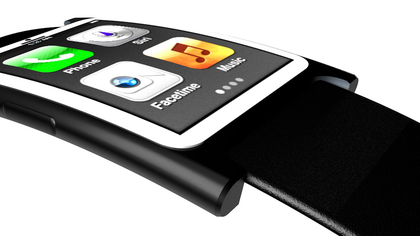
A smart watch, on the other hand (or wrist), costing a fraction of the current price-tag of Google Glass is much more appealing to the general public.
They could have a trendy wrist adornment supplying them with all the important stuff they need to be aware of without causing the social faux-pas of getting out their smartphone at the most inopportune moment.
Conversely, believing that colleagues, partners or bosses would be comfortable with us having a constant stream of distractions fed to our retinas in the form of some kind of headwear still seems a little far-fetched.
With the additional accessory of a high-resolution camera, the smartglasses become not only a potential privacy debate for tabloids to faun over but also something that will likely be banned in a variety of locations or institutions.
Smartwatches will be first to mass-market
So for now, smartwatch it is. The Apple iWatch, iWrist, iTime or whatever iNalogy they decide to call it will of course be incredibly popular.It isn't going to be the cheapest of the wearables by a long way but Apple's intentions with the previous generation iPod Nano and wrist-strap accessories showed a glimpse in the direction Apple is likely to go.
It's difficult to see them making it as just an accessory to a smartphone akin to the Pebble, because as with every other portable device they've ever produced, it has to stand up on its own if it's going to be the consumer's device of choice for pouring money in to Apple's lap; indeed it could even be marketed as the 'Next iPhone'.
It goes without saying that Samsung will introduce something similar, likely at a cheaper price point than Apple, and many other brands such as LG will jump on the wagon right behind them.
If this year isn't, then 2014 will be the year of the smartwatch, when being concerned with details such as the time and date will be a minor function of whichever brand you choose.
You'll be wondering what you ever did without one and we can only hope that being head-down and glued to your smartphone will be replaced by scores of us checking our watches repetitively as if time had suddenly gained a whole new level of importance.

| |
Read More ...
Available Tags:LG , Acer , Windows , Nokia ,


No comments:
Post a Comment