

AMD gets feisty with new Z-Series APU

One week after AMD introduced its second-generation A-Series APUs for desktops, the company is at it yet again with an all-new Z-Series processor.
The Z-60 is the company's "latest entry in the performance and small form factor PC market," the company said in a press release, and supports the latest Windows 8 apps and user interfaces.
Not to be forgotten, it's also compatible with Windows 7 and the full-suite of legacy Windows applications.
It's the Sunnyvale, Calif.-based company's lowest powered APU yet, capable of delivering power and performance to devices as thin as 10 millimeters.
Coming soon to a Windows 8 device near you
AMD said the Z-60 is expected to get its global kick off this year as Windows 8 becomes available.
While it's certainly capable, AMD said this particular processor is meant to fill a void in the market.
"Tablet users seeking an uncompromised experience for both creating and consuming content on the Microsoft Windows 8 platform now have a performance-driven, affordable option with the AMD Z-60 APU," said Steve Belt, corporate vice president of Ultra-Low Power Products, AMD.
"We see a large gap between the lower performance and high-price competitive offerings that allow AMD to be in tablet designs that will please our customers and end users alike."
From A to Z
Talk is one thing, but what does the Z-6- bring to the table?
According to AMD, the Z-60's designed to enhance the tablet experience, providing fast boot and resume from sleep times plus eight hours of battery life while browsing the net.
Clocked at 1 GHz, the chip has two CPU cores and 80 AMD Radeon cores.
HD video playback takes two hours off battery life, though the Radeon graphics on the chip, with full HD 1080p support more than make up for any lost power time.
It also supports HDMI output and provides solid gaming performance with Microsoft Direct X 11 capability.
As with other AMD APU-packing tablets, those with the Z-60 allows for AMD AppZone access.

 |  |
Read More ...
£35m research centre to make UK a 5G hotbed

After arriving as a relative latecomer to the 4G LTE party, in global terms, the government is aiming put the UK ahead of the pack for future 5G development.
The coalition has teamed up with mobile giants Samsung, Telefonica (which owns O2 in the UK) and Chinese manufacturer Huawei, among others, to set up a new research centre at the University of Surrey.
The £35m project, £11.6m of which will be funded by the taxpayer, will make the UK "the playground for advanced mobile technologies," according to professor Rahim Tafazolli, who'll lead the research.
Tafazolli said that the next generation tech, whatever that may turn out to be, will probably arrive in around ten years time, and speculated that it may see speeds of 10Gbps come to mobile handsets and tablets.
Push towards standardisation
Of the project, he told Gigaom: "We're bringing all the major stakeholders together and we are going to decide on the advanced technologies and test them end-to-end.
"Once we are happy with the set of technologies that we have developed, in terms of performance, then we will push that particular technology towards standardisation."
A press release from HM Treasury, which announced the plans as part of $1 billon of investment into university and private research, said the so-called 5G Centre will bring together global industry leaders and "provide real-time experimental facilities to underpin the development of new mobile broadband internet products and services."
4G LTE? More like 4G LATE
While this is great news for the UK communications industry, it does seem a little odd to be talking about pushing towards 5G when the nation is yet to officially possess a fully-functioning 4G LTE network.
The Everything Everywhere 4G network will finally go live on this month in major cities, while the rest of the networks will scrap for the remaining 4G-ready spectrum in the Ofcom-led auction early next year.
Although UK smartphone users will be happy to finally receive next generation internet speeds as 2013 approaches, it still comes long after the infrastructure was established in North America and much of Europe and Asia.
It seems the government is keen to rectify this ill, so perhaps when fifth generation mobile speeds do arrive, the Brits will be first on the scene?

| |
Read More ...
Windows 8 won't require Microsoft Points for payments

Much to the delight of Xbox 360 gamers everywhere, Microsoft has decided that it won't be requiring Windows 8 users to purchase apps using its Microsoft Points system, instead offering credit cards as the default payment system.
While early builds of Windows 8 all required Microsoft Points to purchase or rent videos, the most recent release has shifted the default payment method for digital content through the operating system to credit card.
Microsoft Points - which have been the traditional payment method for digital content via the Xbox 360 console since its launch - requires customers to prepay for a collection of points, which are then in turn used to purchase content.
The Points system of paying for content has long been regarded with disapproval from gamers, who are required to spend more money than the piece of content they want actually costs in order to have enough points for the purchase.
It also created confusion around the actual value of the content being purchased, especially given Microsoft Points were valued differently around the world.
The end of Microsoft Points?
While Microsoft Points will still be a payment option in Windows 8, the default has been switched to credit cards, allowing customers to know exact amount they are spending.
But the shift away from the Points system at the 11th hour of the Windows 8 release schedule has some pundits wondering if it will herald a demise in the payment method. Especially given the rumour mill had Microsoft getting rid of the system earlier this year.
As yet, Microsoft hasn't commented on the shift to real currency or whether or not the Xbox console might see a similar shift away from Points. If it does, it will surely be a change welcomed by gamers everywhere.
Via: The Verge

| |
Read More ...
Box adds new features for Security and BI

US Cloud storage business Box has made some upgrades to their security features and added an open API to enable business intelligence tools to be integrated into the platform.
Security updates include a two-step log-in verification, advanced admin console controls and a partnership with security-as-a-service vendor ProofPoint.
The open API allows developers to incorporate Box activity logs to third-party business intelligence platforms, such as GoodData, to report and monitor events and activities on the Box systems.
"Businesses today need to work fast, collaborating across teams, organisations, companies and countries – the ability to securely share, manage and access content in the cloud can be the difference between winning and losing," said Whitney Bouck, GM of Enterprise at Box.
The new security enhancements were showcased at BoxWorks 2012, the company's annual customer conference and industry event, currently taking place in San Francisco .
Box and Proofpoint Integration
Box is announcing a new relationship with Proofpoint to offer enhanced security, compliance and control over documents shared via Box. The integration simplifies how IT admins identify restricted content and remove it from shared folders, protecting against the loss of confidential information. Using the Box API, when a file is uploaded, Proofpoint's security-as-a-service is notified, will scan the file, and if it finds content in violation of policy, will alert the administrator.
New Advanced Search in the Box Admin Console
Box is also enhancing search for admins, giving IT more tools to rapidly find any content, anywhere on Box. Files can quickly be searched by filename, content type, date range, size and context. Additionally, admins can easily save their most common queries for repeated access through a bookmarked URL, making regular reviews of content simple and straightforward.
New Reporting API and Business Intelligence Partners
The new reporting API, enterprises can now incorporate Box activity logs to third-party business intelligence platforms, such as GoodData, to report and monitor the events and activity that occur as employees collaborate with internal and external partners. If unusual shifts in usage, spikes in traffic on Box or abnormal behavior occur – a user downloading several hundred files at once, for example -- admins can be alerted in real time and take appropriate action.
Two-Step Login Verification
Box has also expanded its authentication choices with the introduction of native 2-step login verification to supplement the current multi-factor authentication through single sign-on partners like Ping, Okta, Intel, OneLogin and VMWare.

| |
Read More ...
Pogoplug launches cut-price cloud backup solution

In the past off-site storage has been expensive but with the introduction of a new service from US startup Pogoplug there's really no excuse not to experiment with cloud-based off site storage.
US storage startup Pogoplug has launched a new cloud-based backup service that gives businesses access to 100Gb of offsite cloud based storage for just £19.99 per year.
The multi-platform solution works with desktops and mobile devices and once backed up the data is available to access and share on any device with an internet connection.
The service is based on Amazon's new Glacier data archiving storage solution - which was designed by Amazon to be a write-once long-term storage solution for large corporates. But to enable a fast retrieval time, Pogoplug have added their own proprietary cloud accelerator front-end software to turn the archiving storage into a more active solution .
"Amazon is revolutionizing cloud storage with Glacier. Our new offering provides the missing link by eliminating the slow retrieval time intrinsic to Glacier and making all content instantly accessible," said Daniel Putterman, CEO of Pogoplug.
Pogoplug also keeps users' data twice as safe by storing and synchronizing a secondary copy of content on Amazon Glacier.

| |
Read More ...
Apple reportedly shipping Lightning-to-30-pin adapters

Apple started shipping the first round of Lightning-to-30-pin adapters, at least in Australia.
This much-needed accessory enables iPhone 5, iPod touch 5th Generation, and iPod nano 7th Generation owners to use their older 30-pin dock connectors. It will also be clutch when Apple rolls out the iPad mini and refreshes the iPad.
According to a MacRumors posting, the Lightning-to-30-pin adapter is scheduled to be delivered on Oct. 9 to its first-known customer Down Under.
As handy as this accessory is, it does come at a cost. That lucky first Australian recipient had to pay AUD$35 (US$29, GB£18) for the special accessory.
It's even more expensive for the Lightning-to-30-pin adapter that comes with a small cord: AUD$45 (US$39, GB£30). Yes, it's $10 more for a 0.2 millimeter cord.
Lightning-to-30-pin may be the only option
Apple customers will have to put up with those prices for a while. There's a unique hardware chip within the Lightning cable preventing cheap knock-offs from flooding the market.
Amazon lists a few third-party Lightning adapter retailers like Nanotch and iTronz, but both have "Currently unavailable" on their respective product pages.
Apple has gone as far as to demand approval of all third-party Lightning accessories. So instead of buying a small company's cheap adapters made in China for a third of the price, customers will be forced to buy Apple's cheap (to make) adapters, also made in China, for an inflated price.
The good news is that the Lightning cable is here to stay, so the $US29 and $US39 for the adapters can be seen as a 10-year investment.

| |
Read More ...
Angry Birds Star Wars soaring in November

The rumors are true, as Rovio begins to pull back the curtain on their biggest partnership yet to create Angry Birds Star Wars.
Launching on Nov. 8, the game will recast the popular disgruntled flyers as "Star Wars" characters.
However, "they are not Angry Birds dressed up as Star Wars characters," according to Paul Southern, Lucasfilm Ltd. vice president of licensing and consumer products marketing. "They are characters in their own right."
Promo art shows Luke Skywalker taking on the role of the iconic Red Bird, along with aviary adaptations of Princess Leia, Han Solo, Chewbacca, Obi-Wan Kenobi, C-3PO, and R2D2.
The pigs, of course, will transform into the stormtroopers and even Darth Vader himself, with masks and helmets giving the traditional "Star Wars" villains an appropriately pig-like snout.
The birds strike back
The game itself will follow the mold of the recently released Angry Birds Space, as planets from the "Star Wars" universe offer their own gravitational fields and environmental hazards from the desert of Tatooine to the freezing cold of Hoth.
"We wanted this to feel like one of the biggest, if not the biggest, entertainment launches of the year," Rovio Executive Vice President of strategic partnerships Andrew Stalbow said.
To build on top of the game's release, Rovio partnered with Hasbro for a range of Angry Birds Star Wars toys, including figurines, plush dolls, play sets, and a new version of Jenga where players must break apart a pig-shaped Death Star.
Rovio also partnered with Rubie's Costume Company to create four Halloween costumes based on the beaked versions of Luke Skywalker, Princess Leia, Darth Vader, and a Stormtrooper.
All of the festivities begin on Nov. 8, when Angry Birds Star Wars gives new meaning to the Millennium Falcon on iOS, Android, Kindle Fire, Mac, PC, Windows 8, and Windows Phone 8.

| |
Read More ...
Asus wins big at the T3 Awards 2012 as Nexus 7 grabs top gong

The T3 Awards winners have been unveiled at a glittering event in London – and it is Taiwanese company Asus that have stolen the show, picking up five gongs including the headlining gadget of the year.
Asus has certainly had a stellar year, but it was the 7 inch tablet made in conjunction with Google – the Google Nexus 7 that picked up the night's most important award and the Tablet of the Year title.
But Asus will also be proud to have snapped up the T3 Design Awards for the Eee Pad Transformer Prime, the computer of the year for its Zenbook UX31 and, fittingly, brand of the year for a stellar 2011-12.
Apple and Raspberry
Apple is traditionally a big winner at the awards, but it picked up only one this year – with the iPhone 4S getting Work Gadget of the Year.
Innovation of the Year deservedly went to the UK-designed Raspberry Pi computer and Sony's PS Vita won Gaming Gadget of the Year.
Go for Zeebox
Sky Go has done amazingly this year and picked up the Digital Media Service of the year and one of Sky's partners, Zeebox, was picked for App of the Year.
Nike's innovative fuelband grabbed the Gadget Accessory of the Year, Amazon was named Retailer of the Year and Bowers & Wilkins' P3 won the Music Gadget award.
Thermostatic
Nest's Smart Thermostat got the Home Gadget Nod and it was Panasonic's Lumix DMC-GX1 that pipped the DSLRs to take the camera of the year title. Sony's Bravia KDL-55HX853 was TV of the Year.
In the celeb categories Lord Sugar got the Outstanding Contribution award and the BBC's Rory Cellan-Jones got Tech Personality of the Year.
TechRadar is published by Future Publishing, which runs the T3 Awards, and UK Editor in Chief Patrick Goss is a long-term judge of the awards.

| |
Read More ...
Samsung's Galaxy S3 grabs T3 Phone of the Year award

The Samsung Galaxy S3 has been awarded the T3 Phone of the Year, beating out the likes of the HTC One X and the Apple iPhone 4S.
As TechRadar's Samsung Galaxy S3 review suggests, this is the standout handset of the year, and it sits proudly at the top of our Top 20 Best Mobile Phones list.
Although the Apple iPhone 5 arrived too late to be a competitor in the T3 Awards, it sits only at number 3 in our list.
The Samsung Galaxy S3 is certainly not without competition in the phone market, and the giant handset battled against the likes of Sony's Xperia S, its brother the Samsung Galaxy Nexus, Nokia's Lumia 900 and the beautiful HTC One X.
T3 Phone of the Year 2013
Given the nominees for this year you can already begin to draw up a likely list of candidates for the T3 Awards 2013, which will could include the Nokia Lumia 920, HTC One X+, the Windows Phone HTC 8X and the as yet unannounced LG Nexus phone.
And who would bet against a Samsung Galaxy S4 competing to follow in its predecessor's footsteps?
TechRadar is published by Future Publishing, which runs the T3 Awards, and TechRadar UK Editor in Chief Patrick Goss is a long-term judge of the awards.

| |
Read More ...
How to create a mobile website for your business

More and more people are starting to access the internet from their mobile phone, and analyst Morgan Stanley estimates that if smartphone sales continue at their current pace, then the number of users accessing the internet on a phone will exceed desktop internet users by 2015.
While most smartphones can access the internet the experience they get is less than perfect, as most websites just aren't designed for mobile phones. By creating a mobile-friendly site, you won't just get access to more users: you'll also have a huge leap on your competitors.
Before you create a mobile website it's worth looking at why most websites are hard to access and use on a mobile. Sites designed for desktop users are huge.
Website size matters
Take the TechRadar site as an example, our front page has lots and lots of columns of information, which can be difficult to see and navigate, even on the best iPhone Apple can make. It's also 2.96Mb in size, which, on a fast 20Mbps broadband connection takes less than a second, but on a mobile, in an area with a poor connection it can take minutes to download.
Ideally, you'll want your mobile website to be quick to access, be simple to navigate and be organised in more mobile-friendly chunks.
Mobile site build strategies
There are several different strategies you can adopt for building a mobile website; start afresh and build a completely new website, or adapt your current site. For most businesses the latter option is best, it allows you to dip your toe in the water, and if it works then you can then move to a site that has a mobile strategy at its core.
The quickest way to construct a mobile site is to look at one of the many online mobile portal tools. These services allow you to create mobile sites in just a few minutes or a few hours or little cost.
The sites you build are either created from a selection of pre-defined mobile templates, or they allow you to create new mobile templates using drag and drop features.
With most of the mobile portal building sites, you create a basic mobile site either by specifying the functions you want or, in some cases, you drag and drop the features you want on to a dummy mobile screen.
The range of functions available can be limited - although most portal builders are adding new functions all the time, - but most allow you to create multiple pages and sections, add feedback forms, create links to social networks like Twitter and Facebook, and have some sort of analytics to tell you where your customers came from.
Here's just a small selection of the current tools for creating a mobile website.
Wapple http://www.wapple.net
Wappledescribes itself as "the most advanced mobile web build, development and publishing technology" and it's not an idle boast. With Wapple you can create very sophisticated mobile websites and have them up and running very quickly.
There are two ways to develop with Wapple, you can either use the simple drag-and-drop controls which will get you a workable and well-designed site in less than 30 minutes. Or you can drill-down and tweak every element of a page and produce something very sophisticated.
Features include click-to-call, SEO functions, polls, questionnaires, a mobile shop, built-in forms, analytics, social media, video and Google maps integration.
mobiSiteGalore http://www.mobisitegalore.com
mobiSiteGalore has a huge selection of available features that you can draw on to create some very sophisticated mobile websites.
Features include widgets to do site search, add Google News and Sitemap, as well as creating click-to-call features, ecommerce features include the ability to accept Google checkout, PayPal or Bango payments, and design features include photo galleries through to adding audio and video clips.
mobiSiteGalore has a free limited trial service that allows you to setup a website with three pages and limited features and hosting, through to a professional pack with unlimited pages and features for just $225 a year.
MobilePress http://mobilepress.co.za
If your website is built using the WordPress content management service (CMS) then MobilePresswill get your business up and running very quickly.
MobilePress is a free WordPress plugin that will enable you to browse your WordPresswebsite on mobile handsets, with the ability to use customised themes.
Built into MobilePress is the ability to track your mobile sites analytics and serve ads from some of the biggest mobile ad networks such as Admob, Quattro Wireless, Buzzcity and InMobi. You can also serve you own managed ads.

| |
Read More ...
Kinect gets Windows 8 update and releases in China

Microsoft announced an update to the Kinect for Windows' software development kit, or SDK, in preparation for the launch of Windows 8.
A number of enhancements to the SDK will provide developers with new data in the API for their Kinect applications.
For example, API access to accelerometer data will allow developers to determine the Kinect sensor's orientation, and extended-range depth data will allow Kinect to return data from objects more than four meters away.
Developers will also have access to the Kinect camera's brightness and exposure settings, as well as infrared stream exposure settings, opening up new environments such as low-light settings.
The updated SDK will also better support multiple Kinect sensors working together, with faster infrared sensing and improved skeletal tracking.
Windows 8 compatible
In addition to the Kinect's new technical capabilities from the update, the new SDK makes Kinect sensors compatible with Windows 8, allowing developers to create Windows 8 desktop applications using the 3D camera.
Kinect applications support Visual Studio 2012 and Microsoft's .NET Framework 4.5. With the updated SDK, developers can also create Kinect applications for virtual machine environments, including Microsoft Hyper-V, VMWare, and Parallels.
Microsoft also launched the Kinect sensor for Windows in China, with launches to soon reach Chile, Colombia, the Czech Republic, Greece, Hungary, Poland, and Puerto Rico.
Kinect is still gaining support from various fields, used in applications for manufacturing and even medical purposes, and the new SDK features will help to further expand those uses.
Microsoft has not given up on Kinect for gaming yet either, as recently leaked images hint at an even more accurate sensor in store for firm's next console, commonly referred to as the Xbox 720.

| |
Read More ...
32GB Nexus 7 tablet accidentally shipped to unsuspecting customer

Currently, Google and Asus' Nexus 7 tablet is only officially available in 8GB and 16GB varieties.
Unofficially, though, a 32GB Nexus 7 may arrive at customers' doors anyway.
One Japanese customer, who reportedly ordered a 16GB Nexus 7 from the Google Play store, said on Monday that he actually received a 32GB device.
It's unclear how this may have happened, but if it's true then Google won't be able to deny the 32GB Nexus 7's existence for much longer.
An honest mistake?
The 32GB Nexus 7 reportedly arrived in the packaging of a 16GB model, but the device itself shows more than 26GB of free space in its settings.
It seems the person in charge of jamming these Nexus 7 tablets into their boxes may have pulled one from the wrong pile.
Then again, this could simply be a hoax.
TechRadar reached out to Google and Asus to find out if either company would like to respond to this latest development in the saga of the 32GB Nexus 7, but so far there's been no response.
The fabled 32GB Nexus 7
Rumors of a 32GB Nexus 7 first popped up way back on Thursday, when a database listing at Carphone Warehouse seemed to reveal the device's existence.
Then, on Friday, the 32GB Nexus 7 spontaneously appeared on several other retailers' sites, with one even assigning it an Oct. 24 ship date.
This latest development simply adds to the likelihood that the already-likely 32GB Nexus 7 really exists - especially given that the Google tablet's main competitor, Amazon's Kindle Fire HD, will soon arrive with 32GB of storage itself.
It looks like the one question remaining is simply when Google will choose to admit it.

| |
Read More ...
T-Mobile introduces LG Optimus L9 to lineup
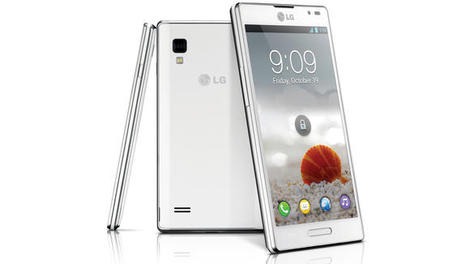
Apple may have snuffed T-Mobile out of the iPhone 5, but the wireless carrier hasn't taken it lying down as last week it announced a deal to buy MetroPCS and Monday revealed a new addition to its listings: the LG Optimus L9.
This dual-core device comes set with Android 4.0: Ice Cream Sandwich and a 4.5-inch qHD Corning Gorilla Glass 2 Display (just try to crack it).
The 4G phone's only 0.36 inches thin and comes as a follow-up to T-Mobile's Optimus L3, L5 and L7.
According to a press release, the L9 drops this fall.
Lovin' for the L9
T-Mobile is clearly enamored with the product, playing up its "sleek, stylish design and slim profile," surrounded by a "premium metal trim to provide designer-level styling."
LG put a 1GHz processor in the L9 while also embedding a 5MP camera with LED flash and 1080p HD recording capabilities. It can even capture a photo and video at the same time.
One nifty photo feature is the "Cheese Shot," which lets users take a pic simply by saying, "Cheese."
Note taking is also a breeze thanks to the LG QuickMemo feature, which lets users add commentary, notes and drawings of their own design to screenshots "with a few swipes of the finger."
The battery is a durable 2,150mAh while Wi-Fi calling allows for making rings with little to no coverage (like in a basement, the companies offer).
No word yet on pricing.

| |
Read More ...
Cisco abandoning ZTE over cover-up, Huawei responds to HPSCI report

Following an intelligence report proposing products manufactured by Chinese firms ZTE and Huawei should be banned fin the U.S., California-based Cisco appears to be taking the first step by ending a sales partnership with ZTE.
The U.S. House Permanent Select Committee on Intelligence (HPSCI) spent nearly a year investigating both Chinese firms, which are now considered national security threats.
The committee recommended national security should zero in on manufacturers like these two companies.
Another report on Monday found Cisco Systems, Inc. conducted its own independent inquiry into allegations ZTE had sold the Cisco-branded networking hardware to Iran.
ZTE under fire
In July 2011, a parts supply list revealed a deal between ZTE and an unnamed Iranian telecommunications company to provide five Cisco-branded switches.
Such sales are a breach of international embargoes against Iran, and the deal soon caught the watchful eye of the FBI after ZTE's U.S. general counsel accused the parent company of attempting to cover up the deal and destroy evidence.
"ZTE is highly concerned with the matter and is communicating with Cisco," said David Dai Shu, a ZTE spokesperson, about Cisco most decision to jettison ZTE.
"At the same time, ZTE is actively cooperating with the U.S. government about the probe to Iran. We believe it will be properly addressed."
Cisco declined to comment on ZTE specifically, but CEO John Chambers said in a recent interview with Reuters that the company would not "tolerate any direct or indirect sales" to Iran.
"When that occurs, we step up and deal with it very firmly," Chambers said. "So I think you can assume that you will not see that happen again."
Huawei responds
Meanwhile, Huawei released a statement regarding the draft of the HPSCI's report that's made the rounds, claiming it should be treated "no different from any start-up enterprises in Silicon Valley."
"The report conducted by the House Permanent Select Committee on Intelligence, which took 11 months to complete, failed to provide clear information or evidence to substantiate the legitimacy of the Committee's concerns," Huawei fired back.
"We had hoped to ensure that the investigation would be fact-based and objective in its review of our business activities and the global issue of cyber-security," the company added.
"However, despite our best effort, the Committee appears to have been committed to a predetermined outcome."
In closing, Huawei promised to uphold the same "upstanding record" the global Fortune 500 company has had for the past 25 years.
"Moving forward, we will continue to do the best we can to provide our customers with safe, convenient, and equal access to information and communications services."

| |
Read More ...
Sprint will offer unique vanity numbers - for a price

Sprint has announced that it will be the first wireless carrier to proved users with their own vanity numbers, through a partnership with Zoove, the creators of the "StarStar Me" service.
The "star star" numbers will cost an additional $3 a month, but they're highly customizable - they're not even limited to 10 digits like most phone numbers, and they apparently don't require an area code at all.
StarStar Me numbers begin with two asterisks - hence the "star star" - followed by any combination of five to 10 numbers.
Users can choose their names - an example would be **MICHAEL (though **MIKE is unfortunately too short) - but any string of characters will do.
StarStar Me: the next big thing?
When you call a StarStar Me number it causes a user's phone to ring, of course.
But it can also use a special app to send the caller an audio or text message linking to a social media or StarStar Me profile.
StarStar Me numbers are now available through Sprint, but Zoove CEO Joe Gillespie purportedly said that "the remaining three" (presumably referring to AT&T, Verizon and T-Mobile) will offer their own StarStar Me numbers by the first quarter of 2013.
It's unclear whether those deals have been inked, but Gillespie seems confident that StarStar Me numbers could be offered on all four carriers by then, "if not by the end of the year," he said.
We're calling **STARMAN right now
Before now, Zoove focused on offering StarStar Me numbers to businesses, but the Palo Alto, Calif.-based company reportedly said that it had been missing out on a big opportunity by not offering the numbers to individuals, as well.
Zoove reportedly has millions of combinations of StarStar Me identifiers available, having allocated mere thousands out to business so far.
That said, all the good ones will likely get taken early, so interested Sprint users should jump on board quickly.
You wouldn't want to get stuck with a random string of numbers, would you?

| |
Read More ...
Lenovo ThinkPad Tablet 2 to start at $629

Drip by drip, information about Lenovo's forthcoming ThinkPad Tablet 2 has trickled out, with the latest pinning a starting price on the Windows 8 slate.
A Lenovo spokesperson has confirmed to TechRadar that the tablet will start at $629 (UK£392, AU$612). That price does not include the keyboard/dock, which the spokesperson said will be available "as an option."
We are still waiting to hear back on a price for that piece.
Earlier this month, we learned the tablet would be available in most parts of the world Oct. 26, though some countries might see a delay due to language verification.
Major countries like the U.S., U.K., Germany and Japan will see the tablet first, the spokesperson said.
Tab time
TechRadar recently got some one-on-one time with the Tablet 2, and while we thought it felt great during use, we weren't charmed by the fact that the tab sits in the keyboard/dock as opposed to actually connecting to it, like the HP Envy X2.
This particular unit ran an Intel Clover Trail processor at 1.8GHz and had several apps running at once with nary a problem.
The tablet (sporting a 10.1-inch IPS display) is set to ship with a full version of Office 2013, while the dock will have an Ethernet port, three USB ports and an HDMI out.
All in all, we felt the ThinkPad Tablet 2 was a solid Windows 8 machine that will be a viable option for many.

| |
Read More ...
News in brief: One more thing: WoW get hacked, characters destroyed

Unherd of - These Swiss cows send a text message to their farmers when they're ready for a spot of mating. It's not your average booty call though; the texts are triggered by thermometers in the cow's genital area (lovely) and a motion sensor that monitors her for restlessness. Who said romance was dead? [Discover]
Angry the birds are - Angry Birds Star Wars is coming, of course, and it'll be here on November 8. The iOS, Android and computer editions all feature Angry Chewie, Angry Han, Angry Luke, Angry Leia and Angry everybody else. Is nothing in the Star Wars universe sacred? Of course not. [Engadget]
Yarn - The Steve Jobs stories just keep on coming. In 2006, the Apple co-founder told people that the company was going to "patent it all" as far as the iPhone was concerned. No wonder the patent wars have become so all-consuming. [Electronista]
MAYDAY - Nerds down: Some cheeky hackers have created a World of Warcraft character which can destroy other human- and computer-controller avitars, and has been wreaking havoc in some of the major cities in the game. The game's creator Blizzard Activison say it's now fixed, but still LOL at those 1337 gamers. [BBC]
4KTV to boom in 2017: Latest research suggests the 4K TV boom won't happen until 2017, with IHS iSuppli suggesting the sets, which will feature the resolution of four HD sets, won't manage to get a foothold in the market anytime soon – sorry eyes, you'll have to make do with poxy 1080p for now. [TechWatch]
Geek-gasm – There's a new search engine on the block, going by the name Symbolab and offering up specialist results for students, mathematicians, scientists and anyone else looking for answers in the mathematical and scientific realm. Well that's Google screwed then. [TheNextWeb]

| |
Read More ...
Android's native Facebook app reportedly in final testing

Facebook is in the final stages of testing its native Android app and will release it super soon, according to reports.
Apparently the app is still being trialled internally, but a tipster told Engadget that the testing is coming to a close so a launch must surely be imminent.
Facebook founder and CEO, Mark Zuckerberg has already confirmed that the native Android app was in the works and admitted that the HTML5 app it currently offers was a bit of a mistake.
FaceDroid
The company is betting big on mobile after a rocky start to its life as a publicly traded company.
However, there probably won't be a Facebook-branded smartphone making its way to the shop shelves any time soon given that Zuckerberg said that would be "the wrong strategy" for the company.
Last week, Facebook celebrated its 1 billionth active user, something that prompted it to proclaim that "Chairs are like Facebook", a marketing slogan we hope it is already regretting.

| |
Read More ...
Dixons.co.uk closes tomorrow
Dixons.co.uk is going the way of the dodo and shutting its virtual doors as of tomorrow.
After exiting the UK's high street scene some time ago, Dixons has existed as a web-only electronics outlet.
Now, though, it's making way for its label-mates, PC World and Curry, to take over the internet shopping scene.
Come away with me
After today, the only places you'll find Dixons at all will be at UK airports where you'll be able to get adaptors and other bits and pieces from Dixons Travel concession stands.
Currys and PC World aren't going anywhere though, although the Dixons Group has been in trouble for a while.
In June, the company announced that it would be closing a further 100 high street shops despite a relatively small rise in profits attributed to the popularity of the Apple iPad.

| |
Read More ...
In Depth: The Ubuntu architect: why it's important to attract all users

Allison Randal is such a brilliant speaker that she could keep us interested in anything, for hours.
Fortunately, when our sister title Linux Format met her she was talking about the best ways to engage the next wave of Ubuntu users to join in and become good citizens.
As technical architect of Ubuntu, it's her job to, as she puts it: "champion the community's vision for Ubuntu; to facilitate conversations as we integrate multiple perspectives and balance multiple needs; to ask good questions that help us find better solutions."
Who better to ask about Unity, the HUD and wanting to punch people?
Linux Format: Let's start with the work you're doing with Ubuntu. It's had really good forums for ages, and the Ubuntu community is one of the best things about it. How important is that in attracting non-techies?
Allison Randal: Ubuntu has focused on non-technical consumer users from the very beginning. So you may not be a developer, but you get recognition for your contributions to the project - Ubuntu membership recognises helping out at a booth, or answering questions at a forum.
Even though I'd say that, as that non-technical userbase gets bigger - there are 29 million users to 200 developers and 700 members - you can definitely feel the tension. For example, right now I'd say the bug queues are totally flooded with bugs that you can't really act on. It's not really a bug report that you can say "OK great, let's dive in, we'll fix this". It's a strain on the project that there are so many users who really don't get it.
So we've been doing a lot of thinking about how to help non-technical users. And I don't necessarily have the immediate answer; it's not a magic solution, it's just something that we're facing, and I know a lot of other projects are going to be dealing with soon.
LXF: I guess they don't have that kind of problem with Fedora or Gentoo. Every user's a developer, right?
AR: Not much with Debian either. Red Hat probably more so, but they're dealing with a lot of business users. That is one answer to the problem: that non-technical users get support, and then you have big support channels for them; business users do that quite a bit.
But I think that there's a big section of non-technical users who aren't going to pay for a support contract. They still have those very low-level questions that they need answered.
LXF: Do you think there's anything you could take from the Red Hat model of paid support? Because it's in their interests to make it easy for customers to contribute.
AR: Canonical does paid support as well, for business users. We'll give you a support contract for your entire company, or just the occasional one-off support contact.
So that's part of the answer: helping non-technical users see that the software is free, and there are people willing to help you, but we may not have the resources for volunteers to give you what you need.
LXF: You mentioned non-actionable bug queues. What kind of bug reports do you get from nontechnical users?
AR: We get a lot of them, unfortunately, and it's often things like: "Thunderbird crashed: fix it," or "I can't find my application anymore now that you rearranged the menus". It's kind of on that level.
The forums tend to get the more productive questions, you know, like "how do I make a presentation?" or "how do I connect my camera?" whereas bug reports are often not helpful. And, unfortunately, you have to keep going back to a standard answer, such as: "thank you for your bug. Could you give us a little more detail about when this happened, or what you were doing at the time?"
The worst thing is when we ask them "could you help us find a crash dump?" They can't, they just don't know how. I think part of the answer there is definitely better automated tools, so that when you have a crash it automatically catches the crash dump - it automatically submits it.
Firefox has some of this, where they actually collect all the information for you and just give you a nice little friendly screen that says "would you like to submit this to Mozilla? It could help us solve your problem". And a little "would you like to tell us about what you were doing?" Instead of having to submit bugs, it does it for them, and collects as much information as it can.
LXF: I know what you mean: we put a Linux distro on the coverdisc every month, and people used to ring us and say "what's my password?" and "where's Word"?
AR: And that's just going to get more and more. The more users that we have, percentage wise, only a very small percentage are going to be the technical folks who are helping out with the project itself.
From the beginning, free software was kind of skewed towards the thinking that all users will be contributors. All users have the potential to be contributors, and we're getting to the point where we have users who will never be contributors; that's not their interest, that's not their field of expertise.
And that's actually a good thing: if everyone were a programmer, that's not really a whole lot of diversity among your users, and it gives you a very small potential userbase. It's awesome if you know someone who's, like, a mathematician - brilliant but not a programmer. If they can get involved, or somebody who doesn't even use computers at all - if their very first computer is a Linux computer.
Or a Linux phone - there are a lot of those now: people who don't use computers at all but who have Android phones.

LXF: We keep coming back to this debate. Is it important for people to know their Android phone is running a kind of free software, or is it enough that they're using it, whether they're aware it's free software or not?
AR: I think the majority won't understand it at first, but it's a gateway. I certainly don't think that if you're using Android and don't know it's Linux, that it's bad that you're using Android. I think it's good that you're using Android, because people are using Linux, Linux is hitting the mainstream. The more people who use it, the more of them will gradually begin to understand it, because they'll get curious, they'll hear somebody talking about it.
But that's kind of our job, to keep talking about it and to keep it in the media. People can pick up on that and then gradually get into understanding what Linux is about and what free software means. Mozilla has done a lot of that.
They get all these users who don't know what free software is at all - all they know is Firefox is great. And then they run programs, sort of like telling people what free software is. When you first install Firefox, you get a little pop-up box that talks about your freedoms and gives you the opportunity to click for more information on the Mozilla website about what it means to be free software.
LXF: How's Unity working out in terms of reaching new users?
AR: Unity is, I would say, an experiment, a pretty advanced experiment, specifically in usability. Unity was developed based on usability research with non-technical users, specifically non-technical users based on the old Gnome, with the little tweaks that Unity had.
We sat non-technical users in front of the old Gnome and the old Ubuntu, and the first version of Unity came out of that. The things that those users struggled with, we changed, and it's an iterative process from there. You develop a new interface, and you sit them down in front of that interface.
Now, how do you react to this? You find the things that they struggle with there, and you change them. It's a process of evolution, and it's not a completed process yet. It's a work in progress.
It's incredibly important that we have distros that are thinking about usability, thinking about how to really approach non-technical users, but I think it's also just important for technology in general.
Windows and Mac haven't been innovating for about a decade. They are now, which is interesting. Like, Gnome Shell and Unity launched, and then Windows 8 and the new release of Mac that's coming out…
LXF: The Lion view, with all the icons spread out over desktop…
AR: Yeah, exactly. All this time free software has been chasing proprietary software and now they're chasing us, which is kinda cool to think about.
LXF: It is awesome that Windows 8 has only just got the spinny desktop cube. That blew my tiny mind when I saw it first in Compiz, and now it's just 'meh'.
AR: Yeah, we've had that for a long time. Get with the program, Windows!
LXF: Is the HUD part of this process of chasing non-technical users?
AR: That's aimed at technical users. Unity was developed along doing usability testing for non-technical users, and we kind of lost some of the technical users along the way. So we started doing usability testing on technical users to see where they're struggling, because there are some things that we introduced that are really perfect for non-technical users but aren't for everyone.
One of the differences is that non-technical users may have one or two windows open; technical users may have 20. So there's stuff about window switching, there's some stuff about finding where you're going. The HUD is - I mean it's partly non-technical users in the sense that if you have someone who doesn't know the application they can just type 'glow' when they want something to glow, and it'll show them how to use that feature - so there are some benefits.
Non-technical users aren't very fond of text interfaces, like typing text, so I suspect it's going to be more appealing to the technical users, and then some non-technical users will kind of pick it up.
So here's where I'm not so sure: Google search. Non-technical users are fine with Google search - they get that. They get that they can type in a few words and it tells them where they want to go. So this whole idea, like with Unity, is to move away from clicking through menus to find my applications to, now, if I want a calculator I type 'calculator' and there it is. So it's a little bit of both; it's for both kinds of users.
LXF: Would you consider yourself a programmer?
AR: Yes, definitely. I started programming when I was about eight. My dad was a programmer, so I started really early on.
But in college, I did linguistics instead of computer science, and then probably about 10 years ago, when I was working heavily on the Perl Foundation and drafting the artistic licence, drafting the Perl contributor agreement, I considered going to law school. But I found that after a day of writing code I would be happy and relaxed, whereas after a day of writing legal text I would feel like punching someone. So I figured law wasn't the best career for me.
LXF: Isn't Larry Wall (another Perl polymath) also a linguistics guy?
AR: He is. In fact, Larry and I used to work in the same organisation. How I got involved with Perl is that I bumped into Larry and his wife Gloria, and we started talking about Perl and linguistics, and it was realised that we used to work for the same organisation. It was a little "ah-ha!" moment.
LXF: I remember reading an interview with Larry in which he was talking about all this cool linguistics stuff, which made so much sense, and the first time I looked at Perl code it scared the life out of me. Why all the brackets? Why all the Ctrl+Shift+weird character stuff?
AR: Larry would say that's not fluent Perl. Those features are there, but fluent Perl flows like text - you can write poetry in Perl. Actually, there's a lady who writes in Perl, called the Perl Poet.
LXF: We interviewed Mark Shuttleworth about three years ago, and he responded to some criticism about Ubuntu not contributing enough upstream, not contributing enough lines to the Linux kernel, and his response was that it's far more important to attract more people to get that system in place, like in Wayne's World II: "If you book them, they will come". Are you doing the same thing with contributors as opposed to users, to try to get more non-technical people contributing to Ubuntu?
AR: Definitely. One of the big focuses of Ubuntu membership is around building an identity in the project around any kind of contribution, so it doesn't have to be code. We have user groups around the world, and running a user group, or participating in a user group, counts towards your membership in the project. That's a really big deal.
It's a big deal not just for growing the Ubuntu userbase, I mean they're really important. When your neighbour tells you: "Hey, you should try this out", it's far more engaging than seeing it on a billboard. So that aspect is really important, but… it's just an important part of Ubuntu culture, accepting non-technical users. And that's not entirely necessarily natural for all the developers, so it's like a constant education process: learning a new culture.

| |
Read More ...
BBC launches iPlayer Radio, aims for consistency across devices

The BBC has launched a new site and app for online access to BBC Radio stations and "listen again" on-demand content.
This isn't a ground-breaking development, but at least it will mean more consistency and prominence for the BBC's stations online.
There will be a new worldwide homepage at bbc.co.uk/radio, plus a new app for phones and tablets that enables on-the-move listening and includes an alarm clock so you can wake up to your favourite station.
You can also view videos, check out catch-up content and set programme reminders, too.
The UK-only app will be available on iOS at first, with Android to follow.

The attempt to better represent the BBC's stations online isn't completely unexpected; the corporation has struggled to effectively integrate radio into iPlayer since it launched, with the joint BBC-commercial partnership Radioplayer also confusing matters.
More interactive content
The app will also mean there will be more on-demand content, clips, videos and downloads available.The BBC says it will also develop the station homepages over time to include more content including videos, downloads, social media feeds as well as more access to content direct from DJs and presenters.
"BBC iPlayer Radio is the platform on which we will develop radio stations as fully multimedia brands so that as well as listen, audiences will be able to watch, share and engage with BBC radio," says Mark Friend, controller of multiplatform and interactive at BBC Audio & Music.
"Our next steps will be to make live radio more interactive, make it easier for people to enjoy the BBC's vast audio archive and strengthen radio's position as the number one place for discovering music in the UK."

BBC radio listening across mobile and tablet devices has risen significantly over the past 12 months, reflecting growing audience demand for access to content anywhere.
Year-on-year, monthly iPlayer requests for radio have increased 56% to 2.8m on mobile, and 300% to 1.2 million on tablet.

| |
Read More ...
Did Amazon really try to buy Netflix for $12 million?

According to a new book, Amazon was keen to buy Netflix in 1999. Quite understandable given its potential. But it only offered $12 million for the then-startup. The derisory offer was rejected and the rest, as they say, is history; Netflix now has a market value of a cool $3.7 billion.
The ingeniously-titled Netflixed is a history of the company that details the 1999 meeting between Amazon's Jeff Bezos and Netflix founders Reed Hastings and Marc Randolph. And yes (haha), the book is available at Amazon.
So what happened next? Hastings tried to sell to Blockbuster for $50 million, but it rejected the offer. Blockbuster filed for bankruptcy in 2010 while Netflix has gone from strength to strength, though it has had recent problems of its own, not least when it attempted to sell off its DVD business and its share price declined.
Dish Network has just announced it is to abandon US plans to relaunch Blockbuster as a Netflix rival.
And just two weeks ago, Hastings called Amazon Prime Instant Video "a confusing mess",
Hitting targets
Netflix has undergone a successful international rollout over the last couple of years though, while its userbase is increasing, profits were down in the second quarter by a whopping 91 per cent and the company warned it may not hit its goal of seven million new subscribers this year.
Amazon tried its own subscription services in various territories until it eventually decided it would buy LoveFilm outright in 2011 (it previously had a stake in the company) for around £200 million ($322 million USD).
Via Cnet

| |
Read More ...
Updated: Best compact system camera 2012: 28 reviewed and rated

Best compact system cameras 2012
Update: We've added the latest great CSCs and updated the listings with current selling prices, including Australian market prices.
The popularity of compact system cameras (CSCs) has exploded over the last year, due to the quality images and flexibility of use they deliver.
If you like to keep up with the latest advances in camera technology, you will have had your hands full for the past year, since the popularity of compact system cameras has resulted in even more new models being released and more manufacturers jumping on the bandwagon, including Nikon and Fuji.
Although choice is generally a good thing, the vast array of CSCs on the market today can make choosing the right one a daunting prospect.
The popularity of these cameras can be put down to a number of factors. Being able to change lenses increases creative possibilities, plus the large image sensor (when compared to compact cameras) in many helps to improve noise levels at high sensitivities and boost dynamic range.
Recent advances in sensor technology have also helped to close the gap in image quality between these cameras and bulkier DSLRs.
Above all else, the compact size means that compact system cameras are not left at home due to their bulk, which, for many, can bring the fun back into picture taking. Models range from those best suited to snap-shooters, right through to cameras with professional-level controls and features.
We've taken a good look through the CSC ranges each manufacturer has to offer and taken each model's strengths into account, to help you to find the camera best tailored to your particular requirements.
Prices listed are typical selling prices for standard packages with a basic zoom lens included, in the UK, Australia and the US. We've grouped the best compact system cameras by brand and ranges, to help you to find your way around the best CSCs on offer now.
Panasonic Micro Four Thirds range
Developed jointly by Olympus and Panasonic, the Micro Four Thirds system was the first true mirrorless interchangeable lens camera system available.
The imaging sensor has an aspect ratio of 4:3, unlike many other cameras that stick to the same 3:2 aspect ratio of 35mm film. There's also a crop factor of 2x, which means a 25mm lens is required to provide the same angle of view of a 50mm lens used on a 35mm camera.
Currently, Micro Four Thirds camera owners have the widest range of lenses to choose from, with lenses from both manufacturers being compatible with all Micro Four Thirds cameras. Due to the wide support this system enjoys, third-party lens and accessory manufacturers such as Sigma and Voigtlander also supply compatible products. Adaptors for a wide range of lenses are available to enable them to be mounted on Micro Four Thirds cameras.
Panasonic G5
Price: £630/AU$1,000/US$800
Spec: 16MP, 1080p video, 3-inch adjustable touchscreen, EVF

Featuring a newly designed 16MP digital sensor and Venus Engine VII FHD processor, Panasonic promises that the G5 delivers images that are cleaner and freer of noise than seen before on a G series camera. Panasonic is keen to call the G5 a Digital Single Lens Mirrorless (DSLM) camera, since it's slightly bigger than most CSCs.
Innovative new features such as the TouchPad AF operation and Eye Sensor AF are appealing. It also has a good number of automatic controls, digital filters and scene guides to appeal to novices or those looking simply to point and shoot.
Read our Panasonic G5 review
Panasonic Lumix GF5
Price: £400/AU$700/US$520
Spec: 12.1MP, 1080p video, 3-inch touchscreen

Panasonic has done a great job at building a compact system camera that will appeal very strongly to those looking to step up from compact or bridge models, while keeping enough manual controls to satisfy those looking for more.
The amount of detail the Panasonic Lumix GF5 captures is particularly impressive - especially considering the lens we used for the majority of our shots was the supplied kit lens (albeit the more expensive option). This is a great option for those looking to get started with a compact system camera.
Read our Panasonic Lumix GF5 review
Panasonic Lumix DMC-GX1
Price: £440/AU$840/US$470
Spec: 16MP, 1080p video, 3-inch LCD touchscreen, extensive manual control

Aimed at enthusiasts and experienced photographers, the Panasonic Lumix GX1 sports plenty of manual control options in a compact, rugged metal body. Adjustments can be made via the camera's physical controls or via the 3-inch touchscreen interface.
A resolution of 16MP enables large high-quality prints to be produced, and video can be recorded at 1080p in the popular AVCHD format. Support for SD, SDHC and SDXC cards is also included, providing plenty of storage options.
Although no optical viewfinder is included, an accessory port on the rear enables an electronic viewfinder to be attached with relative ease. Other stand-out features include a maximum continuous shooting speed of 5.5 frames per second (fps) and an electronic level, which will help to ensure your images don't suffer from wonky horizons and leaning buildings.
Read our full Pansonic Lumix DMC-GX1 review
Panasonic Lumix DMC-G3
Price: £470/AU$745/US$650
Spec: 16MP, 1080p video, 3-inch swivel LCD touchscreen, built-in EVF

The Panasonic Lumix G3 squeezes advanced controls, an electronic viewfinder (EVF) and a 3-inch swivel touchscreen interface into a svelte lightweight body with DSLR styling.
20fps continuous shooting is possible at a reduced resolution of 4MP, and a not too shabby rate of 4fps at full resolution, making this camera suitable for capturing fast-moving action.
Generally well received at its launch, the Panasonic Lumix G3 also produces high resolution 16MP images, suitable for reproduction at large sizes, and 1080p video recording in the popular AVCHD format.
Read our full Panasonic Lumix DMC-G3 review
Panasonic Lumix DMC-GF3
Price: £400/AU$680/US$600
Spec: 12.1MP, 1080p video, 3-inch touchscreen, built-in flash

Currently the smallest, lightest Micro Four Thirds camera with a built-in flash, the Panasonic Lumix GF3 packs a raft of user-friendly features into a slim, compact body with a 3-inch touchscreen interface. Those wishing to travel light will do well to look at pairing the camera with one of the Panasonic range of pancake lenses.
Although this camera is aimed at snap-shooters who like the creative flexibility a compact system camera can offer, manual controls are still available alongside the Intelligent Auto mode and a comprehensive range of pre-programmed scene modes.
12.1MP images provides ample resolution for high-quality prints sized up to around A3, and full 1080p HD video recording is also possible.
Read our full Panasonic Lumix DMC-GF3 review
Panasonic Lumix DMC-GH2
Price: £500/AU$1,085/US$800
Spec: 16.1MP, 1080p video, 3-inch swivel LCD touchscreen, EVF, 60fps continuous shooting

Although the Panasonic GH2 is an older model, largely superseded by the revamped Panasonic lineup, it is still available. The body is larger and chunkier than the G3, with a deep sculpted finger grip providing a firm hold over the camera. Continuous shooting speeds up to 60fps are possible at reduced resolutions, and 5fps is the maximum rate at the full 16.1MP resolution.
Video recording is the strong point of the GH2. It is possible to record Full HD 1080p video footage at an impressive 60fps. This provides smooth footage, and even opens possibilities for slow-motion replay.
An interesting 3D photo function is also included, enabling you to combine images taken from slightly different viewpoints for viewing back on a 3D-capable television.
Read our full Panasonic Lumix DMC-GH2 review
Olympus PENs
Olympus PEN Mini E-PM2
Price: £500/AU$600/US$600
Spec: 16.1MP, 1080p video, fixed 3-inch touchscreen, TruePic VI image processor

Olympus announced the PEN Mini E-PM2 and the PEN Lite E-PL3 together, at Photokina 2012. Both feature touchscreen controls for quick and easy autofocusing, plus ports for external EVFs, the Mini has a smaller body than the Lite, and a fixed LCD screen rather than an articulating one.
It also has the same excellent 16.1MP Four Thirds type sensor and TruePic VI image processor as the Olympus OM-D, Olympus's premier compact system camera. Another feature borrowed from the OM-D is Live Bulb mode for long exposures, which shows you the image building up on the LCD screen so you can simply close the shutter when the exposure looks right.
Read our Hands on: Olympus PEN Mini E-PM2 review
Olympus PEN Lite E-PL5
Price: £600/AU$800/US$700
Spec: 16.1MP, 1080p video, 3-inch tiltable touchscreen, 12 art filters

As before, the new Olympus PEN Lite E-PL5 is smaller than the Olympus PEN, but bigger than the Olympus PEN Mini E-PM2. Like the Olympus PEN Lite E-PL3 that it replaces, the Olympus PEN Lite E-PL5 has a tilting 3-inch screen, and it's now touch-sensitive.
The touchscreen works with the Live Guide that helps novices make settings adjustments, with the 12 art filters, with Touch Shutter mode and for setting autofocus points. The compact system camera also accepts interchangeable grips that are fixed onto the body by a chunky screw.
Read our Hands on: Olympus PEN Lite E-PL5 review
Olympus OM-D E-M5
Price: £1,150/AU$1,210/US$1,100
Spec: 16MP, 1080p Video, 3.0-inch OLED tilting screen, Dust and splash proof magnesium alloy body, Built in EVF

Harking back to the classic design of Olympus OM 35mm SLR cameras, the OM-D E-M5 mixes retro styling with modern sophistication. A 16 megapixel LiveMOS sensor, capable of recording images at sensitivities up to ISO 25600 and full HD video, is encased with a weather-sealed magnesium alloy body with a built-in electronic viewfinder and a tiltable three inch OLED screen.
Being aimed at serious photographers, the OM-D sports quick access to manual exposure functions. A newly developed five-axis sensor-shift image stabilisation system also promises to keep images sharp across the frame by compensations for body movement as well as vertical and horizontal camera movements. This new system also works during video recording.
Read our hands on Olympus OM-D E-M5 review
Olympus PEN E-P3
Price: £650/AU$880/US$730
Spec: 12.3MP, 1080p video, 3-inch OLED touchscreen, dual control dials, built-in flash

Don't be fooled by the chunky retro styling, the Olympus PEN E-P3 is the most advanced CSC from Olympus to date. Housed in the robust metal frame is a 3-inch OLED capacitive touchscreen to aid quick menu navigation. Capacitive touchscreens tend to be more responsive than the resistive type found on most digital cameras, resulting in a slicker user experience, although it isn't possible to use a non-conductive stylus for greater accuracy.
Aimed at experienced photographers and enthusiasts, two control dials give direct access to shutter and aperture functions when shooting in manual exposure mode. Interchangeable finger grips are available too, to customise handling.
This is the first flagship Olympus PEN model to include a built-in flash, which is handy for fill-in and for illuminating dark scenes. As with all Olympus PEN models, image stabilisation is built into the body rather than the lens, so all lenses benefit from this technology. The 12.3MP Live-MOS sensor provides ample resolution for prints up to A3 in size, and Full 1080p HD videos can be recorded with stereo sound.
Read our full Olympus PEN E-P3 review
Sony NEX range
Although Sony NEX cameras aren't the most compact on offer here, they sport a large APS-C sensorwith a crop factor of 1.5x. This means a 30mm lens is required to provide the same angle of view as a standard 45mm lens on a 35mm camera.
Larger sensors have a greater surface area available for reacting with light, which should improve performance at high sensitivities and dynamic range in high contrast situations. Having more surface area available also enables higher pixel counts to be achieved.
A decent number of additional lenses are available for the NEX system, with third-party lens manufacturers such as Tamron beginning to support the E-mount. Owners of Sony Alpha cameras can purchase an adaptor to enable A-mount lenses to be used with the cameras too.
Sony NEX-F3
Price: £410/AU$700/US$600
Spec: 16.1MP, 1080p video, 3-inch tiltable LCD screen, strong high ISO performance

The Sony NEX-C3 has been revised and replaced by the Sony NEX-F3, which has an APS-C sizedCMOS sensor, a resolution of 16.1MP and maximum sensitivity setting of IS0 16000.
A bulkier body and decent finger grip make controls easier to access. All the usual metering modes and manual functions are included too, along with two fully automatic picture-taking modes for those who wish to simply point and shoot.
Read our Sony NEX-F3 review
Sony NEX-5R
Price: £670/AU$800/US$650
Spec: 16.1MP, 1080p video, 3-inch tilting touchscreen, Wi-Fi

The NEX-5R is the first Sony CSC with Wi-Fi connectivity, and is a significant upgrade on the Sony NEX-5N. The inclusion of downloadable apps enables quick and easy customisation, and the new hybrid AF system works well.
The Sony NEX-R5 shows how compact system cameras are really coming into their own. The design doesn't have to rely on retro chic, but instead uses modern research and development to create a compact body shape that both fits the electronics and also feels comfortable to hold.
Read our Hands on: Sony NEX-5R review
Sony NEX-7
Price: £950/AU$1,500/US$1,350
Spec: 24.3MP, 1080p video, 3-inch tiltable LCD screen, EVF, direct manual control

A compact system camera with professional ambition. The Sony NEX-7 is the flagship model in the Sony CSC range, sporting a 24.3MP CMOS sensor, Full HD video recording and direct manual controls. The high pixel count should enable really large prints to be produced.
A 3-inch tiltable LCD screen provides extra flexibility when shooting, and the lightweight magnesium body feels reassuringly rugged.
A high-resolution OLED electronic viewfinder is included, enabling you to choose your preferred method for composing images. ISO sensitivities up to ISO 16000 are available, enabling images to be taken in very dark conditions.
Read our full Sony NEX 7 review
Sony NEX-5N
Price: £600/AU$1,100/US$700
Spec: 16.1MP, 1080p video, 3-inch tiltable LCD touchscreen, 10fps continuous shooting

With a more modest pixel count than its bigger brother, the NEX 5N sits in the middle of the Sony CSC range. Customisable controls on the rear enable the way the camera behaves to be set just how you prefer, and a tiltable 3-inch touchscreen makes navigating menus and shooting from awkward angles a breeze.
An improved Bionz processing engine has enabled Sony to raise the maximum ISO setting to an impressive ISO 25600, which will be ideal for taking images without flash in dimly-lit conditions. Full HD video at 30fps can be recorded at up to 50fps, which should produce smoother footage than standard 25fps footage.
The slim, compact body has a deep finger grip to provide a secure hold over the camera, which is dwarfed by the 18-55mm kit lens. Packages with a 16mm f/2.8 pancake lens are also available, making a more pocket-friendly kit for travel and nights out on the town.
Read our full Sony NEX 5N review
Nikon 1 Series
Nikon was late to the compact system camera party with the 1 Series, and the announcement was quite a surprise for many, due to the small sensor size and other new technologies included as standard.
The CX format sensor, at 13.2 x 8.8mm, is much smaller than the APS-C sensor in the Sony NEX series and the Micro Four Thirds sensor in Olympus and Panasonic CSCs. This results in a crop factor of 2.7x, which means an 18.5mm lens would provide an angle of view equivalent to a 50mm lens used on a 35mm camera.
Having such a small sensor may cause issues for Nikon producing wide-angle lenses for the system, due to the short focal lengths required. Currently only a few lenses are available for the system, but an adaptor is available to enable Nikon F Mount lenses to be used.
Nikon is the only manufacturer currently to employ a hybrid focusing system, which combines the benefits of phase and contrast detection autofocus. To reduce shutter lag, the 1 series also begins taking images before the shutter is fully pressed.
Nikon 1 J2
Price: £500/AU$600/US$550
Spec: 10.1MP, 1080p video, 3-inch LCD screen, creative mode

Unlike other systems, Nikon uses a smaller, 1-inch CX format sensor in the Nikon 1 J1 and Nikon 1 J2, which enables a smaller overall body size.
More of a tweak here and there than a full-blown upgrade, the Nikon 1 J2 nevertheless is a good camera that is more than fit for purpose. The extra resolution on the screen is a welcome addition, as is the ability to more quickly access creative modes.
Read our Nikon 1 J2 review
Nikon 1 J1
Price: £350/AU$680/US$600
Spec: 10.1MP, 1080p video, 3-inch LCD screen, 60fps continuous shooting

Aimed at those ready for a step up from conventional compact digital cameras, the Nikon1 J1 is designed to be compact and, above all, easy to use. The modest 10.1MP resolution is among the lowest found on current CSCs, but since each pixel should have a larger area to react to light, this should help the camera's performance at high ISO sensitivities. A built-in flash is available for extra illumination.
The sleek, compact body is available in a range of five colours, enabling you to choose the one that suits you best. In addition to the HD video feature, which can record 1080p resolution footage, full resolution still images can be taken during recording, which is quite a handy feature. Fast action can be captured at a blazingly fast 60fps at full resolution too.
The Smart Photo Selector feature shoots images before and after the shutter button is pressed, saving the 'best' five to the memory card for whittling down later. This feature is unique to the Nikon 1 series, and should increase your chances of getting the shot you're after.
Read our full Nikon 1 J1 review
Nikon 1 V1
Price: £500/AU$950/US$900
Spec: 10.1MP, 1080p video, 3-inch LCD screen, EVF, 60fps continuous shooting

The Nikon V1 is very similar to the J1, except that it has a higher resolution 3-inch LCD screen and an electronic viewfinder, but lacks a built-in flash. A hotshoe is provided for attaching the new Speedlight SB-N5, which is an optional extra.
The same Smart Photo Selector feature and still image taking during movie recording are present, as is the ability to take shots continuously at 60fps.
Slow motion video at 400fps complements the HD video feature, which records 1080p video at 60fps.
Read our full Nikon 1 V1 review
Samsung NX System
Samsung is often overlooked when considering cameras, but its NX Series of compact system cameras is well worth investigating.
Based around an APS-C sized sensor, similar to the Sony NEX series, this results in a crop factor of 1.5x. A reasonable selection of lenses is available to choose from, with most popular focal lengths covered.
The latest iFunction lenses enable common functions such as ISO, aperture and exposure compensation to be adjusted via the manual focus ring on the lens, providing an intuitive method for manual control.
Samsung NX1000
Price: £400/AU$650/US$550
Spec: 20.3MP, 1080p video, 3-inch LCD screen, Wi-Fi

Samsung's new NX1000 is the most light and compact member of its CSC lineup, but it houses the same 20.3 million pixel sensor as the NX210 and NX20, an APS-C format sensor and Wi-Fi functionality.
Although the NX1000 lacks the quality feel of the other NX cameras, it provides a lot of functionality. And given that it has the same sensor and processor, it should produce comparable images at a more attractive price.
Read our Hands on: Samsung NX1000 review
Samsung NX200
Price: £400/AU$500/US$700
Spec: 20.3MP, 1080p video, 3-inch AMOLED screen, 7fps continuous shooting

Samsung's flagship compact system camera sports an APS-C sized sensor with a whopping 20.3MP squeezed onto it, enabling very high resolution images to be taken, which are suitable for producing large prints. If shooting fast action, these huge images can be captured at a rate of 7fps, so it may be worth investing in a very large memory card to accompany this camera.
Sensitivities from ISO 100 to ISO 12800 can be selected, making the Samsung NX200 suitable for shooting in a wide range of lighting conditions. Full HD video footage can also be recorded.
The sleek metal body is rugged, reasonably lightweight and contains a bright 3-inch AMOLED screen. There's no built-in flash unit, but a hotshoe connection for an external flash is provided.
Read our full Samsung NX200 review
Samsung NX11
Price: £430/AU$600/Not sold in the US
Spec: 14.6MP, 720p video, 3-inch AMOLED screen, EVF

Samsung's NX11 has more conventional DSLR styling and is the only current NX series camera to sport a electronic viewfinder. The same 3-inch AMOLED screen found on other NX cameras is also fitted to the NX11.
A 14.6MP CMOS sensor should provide ample resolution for most users, and HD videos can be recorded at 720p resolution.
A lens priority mode provides optimised exposure settings for the attached lens and scene. Pressing the iFunction button on the lens enables the correct parameters to be entered quickly and simply.
Read our full Samsung NX11 review
Canon, Pentax, Ricoh, Leica and Fuji
Canon EOS M
Price: £770/AU$900/US$780
Spec: 18MP, 1080p video, 3-inch touchscreen, EF lens adaptors

Canon finally enters the CSC fray with the long awaited EOS M, which uses the exact same 18MP APS-C format sensor and other innards as the Canon EOS 650D. One notable difference from the 650D, however, is the use of the new, smaller Canon EF-M lens mount.
Canon wanted to produce a high quality camera that is easy to use and bridges the gap between compact and DSLR cameras. On the face of it, it seems to have achieved this and more, with adaptors for your EF and EF-lenses even available.
Read our Hands on: Canon EOS M review
Pentax K-01
Price: £470/AU$600/US$630
Spec: 16MP, 1080p Video, ISO 100-25600, Compatible with all Pentax K-mount lenses

Pentax is never one to follow the flock, especially if the design of its compact system cameras is anything to go by. Rather than develop a new lens mount with a shorter back focus distance, the K-01 uses the existing Pentax K-mount as a basis for a new system.
This design should appeal to those with existing Pentax K-mount lenses, as every lens right back to those made in the 1970s is compatible. On the negative side, the K-01 is more bulky than other compact system cameras to allow for the extra distance between the lens and the sensor.
Industrial designer, Marc Newson, was drafted in to add a touch of style to the design of the camera body, which sports a 16 million pixel APS-C CMOS format sensor capable of taking images at ISO 25600. Eighty-one AF points are selectable by the user and a sensor-shift image stabilisation system, as found in Pentax DSLRS, should help to tame camera shake. Full HD video can be recorded and output to a television or BluRay recorder via the built in HDMI interface.
The K-01 is Pentax's second CSC. The first was the Q (see below), which is much more compact because it uses a considerably smaller sensor.
Read our hands on Pentax K-01 review
Pentax Q
Price: £280/AU$450/US$400
Spec: 12.4MP, 1080p video, 3-inch LCD screen, smallest CSC currently available

Unlike most other manufacturers, that opted for larger sensors in their compact system cameras, Pentax has chosen to use a sensor no bigger than can be found in many mid-to-high-end compact cameras for the Q. This has enabled Pentax to create the smallest camera with interchangeable lenses currently available.
The 1/2.3'-inch sized sensor produces 12.4MP images, and 1080p HD video can be recorded. Despite the small sensor size, sensitivities up to ISO 6400 are available.
The range of lenses available is currently very limited, bolstered by the addition of a couple of low-cost 'toy' lenses, so it'll be interesting to see whether Pentax releases more optics in the near future. A built-in flash is provided, and a hotshoe will accept an external flashgun.
Read our full Pentax Q review
Ricoh GXR
Price: £325/AU$750/US$580
Spec: Various sensors available, lens and sensor come as one complete unit

Ricoh's GXR is truly unique. Instead of just changing the lens, each lens comes with its own sensor tailored to the job. Although this novel idea makes sense as far as future-proofing the camera is concerned, it means each lens costs almost as much as a camera itself. It also means each lens unit can be a different resolution, to suit your different needs.
Ricoh continues to release new lens units and accessories for the system, the most exciting being a Leica M-series unit, which can accept a wide range of M-series-compatible lenses. Within this unit is a 12MP APS-C sensor, with a crop factor of 1.5x.
This certainly isn't a mainstream system, but if it ticks certain boxes for you, it may be worth a closer look.
Read our full Ricoh GXR review
Leica M9
Price: £4,950/AU$8,000/US$7,000 (body only)
Spec: Various sensors available, lens and sensor come as one complete unit

The Leica M system has existed longer before digital cameras and CSCs were conceived, but the M-series cameras are mirrorless rangefinders. Hence, the M9 deserves a place in this buying guide.
Leica has a reputation for quality that precedes each camera it releases, and these cameras come at a price. Those with a taste for the exotic may consider the Leica M9, the only camera in this list to use a sensor which is equal in size to 35mm film.
The M9's die cast brass construction is incredibly rugged and controls are kept simple. The body also houses an 18MP Kodak CCD sensor specifically designed for the M9. A micro-lens arrangement on the sensor surface is designed to reduce darkening towards the corners, especially with wide-angle lenses. The highest ISO sensitivity available is ISO 2500.
Unlike other mirrorless cameras, there's no video mode or autofocus - focusing is manual, using the rangefinder in the optical viewfinder for reference. Although not for everyone, the Leica M9 is still a compelling choice for photography enthusiasts, collectors and those who require a good digital rangefinder camera.
Read our full Leica M9 review
Fuji X-E1
Price: £1,150/(around AU$1,810))/US$1,400
Spec: 16MP, 1080p video, 2.8-inch LCD screen, EVF, APS-C sized X-Trans CMOS sensor

Combining the fantastic technology of the Fuji X-Pro1 with a more consumer-friendly price and a smaller, more streamlined body will surely make the Fuji X-E1 appeal to a wide range of people.
Adding a new 18-55mm kit lens to the lineup of the Fuji X range of CSCs is also a smart move, which will again appeal to a new crowd. The fact that the lens has a metal build and a wide f/2.8 aperture should also mean that it wins favour with existing X series users, and should allay fears of a drop in performance that is usually associated with kit optics.
Read our Hands on: Fuji X-E1 review
Fuji X-Pro1
Price: £1,540/AU$1,900/US$1,700
Spec: 16.3MP, 1080p video, 3-inch RGBW LCD screen, hybrid viewfinder

Fujifilm has created quite a stir with its announcement of the X-Pro1 mirrorless interchangeable lens camera. It uses the same hybrid viewfinder technology as the Fuji FinePix X100 compact camera. The viewfinder can be switched between an optical or a digital view instantly, with vital exposure information overlaid when using the optical viewfinder.
Fuji has developed a new lens mount for the system, which has a wide opening, enabling lenses to be mounted closer to the image sensor. This should help with lens quality, especially with wide-angles, because the short distance to the sensor can result in simpler optical design. The CSC's Leica M mount adaptor will open up a range of high-quality optics from Leica and Voigtlander.
A newly developed 16.3MP APS-C sized X-Trans CMOS sensor lies at the heart of the Fuji X-Pro1. This sensor is unique, since the individual RGB photosites are arranged more randomly than conventional Bayer pattern sensors. This is claimed to reduce Moiré patterning, so the sensor doesn't require an anti-aliasing filter, which should greatly improve sharpness of images.
Although the images from the X-Pro 1 can't quite match those from full-frame sensors for detail, they are very impressive and the dynamic range is excellent. This is definitely a camera to consider if you like traditional exposure controls.
Read our Fujifilm FinePix X-Pro1 review

| |
Read More ...
YouTube gets two extra BBC channels

BBC Worldwide will launch two original channels on YouTube, with the commercial arm of the UK broadcaster bringing a nature and science channel to the video giant.
The new channels are likely to prove popular additions to the current offerings, which include a BBC Worldwide channel, Top Gear and Eastenders.
BBC Earth Productions will be taking charge of the nature channel which will be arriving soon, whilst the topical science channel will launch in 2013 and be fronted by presenter James May.
Expanding
"BBC Worldwide is very excited about expanding our successful relationship with YouTube," said Daniel Heaf, EVP & managing director of digital at BBC Worldwide.
"Not only is it a place to distribute the best British content around the world it will, through our original content, be a place where we can experiment with new forms of creativity.
"We couldn't be more thrilled at the prospects this brings our company, indies and audiences alike."
BBC Worldwide also had two further announcements; firstly that it would be launching a selection of long-form programming for the UK and Canada and also that it has renewed a deal with YouTube to continue its commitment to add to its existing selection of over 8,000 clips.

| |
Read More ...
First Windows 8 PCs available, still infested with crapware

The first native Windows 8 PCs have gone on sale in the US. But, if you were hoping that the new Windows would bring you a respite from years of new PC crapware hell, you'd be mistaken.
HSN.com has been offering two Gateway notebooks with Windows 8 preinstalled as well as other Acer machines. The images show them complete with Windows 8 stickering and new logo Windows key on the keyboard. Gateway is part of Acer (as Europe's Packard Bell is).
But instead of offering the vanilla Windows 8 experience we'd hoped for, it seems OEMs just can't resist the extra dollar, with CyberLink PowerDVD, Adobe Reader and Norton Internet Security Suite among the apps preinstalled. Then there's numerous extras from the OEMs themselves, including Acer Games and Gateway MyBackup Solution.
While these PCs are available to buy now, they won't be shipping until the Windows 8 release date – 26 October.
A missed opportunity?
ZDNet's Ed Bott noticed that the machines – which are similar to Windows 7 models – have new trackpads to enable edge swiping from the right for the new Charms menu and from the left for app switching. The Acer models also have new touchscreens.
Bott also points out that these machines come with Office 2010 Starter preinstalled which Microsoft has previously said to be phasing out.

It's a shame to see the Windows 8 experience – which will be hard enough for people to get used to – blighted by unnecessary extras. Hopefully crapware won't appear on lower powered Windows RT devices. Is a crapware-infested PC really the experience Microsoft had in mind for Windows 8? If you haven't already, check out our Windows 8 review.
Via ZDNet

| |
Read More ...
Available Tags:AMD , APU , UK , Windows 8 , Windows , Microsoft , Security , Apple , Asus , Galaxy , Windows 8 , Kinect , tablet , LG , Cisco , ZTE , Lenovo , WoW , Facebook , Ubuntu , BBC , Amazon , YouTube , BBC , Windows 8 ,


No comments:
Post a Comment