 Google Reboots The Chromebook: ARM Meets Notebook For $249
Google's been known to throw the spaghetti at the wall to see what sticks. And for every GMail and Android, there's a Wave and Buzz. At best, Google's Chromebook initiative is valiantly clinging to the wall, lost ground not withstanding. Today, they've unveiled their latest Chromebook collaboration with Samsung, and it's frankly quite exciting. The 11.6" notebook weighs in at just 2.5 lbs, and gets to be the first device sporting Samsung's Exynos 5 Dual (5250). Sound familiar? That would be the first ARM Cortex-A15 SoC to show up in a commercially available device, and the first potentially mainstream ARM based PC to hit the market.
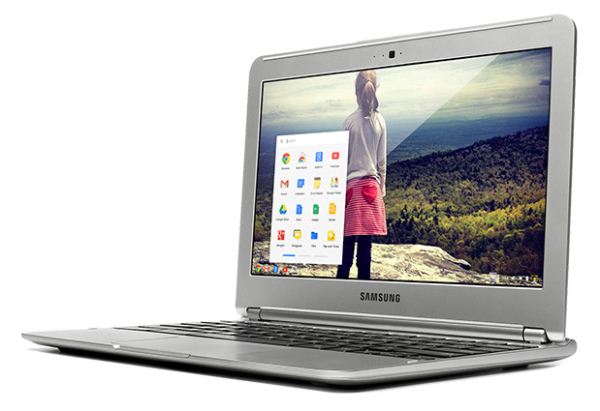
The rest of the specs are relatively modest, the 11.6" panel has a respectable 1366x768 resolution, a VGA camera, SD card slot, one each USB 3.0 and USB 2.0 ports, and an HDMI port. Bluetooth and WiFI are built-in, though this generation foregoes the 3G modem of the first Chromebook. Some noise has been made about the quoted 6.5 battery life; we've never taken too much stock in PR provided data. The Cortex-A15 can be a power hungry SoC when stressed, and there's no details on battery capacity, so we'll have to handle the hardware ourselves to size up the battery life.
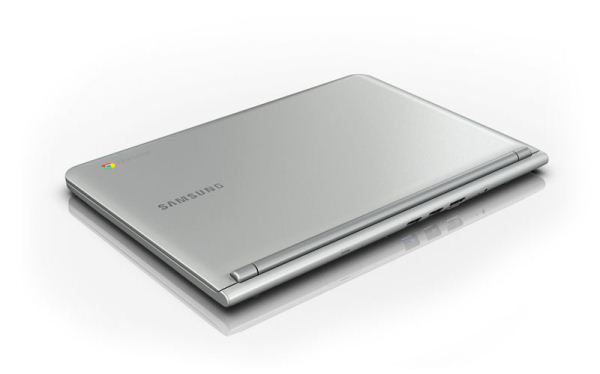
The SSD is a zippy but small 16GB, but local storage isn't really the point of a cloud-centric Chromebook. And to help allay storage fears, Google's including 100GB of Google Drive capacity for 2 years, with the the purchase of the $249 laptop. That additional cloud storage sweetens the value of the device, too; paying for the service out of pocket would cost $120 over the two year span. So, is this the Chromebook that will finally win us over? We'll find out soon, preorders start today, and sales start Monday.
Update: Turns out a 3G option is available, though unannounced. Service is included in the cost of the device for 2-years, up to 100MB a month, and is provided by Verizon. The 3G SKU will cost you $329, and is available for
pre-order now.
Also, I misspoke on the matter of this being the first ARM based PC, I hope the edit adds some clarity.


 Read More ...
AMD Q3 2012 Earnings: $157M Loss; 15% of Workforce To Be Cut
Picking up from where we left off with
Intel, earnings week has continued to roll along with most of the major tech companies having reported their Q3 earnings. As we noted in our look at Intel’s earnings, Intel is the traditional bellwether for the PC industry, and for Q3 that bellwether was reporting that the PC market had unquestionably grown weaker, and that Q4 was to be cast into even more doubt. As one of the strongest PC-centric tech companies Intel has significant exposure to any weakness in the PC market, but at the same time they’re also in the best position to weather whatever may come. For their partners and their competitors however, a weak market can be a significantly bigger drain.
This brings us to today’s major PC earnings announcement: AMD. AMD is by far the weaker CPU manufacturer, and while it has some level of diversification through its GPU division and embedded CPUs, like Intel they’re still significantly exposed to the PC market, setting the stage for a rough quarter. Furthermore rumors began circulating that
AMD was looking at another round of layoffs – rumors that have seen been proven at least partially correct – which would indicate that AMD was struggling even more than anticipated. With these factors in mind there has been a great deal of anticipation for AMD’s Q3 earnings call, so let’s dive right in.
For Q3 of 2012 AMD reported $1.27B in revenue, with a net loss of $157M. Unfortunately for AMD (but not unexpected) this is a significant drop in both revenue and net income on both a quarterly and yearly basis, having furthermore pushed AMD back into the red after turning a slight profit in Q2. Compared to AMD’s Q3 2011 results, revenue is down approximately $420M, a nearly 25% drop; net income meanwhile swung from positive $97M to negative $157M, a shift of nearly $250M. Finally, AMD’s gross margin was an abysmal 31%, well below last year’s gross margin of 45%, which is generally where AMD needs to be to turn any kind of profit.
| AMD Q3 2012 Financial Results |
| Q3'2012 | Q2'2012 | Q3'2011 |
| Revenue | $1.27B | $1.41B | $1.69B |
| Net Income | -$157M | $37M | $97M |
The single biggest factor for this sudden change in fortunes is a $100M inventory write-down AMD had to take this quarter for unsold Llano inventory. In
Q3 of 2011 Llano was the biggest factor in AMD turning a profit, but a year later those chips have been superseded by AMD’s new Trinity APU. Notably AMD is calling this a write-down and not a write-
off, so it looks like they’re accounting for the loss of value of these APUs (i.e. they’ll have to sell them at lower prices than they planned for), as opposed to simply throwing out $100M in Llano APUs. Nevertheless, even if AMD had not taken the write-down they still would have lost around $50M for the quarter, so while Llano inventories were a big problem for AMD they are not the sole reason for AMD’s rough quarter.
Breaking down AMD’s numbers for the quarter, AMD’s Computing Solutions (CPU/APU) segment booked $927M in revenue, for an operating loss of $114M. This represents a 28% decline in revenue on a yearly basis, and like AMD’s overall profitability a flip from an operating income to an operating loss for the division. AMD looks to have been hit twice here; not only are overall sales lower, but their ASPs were also down.
| AMD Q3 2012 Computing Solutions Division Financial Results |
| Q3'2012 | Q2'2012 | Q3'2011 |
| Revenue | $927M | $1.04B | $1.28B |
| Operating Income | -$114M | $82M | $149M |
AMD doesn’t completely break down their CPU revenue by processor line, but they have stated a few facts. For client revenue (i.e. non-server) desktops were cited as being especially hard hit by lower sales volumes and ASPs. As for notebooks, AMD has stated that Trinity’s share of AMD notebook shipments has just surpassed 30%, which implies that the majority of AMD’s notebook APUs are still Brazos and Llano.
Meanwhile AMD’s Graphics division fared much better. For the quarter the Graphics division booked $342M in revenue, and once again turned a small but consistent operating income of $18M. This represents a 14% reduction in revenue over Q3 of 2011, while operating income has actually grown by $6M. AMD attributes the lower revenue to lower OEM sales, but noted that channel sales (i.e. retail) are higher than at this point last year. Interestingly despite the loss of revenue AMD’s GPU ASPs were also up compared to Q2, which is why they turned a greater operating income on lower revenues. Unfortunately as we’ve seen time and time again with AMD, while their Graphics division can consistently turn a small profit, at only 1/3
rd the revenue of their Computing Solutions division it’s not nearly large enough to offset the losses AMD has run there.
| AMD Q3 2012 Graphics Division Financial Results |
| Q3'2012 | Q2'2012 | Q3'2011 |
| Revenue | $342M | $367M | $403M |
| Operating Income | $18M | $31M | $12M |
With all of that in mind, as bad as AMD’s Q3 was, much like Intel their projections are for Q4 to be even worse. Unlike Intel AMD doesn’t provide gross margin guidance, but for their revenue guidance they are predicting a further 9% (+/- 4%) decline in revenue.
This brings us to perhaps the most depressing news of the day: more layoffs. As part of their restructuring plan to return to profitability, AMD will be laying off nearly 15% of its workforce in Q4. They expect to take an $80M charge on this for severance payments, in return for $190M in projected savings in 2013. AMD is being intentionally vague about where these layoffs will come from, and it’s entirely possible they haven't completely figured that out at this time, so at this point it’s impossible to say if this will primarily hit one division (e.g. GPUs) or if it will be spread around all of AMD’s major divisions.
The layoffs are coming as part of a greater restructuring for the company, which will see them accelerating their previously announced shift away from the PC market in favor of mobile, servers, and semi-custom embedded chips. As the PC market continues to weaken – and AMD expects it to remain weak for several more quarters – they will be speeding up this transition in order to derive more of their revenue from non-PC sources sooner. Ultimately AMD wants to be in a position where 40-50% of their revenue comes from these fast-growing markets, with a specific goal of 20% of their revenue coming from semi-custom embedded APUs by Q4 of 2013.
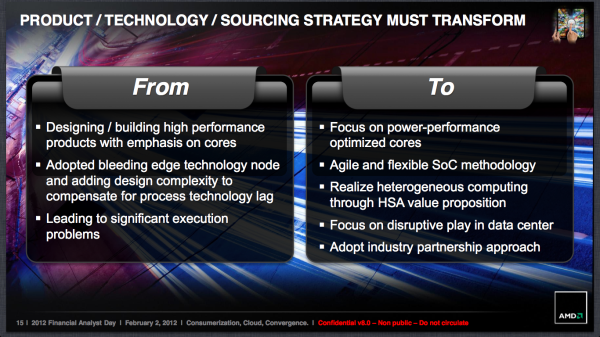
To get there AMD will be simplifying their development cycles and increasing their focus on building reusable IP blocks, in essence transitioning to building their APUs in a more SoC-like fashion. AMD has been very careful to reiterate that they’re still an engineering company, and that graphics in particular are a cornerstone of the company. But much like the vague nature of the layoffs they are not making it clear what projects and products are being deprioritized or discontinued in order to achieve this simplification. What is clear is right now is that AMD will be reusing more IP and designs when they can to avoid having to undertake costly research and development.
Finally, AMD has also spent a bit of time talking about 2013 and beyond. On a financial side of things AMD’s goal is to get their operating costs to the point where a quarterly revenue of 1.3B would be their break-even point, which is part of AMD’s attempt to “reset” the company to survive on what would ultimately be lower margins. Meanwhile on the product side of things, silicon for Kabini (their 28nm Brazos replacement) is already back and AMD is working on a H1 2013 launch for that. As it stands nearly 85% of AMD’s current business is focused on the “legacy” PC market, so AMD is looking to shift into high margin, fast growing markets like tablets as soon as possible, which is where products like Kabini will take them.


 Read More ...
Memory Performance: 16GB DDR3-1333 to DDR3-2400 on Ivy Bridge IGP with G.Skill
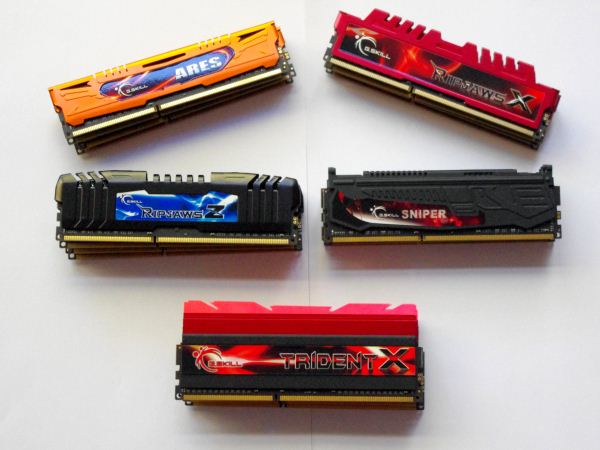
Memory reviews are, in my opinion, actually quite hard to do. There are plenty of memory kits available that are nice and cheap, and the easy way to differentiate between them in a review is usually though synthetics – without too much effort we can find memory comparison articles online that deal solely in synthetics. The downside of synthetics is that they rarely emulate real-world performance. When the requests came in for a comparison of memory kits available on the market, I was stumped to find real-world examples where memory truly matters by significant margins, and benchmarks to match. Fast forward a month or so, and we have compiled a series of tests taking advantage of some of the most memory limited examples common to most users – IGP performance using memory from DDR3-1333 to DDR3-2400. Inside this review we have also mixed in some encoding, compression, and you may be surprised to hear that USB 3.0 performance is also affected by memory speed. In this article we also look at and review the memory kits that G.Skill has gracefully provided from their Ares, Sniper, RipjawsX, RipjawsZ and TridentX brands.


 Read More ...
Iomega StorCenter NAS Lineup Refresh: 2-bay px2-300d and 4-bay ix4-300d
Iomega's network storage family consists of three lineups:
- ARM-based EZ single-bay network attached hard disk for home users
- ARM-based ix series for value-focused consumers
- x86-based px series for performance-focused consumers (These come in both desktop and rackmount form-factors)
Today, Iomega is announcing two new NAS models, one each in the ix and px series. Traditionally, manufacturers have tended to focus their performance platform efforts on 4-bay and higher NAS systems. ARM-based systems make up the majority of the 2-bay offerings. However, huge amounts of data are being generated everyday even in the home (thanks to high resolution videos and photos, as well as movie backups and DVR recordings). This has opened up a market segment for 4-bay value offerings. Distributed SMB (small and medium-sized businesses) locations, in turn, have made small high-availability NAS systems with a performance emphasis necessary.
In order to cater to the performance market, Iomega is launching the px2-300d Intel Atom-based 2-bay model. The platform is based on the D525 running at 1.8 GHz. Equipped with 2 GB of DDR3 memory, the unit supports hot-swapping of drives as well as volume encryption capabilities. The unit also has two GbE ports and comes with a customized version of McAfee Enterprise (with local scanning). A 3-year subscription for virus definitions is included. Pricing ranges from $500 for the diskless configuration to $1200 for the 2 x 3TB configuration. A point to be noted is that the disks shipped with the px2-300d are enterprise / server class drives.
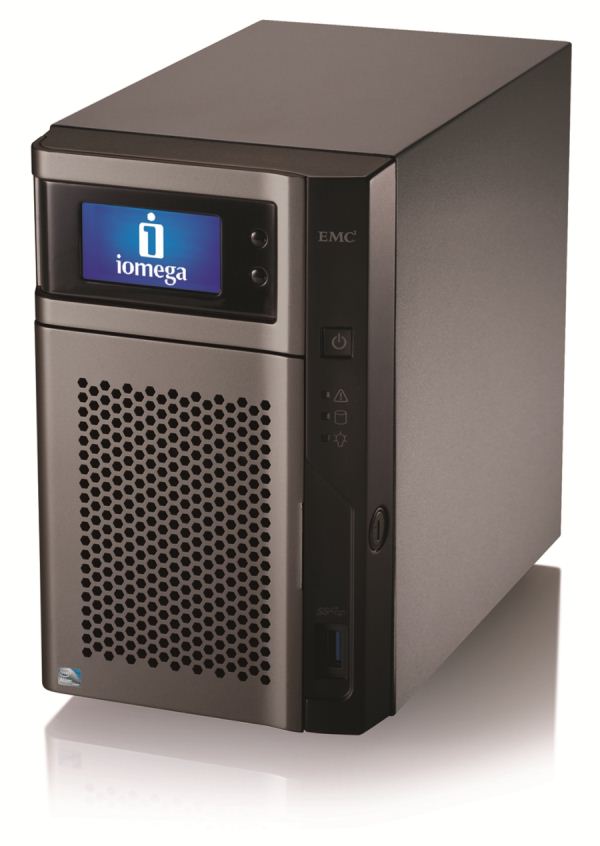
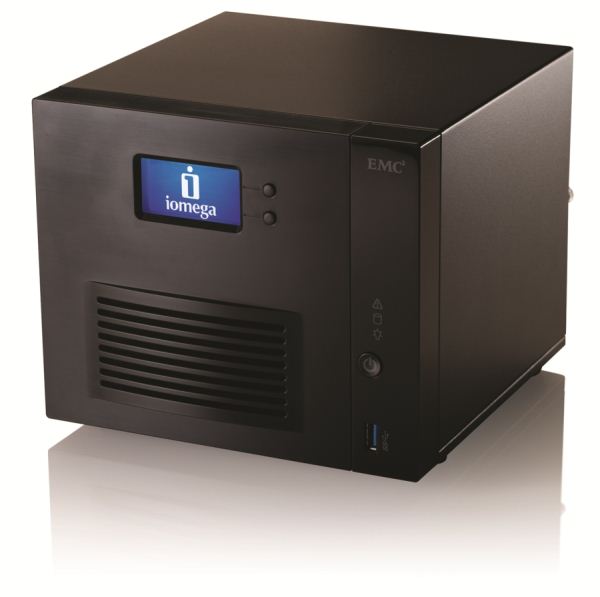
The ix4-300d is equally interesting because it seems to be the first Marvell ARMADA XP based NAS system shipping to customers. The latest Marvell based refreshes we have seen from other manufacturers have all been based on the Kirkwood MV628x platform. The ix4-300d is based on a dual core 1.3 GHz Marvell SoC (
MV78230 seems to be the likely candidate, though Iomega didn't confirm the exact part number). This unit also comes with dual GbE (something we see rarely in the value segment) and has 512 MB of DDR3 memory. Unlike the other 4-bay ARM-based NAS systems such as the Netgear NV+ v2, this model doesn't have hot-swap capabilities. Addition or replacement of disks requires a power cycle. Pricing ranges from $600 for the diskless configuration to $1300 for the 4 x 3TB configuration.
Both of the new NAS systems run the Iomega LifeLine OS. The latest version of the LifeLine OS has shifted the RAID filesystem from EXT3 to EXT4. Iomega indicated that this brought about higher efficiency. The new version has also apparently enhanced Active Directory support and added MySQL server support as well as video surveillance capabilities. Extra apps for the system are available
here. The OS also allows linking of two StorCenter units in different locations for seamless cloud disaster recovery. The Iomega Link iOS / Android application allows mobile devices to access the NAS. The units are also DLNA certified.
We are particularly excited about the Marvell ARMADA XP based 4-bay system (ix4-300d). With Synology having thrown their weight behind Freescale this year, the competition amongst silicon vendors for the value-based NAS platform seems to be heating up.
Update: The official product briefs of the
px2-300d and
ix4-300d are now available.


 Read More ...
Acer Iconia A110 Guns For Nexus 7
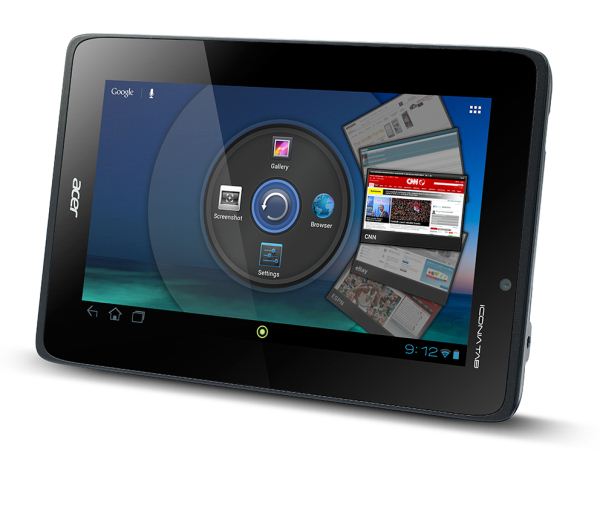
Everyone's getting into the small tablet market, and with the success of Google's own Nexus 7, and Amazon's Kindle Fire, it's no surprise. The Iconia A110 fills that segment for Acer, but does it have what it takes to compete with the Nexus 7? At a high-level it matches up well. The venerable NVIDIA Tegra 3 SoC makes an appearance, as does Android 4.1 (Jelly Bean). The A110 has an edge in connectivity and expandability with microUSB sitting alongside microSD and microHDMI. From there, though, things drop off a bit.
With just 8GB of NAND storage on-board, the out of the box value is a little diminished. Then there's the display, which might be stellar in person, but with just the specs to look at, the 1024x600 resolution is a let down. And then we have pricing. At $229.99 MSRP, the Iconia A110 is somewhat more expensive than the Nexus 7, and if rumors of a 32GB Nexus 7 SKU slotting in at the $249 price point are true, the 8GB A110 will face stiff competition.
We'll find out how it fares on October 30th.


 Read More ...
Boston Viridis ARM Server Gets x86 Binary Translation Support
We covered the launch of the Calxeda-based Boston Viridis ARM server back in
July. The server is makings its appearance at the UK IP EXPO 2012. Boston has been
blogging about their work on the Viridis over the last few months, and one of the most interesting aspects is the fact that x86 binary translation now
works on the Viridis. The technology is from
Eltech, and they have apparently given the seal of approval to the Calxeda platform by indicating that the Boston Viridis was the fastest platform they had tested.
Eltech seems to be doing dynamic binary translation, i.e, x86 binaries are translated on the fly. That makes the code a bit bulky (heavier on the I-Cache). The overhead is relatively large compared to, say, VMware's binary translator (BT) that does x86 to x86, becauseof the necessity to translate between two different ISAs.
Eltech uses a 1 MB translator cache (similar to the translator cache of VMware's BT), which means they can reuse earlier translations. The translation overhead will thus decrease quickly over time if most of the critical loops fit in the translator cache. But it also means that only code with a relatively small footprint will run fast, e.g. get the promised 40-65% of native performance.
Most server applications have a relatively large instruction memory footprint, so it is unclear whether this approach will help to run any heavy server software. Some HPC softwares have a small memory footprint, but since the HPC users tend to pursue performance most of the time, this technology is unlikely to convince them to use ARM servers instead of x86.
In general, the BT software will be useful in the - not uncommon - case where one may have a complex web application comprised of multiple software modules where one small piece of software is not open-source and the vendor does not offer an ARM based binary. So, the Eltech solution does handle a small piece of the puzzle. x86 emulation is thus a nice to have feature, but most ARM based servers will be running fully optimized and recompiled linux software. That is the target market for products such as the Boston Viridis.


 Read More ...
OWC Mercury Electra 3G MAX 960GB Review: 1TB of NAND in 2.5" Form Factor
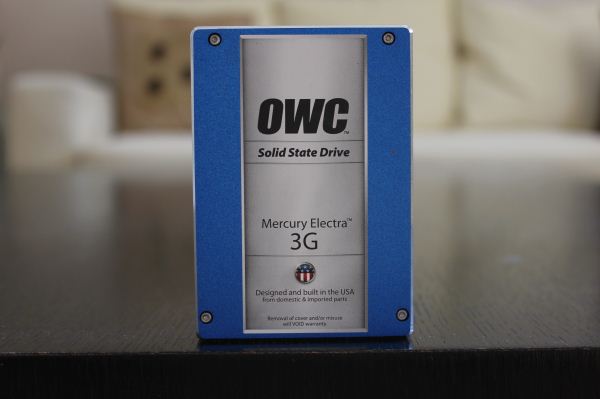
The decrease in NAND prices has opened doors for bigger SSD capacities. 512GB SSDs have been available for a couple of years now but even though prices have come down significantly, we haven't seen a move to capacities bigger than 512GB yet. There are some architectural limitations that cause this but there are a few exceptions that offer more than 512GB. OWC offers a 960GB Mercury Electra 3G MAX, which is among the first 2.5" SATA SSDs with 1TB of NAND. Read on to find out how it is built and how it performs.


 Read More ...
Available Tags:
Google ,
Notebook ,
AMD ,
Ivy Bridge ,
Acer ,
Server ,







No comments:
Post a Comment