

Antec Readies SOLO II-G Case
Antec is readying a variant of its SOLO II case. Called the SOLO II-G, the case dons a gunmetal front, with matte black panels. Like the original, the SOLO II-G's USP is its noise insulation, which consists of 1 mm-thick steel sheets and active noise dampening material. The rest of the SOLO II-G specifications are identical to those of the original. Measuring 470 x 205 x 440 mm, it weighs 9.1 kg. The ATX mid-tower includes two 5.25" drive bays, in addition to three ventilated 3.5"/2.5" bays that are ventilated. Most joints in the case, including the drive cages, and the fan joints, are cushioned by rubber to dampen vibrations. The case is ventilated by TrueQuiet low-noise fans. The SOLO II-G is expected to cost 13,800 JPY (US $172) in Japan, where it hits the stores on May 12.

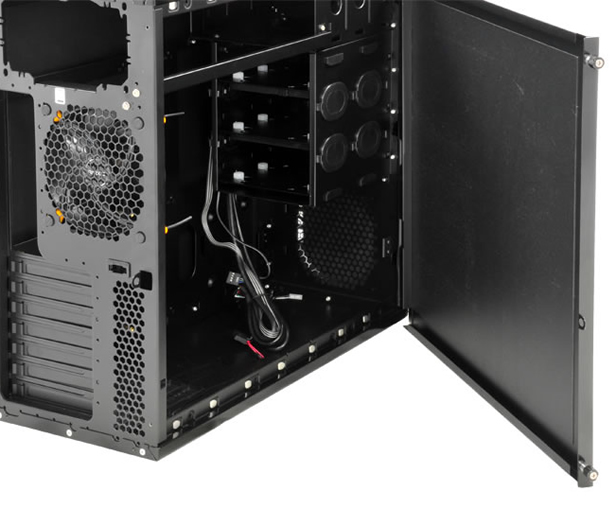


Source: Hermitage Akihabara
Read More ...
NVIDIA's GeForce GTX 670 Short PCB Pictured Up Close
Thanks to the impressive power-draw and temperature figures its GeForce GTX 680 could come up with, NVIDIA's newest SKU based on the 28 nm GK104 silicon, the GeForce GTX 670, will feature a compact PCB. The reverse side of this PCB was first pictured on a Colorful-branded graphics card. A picture of its obverse side was posted earlier today. In comparison to the GTX 680, the GTX 670 PCB is quite short. The eight GDDR5 memory chips are distributed between both the sides, these chips are wired to the GPU over a 256-bit wide memory interface. The VRM area is pushed towards the front-end of the PCB. It consists of a 4+2 phase design. The card draws power from two 6-pin PCIe power connectors. Display outputs include two dual-link DVI, and one each of HDMI and DisplayPort. There are two SLI bridge connectors, giving it 4-way SLI capability.
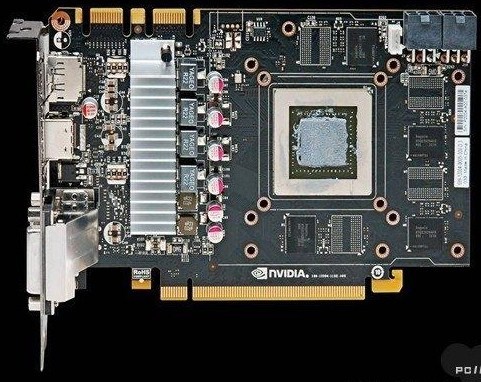
Source: PCinLife
Read More ...
Point of View GeForce GTX 670 Pictured, Too
The press-shot of Point of View GeForce GTX 670 got leaked to the web. It doesn't look like Point of View will be coming up with a non-reference design on d-day, instead it will have, on it hands, an NVIDIA reference-design card. Pictured below, Point of View's accelerator will stick to NVIDIA reference clock speeds of 915 MHz (core base), 980 MHz (core boost), and 6.00 GHz (memory, effective). Point of View could give this card a competitive pricing.
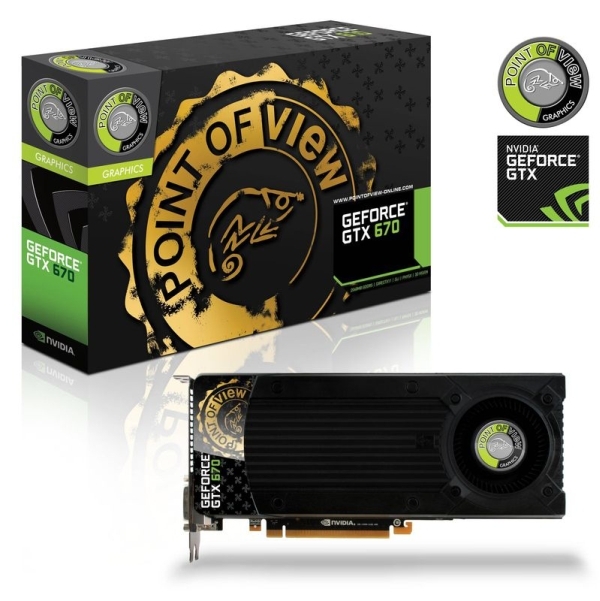
Source: DonanimHaber
Read More ...
GIGABYTE GeForce GTX 670 WindForce OC Pictured
Here are the first pictures of GIGABYTE GeForce GTX 670 WindForce OC graphics card. As the name suggests, the card is GIGABYTE custom-design implementation of NVIDIA's upcoming performance-segment SKU, which utilizes its signature WindForce 3X cooling solution, and is overclocked out of the box. GIGABYTE's card appears to make use of a custom-design PCB, which is longer than NVIDIA reference design. According to a GPU-Z screenshot, the card comes with out of the box clock speeds of 980 MHz (core base), 1059 MHz (core boost), and 1502 MHz (~6.00 GHz effective, memory). Its specifications as reported by GPU-Z match early reports, with a CUDA core count of 1344, and 2 GB of GDDR5 memory over a 256-bit memory interface.



Source: Expreview
Read More ...
AMD Brazos 2.0 Powered Acer Aspire Pictured
Here are some of the first pictures of Acer Aspire E1-421, which caught the eye of a shopper in Asia. Its most distinctive feature is AMD E1-1200APU "Brazos 2.0", driving the machine. The dual-core APU is clocked at 1.40 GHz, and packs Radeon HD 7310 graphics. Other vital components include 2 GB of DDR3 memory, and 320 GB HDD storage. A DVD SuperMulti drive handles removable storage. The notebook's 14-inch screen packs 1366x768 pixels resolution, the GPU utilizes 256 MB from the system memory. 802.11 b/g/n WLAN, and a 6-cell battery make for the rest of it.



Read More ...
(PR) LG’s New Cloud Monitors Combine UPoE and IPS to Create a Total Business Solution
LG Electronics (LG) unveiled its advanced P Series of cloud monitors, allowing companies to do away with desktops and laptops altogether. The new VMware-based Zero Client monitors can be networked to create a virtual comput-ing system and come packaged with Cisco's Universal Power over Ethernet (UPoE) technology, enabling centralized resources, greater system security and reduced costs.
"These monitors are a highly appealing option for the next generation workspace archi-tecture," said J. J. Lee, Executive Vice President and Head of IT Business Unit of LG Home Entertainment Company. "The P Series combines two technologies -- cloud monitor networking and IPS panels -- for a combination that offers exciting new possi-bilities in terms of efficiency in the workplace and gives LG a significant role in virtual computing."

Read More ...
Galaxy Readies Single-Slot GeForce GTX 670
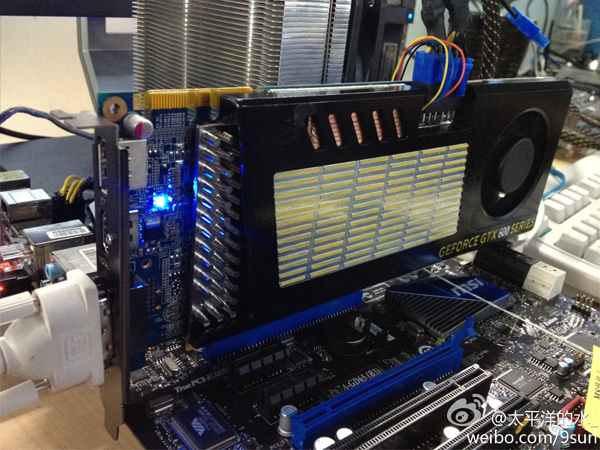
A little later this week, NVIDIA will launch its third SKU based on the GK104 silicon, targeting key performance-segment price points, the GeForce GTX 670. It is possible that NVIDIA will allow AIC partners to come up with custom-designs from day one. One such designs is Galaxy's, which needs no more than one expansion slot in your system. Galaxy's single-slot GeForce GTX 670 appears to use an NVIDIA reference-design PCB, albeit in its signature shade of blue. One could tell so, with the VRM area appeared to be located towards the front, and the PCB appearing to be cutting off at two-thirds the length of the card (where the PCIe power connectors are located).
The extra length of the card is productively used to position a lateral-flow fan. Since there is no PCB, the fan compartment is more roomy, which could mean a bigger fan, with the possibility of intakes on the reverse side of the card. This could result is a slower, quieter cooler. The fan guides air through an aluminum channel stack, with some of the channels being made of copper. It's likely that Galaxy is using a vapor-chamber plate to transfer heat from key components over to the air channels. The portion of the heatsink over the VRM MOSFETs has cylindrical structures, which reminds us of Radeon HD 4850 VRM area.
Read More ...
Available Tags:GeForce , GTX , GIGABYTE , AMD , Acer , Galaxy ,


No comments:
Post a Comment