

V3 Gaming PC Avenger Review: A New Challenger Appears
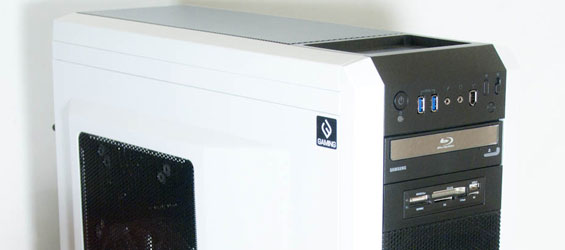
We've had a few boutiques come through here, but what V3 Gaming PC wanted to approach us with was something different than we're used to seeing. Many of the systems sent through here are aggressively tuned, designed for performance at virtually any cost. It looks fantastic on charts, but in practice you're often paying out the nose for a system that left the price-performance curve eating the dust in its speedy wake. With the Avenger, V3 wanted to do something a little different.
Read More ...
Netgear Announces 2-stream 802.11ac R6200 router and A6200 USB 2.0 adapter
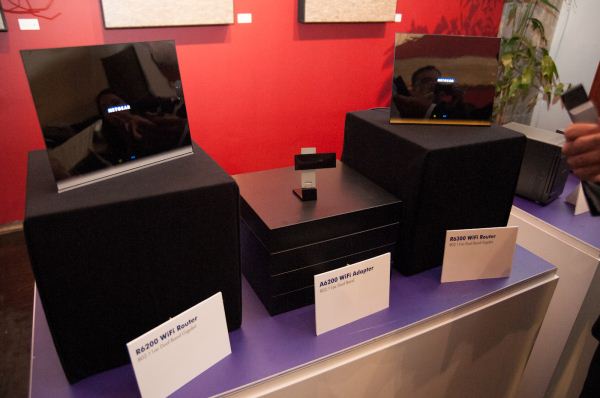
As a reminder, the previously announced R6300 supports 802.11ac at speeds of 1300 Mbps by utilizing 80 MHz channels on 5 GHz, 256QAM, and three spatial streams. That particular router rounds out Netgear's high-end 802.11ac offering with Broadcom's solution inside. The news today is Netgear's mid-range product, the R6200, which includes 2 spatial streams and an 867 Mbps maximum bitrate. The R6200 one USB 2.0 port compared to the R6300's two, for file and printer sharing.
Although MiniPCI Express 802.11ac adapters are coming for notebooks, those wishing to upgrade devices immediately can use the A6200 two-stream USB 2.0 adapter. The USB 2.0 adapter is built around Broadcom's BCM43526 solution. It's unfortunate the adapter isn't USB 3.0, given USB 2.0's 480 Mbps theoretical throughput limit, however BCM43526 only has a USB 2.0 host interface onboard. I'm told that Broadcom has a future USB 3.0 802.11ac solution for those wanting to see higher transfer rates not clamped by USB 2.0.


The R6300 will be available on online retailers starting tomorrow. Netgear expects the rest of the products to be available on store shelves by the end of the week. Pricing for the R6300 will be $199.99, and $179.99 for the R6200, and $69.99 for the A6200 adapter.
Update: We asked for more details about the SoC and WLAN controllers inside both the R6x00 series, and learned exactly what we wanted to know. Inside the R6300 is a BCM4706 for routing and 2.4 GHz 3x3:3, alongside the expected BCM4360 802.11ac 3-stream controller. The R6200 moves one tier down to the BCM4518 for 2x2:2 on 2.4 GHz, and a BCM4352 for 2-stream 802.11ac. This is exactly the combination that we suspected for the devices, but now have confirmed them with Netgear. In addition, the shipping firmware doesn't include beamforming, but will enable it in a software update soon after launch.
Read More ...
What We've Been Waiting For: Testing OpenCL Accelerated Handbrake with AMD's Trinity
With Trinity, AMD has an answer to Quick Sync with its integrated VCE, however the performance is hardly as similar as the concept. In applications that take advantage of both Quick Sync and VCE, the Intel solution is considerably faster. While this first implementation of working VCE is better than x86 based transcoding on AMD's APUs, it still needs work:
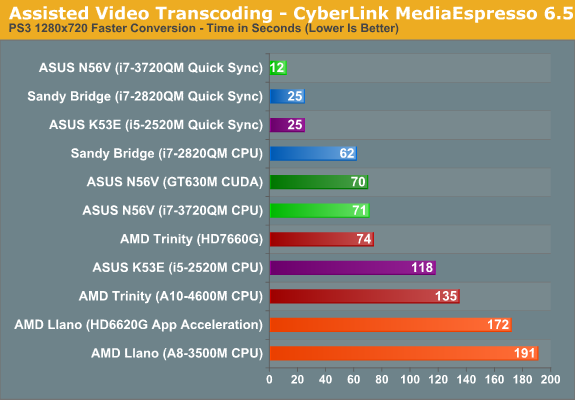
The open source community thus far hasn't been very interested in supporting Intel's proprietary technologies. As a result, Quick Sync remains unused by the applications we want to use for video transcoding.
In our conclusion to this morning's Trinity review, we wrote that AMD's portfolio of GPU accelerated consumer applications is stronger now than it has ever been before. Photoshop CS6, GIMP, Media Converter/Media Espresso and WinZip 16.5 for the most part aren't a list of hardly used applications. These are big names that everyone is familiar, that many have actual seat time with. Now there's always the debate of whether or not the things you do with these applications are actually GPU accelerated, but AMD is at least targeting the right apps with its GPU compute efforts.
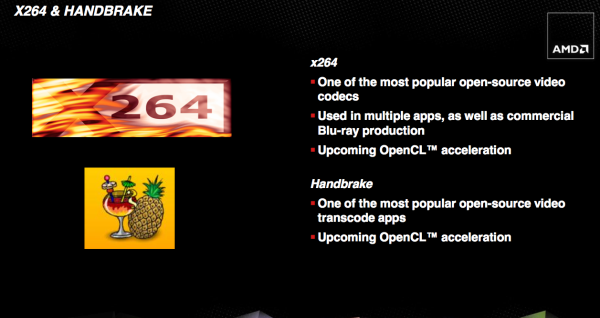
The list is actually a bit more impressive than what we've published thus far. Several weeks ago AMD dropped a bombshell: x264 and Handbrake would both feature GPU acceleration, largely via OpenCL, in the near future. I begged for an early build of both of them and eventually got just that. What you see below may look like a standard Handbrake screenshot, but it's actually a look at an early build of the OpenCL accelerated version of Handbrake:
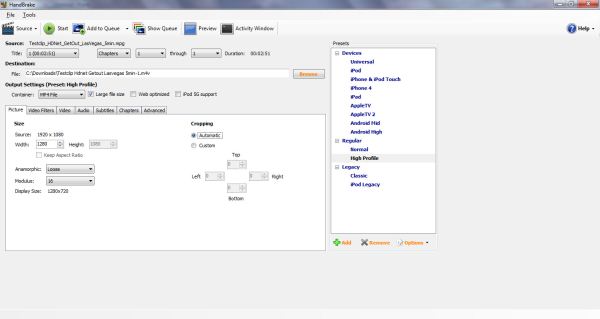
GPU acceleration in Handbrake comes via three avenues: DXVA support for GPU accelerated video decode, OpenCL/GPU acceleration for video scaling and color space conversion, and OpenCL/GPU acceleration of the lookahead function of the x264 encoding process.
Video decode is the lowest hanging fruit to improving video transcode performance, and by using the DXVA API Handbrake can leverage the hardware video decode engine (UVD) on Trinity as well as its counterpart in Intel's Sandy/Ivy Bridge.
The scaling, color conversion and lookahead functions of the encode process are similarly obvious candidates for offloading to the GPU. The latter in particular is already data parallel and runs in its own thread, making it a logical fit for the GPU. The lookahead function determines how many frames the encoder should look ahead in time in the input stream to achieve better image quality. Remember that video encoding is fundamentally a task of figuring out which parts of frames remain unchanged over time and compressing that redundant data.
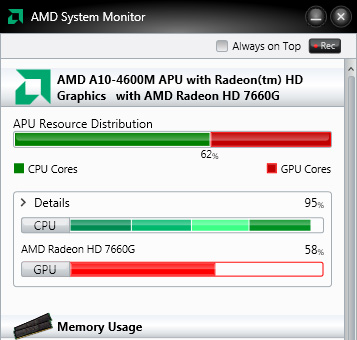
GPU usage during transcode in the OpenCL enhanced version of Handbrake
The OpenCL accelerated Handbrake build worked on Sandy Bridge, Ivy Bridge as well as the AMD APUs, although obviously Sandy Bridge saw no benefit from the OpenCL optimizations. All platforms saw speedups however, implying that Intel benefitted handsomely from the DXVA decode work. We ran both 32-bit x86 and 32-bit GPU accelerated results on all platforms. The results are below:
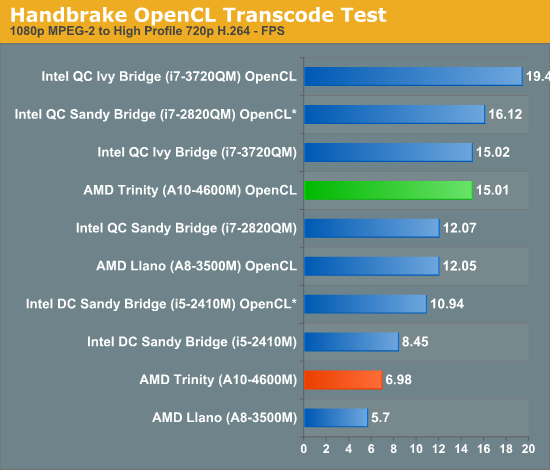
*SNB's GPU doesn't support OpenCL, video decode should be GPU accelerated, all OpenCL work is handled by the CPU
This truly is the holy grail for what AMD is hoping to deliver with heterogeneous compute in the short term. The Sandy Bridge comparison is particularly telling. What once was a significant performance advantage for Intel, shrinks to something unnoticeable. If AMD could achieve similar gains in other key applications, I think more users would be just fine in ignoring the CPU deficit and would treat Trinity as a balanced alternative to Intel. The Ivy Bridge gap is still more significant but it's also a much more expensive chip, and likely won't appear at the same price points as AMD's A10 for a while.
We're working on even more examples of where AMD's work in enabling OpenCL accelerated applications are changing the balance of power in the desktop. Handbrake is simply the one we were most excited about. It will still be a little while before there are public betas of x264 and Handbrake, but it's at least something we can now look forward to.
Read More ...
Tesla Model S Could Land 265-Mile Range Rating from the EPA
High-end Tesla Model S could be the most efficient EV in the land
Read More ...
U.S. Gov Moves Forward with Atlantic Wind Connection Project
The Bureau of Ocean Energy Management could issue its first permit for a wind farm by the latter part of 2012
Read More ...
U.S. and British Leaders Warn of EMP Bombs, Catastrophic Solar Storms
Mechanic: Somebody set up us the bomb./Operator: We get signal./...CATS: All your base are belong to us.
Read More ...
AMD's Trinity, Intel's Sandy Bridge Battle for Budget ($600-and-Lower) Space
Armed with improved battery life, CPU performance, and GPU performance AMD APU proves able in a close race
Read More ...
Stanford Researchers Develop Wireless Retinal Implant
The researchers have already conducted an early trial in the United Kingdom, where the retinal implant allowed blind patients to perceive light and certain shapes
Read More ...
Berkeley Trains "Harmless" Viruses to Harvest Human Kinetic Energy
Viruses act as tiny piezoelectric generators
Read More ...
Facebook IPO Exceeds $100 Billion Mark
Facebook is now looking to raise about $12 billion
Read More ...
Best Buy Chairman Resigns after Probe Finds He Withheld Information
Another one bites the dust...
Read More ...
Available Tags:Gaming , router , USB , Sandy Bridge , Wireless , Facebook ,


No comments:
Post a Comment