

AMD Resigns from BAPCo Over SYSmark12 Concerns
AMD Resigns from BAPCo Over SYSmark12 Concerns
What’s in a Benchmark? This is a pertinent question that all users need to ask themselves, because if you don’t know what a benchmark actually tests and how that relates to the real world, the scores are meaningless. Today, AMD has announced that they are resigning from BAPCo over a long standing dispute over the weighting of scores within the SYSmark suite. AMD specifically references SYSmark12, but there have been complaints in the past and the latest release is apparently the proverbial straw that broke the camel’s back.
You can read more about the decision on CFO Nigel Dessau’s blog, but this announcement comes at an interesting time since BAPCo just shipped us copies of the final SYSmark12 release. We haven’t had a chance to run the suite yet, and we’ll still have a look at the results and see how AMD and Intel platforms compare at some point, but it looks like we have a foregone conclusion: Intel will come out ahead. What we really need to examine is why Intel gets a better score.
If you’re been reading AnandTech for any length of time, you’ll know that we place a lot more weight on real-world benchmarks rather than synthetic tests, but certain tasks can be very difficult to test in a meaningful way. When we really look at the market right now, in many cases we can conclude that just about any current computer will be fast enough for 90% of users. If you want to surf the Internet, write email, work in Office applications, watch some movies, listen to music, etc. you can do that on anything from a lowly AMD Brazos netbook to a hex-core monster system. Yes, we did leave out Atom, because there are certain areas where it falls short—specifically, certain movie formats prove to be too much for the current Atom platform, particularly if you’re looking at HD H.264 content (e.g. YouTube and Hulu).
Reading through AMD’s announcement and Nigel’s blog, it’s pretty clear what AMD is after: they want the GPU to play a more prominent role in measurements of overall system performance. On the one hand, we could say that AMD is simply trying to get benchmarks to favor their APUs, since Brazos and Llano easily surpass the Intel competition when it comes to graphics and video prowess. This would certainly be true, but then we also have to consider what users are actually doing with their PCs. SYSmark has always included a variety of tests, and certainly knowing how fast your computer is in regards to Excel performance can be useful. However, AMD claims that a disproportionate weight is given to certain tests, with mention of optical character recognition and file compression activities in particular.
We don’t have the full SM12 whitepaper yet, but we can look at the list of applications that are tested, and a few things immediately stand out. There are two web browsers in the list, but both versions are now outdated. Internet Explorer 8 has been replaced by Internet Explorer 9, and Firefox 3.6 is replaced by Firefox 4.0—with Firefox 5 just around the corner. We understand that SM12 has been in development for a while, but considering IE9 and FF4 both shift to GPU-accelerated engines, AMD would certainly have benefited from the use of the latest versions. The remaining applications look reasonable, but again we have no information on weighting of scores, so we’ll have to see how the results pan out.
Ultimately, the main thing to take away from all of this is that, just like the PCMark, 3DMark, Cinebench, SunSpider, etc. benchmarks we routinely refer to, SYSmark12 is merely one more tool to analyze system performance. It will be interesting to see how other elements—like the presence or lack of an SSD—impact the score. In our opinion most users would benefit far more from running something like Llano with an SSD as opposed to Sandy Bridge with an HDD, but it still depends on your intended use. If you’re running a server, obviously the demands placed on the system will be far different from the average home computer. Multimedia professionals that spend a lot of time in Adobe Photoshop and/or Premiere likewise have different needs.
Is AMD right? Is heterogeneous (e.g. CPU and GPU working together) computing more important now than raw CPU performance, or is SYSmark12 merely proving what we already know: Sandy Bridge is really fast? Let us know what you think, but as always remember that when you’re looking at benchmark charts, take a minute to think about what the bars actually represent. The full news release is below, but again you can find substantially more detail at Dessau’s blog.
AMD Will Not Endorse SYSmark 2012 Benchmark
— AMD Separates from Association with Industry Group BAPCo —
SUNNYVALE, Calif. — 21, 2011 — AMD (NYSE: AMD) today announced that it will not endorse the SYSmark 2012 Benchmark (SM2012), which is published by BAPCo (Business Applications Performance Corporation). Along with the withdrawal of support, AMD has resigned from the BAPCo organization.
“Technology is evolving at an incredible pace, and customers need clear and reliable measurements to understand the expected performance and value of their systems,” said Nigel Dessau, senior vice president and Chief Marketing Officer at AMD. “AMD does not believe SM2012 achieves this objective. Hence AMD cannot endorse or support SM2012 or remain part of the BAPCo consortium.”
AMD will only endorse benchmarks based on real-world computing models and software applications, and which provide useful and relevant information. AMD believes benchmarks should be constructed to provide unbiased results and be transparent to customers making decisions based on those results. Currently, AMD is evaluating other benchmarking alternatives, including encouraging the creation of an industry consortium to establish an open benchmark to measure overall system performance.
AMD encourages anyone wanting more details about the construction and scoring methodology of the SM2012 benchmark to contact BAPCo. For more details on AMD’s decision to exit BAPCo, please read AMD’s Executive Blog authored by Nigel Dessau.
Read More ...
LG Revolution: LTE for the Masses
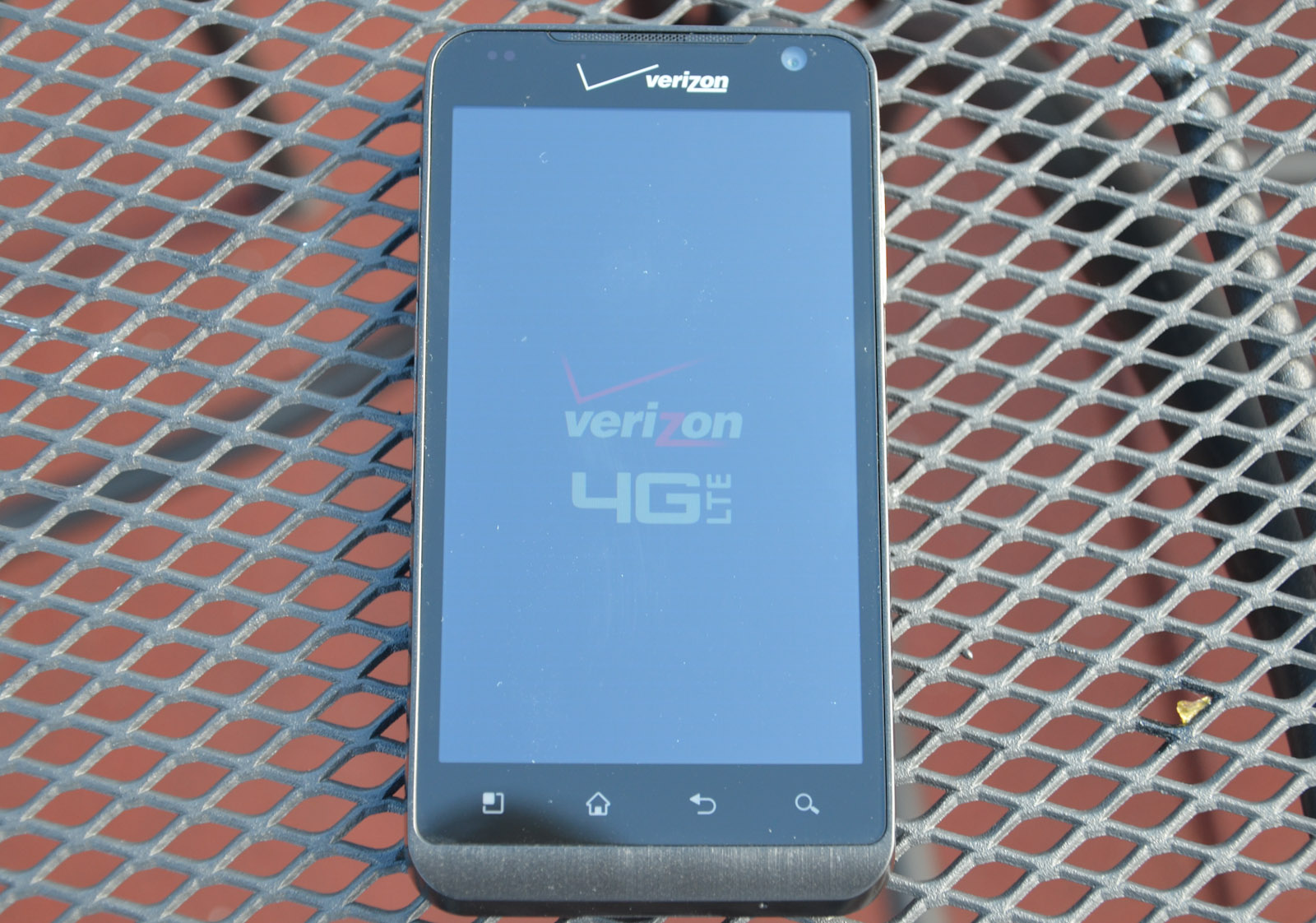
The LTE bug is on in full force over at Verizon, and after launching the HTC Thunderbolt in March and Samsung Droid Charge in May, they’re back for more with the LG Revolution. Packing the same Snapdragon processor as the Thunderbolt as well as a 4.3” screen and the all-important LTE modem, the spec sheet reads very comparably to the earlier HTC device. Does the Revolution live up to its name and change the world in a way that would make John Lennon proud, or does it end up being a more anonymous device in Verizon’s high-powered LTE lineup? Read on to find out.
Read More ...
The HTC Flyer Review
This is HTC's first tablet and unlike the Android tablets that launched last year, it doesn't suck. At the same time, unlike those that came out this year - it doesn't run Honeycomb. You see, NVIDIA was Google's target partner for Honeycomb and Qualcomm was pretty behind on porting the OS to its hardware. As a result the only Honeycomb tablets on the market today use Tegra 2.
Qualcomm is a minority shareholder in HTC and as a result the Taiwanese manufacturer tends to only ship Qualcomm SoCs in its products. With the NVIDIA option pretty much off the table, so was Honeycomb.
Yet HTC clearly saw it as very important to deliver a tablet this year. I'm getting close to overusing this quote but I will never forget what AMD's Eric Demers told me: the best way to lose a fight is to not show up. The tablet battle has only just begun and only through tireless iteration will we see clear leaders emerge, so not showing up to this early fight isn't an option for most of the players.

Read on for our review of the HTC Flyer!
Read More ...
Nokia N9 and N950 Officially Announced - MeeGo Running on OMAP 3630
Back when we reviewed the Nokia N900 we really only wanted a few major improvements. A faster SoC, slightly thinner and more compact hardware, and more of Maemo Linux. It's been a long wait since then, and Nokia has changed its lineup, canceled the original N900 successor, taken on a new CEO, and rebooted itself under the Windows Phone 7 umbrella.
Those of us that wanted a smartphone running real bona-fide linux seemed destined to be waiting forever. Today however, Nokia officially announced the Nokia N9 and N950 at its Nokia Connection event in Singapore.
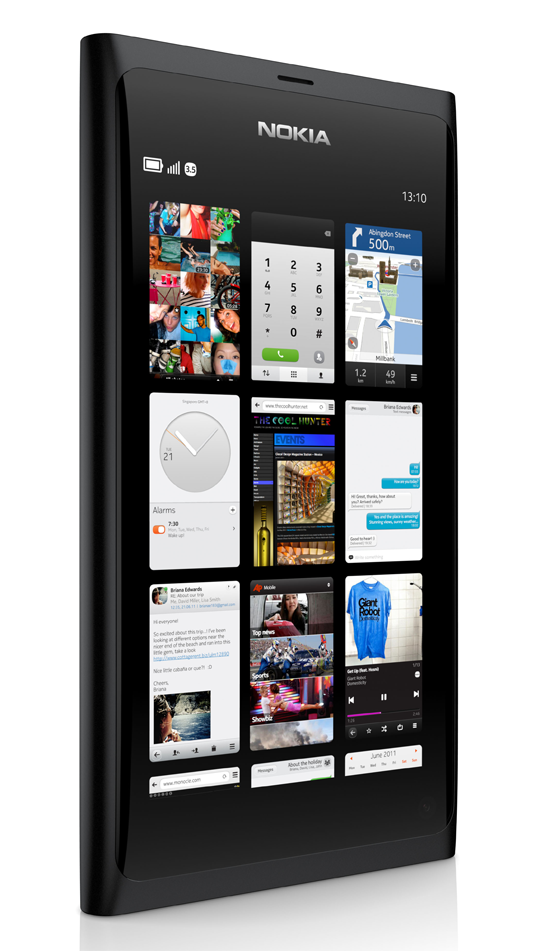
The N9 runs MeeGo, which as you likely know by now is the combination of Nokia's Maemo and Intel Moblin. MeeGo in smartphone form has something we've been waiting patiently for. The N9's industrial design looks nothing short of stunning, though all of the photos of the device so far appear to be renders and not actually physical hardware.
What's unique about the N9 is that the front of the device is buttonless, virtually everything is accomplished by tapping on the capacitive touchscreen, including unlocking the device. There's still volume, power, and camera buttons however.

Nokia really seems to have spent a lot of time working on UI for MeeGo as evidenced by an interesting three home screen design, emphasis on using the swipe gesture to change applications, and pinch gestures for getting a multi-window view. The three home screens are purpose-designed for launching applications, viewing open applications and multitasking, and managing events such as news and messages.
The N9 is polycarbonate plastic and unibody construction, and is sans-keyboard. Its cousin is the similarly-specced N950, which is a non-retail developer device that looks like what remains of the original N9. There are anumber of small differences between the N9 and the N950, chief among which is inclusion of a hardware QWERTY keyboard and aluminum construction, thanks again to Simon for finding these differences and tipping me on them.
Nokia Device Specifications | ||||
Nokia N9 | Nokia N950 | |||
Height | 116.45 mm (4.58") | (?) | ||
Width | 61.2 mm (2.41") | (?) | ||
Depth | 7.6 - 12.1 mm (0.3" - 0.48") | (?) | ||
Weight | 135 g (4.76 oz) | (?) | ||
CPU | TI OMAP 3630 @ 1 GHz | TI OMAP 3630 @ 1 GHz | ||
GPU | PowerVR SGX 530 | PowerVR SGX 530 | ||
RAM | 1 GB LPDDR | 1 GB LPDDR | ||
NAND | 16GB or 64GB integrated | 16GB or 64GB integrated | ||
Camera | 8MP Carl Zeiss 16:9 F/2.2 with Dual LED flash and 720P video capture, Front Facing (?MP) | 8MP with Dual LED flash and 720P video capture, Front Facing (?MP) | ||
Screen | 3.9" FWVGA (854x480) AMOLED with Gorilla Glass | 4.0" FWVGA (854x480) LCD-TFT | ||
Battery | 1450 mAh Integrated(?) | 1320 mAh | ||
Bluetooth | Bluetooth 4.0 | Bluetooth 2.1+EDR | ||
WiFi | 802.11a/b/g/n | 802.11a/b/g/n | ||
NFC | Yes | No | ||
Sensors | Accelerometer, Compass, Proximity, Ambient Light | "N9 has a slightly more sensitive magnetometer and ALS" | ||
OS | MeeGo 1.2 Hartmattan | MeeGo 1.2 Hartmattan | ||
The two devices also have pentaband WCDMA support and quad band GSM/EDGE support, though there's no word on what cellular baseband is at the core of everything. In addition, the N9 includes NFC support, though Nokia hasn't specifically stated whether all three NFC modes are supported. In all likelihood this is assumed now given NFC chipset maturity.
Though the SoC seems dated for a device that still isn't released yet, it's a definite improvement over the N900's 600 MHz OMAP 3430.
Nokia N9/N950- Network Support | |||||
GSM/EDGE Support | 850 / 900 / 1800 / 1900 MHz | ||||
UMTS/HSDPA/HSUPA Support | 850 / 900 / 1700 / 1900 / 2100 MHz | ||||
HSDPA/HSUPA Speeds | HSDPA 14.4 / 5.7 Mbps | ||||
Baseband Hardware | (?) | ||||
Read More ...
Motorola Droid 3 Pops up in GLBenchmark - A Verizon XT883 with OMAP4
A tipster dropped a link our way early this morning to a GLBenchmark 2.0 results browser page that might be of interest to many. Hit that page and you'll find a complete run of the current GLBenchmark 2.0 suite, and a bit of a confirmation about what is and isn't the upcoming Motorola Droid 3. It isn't Tegra 2, it's OMAP 4430.
First off, the hardware specifications that we can glean from the information page seem to make it a virtually identical match with the specs of the Motorola Milestone 3, or XT883. That means a qHD 960x540 display likely 4" in size, hardware five-row QWERTY keyboard, Android 2.3.4, a possible 1 GB of LPDDR2 (512 MB is the other less-desirable, rumored number), 8 MP rear camera, front camera, and of course an accompanying CDMA2000 baseband for Verizon.
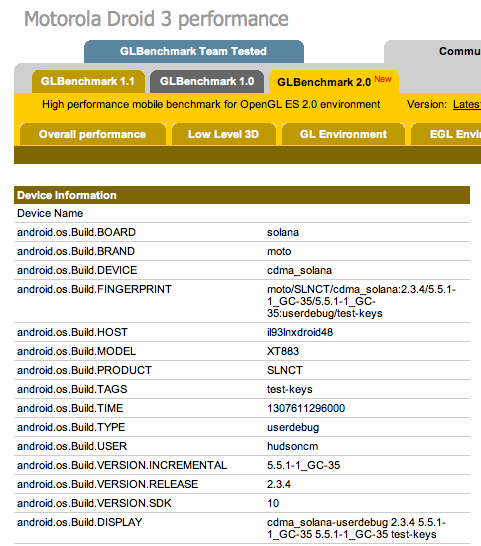

The model in the results browser is codenamed "Solana" which matches the codename we've heard about for the Verizon-bound Motorola Droid 3. The photos below are of the XT883 which the Motorola Droid 3 will undoubtedly bear an uncanny resemblance to.

Motorola Milestone 3 - XT883 for China (courtesy: Motorola Mobility)
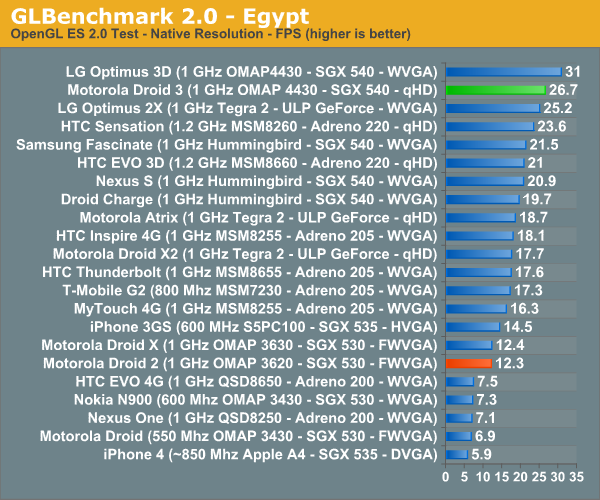
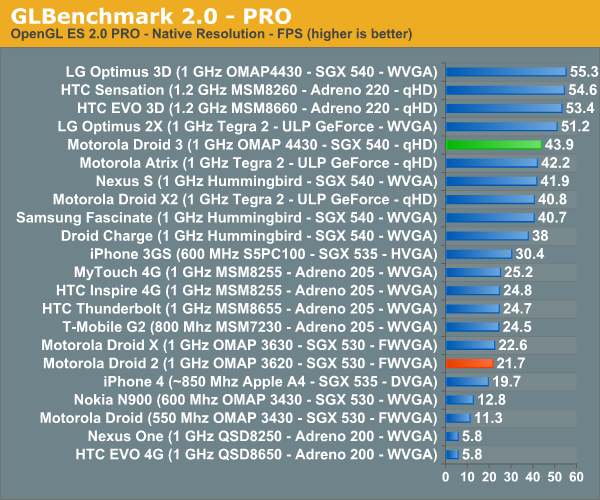
The benchmarks themselves paint an interesting picture, and while we're at it I've tossed in some other devices we have in-hand but haven't finished our full reviews of yet for comparison with these results from the Motorola Droid 3. Again GLBenchmark 2.0 runs we're reporting here are at native resolution for the respective devices, which we've now included in the description line for comparison. For a quick refresher, WVGA is 800x480, FWVGA is 854x480, and qHD is 960x540.
{gallery 1193}
The Motorola Droid 3 results are impressive, edging out the Adreno 220-packing HTC Sensation and EVO 3D in the more demanding Egypt test, but not quite in Pro. No doubt this is thanks at least partially to the newer Imagination drivers which give a small performance boost.
Read More ...
Facebook Beats Google/Yahoo in Overall U.S. Ad Revenue for 2011
Facebook's U.S. advertising revenue for 2011 will total $2.2 billion
Read More ...
Report: Verizon to Launch Tiered Data July 7
Plans are essentially $5 more than AT&T's
Read More ...
Apple Stock Plunges as Investors "Think Different"
Concerns about overvaluation, succession are top on investors' list
Read More ...
Consumers Not Fond of MyFord Touch, PowerShift Dual-Clutch Auto Transmission
Ford and other automakers' newest technologies will be rated this Thursday when J.D. Power and Associates releases its annual initial-quality study, which is based on consumer opinions
Read More ...
Nokia Announces Sleek N9 Smartphone
Touchscreen devices eschews "home" button for swipe gesture
Read More ...
Prostate Cancer Cured in Mice with Human Vaccine
Clinical trials to begin in two years
Read More ...
Chinese Gadget Maker Unveils World's First Ever Android 3.2 Tablet
The final version of Honeycomb reportedly will bring smaller form factors
Read More ...
U.S. Senate Bill Aims to Keep Costs in Check With Lockheed F-35 LRIP-5
any cost overruns would be paid by contractor
Read More ...
6/20/2011 Daily Hardware Reviews
DailyTech's roundup of hardware reviews from around the web for Monday
Read More ...
LulzSec, Anonymous Declare "War" on U.S., International Gov'ts, Banks
Group appears to be refocused on "socially minded" hacking
Read More ...
GPS Units Lead Washington Drivers into Dangerous Territory
Lack of driver attention contributes to some crashes as well
Read More ...
"Call of Duty" Developers Go to Trial with Activision
"Call of Duty" developers Jason West and Vincent Zampella were upset when Activision fired them shortly before $125 million in royalty payments were due
Read More ...
Available Tags:AMD , LG , HTC , Nokia , MeeGo , Motorola , Facebook , Apple , Smartphone , Android , Tablet , Hardware , Activision ,


No comments:
Post a Comment