

(PR) Kingston Technology Revenues Climb to Record $6.5 Billion in 2010
Kingston Technology Corporation, the independent world leader in memory products, today announced that its global revenues in 2010 soared to a record $6.5 billion (U.S.), the highest ever in company history. The $2.4 billion increase in sales over 2009 was attributed primarily to a rise in average selling price (ASP) and increased shipment volume.
"Our company was able to take advantage of an improving global economy as well as catch some lucky breaks to achieve our best sales year ever in 2010," said David Sun, co-founder, Kingston. "We are very fortunate to have dedicated and hard-working employees who work tirelessly alongside our partners and vendors to make sure that Kingston's customers are treated with respect and always taken care of."
Read More ...
(PR) Intel Acquires Egypt-based SySDSoft
Intel Corporation, through its standalone business entity Intel Mobile Communications, today announced that it has acquired most of the assets of SySDSoft, a privately held software company based in Cairo and hired approximately 100 of the company's electrical engineers and computer scientists. SySDSoft designs state-of-the-art IP solutions in the software stack and physical layer domain, and RF/analog circuits embedded in mobile platforms.
"The acquisition of engineering and design talent from an Egypt-based company in the field of cutting-edge wireless and communication technology is the first of its kind for Intel in the Middle East," said Arvind Sodhani, president, Intel Capital and executive vice president, Intel. "The acquisition shows Intel's continued long-term strategic commitment to the region and its appreciation of its young, growing talent pool."
Read More ...
GeForce GTX 590 Key Features Revealed
An alleged partner presentation slide leaked to the internet reveals quite a bit more about the GeForce GTX 590 than what we already know. To begin with, it lays to rest speculations surrounding the shader configuration, each of the two GF110 GPUs have all 512 CUDA cores enabled. Next, the full width of the memory interface is utilized, giving you 1536 MB per GPU, or 3 GB of total memory on the card.
The rest are fascinating features, such as a removable cooler shroud that lets you clean the card from time to time (you might need to clean it now and then for the best cooling performance), heatsinks that use vapor-chamber technology, getting rid of those pesky heat-pipes, high-grade 12-layer PCB that uses 2 oz copper layers, and a 10-phase VRM (looks like 4+1 phase per GPU). As expected, the final iteration of the card needs to draw power from two 8-pin PCI-E power connectors. "Barely Street Legal"? Is it because they'll throw you out of LAN parties for having too much of a performance advantage? Hmmm.
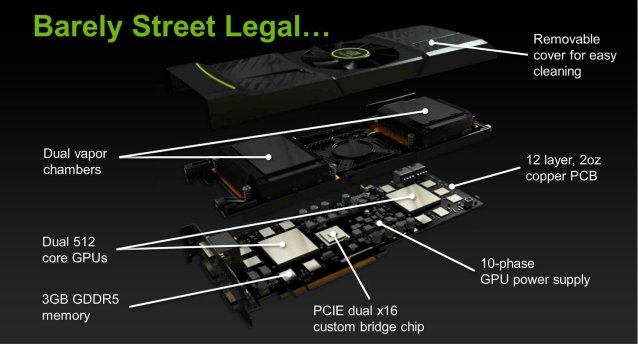
Source: XtremeSystems Forums
Read More ...
Sandy Bridge-Based Pentium Dual-Core G840 Processor Surfaces
The first Intel Pentium branded processor based on the Sandy Bridge architecture surfaced in China. The Pentium Dual-Core G840 as it's identified, is said to be based on the 32 nm dual-core silicon. It differs from Core i3 dual-core processors in having no HyperThreading technology (one thread per core), and 3 MB of L3 cache enabled. The AVX instruction set also seems to be lacking according to the CPU-Z screenshot.
The Pentium G840 is clocked at 2.80 GHz, with a base clock of 100 MHz, and 28x multiplier. The embedded Intel HD Graphics GPU is clocked at 850 MHz, with 1100 MHz GPU Turbo Boost frequency. The processor cores lack Turbo Boost. The chip has a TDP of 65W. Pricing and availability details are awaited, though expect this LGA1155 chip to cost under $100.
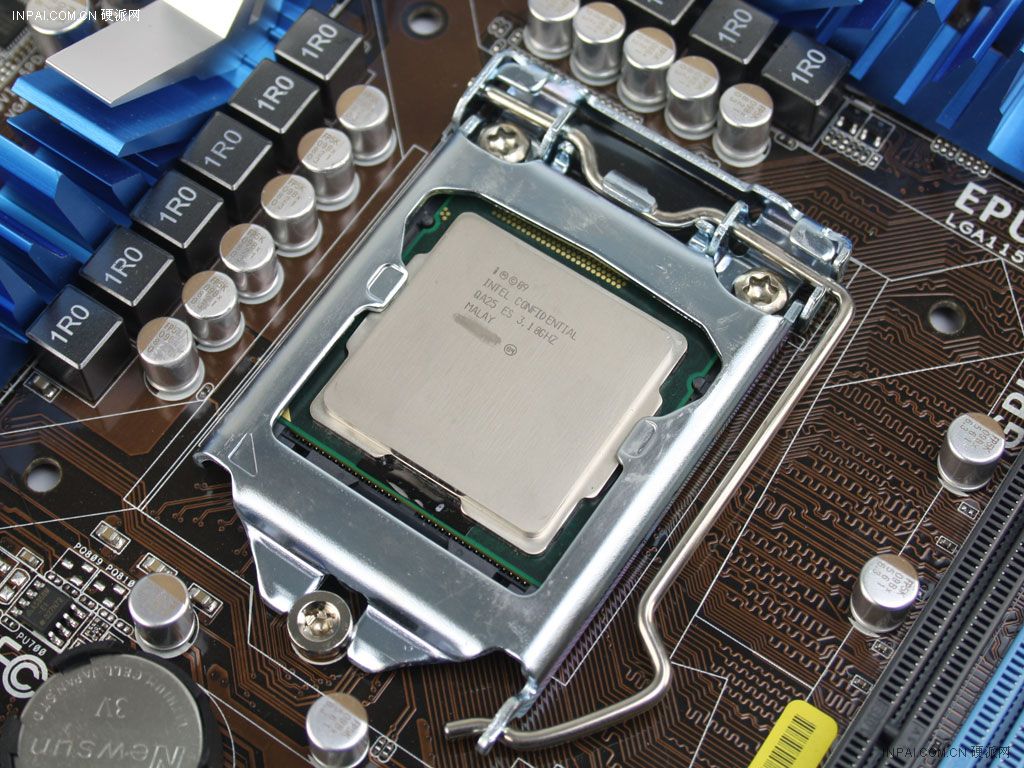

Source: INPAI
Read More ...
GeForce GTX 590 Cooler Shroud Design Surfaces
VR-Zone got a hold of the cooler shroud design of NVIDIA's upcoming GeForce GTX 590 graphics card. The drawing reveals something very similar to that of the GeForce GTX 295 rev. 2 (or single-slot), and tells us a bit about the cooler. The cooler will use a large fan (probably 80 mm in diameter) to blow air on to two heatsinks on its either sides. Channels, and the heatsinks themselves will guide air across both ends of the cooler. Hot air from the first GPU (closest to the display connectors) will exhaust from the rear bracket, while that from the second GPU (farthest from the display connectors), will exhaust into the case. There are spaces on either sides of the fan for partner product artwork. There is more space on top. Next to the cutout for the power connectors, is the GeForce logo. NVIDIA's GeForce GTX 590 is a dual-GPU graphics card based on two GF110 cores. It will be released on the 22nd of March.

Source: VR-Zone
Read More ...
(PR) G.Skill Launches Its New Sniper Memory Series Aimed at Gamers and Case Modders
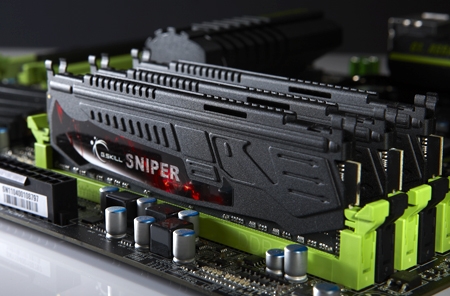
G.Skill, the worldwide leading memory designer and manufacturer, has announced the newest concept and development of new Sniper series designed specifically for PC gamers and modding enthusiasts. Extensive compatibility tests are conducted on a wide range of Intel and AMD platforms, which guarantee the best performance, quality and reliability for user's gaming needs.
The New Sniper series is designed in ultra low voltage, especially 1.25V. This kit can save up to 10% electric power which will simultaneously allow gamers to enjoy smooth gaming without any overheat problems and meet energy efficiency requirements.

Read More ...
NVIDIA BIOS Editor (NiBiTor) Version 6.1 Released
NVIDIA BIOS Editor (fondly known as NiBiTor), got updated to version 6.01 by its developer. NiBiTor is a lightweight NVIDIA GeForce/Quadro BIOS file manipulation utility that lets to fine-tune your GeForce or Quadro graphics card at the BIOS-level. Version 6.01 packs updated GPU support, some minor fixes and a redesign to support as well unknown devices in some limited way. New GPUs supported by this version are:
- GeForce GTX 560
- GeForce GTX 460 SE
- Quadro FX3800M
- GeForce GTX 480M (updated support)
- GeForce GTX 460M (updated support)
DOWNLOAD: NVIDIA BIOS Editor (NiBiTor) v6.01
Read More ...
AMD FX ''Zambezi'' Processor Box-Art Revealed
Here are the first box-shots of AMD's upcoming series of high-end desktop processors, under the FX series, referred to as "Zambezi" by the company, internally. Zambezi is based on AMD's newest Bulldozer architecture that improves instruction per clock-cycle (IPC), and packs the latest industry standard instruction sets. As stated in an older article, AMD will not assign a brand-name (such as Phenom or Athlon) to name its high-end desktop processors, but will instead refer to them as "FX" processors. To that extent, the processors will even feature a logo that resembles that of AMD Radeon to a very large extant.
AMD designed two iterations of box-art each for its FX eight-core and FX quad-core processors, puictured below. The processors look to be shipping in cuboidal paperboard boxes, very much like AMD's processors already do. The art looks very "energetic" and makes use of the AMD "arrow" motif pointing in the top-right direction. The background in each iteration is distinct, one shows splashes of red (eight-core) or orange (quad-core), the other shows flow of red/orange. It's interesting to note that all boxes denote Black Edition with its unlocked bus multiplier feature, leading us to speculate that unlocked multiplier could be standard issue with FX series processors. Also shown is the second generation TurboCore technology support, and AMD's claim to be selling the first eight-core processor [in the consumer market]. AMD's FX processors will be released to market in June.

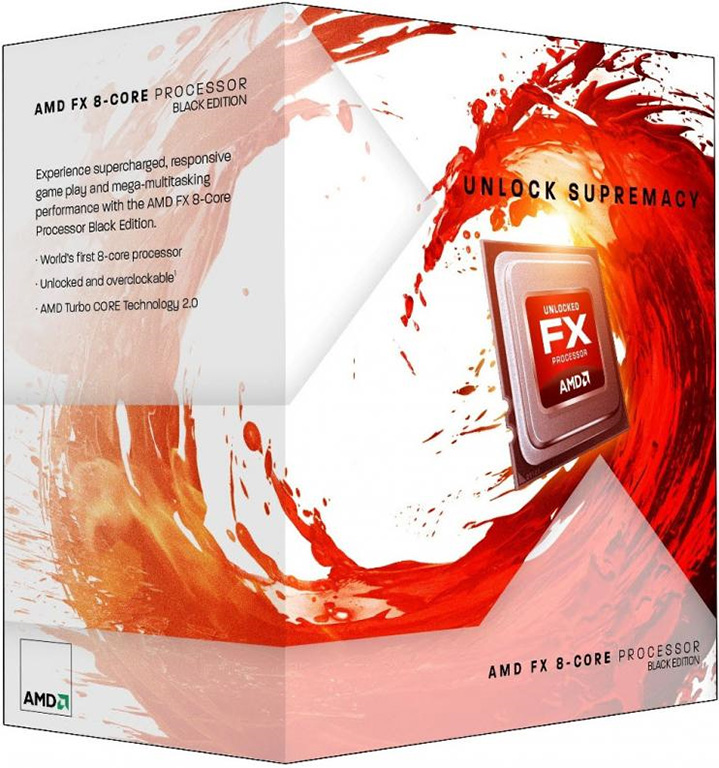


Source: NordicHardware
Read More ...


No comments:
Post a Comment