

Intel Plans on Bringing Atom to Servers in 2012, 20W SNB Xeons in 2011
The transition to smaller form factors hasn't been exclusively a client trend over the past several years, we've seen a similar move in servers. The motiviation is very different however. In the client space it's about portability, in the datacenter it's about density. While faster multi-core CPUs have allowed the two-socket 1U server to really take off, they have also paved the way for a new category of density optimized servers: the micro server.


| Intel SNB Xeon Lineup | ||||||||
| Intel Xeon Processor Number | Cores / Threads | Clock Speed | Single Core Max Turbo | L3 Cache | Memory Support (Channels / DIMMs / Max Capacity) | Power (TDP) | ||
| E3-1280 | 4 / 8 | 3.50GHz | 3.90GHz | 8MB | 2 / 4 / 32GB | 95W | ||
| E3-1270 | 4 / 8 | 3.40GHz | 3.80GHz | 8MB | 2 / 4 / 32GB | 80W | ||
| E3-1260L | 4 / 8 | 2.40GHz | 3.30GHz | 8MB | 2 / 4 / 32GB | 45W | ||
| E3-1240 | 4 / 8 | 3.30GHz | 3.70GHz | 8MB | 2 / 4 / 32GB | 80W | ||
| E3-1230 | 4 / 8 | 3.20GHz | 3.60GHz | 8MB | 2 / 4 / 32GB | 80W | ||
| E3-1220L | 2 / 4 | 2.20GHz | 3.40GHz | 3MB | 2 / 4 / 32GB | 20W | ||
| E3-1220 | 4 / 4 | 3.10GHz | 3.40GHz | 8MB | 2 / 4 / 32GB | 80W | ||
Long term there is a bigger strategy issue that has to be addressed. ARM has been talking about moving up the pyramid and eventually tackling the low end/low power server market with its architectures. While Xeon can scale down, it can't scale down to the single digit TDPs without serious performance consequences. Remember the old rule of thumb: a single microprocessor architecture can only address an order of magnitude of TDPs. Sandy Bridge can handle the 15 - 150W space, but get too much below 15W and it becomes a suboptimal choice for power/performance.
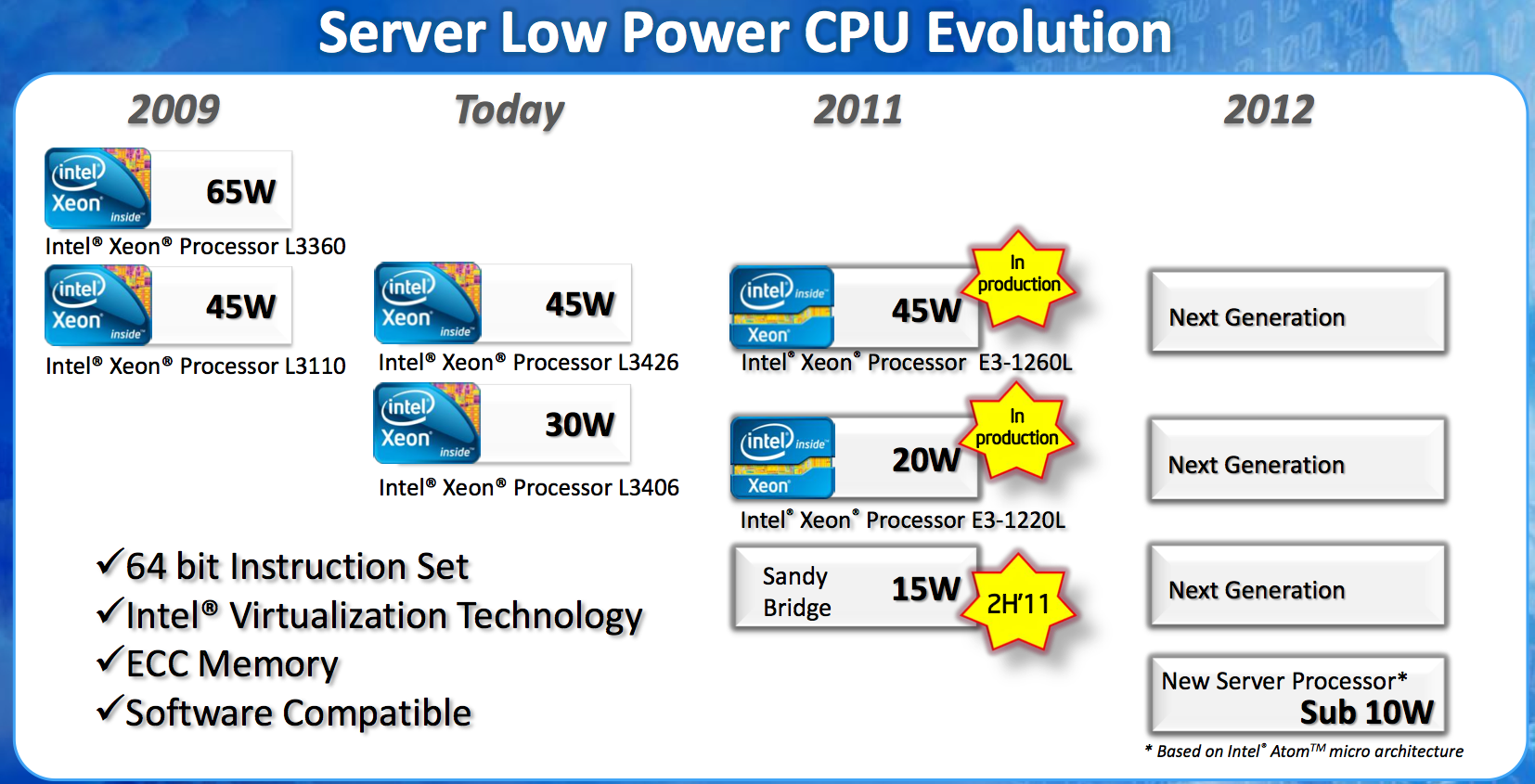
Intel's slide above seems to imply that we'll have ECC support with this server version of Atom in 2012, which is something current Atom based servers lack.
The only real question that remains is what Atom architecture will be used? We'll see an updated 32nm Atom by the end of 2011 but that's still fundamentally using the same Bonnell core that was introduced back in 2008. Intel originally committed to keeping with its in-order architecture for 5 years back in 2008, that would mean that 2012 is ripe for the introduction of an out-of-order Atom. Whether or not that updated core will make it in time for use in Atom servers is still up for debate.
Read More ...
Canadian Researchers Develop First Remote-Controlled Microcarrier Drug Delivery System
Could improve chemoembolization, which is the current liver cancer treatment used
Read More ...
3/16/2011 Daily Hardware Reviews -- Geforce GTX 550 Ti Edition
DailyTech's roundup of hardware reviews from around the web for Wednesday
Read More ...
Samsung's 13" 9 Series MacBook Air Fighter Coming Tomorrow, 11" Model in April
Samsung's 13" 9 Series is a bit on the pricey side
Read More ...
Survey Says: Consumers Still Don't Understand Hybrids
After more than ten years on the market, hybrids still confuse car shoppers
Read More ...
Researcher Invents Better Laser Diode, Could Dramatically Improve Hardware
Breakthrough could also be used in high speed internet communications
Read More ...
U.S. Military Blocks 13 Websites in Japan to Increase Available Bandwidth
Blockage is a temporary measure
Read More ...
Netflix May Acquire Original Programming
Netflix may be purchasing its first original program, "House of Cards," which is a drama series that is executive produced and directed by David Fincher, and also executive produced by and starring Kevin Spacey
Read More ...
Obama to Push Internet Privacy Bill, Create Online Tracking, Opt-Out
Internet rights measure enjoys bipartisan support
Read More ...
Nokia Tablets Patents Surface
Patents filed in May 2010, fate unknown
Read More ...
Motorola Xoom Wi-Fi Coming March 27, Priced at $599
Motorola's Xoom gets a lower price of entry
Read More ...
Adobe Discovers "Critical" Security Flaw in Flash, Won't Release Patch Until Next Week
Vulnerability is being actively exploited
Read More ...
Netflix Dominates Digital Movies Streaming
The NPD Group found that six out of 10 digital movies are streamed through Netflix
Read More ...
Bon Jovi: Shot to the Heart and Jobs is to Blame, He Gives Music a Bad Name
Rock superstar says Steve Jobs is killing music with iTunes
Read More ...


No comments:
Post a Comment