

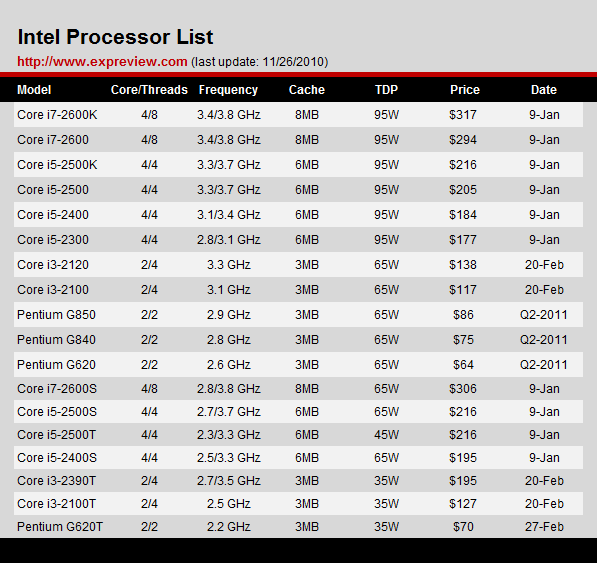
Back in August, a report with details sourced from ComputerBase.de was bang-on in tabling what the 2011 Intel Core processor lineup is going to look like. With a little over a month to go for the market release of these processors, fresh details emerged that reveal pricing and precise availability dates of each model. To begin with, 9th January is D-day for the socket LGA1155 platform, when one can expect a large wave of motherboards to reach stores, along with 10 new Core i5, Core i7 "Sandy Bridge" quad-core processors.
The quad-core lineup consists of 7 Core i5 models. Based on a Sandy Bridge derivative silicon, these processors differ from the Core i7 models in having no HyperThreading (4 cores/4 threads), and 25% of the L3 cache being disabled (set at 6 MB). The lineup overall is seeing a clock speed increase compared to current-generation "Lynnfield" processors. The Core i5 lineup also includes an overclocker-friendly "K" model, which features an unlocked BClk multipler. The fastest in the lineup is the Core i7 2600/2600K, which is clocked at 3.40 GHz. With the default BClk (base clock) of Sandy Bridge running at 100 MHz (compared to 133 MHz on Nehalem/Westmere), one can expect very high multiplier values. It should also be easier to calculate speeds and keep track of, for overclockers.
Read More ...
MSI Intros GeForce GTX 460 OC with New Single-Fan Cooler
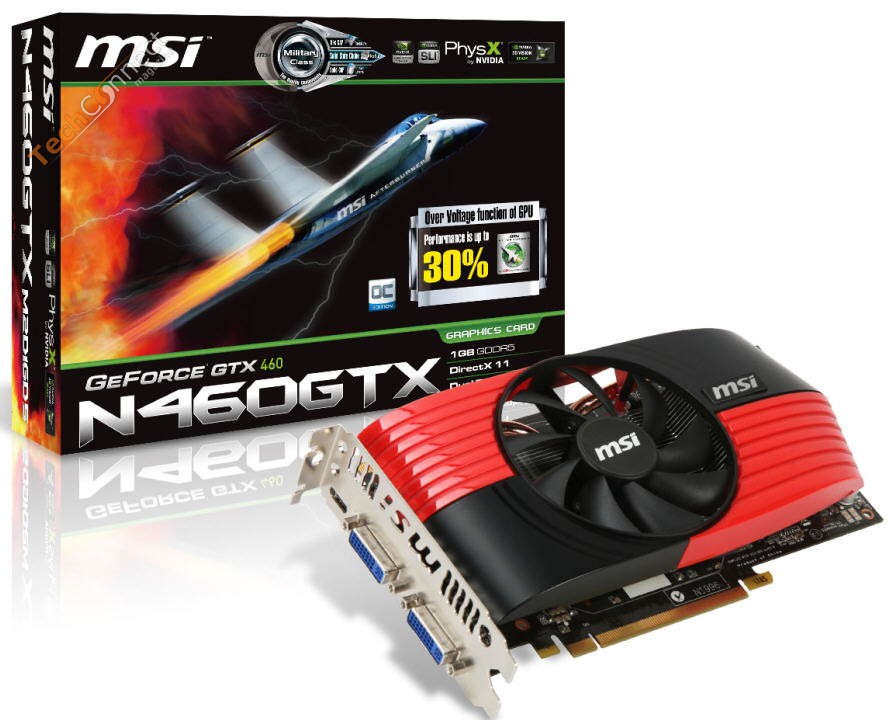
MSI released a new factory-overclocked GeForce GTX 460 1 GB graphics card that makes use of the company's new sporty-looking single fan cooler the company first introduced with its Radeon HD 6850 graphics cards. The uses the same PCB as the one on the GTX 460 Cyclone OC graphics card. The cooler uses a 90 mm fan to blow air onto a large aluminum fin array, to which heat is conveyed by 8 mm thick heatpipes. The clock speeds are also identical with those of the Cyclone OC: 725 MHz core, 1450 MHz CUDA cores, and 900 MHz (3600 MHz effective) memory. The card also features software voltage control, which when combined with increased frequencies, up performance by 30%. Released in Europe, the new GTX 460 OC is priced at €155.
Source: TechConnect Magazine
Read More ...
ASRock Designs LGA1156 Motherboard Based on Intel P67 Chipset
ASRock is known to mix and match sockets and chipsets to come up with some interesting hybrids that give users access to latest features offered by the chipset. A recent example of this is a socket 939 motherboard based on the AMD 785G chipset (read here), which gives users of socket-939 Athlons access to a fast IGP and PCI-Express 2.0. The company's latest such innovation is the P67 Transformer. This is a socket LGA1156 motherboard, it supports existing Core i5/Core i7 "Lynnfield", and Core i3/Core i5 "Clarkdale" processors, but is based on the Intel P67 Express chipset. The board gives users access to some advanced features of the P67 chipset, but won't support LGA1155 processors.
So what's in it for you? Well, the P67 PCH embeds a PCI-Express 2.0 hub compared to P55/H55, which pack an older PCI-Express 1.1 hub. The older hub is known to heavily bottleneck devices such as USB 3.0 and SATA 6 Gb/s controllers that use only a single PCI-E lane (since PCI-E 1.1 has 250 MB/s per direction bandwidth, compared to 500 MB/s on the PCI-E 2.0). So significant is this bottleneck, that some motherboard designers even used bridge chips that convert the P55's PCI-E 1.1 x4 port to two PCI-E 2.0 x1, for USB 3.0 and SATA 6 Gb/s controllers. The PCI-E x16 slots however, are wired to the processor and are Gen 2. ASRock's board hence gives you two USB 3.0 and two SATA 6 Gb/s with an alleviated bus bottleneck.

Read More ...
Hitachi and Partners Develop New HDD Technology Providing 8-Fold Density Increase
A consortium led by Hitachi, including Japan's New Energy and Industrial Technology Development Organization (NEDO), a public-sector body that promotes research of energy-efficient technologies, National University Corporation Tokyo Institute of Technology, and Kyoto University, have developed a new hard drive data recording technology that promises to increase data density 8-fold.
The researchers have developed a new patterning technology for the magnetized bits that are laid on the platters, which are just 10 nm in size. This is made possible by using new materials, and making use of a self-arranged phenomenon of polymer materials. Its practical applications increases areal-density of disk platters to 3.9 Terabits per square inch, an 8-fold increase compared to the 500 Gigabits per square inch that's currently standard. This paves the way for 24 Terabyte (TB) hard drives in the very near future.

Source: CDRInfo
Read More ...


No comments:
Post a Comment