

Updated: Windows Phone 7: 21 things you need to know

Windows Phone 7 will be out later this year - probably 21 October in the UK - and the jury is very much still out on whether Microsoft can finally compete with the iPhone and the up-and-coming might of Android.
Interested in what's in store? Here's the ultimate guide to everything you need to know about Microsoft's new mobile OS.
1. The Windows Phone 7 release date is 21 October
Retailers were preparing for a September launch of Microsoft Windows Phone 7, according to leaked documents from the computing giant. The news followed the killing off of Microsoft's Kin phones in Europe, which might well have something to do with the rush to get a decent smartphone on the market to compete with Apple, BlackBerry, Android and Nokia's Symbian phones later this year. Microsoft has said that the the internal Kin development team have now been transferred to work on Windows Phone 7.
As of 27 September, the latest rumours are that the Windows Phone 7 UK release date is 21 October - Microsoft has called TechRadar to a press conference on 11 October. so it seems likely that Windows Phone 7 will be officially announced then.

2. Windows Phone 7 phones
Windows Phone 7 handsets should be plentiful - on board a whole heap of handsets from numerous operators. The initial partner list named - AT&T, Deutsche Telekom AG , Orange, SFR, Sprint, Telecom Italia, Telefónica (they own O2), Telstra, T-Mobile USA, Verizon Wireless and Vodafone and manufacturers Dell, Garmin-Asus, HTC Corp., HP, LG, Samsung, Sony Ericsson, Toshiba and Qualcomm. Wowsers.
The HTC Mozart and Trophy Windows Phone 7 handsets were caught on video on 22 September.
WMPoweruser.com reported that LG is set to release two Windows 7 Phone devices later this year - the LG E900 and LG C900. Elsewhere, Tera-wurfl.com has also revealed that the SGH i707 by Samsung also runs Windows Phone 7.
3. Windows Phone 7 operators
Windows Phone 7 devices will come to Orange, O2, Vodafone, T-Mobile and Three customers, although there is no mention of Tesco and Virgin Media, which run on those networks.
4. Windows Phone 7 games
The impact of the Games hub will be crucial. Microsoft has confirmed that it will be easy for developers to port games created for the Xbox Arcade to Windows Phone 7.
Although it was already common knowledge that the XNA framework, used for creating Xbox Arcade games, was going to be used for the Windows Phone 7 handsets, Oded Ran, head of Consumer Marketing for Windows Phone confirmed to TechRadar that Microsoft is hoping to be seen as a market leader in mobile gaming. "There are 4 million Xboxes in the UK compared to 2.5 million iPhones; we're now working with developers who know how to make games, and they're able to port Xbox Arcade games to mobile phones easily," said Ran.

5. It has a long way to catch up
Windows Mobile devices accounted for a mere 7 per cent of smartphone sales in Q1 of this year, according to Gartner, with Symbian leading the way with 44 per cent, RIM in second place with 19 per cent, Apple in third place with 15 per cent and Android in fourth place with 10 per cent of the market. It's a long way up.
6. Windows Phone uses Dorado
Dorado is the codename for the Zune software for the PC. And now, iTunes style, it'll sync content to your Windows Phone, too. After all, ActiveSync is rubbish, isn't it?
7. But there's no copy and paste
Can it really be true that Windows Phone 7 won't have copy and paste? Turns out that delivering the context-sensitive tools for handling information like phone numbers and addresses was part of the reason that the copy and paste feature of Windows Mobile didn't make it into version one of Windows Phone. Microsoft senior director Paul Bryan confirmed: "We ended up getting to the point where we said we need to deliver a great experience and there are certain things we can get done in this period of time and certain things we can't."
8. It's good for work and pleasure
Windows Phone has to keep the features that make it so appealing to corporates – compatibility with Exchange and Office, for example. But in Windows Phone 7, Microsoft may finally have found a way to balance this with the thirst for snazzy smartphone tech. Never mind getting two push email accounts on Android 2.2 or iPhone 4; not only will Windows Phone 7 let you have the two Exchange Active Sync connections, but Microsoft senior director Paul Bryan told TechRadar that you can sync as many EAS [push] email accounts as you like to your phone. "We can do more than two - there's no limit," he said, adding that he's syncing three accounts on his own phone.
9. No multitasking
The OS will process Microsoft's core integrated experiences, including music and phone calls, in the background, but not those of third-party apps – very much like the iPhone was before iOS 4. There will, however, be support for push-notifications so that third-party apps can send you updates and status messages when the app itself is not running. Multitasking will probably be implemented in a later version of Windows Phone, but Microsoft is currently choosing to be cautious in terms of battery life.

10. It's great with people
The People Hub is the finest way we've yet seen to bring all your communication together in one place, Oded Ran previously told TechRadar that Microsoft would enable social networks to implement their services.
11. High res screens are still the way forward - for now
You should remember that Windows Phone 7 will be only running phones with WVGA (800 x 480) screens - we like that level of resolution. But the problem is that that screen res can be a) heavy on the wallet and b) not necessary in some phones. So to that end, Microsoft will be adding HVGA (480 x 320) to the mix in the future, which means slightly lower res video, and apps will have to be rescaled to run on lower-pixelled screen. But Android has managed it with recent reboots, so there's no reason why Microsoft can't be successful with it as well.
12. It's all about the live tiles
At a time when Apple's iPhone UI still holds major influence over the market (look at Samsung's Wave and other new handsets to see why), Microsoft has managed to at least mix things up a little. Taking the best aspects of the Zune interface and combining them with the dynamic tiled approach is clever – we're fans.

13. Search is central to the experience
As well as the Start button, every Windows Phone 7 phone will come with a dedicated hardware button for Bing, providing one-click access to search from anywhere on the handset. "A special implementation of Bing search provides intent-specific results, delivering the most relevant web or local results, depending on the type of query," says Microsoft. What that actually means is that if you search for "pizza" on a phone, it'll search local businesses for you first.
14. There will be plenty of ads
Windows Phone 7 is set to allow advertisers to push through info on their products through a platform called Toast. "(WP7 is) an extra move on our NUI (natural user interface). We're trying to get technology out of the way of people," said Kostas Mallios, Microsoft's general manager for Strategy and Business Development, speaking at the Cannes Lions International Advertising Festival in France.
15. Windows Phone 7 specifications
Windows Phone will have plenty of punch. As we saw at Microsoft's Mix developer event back in March, Windows Phone 7 will be able to draw from the phone's resources in a big way and still survive - which makes sense when you think it's going to have a 1GHz processor as a minimum in most devices.
16. Hubs are it
The People Hub is clever (even if it's not totally original). But we like the idea of gathering together content – after all gathering media together is basically what Apple does with the iPod app on the iPhone. Integration with third-party apps and services also marks a real departure for the OS, even if it may be seen as a necessary evil by some Microsoft internals. Windows Phone 7 includes six hubs including Office, Xbox Live and Marketplace for apps.

17. Developers will be well catered for
Devs will be able to take advantage of elements like multi-touch, the camera, GPS, push notifications and accelerometers to make cool new applications, while there's also full Silverlight support.

18. An improved Marketplace
Microsoft has decided to overhaul the Windows Phone Marketplace, so it will feature a panoramic design and 'active merchandising' to increase the discoverability of games and applications. Microsoft will now stop unlicensed third party apps from making their way on to WP7 devices. This means app vendors like Handango will have their noses put firmly out of joint - it's a significant revenue stream gone bye bye. The Marketplace will also support one-time credit card purchases, mobile operator billing and advertising-funded applications to increase the raft of options on offer - basically offering more ways to pay makes developers happier.
19. You can 'try before you buy' Windows Phone apps
At a recent briefing with Microsoft, TechRadar was told that one problem with free versions of applications on other app stores is people will install the trial, take a quick look then uninstall.
When asked to rate, the results are invariably low - therefore by placing both the free trial version of the app and the full price version together, the end rating will better reflect the quality.
Microsoft also promised us there would be "enough applications on day one of the Windows Phone [7] launch" and that no longer would the phone interface simply be a "sea of icons".
20. There's no memory card support
Here's a down side - there won't be any memory card support. Actually, there will be support for them, but you can't get to them. That's right - the two options will either be built-in memory, and gallons of it, with no memory card slot (think Nokia X6) or there will be a 'locked' memory card under the battery. Why? We have no idea. It seems that if you can support hot-swappable memory cards, you should. It just makes life easier for the end-user.
21. It'll sync over Wi-Fi
Apple, please sort this out. Microsoft has beaten you to the punch.

 |  |
Read More ...
Three offers free Facebook phone access
 Customers of mobile network Three can now access Facebook for free, thanks to a new deal with the social-networking site.
Users can now access 0.facebook.com, which is a stripped down version of the website that features no graphics, only a list of status updates and the like.
Three is the first network to offer the service in the UK, explaining in a press release: "At Three, we want to make the mobile internet easy and affordable for everyone.
"We are delighted to work with Facebook to bring one of the most visited mobile websites to our customers for free.
"We have the only 100% 3G network in the UK so that we can provide our customers with the very best experience of the mobile internet"
Facebook for free
There have been a number of rumours that a Facebook phone is imminent from INQ, a manufacturer which already makes a Skype-branded phone (the Skypephone S2) and an unofficial Facebook handset (the INQ1), which featured layering dedicated to the social network.
Three was the mobile operator for both these handsets, so it makes sense that it would be the first in the UK to effectively offer Facebook for free to its users.
While this phone is yet to surface, the free Facebook deal by Three (try saying that 10 times fast) seems like a decent stop gap for those who want to browse the site, but don't want to pay for it.
"We are always looking to work with innovative companies to provide simple and fast mobile access to Facebook across the world," said Henri Moissinac, head of mobile business, Facebook.
"Thanks to our collaboration with Three, people will be able to stay connected to their friends on Facebook while they are on the go – all completely free."

| |
Read More ...
Windows Phone 7 UK release date: 21 October?
 The UK will be able to get its hands on the first wave of Windows Phone 7 handsets on the 21 October.
This is according to Neowin, who believes it has bagged the exclusive on this titbit of news.
The date is the same for the most of Europe with the UK, Germany, France, Italy and Spain ready to unleash their handsets next month.
The US will get its hands on Windows Phone 7 in November, although this date may also move back to October.
Windows Phone 7 UK release date
Leaks of Windows Phone 7 handsets are increasing and it was announced last week that all of the main UK mobile operators will be stocking the devices.
It is Orange who will be the first telco to release a Windows Phone 7 handset in the UK – as it was the first to announce it will be adding the OS to its handset line up.
Prior to the 21 October Windows Phone 7 UK release date, there will also be a formal kick-off of Windows Phone 7, with a Microsoft press conference pencilled in for 11 October.

| |
Read More ...
Segway owner falls to death from Yorkshire cliff
 The UK boss of motorised scooter company Segway has fallen to his death in a tragic accident, after riding one of the two-wheeled machines off a cliff.
 Jimi Heselden, the 62-year-old Leeds-based owner of the Segway company, has fallen to his death after riding a Segway over the edge of a cliff and into the River Wharf.
Ex-miner millionaire
Ex-miner Heselden set up the UK Segway operation after making his millions from founding his first company HESCO Bastions with his redundancy pay when he was laid off from the pits.
Heselden was worth over £166m and ranked 395th on the Sunday Times Rich List. He was believed to have been inspecting the grounds of his North Yorkshire estate on an off-road version of the Segway.
A passer-by found Heselden's body in the Boston Spa area at about 11.40am on Sunday 26 September.
A spokesman for West Yorkshire Police said: "Police were called at 11.40am yesterday to reports of a man in the River Wharfe, apparently having fallen from the cliffs above.
Non-suspicious death
"A Segway-style vehicle was recovered. He was pronounced dead at the scene. At this time we do not believe the death to be suspicious."
Heselden made his millions from defence contracts, after he created the "blast wall" - a wire-cage water containment system which proved to be a significant defence against bullets, missiles and suicide attacks for soldiers in Afghanistan and Iraq.
A West Yorkshire Police spokesman said: "Police have named James William Heselden as the 62-year-old local man who was pronounced dead yesterday after being pulled from the River Wharfe near to Leys Lane at Boston Spa.
"Officers were called to the incident around 11.40am following a call from a member of the public.
"Mr Heselden, who is from Thorp Arch, was pronounced dead at the scene by paramedics.
"The incident is not believed to be suspicious and the coroner has been informed."

| |
Read More ...
Opinion: Why a Facebook phone makes sense
 If you believe the rumours, Facebook is working with INQ mobile and AT&T on an iPhone-style phone, and a network to go with it.
It makes perfect sense - a Facebook phone has the potential to dissolve geographical boundaries and equip you with a globally-transparent currency that'll let you do things that you can't do in your local currency.
A phone and currency?
Let's take it from the currency. Facebook has one thing that everyone wants - users. So many, in fact, that it ranks the fourth largest country in the world. And every country needs currency, even a virtual one.
Facebook calls its virtual moolah "Credits". It debuted last year, and is now the only method of payment for the games created by Facebook's number one third-party developer, Zynga
How do you acquire these virtual Credits? Facebook sells them in gift stores in the US. Expect them to be available in a UK store near you soon.
So at the end of a virtual currency is a physical bank account with real cash. Inside Networks, which tracks Facebook apps, says the virtual currency is expected to generate $835 million in hard cash this year. From here on, it's only going to grow. Facebook projects that its virtual currency will be used to purchase much of what is sold on the site, and Facebook gets 30 percent of every sale.
The advantage of a virtual currency is that it's impervious to physical borders, and streamlines International transactions. If an item costs 5 credits in the US, it costs 5 credits here in the UK.
Happening now
Now take this virtual currency a step further, and you have access to a broad range of items which you could pay for with virtual Credits. And you'll do it using your Facebook phone.
Far fetched? No, it's already happening. There's the yet-to-be-launched Social TopUps service which allows Facebook users to directly recharge a mobile phone user's prepaid mobile phone in another country.
Of course something like SocialTopsUps requires the participation of network operators across the globe. To tie up with the operators, Facebook needs its own phone.
The rumoured phones are said to be modeled on the iPhone, but the similarities will extend far beyond aesthetics. Much like the iPhone, Facebook would want to meld its platform with the phone's hardware. If it's your own money involved, who would you trust as a user - a third-party app using the Facebook API or an official, tightly integrated Facebook phone and app?
The possibilities of a cross-border virtual global currency and the convenience of a phone, are limitless. SocialTopsUps and a Facebook-badged phone will whet your appetite. Soon you'll be able to use your Facebook phone and virtual credits to pay for items in the real world.

| |
Read More ...
Review: Canon PIXMA MG6150
 Canon's recent PIXMA multifunction printers have impressed, and the PIXMA MG6150 is no exception.
 Combining a fantastic feature set with a consistently superb print engine, it's arguably the best home inkjet in its price range. Connecting through Wi-Fi, USB or Ethernet (optional Bluetooth available), the MG6150 has two 150-sheet paper trays, a 7.5cm LCD, PictBridge, Duplex and a card reader.
You can print directly to an optical disc with adapter, but there's no faxing. Ink tanks are up to six, with CMYK and pigment black joined by a grey tank for improved monochrome printing. And it shows.
Even at default quality, its greyscale ramp is smooth and consistent, with very little banding.
The MG6150's high-quality photo prints are impressive too. Colours are rich and strong, subtle shades are beautifully realised and fine details accurately reproduced. Photos printed on plain paper at the default speed are a little grainy, but colours remain strong.
Text quality is excellent. Characters are well-defined and readable even at very small point sizes. Our 20-page test document printed four minutes, six seconds, which is acceptable for a home printer.
A high-quality A4 PhotoDisc test print took just under two minutes on photo paper and one minute 15 seconds on plain paper.
So much functionality has been crammed into such a small box, with almost no weaknesses. If you're after a multifunction printer, this is it!
Related Links

| |
Read More ...
Online porn boss meet-up announced to tackle piracy
 Adult film retail outfit Pink Visual has decided enough is enough in the fight against the online piracy of pornography and has organised a conference for the biggest players in the porn industry to attend.
Called the Content Protection Retreat, the three-day meet up (that's 'meet up' not 'meat up') will educate the adult industry in the ways of the pirate and help tackle what is a bit of a headache for the pornographic industry.
"Like a certain better-known form of 'CPR,' the Content Protection Retreat is all about breathing new life into something that might otherwise die," says the safe for work CPR website.
"In this case, what we're trying to 'resuscitate' is nothing less than the profitability of the adult entertainment industry."
Administering CPR
As there is likely to be big demand to attend CPR, the event is limiting itself to 30 companies, which have to match the following criteria: "In order to be considered as an attendee of the CPR, your company must own the rights to at least 2,000 adult videos."
To reiterate, that is 'own the rights' to 2,000 bits of video smut, not just own 2,000 adult DVDs.
This is one of the first conferences of its kind to tackle piracy in the pornographic market and it has already had the backing from big names, like Hustler, Titan Media and Private.
Pink Visual is hoping that the conference will help with its plight to "effectively drive those who engage in adult content piracy completely underground by January 2012".

| |
Read More ...
Review: Apple Mac mini server 2.66GHz
 The new Mac mini with Snow Leopard Server has surely been taking tips from Doctor Who's TARDIS – despite being cut from a single block of aluminium, it must somehow be bigger on the inside – how else could one shoehorn that amount of hardware into such a small form-factor?
 Like its predecessors, it comes without monitor, keyboard, or indeed mouse. (While it can be set up remotely, it's a good idea to connect it up to a monitor and keyboard for initial setup.) An optical drive is sacrificed for a second 500GB drive for a total of 1TB storage, while the external power brick is notable only by its absence – that's tucked inside too.
Its most cunning design element is a twist-off base, which makes upgrading the supplied 4GB memory to 8GB a snap.
It's quiet in use, consuming just 11W when idle, and it seems determined not to heat up, however much you thrash it.
The 10.6 Server software comes pre-installed, ready for setup. If you need to reinstall, you have to attach an external drive or share a drive, á la Macbook Air. Setup is straightforward, and if you use the same login name and password, local Mac clients are offered Calendar and Address Book sharing the first time they log in.
Server 10.6 includes Mail, Address Book, Wiki Server 2, Time Machine, and web server tools, both to logged-in clients and via a web portal. It supports Podcast Producer too. For design and software functionality, it's clearly value for money.
The competition – Windows Small Business Server with its perclient licensing – is more expensive. Server 10.6 provides more functionality than a generic network attached storage (NAS) box. If you are worried about support because of its bundled nature, an extra Apple Care cost of £130 includes three years' hardware and software support.
Small offices might consider cloud services such as Google Docs or Dropbox an alternative, but with the Mac mini you know exactly where your files are.
Related Links

| |
Read More ...
In Depth: Best budget processors reviewed and rated
 Just as Intel dominates the upper end of the CPU price range, AMD has managed to position itself as the tightly-pursed PC enthusiast's processor manufacturer of choice.
This isn't necessarily a bad thing: cheap AMD processors often prove just as good, if not better, than cheap Intel processors. What's more is that AMD's AM3 architecture means that processors can be taken out and swapped willy-nilly, without having to worry about upgrading your motherboard or memory.
We've picked out five of the cheapest chips we've recently reviewed, put them in price order and included an Intel one for good measure. If you're planning on building a budget system, this is essential reading.
1. AMD Athlon II X2 250 - £44
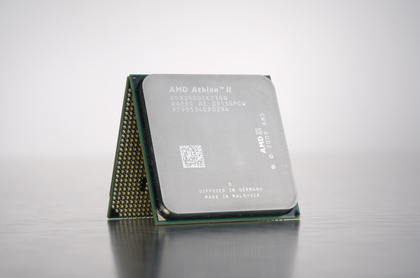
A £44 processor is never going to be able to match a £150 one, but that price does make the Athlon II X2 250 the cheapest in our recent spate of processor reviews. Its performance is surprisingly good, too - it naturally chugged when we tested games, but its HD video playback performance was excellent. It's a dual-core processor through-and-through, packing a pair of 3GHz cores and no more, but AMD has at least included an onboard memory controller and the high speed HyperTransport interconnect. As the heart of a cheap media centre or non-gaming PC it will really come into its own.
Read our AMD Athlon II X2 250 review
2. AMD Phenom II X2 550 Black Edition - £65
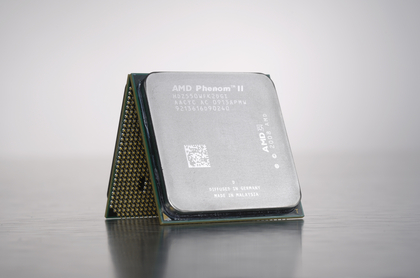
Don't let the Phenom II X2 550 Black Edition's dual-core nature put you off: it's still a perfectly able performer for gaming. This is thanks to its 3.1GHz clock speed and 6MB of L3 cache memory - which mean it flies in gaming benchmarks. Being a "Black Edition", it's designed to play nicely when overclocked, and we managed to get it up to 4GHz. It inevitably falls down a bit when it comes to multi-core tasks, and it's never going to be able to keep up with Intel's lower priced chips. But it's still got an unbeatable price tag, and makes a solid first step into the world of overclocking.
Read our AMD Phenom II X2 550 Black Edition review
3. AMD Athlon II X4 620 - £86
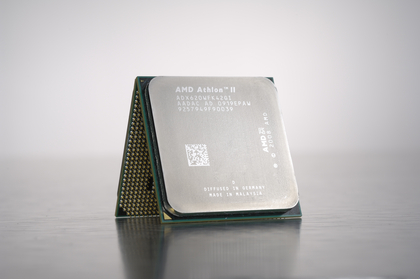
In stark contrast to the Phenom X2 550, the Athlon II X4 620 packs four cores into a single chip, and comes in at only £20 more. It's an expertly-engineered multi-core chip; it's able to handle video encoding and professional 3D rendering without even breaking a sweat. Embarrassingly for the big I, it came mightily close to Intel's far pricier chips in our video encoding tests. Gaming performance - which relies on a single core - was a bit of a let-down, but as an all-rounder you could do far, far, worse; it's perfect for those who like to use their PCs for intensive tasks other than shooting pretend people in the face.
Read our AMD Athlon II X4 620 review
4. AMD Phenom II X4 965 BE - £129
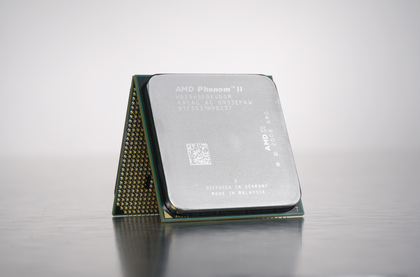
A perfect chip for overclocking enthusiasts on a budget, the Phenom II X4 965 Black Edition includes four cores running at 3.4GHz. This is not to be quibbled with, and in HD video encoding and professional 3D rendering, it matched Intel's similarly-priced Core i5 750. It couldn't quite keep up with the Core i5 750 in gaming performance, but one of the key draws of AMD's chip is that the price of building a PC on its AM3 architecture is far, far cheaper. It also overclocks nicely to 4.1GHz, which is higher than AMD's own six-core processors.
Read our AMD Phenom II X4 965 BE review
5 Intel Core i5 750 - £129

The cheapest Intel chip in our "budget" round-up still comes in at a rather wallet-quaking £129, but in terms of sheer performance it's worth every penny. It includes the obligatory four cores, 8MB of cache and dual-core memory controller, but this chip has got it where it counts in terms of monumental gaming performance. Each of those cores is ready and willing to take on strenuous tasks like games and file decompression, and what's more is that Intel has included plenty of overclocking headroom for system tweakers. It even beat Intel's supposedly-faster Core i5 760 in our tests, which is impressive stuff for such a (comparatively) cheap chip.
Read our Intel Core i5 750 review

| |
Read More ...
Sponsored: Making science special
 This is a sponsored article in association with Microsoft.
When Bill Gates saw Richard Feynman speak, his mind was well and truly blown - so much so that more than twenty years later, he tracked down footage of the famous physicist's lectures, used his own money to pay for the rights to the videos and digitised them so that a new generation could enjoy them.
He didn't just stick the footage online, though: Gates wanted Feynman to inspire a new generation, so he gave the clips to Microsoft Research. The result, Project Tuva, is extraordinary.
Richard Feynman is a legend in scientific circles, not just for his sharp mind but for his enthusiasm, sense of humour and his ability to explain complex concepts in plain English.
"No one was more adept at making science fun and interesting than Richard Feynman," Bill Gates explains. "More than 20 years after first seeing them, these are still some of the best science lectures I've heard. Feynman worked hard during his life to popularise science, so I'm sure he'd be thrilled that now anyone, anywhere in the world, can just click a button and experience his lectures."

INSPIRED: Project Tuva was a labour of love for Bill Gates, who used his own money to pay for the rights to broadcast Richard Feynman's lectures
Experience is a good way to put it, because Project Tuva isn't just video, as entertaining as the footage of Feynman is. Think of it as Feynman: The Director's Cut: as Feynman speaks you can access other viewers' notes, audio commentaries from physics experts, full transcripts for the hearing impaired and a range of extras.
When Feynman mentions an equation you can see the formula; when he mentions a constellation you can visit it using imagery pulled in from Microsoft's Worldwide Telescope; when he mentions another scientist, you can pull up that person's biography; when he tells a joke, a note explains why it's funny.
These notes and text extras are all searchable, and clicking on a search result takes you to the appropriate point in the video.

EXTRAS: In addition to the smooth streaming video, Project Tuva provides extra content - and you can add your own notes too
There are some other clever ideas too. Project Tuva is built in Silverlight, and that means it can remember your preferences: if you'd turned the volume down the last time you used it, Project Tuva remembers and keeps the volume setting the same today. Notes you've made will still be there tomorrow, and if you stop watching before the end of a clip you can pick up where you left off when you come back.
Project Tuva also uses Microsoft's Smooth Streaming technology, which monitors your internet connection for congestion and instantly increases or decreases the video quality to ensure you get the best possible quality at all times.
Smooth Streaming also enables very fast switching from one bit of a clip to another, which is particularly handy when you're using the search tool or clicking on notes you've left.

TELESCOPE TOURS: In addition to supplemental text, Project Tuva provides additional content such as images and even Worldwide Telescope tours
We're sure Feynman would appreciate the way Project Tuva uses cutting-edge technology to bring his lectures to a new audience, and we'd love to see the same technologies used in other educational applications.
We suspect that had Project Tuva been around when we were at school, we'd have paid a lot more attention.

| |
Read More ...
Leeds Uni trials free iPhone loan scheme
 Leeds University is issuing Apple iPhone 3GSs to its fourth and fifth-year medical students in a ground-breaking educational initiative.
The Uni's press release heralds the message that 'Generation Y' student doctors are swapping textbooks for iPhones.
Phones versus textbooks
As such, the Uni announces this week that the Department of Medicine is issuing iPhone 3GSs to its senior med students in order to allow them access to progress files, assessment modules and other course materials on the go.
"This will be the first time that a UK medical school has provided undergraduates with all the tools they need to study off-campus via mobile phone technology," the release claims.
520 medical students will be loaned an iPhone 3GS 16GB for the remainder of their undergraduate course in Medicine at Leeds.
This is because undergraduates "typically spend much of their time in local NHS hospitals, GP surgeries and community health clinics" in these final two years of their course, which makes it difficult to stay in regular contact with tutors and course materials and text books.
Pioneering educational scheme
Leeds's pioneering iPhone scheme hopes to resolve these problems, with the smartphones "pre-loaded with a range of dedicated 'apps' that will let students record notes on interesting cases whilst still on the wards, and test their knowledge of procedures or protocols they have just observed.
"Copies of key medical textbooks and reference works, including up-to-date guidelines on administering prescription drugs, will also be distributed as iPhone apps. A range of other relevant medical apps that can be downloaded free-of-charge or purchased will be provided too."
Students will get unlimited mobile broadband connectivity from O2 on their iPhones as part of the loan deal, with phone and text functions available to them on a pay-as-you-go basis.
"This is a fantastic scheme and one that Leeds should be proud of. By equipping our students with smartphones, we are putting a whole suite of training tools and educational resources in the palm of their hand," said Professor David Cottrell, Dean of the School of Medicine at the University of Leeds.
Virtual learning environments
Professor Trudie Roberts, Professor of Medical Education at the University of Leeds added: "No other UK medical school is taking advantage of the virtual learning environment to such an extent.
"It is vitally important that medical students continue to develop their skills and record their progress when they are in practice, as well as when they are on campus.
"Mobile phone technology means that students can do this quickly and easily, wherever they happen to be working."

| |
Read More ...
Sony Ericsson waves goodbye to Symbian on its smartphones
 Sony Ericsson has announced that it is no longer supporting Symbian as an OS for its smartphone range, preferring Google's Android platform instead.
Speaking to Business Week, Aldo Liguori, a spokesman for SE, confirmed that the phone company is no longer putting its efforts into creating phones with Symbian as an OS, explaining: "We have no plans for the time being to develop any new products to the Symbian Foundation standard or operating system."
Sending out an S-OS
This echoes remarks made by chief technology officer Jan Uddenfeldt to a Swedish newspaper early last week.
While this doesn't mean that Sony Ericsson will never go back to Symbian, it will be a blow for the OS.
Even though it is ducking out of using the platform, the company still remains a member of the Symbian Foundation, alongside Nokia and Samsung.
The news means that the last Sony Ericsson phones to run on Symbian will be the Vivaz and Vivaz Pro – two phones which didn't get exactly blow TechRadar away when we reviewed them.
Nokia, however, remains absolute about Symbian, which makes sense considering it was the one who set up the Symbian Foundation in 2008 to share code with other phone manufacturers.

| |
Read More ...
Leeds Uni trials free iPhone loan scheme
Leeds University is issuing Apple iPhone 3GSs to its fourth and fifth-year medical students in a ground-breaking educational initiative.The Uni's press release heralds the message that 'Generation Y' student doctors are swapping textbooks for iPhones.
Phones versus textbooks
As such, the Uni announces this week that the Department of Medicine is issuing iPhone 3GSs to its senior med students in order to allow them access to progress files, assessment modules and other course materials on the go.
"This will be the first time that a UK medical school has provided undergraduates with all the tools they need to study off-campus via mobile phone technology," the release claims.
520 medical students will be loaned an iPhone 3GS 16GB for the remainder of their undergraduate course in Medicine at Leeds.
This is because undergraduates "typically spend much of their time in local NHS hospitals, GP surgeries and community health clinics" in these final two years of their course, which makes it difficult to stay in regular contact with tutors and course materials and text books.
Pioneering educational scheme
Leeds's pioneering iPhone scheme hopes to resolve these problems, with the smartphones "pre-loaded with a range of dedicated 'apps' that will let students record notes on interesting cases whilst still on the wards, and test their knowledge of procedures or protocols they have just observed.
"Copies of key medical textbooks and reference works, including up-to-date guidelines on administering prescription drugs, will also be distributed as iPhone apps. A range of other relevant medical apps that can be downloaded free-of-charge or purchased will be provided too."
Students will get unlimited mobile broadband connectivity from O2 on their iPhones as part of the loan deal, with phone and text functions available to them on a pay-as-you-go basis.
"This is a fantastic scheme and one that Leeds should be proud of. By equipping our students with smartphones, we are putting a whole suite of training tools and educational resources in the palm of their hand," said Professor David Cottrell, Dean of the School of Medicine at the University of Leeds.
Virtual learning environments
Professor Trudie Roberts, Professor of Medical Education at the University of Leeds added: "No other UK medical school is taking advantage of the virtual learning environment to such an extent.
"It is vitally important that medical students continue to develop their skills and record their progress when they are in practice, as well as when they are on campus.
"Mobile phone technology means that students can do this quickly and easily, wherever they happen to be working."

| |
Read More ...
Review: Asus G51Jx
 Over the last couple of decades 3D has spasmed violently in and out of fashion, never quite managing to break free from the sickening effects and dodgy cardboard spectacles that seem to have doomed its every attempt at making it mainstream.
Now, thankfully, technology has advanced far enough for companies such as Nintendo (with the 3DS) to demo 3D content without the need for glasses at all, albeit for more basic games and graphics.
The Asus G51Jx doesn't quite manage that, but it does employ nVidia's cutting edge 3D Vision technology, which features a special design of glasses that enable you to play the latest games – and enjoy 3D content – in impressive 3D.
Elsewhere the G51Jx proves itself to be a more than capable gaming rig, offering enough power and performance to play the latest gaming titles at full settings. It's also a highly versatile multimedia centre, which will suit you if you enjoy high definition (HD) movie editing, for example, when not playing the latest games.
As mentioned above, we were very impressed by Nvidia's active 3D Vision technology, and the effect it produces. The system works using a set of wireless glasses that are connected to the G51Jx by an infrared module, both of which are bundled with the laptop.
We actually found synchronising the glasses to the infrared module to be quite a fiddly process first time round, despite a setup wizard and instruction manual, and even the nVidia representative had a small skirmish with the equipment when it was first demonstrated to us.
Once you've established a connection between the G51Jx and the glasses you're ready for action, and simply launching a game, opening a 3D video or viewing 3D photos will automatically cause the glasses to click into 3D mode.
The way the glasses work is surprisingly simple. Fundamentally each of the lenses shutter independently, with each eye offered a slightly different version of the image on the G51Jx's screen. Your brain naturally blends the two pictures into one image and the 3D effect is created.

Of the three types of 3D content you can view on the G51Jx (movies, photos and games), the first two are most consistent in producing a decent effect. In our experience the effect is less forced than when employed on the games, and we've been impressed by all the demos we've been shown.
But the G51Jx is predominantly a gaming machine, and ultimately it impresses here as well. nVidia's technology will turn pretty much any game into 3D, but some are more suited to the transformation than others – a comprehensive list can be found on nVidia's website here.
Many games have been designed specifically with 3D Vision in mind, yet some of the early ones, such as Resident Evil 5 and Batman Arkham Asylum, failed to make a splash when it came to the 3D effect. We especially found that colours were washed out and the screen brightness very dim.
Fortunately developers have reacted to the criticism, and the latest 3D Vision-ready titles such as Just Cause 2 and Battlefield Bad Company 2 are fantastic ambassadors for the technology, and it's fair to say that going back to playing these games in 2D is quite a depressing experience.
So there's no doubt that with the correct software, the 3D effect works great, and it's also worth mentioning that we suffered none of the nausea we experienced with Acer's Aspire 5738DZG-434G50Mn, which features a passive screen technology that'll have you reaching for a bucket after about 15 minutes.
The G51Jx's 15.6-inch screen is very bright when not in 3D mode, but we'd have expected a full 1920 x 1080 pixel resolution for such a high-spec machine. Nevertheless images are crisp enough, but, as with all screens with a shiny coating, reflections are irritating in bright light.
The G51Jx's backlit keyboard features the Asus chiclet design, but is a little spongy for our liking. The flex especially affects the centre of the board, and we found these keys to be a little sluggish to our inputs, which isn't ideal. Nevertheless the board is comfortable enough during everyday use, and you'll have no problem typing for hours on the G51Jx.

A dedicated number pad is included, which is great for left-handed gamers, and makes it quicker and easier to regularly input data.
The G51Jx boasts a decent array of ports. There's four USB 2.0 ports for connecting or charging any peripherals you may have, from a smartphone to an external gaming mouse, as well as both VGA and HDMI interfaces. These allow you to hook up to analogue and HD monitors respectively if you want to play games and view content on a larger screen. Obviously the monitor or TV would have to be nVidia 3D Vision-ready to enjoy 3D content on it.
The G51Jx also boasts a Firewire connection for importing video at high speeds from a camera, for example, and an eSATA interface for rapidly transferring data to a compatible external hard drive.
Although not as well built as the superb Alienware M17x, the G51Jx is well put together, and you'll be able to travel safe in the knowledge it'll absorb a few knocks and bangs.
Having said that, the 146-minute battery life will mean travel with the G51Jx is limited to the shortest of journeys, even though the 3.7kg machine isn't as hernia-inducingly heavy as the likes of the Alienware M17x.
As with the likes of the MSI GX660 a garish design with all the bells and whistles has been implemented. Flashing lights and aggressive paint schemes might not endear the G51Jx to everyone, but will certainly appeal to some.
As you'd expect for a high-powered gaming machine, the G51Jx features some eye-wateringly fast performance.
A quad-core Intel Core i7 720QM, with 8912MB of DDR3 memory onboard, produces enough performance for you to multitask a variety of very resource-intensive applications with little problem.
As a result this is an option for those who really don't want to mess around when it comes to power, and you'll find this kind of performance also produces a serious amount of futureproofing – meaning the G51Jx will happily tick all the software requirement boxes for most applications for many years to come.
Likewise, the nVidia GeForce GTS 360M – backed up by 1GB of dedicated video memory – provides more than enough gaming power for running the latest titles at full whack. It's not quite as powerful as the Alienware M17x, which features two ATi chips, but it's not nearly as expensive either.
The 640GB hard drive spins at a fairly standard 5400rpm, and will provide you with plenty of storage for your multimedia libraries, alongside any work files and folders you might have.

The G51Jx also features a Blu-ray optical drive, for watching HD movies on, and although it can both write and read DVDs, it can only read Blu-rays. It's also a shame that because of the low pixel resolution of the screen, you won't get the full HD effect on the laptop.
A host of features include 2.0 mega pixel webcam for video messaging your friends and family, Bluetooth for wirelessly connecting to your smartphone, for example, and 802.11n Wi-Fi. The G51Jx also comes with a dedicated gaming mouse and bag, which is a nice touch.
So it looks like 3D has finally landed, and for good. The Asus G51Jx was one of the first on the scene, but a host of other manufacturers, including Toshiba with the Satellite A665 and Rock with the Xtreme 680, are pushing 3D Vision capable laptops out of their factory doors.
The Asus G51Jx itself is a good machine, with just a couple of quirks that stop it from being a great one. Either way the 3D element of the laptop works well, and we think you'll be pleased with the results too.
We liked
We like the fact that 3D works well on a laptop, and that the technology genuinely enhances the gaming experience – finally 3D isn't a gimmick.
The power on offer from both the graphics card and processor is formidable, and will keep you ticking software requirement boxes for many years to come.
The laptop may not be the most portable, but the 3.5kg weight is pleasingly light, meaning travel with the G51Jx is a possibility.
We disliked
There's not a lot to dislike about the G51Jx. The garish design won't suit all, but we actually quite liked it.
It's a shame the panel doesn't feature a full HD screen resolution for the highest levels of detail, and it is also a shame the keyboard isn't a bit firmer. But in the grand scheme of things these are minor quibbles.

Verdict
Ultimately this is a great laptop, and kudos to Asus for being the first out the gates with a nVidia 3D Vision laptop. That the technology works well – given the correct content – demonstrates that 3D is now ready to come out of the wilderness and start enjoying some success as a mainstream technology.
There are a few niggles, including the screen resolution and keyboard, but neither are a massive cause for drama.
Related Links

| |
Read More ...
Review: Apple Mac Pro
 Apple's mid-2010 refresh brings us three new models of the Mac Pro – the top-of-the-range tower format Mac aimed at professionals and high-end users. The one we're reviewing here is the entry-level model at £1999, based around a 2.8GHz quad core Intel Xeon processor using the 45nm Nehalem microarchitecture.
 If you need even more processing power, the mid-range Mac Pro sets you back £2,799 and features two 2.4GHz quad core Xeons based on the Westmere 32nm process. If you're really ambitious (and rich), the top-of-the-range model costs £3999, and boasts twin six-core 2.66GHz Xeon Westmere processors, for a total of 12 cores.
Naturally, if you order online, any and all of these machines can be customised. The entry-level model reviewed here can be boosted to a 3.2GHz quad-core CPU or a six-core 3.33GHz chip, though if you really want to spend some money, go for a top-of-the-range model with twin 2.93GHz six-core Xeons.
This particular Mac Pro comes with 3GB (three 1GB DIMMs) of DDR3 ECC SDRAM at 1066MHz, but its four memory slots can support up to 16GB. The two-processor models are supplied with 6GB of memory out of the box, but offer eight slots for up to 32GB in total. The top-of-the-range Mac Pro also uses faster, 1333MHz SDRAM.
Processor and memory aside, the three models brought to us with the Mac Pro's mid-2010 refresh have a lot in common. They all have a 1TB SATA hard drive running at 7200rpm; a ATI Radeon HD 5770 graphics card with 1GB of GDDR5 memory, offering two Mini DisplayPort outputs and one dual-link DVI video output; and an 18x dual layer-compatible SuperDrive for optical discs.
Each has two USB 2.0 ports and two FireWire 800 ports at the front of the machine, plus three USB 2.0 and two FireWire 800 at the back, where you'll also find dual 10/100/1000BASE-T (Gigabit) Ethernet ports. Wireless-N is catered for, as is Bluetooth 2.1.
Enough about the new Mac Pro range. Let's take a closer look at the entry-level, 2.8GHz quad core Xeon model and see what it can do. Its Xeon processor, like the Core-i series used in the current iMac range, has a feature called Hyper Threading. This allows each of the processor's four cores to run two threads simultaneously, giving a total of eight virtual cores.
Workload can be shared more evenly, maximising its use of resources and delivering enhanced performance. Naturally, not every software application is capable of using every available core. The Xeon's Turbo Boost feature shuts down idle cores and boosts the clock speed for those that are active. The quad core Xeon can reach a clock speed of up to 3.06GHz in this way.
The Mac Pro's speed advantages don't end with the processors. Its new ATI Radeon HD 5770 with 1GB of GDDR5 memory is up to five times faster than the graphics cards offered by the previous generation, and even outperforms its speediest configure-to-order option.
If you want something faster still, you can upgrade to a ATI Radeon HD 5870 using the online custom order option, or even add a second HD 5770 card. The 5770 offers a single dual-link DVI port and two Mini DisplayPorts, which can be connected to a DVI monitor using an adapter, giving a potential three-display set-up, or up to six displays if you fit a second graphics card.
A bidirectional point-to-point connection called QuickPath Interconnect gives the processor quick access to the Mac's various subsystems, such as the hard drive. This helps to reduce latency, allowing the CPU to get on with processing data instead of waiting for it to arrive.
The Mac Pro is built with configurability in mind. Its interior is designed to make access as simple as possible, giving the end user the freedom to change or upgrade components without professional assistance. Fitting extra hard drives is a simple task, or you can use some or all of its four cable-free SATA drive bays for solid state drives instead.
They're easy to fit – just attach the drive carrier to the drive and slide it in. RAID 0 and 1 are supported out of the box, and you can add a RAID card for additional configurations. You can fit and swap PCI cards without tools too, and because the Mac Pro uses a double-sized graphics slot, your graphics card won't block an adjacent port.
Like all modern Macs, the new Mac Pro comes supplied with OS X (specifically, 10.6: Snow Leopard), and the latest version of the iLife application suite. It's bundled with a full-sized USB keyboard, and Apple's Bluetooth Magic Mouse.
In our benchmarking tests, the new Mac Pro performed admirably. Using MAXON's Cinebench to test its 3D rendering capabilities, the advantage offered by the Xeon's multiple cores became very apparent indeed.
Compared with the 3.2GHz mid-2010 iMac, the Mac Pro was just under 3 per cent slower using a single core. But when all available processors were brought into play, it outperformed the all-in-one by an incredible 67.5 per cent.
For our gaming test, we ran the notoriously system-hungry Doom 3 with the graphics options turned up to maximum. It gave us almost 180 frames per second, an increase of almost 34 per cent over the 3.2GHz Core i3 iMac. It encoded our five-minute test movie to iPod format in just 129 seconds too, 31 per cent faster than the iMac.
Although designed for professionals, there's clearly an advantage in having a Mac Pro as a home machine.
Perhaps the most surprising (though extremely welcome) test result came when we timed how long it took iTunes to rip and encode our test CD. For a long time this test has been stuck at around 380 seconds, as a series of Macs under test failed to capitalise on incremental power increases due to the limitations of the standard 8x SuperDrive.
Thankfully, the Mac Pro uses a faster optical drive – specifically an 18x dual layer-compatible SuperDrive introduced with the previous generation of Mac Pros. Our test CD was ripped and encoded in 177 seconds, a little under half the time taken by the 8x optical drive used in the rest of the Mac range. These figures suggest the optical drive is still the limiting factor, but this is hardly surprising.
The Mac Pro has two optical drive bays, only one of which is populated. You can add a second SuperDrive if you wish, although Apple still hasn't seen fit to give us a Blu-ray option.
To be fair we weren't expecting one, though – the Cupertino-based company simply isn't interested in high-density optical storage, and prefers to promote its HD movie downloads through iTunes to facilitating Blu-ray movie playback on the Mac. But expected or not, it's still annoying.
One thing Mac Pro owners won't find annoying is background noise. The new machine runs almost silently, even with the optical drive running at full speed and the processors working hard. This is also true for the new iMacs and Mac mini, and is something Apple has definitely got right of late.
The mid-2010 refresh's entry-level Mac Pro is a very capable machine. Its 2.8GHz quad core Intel Xeon CPU boasts Hyper Threading and Turbo Boost features that help it make the most of its processing power. The graphics card is certainly impressive.
Off the shelf it boasts an ATI Radeon HD 5770 with 1GB of GDDR5 memory, allowing you to connect up to three displays. This can be upgraded to an ATI Radeon HD 5870, or augmented with a second HD 5770. A dual graphics card set-up can support up to six displays.
The Mac Pro is designed with configurability in mind. Components are easy to reach, and can be upgraded and replaced by the end user. This particular model can take up to 16GB of memory (the other two Mac Pros can handle up to 32GB), and there are four cable-free SATA bays for hard drives, giving up to 8TB storage.
In our tests, it performed admirably. When rendering 3D images, it almost matched a 3.2GHz iMac in a single-core test, and roundly trounced it when all available processors came into play. Its 18x SuperDrive makes short work of ripping CDs to iTunes too, and you can fit a second if you wish.
We liked
There's plenty to like about this new Mac Pro. Although the entry-level model, it's still blisteringly fast. Dock applications such as iCal and iPhoto open after a single bounce, and tasks such as video and music encoding are handled much quicker than with other Macs.
And although even a high-end Mac will never be the gamers' computer of choice, if you like the odd blast, this new Mac Pro is quite capable of pushing around the polygons with the best of them.
We disliked
The only real drawback here is that the new Mac Pro still doesn't bring us Blu-ray support. Apple is famously pushing HD downloads and probably feels a Blu-ray drive would cut into its sales through iTunes, but many Mac owners lament the fact that they can't play their Blu-ray movie collection on their Macs as well as their under-the-TV Blu-ray players.
Verdict
The entry-level mid-2010 Mac Pro gives us little cause for complaint. A Blu-ray drive would be welcome but was never on the cards, and it's expensive, but not poor value for money. It's great to see that even in the midst of a recession, Apple isn't neglecting its high-end range.
Related Links

| |
Read More ...
Sponsored: Be an armchair astronaut
 This is a sponsored article in association with Microsoft.
Space is an amazing place, but it's also amazingly dangerous: if your rocket doesn't fall to bits on the way up you have to dodge space junk, keep an eye out for aliens and cross your fingers that you won't burn up on re-entry.
Wouldn't it be great if you could get all the brain-expanding benefits of space exploration without the danger, expense or fear of alien abduction?
It turns out that all you need to become an armchair astronaut is a decent internet connection. The extraordinary Worldwide Telescope takes terabytes of images and data from Earth- and space-based telescopes and stitches it all together, enabling you to explore the universe in eye-popping style and with extraordinary amounts of detail.
You can pan across the sky and zoom in on stars, nebulae and planets, and every object comes with a massive amount of related information that's just a mouse click away.

EXPLORE: The Worldwide Telescope combines photography and expert guides to bring you guided tours of the known universe
In addition to your solo adventures Worldwide Telescope also offers guided tours of the cosmos. Harvard astronomer Alyssa Goodman can show you how dust turns into stars and planets, while University of Chicago cosmologist Mike Gladders travels back billions of years to show gravity bending the light from far-flung galaxies.
You can head off on your own tangents at any time and pick up from where you left off, and you can even create your own space tours for others to enjoy.
The secret to the Worldwide Telescope's success is Silverlight, Microsoft's impressive system for delivering online media.
The same Deep Zoom technology that enables you to see details of Jimi Hendrix's guitars works even better with distant stars, providing ever-increasing levels of zoom without stuttering, buffering or indistinct images.
In a nice touch, Silverlight also means you can bring Worldwide Telescope to Bing Maps, enabling you to see the sky from anywhere in the world. Simply find a location in Maps, click on the Map Apps button and add Worldwide Telescope; this gives you a telescope icon you can drop onto the map to show visible constellations, planets and Hubble photographs.

MAP IT: Worldwide Telescope now works with Bing Maps, so you can see the cosmos from any vantage point you choose
Worldwide Telescope isn't the only superb Silverlight space application: NASA's built something amazing too. If you check out its Photosynths page you can explore 3D models of the International Space Station.
You can float around the exterior, viewing the station from any angle you like, or you can explore its innards: there are dedicated Photosynths of the Quest airlock, the Destiny laboratory from the US, the Kibo Japanese laboratory and the nodes that link the different sections together.

SPACE OUT: NASA used Microsoft's Photosynth to create 3D models of the International Space Station that you can explore online
If you're wondering what a Photosynth is, it's another Microsoft technology built into Silverlight.
By taking huge numbers of photographs and stitching them together, Photosynth can create immersive 3D models from static images - and it's not just limited to space stations, either. You'll find all kids of "synths" at the Photosynth web site, and you can even create your own.
Once you've explored the inside of the International Space Station and navigated the visible universe, you're almost an astronaut; all you need is a bit of experience dodging asteroids and blasting the odd flying saucer.
For that, point your browser to Silverlight Space Rocks, a nifty version of an arcade favourite. It isn't NASA-approved, but it's a lot of fun.

| |
Read More ...
EU drops Apple antitrust probe
 EU antitrust regulators have dropped two investigations into Apple's iPhone, with the European Competition Commissioner welcoming Apple's changes to its policies.
 EU Competition Commissioner Joaquin Almunia "welcomed" changes that Apple has made, according to a statement released Saturday by the EU.
Development restrictions relaxed
That statement notes that Apple "has relaxed restrictions on the development tools for iPhone applications (apps) and introduced cross-border iPhone warranty repair services within the EU/EEA.
"In light of these policy changes, the Commission intends to close the investigations into these matters," the EU antitrust watchdog added.
Following Apple's relaxation of its restrictions on a number of development tools for the iPhone, Adobe has now resumed development of its Flash to iPhone tool, and iPhone users have been treated to the return of a number of ringtone-generating apps and Google Voice-enabled apps.
Repairs across Europe
The EU was also initially concerned with Apple's "country of purchase rule," which meant that repair services would be made available to consumers only in the country where the iPhone was bought.
Following the investigation by the European Commission, Apple is no longer enforcing the rule, and is now set to offer the aforementioned "cross-border iPhone warranty services."
"Apple's response to our preliminary investigations shows that the Commission can use the competition rules to achieve swift results on the market with clear benefits for consumers, without the need to open formal proceedings," Almunia said.
The Commission does have the power to fine companies up to 10 per cent of their global revenues for breaching EU antitrust rules.

| |
Read More ...
Google celebrates 12th birthday with cake
 Google is 12 years old today and has celebrated the occasion in its own way by creating a cake doodle for its homepage.
Considering the search giant hasn't even hit its teenage years yet – though we do count Google Wave as that awkward period in its life when its voice tried to break and all that came out was a tortured cadence of high and low notes – Google has managed to become one of the biggest technology companies in the world and is showing no signs of slowing down.
Let them eat cake
The cake doodle was created by US painter Wayne Thiebaud. Unsurprisingly, Thiebaud has made his living out of painting cakes so we're guessing that this is the reason he was chosen to illustrate this momentous day.
He also does a cracking rendition of a toilet and some lipstick, but we can't see Google ever asking for that commission somehow.
According to Mashable, the Google.com domain name was actually created on 15 September 1997, but Google has decided to make 27 September its official day, as it was when it was incorporated as a privately held company.

| |
Read More ...
Sponsored: Don't drown in data, surf it
 This is a sponsored article in association with Microsoft.
One of the problems of living in the Information Age is that, well, there's too much information.
Government departments are publishing data like never before, archived material is being made public for the first time and Internet users are posting and publishing in incredible quantities.
It's not just one kind of data, either: there are photos and video clips, statistics and essays, opinion and analysis. So how can we make sense of it all?
Instead of drowning in data, we can surf it. For example, the extraordinary MSN Battle of Britain website takes information from a variety of sources and, with some help from Microsoft's Silverlight, Bing Maps and Deep Zoom technologies, makes that data into something truly special.
The first thing you'll find is an enormous photo and video archive, all of which lives inside the iconic image of St Paul's with London blazing in the background. Deep Zoom technology enables you to zoom in and see images, captions, and even scans of secret documents detailing Luftwaffe bombing missions.
Then there's the TimeMap, which overlays World War 2 maps over present-day ones, shows bombing targets, displays aerial reconnaissance photos, and there's also a series of interactive image walls - based on Microsoft's Photosynth - that enable you to explore some of the aircraft that took part in the Battle of Britain.

IN PLANE VIEW: The MSN Battle of Britain site is an extraordinary resource, packed with photos, maps and even top secret documents
The site was created by Silverlight experts Shoothill. MD Rod Plummer explains how it all came together.
"We started by co-ordinating with the Imperial War Museum to gather the target allocation sheets, target maps and correct aerial reconnaissance photos taken by the Luftwaffe for each target for 35 different bombing missions that took place in London and Coventry during The Blitz," he says.
"We then secured historic Ordnance Survey maps from 1950 of London and Coventry through our partner Groundsure, and by combining them all together, we enable end users to compare these cities before, during and after the raids and so see the results of the bomb damage."
Plummer continues: "We also gathered pictures from the Battle to make the Deep Zoom Picture Wall and lastly, we were given access by the Imperial War Museum and the RAF Museum to the photograph the aircraft featured in the Photosynth 'Hangar'. We then aligned all the maps and photos over the 'modern' world and added a unique feature we've developed called 'TimeScope' which allows users to move around the map and zoom into individual areas."
The maps are organised into layers that enable the user to slide forwards and backwards through time. "Users only see the bits they're interested in as they switch between maps - without this facility, all you would see is an old map over the modern world, so you'd lose your bearings."

EXPLORE HISTORY: By overlaying old maps and other data on modern maps, the Battle of Britain site enables you to slide backwards and forwards through time
This isn't the first war-related site Shoothill has worked on - the team was also responsible for the superb Winston Churchill Deep Zoom mosaic, which it created in conjunction with the Imperial War Museum - and it has something of a track record in bringing different kinds of data together and making them interesting and useful with a little bit of help from Silverlight.
They've even created a Deep Zoom of Kylie Minogue. It's impressive stuff.
"The response to the Battle of Britain Guide has been truly fabulous - we have had a Professor of History complement us and our Local Education Authority is interested in using it as part of its history curriculum," Plummer says, and "we were particularly thrilled when Stephen Fry recently tweeted about the Silverlight Deep Zoom Mosaic we created of the endangered Sumatran tiger for the conservation charity Fauna and Flora International."

EYES OF THE TIGER: This awareness-raising Sumatran Tiger uses Deep Zoom to make a mosaic from images of endangered species and habitats around the world
Marketing manager Lara Page points to three recent successes: a political heatmap showing MPs' expenses, a map for the Stoke Primary Care Trust that "takes huge volumes of complex geographical and socio-economic data, displays it and filters it into selected datasets on a heatmap - this has made it easier for healthcare analysts to spot anomalies and channel healthcare to the areas of greatest medical need" - and the Bombadier Visual Mapping system, which uses Bing mapping technology to plot live train information across Bombadier's entire network.
As Page points out, that's no mean feat: "The service filters through 18,000 bits of data per carriage per hour."
So what's next for Shoothill? Is there a particular project they'd love to get their technical teeth into? "Apart from education we see many additional uses of TimeMap, particularly in urban planning, and we are working on some projects that I'm really excited about," Plummer says.
As for the fantasy project, "I am a real history buff, so my fantasy project for TimeMap would be to expand it to include D-day, the Allied invasion of Normandy, through to Arnhem and The Battle of the Bulge and then to also look at the First World War - the Somme and the Battle of Gallipoli, etc. Now that would be epic!"

| |
Read More ...
Sponsored: How Augmented Reality will rock your world
 This is a sponsored article in association with Microsoft.
Reality's been around for an awfully long time, but it's still missing some key features. We can't travel through time, or read other people's minds, or see through other people's eyes. Wouldn't it be great if we could?
If you answered "yes", you're going to love Augmented Reality.
Augmented Reality, or AR for short, is a simple idea: you take the real world and stick data on top of it.
That could be useful data, such as where the nearest cash machine, tube station or decent coffee shop is, or it could be interesting data, such as people's photographs of a particular tourist trap or additional information about a local landmark. It promises the best of both worlds, Reality 2.0, and you can try it right now.
The key to Augmented Reality is location, so the best way to experience it is to use a map. If you enter a location such as Waterloo London into Bing Maps you can overlay data on the map, so for example you can see where the nearest restaurants are and narrow them down by category, or you can overlay traffic information to see which streets you should avoid.
You can also change the way the map works, switching from the traditional top-down view to a 45-degree birds-eye view that makes it much easier to work out what's where.
If you look at the bottom of the screen you'll see a button marked Map Apps. That's where the fun stuff lives: you can add data from Foursquare to show where your friends are or see what people have said about particular places, you can use Worldwide Telescope to see what stars are visible from that location, and you can take advantage of WeatherBug to see if it's going to rain on your parade.
You can even track down Banksy's artwork via the Urban Graffiti overlay, or use Photosynth to explore 3D models of places created entirely from people's photographs. Everything is delivered using Microsoft's Silverlight technology, which means navigation is smooth, zooming in is instant and all kinds of data can be added to the map.

MAP APPS: You can add all kinds of additional content to Bing Maps: friends' locations, user reviews, Foursquare check-ins and even where to find the best graffiti
The possibilities are enormous. Earlier this year, Bing Maps architect Blaise Aguera y Arcas made jaws drop at the TED technology conference when he used Silverlight to demonstrate maps that brought in people's Flickr pictures, 3D models and even live video. If you can imagine it, you can add it to a map.
What's particularly impressive about the technology is that you don't even need a computer to use it - and that's where things get really interesting.

BEER HERE: By adding data to the real world, Augmented Reality offers the best of both worlds. Here, we're using cutting edge technology to find pubs
The new generation of Windows Phone smartphones support the same Silverlight technology that Agueara y Arcas used during his TED talk, and that means Augmented Reality will be available wherever you happen to be.
You probably won't be using it by typing addresses into a browser, though. Many mobile phones now include GPS (Global Positioning System) receivers and compasses, so they know where they are and in what direction they're pointing at.
That means AR applications could use your phone's camera as an input device, overlaying data - images, video, comments or anything else you might want - over live footage of whatever you're pointing your phone at.
Augmented Reality can even turn the real world into a game: last year, Microsoft Research created an AR treasure hunt, where users followed arrows and floating bubbles that appeared over real-world images in their mobile phone screens.

ADD LAYERS: You can add anything you like with Augmented Reality: in this screengrab, the application is streaming live video from a smartphone
The amazing thing about mobile AR is that it simply wasn't possible just a few years ago. Mobile phone processors weren't powerful enough to process the data, screens weren't big enough to show the details, GPS chips weren't widely installed and most importantly of all, mobile phone networks weren't fast enough or reliable enough for data.
That's all changed, and it's continuing to change with ever more powerful phones that put an incredible amount of power into your pocket.
If you think today's smartphones are pretty smart, you ain't seen nothing yet.

| |
Read More ...
Huge crowds gather for iPhone 4 launch in China
 Pre-orders for Apple's iPhone 4 in China have exceeded 200,000 since the smartphone launched in the country this weekend.
Apple has stopped taking orders online in China for the time being, due to the strong demand for the handset.
China Unicom
Mobile operator China Unicom has exclusivity with the iPhone in China. The company announced in a statement that around 60,000 buyers had received phones so far through China Unicom.
The mobile operator is offering iPhone 4s to Chinese buyers on a two-year mobile subscription contract, in addition to Apple selling the handsets directly via its retail stores in China.
China is the world's largest mobile phone market, with over 800 million subscribers.
Over 1000 eager Apple fans were already queuing outside the new Apple Store in Beijing's Joy City shopping mall at 8am on Saturday morning.
"It's like waiting in line to see a movie star," Sun Jian Kuan, 26 told Computerworld "No phone can best the iPhone."
A contract-free 32GB iPhone 4 retails for 5,999 yuan in China (£566), while the 16GB model goes for 4,999 yuan (£472).

| |
Read More ...


No comments:
Post a Comment