

AMD's Zacate APU Performance Update
It’s 12:43AM and I just got back into my hotel room. I spent the past few hours in AMD’s suite a block from IDF trying to get to the bottom of an issue we discovered in our post on AMD’s Zacate GPU performance numbers earlier this week.
Let’s recap. Zacate is AMD’s 18W APU aimed at the mainstream notebook market (~$500 notebooks). The APU features a pair of Bobcat cores and a Cedar-class AMD DX11 GPU. Spending some time with the physical Zacate package, it seems to have a single 64-bit DDR3 memory interface ala Atom. Unlike Atom however, both the Bobcat cores and the DX11 GPU should be relatively high performance.
Earlier this week, AMD showed us the first public demonstration of Zacate. In its suite were two systems: a Zacate test platform and a Core i5-M 520 notebook from a major OEM. Both systems were configured with 4GB of memory and were running the 64-bit version of Windows 7 Premium.
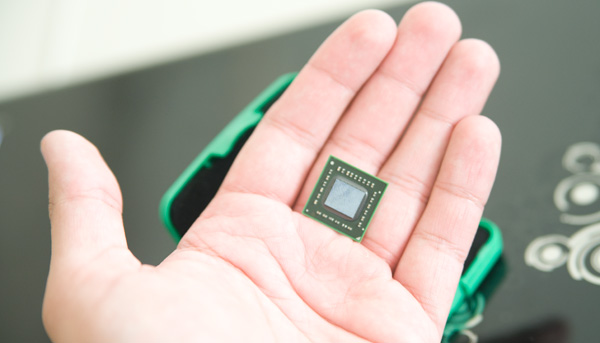
AMD's Zacate
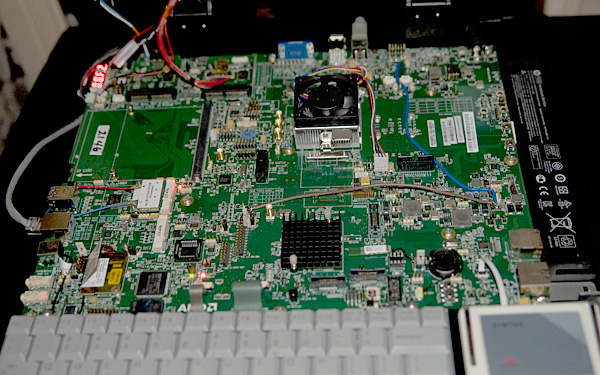
The Zacate test platform
I borrowed a Core i5 notebook from Intel (we are at IDF after all) and ran the same tests on it. The performance was much better than what I saw in AMD’s suite. I went back to AMD to find out exactly what was going on.
Read More ...
Intel announces Tunnel Creek - Atom E600 System on Chip
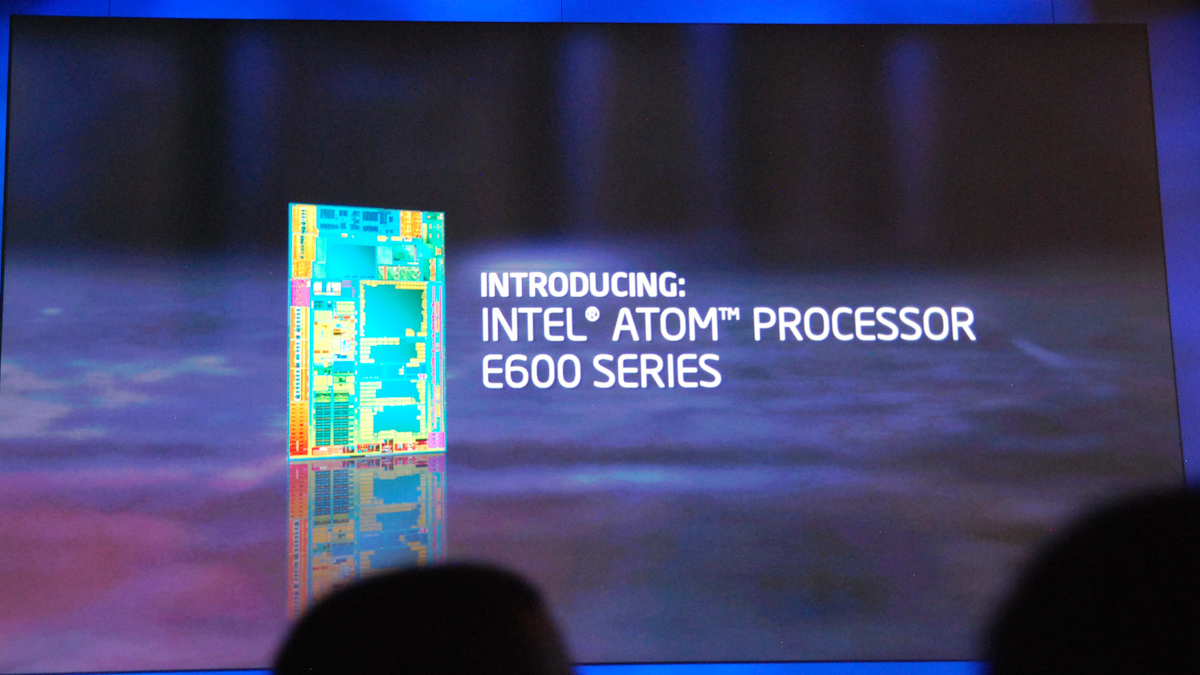
At the end of this morning's keynote at IDF 2010 intel announced the Atom Processor E600 series. It's a Moorestown-like SoC designed for embedded applications.
Read More ...
Dell Shows off 10" Inspiron Duo Convertible Netbook/Tablet
Dell just demonstrated its upcoming 10-inch Inspiron Duo convertible netbook/tablet. Based on the dual core Atom N550 the Inspiron Duo runs Windows 7 Premium. The system can work as a tablet:
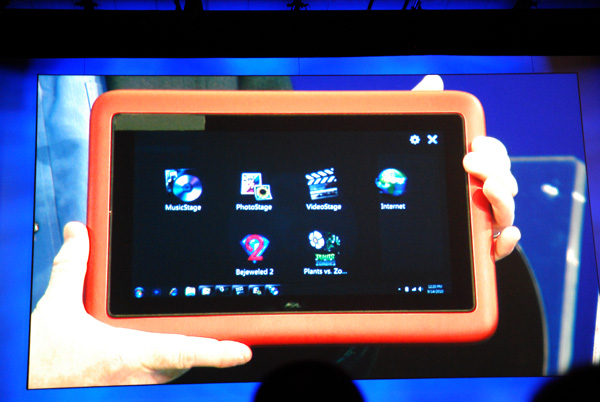
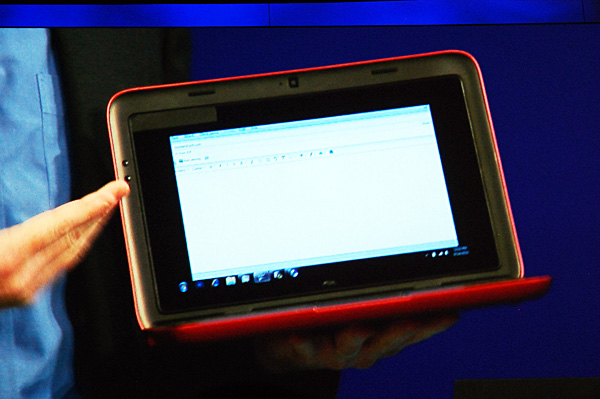
Check out our full gallery of the Inspiron Duo here.
Read More ...
First Public Demo of Oaktrail and Windows Gaming Tablet
Earlier this year Intel unveiled its Moorestown architecture, branded as the Atom Z600 series for smartphones and handhelds. Moorestown focused on a significant reduction in idle and active power, the former enabled by completely ditching the PCI bus. While this well for getting Atom into smartphones, the missing PCI bus means that you can't use Moorestown in Windows.
Intel made an alternate version of Moorestown to address this shortcoming. Oak Trail takes the Lincroft SoC (CPU + GPU + memory controller) and pairs it with a new PCH, codenamed Whitney Point. Whitney Point adds PCI support, enabling Windows support.
Just a few minutes ago Intel demonstrated its first Oak Trail platforms, both shipping in 2011. The first was a conventional looking tablet:

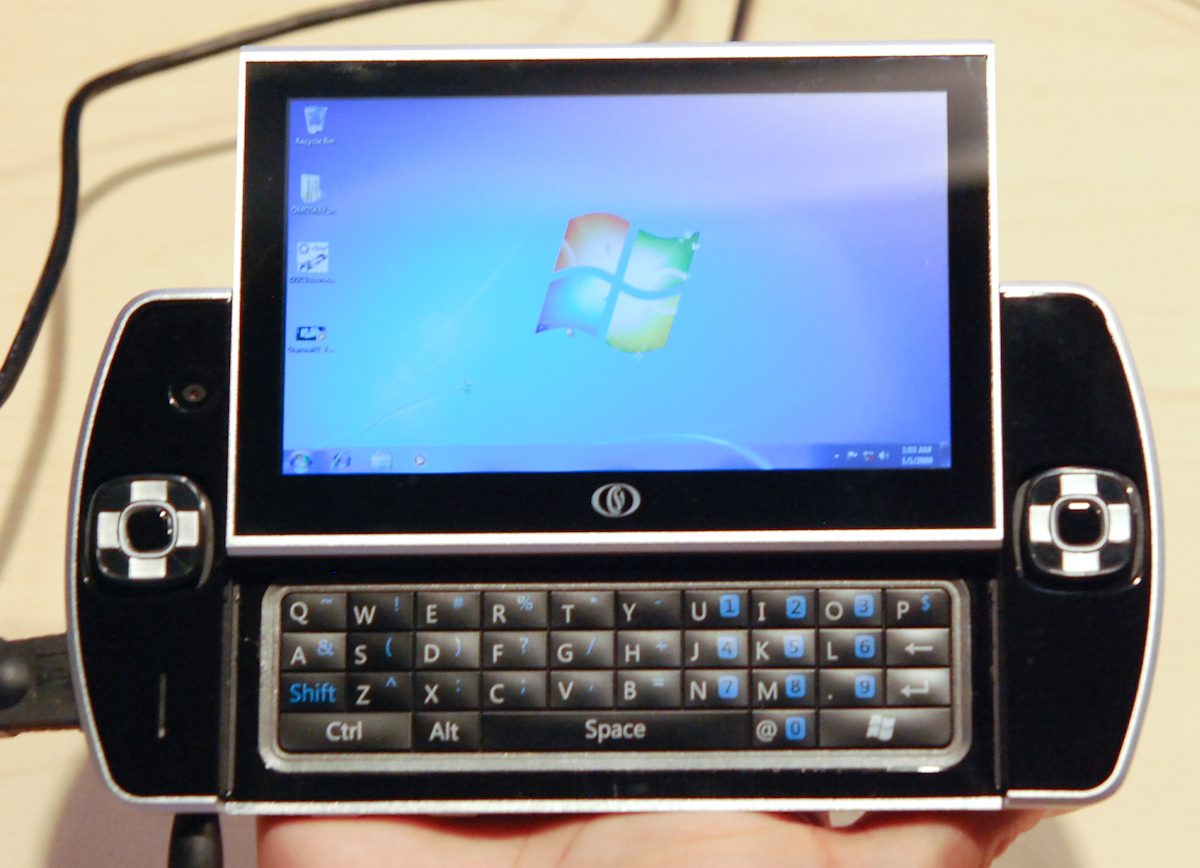
Read More ...
Intel Announces CE4200 SoC for Smart TVs
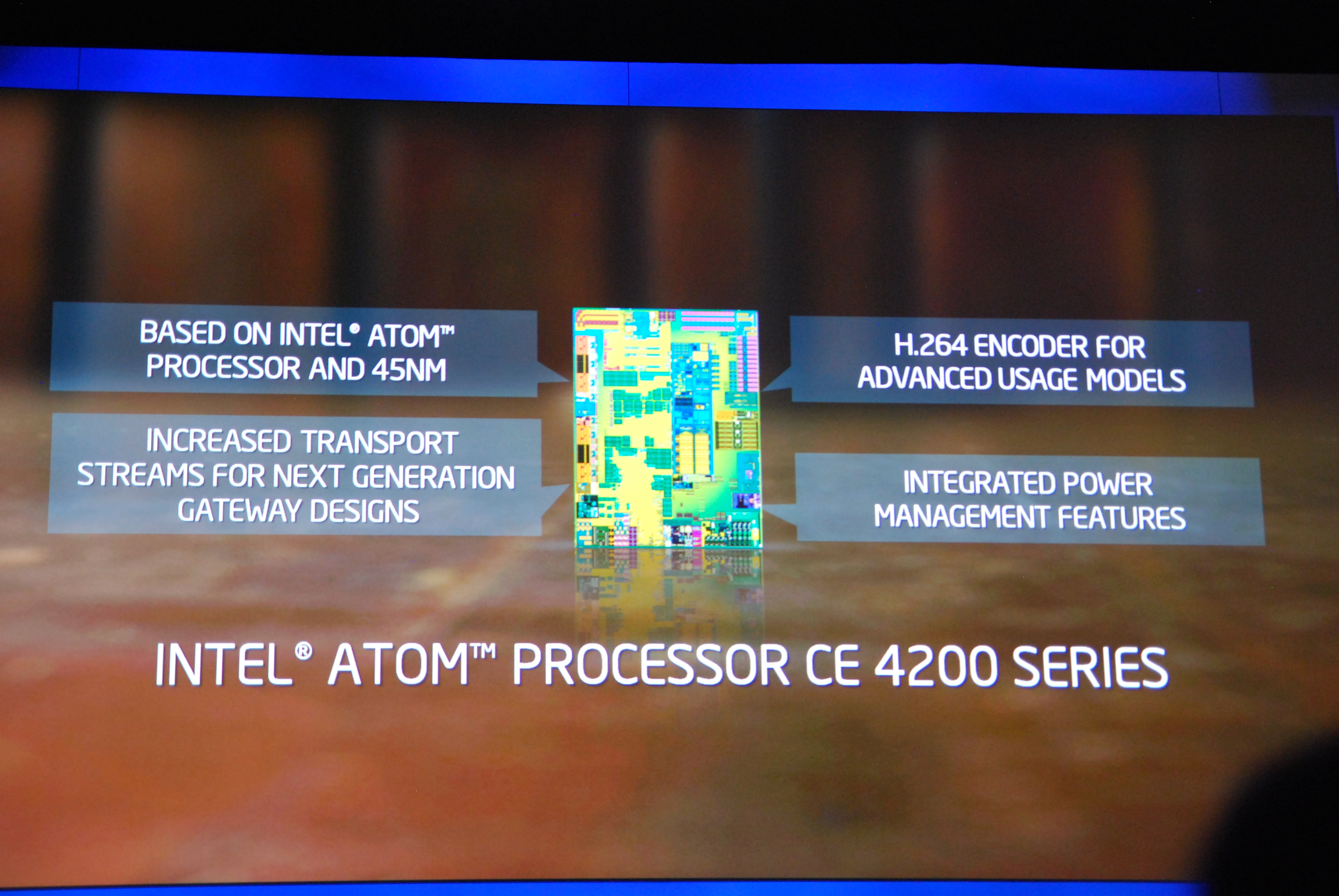
The CE4200 is based on Intel's 45nm Atom architecture and features a H.264 encoder. Presumably this is the same architecture as Intel's Moorestown SoC which added a 720p H.264 encode engine.
Intel didn't disclose any additional details about the CE4200 but we'll be asking around at the show to find out what we can.
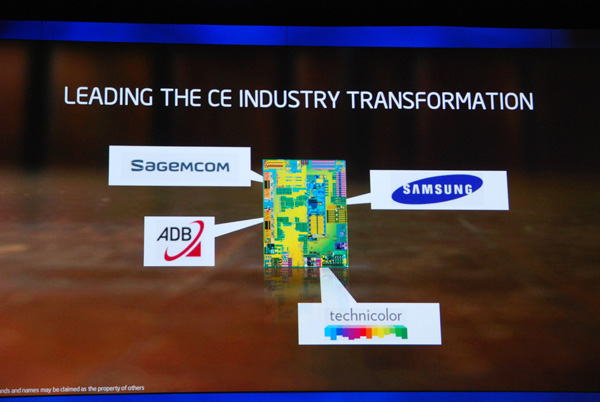
{Gallery 777}
Read More ...
Neofonie WeTab: Preliminary Impressions of MeeGo
Out of Germany comes the WeTab, the first shipping MeeGo-based tablet, running Intel’s new open source operating system on top of the venerable Atom N450 processor. It’s a fairly standard Atom based tablet, pretty similar to the Exo PC and others, with the netbook internals, an SSD, and an 11.6” WXGA screen.
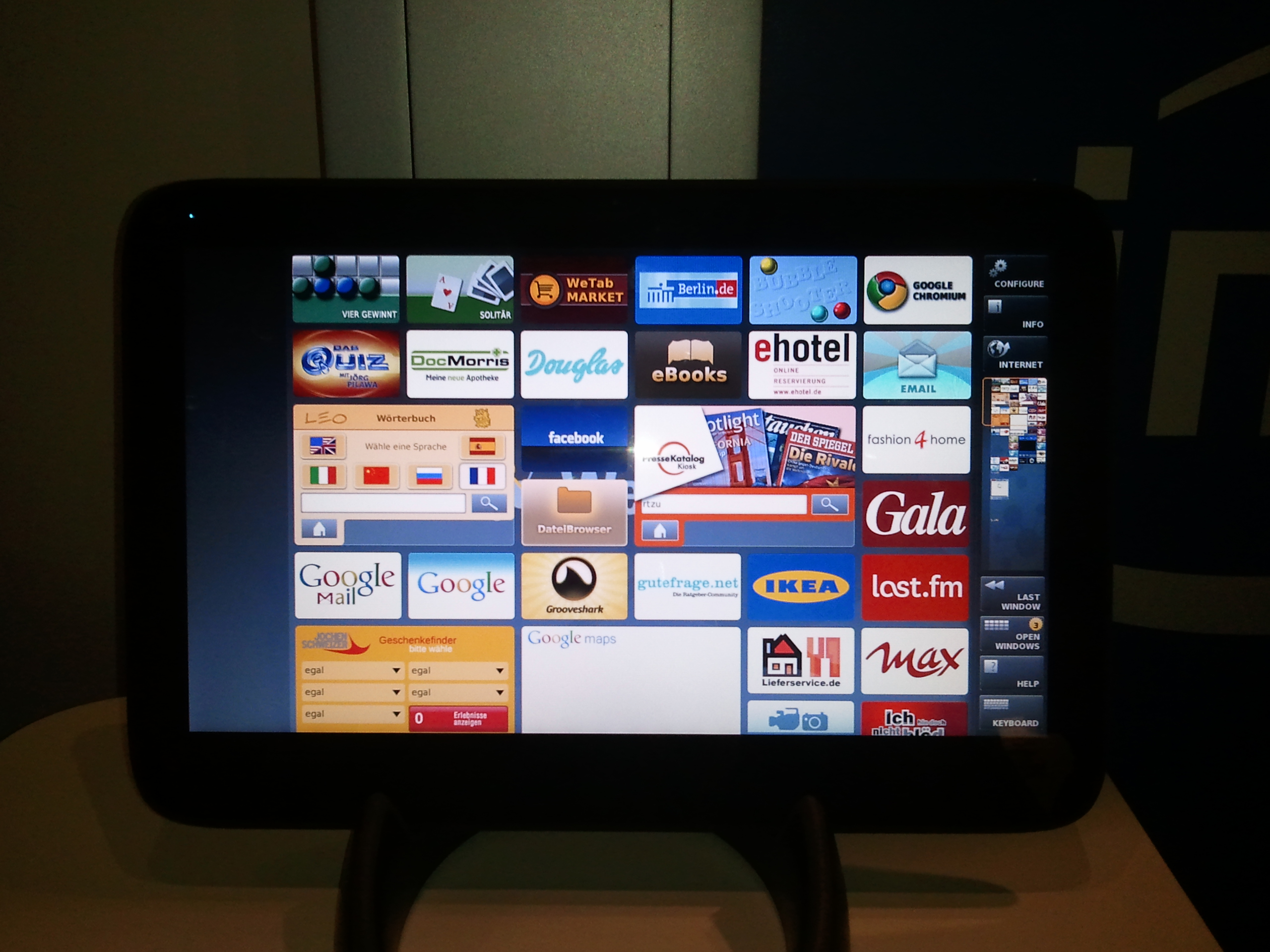
Neofonie’s skin on MeeGo consists of a number of tiles on the homescreen, and scrolls through the application tiles with a thumb-based navigation on the sides of the screen. All of the settings and controls are also located on the sidebars, making both navigation and changing options pretty simple. While it’s not the most intuitive UI to pick up immediately, once you get used to it, I can see it being pretty efficient to use. The keyboard is definitely better than the stock Windows 7 keyboard, but not quite iPad quality, since the keys are pretty small. Overall, the experience isn’t as impressive as some of the skinned Windows UIs like the ExoPC, but it’s quick and MeeGo is definitely noticeably more responsive than the Windows-based Atom tablets.
The claimed battery life of 6 hours suggests a 4 cell battery inside with around 32 Wh in capacity. Build quality is pretty good, with a solid chassis and a good feel in hand. At 1.8lbs, it’s a bit heavier than the iPad, but since it’s larger, you don’t feel it as much.
Unfortunately, the screen is a pretty big letdown on the WeTab. The 11.6” WXGA panel has a decent resolution, producing crisp images, but the viewing angles are pretty bad and the responsiveness was not very good. There were pretty frequent missed presses throughout our hands-on experience with the WeTab, and it really puts a downer on the otherwise decent UI. For a device that is shipping next week, that’s pretty disappointing, though it is possible that we were using an earlier prototype. If WeTab can figure out the touchscreen responsiveness, it could really push the MeeGo platform for tablets and carry the OS until the tablet-specific build of MeeGo is released early next year.
Read More ...
Kingston DataTraveler Ultimate 3.0 & OCZ Enyo, Quick Look at Two USB 3.0 SSDs
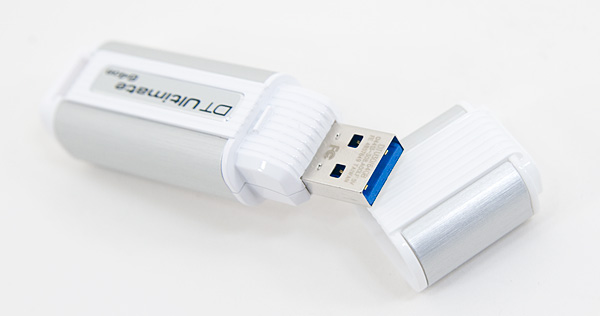
As a result of prices dropping, SSDs are being used for more than just expensive boot/application drives. Personally, I use a couple of old SSDs connected to Apricorn SATA-to-USB adapters as Windows 7 and Mac OS X 10.6 install discs. Using an SSD instead of a DVD drive speeds up OS install time considerably. I can install Windows 7 from one of these SSDs to an SSD in just under 3 minutes (timed from the moment it starts installing to the first reboot).
OCZ was the first to produce an interesting SSD for external use but Kingston has since delivered a lower priced alternative. Read on as we look at both options.
Read More ...
AMD Benchmarks Zacate APU
Update: We've spent more time with Zacate and have some more accurate performance comparisons here.
It's tradition for AMD to have an off-site meeting place during IDF week and this year is no exception. I headed over to AMD's suite to talk about servers, desktops and the imminent mobile Fusion launches. We've talked about AMD's three new microprocessors in great detail before. Bulldozer is targeted at the high end desktop and server markets, due out sometime in 2011 (sampling in Q4). Llano will arrive at the end of Q2 2011 and feature multiple 32nm Phenom II derived cores paired with a very beefy AMD DX11 GPU. What I'm most excited about however is the parts that will begin shipping in Q4 2010: Zacate for mainstream notebooks (18W TDP) and Ontario for netbooks (9W TDP).
Both APUs will have a pair of low-power Bobcat cores and an AMD DX11 GPU. AMD isn't publicly confirming how many cores the GPU side will have but both will share the same die manufactured on TSMC's 40nm process. The package is extremely compact:
Read More ...
Bing Kicks Yahoo Out of Second Place in Search Market
Bing/Yahoo combines has about 26% of search market
Read More ...
Dell to Push Streak Tablet in Medical Settings
An app will allow doctors to access hospital databases using the Streak
Read More ...
Summer of 2010 Was Fourth Hottest in U.S. History
Ten U.S. states experienced their hottest summer yet
Read More ...
Simplified Twitter Redesign On Its Way
Popular website will be more user and ad-friendly
Read More ...
Nikon Unveils 16.2MP D7000 D-SLR
Nikon's latest D-SLR features dual SDXC memory slots and a magnesium alloy body shell
Read More ...
British Teen Reportedly Banned From U.S. Life for Swearing at Obama in Email
Note to self: do not send drunken emails
Read More ...
9/14/2010 Daily Hardware Reviews -- NVIDIA GTX 450 Edition
DailyTech's roundup of hardware reviews from around the web for Tuesday
Read More ...
Talking Into Your Mobile Phone Could Soon Extend Your Battery Life
Scientist use household product to fuel sound wave advancement.
Read More ...
Blu-ray's HDCP DRM Scheme May be Cracked, Key Posted on Twitter
"You hear that Mr. Anderson?... That is the sound of inevitability..."
Read More ...
Inedible Plant Enzymes Discovered, May Lead to Biofuel Production
Biofuel that won't negatively affect the food chain
Read More ...
USAF Says New Bomber is Critical for U.S. Defense
Shaft getting larger for the Army?
Read More ...
Canon Debuts PowerShot G12, SX30 IS Digital Cameras
SX30 IS has world's first wide-angle 35x zoom lens
Read More ...
Chattanooga, TN to Get Nation's Fastest Internet -- 1 Gbps
Socialized municipal offering handily beats out local commercial competitors
Read More ...


No comments:
Post a Comment