

Galaxy Designs GeForce GTX 480 with Dedicated PhysX GPU
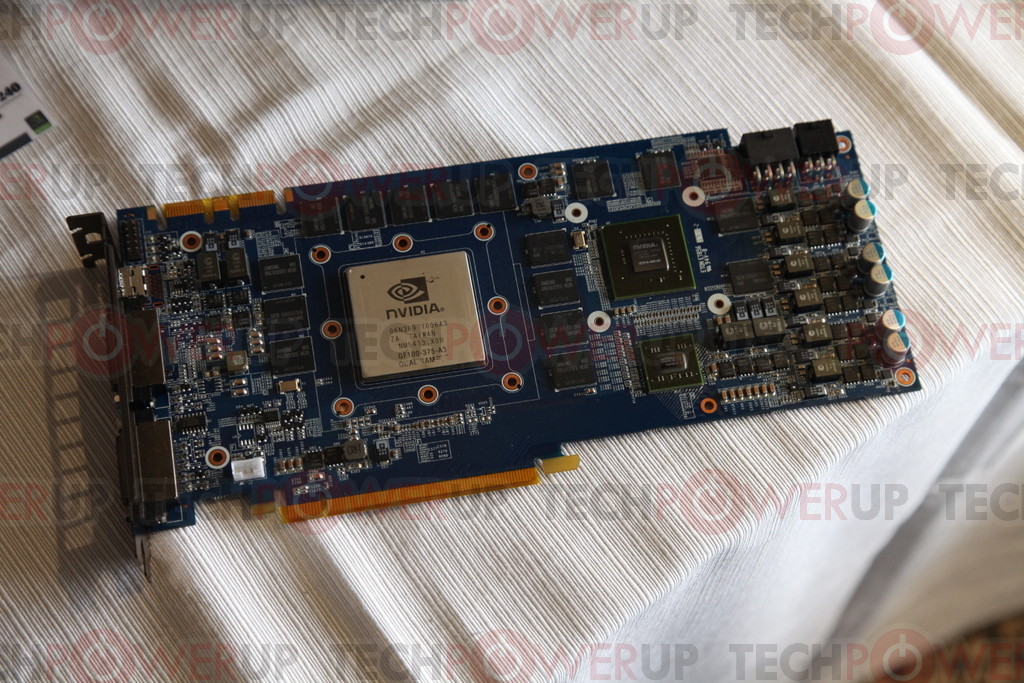
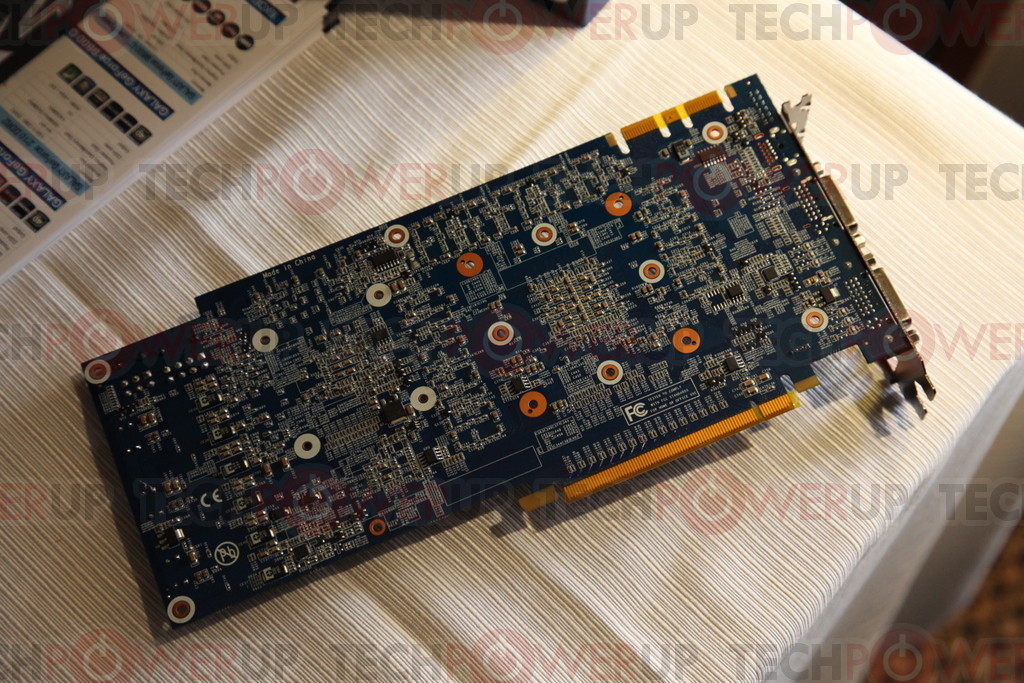
While every NVIDIA GPU since GeForce 8 series, with over 256 MB of memory supports the CUDA GPU compute technology, and with it PhysX GPU acceleration, the prospect of dedicated GPUs for computing PhysX interests many, especially enthusiasts, after NVIDIA stopped production of the PhysX processor from erstwhile Ageia. EVGA first devised a graphics card that has a high-end GPU processing graphics, and a mainstream GPU dedicated to PhysX processing, with its GeForce GTX 275 Co-op. Building on the same principle, Galaxy designed an enthusiast-grade graphics card that uses an NVIDIA GeForce GTX 480 for DirectX 11 compliant graphics processing, while its sidekick on board is a 40 nm GeForce GT 240 GPU.
The GeForce GTX 480 sticks to specifications, complete with 1536 MB of GDDR5 memory across a 384-bit wide, while the GT 240 has its own 512 MB of GDDR5 memory across a 128-bit wide interface. Both GPUs share the system bus over an NVIDIA nForce 200 bridge chip, which gives both GPUs a PCI-Express 2.0 x16 link. The GTX 480 GPU packs 480 CUDA cores, and features the latest GPU technologies, including 3D Vision surround. Since it is independent from the GT 240, the GTX 480 can pair with three more of its kind for 4-way SLI, without affecting the functionality of the GT 240 in any way.

Read More ...
Gigabyte Displays GA-P67A-UD7 Socket LGA-1155 Motherboard
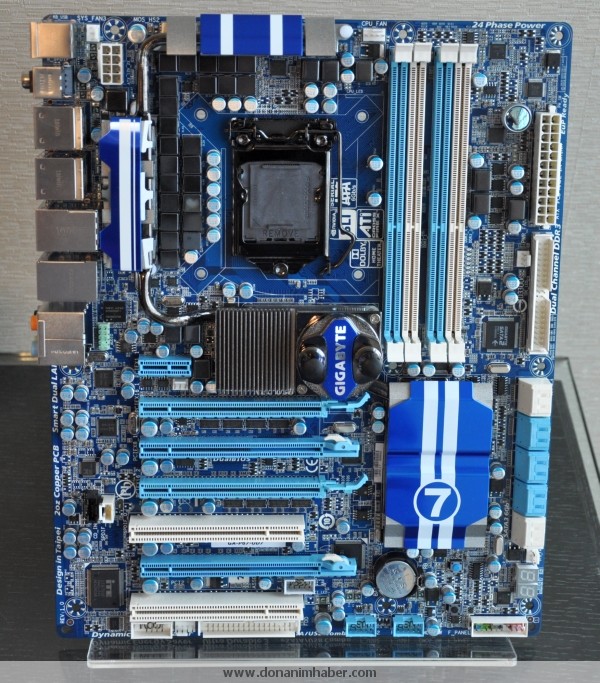
Gigabyte is next in line to exhibit its product readiness for Intel's next-generation "Sandy Bridge" socket LGA-1155 processors that release next year, with the company showing off its high-end GA-P67A-UD7 motherboard. Resembling the GA-P55A-UD7 in many aspects, this board features a 24-phase VRM. Apart from the Intel P67 PCH, an NVIDIA nForce 200 bridge chip multiplies the processor's 16 PCI-E 2.0 lanes intro 32 PCI-E 2.0 lanes, which split up between four PCI-Express 2.0 x16 slots, depending on how they are populated. The monolithic VRM+chipset cooler has a water-block for better cooling. Other expansion slots include one PCI-E x1, and two PCI. The usual plethora of connectivity features, such as dual Gigabit Ethernet, USB 3.0, SATA 6 Gb/s, eSATA, and 7.1 channel HD audio, are also present. Expect this board to be out in 2011.
Source: DonanimHaber
Read More ...
(PR) Mach Xtreme Technology also Unveils Value 2.5'' MX-Starter SSD Series
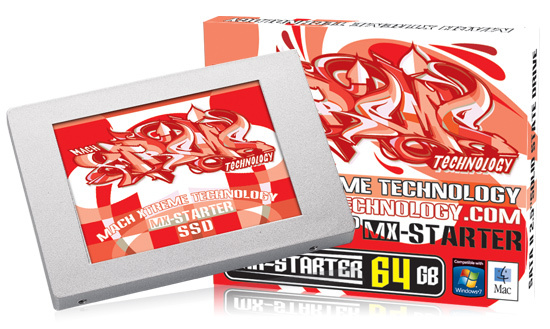
Mach Xtreme Technology Inc., a worldwide leader in top performance, high reliability and user-friendly designed PC components, launched MX-STARTER Series 2.5" SSD for mainstream users demanding the latest technology at an affordable price point.
The new MX-STARTER Series of SSDs is the latest addition to the Mach Xtreme lineup of solid state drives. The MX-STARTER Series of 2.5" SATAII SSDs are ideal for upgrading desktop for all those who are on a budget. Mach Xtreme recommends adding an SSD option to current desktop PC in a dual-drive or "boot drive" set up. In a dual-drive configuration, the MX-STARTER solid state drive is added to a desktop with an existing hard disk drive. Replacing your hard disk drive with MX-STARTER will revolutionize your computing experience. Games load quicker, your computer starts faster, and multiple applications run smoother, all while running cool and silent. MX-STARTER is provided at an incredible value, so the upgrade won't ruin your budget as well.
Read More ...
(PR) Mach Xtreme Technology Unveils High-Density 8GB Dual-Channel DDR3 Memory Kits
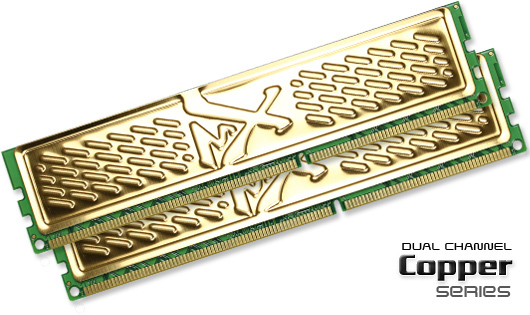
Mach Xtreme Technology Inc., a worldwide leader in top performance, high reliability and user-friendly designed PC components, today unveiled Copper Series 8GB (4GB x2) Dual-Channel DDR3 high-density memory kits based on the latest DRAM chips. MX-Technology develops and manufactures a wide range of high quality memory modules, whether seeking maximum frames rates on the latest games, achieving the highest benchmarks through overclocking or demand ultimate, consistent stability.
Copper is the mainstream memory solution within the MX Technology Dual-Channel DDR3 desktop memory product line. Featuring enhanced capacity of 4GB per module, these new high-density 8GB kits provide customers with cutting-edge memory solution and significantly increase memory space. All kits are strictly hand-selected with focus on stable performance. Coupled with an attractive price, the Copper 8GB kits are an excellent choice for your next upgrade.
Read More ...
ASUS Packs a Load Onto Mini-ITX for AMD Users
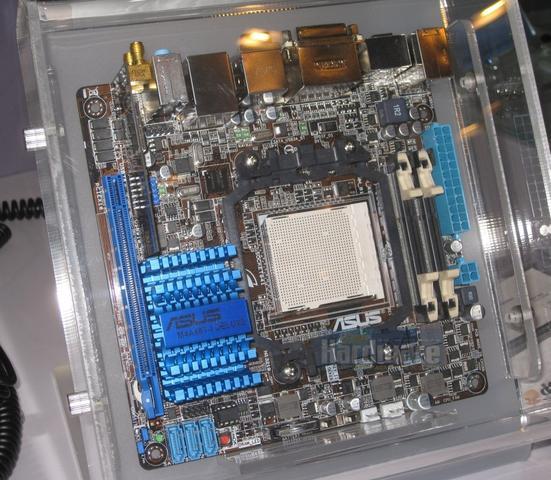
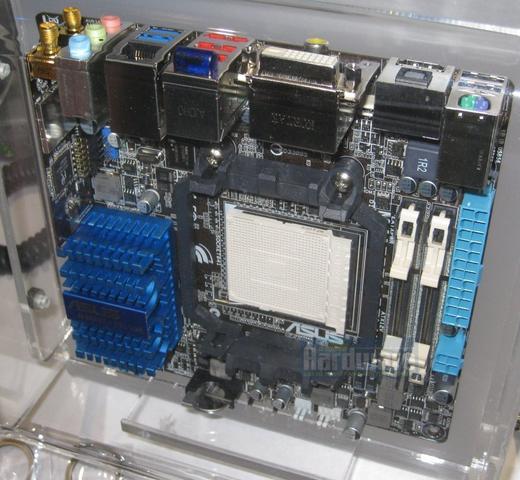
ASUS is ready with a feature-packed socket AM3 motherboard in the mini-ITX form-factor, based on the AMD 880G + SB710 chipset. The ASUS M4A88T-I Deluxe, as it is called, supports AM3 processors, probably with a TDP limited at 95W or 125W, and supports up to 8 GB of dual-channel DDR3 memory using SODIMMs (laptop memory). It far from stops here. The 880G chipset packs a DirectX 10.1 compliant ATI Radeon HD 4290 graphics, complete with SidePort memory and HD video acceleration features. The SB710 gives out five SATA 3 Gb/s ports on this board, of which three are internal, and two eSATA. The lone expansion slot is a PCI-Express 2.0 x16.
Connectivity includes 6-channel HD audio with optical and coaxial SPDIF output, WiFi b/g/n, gigabit Ethernet, Bluetooth, USB 3.0 and USB 2.0, and display connectivity which includes DVI and HDMI (with 7.1 channel HDMI audio). The SB710 comes with the unintended functionality of unlocking disabled cores on some processors.
Source: PCGH
Read More ...
A-Data Ready with SATA 6 Gb/s and Turbo SSDs
A-Data showed off two lines of 2.5" internal SSDs, the S501 and S596 Turbo. The S501 uses the SATA 6 Gb/s interface, and has transfer rates that could use the additional bandwidth at its disposal. The S501 reads at 350 MB/s, and writes at 200 MB/s. It makes use of 34 nm MLC NAND flash chips, and 128 MB of cache. It will be available in capacities of up to 512 GB.
The S596 Turbo is a upgraded version of the original S596, it uses SATA 3 Gb/s and mini USB 2.0 interface. The 128 MB of cache in place is of DDR2 type. The SSD can read at speeds of up to 280 MB/s, and write at 180 MB/s. It is available in capacities of up to 256 GB.

Read More ...
GeIL Readies Evo Two Series DDR3 Memory
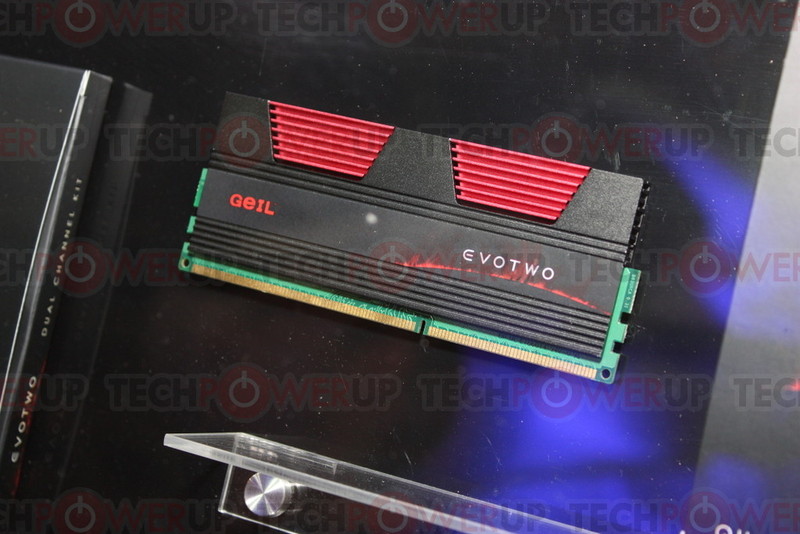
GeIL is readying a wide range of dual, triple, quad, and hexa-channel (6 piece) DDR3 memory kits that consist of the new Evo Two series DDR3 modules. Evotwo uses a redesigned heatsink that draws and dissipates heat from the heatspreader. The company claims that a technology designed by it called Maximum Thermal Conduction and Dissipation (MTCD) helps, apart from GeIL's much marketed DBT technology that seasons DIMM modules through harsh conditions.
Module densities include 1 GB, 2 GB, and 4 GB; to give 2, 4, 8 GB dual-channel, 3, 6, 12 GB triple-channel, and 12, 24 GB hexa-channel. Speeds range from PC3-8500 (1066 MHz) with timings of 6-6-6-15T, thru PC3-10660 (1333 MHz), PC3-12800 (1600 MHz), PC3-14400 (1800 MHz), PC3-16000 (2000 MHz), PC3-17600 (2133 MHz), PC3-19200 (2400 MHz), and PC3-20000+ (2500+ MHz).

Read More ...
(PR) Antec Premiers High Current Pro Power Supply Series
Antec, Inc., the global leader in high-performance computer components and accessories for the gaming, PC upgrade and Do-It-Yourself markets, today announced its newest premium line of consumer power supplies, the High Current Pro series. Available in four 80 PLUS Gold certified models, the High Current Pro series boasts unrivaled server-grade efficiency and reliability for powering the most demanding system builds.
The High Current Pro uses a unique full-bridge phase-shift topology for fast response time, superb efficiency and none of the annoying pitch noise typically found in higher-power PSUs. The HCP-750, HCP-850, HCP-1000 and HCP-1200 with 750 watts, 850 watts, 1000 watts and 1200 watts of Continuous Power, respectively, all achieve the highest 80 PLUS certification level, Gold, delivering their rated Continuous Power with least 87% efficiency at 20%, 50% and 100% loads, even at up to 50?C - a rare distinction in energy efficiency attained by very few other power supplies. In addition, Active Power Factor Correction (Active PFC) on all models, with a power factor above 0.9 helps reduce electrical waste and further increases efficiency.

Read More ...
GeForce GTX 460 Details and Launch Date Emerge
NVIDIA's GeForce GTX 460 (not to be confused with the older speculative name of GTX 465), is expected to be the company's weapon of choice to take on the lower-end of ATI Radeon HD 5800 series, and Radeon HD 5770. Based on the new 40 nm GF104 GPU, the GTX 460 will step up competition in the DirectX 11 compliant performance GPU category.
The specifications so far known show that the GPU will make use of all the components available on the GF104, which include 240 CUDA cores, and will feature 768 MB of GDDR5 memory across a 192-bit wide memory interface. Apart from basic specs, the board's TDP too will be much lesser than that of the GeForce GTX 480, at 180W. It comes with the usual bunch of NVIDIA exclusive features including SLI (we expect 2-way), CUDA, PhysX, and 3D Vision Surround. It expected to launch in mid-July, just in time for summer.
Source: bit-tech.net
Read More ...
(PR) Lexar Announces Crucial Ballistix Memory Modules with Thermal Sensor
Lexar Media, a leading global provider of memory products for digital media, today announced Crucial Ballistix high-performance memory modules with thermal sensor and temperature-monitoring utility, encased in a radically redesigned and more effective heat spreader. The thermal sensor and monitoring utility allow PC enthusiasts to view memory module temperature in real time, a major benefit for overclockers and enthusiast users constantly battling against excessive system heat. Additionally, the new Crucial Ballistix modules feature a redesigned "finned" heat spreader design that reduces memory module temperature by up to 30% more than the current Crucial Ballistix design. The new Crucial Ballistix modules are initially available exclusively at popular online retailer Newegg.com.
"Ask any PC enthusiast and they'll tell you that system heat is a constant concern," said Crucial Ballistix senior product manager, Jeremy Mortenson. "Our new Crucial Ballistix memory modules offer two incredibly effective tools in memory cooling: thermal sensors for temperature monitoring, and an improved heat spreader design."

Read More ...
VIA Demos Dual-Core Nano Processor
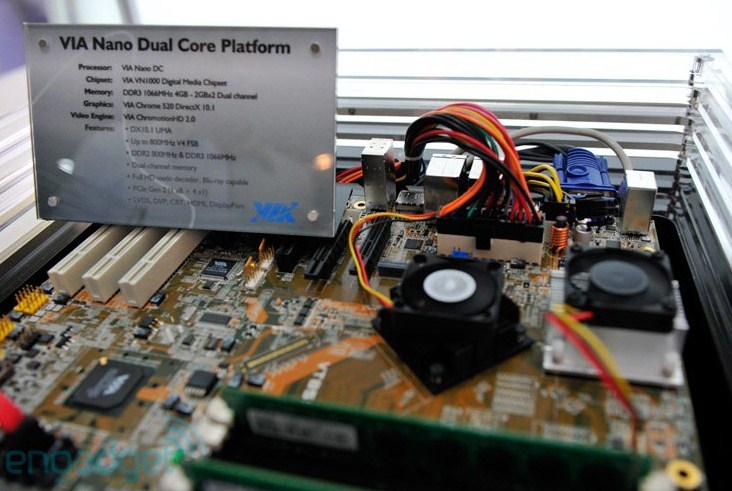
VIA demonstrated a dual-core variant of its Nano processor. With tiny board and power footprints, Nano is designed to be a competitive processor to Intel's Atom. The processor was displayed on a working demo platform. Although the chip in the demo system was built on the 65 nm manufacturing node, the final product will be built on 45 nm. The dual-core Nano runs at 1.60 GHz, with an FSB of 800 MHz. It is paired with the VIA VN1000 Digital Media chipset, that has a dual-channel DDR3 memory controller which supports DDR3 1066 MHz memory, and S3 Chrome 520 graphics that is DirectX 10.1 compliant. The Chrome 520 claims to pack enough power for 1080p Blu ray playback, and the Aero UI, while giving multiple connectivity options that include DVI, HDMI, and DisplayPort.
Also located in the VN1000 is the PCI-Express 2.0 root complex, which gives out one PCI-Express 2.0 x8 and four PCI-E 2.0 x1 links. The southbridge packs all the bare essentials, including a 4-port SATA 3 Gb/s and IDE storage controller. Gigabit Ethernet and HD audio will also be part of the package. VIA expects the Nano dual-core to feature in nettops, netbooks, and ULPCs, especially for cloud computing.
Source: Engadget
Read More ...
ASUS and MSI Show off LGA-1155 Motherboards based on P67 Chipset
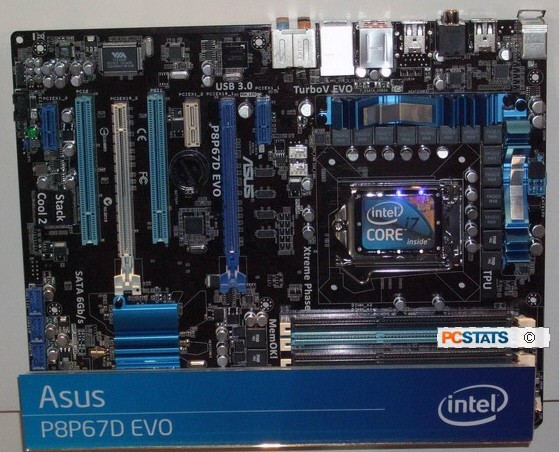
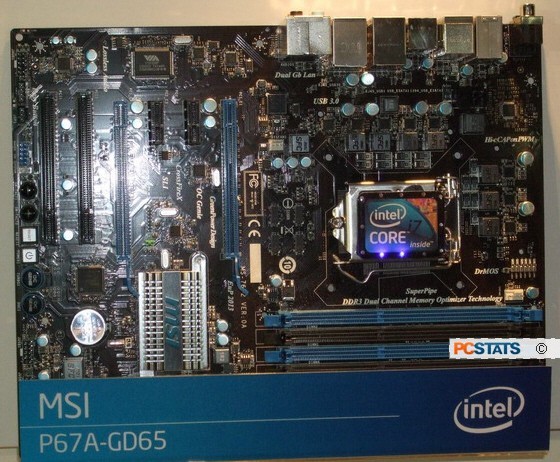
Following Biostar's display of its socket LGA-1155 motherboard, market-heavyweights ASUS and MSI were also seen exhibiting their LGA-1156 motherboards based on the Intel P67 chipset. The ASUS P8P67D EVO uses 12+2 phase CPU VRM, has four DIMM slots for dual-channel DDR3 memory, and expansion slots which include two PCI-Express x16 (electrical x8 when both are populated), two PCI, and three PCI-E x1. MSI's P67A-GD65 uses an 8+1 phase VRM with High-C capacitors. Both models feature SATA 6 Gb/s, USB 3.0, and other features commonly found in today's P55-based motherboards, with the difference of the LGA-1155 socket that will fit next-generation Sandy Bridge processors. LGA-1155 is not compatible with LGA-1156, probably except for the cooler mount hole spacing. LGA-1155 platform will likely be introduced in early 2011, looking at how major motherboard vendors are ready with their products in time for this year's Computex event, which is the large major IT exposium before next year's CES.
Source: TechConnect Magazine
Read More ...


No comments:
Post a Comment