

Check it out – Android finally running on the iPhone

A clever little hacker has managed to probe around inside his iPhone enough to install both the iPhone OS and Android on there together.
This version of Android works pretty well on the phone, despite being only in 'Alpha' version according to the demonstrator.
It's also only running on the iPhone 2G, which is obviously the slowest iPhone out there, but it still functions pretty well, only slightly lagging at times.
All the tricks
You can search for Wi-Fi, make calls and listen to music, with some clever tweaks to compensate for the lack of dedicated keys (the volume buttons are called into action to function as the call/terminate keys).
If you've ever wanted to see what it would like to see the Google OS on Apple's device, then you can check out the video below; be warned there is about a minute of watching code load but after that it's just a straight ride into hideous mutant OS territory.

 |  |
Read More ...
Ten-year study into long-term health impact of mobiles launches

Are mobile phones bad for our health? Do they emit radiation that is going to cause dangerous cancers in the brain?
The scare stories have run for years, but as yet nobody really knows that much about the health impact of the mobile phone on human beings.
Cancers and brain disease
This week, a new Imperial College study launches, set to monitor the impact of mobile phones and long-term health problems such as Parkinson's, Alzheimers and other brain diseases and cancers.
The Cohort Study on Mobile Communications (COSMOS) is set to be the largest of its kind, with over 250,000 subjects between the ages of 18 to 69 in Britain, Finland, the Netherlands, Sweden and Denmark taking part.
Imperial College's Professor Paul Elliott is the Principal Investigator in the study, and says that research to date examining the mobile phone health link had been reassuring. However, this has only really been carried out on an ad hoc basis over the last ten years.
COSMOS launches
"For the sake of current users and future generations this is the sensible thing to do," Elliott told a press conference in London this week. "The COSMOS study will be looking at long-term use, 10, 20 or 30 years. And with long-term monitoring there will be time for diseases to develop."
Professor Lawrie Challis from the independent MTHR group said we still cannot rule out the possibility that mobile use might cause cancer.
"There just hasn't been enough time. Most of us have not had mobile phones for more than 10 years," said Challis. "Many cancers take 10, 15 years for the symptoms to appear. So we've got to address the question, could there be something out there that we need to look at."

| |
Read More ...
HP launches new eco-friendly all-in-one PC

HP is set to release a new all-in-one PC that the company claims to be the 'perfect balance between form and function' with the marketing message focusing on eco-friendly efficiency and space-saving design.
HP's latest desktop will offer users a clutter-free workspace and sap up less of your 'leccy, which is clearly a good thing.
"The PC can reduce up to 13 and more cables to 1," says HP of its new All-in-One 200 offering, "the performance of a traditional tower and monitor solution in one sleek, integrated design."
The HP All-in-One desktop PC features a 54.6 cm diagonal, 1080-pixel, LED backlit, high-definition display, that tilts up to 30 degrees and swivels from side to side, along with all the to-be-expected gubbins such as an integrated webcam and built-in microphone and an optional TV tuner.
All-in-ones are becoming increasingly popular (and cheaper) with many other manufacturers, a reaction to the runaway success of the netbook in recent years, with consumers unwilling to pay over the odds for a hefty desktop machine anymore.
Compelling offering
"Today's announcement expands HP's portfolio with a compelling desktop offering for consumers and businesses who want performance, and space-saving design," claims Charl Snyman, VP and General Manager, HP Personal Systems Group, Europe, Middle East and Africa (EMEA).
"This new offering consumes less energy and is proof of our commitment to reducing waste in the design, manufacturing, packaging and transportation of our products.
The HP All-in-One desktop PC will be priced from £599 and has been given a UK release date of June.

| |
Read More ...
HTC Legend update fixes Market problems – Desire next?

HTC has popped out a little update for European Legend owners, and it's averted a potentially massive app crisis.
We've been looking into complaints from a number of readers that they can't get access to certain applications on the Android Market, with most of the issues coming from users of the HTC Desire, HTC Legend and Sony Ericsson Xperia X10.
But according to Engadget, HTC has figured out the problem (with the Legend at least) and it's simply 'camera incompatibility'.
I can't price compare!
Things like MySpace and Barcode Scanner were just simply missing for a lot of users, prompting speculation over what this is all about.
We've spoken to Google over the issue (which apparently doesn't affect the Nexus One) and it's looking into it – but after this pseudo-admission from HTC it could be more to do with the manufacturers than the search giant.
If you're a Legend user, simply sit back and wait – HTC say it will just find the upgrade, but make sure you're in a Wi-Fi area or it will munch on a LOT of data.
We'll keep you posted on how this unfolds – but it's not the first time we've seen an issue with Android Market, is it?

| |
Read More ...
Big smartphone growth for Nokia

Nokia sold more than 107 million mobile devices in the first quarter of 2010, a 16 per cent increase on sales last year, with the Finnish communications giant shifting 21.5 million smartphones and netbooks.
Although the main focus is on smartphones at the moment, there is still clearly a market for traditional mobile phones (dumbphones?) where sales were up 6.4 per cent, with emerging markets helping significantly.
But the headline will be in Nokia's huge increase in the sale of smartphones, mobile internet devices and its Nokia netbook.
The company reported a 57 percent increase on the same period in 2009, and this helped them to a 3 per cent increase in net sales to €9.5 billion (£8.25bn).
Delivered
"In Q1, Nokia delivered both year-on-year net sales and operating profit growth," said CEO Olli-Pekka Kallasvuo.
"We continue to face tough competition with respect to the high end of our mobile device portfolio, as well as challenging market conditions on the infrastructure side.
"During the quarter, we also demonstrated our ability to deliver the Nokia smartphone experience to consumers on a global scale, with our smartphone shipments up by more than 50% year-on-year."
Another growth area was the company's navigation software on its high-end phones.
"The consumer response to the inclusion of our walk and drive navigation offering on our smartphones has been tremendous, added Kallasvuo.
"Since launching in January, 10 million Nokia smartphone users around the world have downloaded the offering."

| |
Read More ...
Samsung Wave available for UK pre-order – not cheap though
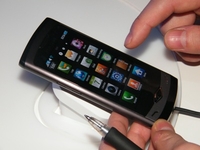
The first phone running the new Bada platform – the Samsung Wave S8500 – is now available in the UK.
It's not going to be cheap though, with a number of third party outlets offering the new device unlocked as a SIM free package.
For instance, Expansys is offering the Samsung Wave for £375 with a 2GB memory card, but with an expected release date of 26 April.
Mobile Phones Direct has a similar price, or is offering the chance to pick up the phone on contract for free with various tariffs. However, you'll have to wait until later in May if you go down this route.
Network rumblings
While some may not want to go down the third party route, the fact these independent outlets are starting to list the Samsung Wave for pre-order hints that we'll be seeing it on the shelves of the UK networks sooner rather than later.
Just to refresh your memory, the Samsung Wave has a beautiful Super AMOLED screen, which has a better viewing angle and performance in direct sunlight, and a 'Social Hub' for accessing services like Facebook and Twitter.
There's also multi-codec support for DivX and Xvid, 5.1 SRS pseudo-surround sound and 720p HD video decoding and recording.
We're still waiting for an official UK release date, but we reckon it can't be too far away now.

| |
Read More ...
Samsung Wave available for UK pre-order – not cheap though
The first phone running the new Bada platform – the Samsung Wave S8500 – is now available in the UK.
It's not going to be cheap though, with a number of third party outlets offering the new device unlocked as a SIM free package.
For instance, Expansys is offering the Samsung Wave for £375 with a 2GB memory card, but with an expected release date of 26 April.
Mobile Phones Direct has a similar price, or is offering the chance to pick up the phone on contract for free with various tariffs. However, you'll have to wait until later in May if you go down this route.
Network rumblings
While some may not want to go down the third party route, the fact these independent outlets are starting to list the Samsung Wave for pre-order hints that we'll be seeing it on the shelves of the UK networks sooner rather than later.
Just to refresh your memory, the Samsung Wave has a beautiful Super AMOLED screen, which has a better viewing angle and performance in direct sunlight, and a 'Social Hub' for accessing services like Facebook and Twitter.
There's also multi-codec support for DivX and Xvid, 5.1 SRS pseudo-surround sound and 720p HD video decoding and recording.
We're still waiting for an official UK release date, but we reckon it can't be too far away now.

| |
Read More ...
Opinion: Apple's ARM race - this could be war

Did you read about Apple's earnings call this week? Apple is making so much money that the cash stuck down the back of Steve Jobs' sofa is enough to buy Belgium.
Can you imagine what would happen if Apple decided to use its war chest to start a war? According to "gossips" in the city of London, it's planning to do just that.
No, Steve Jobs isn't building Doctor Robotnik-style flying death machines - or at least, if he is then nobody's lost one one of them in a bar - but he's up to something much scarier. If the Evening Standard is correct, Apple intends to buy ARM.
If you're not familiar with ARM, they're the chip geniuses responsible for the processors used in some of our favourite gadgets. ARM's technology is in chips inside not just Apple kit, but smartphones by the likes of HTC, Sony Ericsson, Nokia and Samsung as well as handhelds such as the PSP and Nintendo DS.
Assuming anti-monopoly regulators didn't stop it, an Apple-owned ARM is a terrifying prospect for Apple's rivals.
All about control
In one fell swoop Apple would essentially control the silicon in most of the mobile technology market. We doubt Apple would stop licensing the tech even if it could do so and get away with it, but it's not hard to imagine the licensing costs going up or Apple keeping newly invented ARM technology to itself.
Apple doesn't even need to do that. If it owned ARM, it'd effectively make money from every non-Apple smartphone sold. In effect, whenever you bought an Android phone or a new Nokia, Apple would get a little bit richer.
It's not just phones and games consoles, either. ARM technology is everywhere. Check out the website: the tech is in laser printers, Dell laptops, Archos internet tablets, Sony's Reader, Palm's Pre, Samsung TVs, the Kindle… an Apple acquisition would mean Apple would have a finger in every one of those product pies.
Can Apple afford it? Certainly: Apple's got 47 billion dollars hanging around, and ARM's valued at roughly one-fifth of that. Would the regulators allow it? Nobody knows.
Can we imagine Steve Jobs doing it just so he can give the entire technology industry a heart attack? What do you think?
-----------------------------------------------------------------------------------------------------

| |
Read More ...
Dell's new 'Looking Glass' tablet PC detailed

Dell's forthcoming tablet PC is set to be called, following Lewis Carroll's lead, the 'Looking Glass' PC with details leaking online this week.
Dell's new Tegra 2 tablet is set to arrive in the US at some point soon. TechRadar has spoken with Dell's UK PRs who currently have no further information on a UK release date for the Looking Glass.
Tegra 2 powered
Still, the Dell Looking Glass has been revealed by Engadget to have a seven-inch screen, running Android 2.1 on a Tegra 2 processor.
The device also has an optional TV tuner module to let users watch ATSC or DVB-T on its 800x480 display. Dell's slightly smaller 5-inch screened 'Streak' device also has the same resolution.
RAM is claimed to be 4GB, with an extra 4GB of flash and an SDHC slot for up to 32GB of memory expansion.
Unlike the Apple iPad the Looking Glass will also pack in a 1.3 megapixel camera. Until we know the speed and power of the device's processor, we will hold fire on getting too overexcited about the 'iPad killer' potential of Dell's latest tablet.

| |
Read More ...
In Depth: Is AMD's Fusion processor an Intel killer?

AMD, the PC processor industry's perennial second stringer, is tooling up to release its long awaited CPU-GPU "Fusion" processor.
It has all the makings of an Intel killer, particularly in mobile trim for laptop PCs.
Codenamed Llano and due out early next year, key advantages include a single-die fusion architecture and graphics power an order of magnitude greater than any previous integrated solution.
About time, too. While Intel rolls out advanced new PC processor architectures on a seemingly weekly basis, the current culmination of which is a six-core monster, AMD is almost nowhere to be seen.
Arguably, it hasn't released a properly new processor since 2003.
That's about to change. The fight back begins later this month with Thuban, AMD's six-core effort. However, Thuban is just a six-core rehash of AMD's current processor technology. Interesting addition to the meaty mid-range CPU market though it may well be, it won't worry Intel.
Instead, it will be Llano that marks AMD's real renaissance and the beginning of a danger period for Intel. AMD has been trickle-charging us with info on Llano in recent months.
Turns out it's not quite the chip we were expecting. In some ways it's actually a disappointment. But as an overall package, it's shaping up to be potentially lethal.
Crucially, Llano combines a conventional PC processor and a full-function graphics core in a single slice of silicon. Intel, of course, already has a CPU-GPU hybrid processor on sale in the form of its Arrandale and Clarkdale processors.
Strange branding
They're sold variously as Core i3, i5 and i7 processors depending on the target form factor, price segment and apparently which way the wind is blowing. There's little logic to Intel's current PC processor branding scheme.
More importantly, Intel's CPU-GPU chips are not full-on fusion products. Crack open the CPU package (highly inadvisable if you want to keep using it) and you'll find not one but two individual processor dies.
That's Intel's way of getting fusion to market faster and with fewer risks. But it's also architecturally suboptimal. Enter therefore Llano, the real single-die fusion deal and with it the promise of that rarest of things for AMD - a competitive advantage.
First up is Llano's intriguing integrated graphics core. It's absolutely huge. Exactly how huge in terms of the all-important stream processor count we can't say for sure. AMD hasn't divulged the hard numbers.
However, AMD has teased us with a few photographs of Llano which in turn reveal that the graphics core consumes nigh on 50 per cent of the entire die.
We also know that Llano will be built on AMD's upcoming 32nm chip production process and will enjoy a total transistor budget around the one billion mark.
Put those facts together and you're looking at an integrated graphics solution with a probable stream processor count somewhere north of 400 units. Not all that impressive in the context of AMD's monstrous 1,600-stream-processor-strong desktop GPU, the Radeon HD 5870. But remember, AMD's fastest current integrated graphics core sports just 40 stream processors.

Admittedly, there are doubts regarding Llano's ability to feed that graphics core with data. GPUs are extremely data hungry and it's not yet clear whether the CPU and GPU parts will share a single memory bus and if so what that bus will look like.
As for the conventional CPU half of Llano, it's based on AMD's current Stars processor architecture. Four cores, each with 1MB of L2 cache and a few tweaks to what is a rather ancient architecture will be your lot.
That's a little bit of a bummer given that AMD had originally planned to use a brand new CPU architecture for its first Fusion product.
Moreover, there's nothing Llano has or does that will upset the status quo on the desktop. As a CPU it will be unremarkable. Meanwhile, any desktop graphics card worth its salt with give it thumping for sheer 3D rendering grunt.
Laptops and GPGPU
Shift the emphasis to mobile computing, however, and suddenly Llano looks a lot more clever. What you have is a highly integrated solution based on cutting edge 32nm chip tech with thoroughly adequate quad-core performance and the added bonus of some serious vector throughput. And all from a power efficient chip suitable for very thin and very light portables.
What we're also hinting at here is the much-hyped but little realised notion of running general purpose software on a graphics chip. Known as GPGPU for short, it's often claimed to deliver a massive leap in performance for applications that major on floating point calculations and lend themselves to the massively parallel nature of graphics chips.
Thanks to the arrival of the compute shader in DX11 along with several other industry-wide efforts, GPGPU is expected to finally gain traction over the next 12 months or so. Just in time for the arrival of Llano. If that does happen, Intel will almost definitely have no answer.
What about Sandy Bridge?
For starters, Intel has a poor track record in graphics and has yet to prove it can build a really decent 3D core. What's more, die shots of Intel's upcoming Sandy Bridge processors, due next year and slated to take on Llano, reveal two things.
The good news is that Sandy Bridge is going monolithic: the graphics features will be on-die rather than merely in-package. Less impressive is the size of the graphics core. It's tiny compared to Llano's.
In short, Llano looks like a much more balanced architecture. In fact, it looks so good it's not hard to imagine a certain fruit-theme maker of computing devices sizing it up. Llano power for the next MacBook Air? It would make an awful lot of sense.

| |
Read More ...
Facebook and Google given BBFC '12' rating

An ISP is offering customers and concerned parents a new web-filtering system that uses the British Board of Film Classification's well-known age-ratings logos.
It is the first time that the BBFC has teamed up with an internet service provider – allowing parents to select the level of filter that they require - U, PG, 12, 15 or 18 – to ensure safe web surfing for their kids.
Parents simply select the filter level they require – and Tibboh (the ISP) does the rest, using filtering technology such as Netsweeper to classify websites accordingly.
Right now the service is only available as a 3G mobile dongle offering. Once customers have signed up then they can register various profiles for all the members of the family, according to their age.
The service costs £19.99 a month and has a 15 gigabyte data limit.
Facebook rated '12'
Social networks such asFacebook and Twitter and search engines such as Google and Bing are rated '12' by Tibboh.
"Search engines are great but at the "U" and "PG" level we found so many results and sponsored links that were inappropriate," Tibboh MD Phil Dawson told the BBC.
Tibboh claims its filtering tech has, to date, classified around three billion websites.
The company effectively licenses the BBFC's age-rating symbols, which it clearly feels is an ideal way of supporting the UK Council for Child Internet Safety (UKCCIS)'s "Zip It, Block It, Flag It" campaign.
Andrew Cooke, of BBFC online says: "We're delighted to be able to welcome tibboh as the first internet service provider to meet the BBFC online membership standards. We've been working very closely with tibboh and have helped them to develop bespoke criteria which match our standards.
"Parents often find themselves in the unenviable position of having to lay down the law in a digital universe they barely understand. Our classifications are understood and trusted by UK parents and they are based on our unique understanding of child development and parental expectations. Our research shows that 91% of parents want to see BBFC film and DVD classification on downloads or streaming films and other digital audiovisual content.*"
For more info on the new system head over to tibboh's own website (www.tibboh.co.uk).

| |
Read More ...
Gary Marshall: McAfee's epic fail: it's a matter of trust

For most of us, security software is a necessary evil: you install it and learn to live with the annoying pop-ups and "update me!" nags because you know that one day it will, er, delete important bits of Windows.
That's what McAfee's software has been up to, anyway. An error in a virus definition file wrongly identified svchost.exe, an important Windows component, as malware.
The result? Crashing and constantly rebooting Windows XP PCs all over the place.
The good news is that it hasn't affected too many ordinary users, because most of us don't run XP any more. The bad news is that lots of corporate customers do, and McAfee's error affected hospitals, police forces and even Intel.
In related news, Intel's still running Windows XP. Isn't that the same firm that's always telling us we need the latest, greatest tech?
But we digress. How badly has McAfee screwed up here? On a scale of one to ten, where one is "not badly at all" and ten is "Oh my god!", this goes to eleventy-three. And yet the only thing that's really different about this problem is the publicity it's generated.
Not good enough
This kind of nonsense happens all the time. In 2007, AVG decided that Adobe Reader was a Trojan and a Symantec update crippled Chinese PCs. Last year, CA's eTrust software attempted to quarantine a whole bunch of Windows .dll and .exe files.
Earlier this year Kaspersky's software decided that Google AdSense was malware, while last summer McAfee decided Spotify was a virus.
This really isn't good enough. Security software that occasionally deletes your music software or trashes Windows is a bit like a dog that only eats children occasionally, a car that only runs over the odd pedestrian or a policeman who only shoots innocent people from time to time.
We know that security software is complicated stuff, and that it not only needs to detect thousands of different threats but it also needs to work with thousands of different configurations. It's a tough job, we know.
But security firms are telling us to trust them, and if we're going to do that we need to be confident that their products won't turn our PCs into ornaments. Being overly cautious and asking whether a new program is supposed to be there is fine. Attacking system components with an electronic axe isn't.
Here's hoping McAfee does a good job of handling the bad publicity - and that all security firms take steps to ensure problems on this scale can't happen again.
Computer security is rather like vaccination: if enough people have up-to-date security software then malware can't really spread; the people who do get it can't do much damage. It's the electronic equivalent of herd immunity.
If people don't install the updates because they feel they can't trust them, then everybody suffers.

| |
Read More ...
Dell leaks four rather lovely high end smartphones

Dell has supposedly leaked four new smartphones from its upcoming line – the Smoke, Flash, Thunder and Lightning.
These were from an apparently leaked internal Dell presentation, and show mock ups of the potential phones, so we don't know if it's strictly all real.
Lightning strikes
The Lightning appears to be the pick of the bunch, with all the mandatory high end Windows Phone 7 specs necessary to let it be part of that camp.
That means a huge 4.1-inch WVGA OLED display, a 1GHz Snapdragon processor and a 5MP camera and here's the best bit: full flash support.
Coming out in Q4, does this mean we could see other WP7 devices with Flash integrated? We certainly hope so.
When the Thunder calls you
The Thunder is the Android version of the Lightning, coming with some very similar specs, with a 4.1-inch OLED screen and an even better 8MP camera – along with the latest 2.2 Froyo version of Android.
However, we're still waiting to hear which processor this model has - we'd be surprised if it wasn't a 1GHz Snapdragon given how similar it is to the Lightning.
It will also feature some nice social networking (read Twitter and Facebook) integration, and Flash 10.1 looks likely too. This is supposed to also hit in Q4 this year, hopefully as a joint release.
Flash – boom – aaa-aaah
The Flash is another Android device, also taking the 2.2 Froyo route – but with a slightly lighter spec sheet.
Still using Qualcomm, this one has an 800MHz MSM7230 core, but more importantly it's hewn out of glass (not all of it, just the chassis) and is just 11mm thick. It will support microSD cards up to 64GB apparently, and pack a 3.5-inch WVGA LCD screen with TV-out socket too, with a mooted Q1 2011 UK release date.
Smokin'
And saving the weirdest to last: the Smoke. We're still on the Android tip here, but this one is weird: a candybar design with 2.8-inch QVGA screen and a full, portrait, QWERTY keyboard. Yup, and as you can see it's as weird as you'd think.

It has the same processor as the Flash in the shape of the 800Mhz MSM7230, and the usual Wi-Fi, Bluetooth, GPS spec list we're used to with Android phones – plus a 5MP camera with autofocus.
While we're all for new designs, given this one's been pegged for a released in Q2 2011, we've got quite a while for someone within Dell to look at the Smoke and go: 'Actually, nah, let's leave this one. Who wants soup?'

| |
Read More ...
Review: Epos Encore

With the Encore 50, Epos is gunning for the likes of ATC, Bowers and Wilkins and anyone else brave enough to poke their tweeter over the parapet. This speaker makes a statement of intent that no redblooded audio enthusiast could resist: it's made to play loud.
Ironically, when you think of substantial speakers that play as loud as you like, Epos is not a name that comes readily to mind. It makes some pretty good speakers, but up until now they have been reasonably manageable, one man lift-type devices.
But what the high-end Encore 50 promises, is Epos' signature timing and finesse combined with the ability to rock the house for the deep-pocketed.
A real hi-fi speaker
You can tell from this loudspeaker's stature that it means business, it measures 1,230mm high on its substantial and elaborate spikes and makes no concessions to the whims of interior design. This is a speaker for those of us who are not afraid to admit that bigger is better when it comes to recreating a musical performance in the home.
It's 45-kilo carcass contains a set of drive units that have been designed to fulfil this mission. For the bass, Epos has used a pair of 220mm woofers that are not only sizeable, but have a lightweight cone made out of Kevlar, carbon fibre and pulp (or paper as it's usually known).
A composition that's not dissimilar to the bass drivers in Bowers and Wilkins' 800 series models, these cones sit in an aluminium chassis with a big 40mm voice coil that has (+/-) 30mm of travel – a lot for a cone of this size – the driver doesn't have to work too hard to make itself heard.

In a separate enclosure there is a 158mm midrange cone in the same material as the bass drivers and with a matching inverted dust cap, the idea being that the two systems can be seamlessly integrated through the crossover.
This network is housed in a separate chamber at the bottom of the speaker, you can remove the back panel and see its air-cored inductors and, rather unusually, a tapped auto-transformer for adjusting midband output.
Look underneath the speaker and you'll find a panel with a pair of cables in it that allows the midband output to be increased or decreased by one decibel and treble by 0.5dB. Interestingly, using the plus setting on the treble bypasses the resistor in the crossover.
The tweeter is the only element on the Encore 50 that you will see on other Epos speakers, at least that's the way it looks, as this is actually a modified version of the Mi tweeter. Epos drilled out the pole piece and put a cap on the back of the driver that's damped and sealed. This, coupled with thinner ferrofluid, means that it can cope with the power delivery demands of the speaker as a whole.
The cabinet is not quite what it appears to be either, its bass and midrange enclosures are built with a laminate of 20mm birch ply and the 12mm MDF that wears the real cherry veneer jacket. We don't recall anyone using this combination of materials before, but Epos reckons that the key qualities from the two materials makes for a cabinet that's both stiff and well damped.
Beautifully built
This is a well-built and substantial loudspeaker, but it's not a particularly beautiful one. It comes in one real -wood veneer finish and this, while entirely professional, is not quite as smart as we have encountered elsewhere.
The Mordaunt-Short Performance 6 LE is marginally less expensive, but looks rather more so in its striking moulded enclosure. The Monitor Audio PL200 and Tannoy Definition DC10T are better finished.
The Epos is well-built though and a lot of thought has gone into the massive spikes which are nicely machined and can be easily adjusted from above. The drive units may not look particularly high tech, but they are well-engineered with alloy baskets and excellent fit and finish.
One unique feature is the 'skateboard' that Epos supplies for you to move the speaker about on. With a speaker of this weight this is a major boon for every mere mortal that wants to install it.

This is undoubtedly a high-value loudspeaker from Epos. From its tri-wire/-amp cable terminals to its footprint-extending plinth and dual-material bass enclosure, the Encore 50 does not skimp on either the details nor the overall build.
It weighs a lot more than all of its competitors at the price and while mass is no indicator of sound quality it often reflects on the build. The lamination is probably where this extra bulk comes from and it should make for a more solid bass enclosure.
The physical mass of the Encore 50 clearly helps when it comes to bass, which is both well-extended and controlled. It's also very even, in fact the whole speaker is very even, but this doesn't always make for maximum entertainment.
It's very neutral balance is a shade on the restrained side which can undermine the ability of the music to really provide a thrill. This can also be compensated for with the right electronics, so we tried a number of alternatives. We dropped in a Leema Antila II CD player in place of our Copland CDA 825, the latter being the more refined and revealing player but, in balance terms, it's too calm for the Epos.
With the Antila feeding a Classé CP-700 preamp and Gamut D200 III power amp more of the Encore 50's qualities become apparent. Chief among them is a fabulous sense of ease, this is a speaker that does not have to try too hard (thanks to the way that designer Dave Berriman has engineered it) to be able to play at high levels. It also sounds more efficient than the sensitivity rating would suggest, which is a very appealing thing and contributes to the effortlessness of the presentation.

We also had Quad's new integrated amp on hand for a short period. It only produces 25 watts, but every watt counts! This amp proved the best partner of all, by adding richness of tone and a seductive curviness to the result.
It doesn't allow the Epos to reveal the full extent of its room shaking powers, but the transparency of the mid is loud and clear. Voices are particularly well served and we got a remarkably revealing result with artists as diverse as Gillian Welch and Donald Fagen.
Loves to play loud
In many ways, this speaker only really comes into its own at high levels, a quality that's rare even at this elevated price point. If your tastes include music from the heavier end of the spectrum and you have some suitably lively electronics it's a lot of speaker for the money.
If you are constrained to playing at normal levels, however, its presentation does mean that the music can lack energy and zip. This is probably due to timing more than balance, speed is not a strong point by the standards available elsewhere.
Bass on the other hand, is powerful and well extended and this combined with the ease that it exudes whatever you play will make it appeal to many.
Related Links
| |
Read More ...
In Depth: Free vs open: What's the difference?

Language is a tricky thing. Our word 'free' exists in old English, and means something not in bondage or under control – a freed slave, free speech.
And by 1382 John Wycliffe's English translation of the Bible says: "forsoth where is the spirit of God, there is liberte", showing that we had spotted and stolen 'liber' from Latin, also meaning 'without restraint'.
So, we certainly weren't short of words to describe freedom, and yet things were destined to go wrong.
In the 16th century 'free of cost' collapsed into 'free', making 'free' do the job of two rather important meanings: without cost, and without restraint. So when we talk about free software, what do we mean?
The phrase 'Free Software' is used by the Free Software Foundation (FSF) in its older meaning: it's software that comes with no restrictions for you to modify it and distribute it.
The FSF defines these freedoms as: the freedom to run the program for any purpose, commercial or otherwise; the freedom to study how the program works, and change it to make it do something else the freedom to redistribute copies; the freedom to improve the program, and release your improvements.
That much makes sense: we share our software and everyone benefits. But it does confuse many people because you are quite within your rights to sell that software if you want it – Free Software can have a non-free price tag.
This is made even more confusing because many people are familiar with the term 'freeware', which means pretty much exactly the opposite of Free Software – you can't modify it or charge for it!
In 1998, with the hope of clearing up this confusion, a group of well-known hackers gathered in Palo Alto, California, to create a new term to describe the release of the Netscape Navigator code.
That term – Open Source – was supposed to remove the ambiguities of 'Free Software', but it actually made things worse: the FSF insists that Open Source does more harm than good by focusing on the mere availability source code rather than important user freedoms.
This makes a great deal of sense: I program for Linux, and I'm not content with simply being able to read your source – if it doesn't come with the four freedoms, I don't want it.
Combining the two
One ugly, but workable, solution is to put the names together. So, Free Software plus Open Source software becomes FOSS: Free/Open Source Software. Other people clarify 'Free' to mean 'liberty' by using the French word 'libre', making Free/Libre/Open Source software, or FLOSS.
Sadly, no one knows what 'FLOSS' actually means, so you end up not just explaining the acronym, but also explaining what Free Software and Open Source is, as well as translating a word from a foreign language.
In short, it's not designed to solve the naming problem, just to pacify folks who spend far too much time arguing over naming. And so, the two fight on. And, sadly, fight they do: someone wrote in to our letters page last issue, saying:
"The 'open source' tag is a determined effort to relegate 'free software' to the back ranks to allow Linux to develop commercially", but I just don't think that's true. Free Software was never designed to stop commercial exploitation of software, as can be seen by the fact that Red Hat posted a revenue rise of 21% this year – that adds up to just under $200,000,000 in 2009.
However, it is true that open source does place a different emphasis on the benefits of our movement. Companies aren't always too interested in giving back to the community, but if you say: "Hey, you can make money from this," you usually get their attention. Of course, the Open Source definition comes with the same rights for modifying the source code – as the Open Source Initiative points out on its website:
"By constraining the licence to require free redistribution, we eliminate the temptation to throw away many long-term gains in order to make a few short-term sales dollars." In short, the Open Source movement takes a pragmatic view towards the freedom to modify software: it's great to have, but there are other things that average users care far more about.
One of the side effects of this is that many Linux users install closed-source drivers (such as for an Nvidia graphics card) or software (eg Adobe Flash Player), without thinking twice about freedom, and that doesn't sit well with the FSF.
Clashing philosophies
"The rhetoric of open source has convinced many businesses and individuals to use, and even develop, free software, which has extended our community – but only at the superficial, practical level… it brings many people into our community, but does not teach them to defend it."

RICHARD STALLMAN: Founder of the GNU project and the FSF, is a strong defender of the four software freedoms
That's from Richard Stallman's essay, Why Open Source misses the point of Free Software, and illustrates one of the downsides of the open source movement: if you want everyone to care about our free community, then couching the core beliefs in a pragmatic message may cause more harm than good.
This is where the real fighting starts. Have you ever met someone who always puts 'GNU/' before 'Linux'? Some people – even RMS himself – actually pronounce the /, giving "Guh-noo Slash Linux." This is a simple, voiced way of saying that the GNU project and all it stands for lie at the very core of Linux.
Not everyone agrees with this. Linux Format, for example, tries to sit in the middle by saying "GNU/Linux is abbreviated to Linux throughout for brevity" – it's right there in the small print on p108. Others, trying to make light of the situation, say they pronounce it "Linux" because the "GNU/" are silent letters. And then there are the truly belligerent among us, who make a point of over-emphasising "GNU Slash" and often adding "X11 Slash Gnome Slash Gimp Slash Frozen Bubble".
No one is denying that the GNU tools are pervasive – where would be without GCC? – but equally it's true that many people just don't care. As far as most people are concerned, the GNU project makes software. Very good software. Free software. But it's still just stuff to run on their computer – they aren't too concerned about the politics behind it all.
You say tomato
Richard Stallman is personally responsible for starting GCC. He also worked on GDB, Emacs and more, as well as putting in thousands of hours encouraging, supporting and building community groups around the world. So, I'm certainly not trying to ignore the past, or what Richard stands for, but I do believe that people shouldn't have to care about software freedom in order to use Linux.
If they see it as just another OS, that's fine with me. There's room enough for everyone in our community. The BSD licence says that everyone can take and use your code, as long as they give credit. The GPL licence says that everyone can take and use your code, as long as they give credit and share their own work under the same licence. Both help us build a free and open community.
You could spend hours arguing whether the BSD licence is 'more free' than the GPL, but it wouldn't change anything – we'd just be spinning our wheels while the real enemy, closed-source software, marches on.
Similarly, I think it's counter-productive to take a hardline view on open source and free software. If you think everyone should respect the founding principles of the FSF, that's awesome. If you want to say GNU Slash Linux, that's fine with me.
The point is that we shouldn't try to force our opinion on other people, because doing so is divisive, destructive and ultimately self-defeating. As George Gershwin put it, whether it's tomayto or tomahto, "if we ever part, then that might break my heart."
What we don't want – in fact, what we must actively avoid – is the formation of a real division in our community caused by arguing about philosophies. Yes, there are some small differences between the open source and free software movements, but we have far more in common than separating us, and the few philosophical differences can easily be put to one side so that we can accomplish our goal of giving freedom back to end users once and for all.
Do they need to understand that freedom? Do they need to want to fight for it? I don't think so, in the same way that not every citizen has to be a soldier to defend democracy.
So, here's the deal: thousands of coders have worked together to produce GPL, LGPL, BSD, MIT, Mozilla and Apache-licenced software, and you get to use as much of it as you want regardless of whether you say open source or free software, Linux or GNU/Linux.
However, I hope you can accept that some people choose to run on top of that some non-free software, because they don't take free software as seriously as you might. If you want to tell them about why Free Software is important, that's fine too – start a website to educate people. But you need to understand that people use their computers to Get Stuff Done.

COMPIZ DESKTOP: With the right hardware and a recent kernel, you can get Compiz desktop effects without a proprietary driver
You can't make them have your principles, and neither can you force your view of the past on them – and you'd better get used to that situation, because it's not going to change.
And if you want Nvidia drivers or like the Adobe Flash plugin, go for it. It's free software – free as in freedom – and I'm not going to presume that my definition of freedom should stomp over yours.

| |
Read More ...
Google snaps up chip company

Google has reportedly bought a startup created by former members of PA Semi who jumped ship when the company was bought by Apple – sparking talk of the internet giants building its own server processors or even considering launching its own tablet.
According to Fudzilla, Google has snapped up AgniLux, and will probably be tasking the chip specialists with designing a more efficient processor for its thousands of servers.
However, with Chrome OS coming, suggestions of a Google tablet have inevitably started – something that looks highly unlikely.
Not hardware makers
Eric Schmidt reiterated several times through his speech at the Atmosphere Cloud Computing that Google was not looking to make the hardware for Chrome OS devices, merely offering the operating system.
Google hardware does exist, of course, although the Nexus One is made by HTC, which might well suggest that a Google branded Chrome OS device is not out of the bounds of possibility.
In the meantime, the purchase of a chip design team is much more likely to be focused on Google's continuing search for more efficient server farms.
However, just before we drain all the fun out of the story, should Google dip its toe into chip production then the prospect of Google hardware in the long term would certainly be more likely, if still straining credibility.

| |
Read More ...
PS3 3.3 firmware arrives to pave way for 3D gaming

The 3.3 firmware which paves the way for 3D gaming on the PlayStation 3 is being rolled out – although you won't be able to play anything as yet.
The 3.3 firmware, which also bring some fairly inconsequential upgrades to the trophy list, is primarily concerned with adding the potential for 3D gaming – but not 3D Blu-ray support.
The update is being rolled out to coincide with the launch of Sony's 3D Bravia range, which shows a very un-Sony-like and encouraging burst of joined-up thinking.
"Hi everyone, in our continued effort to provide the best, most comprehensive entertainment experience possible, we'll be adding a few new features to PlayStation 3 (PS3) via the latest system software update, which is a mandatory update and will be available shortly," said Sony's Eric Lempel on the PS3 blog.
Notable
"Most notably, you'll see some new sorting options within Trophies that make it easier to claim bragging rights among your friends on PlayStation Network. Trophy enhancements," he added.
"Now you can more easily sort trophies in the [Trophy Collection] and [Comparing Trophy] sections. Sorting can be done with [Trophy Collection] in the [Game Category] and also when comparing trophies with your friends in the [Friend Category].
"In addition, this update preps the PS3 system for some upcoming new features, including 3D stereoscopic gaming, which is coming soon to PS3, in time for the launch of Sony's 3D Bravia TVs."
So fun times ahead for the PS3 – if you like the idea of 3D gaming – and another illustration that 3D is not going to be disappearing in a dust cloud of gimmickry comments and apathy any time soon.

| |
Read More ...
Review: Townshend Stella

The Stella is Townshend Audio's latest and most elegant incarnation of a base that isolates the speaker from the floor.
But this particular variation uses an innovation called variable gas damping suspension, which can also be found on the Rock 7 turntable and yet here can support loudspeakers weighing up to 80 kilograms!
In fact, it's the perfect solution, if you've have taken your high-end system as far as cables, equipment supports and tweaks will allow without replacing the hardware.
Break the link
The standard Stella Stand is an X-shaped device that has sprung rubber bellows or 'dynamically variable gas-dampers' at each corner. These come in three variants according to how much mass the stand will need to support.
The Stella can also be used with both floorstanding and standmount speakers and has a bracket to stabilise the latter; the soft nature of the suspension means that a top heavy standmount needs to be bolted down at its base.
Townshend also makes dedicated stands for specific speakers and this is the one we were sent for review – in this case the Bowers and Wilkins 802D floorstander (£1,500). At 80kg this is at the top end of the Stella's raise the speaker about 35mm off the ground.
To use the Stella Stand these feet need to be replaced with the castors that are supplied as standard, so that the speaker can be rolled into place. This leaves it standing 70mm off of the ground. A change in height that might effect the bass slightly because the first reflection from the floor will be slightly longer, but we didn't encounter any reduction in low-end extension or power and could no longer feel the floor moving under our feet.
What you hear is a distinct increase in detail across the band. The bass becomes more articulate, so that you can hear more of an instrument's character, like MeShell NdegeOcello's bass guitar. This can often sound rather thick and heavy but not very tuneful, whereas the Stella opens up the sound and lets you hear her playing in full effect.
Expanding the sound is the Stella trademark and this is nowhere more obvious than in the midband, where there is considerably more nuance in voices and instruments, the inflections are better marked and the resonances of wooden instruments far more clear. It's quite a revelation in fact, we already know that the 802D is a great speaker, but you don't know what it's capable of if you've only heard it on the floor.
Realism
So, if you have found your ultimate loudspeaker, but would like to hear more of what it's capable of then the Stella Stand will be a revelation. It opens up the listening window in a tremendously revealing fashion and this means you can hear more of what's going on in the recording.
A secondary advantage is that it doesn't resonate the floor which means that sound transmission around the building is greatly reduced, so you can rock on without waking the neighbours. Result!
Related Links
| |
Read More ...
In Depth: Tablet 2.0: the tech inside iPads of the future

The Apple iPad has turned plenty of heads - partly because of the bright screen, and partly because the screen will be viewable from a 178-degree viewing angle.
Indeed, tablet technology has evolved quickly over the past few years.
That's why new devices such as the Notion Ink Adam, Apple iPad, and the Lenovo T10-3t look and function different from first-gen tablets, such as those marketed by Microsoft in the last decade.
So let's look at some of the ways we can expect tablets to improve still further over the coming years.
1. Advanced touch sensitivity
One reason the new crop of tablets will work better than first-gen models (those behemoths that ran the original Windows Tablet PC) has to do with improved touch technology.
On the Lenovo S10-3t, for example, the resistive touchscreen consists of fine etched leads that precisely examine finger presses according to their X-Y coordinates and calculate where you press.

On the Apple iPad, swipes and gestures are more accurate thanks to software that reads fingertip movements accurately. This is one of the primary reasons the iPhone has become so popular - gestures actually work. The Notion Ink Adam uses Pixel QI screen technology that sips power like an e-reader.
2. New battery technology
Battery technology has allso changed dramatically in recent years - Lithium Ion batteries, for example, have been weighted differently on new tablets so that the device doesn't feel heavy on one end, can withstand drops, and are engineered to more intelligently manage charging.
On the Apple iPad, the Lithium-polymer battery is molded so it can be much larger and fit around the other components in the device -- one reason the iPad does not have a replaceable battery, according to Rob Enderle, an analyst with Enderle Group. Enderle also says the larger size is why the battery lasts 10 hours.
3. Minimal screen glare
First generation tablets were hard to read in sunlight or hard indoor lighting. New technology for anti-glare screens helps make them much more readable. Lenovo tablets use a bonding technology that minimizes the air gap between materials (the primary cause of those annoying reflection).
On the iPad, the in-plane switching (IPS) technology used for the screen makes it viewable at multiple angles. the ani-glare technology makes the device more useable in a variety of conditions.

4. Faster processing
Every computer - no matter the form factor - lives or dies by its processor. Some newer tablets such as the Lenovo S10-3t, use the Intel Pinetrail chipset, which combines the CPU and GPU into one to help with battery life and improve processing speed.
The Apple iPad uses a new A4 processor that is custom-tuned for the iPad OS. Enderle says the Apple A4 is likely tuned and customized for the exact OS routines on the iPad to speed up media applications, make ebooks pop, and to handle game graphics.
5. Software support
The latest tablets are much more advanced that previous tablet models in terms of software and operating system. The new HP Slate, for example, will support Adobe Flash (according to Enderle) and run on Windows 7.
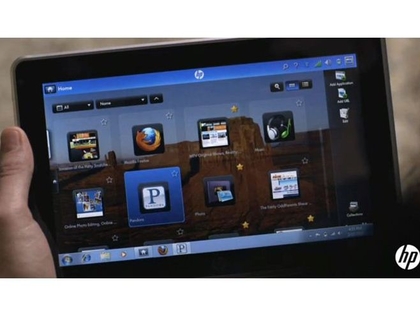
The Entourage Edge uses the Android operating system on a dual-screen device, supporting media and productivity apps on one screen and a high-res 166-DPI screen. The iPad will use support HTML5 in the browser for faster Web processing and Flash-like media playback.
6. Two-way videoconferencing
Notion Ink is a perfect example of how tablets could become the new video phones. The device - like the Apple iPad - supports both Wi-Fi and 3G access, so you can place calls anywhere and anytime. The camera swivels for the best viewing angle.
The JooJoo pad also supports high-def webcam chats on a larger 12-inch screen than the iPad, which Enderle says is its primary market advantage.


| |
Read More ...
BlackBerry planning big step up with high-spec flipper

RIM looks likely to be bringing out its second BlackBerry flip device – but this one is rocking some high end specs and a whole new OS.
The new BlackBerry 9670 isn't the best looking phone we've ever seen in our life – it's short and squat in the leaked photos on BGR but it apparently is using BlackBerry OS 6.0, which is a big jump up in functionality.
The 9670 looks like it will be packing a full QWERTY keyboard, a 5MP camera (which would be the largest seen on a BlackBerry) and a 360x480 internal display.
One inside, one out
There's also a huge external screen, allowing you (presumably) to preview emails when they arrive so you don't have to go through all the palaver of opening the phone.
The addition of BlackBerry OS 6.0 is novel too – this is the first phone we've seen running a tabbed browser, use album artwork and add system-wide multi-touch support.
Such specs can only lead us to believe that the 9670 is touch enabled too, unless it's a wasted feature on this new device.
We'd imagine there will be some modification to this chunky little device before launch, but RIM needs to be careful about playing with form factors after the full touchscreen Storm series wasn't as well received as it would have liked.

| |
Read More ...
Facebook Platform linking web with your friends

Mark Zuckerberg has explained the forthcoming changes to Facebook, including the way in which it plans to share the connections you make on sites with your friends on Facebook.
Facebook is set to bring in a like button that will allow you to share and highlight content to your friends from other sites, something which founder Zuckerberg believes is increasingly important to the social network.
"We are making it so all websites can work together to build a more comprehensive map of connections and create better, more social experiences for everyone," Zuckerberg blogged.
Redesigned
"We have redesigned Facebook Platform to offer a simple set of tools that sites around the web can use to personalize experiences and build out the graph of connections people are making," he added.
"This next version of Facebook Platform puts people at the center of the web. It lets you shape your experiences online and make them more social.
"For example, if you like a band on Pandora, that information can become part of the graph so that later if you visit a concert site, the site can tell you when the band you like is coming to your area.
"The power of the open graph is that it helps to create a smarter, personalized web that gets better with every action taken."
Partnerships
Facebook has partnered with the likes of Pandora, Yelp and Microsoft to showcase the new Facebook Platform – which spells the end of the Facebook Connect branding.
"We think that the future of the web will be filled with personalized experiences. We've worked with three pre-selected partners - Microsoft Docs, Yelp and Pandora - to give you a glimpse of this future, which you can access without having to login again or click to connect.
"For example, now if you're logged into Facebook and go to Pandora for the first time, it can immediately start playing songs from bands you've liked across the web. "And as you're playing music, it can show you friends who also like the same songs as you, and then you can click to see other music they like."
It's certainly exciting times if you like sharing, and it will be interesting to see how Google – a company whose Buzz tool has not had the impact it would have helped – responds.

| |
Read More ...
Google adds voice search for Maps on WinMo and Symbian

Google has announced it's updating Google Maps for mobile to include voice search for your Windows Mobile and Symbian S60 phones.
This means that when you want to look up a place to go to, simply press the 'call' key and state your intentions to the phone – and it can recognise some pretty obtuse questions apparently.
You can ask it to search for a specific address (17 Rue de la Mer), a business (Starbucks) or a type of place (coffee shops).
If your phone is GPS enabled, it will search in the immediate area – but you know how Google Maps works already, and this is just a voice option on top.
Ey lad, gooin' up t'shops, where be Costa?
There will also be a redesigned settings page, with 'many English accents and Mandarin Chinese' supported too according to Google.
This seems to be related to the announcement of Google Maps Navigation in the UK yesterday, where Android phones in the UK are now capable of running as full san nav devices.
We can't see why you'd be desperate to voice search when walking around town on your WinMo phone – while yes, it is easier, you have to reconcile that against looking like a fool shouting commands at your mobile phone.

| |
Read More ...
Apple linked to ARM purchase

It's still firmly in the realm of rumour, but Cambridge-based ARM is rumoured to be the target of a potential acquisition by Apple.
ARM-designed chips are becoming a common sight in today's gadgets and the UK company is one of the country's biggest tech success stories.
The link to Apple has rippled across both the news sphere and the market, although some analysts already questioning its validity.
£3 billion
Apple bought chip specialists PA Semi in 2008, and used its designs in the current gadget sensation the iPad.
With ARM likely to cost over £3 billion, the acquisition would represent a massive financial risk for Apple.
The fact that ARM is even being talked as a potential target for Apple is testament to the growth the company has made in recent years.
Shares in the chip designer rose 1.8 per cent to 243p as news of the link circulated.

| |
Read More ...
US $100 bill gets 3D makeover

The US $100 bill has been given a 3D makeover – with a security ribbon taking advantage of the latest techniques to defend against forgery.
The banknote utilises a "3D Security Ribbon" which makes it harder for forgers to copy the bill accurately.
Tilting the bill should immediately show if the strip is present and the note genuine.
Best tech
"As with previous US currency redesigns, this note incorporates the best technology available to ensure we're staying ahead of counterfeiters," said US Treasury Secretary, Tim Geithner.
The note, which still features Benjamin Franklin, also features a second security thread, portrait watermark and Liberty Bell image which changes colour when tilted.
So can we expect to see a three dimensional Queen Elizabeth II on our banknotes any time soon?

| |
Read More ...
Microsoft makes Windows 7 Touch Pack available for all

Microsoft has made its Touch Pack for Windows 7 available for all, allowing people with touchscreens to show off a blackboard, a pond and the surface globe.
Touch Pack for Windows 7 was made available for manufacturers to out on their touch-screen enabled PCs a year ago, but Microsoft has now decided that everyone deserves a chance.
"The Microsoft Touch Pack for Windows 7 was first introduced last May as a series of 6 applications that are designed to showcase Windows Touch in Windows 7 and to help people learn touch gestures," explained Microsoft.
Casual and Surface
"It consists of 3 casual games, and 3 Microsoft Surface applications that have been created for Windows 7," it added.
"Until today, the Microsoft Touch Pack for Windows 7 was only available for OEMs to put on new Windows 7 PCs capable of Windows Touch. Due to feedback and requests from both partners and customers, we are releasing the Microsoft Touch Pack for Windows 7 for anyone with Windows Touch capable devices to download."
The applications in the pack are: Microsoft Blackboard, Microsoft Garden Pond, Microsoft Rebound, Microsoft Surface Globe, Microsoft Surface Collage and Microsoft Surface Lagoon.

| |
Read More ...


No comments:
Post a Comment