

Gateway and Acer Netbooks: Wonder Twin Powers, Activate!
You're not seeing double: what we have for review today are the Acer and Gateway netbook "twins". At their core, these are virtually identical 10.1" Pine Trail netbooks, with all that entails. And these aren't the only "twin" netbooks out there, as just about every Pine Trail netbook boasts similar specs, features, and performance.

Other than cosmetic differences like the color and an LCD panel lottery that results in two different panels being used, there's nothing to separate these two netbooks from each other. So how do they stack up against the competition? And are they worth the entry price of $335 for the Acer or $340 for the Gateway? Join us as we compare a couple more netbooks against the competition.
Read More ...
Phenom II X6 Compatibility, Over 170 Boards Supported at Launch
Earlier today AMD announced its Phenom II X6 processors. One vendor even started offering them at a huge discount if you're willing to put up with a mail in rebate. The X6 is quite possibly the most affordable route to tons of threaded compute power. If you do a lot of video encoding or offline 3D rendering, for $150 you can't beat the deal TigerDirect is running on the 1055T. And it looks to be a beast of an overclocker.
The new X6s are supposed to work in all Socket-AM2+ and Socket-AM3 motherboards, all you need is a BIOS update. Many of you asked for a performance comparison between AM2+ and AM3 with the X6, but I quickly realized that none of the boards I had around the lab supported the chip. I decided to do a quick survey of all of the motherboard manufacturers to see who was ahead of the game on enabling Phenom II X6 support:
| AMD Phenom II X6 Support at Launch | ||||||||
| ASRock | ASUS | Biostar | ECS | Gigabyte | MSI | |||
| Number of AM2+ Boards Supported at Launch | 10 | 19 | 7 | 16 | 4 | 11 | ||
| Total Boards Supported (AM2+/AM3) | 28 | 37 | 23 | 26 | 43* | 22 | ||
ASUS and Gigabyte lead the charge with 37 and 43 boards supported at launch. The star next to Gigabyte's number means that you'll have to do some digging to find all of the Gigabyte boards with support. The CPU supported list only lists 10 boards but if you dig through Gigabyte's BIOS pages you'll find a lot more. In terms of older AM2+ boards, ASUS and ECS support 19 and 16 respectively. AMD tells us that the priority is to enable AM3 motherboards so over the coming weeks we'll see the AM2+ numbers climb.
Have any of you pulled the trigger on a Phenom II X6 purchase? What board are you pairing it with? Leave your experiences in the comments!
Read More ...
Windows Home Server v2 'Vail' Beta: Drive Extender v2 Dissected
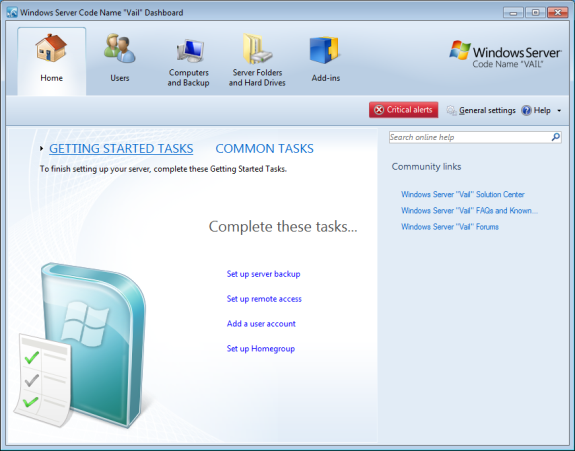
Yesterday Microsoft released the first public beta of the next version of Windows Home Server, currently going under the codename of Vail (or as we like to call it, WHS v2). WHS v2 has been something of a poorly kept secret, as word leaked out about its development as early as 2008. In more recent times an internal beta leaked out late last year, confirming that WHS v2 existed and giving everyone an idea of what Microsoft has in store for the next iteration of their fledgling home server OS.
One thing in particular caught our eye about the WHS v2 beta: the new Drive Extender. Drive Extender is the secret sauce of Windows Home Server that gives it its storage pool and data redundancy features, and now Microsoft has rearchitected it for WHS v2. We'll take a look at just what they did, why it's going to be more compatible and fault-tolerant than WHS v1's Drive Extender was, what the costs of all of this are, and why we think it's a great deal like Sun's popular next-generation ZFS file system.
Read More ...
Phenom II X6, 4GHz and Beyond in 64-bit OSes
In most of my CPU reviews I tend to focus on light overclocking - the low hanging fruit if you will. Over the past few years the focus has shifted from absolute performance to performance per watt. An overclock stops being so interesting if you have to incur a huge power penalty to get there. That's the reason I've put more emphasis on stock voltage overclocks in the past few years.
The fact that I was able to get my Phenom II X6 1090T running at 3.8GHz with minimal effort was very impressive in my opinion. Remember that unlike Gulftown, AMD didn't get the benefit of a process shrink with the Phenom II X6. Six cores and nearly a billion transistors running at 3.8GHz with less than 10% more core voltage is awesome. But you all wanted more:
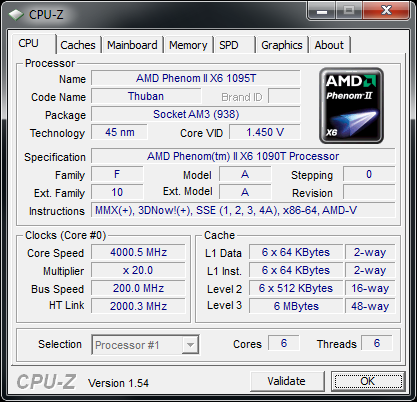
The most I could get out of the X6, reliably with air cooling, was 4GHz. It required more voltage than 3.8GHz but it's doable. The other important takeaway? It was fully stable in a 64-bit OS. In the past we've had issues with AMD's processors and ~4GHz overclocks in 64-bit Windows, but Thuban appears to have fixed that. I'm able to get into Windows at 4.1GHz but not what I would consider stable.
Note that at 4GHz the Phenom II X6 is faster than a Core i7 975 in our x264 encoding test.
Read More ...


No comments:
Post a Comment