

Intel's X25-V for $98 at Newegg, Update: Sold Out
Update: Congrats to all who got them, the drives are now sold out.
A few folks have sent this in so I thought it was worth posting about. Intel's X25-V that we've recently reviewed is now on sale at Newegg for $98. The deal lasts as long as supplies last but given the incredible performance we've seen from a pair of the drives in RAID-0, this might be worth looking at if you're thinking about jumping to an SSD.
I'm still waiting on OCZ's Onyx before calling the value race over at this point. The competition below $130 isn't huge yet but we're at least getting some action down there. As I've said before, once 25nm NAND starts shipping in Q4 then we should really see $/GB start to drop.

Read More ...
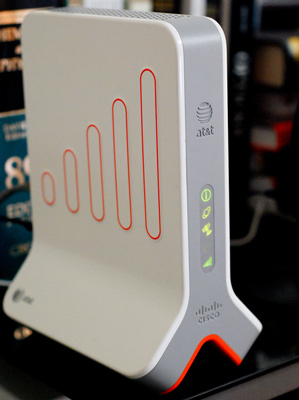
AT&T 3G MicroCell: A Comprehensive Exploration
Over the past two years the carrier debate has really heated up. AT&T has been dangling its waning iPhone exclusivity while Verizon has poked fun at the former's 3G coverage. As the number of smartphones and other data heavy devices on cellular networks increases, carriers will have to find new ways to manage the load.
Simply upgrading the network is an obvious but expensive option. Large corporations and businesses often have cell repeater nodes on their campuses (picocells), something not feasible for normal users at home. There's another option however: the femtocell. Acting as an in-home cellular node, a femtocell uses your broadband internet connection to route cell traffic. The idea is you get great performance since the access node is in your home and it alleviates network congestion by using your internet connection for traffic.
Read More ...
Smartphone Silicon: The 2010 CTIA Wireless Show Roundup
With the exception of Microsoft's Windows Phone 7 Series announcements over the past couple of months, the smartphone market hasn't really been all that interesting. We're at a transition period between SoCs. We're finally seeing a steady flow of Cortex A8 class SoCs, we'll see the first 45nm devices later this year and then next year we'll have first A9s.

Two phones stood out at last week's CTIA show in Las Vegas - Sprint's HTC EVO 4G as it's the first US WiMAX smartphone, and Samsung's Galaxy S which uses Samsung's brand new 45nm Cortex A8 SoC. These two are important, but for very different reasons. One will try to pave the path for the future of cellular networks, while the other will give us a preview of the performance in the next iPhone and Android devices.
Read More ...
AMD's Radeon HD 5870 Eyefinity 6 Edition Reviewed
Last September when AMD unveiled its new DirectX 11 GPUs, we were promised the ability to drive a minimum of 3 or a maximum of 6 displays off of a single card. Every single AMD DX11 graphics card that has launched since has delivered on that promise, even down to ridiculously low price points. The one thing we've been missing is a card that we can hook up to six displays. Until now that is.

This is the Radeon HD 5870 Eyefinity 6 Edition. It's a standard 5870 with 2GB of GDDR5 memory instead of the default 1GB, all clock speeds are the same (850MHz core, 1.2GHz memory). Power requirements go up slightly due to the increase in memory size, and thus the card requires a 6-pin and an 8-pin power connector. The big difference is the Eyefinity 6 Edition's 6 mini Display Port connectors which allowed us to drive one ridiculous display in today's review.
Read More ...
Alienware M11x: World’s Smallest Gaming Laptop
When you think of a gaming notebook what usually comes to mind is a 17" behemoth with a ridiculous paint job and the weight of a small child. While many manufacturers have outfitted smaller notebooks with the right components to make them capable of playing games, it's rare that they actually are marketed as such. Alienware aimed to change all of that.
As the enthusiast arm of Dell, Alienware doesn't have to worry about catering to a wide audience. Surprisingly enough, that's exactly what this latest notebook seemed to do when we first laid eyes on it. Announced at CES 2010, the Alienware M11x boasts specs that make it a more than capable gaming laptop with a size that many thought impossible to achieve. We're definitely impressed with the M11x, so join us as we put 11.6” of gaming goodness to the test to see where it excels and where it comes up short.

Read More ...
Welcome to the 2010 AnandTech Beta
That old design lasted us a long time, didn't it? :) Welcome to the 2010 AnandTech Beta. We've done a lot of updating behind the scenes as well as (obviously) on the front end.
Most obvious is the brand new look and feel. For a site that reviews the latest and greatest tech, we can't get by looking like we're still living in 2004. Now when the 80s make a comeback we'll be on top of that, you've got my word.

We've ditched the left hand column, streamlined some of the ads and widened the content column. While each article will still give you a preview of 10 comments, we finally have an option to view all comments on each review page. Right now we've got this set to 50 comments per page but we'll be tweaking as need be. We're also cutting down on the number of page loads you'll encounter. In view all comments mode there's no page refreshing between comment pages. We'll be bringing this feature to more parts of the site in the future. User friendliness is our drug :)
The front page allows for both linking to our superlong articles as well as shorter stories that can just appear on the front page for quick scanning. By default the latest 5 articles will appear in the rotating carousel up top, but if something super interesting comes up we'll promote it up there (similar to what did on the old site). The expanded summaries on the front page will give you more insight into what it is we're talking about in the article before you ever click anything.
Tags are enabled but not in full effect just yet. We'll be beefing up search, comments (the return of ratings!), galleries, Bench, user profiles and site layout/color customization over the coming weeks. We're planning on this being a regularly updated thing so if you see anything that warrants our attention let us know.
It's not all about a pretty face though, we're still going to be publishing the content that you demand from us. If you haven't seen it, be sure to read Ryan's GeForce GTX 480 & GTX 470 Review. And I'm commemorating today with a new SSD article addressing one of the longest running questions you've been asking: how do SSDs perform in RAID?
As always, thank you for your support over the years and for reading the site. It's been a pleasure to be able to write for you all over the past 13 years. Thank you guys for giving me and all of us the opportunity to do just that. If you haven't been able to tell by now, I love writing this stuff - and you all make it possible.
Read More ...
Intel X25-V in RAID-0: Faster than X25-M G2 for $250?
Intel has been shipping its value 40GB X25-V SSDs for a little while now, but the official launch was just 11 days ago. In our review we found that for $125, the X25-V was a reliable way to enjoy all of the benefits of an SSD without breaking the bank. Today we're here to tempt you a bit more.
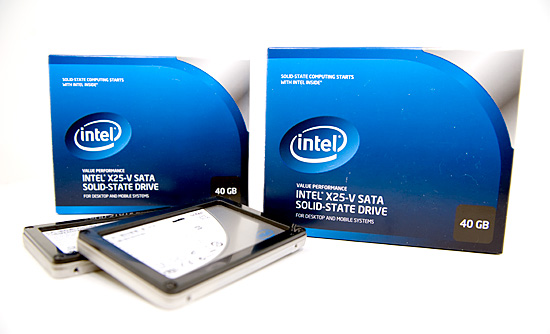
For $220 you can get an 80GB X25-M G2 but for another $30 you can nab a pair of X25-Vs and RAID them together. The resulting performance is truly staggering. I'm talking faster than a 6Gbps Crucial C300 in some cases, and faster than a SandForce drive in others.
It's not all perfect though, you don't always get the best performance and you do lose TRIM. The question: is it worth it? Go ahead and click that fancy new Read More link to find out.
Read More ...


No comments:
Post a Comment