

Review: Panasonic Lumix DMC-ZX1

The DMC-ZX1 is Panasonic's all-new 'Super Compact Camera'. Squeezed into a matt silver casing no bigger than a packet of Malboro Lights you'll find a 12.1-megapixel machine ready and eager to take snaps at the push of a button.
The DMC-ZX1 is the latest addition to the award-winning Panasonic Lumix range of cameras. It's the younger sibling to the more powerful Panasonic TZ series, with the DMC-ZX1 trying to push the boundaries of what we've come to expect from today's truly compact compacts.
The DMC-ZX1 incorporates an 8x optical zoom lens in its slim body. Panasonic has been able to get such a whopper of a lens into such a trim casing thanks to a newly developed lens unit which features the world's first 0.3mm super-thin aspherical lens.

This 8x zoom lens provides a 'super zoom' focal length range equivalent to 25-200mm (on a 35mm film SLR or full-frame DSLR) so the DMC-ZX1 is all set to capture expansive landscape on its wide end, then with a quick zoom, you can focus on the main points of interest with your chosen scenes. You can also use this ultra-wide-to-telephoto zoom lens to take group portraits of friends or family, then quickly zoom in to get individual portraits.

That's an optical zoom, by the way, not the naff digital zooms some cameras have which isn't a zoom at all, just a cheap way of pretending to zoom in digitally and ruining image quality as a result.
You'll find a roomy 2.7-inch LCD on the rear of the DMC-ZX1 to clearly compose your photos, and with a flick the Record/Playback selector switch, you'll be able to accurately review your shots on the same sizeable screen, zooming in to check for sharpness.
Other highlights we'll explore in more detail in this review are the DMC-ZX1's improved Face Recognition technology – which can be set up to 'remember' faces and prompts you to focus on that person when taking group shots so their faces are bright and in focus.
There's also five iA (intelligent Auto) shooting modes on offer to help enhance your photography the easy way. Plus the Intelligent ISO Control which aims to reduces motion blur by adjusting the ISO sensitivity if your subject moves.
As we've come to expect from the latest and greatest compacts, the DMC-ZX1 comes primed with new and improved image stabilisation tech (POWER Optical Image Stabiliser) to make sure your chances of sharp shots are significantly increased. Plus, there are the ubiquitous Scene Modes – all 29 of 'em, including such modes as Candle Light, Sunset, Fireworks and, er, Underwater!
With online prices around آ£220, the DMC-ZX1 still has room for a 'Motion Picture' mode which can record HD 1280x720p, 30fps videos you can view full-screen on HD TVs.
However, all this hi-techery doesn't mean jack if this new, slick Panasonic compact can't take decent photos. Read on to see what we really think of the DMC-ZX1…
Once you remove the gaudy sticker it comes with on its breast plate, the DMC-ZX1 is a neat and stylish little number and no mistake. It's been designed with clean lines to suit its slender, silvery, light-weight nature and it fits in your hand(s) comfortably.
But as the DMC-ZX1 is so supermodel skinny, the two buttons up top – the shutter button/zoom lever and mode dial – are really tiny. Both buttons are dwarfed by a five pence piece.


It's the same on the rear. As the LCD takes up most of the backside, there's only room left for a tiny array of, er, tiny buttons: including the four cursor buttons, the Record/Playback selector switch, and the Display, Q.Menu and E.Zoom buttons.

We soon got used to the little buttons (the zoom lever can take a few tweaks to get it right) as we have average sized man hands on TechRadar, but if you're a proper sausage fingers you may well end up pressing multiple buttons at once and getting into all sorts of bother.
Start up
The DMC-ZX1's start-up time is impressive – 1.1 seconds says Panasonic. One thing we found was the DMC-ZX1's lens stays protruded until you switch the camera off/or the Power Save kicks in. On Standby the lens stays out, which means you can't slip it back in your pocket. But, as start-up times were quick from Power Save (simply tap the Shutter Button), this wasn't an issue, and we were able to wake up the DMC-ZX1 and quickly seize photo ops.

How many megapixels?
The DMC-ZX1 has a 12.1-megapixel sensor. Anything over 10 megapixels in a compact is certainly not to be sniffed at. This means with the maximum 4,000x3,000 pixel resolution images, you'll be able to get big prints of your photos without fear of loss of image quality.
Attempts to keep image noise to a minimum are enhanced by the new, cunningly named 'Venus Engine V' processor which aims to reduce luminance and chromatic noise. Basically, this means, all being well, your images won't come out too grainy (more on this later).
Zoom
The DMC-ZX1 features an ultra-wide Leica DC Vario-Elmar lens. This little beauty offers a mighty 8x optical zoom (the 4x digital zoom is on top of that) which is a 25-200mm equivalent focal length range if it were on a 35mm film SLR or full-frame DSLR.

What this means is that at the wide end you can fit more into your shots, ideal when space is tight when taking photos indoors (at home, in the pub) or if you want to capture the vast sweeping landscape before you. While at the long end you can zoom in on subjects – wildlife, sports, people, performers on stage – and have a better chance of filling the frame for more dynamic photos.
In the 3-megapixel mode, the Extra Optical Zoom extends the zoom power to a whopping 15.6x – although it does this digitally using the centre of the CCD sensor.
Optical image stabiliser
The DMC-ZX1 comes equipped with ever-helpful image stabliser (IS). Panasonic call this POWER OIS (Optical Image Stabiliser). Whatever it's called, all you need to know is that this clever bit of built-in tech will help you to obtain sharp images in difficult lighting situations.

Camera shake and blurred photos invariably appear if you're shooting handheld in lowlight with a shutter speed that's too slow for sharp shots.
With Panasonic's POWER OIS your chances of sharper shots are greatly increased compared to using compacts without built-in IS. Or as Panasonic say on its website, "POWER OIS is about twice as effective as MEGA OIS at reducing low-frequency vibration-caused blur when shooting with a slow shutter speed."
Funny, we thought MEGA OIS would've kicked POWER OIS's arse. Shows how much we know about the outcome if there was ever an Image Stabliser fight to the death.
To keep the DMC-ZX1 completely still for guaranteed sharp results, you can screw it onto a tripod – although on larger stands it looks pretty daft with such a miniscule camera!
Face recognition
One area the DMC-ZX1 has upped its game is in the Face Recognition stakes. Not only will the DMC-ZX1 recognise faces in your shots so you can get sharp shots of people easier, it will now also 'remember' faces if you've photographed the same person a bunch of times, and then tries to make sure that person's face is bright and in focus.
Up to six people's faces can be registered. The detection worked mostly okay from our experience, but it wasn't noticeably different all the time.
We hoped that also meant when taking family photos with the annoying aunt and uncle in, we could somehow not detect their faces - and possibly replace them with someone else's faces instead, like Brad and Angelina's… sadly the DMC-ZX1 can't stretch to that sort of in-camera jiggery pokery yet.
However, there is a 'Transform' portrait mode for making people skinnier, wider or taller in-camera. So we could make aunt and uncle's faces really fat if we were feeling particularly malicious. Sadly, the Transform portrait results weren't particularly realistic, but still, it's a fun Scene mode that's available to use to annoy/amuse your friends and family.
Burst mode
Burst mode is restricted to a reasonable 2.3fps and five images in its full resolution 12.1-megapixel mode. But this is increased to a very respectable 10fps when using the lower image quality 3-megapixel mode. The 10fps speeds match pro-level DSLRs (like the Canon EOS-1D Mark III) for burst mode continuous shooting performance, although don't expect the same image quality to be pumped out the other end.
Just in case you didn't realise, all this fps speed is helpful when shooting moving subjects, such as fast flapping birds or skittish wildlife when you need more than one bite of the cherry to get the shot. It's best used in conjunction with the AF Tracking mode, which focuses on moving targets. Fast burst speeds can also be helpful when photographing action sports or children who refuse to sit still when you want to take pictures of them.
Shooting modes
There are five iA (intelligent Auto) shooting modes on offer to help your photography; Portrait, Scenery, Night Portrait, Night Scenery, Macro. Mostly worked admirably, and the DMC-ZX1 generally picked the best one depending on our subjects.
In 'Normal' auto shooting mode we found selecting Macro a bit fiddly and the results were hit and miss – subjects could end up overexposed as the DMC-ZX1 insisted on using flash.
As we mentioned earlier, in the Scene shooting mode there are a chuffing 29 Scenes on offer. You certainly won't be stuck for choice, but you may well, as happened to us, get stuck wondering which Scene mode to choose, and then end up missing the photo opportunity.
As we've got room, those Scene modes are: Portrait, Soft Skin, Transform, Self-Portrait, Scenery, Panorama Assist, Sports, Night Portrait, Night Scenery, Food, Party, Candle Light, Baby1, Baby2, Pet, Sunset, High sensitivity, Hi-Speed Burst, Flash Burst, Starry Sky, Fireworks, Beach, Snow, Aerial photo, Pinhole, Film Grain, High Dynamic (Standard, Art, B&W), Photo Frame and Underwater.
It's worth getting familiar with a few favourites so you know which one to choose depending on what you're photographing. We found most worked pretty well, although not necessarily for their intended use! 'Pet' was actually good for close-up shots, Night Scenery was also good for indoor shots when you didn't want to use flash. We didn't get to try out Snow as it's summer here –we could've done with a Rain shooting mode instead.
LCD screen
Composing your shots and reviewing the results afterwards are both made easy thanks to the sizeable 2.7-inch LCD. It 'only' has a 230,000 pixel resolution – many modern camera's LCD's now have a 460,000 or 920,000 pixel resolution – but it is clear, bright and sharp.

The DMC-ZX1 also has HD Video capabilities in its Motion Picture mode. Using our 4GB SecureDigital card we were able to record over eight minutes of HD 1280x720p quality video or 15 minutes of VGA (640x480) video.
It's a fun feature and if you want to record a snippet of a family birthday party or other short events, it's nice to have the option, although we can't honestly say we used the Motion Picture mode much on the DMC-ZX1. If we're going to record videos we'd rather do it properly with a decent HD camcorder.
Overall we enjoyed playing with the pocket-sized Panasonic Lumix DMC-ZX1. It's a fun, easy to use and responsive compact camera. Its optical zoom was impressive, as was its wide-angle capabilities, and it's packed with helpful 'intelligent' tech to make it easier to take half-decent photos.
Image quality
So, down to the all important image quality. We're pleased to report that image results were, overall, very good. Colours were accurately recorded, the vast majority of the time we were able to capture sharp shots (regardless of how far we'd zoom in – something that can cause other compacts to lose image quality) and the DMC-ZX1 performed okay when shooting in mixed lighting conditions when bright sunshine was mixed with dark shadowy areas in scenes.
Even when we relied on the camera's iA modes it returned accurate images, although we did find it was sometimes over keen to use the flash which caused a few overexposures.
However, when the ISO was automatically upped to around ISO 500 or 800 (such as when using the Night Scene mode which doesn't use flash) the noise levels crept up dramatically. In fact, we found that with anything over the base ISO 80 level the noise was noticeable – even at around ISO 250 or 320 pictures are unpleasantly grainy when you look closely (we were zooming in to images in Photoshop at 100 per cent view) which means poor print quality.
That might sound a bit harsh considering the DMC-ZX1 is a compact priced at barely over آ£200, but images taken at ISO 400 or below shouldn't really be revealing so much noise in our book.

We liked
The Panasonic Lumix DMC-ZX1 is a small but slick bit of camera kit. It's quick and easy to use and it takes top shots with very little input from us. If you're feeling lazy, and like to leave your compact on auto or use Scene modes, that's ideal. If you like to take control of your photography a bit more and set apertures and shutter speeds… well, perhaps you need think about a DSLR!
We disliked
You only get Basic Operating Instructions in the box, you have to get the more in-depth manual from the supplied CD.
When taking photos using the flash, we had to be careful composing our shots square on to our subjects, otherwise we got nasty shadows appearing across the sides of our images.
And as the flash is to the top right side of the lens, this means when taking very tight shots (macro close-ups for instance) and flash, if you angle the camera to the right, you could shadow appearing from the lens itself. A small point, but an important onenonetheless.
We also didn't like the high noise levels above ISO 200.
Verdict
Small enough to slip into a shirt top pocket and light enough to go unnoticed in a handbag, the DMC-ZX1 is an ideal camera to take with you to get some happy snaps. It's impressive that Panasonic's managed to fit in so much when you consider the DMC-ZX1 is so small – 97.8x54.6x26.0mm to be precise.
It's also worth noting the DMC-ZX1 is also available in blue, red or black as well as traditional silver – a colour choice for everyone then.
Related Links
 |  |
Read More ...
In Depth: First impressions: 15 minutes with Avatar 3D

TechRadar has just got back from the screening of 15 minutes of James Cameron's Avatar – the movie that has been tipped to take 3D into the mainstream.
With 3D TVs the talk of the town (and probably the forthcoming IFA), Sky announcing a 3D channel in 2010 and digital IMAX arriving in cinemas around the nation, Cameron's next film is still being seen as a rallying point for the industry.
To spark even more interest in the film, a quarter of an hour of Avatar was shown off to people across the globe, and three of the TechRadar team were there to take a look.
Editor - Patrick Goss
I wasn't sat in the ideal place to be honest; my heart sank when I saw the words Row B on the ticket, and after seeing the Avatar film trailer yesterday and the game trailer today I couldn't help but think of Dances with Wolves and the Night Elves' homeland in World of Warcraft.
But, the moment the giant 3D James Cameron disappeared after introducing his film, I felt the excitement rising. The clips from the first half of the film – which made up the lion's share of the 15 minutes – varied in pacing, and to be completely honest the faster stuff still suffered badly in 3D.
As much as I wanted to be thrilled by the chases through trees, the really quick stuff was confusing and difficult to follow, making me wish I could watch it in more straightforward 2D.
However, the moment things slowed down, the reasoning behind the 3D was obvious. The early jarring glimpses of the aliens quickly faded to acceptance of the characters and little details shone through, like the glimmering eyes, and the vertiginous drops from the cliffs.
I certainly feel excited about seeing Avatar in 3D, although I'm still not convinced that this will burst through the notion that 3D is a neat trick rather than the future of cinema.

Gareth Beavis – News Writer
I'm not a movie buff by any stretch of the imagination, and my 3D experiences so far have been mainly made up by the recent slew of 3D Disney films. I've taken almost zero interest in the build up to Avatar, but was intrigued to see what all the fuss is about.
And after seeing 15 minutes of it, I'm torn. On the one hand, there were times when you could see how Cameron has taken the 3D / CG boat out so far you thought about calling the virtual coastguard - it was utterly mesmerising and so beautiful and engaging in the quieter, slower scenes.
On the other hand, it's not a lot more than an average fantasy film (think the product of Lord of the Rings mating with Ferngully in a fit of celluloid passion - in 3D) and while the physicality of the Blue Cat Things was excellent - you're still constantly aware you're watching CG-created Blue Cat Things, which ruins the immersive illusion at times.
For me, 3D is still just 'a bit cool' and a long, long way away from 'I'm going to pay آ£4 more to watch this in 3D'. Avatar looked very impressive, but from what I've gathered it looks massively over-hyped. Come on Cameron, next time spend the 3D budget on 'Titanic 2: This time we'll turn a bit earlier'.
Marc Chacksfield – AV specialist
After following the internet build-up surrounding Avatar for what feels like eons, seeing the film in all its 3D glory for the first time is something of a let-down.
Yes, it's mesmerising and the 3D does look a touch better than what been seen in the past but it all feels, well, too much. The action scenes are stunning but your eyes just don't register everything that is happening.
Couple this with a disparate script that seems to mesh childlike videogame fantasy with Aliens-style space marine fighting and what you have is something that's stylistically a mess. When things calmed down, however, there was much sparkle in the 3D – facial gestures were jaw-dropping and the CGI faultless.
What we saw today were unrelated scenes and the faith that I have in James Cameron as a filmmaker should, and most probably will, mean that Avatar will be a success. Let's just hope that he hasn't spent too much time in making things look pretty and forgotten to take care of little things, like, er, the script.

| |
Read More ...
GamesCom 2009: Hands on: Microsoft Project Natal review

When Microsoft unveiled Project Natal, its non-physical game controller, at E3, it certainly caused astonishment, but there was an undercurrent of scepticism – after all, the smoke and mirrors of press conferences can gloss over most quirks and imperfections, and Natal seemed so outlandish that one had to question whether it would work in the typical, chaotic living room in which one's Xbox 360 generally resides.
But at the GamesCom show in Cologne, I managed to use the system, and all those doubts evaporated.
Project Natal is a game-changer, quite literally – one of those items of technology which has one racking one's brains to imagine the different ways in which it will transform its sphere (in this case, of course, videogames).
The easiest way to describe it is as effectively having a motion-capture studio in one's home. It can lock onto human bodies and track their movements in such minute detail, and with such responsiveness, that developers can use it to let players control their games with the tiniest of gestures.
Microsoft demonstrated two Project Natal apps at GamesCom, both stunning when you got to jump in and try them out. The first is a sort of Breakout, in which you look down a virtual room, at the end of which are blocks.
he system scans you, and puts a ghost outline of your body on the screen; balls bounce towards them, and you must send them back to break the blocks, using whatever part of your body is appropriate. By moving around in front of the system, you can head, kick or chest balls, bat them back with your arms and so on.

NATAL: Look, I'm playing 'soccerball'!
The second demo was simply a tweaked version of Burnout Paradise, in which you stood up (or you can sit down), put your arms out in front of you as if gripping an imaginary steering wheel and move your hands as you would if gripping a real steering wheel in order to steer your virtual car.
Step forward with your right foot to accelerate, and back to brake. This felt a bit odd at first, but only for a few seconds: the sheer responsiveness meant that you soon trusted the system.
Perhaps the most impressive aspect of Project Natal is that, unlike even the Wii's control system, it requires no calibration, and a glimpse at the end of the demo at a developer's kit screen which showed the data processes let us instantly understand why that should be and, indeed, how the system works. It sucks in a lot of data, with infra-red sensors, a video-camera and a high-end directional microphone, but its real genius lies in how it processes that data (it has its own microprocessor which, one suspects, is a custom job).

NATAL: And this is what it looks like
Basically, what it does is look for human bodies, lock onto them and ignore everything else. Those bodies can be standing or sitting, but must, at least initially, face the Project Natal box (which, invariably, will be under or by your TV).
In a split-second, it realises it has a body in front of it, and using the distance data generated by the infra-red sensors (which also allow it to work no matter what the lighting conditions) builds up a scan of your body, working out the positioning of, apparently, 48 key joints of your body.
Thus it assembles a skeleton, which it monitors in obsessive detail. Clever algorithms allow it to ignore "occlusions" - such as your dog running across the room in front of you. If someone else wants to jump in, they just come and stand next to you; in an instant, their body has been automatically scanned, too. Up to four people can use one Natal unit at a time - you'd need a hell of a big room for that, though.
The possibilities that Natal offers are endless – every developer in the world must be racking his brains about how he will use it to outdo his rivals. It should work with most game genres, as it's all about letting people use natural, intuitive, real-life movements to control their games.
But you could, should you like, also use it for outlandish purposes – by programming it to recognise bizarre gestures or so on. It really does open up a whole new world of possibilities, and gaming simply won't be the same when it arrives. It won't necessary supplant the traditional gamepad, but it will certainly augment it, and give Microsoft the mainstream appeal that it has always craved and currently has to cede to Nintendo.

NATAL: Steven Spielberg introduces Microsoft's Project Natal at E3
We wish we could tell you when it will be available and how much it will cost, but Microsoft remains tight-lipped on both counts; it's a seriously high-tech piece of kit, and it will have to be pricey in order for Microsoft to make money out of it (although Microsoft has always been prepared to take a loss-leading period with its games hardware).
All we know is that we want one: now.

| |
Read More ...
TechRadar Choice: Five 32-inch LCD TVs reviewed and rated

If you want our opinion, while bigger TVs may steal the show for glamour, there's currently no more useful size than 32 inches.
After all, it's hard to think of any other screen dimension that's big enough to be visible in your living room, yet also small enough to slot into a bedroom, study, kitchen or conservatory without becoming too overwhelming.
In other words, the 32" TV offers something for everyone.
It's little wonder, then, that so many manufacturers are rushing to meet demand, and pitching so many different models at this potentially lucrative part of the market. Our group test sorts through the confusion of different models available to make your choice as easy as possible.

Toshiba 32AV635
The good: Astounding value; exceptional SD; good features.
The bad: HD could be sharper; not very bright images.
Getting any 32-inch LCD TV for آ£425 seems a fair deal to us, but when that TV has a brain like the 32AV635's, our bargain-hunting antennae go into overdrive.
MetaBrain is a combination of Toshiba's Active Vision multipurpose video processing for boosting picture elements, plus the Resolution+ upscaling technology.
Mini verdict: Although inevitably flawed, the 32AV635 is still remarkably good value for money in these cash-strapped times. âک…âک…âک…âک…
Read: The full Toshiba 32AV635 review

Panasonic TX-L32X10
The good: Great operating system; crisp HD pictures; incredibly wide angle viewing.
The bad: Not very vibrant colours; black levels not the best.
This TV's price tag looks pretty steep for what's ostensibly an entry-level TV. After all, Toshiba's 32AV635 above only costs آ£425, despite including the excellent Resolution+ processing.
The L32X10's price justification process starts well enough, though, with some robust build quality –
even if its predominantly black, angular design is unexciting.
Mini verdict: The L32X10 is a surprisingly average TV with an above average price that doesn't come up trumps. âک…âک…âک…
Read: The full Panasonic TX-L32X10 review

Samsung LE32B650
The good: Superb pictures; gorgeous design; great value.
The bad: Sound is a bit feeble; limited viewing angle.
Samsung is usually pretty good at pushing the boundaries of value, so the LE32B650 32-inch LCD TV's price tag initially looks surprisingly high. But once you see what the set can do, it's really not bad at all.
For starters, this screen can provide an instant exotic design highlight to any room, thanks to its glorious 'crystal' glass-like finish, delightful curves and elegant lines.
Mini verdict: Samsung follows up its recent LED successes with another excellent LCD performer that's also aggressively priced. âک…âک…âک…âک…âک…
Read: The full Samsung LE32B650 review
Philips 32PFL9604
The good: Picture quality; huge feature count; good audio.
The bad: Expensive; some processing elements need care.
Having produced some of the best TVs at this size in the past year, Philips is making the most of its glowing reputation with this feature-packed, aluminium-clad 32" TV. While the inclusion of Ambilight and wireless web browsing are the headline acts, the 32PFL9604 has got much more up its sleeve.
It's exceptionally well connected, with Net TV being Philips' first foray into internet features. Unlike most sets that offer a ring-fenced platform on a wired ethernet connection, the 32PFL9604 can access the Net TV portal using Wi-Fi and even browse the internet at large.
Mini verdict: A fearsomely well-specified, seriously high performance TV, whose qualities certainly don't come cheap. âک…âک…âک…âک…âک…
Read: The full Philips 32PFL9604 review

Sony KDL-32W5500
The good: Excellent pictures; reasonable value.
The bad: Limited online features; some motion blur.
Sony's KDL-32W5500 32-inch LCD TV is effectively the 'plain' sibling of the fancy-looking KDL-32E5500. With that in mind, this model is not nearly as dramatically designed as the nearly twice as expensive 32E5500.
For, in place of the latter model's sleek, white bezel with contrasting black, wood or metallic options, the 32-inch 32W5500 sports a gloss black frame and routine lines.
Mini verdict: Exceptionally well-featured, but its pictures are just flawed enough to stop us giving it an unreserved thumbs up. âک…âک…âک…âک…âک…
Read: The full Sony KDL-32W5500 review
While none of our five 32-inch contenders is bad by any means, there is one that must be classed as a disappointment, given the quality levels usually associated with its brand and that's the Panasonic L32X10.
Surprisingly, given the quality of its plasmas, it just doesn't have the black levels or colour saturation to really rival those of our other LCD models today and is hardly cheap.
Winners
With all four of our remaining TVs having something good to say for themselves, though, picking our fourth-placed set is inevitably going to be a rather harsh decision. But it's got to be done, so let's go for the Toshiba 32AV635.
This TV is, for the most part, outstanding value, punching well above its price tag – especially with standard definition – and actually making it a great choice for the buyer on a tight budget.
However, in the end we can't ignore the fact that it has considerably fewer features than our remaining three TVs, and doesn't have the brightness or HD kudos to win us over totally.
Our bronze medal goes, then, to Sony's KDL-32W5500. This highly specified TV is reasonably well priced, considering what it offers, and is more than capable of serving up truly outstanding pictures.
But its rather limited online system, motion problems and curious, if rare, glowing artefacts ultimately stop the TV from reaching the top spot.
In second place we've put the Philips 32PFL9604. This is a pretty awesome TV, with a truly fearsome feature count and some absolutely spectacular pictures, with HD and standard definition alike. It even sounds good, for heaven's sake.
In fact, the only thing stopping it from bagging the gold medal is its price; at آ£950 it really is something only the most quality obsessed, financially untroubled punter will be able to seriously contemplate.
This all means, of course, that our winner is Samsung's 32B650.
Although not perfect (its sound, in particular, needs work), it's phenomenally good value, combining mostly terrific pictures with a huge feature count and gorgeous aesthetics to truly tantalising effect.

| |
Read More ...
In Depth: 11 ways Apple can kill Spotify on iPhone

Everybody loves Spotify, and its impressive iPhone app is currently sitting on an Apple desk waiting to be rubber-stamped or rejected.
So what can Apple do to kill it? Could iTunes on the iPhone/iPod be better, and are there any Spotify tricks Apple should nick? Here are eleven ways Apple can beat the European upstart.
1. Start offering an iTunes subscription service
You know it, we know it, Steve Jobs knows it: the musical wind is changing, and in the not too distant future the idea of paying to own music will seem as quaint as having a giant handlebar moustache and travelling by Penny Farthing.
Apple's interested in hardware, not software, and a subscription service won't harm iPod or iPhone sales. Quite the opposite: we can easily imagine The Kids going crazy for an iPhone 3GS with an unlimited music subscription built into the monthly data plan.
2. Add wireless syncing to iTunes
Spotify's Wi-Fi synchronisation is very nifty, and it's something we've wanted to see the iPhone do since day one. And no, MobileMe doesn't count. Apple got rid of the dock ages ago. Surely it's time to get rid of the USB cable, too?

SYNCING FEELING: Syncing via Wi-Fi is an excellent idea, and we can't think of any reason why iTunes shouldn't do it
3. Stream everything in iTunes
Spotify's playlist is big, but at 6 million-odd tracks it's nowhere near as comprehensive as iTunes' selection of over ten million songs - and Spotify might not have permission to stream all of that catalogue, either: earlier this week, Spotify had to remove Bob Dylan's stuff until such time that it can prove it has the rights to stream his music.
4. Cache content
What makes Spotify on the iPhone so desirable is its caching: you can download playlists to your phone and cache all the songs, enabling you to play them back even when your iPhone's in airplane mode. A subscription version of iTunes could and should do the same.
5. Make offline available online
For those of us in places where 3G coverage ranges from patchy to completely non-existent, such as "pretty much anywhere that isn't a city", it'd be extremely handy to have an offline mode that works independently of our phones' cellular radios.

OFFLINE: Spotify's offline playlists are a brilliant idea, enabling you to keep on listening even when you can't get online
6. Tell the networks to get stuffed
Some iPhone apps are crippled for no other reason than phone operators don't like them - so for example Skype is Wi-Fi only. A streaming iTunes needs 3G connectivity to be worthwhile, and as Spotify's demonstrated you can deliver 3G streaming with excellent sound quality.
7. Go social
Unlike Spotify, iTunes is a one-person system. The iPhone's support for peer to peer networking makes Spotify-style playlist sharing perfectly possible, and of course in MobileMe Apple already has a solid data sharing system that iTunes could plug into.
8. Offer it to Americans
Spotify isn't available in the US yet, and that's an awfully big market. If Apple beats Spotify to the US, Spotify's going to have a hard time fighting back - assuming, that is, that record labels are willing to play ball. US labels aren't entirely happy about Apple's market dominance; will they really want to make Apple even more powerful?
9. Don't let anyone multitask
The iPhone OS won't let third-party applications multitask, and while that's attracted criticism it does mean Spotify is damaged, possibly fatally. The iPod app keeps playing when you do other things with your iPhone. The Spotify app can't.

APPLE ONLY: Here's something only Apple applications can do: keep on going when you're doing something else
10. Hang on a bit
Despite the hype, Spotify is losing massive amounts of money. As long as its investors are happy it'll keep going, but sooner or later they're going to expect to see a return on their investment. The internet is littered with the corpses of sites and services that simply ran out of money, and Spotify could turn out to be one of them.
11. Keep Spotify locked in the App Store approval dungeon, refusing to let anybody know whether it's going to be approved or not, thereby making other developers think twice about attempting to create anything vaguely musical for the iPod and iPhone - and keep on doing it until everyone at Spotify hurls themselves off a bridge in despair.
Apple wouldn't do that… would it?

| |
Read More ...
Guest Blog: Where next for the eBook?

Peter Zieleman is the Managing Director of eBook manufacturers, BeBook
In the last decade electronic ink (e-ink for short) screens have been invented, enhanced and implemented in dedicated electronic book readers or eReaders.
Nowadays there are devices which have the same characteristics as paper printed books, but with some important twists. The downsides are the lack of 'feel' and 'smell' of paper, but advantages are the greatly improved portability (take thousands of books on holiday) and the possibility to change the appearance of a book to your liking (changing font size or type) amongst a lot of other things.
When we at BeBook first noticed an early prototype of an e-Ink screen on the CES showfloor in Las Vegas a few years ago, we were immediately convinced that the tech was the future of book reading. We realised the book industry was on the verge of a total makeover.
There are clear parallels with the changes in the distribution of recorded music in recent years, which has transitioned from vinyl records to CDs which to MP3s, within less than a 20 year timespan.
Another similarity is the role of the publishing industry itself. The music industry was confronted with MP3s, without asking for it. Long after the public embraced this new music standard, the industry started to realise it was an opportunity instead of a threat and they had to (and still have to) catch up and adopt, instead of reject, the new format.
Consumers driving e-ink innovation
Like the introduction of the MP3, the introduction of eBooks was almost entirely consumer based: there was a demand from the consumers itself which got fulfilled by a small group of enthusiasts at first followed by a rapidly growing group of early adopters in both consumers and companies.
It truly turned out in "seeing is believing": almost anyone who saw an eReader and an eInk screen were immediately convinced of it's potential.
Unlike the music industry the book industry realized in time that things in their industry were about to change whether they liked or or not. The first concern, of course, was DRM (Digital Rights Management) and the traditional role of the publishers.
All large players in the industry got organized in the IDPF, the International Digital Publisher Forum, after some initiatives of private parties using their own DRM system, the industry together chose ePub and Adobe DRM as the standard. Epub being an open source text format and the DRM system from Adobe was 'independent' within the book industry.
Book publishers find new role
Next up there was the discussion what, or even 'if', role the publishers would have. A large concern was the thread of elimination: once digital, everyone could publish books.
It appeared to be mostly theoretical: the added value of publishers goes beyond the general belief of the public that publishers are mainly 'duplicators'. Their services go beyond the duplication process itself ranging from distribution to marketing, to brand awareness and so on.
Just look at it a a simple way: If you have a bakery, you can try to sell the bread you bake yourself, but if you sell it through a chain of supermarkets, you are more efficient and more profitable, as you can share costs.
BEBOOK MINI: BeBook is soon to introduce the wireless-enabled BeBook 2 and the affordable آ£135 BeBook Mini
Going back to BeBook's core business: the hardware side of eReaders. Up until now the eReaders business has been pretty transparent: there were, and still are, just a few players on the market.
In our opinion, all of the current players are all innovators : they've recognized the evolution of book reading at an early stage and are genuinely enthusiastic about it, for the simple reason they like reading books.
Wireless eReaders on the way
Every other week our opinion is asked on the latest development(s) of one of our competitors. Ranging from 'they' have a larger screen, ''they' have "whatever" new feature, do you see 'competitor X' as a thread? And so on …
The general belief of the public, and even press, is that there is a fierce competition going on between eReader manufacturers. Truth is, all players in the eReader market are just genuinely trying to make the best eReader possible. And the best possible reading experience.
Of course there is envy every now and than, but also admiration at the same time. The main thing is that players who reach a milestone first will get a bit of both, but at the same time, all milestones, regardless of who reaches them first are an evolution, thus opportunity, of the eReader market itself.
None of the current players in the eReader market have the illusion that whatever improvement they come up with will be their exclusive improvement forever. In a broader view even all eReader manufacturers have a mutual goal : we are the innovators and we want to prove "we're right", encouraged by both customers and the industry.
For example: with our upcoming BeBook 2, a 3G wireless connected eReader, we will be the first to offer worldwide connectivity, but we know for a fact we won't be the only one for the years to come. There will be colour screens at some point (but not accessible to the general public at an affordable price in a the next couple of years). And there will be cheaper models, once eReading gets more common. We already broke the magic $200 barrier with the BeBook Mini, but we're aware that this is still a start.
New eBook manufacturers
The same goes for new manufacturers entering the market: analyst tend to think this scares the current players. It doesn't. When Ford introduced their Model-T, it was only a matter of time until other manufacturers followed the great example. Today there are hundreds of cars and models, all existing next to each other and even complementing each other.
Every few weeks all of the manufacturers meet up on book (or consumer electronic) fairs, and instead of avoiding each other, there's always great contact between all of us.
Of course we discuss the market off the record and the best way to define the current market is by quoting a staff member from a Japanese 'competitor' (you can probably guess who) commenting on our BeBook 2 and the growing number of players in the market:
"All boats rise with the flood," they said.
With new players, awareness of eReading is still growing, which enlarges the market, which benefits both manufacturers (larger potential market) and consumers (lower prices, technology enhancements).
From BeBook's perspective we're not dividing a small pie, we're discovering an ocean. And we just left port.
Peter Zieleman is the Managing Director of eBook manufacturers, BeBook.
For more on BeBook's forthcoming Mini eBook and BeBook 2 check out TechRadar's news feature from earlier this year.
Related Links- News: Flexible eBook launching early 2010
- Cool-er eBook is 'iPod moment' for eReaders
- BeBook unveils آ£135 mini eBook

| |
Read More ...
Guest Blog: The future of eBook technology
Peter Zieleman is the Managing Director of eBook manufacturers, BeBook
Since the invention of the printing press in the 15th Century, reading books has become one of man's favourite pastimes.
While most inventions evolve over the years, book printing and publishing hardly have. The same process has been going on for almost 600 years : someone writes a book, a publisher transfers it to a machine, than stamps it on a pile of paper using ink.
This all changed with the introduction of the Personal Computer. For the first time in over 500 years there was an alternative way to display text, thus an alternative way to read books. One now could read a book, or other text, from a screen instead of paper printed source.
Needless to say this wasn't very convenient at first; green or amber blinking screens could hardly be considered portable. Next up were the early portable devices using an LCD screen: PDAs like the Palm Pilot. At last digital reading became portable. But it still wasn't very convenient; the screen was too small, the amount of content limited, the battery drained too fast and it still didn't feel like reading a book.
The emergence of the eReader
In the last decade electronic ink (e-ink for short) screens were invented, enhanced and implemented in dedicated electronic book readers or eReaders. Finally, a solution came along to solve the portability issue and the technical limitation issue.
Nowadays there are devices which have the same characteristics as paper printed books, but with some important twists. The downsides are the lack of 'feel' and 'smell' of paper, but advantages are the greatly improved portability (take thousands of books on holiday) and the possibility to change the appearance of a book to your liking (changing font size or type) amongst a lot of other things.
When we first noticed an early prototype of an e-Ink screen on the CES showfloor in Las Vegas a few years ago, we were immediately convinced that the tech was the future of book reading. We realised the book industry was on the verge of a total makeover. There are clear parallels with the changes in the distribution of recorded music in recent years, which has transitioned from vinyl records to CDs which to MP3s, within less than a 20 year timespan.
Another similarity is the role of the publishing industry itself. The music industry was confronted with MP3s, without asking for it. Long after the public embraced this new music standard, the industry started to realise it was an opportunity instead of a threat and they had to (and still have to) catch up and adopt, instead of reject, the new format.
Consumers driving e-ink innovation
Like the introduction of the MP3, the introduction of eBooks was almost entirely consumer based: there was a demand from the consumers itself which got fulfilled by a small group of enthusiasts at first followed by a rapidly growing group of early adopters in both consumers and companies.
It truly turned out in "seeing is believing": almost anyone who saw an eReader and an eInk screen were immediately convinced of it's potential.
Unlike the music industry the book industry realized in time that things in their industry were about to change whether they liked or or not. The first concern, of course, was DRM (Digital Rights Management) and the traditional role of the publishers.
All large players in the industry got organized in the IDPF, the International Digital Publisher Forum, after some initiatives of private parties using their own DRM system, the industry together chose ePub and Adobe DRM as the standard. Epub being an open source text format and the DRM system from Adobe was 'independent' within the book industry.
Book publishers find new role
Next up there was the discussion what, or even 'if', role the publishers would have. A large concern was the thread of elimination: once digital, everyone could publish books.
It appeared to be mostly theoretical: the added value of publishers goes beyond the general belief of the public that publishers are mainly 'duplicators'. Their services go beyond the duplication process itself ranging from distribution to marketing, to brand awareness and so on.
Just look at it a a simple way: If you have a bakery, you can try to sell the bread you bake yourself, but if you sell it through a chain of supermarkets, you are more efficient and more profitable, as you can share costs.
BEBOOK MINI: BeBook is soon to introduce the wireless-enabled BeBook 2 and the affordable آ£135 BeBook Mini
Going back to BeBook's core business: the hardware side of eReaders. Up until now the eReaders business has been pretty transparent: there were, and still are, just a few players on the market.
In our opinion, all of the current players are all innovators : they've recognized the evolution of book reading at an early stage and are genuinely enthusiastic about it, for the simple reason they like reading books.
Wireless eReaders on the way
Every other week our opinion is asked on the latest development(s) of one of our competitors. Ranging from 'they' have a larger screen, ''they' have "whatever" new feature, do you see 'competitor X' as a thread? And so on …
The general belief of the public, and even press, is that there is a fierce competition going on between eReader manufacturers. Truth is, all players in the eReader market are just genuinely trying to make the best eReader possible. And the best possible reading experience.
Of course there is envy every now and than, but also admiration at the same time. The main thing is that players who reach a milestone first will get a bit of both, but at the same time, all milestones, regardless of who reaches them first are an evolution, thus opportunity, of the eReader market itself.
None of the current players in the eReader market have the illusion that whatever improvement they come up with will be their exclusive improvement forever. In a broader view even all eReader manufacturers have a mutual goal : we are the innovators and we want to prove "we're right", encouraged by both customers and the industry.
For example: with our upcoming BeBook 2, a 3G wireless connected eReader, we will be the first to offer worldwide connectivity, but we know for a fact we won't be the only one for the years to come. There will be colour screens at some point (but not accessible to the general public at an affordable price in a the next couple of years). And there will be cheaper models, once eReading gets more common. We already broke the magic $200 barrier with the BeBook Mini, but we're aware that this is still a start.
New eBook manufacturers
The same goes for new manufacturers entering the market: analyst tend to think this scares the current players. It doesn't. When Ford introduced their Model-T, it was only a matter of time until other manufacturers followed the great example. Today there are hundreds of cars and models, all existing next to each other and even complementing each other.
Every few weeks all of the manufacturers meet up on book (or consumer electronic) fairs, and instead of avoiding each other, there's always great contact between all of us.
Of course we discuss the market off the record and the best way to define the current market is by quoting a staff member from a Japanese 'competitor' (you can probably guess who) commenting on our BeBook 2 and the growing number of players in the market:
"All boats rise with the flood," they said.
With new players, awareness of eReading is still growing, which enlarges the market, which benefits both manufacturers (larger potential market) and consumers (lower prices, technology enhancements).
From BeBook's perspective we're not dividing a small pie, we're discovering an ocean. And we just left port.
Peter Zieleman is the Managing Director of eBook manufacturers, BeBook.
For more on BeBook's forthcoming Mini eBook and BeBook 2 check out TechRadar's news feature from earlier this year.
Related Links- News: Flexible eBook launching early 2010
- Cool-er eBook is 'iPod moment' for eReaders
- BeBook unveils آ£135 mini eBook

| |
Read More ...
In Depth: 7 best magazine cover tech innovations
In honour of Entertainment Weekly hosting the first-ever full motion video advert in its magazine, TechRadar has compiled a list of the seven best magazine covers that have blown us away – whether through sheer ingenuity, tech prowess or all-out craziness.
1 Empire 'Behind the Mask' (2005)
The first living, breathing cover ever! Okay, maybe it wasn't quite living but Empire's brilliant approach of adding Darth Vader's iconic breathing to its pages cemented the mag's brand and was one of the best celebrations of the original Star Wars Trilogy coming out on DVD.

we're just glad that they didn't go with a talking Jar-Jar Binks cover to celebrate Episodes I-III as that would have been very, very wrong.
Tech used: a simple microchip – similar to the ones used in those really annoying singing birthday cards
2 Wired 'You are Here' (2007)
Teaming up with Xerox, Wired invited 5,000 subscribers to create their very own cover. All they had to do was send in a picture and location, and their own personal cover was sent in the post.

The stunt was all part of Wired's 'personalisation of all things cyberspace'. While Wired (and its publisher Condأ© Nast) didn't make any money on the promotion, it did show the magazine once again pushing the boundaries of what is possible in magazine publishing.
Tech used: a mere JPEG and a little help from Xerox
3 Esquire 'E-ink cover' (2008)
Men's magazine Esquire used the magic of E-Ink to power up its 21st Century issue, which perfectly exemplified the future-babble that was within its pages.
When TechRadar spoke to the makers of the E-Ink tech and they said it was something that was eight years in the making.

The reason that it took that long was that Esquire wanted to do the same sort of thing in the Year 2000 but the technology wasn't quite ready. How's that for forward-thinking?
Tech used: E Ink – the same stuff that makes up the words for the Sony Reader
4 Rolling Stone '3D cover' (2006)
3D, man – it's the future (not garlic bread, after all!). Yes, we have been saying that for a while and with Avatar out soon it should be the case but Rolling Stone had the right idea in 2006, using 3D technology for its 1,000th issue.

Instead of going with the 3D glasses approach, though, Rolling Stone made it really 3D, with a lenticular design. Groovy. The cover featured 150 pop icons and cost $1 million to make.
Tech used: it's all about the lenticular printing here, which gives off a lovely illusion of depth.
5 Total Film 'LED Terminator' (2009)
The Terminator's red-eyed stare is one of the scariest images in the history of cinema and so was perfect cover star for Total Film's 150th issue.
After months of negotiation Total Film – made by Future Publishing, TechRadar's publishing company – managed to get the Terminator on-board, coupled with a two push-button LED light design which created the iconic blinking look.

While the magazine's LED tech did have a limited lifespan, you could still get 800 to 1,000 pushes out of it – enough to impress your mates and scare the crap out of commuters on the tube.
Tech used: LEDs – fiery red, evil-looking LEDs
6 Time 'Person of the Year' (2006)
So, who was the person of the year in 2006? It was YOU. Well, you, me and everybody who had joined a social-networking site and uploaded things to that little known video site called YouTube.

Yes, Time magazine honoured everyone in 2006 and the way they showed this on the mag's cover was by using a YouTube frame and a reflective material – so it was just like looking in the mirror. Simple but very effective.
Tech used: tin foil – well, some sort of reflective mirrored paper so you could both read the magazine and do your hair
7 Opium 'Infinity issue' (2009)
As tech innovations go, this has to be up there for the most innovative. While many of you may not have read or know about Opium magazine, but the style tome had a fantastic gimmick on its front cover this year.

Essentially, the makers of the mag have created a story which will take 1,000 years to read. The cover was printed using high-quality acid-free paper and features a story which is a mere 10 words long (written by conceptual artist and journalist Jonathon Keats) but the catch is only one word will be revealed every century. This is due to the way the cover was printed, using multiple ink layers.
We will not be around to see pretty much any of the story, but you have to admire Opium doing something that's a bit different in what is a difficult and saturated market-place.
If only Jeffrey Archer decided to write all his novels this way and TechRadar would be so much happier.
Tech used: Ink and acid-free paper

| |
Read More ...
Guest blog: The future of the eBook
Since the invention of the printing press in the 15th Century, reading books has become one of man's favourite pastimes.
While most inventions evolve over the years, book printing and publishing hardly have. The same process has been going on for almost 600 years : someone writes a book, a publisher transfers it to a machine, than stamps it on a pile of paper using ink.
This all changed with the introduction of the Personal Computer. For the first time in over 500 years there was an alternative way to display text, thus an alternative way to read books. One now could read a book, or other text, from a screen instead of paper printed source.
Needless to say this wasn't very convenient at first; green or amber blinking screens could hardly be considered portable. Next up were the early portable devices using an LCD screen: PDAs like the Palm Pilot. At last digital reading became portable. But it still wasn't very convenient; the screen was too small, the amount of content limited, the battery drained too fast and it still didn't feel like reading a book.
The emergence of the eReader
In the last decade electronic ink (e-ink for short) screens were invented, enhanced and implemented in dedicated electronic book readers or eReaders. Finally, a solution came along to solve the portability issue and the technical limitation issue.
Nowadays there are devices which have the same characteristics as paper printed books, but with some important twists. The downsides are the lack of 'feel' and 'smell' of paper, but advantages are the greatly improved portability (take thousands of books on holiday) and the possibility to change the appearance of a book to your liking (changing font size or type) amongst a lot of other things.
When we first noticed an early prototype of an e-Ink screen on the CES in Las Vegas some years ago, we were immediately convinced this truly was the future of book reading. We realized the book industry was on the verge of a total, or at least partial, makeover. Just like music records changed from vinyl to CDs which again changed to MP3s. This also happened within a less than a 20 year timespan.
Another similarity is the role of the publishing industry itself. The music industry was confronted with MP3s, without asking for it. Long after the public embraced this new music standard, the industry started to realise it was an opportunity instead of a threat and they had to (and still have to) catch up and adopt, instead of reject, the new format.
Consumers driving e-ink innovation
Like the introduction of the MP3, the introduction of eBooks was almost entirely consumer based: there was a demand from the consumers itself which got fulfilled by a small group of enthusiasts at first followed by a rapidly growing group of early adopters in both consumers and companies.
It truly turned out in "seeing is believing": almost anyone who saw an eReader and an eInk screen were immediately convinced of it's potential.
Unlike the music industry the book industry realized in time that things in their industry were about to change whether they liked or or not. The first concern, of course, was DRM (Digital Rights Management) and the traditional role of the publishers.
All large players in the industry got organized in the IDPF, the International Digital Publisher Forum, after some initiatives of private parties using their own DRM system, the industry together chose ePub and Adobe DRM as the standard. Epub being an open source text format and the DRM system from Adobe was 'independent' within the book industry.
Book publishers find new role
Next up there was the discussion what, or even 'if', role the publishers would have. A large concern was the thread of elimination: once digital, everyone could publish books.
It appeared to be mostly theoretical: the added value of publishers goes beyond the general belief of the public that publishers are mainly 'duplicators'. Their services go beyond the duplication process itself ranging from distribution to marketing, to brand awareness and so on.
Just look at it a a simple way: If you have a bakery, you can try to sell the bread you bake yourself, but if you sell it through a chain of supermarkets, you are more efficient and more profitable, as you can share costs.
The eBook hardware biz
Going back to BeBook's core business: the hardware side of eReaders. Up until now the eReaders business has been pretty transparent: there were, and still are, just a few players on the market.
In our opinion, all of the current players are all innovators : they've recognized the evolution of book reading at an early stage and are genuinely enthusiastic about it, for the simple reason they like reading books.
Every other week our opinion is asked on the latest development(s) of one of our competitors. Ranging from 'they' have a larger screen, ''they' have "whatever" new feature, do you see 'competitor X' as a thread? And so on …
The general belief of the public, and even press, is that there is a fierce competition going on between eReader manufacturers. Truth is, all players in the eReader market are just genuinely trying to make the best eReader possible. And the best possible reading experience.
Of course there is envy every now and than, but also admiration at the same time. The main thing is that players who reach a milestone first will get a bit of both, but at the same time, all milestones, regardless of who reaches them first are an evolution, thus opportunity, of the eReader market itself.
Wireless eReaders on the way
None of the current players in the eReader market have the illusion that whatever improvement they come up with will be their exclusive improvement forever. In a broader view even all eReader manufacturers have a mutual goal : we are the innovators and we want to prove "we're right", encouraged by both customers and the industry.
For example: with our upcoming BeBook 2, a 3G wireless connected eReader, we will be the first to offer worldwide connectivity, but we know for a fact we won't be the only one for the years to come. There will be colour screens at some point (but not accessible to the general public at an affordable price in a the next couple of years). And there will be cheaper models, once eReading gets more common. We already broke the magic $200 barrier with the BeBook Mini, but we're aware that this is still a start.
New eBook manufacturers
The same goes for new manufacturers entering the market: analyst tend to think this scares the current players. It doesn't. When Ford introduced their Model-T, it was only a matter of time until other manufacturers followed the great example. Today there are hundreds of cars and models, all existing next to each other and even complementing each other.
Every few weeks all of the manufacturers meet up on book (or consumer electronic) fairs, and instead of avoiding each other, there's always great contact between all of us.
Of course we discuss the market off the record and the best way to define the current market is by quoting a staff member from a Japanese 'competitor' (you can probably guess who) commenting on our BeBook 2 and the growing number of players in the market:
"All boats rise with the flood," they said.
With new players, awareness of eReading is still growing, which enlarges the market, which benefits both manufacturers (larger potential market) and consumers (lower prices, technology enhancements).
From BeBook's perspective we're not dividing a small pie, we're discovering an ocean. And we just left port.
For more on BeBook's forthcoming Mini eBook and BeBook 2 check out TechRadar's news feature from earlier this year.
Related Links- News: Flexible eBook launching early 2010
- Cool-er eBook is 'iPod moment' for eReaders
- BeBook unveils آ£135 mini eBook

| |
Read More ...
Google Listen to podcasts on Android

Those chaps over at Google Labs have been hard at work to bring new functionality to the Android platform, and have come up with Listen, an application to search for and organise your podcasts.
It's very much a beta release at the moment, but you can either search for official podcasts or subscribe to a search term, with the app automatically pulling the content down for you.
Google describes Listen as: "A research Android app providing a personalized audio news-magazine loaded with fresh and interesting content whenever it is turned on."
Quick hands on
We had a quick go on the new application, and while it is easy to organise your feeds into one place, it's a little bit sparse on finding all the content out there.
The search subscription function is also a little ropey - 'Football UK' gives us a couple of relevant answers then spirals off into financial and entertainment podcasts too.
Still, if you're interested in getting the latest in what Google has to offer, check out Google Labs now to have a gander.

| |
Read More ...
Amazon, Yahoo and Microsoft to join Google Books fight?

Amazon, Microsoft and Yahoo will join forces with the Open Book Alliance in an attempt to battle Google Books.
Google's attempts to put every book online has been blighted by controversy, and the Internet Archive is hoping that three of the internet's biggest hitters will swing things back away from the search giant.
In early September, a judge in New York will hear feedback on a deal Google did in 2008 that could see it given permission to publish thousands of books online.
'Monopolise the library system'
"Google is trying to monopolise the library system," the Internet Archive's founder Brewster Kahle told BBC News.
"If this deal goes ahead, they're making a real shot at being 'the' library and the only library."
As part of a 2008 settlement, Google agreed to pay to set up a Book Rights Registry – where authors would receive 70 per cent of sales (and Google the remaining 30 per cent).
Google takes in Orphans
Google would also receive rights to digitise what are know as orphan works – books whose right-holders are unknown and make up a staggering percentage of works published after 1923.
"The techniques we have built up since the enlightenment of having open access, public support for libraries, lots of different organisational structures, lots of distributed ownership of books that can be exchanged, resold and repackaged in different ways - all of that is being thrown out in this particular approach," warned Kahle.
Microsoft and Yahoo are definitely part of the Open Book Alliance that the Internet Archive is spearheading, and the BBC believes that Amazon will declare its membership when the alliance is formally launched.

| |
Read More ...
Snow Leopard OS X out 28 Aug

Apple has announced a 28 August release date for its Snow Leopard operating system, much to the delight of Mac owners worldwide.
An extended Bank Holiday weekend is the perfect opportunity to settle down with Apple's latest operating system, to familiarise yourself with its latest updates and features (although your better half might not be entirely happy with you dedicating some 'me time' to your Mac instead of her/him).
Apple is planning a music-related press event on 7 September, so expect to see more discounting of Apple iPod and Mac hardware later next month.
Faster, leaner, quicker
Snow Leopard was originally announced at Apple's Worldwide Developers Conference (WWDC) has been available to pre-order on Amazon for a few weeks already.
Amazon and Apple are now running 28 August as the release date for Snow Leopard, so you may want to pop down to your local Apple Store next week, or just order it online (if you can put up with waiting a day or two longer).
Macenstein has also published Apple training documents based around the Snow Leopard launch, also dating 28 August as the release date.
Apple promises faster boot-up times and increased stability with its latest version of OS X, alongside 64-bit support, application support for multicore processors and a smaller footprint, meaning you get a smidgeon of extra space on your hard drive, with up to 6GB saved.
US prices for Snow Leopard are confirmed to be $29 for the upgrade and $129 for the full package. UK pricing is still to be confirmed.

| |
Read More ...
Spotify app pulled from Android market
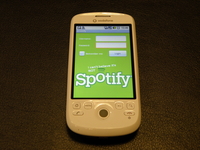
Droidify, the first Spotify application on the Android Market, has been pulled from the site.
According to Bobcat Zed, the designer of the program, he decided to pull the application in order to protect the arrangement Spotify has in place for its forthcoming app.
He revealed the decision on his official Twitter feed:
"Just talked to @gustavs of Spotify and we agreed on me removing #Droidify because it violates Spotify's arrangements with the music labels.
Consequences
"Otherwise consequences could be that the labels would start removing music from Spotify, something that would be a great loss to us all.
"So there will be no future updates to #Droidify. (Even though a bugfix for the login crash was in the pipeline.)"
The application was likely to be a similar incarnation to the official application on its way, with a premium account needed for streaming over 3G and Wi-Fi, although offline synchronisation wasn't allowed.
Still, we hope the official version is on its way in the near future, and perhaps on the iPhone as well!

| |
Read More ...
Review: Apple TV

In many ways, Apple's media-streaming solution, the Apple TV, was ahead of its time. Launched in 2007, it predated what has become a wave of AV-centric network products, designed to sit on your LAN and provide access to video and audio.
Being an Apple product, the unit is predictably sweet and minimalist, even if the spec isn't mouth-watering (256RAM, 40GB HDD). In practice, neither is an issue, as the bulk of your content won't be on the Apple device, but on a capacious hard drive somewhere else on your network.
In use the Apple TV is quiet and connectivity is good – choose from HDMI, component video, stereo audio and digital optical. You can take it online via Ethernet or wi-fi (I chose the former).

The interface is simple and intuitive. But unless you are a dedicated Mac evangelist, its appeal is severely limited. Apple TV syncs with your iTunes library and hooks up to the iTunes store, and can play mainstream audio formats.
However, its video file support is very limited. If your video collection contains DivX, XviD, WMV or MKV, you'll need to look elsewhere. There's also the much reported 4GB file limit and 5Mbps bitrate cap, so this is not a machine optimised for HD.

BASIC MENU: Apple simple main menu - with our additions (click here for high res version)
For a non-Apple user (like myself), the most fun the device offers is browsing Apple's movie trailers or looking at popular clips on YouTube. So should you pass it by?
Strangely enough, no. Because it's relatively easy to hack this streamer, giving it the kind of functionality Apple doesn't build into the box. A patch which installs XBMC (Xbox Media Centre) and an open-source multimedia software package called Boxee (created by some of the folks behind the XBMC project) will transform this unit into a must-have AV device. The good news is that hacking the Apple TV is not a difficult procedure, and is detailed on a variety of websites.
Essentially you need to download a Linux USB flash drive creator, called atvusb-creator (choose your OS flavour), and install it on a spare 1GB USB stick to create a bootable patchstick which re-flashes the Apple TV device.
For Windows users, creating this patchstick is actually more of a faff than flashing the Apple box. In a nutshell, this is the routine for Vista users: unzip your atvusb download and double-click on the mk.atv-xbmc-ssh Windows batch file. This runs automatically to give you the USB Image Tool. From this you can install a bootable image of the firmware patch onto the USB stick.
On the Apple TV itself, first check for any Apple updates, and install them. Then power down the Apple box, insert the patchstick, and power back up. The Apple TV will now boot from the USB. You'll know it's worked when you see a graphic of Tux, the Linux penguin, sitting on the Apple box.
The patch itself is installed in a matter of seconds. Once done, power down the Apple device and remove the USB. When you reboot, the Apple TV will start as usual, but the menu will sport two new items: XBMC and Boxee. Check for updates to both of these. Once done, you're good to go – Apple TV has a new lease of life.

MEDIA MARVEL:XBMC expands your media support significantly (click here for high res version)
The great thing about this hack is that it doesn't change any of the functionality of the Apple TV, so you haven't compromised any usability. You can still hang out at the iTunes store and sync with your iTunes library. And if you want, you can go select Factory Reset and reverse the entire procedure. But there's no good reason why you should…
XBMC on Apple TV looks just like it does on any other platform. It's a great interface to browse your music, video and photo collection. Simply Add Sources, to set up shares with storage devices and PCs on your network. Boxee looks altogether different. Unlike XBMC, there's an element of social networking involved in the Boxee proposition, in that you can take recommendations on software from friends and strangers alike.

INTERNET EXPANSION: Add IPTV streaming to your own media using Boxee (click here for high res version)
Naturally, you can also access your own networked multimedia files, but you can also browse other content providers. Some internet TV content, such as Hulu and the WB, is for US-eyes only, but there's plenty more good stuff that's not restricted: the hilarious Onion News Network, Revision 3 and so on.
Apple alchemy
If you already have an Apple TV, then I strongly urge you to add these two great applications for much needed extra functionality. With Boxee and XBMC installed, the Apple TV is comparable to our favourite media streaming devices, from Popcorn Hour A110 and HDX, both of which run the same Sybass middleware. So if you've never felt compelled to audition the Apple TV because of Apple's walled-garden approach, then it's well worth reconsidering.
Related Links
| |
Read More ...
TechRadar bargain hunt: tech deals of the week

We all want new tech and we want it at the best price. This is the mission of TechRadar's weekly bargain round-up - to save you time and save you cash.
Some of these deals run for the next week, while some expire today - so if you want to take advantage, be quick!
Here are our 10 recommended bargains for this week.
1. Yusmart 20.1-inch Widescreen TFT
آ£79.99 - www.bigpockets.co.uk
Adding some extra screen real estate is always a good thing, and bigpockets' price can't be beaten. It has a 1,680x1,050 resolution - the same as 22" monitors - for high-definition viewing.

Buy the Yusmart 20.1-inch Widescreen TFT
2. CoPilot Live 7
آ£54.99 - www.expansys.com (TODAY ONLY)
A smart investment: CoPilot Live 7 turns any Windows-based GPS smartphone into a fully fledged sat nav. It's of a better quality than a standalone unit at this price, and you've only got one device to worry about.

Read TechRadar's CoPilot Live 7 review
3. Samsung B2100 Xplore
آ£89.99 - www.expansys.com (TODAY ONLY)
It's not the most fully featured of phones, but the B2100 has one thing on its side: ruggedness. It's dust and water resistant, and certified to military standard. An ideal gift for a butter-fingered family member.

4. Samsung NC20
آ£359.98 - www.amazon.co.uk
We gave Samsung's NC20 netbook a glowing review thanks to its lovely screen and incredible battery life. Amazon are now stocking it at آ£360, which makes it an absolute steal.

Read TechRadar's Samsung NC20 review
5. Asus Xonar ST
آ£132.56 - www.scan.co.uk (UNTIL 1PM ONLY)
Getting quality sound out of your PC is often forgotten, but Asus' 7.1 card was awarded an astonishing score in our recent review. The only caveat was the price; Scan is now stocking it with آ£40 off.

Read TechRadar's Asus Xonar ST review
6. Nokia 5800 XpressMusic
آ£18/month - www.omio.com
Nokia's first touchscreen phone won our hearts when it was released. Virgin is now giving it away on an 18-month contract with 150 free minutes, but the major draw here is that it includes unlimited data. Facebook away!

Read the Nokia 5800 XpressMusic review
Buy the Nokia 5800 XpressMusic
7. Samsung Series 4 450
آ£329.99 - www.play.com
Usually costing آ£500, Samsung's LCD TV is a stunner, with a high contrast ratio and lovely panel. It's got built-in Freeview, so you don't have to worry about external boxes.

8. Panasonic Lumix FS6
آ£99.99 - www.play.com
Panasonic has packed a surprising array of features into this point 'n' click camera, including a rechargeable lithium-ion battery and high-quality Leica lens. Play has knocked آ£60 off the price, so it's worth snapping up.

9. HP ProBook 4515s
آ£388.99 - www.ebuyer.com
We gave this a rave review in its Intel flavour; this is the superior AMD version. Ebuyer and HP have a deal whereby you can send in your aging laptop and get even more money off.

Read TechRadar's HP ProBook 4515s review
10. 1TB Hitachi Deskstar
آ£54.35 - www.scan.co.uk (UNTIL 1PM ONLY)
A whopping one terabyte of storage for just over آ£50. Essential if you've got a large media collection and you're thinking about taking the plunge and upgrading to Windows 7.


| |
Read More ...
Weird Tech: Cosy up to Marilyn Monroe, as long as you're properly dead
If you have an extremely understanding wife or are just resigned to eventually dying alone, why not enjoy yourself resting for all eternity next to last-gen sex siren Marilyn Monroe?
A very hopeful eBayer is selling her husband's burial spot in the same crypt as Monroe, meaning the winning bidder gets to lie on top of the formerly curvaceous famous body - and there's nothing the screen siren can do to stop you.
The listing is up on eBay right now, with bidding currently at an astonishing $4.5m. The body of the grave's current occupant, Richard Poncher, will be shifted out so you can move your stuff in, but even then you won't have Marilyn all to yourself - dressing-gowned sex lizard Hugh Hefner has already bought the tomb next door to Monroe with an eye on enjoying a fiddle for all eternity.

SNAP IT UP: At least living women can make you a cup of tea every now and again
The above story got us thinking. Not about death or conspiracy theories or anything that dull, but about gadgets for dead people. Are there any?
Of course there are. Inventor Robert Barrows has been making people feel a bit ill on the internet with his Video Enhanced Gravemaker concept piece for quite some time.
His idea is that if you were particularly full of yourself in life you may now carry on braying about your achievements in video form from beyond the grave, via an embedded video screen in the tombstone itself. Your fans will also be able to record messages about how great you were, via the built-in camera.
Mr Barrows is seeking manufacturing partners to help fund his idea. We think there's a good chance he'll die of old age before that happens.

REST IN VIDEO: "Another funny thing that happened to me when I was alive was the time..."
If you suffer from the age-old fear of being buried alive, what you need to request from the very understanding man at the funeral parlour is a modern remake of the Safety Coffin. Numerous styles used to exist, all designed to let the buried person communicate with the outside world - usually by ringing a bell - should they wake up six feet underground as the victim of some terrible administrative mix-up.
You won't get a mobile signal down there, so it's your best bet. You should also take a book, as once your phone battery's dead it'll get very, very boring.

REST IN SAFETY: At least you don't have to pay council tax
And finally, if you're planning on stretching out your time on the planet for as long as possible, why not pick yourself up a Welch Allyn AED 10 Defibrillator Portable Quick Response Kit - your guarantee of many more productive hours spent staring emotionlessly at the internet before you go.

HEART BROKEN? Might also work as a home electroshock therapy kit to keep the kids off the Jaffa Cakes
The heart jump-starter's tech specs boast a "large internal memory" - although it doesn't say what media formats that screen will play back.

| |
Read More ...
Magazine to get full-motion video adverts

Magazine readers in the US are set to witness a little bit of magazine history this September, as Entertainment Weekly has announced it is to include full-motion video adverts within its pages.
The adverts are 2-inches by 1.5-inches (320x240) and are said to be only as thin as a piece of cardboard.
When the video is switched on, it will be capable of running for forty minutes before the battery dies. Don't fret, though, as the battery can be recharged via mini-USB. The 'electronic paper' technology has been developed by LA-firm Americhip.
Screen time
The adverts that are to be shown on the diminutive screen include promos for US sitcoms Two and a Half Men, How I Met Your Mother and The Big Bang Theory.
Speaking about the advert, George Schweitzer, President of CBS' marketing group, said: "As a rule, 90 per cent of people will say they heard about new programming on television.
"This is the first way we can get video samples into the hands of entertainment enthusiasts off the television screen."
While the technology does sound impressive and may well perk up the downtrodden US advertising market – experts reckon advertisers will pay six times more to be on the video – the new innovation has been given the unfortunate label of a 'maga-screen'.
Geddit? It's like a magazine but with a… never mind.

| |
Read More ...
PlayStation motion control: video demo

Sony is set to make more announcements about its 'PS3 Wand' motion controlling tech at next month's Tokyo Game Show, with this month's GamesCom event being dominated by news of the PS3 Slim, price-cuts of the old PlayStation model and games, games and more games.
However, there was a tantalising mention of the 'PS3 Wand' at Sony's media conference, with Sony releasing this latest PS3 motion control demo video that you can see right below this news.
Tokyo Game show teaser
The demo from GamesCom shows that the device can be swung around and used as a wand, a torch and even a hair brush. The mind actually boggles as to what games will make use of hair-brushing mechanics…
The Tokyo Game Show is on the 24 September, when we expect Sony to make its full, final reveal on its plans for motion control tech and games.

| |
Read More ...
Review: Harman Kardon BDP 10

Harman Kardon's debut Blu-ray player, the BDP 10, appears to tick most of the boxes required for consideration – it's a full Profile 2.0 machine with BD-Live, DivX playback and 1080p upscaling, all wrapped in a sassy case in keeping with the أ¼ber-cool HK house style.
The only fly in this otherwise sumptuous ointment is that, at the best part of آ£600, the BDP 10 is pricey in the face of the latest batch of Profile 2.0 machines to hit the shops.
Feature hole
What's more, you have to dig deep to find any features that justify the BDP 10's ticket. Yes, it offers onboard decoding for DTS-HD Master Audio and Dolby TrueHD, but only to 7.1-channel LPCM over HDMI rather than to analogue outputs.
There is little in the way of picture tweaking options, and even those good looks, which not so long ago would have appeared highly contemporary, seem a little bland compared with the cosmetic charms of the latest players from LG and Pioneer.
Hooked up, plugged in, and powered on, the BDP 10 suddenly makes a whole lot more sense. The Ethernet connection is self-configuring and had plucked the IP and Mac addresses from my router even before I had found my way into the network menu. The front end interface is easy to use, opening with the simple option to play from disc, USB, or go into the set-up menu.
Like most Profile 2.0 spinners you can play an assortment of media over a USB-connected storage device including WMA, MP3 and JPEGs. It's not rocket science these days, but the ease with which the BDP 10 offers access to folders and ID3 tags is impressive. Factor in the chunky back-lit remote control and the solid build quality and perhaps the BDP 10 is ready to play with the big boys residing in the prestige market.
Confirmation comes with a silky smooth picture and immersive sound. The thumping soundtrack to Slumdog Millionaire is crisper than a bag of Walkers. Using the player's own decoding to LPCM, the BDP 10 pushes the film's early chase scene through the slums with outstanding pace and gusto.
Ramp up the volume and you are treated to a three-dimensional vista of aural effects that does an outstanding job of putting you there between the shacks, stalls, and alleyways. I suspect most people willing to spend آ£600 on a Blu-ray player may already own a top-spec AV amp and prefer to do the decoding there – but you can't knock HK's own internal trickery.
The same scene is a little less visually impressive, falling well short of the stunning eye-candy of the leading models from Sony and Pioneer, but mixing it well with players from the middle of the market, like the Yamaha BD-S2900.
The picture is effortlessly smooth and scrolls like it's on well-oiled rails, but to my mind it's a fair bit softer than the razor sharpness of the upper-market players. Conversely, some might argue that the player does deliver a more natural picture that is easier on the eye. The trouble is, I kept finding myself searching for a sharpness control to tweak the edge definition, which the BDP 10 simply doesn't have.
Rainbow reality
Colour fidelity is on the natural side of vivid. After seeing several players in a row that were determined to redefine the rainbow with more hues, I found this rather pleasant. Rather than make Slumdog's Mumbai slums look overtly vibrant, the BDP 10 renders the whole location as an altogether more believable scene. From the black and white dog that raises a lazy eye as the brothers run past, to the multi-colour rubbish floating in the river, the picture is packed full of natural-looking components.
In a quick A/B comparison I am sure 9 out of 10 viewers will opt for a more vivid and artificial-seeming colour palate, but the BDP 10 has long-term appeal and I can't help think it probably gets closer to the look that director Danny Boyle intended.
However, switch to a film like Tarsem Singh's The Fall – a positive cornucopia of OTT colour and contrast – and the BDP 10 suffers; lacking the in-yer-face hues, contrast and black levels that make this film come alive like I know it can.
The desert island scene, for instance, is one of the most vivid and shockingly colourful sequences yet to grace a Blu-ray disc, and the Harman manages to make it look muted and shady.
Bringing up the rear
Ultimately, this Blu-ray market entrant arrives a little too late for its own good. The BDP 10 is a fine machine that, perhaps a year ago, would have earned praise for its performance.
But in today's more cutthroat and ever advancing Blu-ray player market, packed with goodies like LG's آ£200 BD370, the BDP 10 is going to have to fight to find an audience.
Related Links
| |
Read More ...
PS3 Slim gets much-improved audio

More tech details are slowly seeping out on the newly announced PS3 Slim from Sony, with the latest news being that the latest PlayStation 3 has much-improved audio features compared to the original PS3.
In addition to what we already learnt from Sony's media conference earlier in the week – which focused on the physical size of the unit, the increased 120GB hard drive capacity and other features such as the fact that the PS3 Slim supports BraviaLink – the latest tech news out of Japan indicates that the PS3 Slim will bitstream Dolby TrueHD and DTS-HD Master Audio direct to your receiver.
PS3 Slim trumps the 'Phat'
The HDMI chip on the PS3 'Phat' couldn't bitstream new high def codecs like Dolby TrueHD and DTS-HD MA, having to decode it internally and then sending the data to your receiver via LPCM.
Of course, you are only really going to notice the audio-improvements if you have a really good high-end surround sound set up.
TechRadar can only surmise that Sony didn't want to make too much of a big deal about the improved technical features on the PS3 Slim, in order to fully run down the remaining stocks of the 'Phats'.
and all the other big news from Sony's Gamescom conference
Related Links
| |
Read More ...
The 50 Gadgets that changed the world

We're currently undertaking a massive task: deciding which gadgets would make it in to a list of the most influential, life-altering, important gadgets of all time. It's a sizable challenge, and - whilst thankfully the debate hasn't yet come to blows – there seems to be a lot of differing opinions among our rank.
Who's more worthy of 'world-changing' credentials – the first mouse, or the iPod? The Asus Eee PC, or the Dyson? Frankly, they all are equally, as are hundreds of other tech champions that we're terrified of missing off our list of 50. As such, we're opening the floor to you.
If you've got an opinion about a specific gadget legend that truly deserves a spot among the rest of the best, all you need do is put it in the comments box below. We'll vigilantly scour every comment left, and incorporate your suggestions into the final list, which is set to be a true T3 Magazine spectacular.
Via T3.com

| |
Read More ...
Review: Sony Bravia KDL-46Z5500

Sony's KDL-46Z5500 Bravia LCD TV is exceptional. And brave. For starters, it doesn't have an LED backlight, which, for a two-grand telly, strikes me as rather courageous.
Instead, Sony has put its faith in CCFL. And while that is to the slight detriment of black levels (which are extremely good regardless, helped by a real world contrast ratio of over 60,000:1), it is a move that has seemingly allowed the boffins to concentrate on detail reproduction and colour saturation.
Both of these picture elements are extraordinary. The colourfield is natural and, just, right. There's also a solidity in static image representation that even Samsung's LED panels can't match. But it is with fine detail that the Z5500 really sings.
Blu-ray should be a natural bedfellow to a Sony TV, and in this instance, it is. The US Director's Cut edition of Watchmen is a dark experience (physically and tonally), but the screen picks out every minute speck of information from the shadows. If it didn't look too weird to do so, I could've applauded its video prowess openly in the office.

That's not to say there aren't caveats. I'm not overly enamoured by the design of the bezel. There's a silver strip that ranges along the bottom of the glass, which reflects ambient light – it's distracting.
Also, off-axis viewing relegates image-quality rapidly the further around, above or below you get. If your child is watching Thomas the Tank Engine while sat on the floor gazing up, he'd be hard-pushed to recognise the individual trains from the greyness of their livery.
There's also a minor issue with reds, which can look a little orangey. But I am being rather picky. None of these gripes are pronounced enough to spoil proceedings.
One-man show
The 46Z5500 is a multi-talented performer with both hi-def and standard-def content and that's all that matters. I'd actually go as far to say that it offers one of the best digital TV (Freeview) experiences I've actually seen on a TV above 37in this year. And, while not especially loud, the audio it creates is meaty enough.
When it comes down to it, for generic television viewing it's almost flawless. And, while I'm not really a fan of the weird artefacts that frame rate doubling (quadrupling, here) can often introduce to a movie, Sony's own proprietary, motion-smoothing 200Hz processor gives as natural an experience as can be.
Clearly, I'm a fan of this TV. It does the basics right. As with most screens these days, there are bells and whistles – such as AppliCast, Sony's web access features, and DLNA certification – but they're largely irrelevant. Instead, it's good, old-fashioned performance that's won me round. And it's certainly worthy of the Sony legend.
Related Links
| |
Read More ...
Panasonic makes Avatar marriage official

Panasonic has formally tied up with Twentieth Century Fox to cross-promote James Cameron's upcoming 3D SF movie Avatar.
On the eve of free teaser screenings of 15 minutes worth of material from the movie at selected UK cinemas, Panasonic's Masayuki Kozuka told the Associated Press: 'We want to get global interest rolling. For people to want to watch 3D at home, the movie has to be a blockbuster.'
Avatar, which is fast shaping up to be the most hyped big-screen event of the year, has its worldwide theatrical launch this December. The title has long been identified as the movie which will spearhead 3D on Blu-ray, when the format is officially launched in 2010.
The Japanese CE giant has been supplying hardware to Cameron and Fox throughout the film's production, and believes it's the best launch title the system could hope for.
The first 3D TVs from the brand are expected to be heavily promoted with visuals from the movie alongside endorsements from Cameron himself. 3D roadshows featuring 3D Blu-ray presentations around the movie's Blu-ray release are also planned.

| |
Read More ...
Review: Vivitek H9080FD

Vivitek is the first manufacturer to release a lamp-free home cinema projector in the guise of the H9080FD – a feat made possible with the adoption of Luminus Devices' PhlatLight technology – and it won't be the last.
The unit utilises a module containing different-coloured LEDs (R, G and B) housed on individual chips to provide the light source. The resulting beam is then fed through Texas Instruments' 1080p DMD chip to project images. Simple stuff really, but incredibly clever in practice.
It's a system that yields several benefits. Unlike traditional single-chip DLP projectors , there's no call for a colourwheel, so images do not suffer (however slight) with DLP's colour-fringing rainbow effect.
LEDs also have an incredibly lengthy half-life. It's claimed that the PhlatLight engine will still be going strong up to 20,000 hours from purchase. That's 18-20 years if you watch one film a night, every single night of the week. Impressive. In all likelihood, you'll never need to replace the light source during the life of the unit.
This makes LED tech particularly appealing for users in the corporate or educational markets. Compare that to the bulb in a JVC DLA-HD750, for example, which has a claimed 2,000 hour lamp life. By the same criteria, that'll last just under two years, and a replacement costs around آ£250. So, to get the same longevity, you'll need to spend around an extra آ£2,500 for a normal home cinema projector.
There is, however, a downside to this fledgling technology. Currently, LEDs are like the trendy kid in class; they're popular, colourful, but none too bright. And so, this projector does have a Lumens deficiency compared to its rivals. In fact, in normal ambience (room lights switched on, for instance) you can't really see anything from ten feet away.
The H9080FD is not a projector for anything less than a fully light-controlled room, and, unless you're happy to watch EastEnders in a blacked-out environment, it's not particularly designed for casual use. Nope, this is a good, old-fashioned, honest-to-garden home cinema projector and, in that sense, it is more than fit for purpose.

FORWARD THINKING: The labels on the H9080FD's connections are actually upside-down, so you can read them when it's ceiling-mounted (click here for high-res version)
Also hidden within its chunky build is the same Gennum 9450 video processor found in the Planar PD8150. One of the more interesting features of this chipset is the option to manually change the refresh rate – seemingly without adding unnecessary artefacts. To be honest, you'll probably never stray far from the 'Auto' frame rate mode, which matches the incoming signal, but tweakers and purists will be glad of its inclusion.
More important though, is this specific processor's scaling and de-interlacing prowess. It does such a good job with upscaling standard-definition video that I advise you turn off any equivalent processing in the source.
It doesn't make SD content look as good as HD images – that's a fallacy perpetuated by Looney Toons – but it holds up very nicely indeed, even when blown up above 100 inches. Edge enhancement succeeds in this instance where it often fails in others, and the pictures retain a filmic quality even with noise reduction switched on.
High-definition video is staggeringly detailed on the H9080FD, and 24 frame footage moves like a female ice dancer. Indeed, I would argue that the pictures are worse at 90 per cent of cinema multiplexes. There's also proof positive that an LED lighting system enhances colour saturation, especially when combined with TI's DLP Brilliant Color system. The reds are simply breathtaking, even on the picture presets. Of course, you can also calibrate to your heart's desire with an exhaustive set of tools.
I'm less enamoured by the contrast level, which is mainly dampened by the lack of true brightness. That said, black levels are good and the dynamic iris does a fair job without being too overt – it's neither too loud nor too crazy in its lightening and darkening of scenes, so you'll probably opt to keep it on.
My other quibble concerns the LED driver. Although the model makes a virtue of the whisper-quiet fans it utilises, there was still a faint buzzing sound on our review sample. This changes in pitch during certain sequences as the driver needs to increase the voltage depending on the brightness required. It transpires that this is an inherent issue with the technology itself and is not unique to this specific projector. And Vivitek has greatly lessened the effect by adding acoustic foam internally.
Tech trendsetter
So neither of its flaws are insurmountable, and its many unique properties make the H9080FD an interesting proposition. Unfortunately though, many may be put off by the cost to even give it an audition. As with any new-fangled technological breakthrough, there's a premium attached, and ten grand may seem too much, regardless of its tasty light engine and superb longevity. It's hard to argue otherwise too, especially considering most rivals are roughly half the price. However, there's something exclusive about being a trendsetter.
Related Links
| |
Read More ...
Twitter all set to roll out premium accounts

Twitter will roll out commercial accounts this year in an attempt to make money out of the phenomenally popular micro-blogging site.
Biz Stone – co-founder of Twitter – has confirmed that the company is already taking its long mooted foray into commercial accounts – allowing businesses to get superior exposure for premium services.
"Twitter will still be free for everybody and we'll still tell them to go crazy with it," Stone told Venture Beat.
"But we've identified a selection of things that businesses say are helping them to make more profit."
Stats and analytics
Some of these additional services will come in the form of improved tools and analysis, with Stone stating: "We want to build statistics or analytics that let users know — 'How am I doing on Twitter?'"
Interestingly, the company has made enough from venture capitalists to consider buying up rival companies – following the news that rival FriendFeed was snapped up by Facebook.
"We're at a point where even though we're only two years old, acquisitions are definitely possible," Stone said.

| |
Read More ...


No comments:
Post a Comment