

New Archos9 Windows 7 PCTablet launches
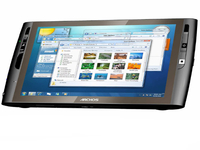
Archos has announced its new Archos 9 PCTablet is now on sale, bringing widescreen touch technology to the new Windows 7 OS.
The new device will cost آ£449.99, and will be sold in the UK through PC resellers and Archos' own website.
It might look like an overgrown internet media tablet, but it has all the necessary ports you'd expect on a tablet PC, with a VGA-out socket to connect to a monitor and multiple USB ports and audio jacks to extend your use.
Slim 'n' light
And as our hands on with the new device showed, it certainly is thin at less than 1.7cm thick and just 800g.
It's also got a very slick touchscreen, despite being resistive, although touch typing on the large 9-inch screen can be a little tricky if you're holding it in your hands.
It sadly only packs 60GB of HDD space, with another 25GB online, and users get آ£80 worth of credit to download films from the Archos Media Club.
It might not be a traditional Archos device or rival the likes of the netbooks, but if you want a PC that will entice fellow commuters to peer at your new gadget, you should probably give the Archos 9 PCTablet a look.

 |  |
Read More ...
Nokia sues Apple over iPhone infringement

Nokia has filed a complaint against Apple for an alleged infringement of multiple patents for technology used in the iPhone.
Nokia has a large patent portfolio relating to a huge number of technology types used in mobile phones, with many of these licensed by the major handset manufacturers.
But the Finns are alleging that Apple has unlawfully used technology relating to GSM, UMTS and WLAN technology (2G, 3G and Wi-Fi connections) on mobile phones, previously developed and patented by Nokia.
The patent infringement case covers all iPhone models developed by Apple, and if successful could lead to a huge fine for Jobs' firm for stealing vital technology.
Apple's free ride
"Nokia has created one of the strongest and broadest patent portfolios in the industry, investing more than EUR 40 billion in R&D during the last two decades," said the company in a statement.
"The ten patents in suit relate to technologies fundamental to making devices which are compatible with one or more of the GSM, UMTS and wireless LAN standards. The patents cover wireless data, speech coding, security and encryption and are infringed by all Apple iPhone models shipped since the iPhone was introduced in 2007.
"The basic principle in the mobile industry is that those companies who contribute in technology development to establish standards create intellectual property, which others then need to compensate for.
"Apple is also expected to follow this principle. By refusing to agree appropriate terms for Nokia's intellectual property, Apple is attempting to get a free ride on the back of Nokia's innovation."
The case is being heard in the Federal District Court in Delaware, and will likely take a number of months, if not years, to resolve if other big-name suits are anything to go by.

| |
Read More ...
Fingers-on: Apple Magic Mouse review

TechRadar has had a good play around with Apple's latest peripheral today – the multitouch Magic Mouse - read on for our initial thoughts on the latest in computer input tech from Cupertino's product designers.
The initial response on seeing the new (wireless Bluetooth) Magic Mouse is how sleek and sexy it looks (in as much as you can describe a computer mouse as 'sexy').
If you're an Apple user, even before you've picked it up and played with it, you already want one, because you will like the look of it on your desk.
And you will like the fact that others will like the look of it on your desk. It will be a conversation piece.

Apple's chief design guru Jonathan Ives knows the value of cool accessorising, after all. And the company's marketing messages have always stressed the equal importance of looks and product design alongside ease-of-use intuitive functionality and cutting-edge tech.
This is why people shell out (often obscene) amounts of money on Apple's computers and gadgets and peripherals. It's why PC fanboys work themselves up into a frenzy of barely-contained anger when presented with new kit from Apple ("it cost HOW much!?").
And it is also why the Apple Store on Regent Street has the highest footfall of any store in the UK. Go. Figure.

And here we are again, talking to Apple's PR reps and product marketing execs who genuinely are excited about their new products. We know this, because they tell us how excited they are around thirty times over the course of a half hour presentation. Roughly around once a minute.
But are we excited? Can we drum up excitement over a computer mouse?
The Apple Magic Weapon
The second thought when you pick the Magic Mouse up and hold it in your hand is that this is a surprisingly weighty and solid bit of kit. You could do some serious damage if you used Apple's new peripheral as a weapon to smash somebody in the face. Best if you don't though, as it may void the warranty.

The aluminium base (with two plastic rails) and translucent plastic top seem to all have been put together very well. The build quality is pretty much faultless and the mouse looks like it could survive being dropped from quite a height. Though we didn't get chance to test that out at Apple's HQ today!
Once you've coo-ed over (or sneered about) the look and feel of the thing, you scoot it around the desk and it feels pretty damn good. It's nicely weighted and the hidden two left and right buttons click audibly when pressed. In short, it works perfectly well as a nice-looking wireless mouse. And there are no side-buttons or scroll-wheels or any other extraneous gubbins to get in the way of the main function of the mouse – which is using your hand to direct a cursor on the screen in front of you.
Touch me, feel me, please me
Now to the fun bit.
The Magic Mouse's multitouch support rocks. You can swipe your index finger across the mouse to scroll a document or webpage or photo left, right, up or down. And while some might prefer the tactility of the traditional scroll-wheel on their current mouse, we have to admit to being immediately enthralled by this simple new design.

Less enthralling was the two-finger swiping moves – which can be used in iPhoto, for example, to move horizontally between photos. It worked, but it just didn't work as well as the single-finger scrolling. And it felt far less intuitive. However, saying this, after an hour or two of using the mouse, perhaps the two finger swipe will become second nature. We hope so.

And then a minor disappointment when we tried to 'pinch zoom' with the Magic Mouse, much like we do on the iPhone. And we were immediately disappointed to discover that the feature was not supported by the multitouch, because of the curvature of the device. Which sounds a little bit of a lame reason to not build it into the thing, frankly. We can only hope.
Instead of zooming through a pincher movement with your thumb and finger, you need to hold down the Control key on your keyboard while scrolling up and down with a finger on the mouse. Less intuitive than the former movement, but again, something we might get used to after a few hours of use.

Apple's Mighty Mouse will work with any Mac running OS X version 10.5.8 or later, providing you have the latest Wireless Mouse Software update 1.0. installed. An Apple rep informed TechRadar that some of the 'basic functions' will be compatible with Windows PCs but didn't go into any further detail on what these were.
Full review very soon. Once we've spent a few more hours getting our paws all over Apple's new Magic Mouse. For now you can drool over the pics of the Magic Mouse here. Or laugh at them. Depending, of course, on your own personal levels of fanboy-itis.

| |
Read More ...
BBC plans new web-based Eastenders spin-off series

Eastenders is moving online, with the BBC planning a web-based spin-off series in early 2010 called Eastenders: E20
The new spin-off will be written by younger writers aged between 17 and 22 – Skins-style – based around four new teenage characters on Albert Square.
Eastenders: E20 is being written by a team of 13 new London writers and is scheduled to launch online in January 2010, in the run-up to the 25th anniversary of the soap.
Teens in trouble
The casting for the four new teenage characters is still to be finalised. Each of the new characters will be arriving in Albert Square trying to escape their pasts.
BBC reps have said that the show will work as a stand-alone programme that can be watched by viewers that might not normally keep up with the general ongoing, never-ending misery of the TV soap.
The Beeb is also promising "crossover treats" for Eastenders fans.
EastEnders exec producer Diederick Santer said: "These talented writers are creating a whole new Walford, infused with their own experiences of London life.
"A fresh perspective on a British classic, Eastenders: E20 will - I hope - delight new audiences and EastEnders diehards alike."
For more on Eastenders head over to www.bbc.co.uk/eastenders/

| |
Read More ...
Spotify offering subscribers آ£5 premium accounts

Spotify has apparently begun offering existing subscribers a cheaper deal for their premium accounts in association with Swiftcover.com.
Music Ally broke news of the discount, with the monthly price bring dropped to آ£8.99 (for a limited time) to strip the music of ads.
The reason for the loss is simply "thanks to our good friends at Swiftcover", meaning the insurance firm is looking to extend its tie in with Spotify beyond simply being an advert on the free service.
Cheaper then cheaper still
But Pocket-lint is stating users are being offered subscriptions of آ£4.99 per month, with no reason being given for the disparity.
The lower price would mimic other similar services being offered, such as Vodafone's Music Unlimited, although whether Spotify could lose half the revenue from subscribers this early in its life remains to be seen.
The news follows 3's offering of a two year Spotify deal as part of a contract, essentially giving the premium account for آ£100 as part of the deal.
We'll try and find out how long these deals will be continuing for, but those of you lucky enough to get a cut price Spotify code will at least be able to enjoy cut price tunes for the foreseeable future.

| |
Read More ...
Windows 7 Week: 62 Windows 7 tips, tricks and secrets
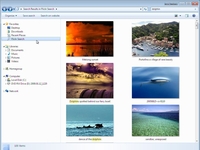
Windows 7 is out and if you've either installed it or bought a new PC running Windows 7, then we're here to help you get the most from it.
Look beyond the headlines about interface tweaks and you'll find Windows 7 is crammed with lesser known, but still important, new and enhanced features, which taken together deliver improved performance and productivity, better troubleshooting, stronger security and a whole lot more.
To celebrate the launch of Windows 7, we've updated our Windows 7 tips with a bunch of new ones. Read on for 62 ways in which Windows 7 will make a real difference to your PC.
1. Problem Steps Recorder
As the local PC guru you're probably very used to friends and family asking for help with their computer problems, yet having no idea how to clearly describe what's going on. It's frustrating, but Microsoft feels your pain, and Windows 7 will include an excellent new solution in the Problem Steps Recorder.
When any app starts misbehaving under Windows 7 then all your friends need do is click Start, type PSR and press Enter, then click Start Record. If they then work through whatever they're doing then the Problem Steps Recorder will record every click and keypress, take screen grabs, and package everything up into a single zipped MHTML file when they're finished, ready for emailing to you. It's quick, easy and effective, and will save you hours of troubleshooting time.
2. Burn images
Windows 7 finally introduces a feature that other operating systems have had for years - the ability to burn ISO images to CDs or DVDs. And it couldn't be much easier to use. Just double-click the ISO image, choose the drive with the blank disc, click Burn and watch as your disc is created.
3. Create and mount VHD files
Microsoft's Virtual PC creates its virtual machine hard drives in VHD files, and Windows 7 can now mount these directly so you can access them in the host system. Click Start, type diskmgmt.msc and press Enter, then click Action > Attach VHD and choose the file you'd like to mount. It will then appear as a virtual drive in Explorer and can be accessed, copied or written just like any other drive.
Click Action > Create VHD and you can now create a new virtual drive of your own (right-click it, select Initialise Disk, and after it's set up right-click the unallocated space and select New Simple Volume to set this up). Again, you'll be left with a virtual drive that behaves just like any other, where you can drag and drop files, install programs, test partitioning software or do whatever you like. But it's actually just this VHD file on your real hard drive which you can easily back up or share with others. Right-click the disk (that's the left-hand label that says "Disk 2" or whatever) and select Detach VHD to remove it.
The command line DISKPART utility has also been upgraded with tools to detach a VHD file, and an EXPAND command to increase a virtual disk's maximum size. Don't play around with this unless you know what you're doing, though - it's all too easy to trash your system.
4. Troubleshoot problems
If some part of Windows 7 is behaving strangely, and you don't know why, then click Control Panel > Find and fix problems (or 'Troubleshooting') to access the new troubleshooting packs. These are simple wizards that will resolve common problems, check your settings, clean up your system and more.
5. Startup repair
If you've downloaded Windows 7 (and even if you haven't) it's a good idea to create a system repair disc straight away in case you run into problems booting the OS later on. Click Start > Maintenance > Create a System Repair Disc, and let Windows 7 build a bootable emergency disc. If the worst does happen then it could be the only way to get your PC running again.
6. Take control
Tired of the kids installing dubious software or running applications you'd rather they left alone? AppLocker is a new Windows 7 feature that ensures users can only run the programs you specify. Don't worry, that's easier to set up than it sounds: you can create a rule to allow everything signed by a particular publisher, so choose Microsoft, say, and that one rule will let you run all signed Microsoft applications. Launch GPEDIT.MSC and go to Computer Configuration > Windows Settings > Security Settings > Application Control Policies > AppLocker to get a feel for how this works.
7. Calculate more
At first glance the Windows 7 calculator looks just like Vista's version, but explore the Mode menu and you'll see powerful new Statistics and Programmer views. And if you're clueless about bitwise manipulation, then try the Options menu instead. This offers many different unit conversions (length, weight, volume and more), date calculations (how many days between two dates?), and spreadsheet-type templates to help you calculate vehicle mileage, mortgage rates and more.
Don't take any Windows 7 applet at face value, then - there are some very powerful new features hidden in the background. Be sure to explore every option in all Windows applets to ensure you don't miss anything important.

CALCULATE MORE: The new Calculator is packed with useful features and functionality
8. Switch to a projector
Windows 7 now provides a standard way to switch your display from one monitor to another, or a projector - just press Win+P or run DisplaySwitch.exe and choose your preferred display. (This will have no effect if you've only one display connected.)
9. Get a power efficiency report
If you have a laptop, you can use the efficiency calculator to get Windows 7 to generate loads of useful information about its power consumption. Used in the right way, this can help you make huge gains in terms of battery life and performance. To do this you must open a command prompt as an administrator by typing 'cmd' in Start Search, and when the cmd icon appears, right-click it and choose Run as administrator.
Then at the command line, just type in 'powercfg -energy' (without quotes) and hit Return, and Windows 7 will scan your system looking for ways to improve power efficiency. It will then publish the results in an HTML file, usually in the System32 folder. Just follow the path it gives you to find your report.
10. Understanding System Restore
Using System Restore in previous versions of Windows has been something of a gamble. There's no way of telling which applications or drivers it might affect - you just have to try it and see.
Windows 7 is different. Right-click Computer, select Properties > System Protection > System Restore > Next, and choose the restore point you'd like to use. Click the new button to 'Scan for affected programs' and Windows will tell you which (if any) programs and drivers will be deleted or recovered by selecting this restore point.
11. Set the time zone
System administrators will appreciate the new command line tzutil.exe utility, which lets you set a PC's time zone from scripts. If you wanted to set a PC to Greenwich Mean Time, for instance, you'd use the command
tzutil /s "gmt standard time"
The command "tzutil /g" displays the current time zone, "tzutil /l" lists all possible time zones, and "tzutil /?" displays details on how the command works.
12. Calibrate your screen
The colours you see on your screen will vary depending on your monitor, graphics cards settings, lighting and more, yet most people use the same default Windows colour profile. And that means a digital photo you think looks perfect might appear very poor to everybody else. Fortunately Windows 7 now provides a Display Colour Calibration Wizard that helps you properly set up your brightness, contrast and colour settings, and a ClearType tuner to ensure text is crisp and sharp. Click Start, type DCCW and press Enter to give it a try.
13. Clean up Live Essentials
Installing Windows Live Essentials will get you the new versions of Mail, Movie Maker, Photo Gallery and others - great. Unfortunately it also includes other components that may be unnecessary, but if you like to keep a clean system then these can be quickly removed.
If you left the default "Set your search provider" option selected during installation, for instance, Windows Live will install Choice Guard, a tool to set your browser home page and search engine, and prevent other programs from changing them. If this causes problems later, or you just decide you don't need it, then Choice Guard may be removed by clicking Start, typing msiexec /x {F0E12BBA-AD66-4022-A453-A1C8A0C4D570} and pressing [Enter].
Windows Live Essentials also adds an ActiveX Control to help upload your files to Windows Live SkyDrive, as well as the Windows Live Sign-in Assistant, which makes it easier to manage and switch between multiple Windows Live accounts. If you're sure you'll never need either then remove them with the Control Panel "Uninstall a Program" applet.
14. Add network support
By default Windows Live MovieMaker won't let you import files over a network, but a quick Registry tweak will change this. Run REGEDIT, browse to HKEY_CURRENT_USER\Software\Microsoft\Windows Live\Movie Maker, add a DWORD value called AllowNetworkFiles and set it to 1 to add network support.
15. Activate XP mode
If you've old but important software that no longer runs under Windows 7, then you could try using XP Mode, a virtual copy of XP that runs in a window on your Windows 7 desktop. But there's a big potential problem, as XP Mode only works with systems that have hardware virtualisation (AMD-V or Intel VT) built-in and turned on. If you've a compatible CPU then this may just be a matter of enabling the option in your BIOS set-up program, however some high profile brands, including Sony Vaio, disable the setting for "security reasons". And that blocks XP Mode from working, too.
One solution has emerged, but it's a little risky, as essentially you'll have to alter a byte in your laptop firmware and hope this doesn't have any unexpected side-effects. Gulp. If you're feeling brave then take a look at the Feature Enable Blog for the details, but don't blame us if it goes wrong.
A safer approach might be to use VirtualBox, a virtualisation tool that doesn't insist on hardware support, but then you will need to find a licensed copy of XP (or whatever other Windows version your software requires) for its virtual machine.
16. Right-click everything
At first glance Windows 7 bears a striking resemblance to Vista, but there's an easy way to begin spotting the differences - just right-click things.
Right-click an empty part of the desktop, for instance, and you'll find a menu entry to set your screen resolution. No need to go browsing through the display settings any more.
Right-click the Explorer icon on the taskbar for speedy access to common system folders: Documents, Pictures, the Windows folder, and more.
And if you don't plan on using Internet Explorer then you probably won't want its icon permanently displayed on the taskbar. Right-click the icon, select 'Unpin this program from the taskbar', then go install Firefox, instead.
17. Desktop slideshow
Windows 7 comes with some very attractive new wallpapers, and it's not always easy to decide which one you like the best. So why not let choose a few, and let Windows display them all in a desktop slideshow? Right-click an empty part of the desktop, select Personalise > Desktop Background, then hold down Ctrl as you click on the images you like. Choose how often you'd like the images to be changed (anything from daily to once every 10 seconds), select Shuffle if you'd like the backgrounds to appear in a random order, then click Save Changes and enjoy the show.

DESKTOP SLIDESHOW: Select multiple background images and Windows will cycle through them
18. RSS-powered wallpaper
And if a slideshow based on your standard wallpaper isn't enough, then you can always create a theme that extracts images from an RSS feed. For example, Long Zheng has created a few sample themes to illustrate how it works. Jamie Thompson takes this even further, with a theme that always displays the latest BBC news and weather on your desktop. And MakeUseOf have a quick and easy tutorial showing how RSS can get you those gorgeous Bing photographs as your wallpaper.
19. Customise the log-on screen
Changing the Windows log-on screen used to involve some complicated and potentially dangerous hacks, but not any more - Windows 7 makes it easy.
First, browse to HKEY_LOCAL_MACHINE\Software\Microsoft\Windows\CurrentVersion\Authentication\LogonUI\Background in REGEDIT, double-click the DWORD key called OEMBackground (not there? Create it) and set its value to 1.
Now find a background image you'd like to use. Make sure it's less than 256KB in size, and matches the aspect ratio of your screen as it'll be stretched to fit.
Next, copy that image into the %windir%\system32\oobe\info\backgrounds folder (create the info\backgrounds folders if they don't exist). Rename the image to backgroundDefault.jpg, reboot, and you should now have a custom log-on image.
Alternatively, use a free tweaking tool to handle everything for you. Logon Changer displays a preview so you can see how the log-on screen will look without rebooting, while the Logon Screen Rotator accepts multiple images and will display a different one every time you log on.
20. Recover screen space
The new Windows 7 taskbar acts as one big quick launch toolbar that can hold whatever program shortcuts you like (just right-click one and select Pin To Taskbar). And that's fine, except it does consume a little more screen real estate than we'd like. Shrink it to a more manageable size by right-clicking the Start orb, then Properties > Taskbar > Use small icons > OK.
21. Enjoy a retro taskbar
Windows 7 now combines taskbar buttons in a way that saves space, but also makes it more difficult to tell at a glance whether an icon represents a running application or a shortcut. If you prefer a more traditional approach, then right-click the taskbar, select Properties, and set Taskbar Buttons to "Combine when taskbar is full". You'll now get a clear and separate button for each running application, making them much easier to identify.
22. Remove taskbar buttons
One problem with the previous tip is the buttons will gobble up valuable taskbar real estate, but you can reduce the impact of this by removing their text captions. Launch REGEDIT, browse to HKEY_CURRENT_USER\Control Panel\Desktop\WindowMetrics, add a string called MinWidth, set it to 54, and reboot to see the results.
23. Restore the Quick Launch Toolbar
If you're unhappy with the new taskbar, even after shrinking it, then it only takes a moment to restore the old Quick Launch Toolbar.
Right-click the taskbar, choose Toolbars > New Toolbar, type "%UserProfile%\AppData\Roaming\Microsoft\Internet Explorer\Quick Launch" (less the quotes) into the Folder box and click Select Folder.
Now right-click the taskbar, clear 'Lock the taskbar', and you should see the Quick Launch toolbar, probably to the right. Right-click its divider, clear Show Text and Show Title to minimise the space it takes up. Complete the job by right-clicking the bar and selecting View > Small Icons for the true retro look.
24. Custom power switch
By default, Windows 7 displays a plain text 'Shut down' button on the Start menu, but it only takes a moment to change this action to something else. If you reboot your PC a few times every day then that might make more sense as a default action: right-click the Start orb, select Properties and set the 'Power boot action' to 'Restart' to make it happen.
25. Auto arrange your desktop
If your Windows 7 desktop has icons scattered everywhere then you could right-click it and select View > Auto arrange, just as in Vista. But a simpler solution is just to press and hold down F5, and Windows will automatically arrange its icons for you.
26. Disable smart window arrangement
Windows 7 features interesting new ways to intelligently arrange your windows, so that (for example) if you drag a window to the top of the screen then it will maximise. We like the new system, but if you find it distracting then it's easily disabled. Run REGEDIT, go to HKEY_CURRENT_USER\Control Panel\Desktop, set WindowArrangementActive to 0, reboot, and your windows will behave just as they always did.
27. Browse your tasks
If you prefer the keyboard over the mouse, you will love browsing the taskbar using this nifty shortcut. Press Windows and T, and you move the focus to the left-most icon on the taskbar. Then use your arrow keys to change the focus to other icons, and you get a live preview of every window.
28. Display your drives
Click Computer in Windows 7 and you might see a strange lack of drives, but don't panic, it's just Microsoft trying to be helpful: drives like memory card readers are no longer displayed if they're empty. We think it's an improvement, but if you disagree then it's easy to get your empty drives back. Launch Explorer, click Tools > Folder Options > View and clear 'Hide empty drives in the computer folder'.
29. See more detail
The new and improved Windows 7 magnifier offers a much easier way to zoom in on any area of the screen. Launch it and you can now define a scale factor and docking position, and once activated it can track your keyboard focus around the screen. Press Tab as you move around a dialog box, say, and it'll automatically zoom in on the currently active control.
30. Hiding the Windows Live Messenger icon
If you use Windows Live Messenger a lot, you'll have noticed that the icon now resides on the taskbar, where you can easily change status and quickly send an IM to someone. If you prefer to keep Windows Live Messenger in the system tray, where it's been for previous releases, just close Windows Live Messenger, edit the shortcut properties and set the application to run in Windows Vista compatibility mode.
31. Customise UAC
Windows Vista's User Account Control was a good idea in practice, but poor implementation put many people off - it raised far too many alerts. Fortunately Windows 7 displays less warnings by default, and lets you further fine-tune UAC to suit your preferred balance between security and a pop-up free life (Start > Control Panel > Change User Account Control Settings).
32. Use Sticky Notes
The Sticky Notes app is both simpler and more useful in Windows 7. Launch StikyNot.exe and you can type notes at the keyboard; right-click a note to change its colour; click the + sign on the note title bar to add another note; and click a note and press Alt + 4 to close the note windows (your notes are automatically saved).
33. Open folder in new process
By default Windows 7 opens folders in the same process. This saves system resources, but means one folder crash can bring down the entire shell. If your system seems unstable, or you're doing something in Explorer that regularly seems to causes crashes, then open Computer, hold down Shift, right-click on your drive and select Open in New Process. The folder will now be launched in a separate process, and so a crash is less likely to affect anything else.
34. Watch more videos
Windows Media Player 12 is a powerful program, but it still won't play all the audio and video files you'll find online. Fortunately the first freeware Windows 7 codecs package [shark007.net/win7codecs.html] has been released, and installing it could get your troublesome multimedia files playing again.
35. Preview fonts
Open the Fonts window in Windows XP and Vista and you'll see the font names, probably with icons to tell you whether they're TrueType or OpenType, but that's about it. Windows 7 sees some useful font-related improvements.
Open the new fonts window and you'll find a little preview for every font, giving you a quick idea of how they're going to look.
The tedium of scrolling through multiple entries for each family, like Times New Roman, Times New Roman Bold, Times New Roman Bold Italic and so on, has finally ended. There's now just a single entry for each font (though you can still see all other members of the family).
And there's a new OpenType font, Gabriola, added to the mix. It's an attractive script font, well worth a try the next time you need a stylish document that stands out from the crowd.
36. Restore your gadgets
Windows 7 has tightened up its security by refusing to run gadgets if UAC has been turned off, so limiting the damage malicious unsigned gadgets can do to your system. If you've disabled UAC, miss your gadgets and are happy to accept the security risk, though, there's an easy Registry way to get everything back to normal. Run REGEDIT, go to HKEY_LOCAL_MACHINE\SOFTWARE\Microsoft\Windows\CurrentVersion\Sidebar\Settings, create a new DWORD value called AllowElevatedProcess and set it to 1. Your gadgets should start working again right away.
37. New WordPad formats
By default WordPad will save documents in Rich Text Format, just as before. But browse the Save As Format list and you'll see you can also save (or open, actually) files in the Office 2007 .docx or OpenDocument .odt formats.
38. Protect your data
USB flash drives are convenient, portable, and very easy to lose. Which is a problem, especially if they're carrying sensitive data. Fortunately Windows 7 has the solution: encrypt your documents with an extension of Microsoft's BitLocker technology, and only someone with the password will be able to access it. Right-click your USB flash drive, select Turn on BitLocker and follow the instructions to protect your private files.

PROTECT YOUR DATA: Your USB flash drives can easily be encrypted with BitLocker
39. Minimise quickly with shake
If you have multiple windows open on your desktop and things are getting too cluttered, it used to be a time-consuming process to close them all down. In Windows 7 you can use the Aero Shake feature to minimise everything in seconds, using a cool mouse gesture. Grab the title bar of the window you wish to keep open and give it a shake, and rejoice in a clear desktop area.
40. Configure your favourite music
The Windows 7 Media Centre now comes with an option to play your favourite music, which by default creates a changing list of songs based on your ratings, how often you play them, and when they were added (it's assumed you'll prefer songs you've added in the last 30 days). If this doesn't work then you can tweak how Media Centre decides what a "favourite" tune is- click Tasks > Settings > Music > Favourite Music and configure the program to suit your needs.
41. Customise System Restore
There was very little you could do to configure System Restore in Vista, but Windows 7 improves the situation with a couple of useful setup options.
Click the Start orb, right-click Computer and select Properties > System Protection > Configure, and set the Max Usage value to a size that suits your needs (larger to hold more restore points, smaller to save disk space).
And if you don't need System Restore to save Windows settings then choose the "Only restore previous versions of files" option. Windows 7 won't back up your Registry, which means you'll squeeze more restore points and file backups into the available disk space. System Restore is much less likely to get an unbootable PC working again, though, so use this trick at your own risk.
42. Run As
Hold down Shift, right-click any program shortcut, and you'll see an option to run the program as a different user, handy if you're logged in to the kids' limited account and need to run something with higher privileges. This isn't really a new feature - Windows XP had a Run As option that did the same thing - but Microsoft stripped it out of Vista, so it's good to see it's had a change of heart.
43. Search privacy
By default Windows 7 will remember your PC search queries, and display the most recent examples when searching in Windows Explorer. If you're sharing a PC and don't want everyone to see your searches, then launch GPEDIT.MSC, go to User Configuration > Administrative Templates > Windows Components > Windows Explorer, double-click "Turn off display of recent search entries..." and click Enabled > OK.
44. Tweak PC volume
By default Windows 7 will now automatically reduce the volume of your PC's sounds whenever it detects you're making or receiving PC-based phone calls. If this proves annoying (or maybe you'd like it to turn off other sounds altogether) then you can easily change the settings accordingly. Just right-click the speaker icon in your taskbar, select Sounds > Communications, and tell Windows what you'd like it to do.
45. Rearrange the system tray
With Windows 7 we finally see system tray icons behave in a similar way to everything else on the taskbar. So if you want to rearrange them, then go right ahead, just drag and drop them into the order you like. You can even move important icons outside of the tray, drop them onto the desktop, then put them back when you no longer need to keep an eye on them.
46. Extend your battery life
Windows 7 includes new power options that will help to improve your notebook's battery life. To see them, click Start, type Power Options and click the Power Options link, then click Change Plan Settings for your current plan and select Change Advanced Settings. Expand Multimedia Settings, for instance, and you'll see a new "playing video" setting that can be set to optimise power savings rather than performance. Browse through the other settings and ensure they're set up to suit your needs.
47. Write crash dump files
Windows 7 won't create memory.dmp crash files if you've less than 25GB of free hard drive space, annoying if you've installed the Windows debugging tools and want to diagnose your crashes. You can turn this feature off, though: browse to HKEY_LOCAL_MACHINE\SYSTEM\CurrentControlSet\Control\CrashControl, create a new DWORD value called AlwaysKeepMemoryDump, set it to 1, and the crash dump file will now always be saved.
48. Find bottlenecks
From what we've seen so far Windows 7 is already performing better than Vista, but if your PC seems sluggish then it's now much easier to uncover the bottleneck. Click Start, type RESMON and press Enter to launch the Resource Monitor, then click the CPU, Memory, Disk or Network tabs. Windows 7 will immediately show which processes are hogging the most system resources.
The CPU view is particularly useful, and provides something like a more powerful version of Task Manager. If a program has locked up, for example, then right-click its name in the list and select Analyze Process. Windows will then try to tell you why it's hanging - the program might be waiting for another process, perhaps - which could give you the information you need to fix the problem.

FIND BOTTLENECKS: Resource monitor keeps a careful eye on exactly how your PC is being used
49. Keyboard shortcuts
Windows 7 supports several useful new keyboard shortcuts.
Alt+P
Display/ hide the Explorer preview pane
Windows Logo+G
Display gadgets in front of other windows
Windows Logo++ (plus key)
Zoom in, where appropriate
Windows Logo+- (minus key)
Zoom out, where appropriate
Windows Logo+Up
Maximise the current window
Windows Logo+Down
Minimise the current window
Windows Logo+Left
Snap to the left hand side of the screen
Windows Logo+Right
Snap to the right hand side of the screen
Windows Logo+Home
Minimise/ restore everything except the current window
50. Faster program launches
If you've launched one instance of a program but want to start another, then don't work your way back through the Start menu. It's much quicker to just hold down Shift and click on the program's icon (or middle-click it), and Windows 7 will start a new instance for you.
51. Speedy video access
Want faster access to your Videos folder? Windows 7 now lets you add it to the Start menu. Just right-click the Start orb, click Properties > Start Menu > Customize, and set the Videos option to "Display as a link". If you've a TV tuner that works with Windows 7 then you'll appreciate the new option to display the Recorded TV folder on the Start menu, too.
52. Run web searches
The Windows 7 search tool can now be easily extended to search online resources, just as long as someone creates an appropriate search connector. To add Flickr support, say, visit I Started Something, click Download the Connector, choose the Open option and watch as it's downloaded (the file is tiny, it'll only take a moment). A "Flickr Search" option will be added to your Searches folder, and you'll be able to search images from your desktop.
A multitude of other ready-made searches, such as Google and YouTube, can be downloaded from the windowsclub.com website.
53. Schedule Media Centre downloads
You can now tell Windows Media Centre to download data at a specific time, perhaps overnight, a useful way to prevent it sapping your bandwidth for the rest of the day. Launch Media Centre, go to Tasks > Settings > General > Automatic Download Options, and set the download start and stop times that you'd like it to use.
54. Multi-threaded Robocopies
Anyone who's ever used the excellent command-line robocopy tool will appreciate the new switches introduced with Windows 7. Our favourite, /MT, can improve speed by carrying out multi-threaded copies with the number of threads you specify (you can have up to 128, though that might be going a little too far). Enter robocopy /? at a command line for the full details.
55. Load IE faster
Some Internet Explorer add-ons can take a while to start, dragging down the browser's performance, but at least IE8 can now point a finger at the worst resource hogs. Click Tools > Manage Add-ons, check the Load Time in the right-hand column, and you'll immediately see which browser extensions are slowing you down.
56. An Alt+Tab alternative
You want to access one of the five Explorer windows you have open, but there are so many other programs running that Alt+Tab makes it hard to pick out what you need. The solution? Hold down the Ctrl key while you click on the Explorer icon. Windows 7 will then cycle through the Explorer windows only, a much quicker way to locate the right one. And of course this works with any application that has multiple windows open.
57. Block annoying alerts
Just like Vista, Windows 7 will display a suitably stern warning if it thinks your antivirus, firewall or other security settings are incorrect.
But unlike Vista, if you disagree then you can now turn off alerts on individual topics. If you no longer want to see warnings just because you've dared to turn off the Windows firewall, say, then click Control Panel > System and Security > Action Centre > Change Action Centre settings, clear the Network Firewall box and click OK.
58. Parallel defrags
The standard Windows 7 defragger offers a little more control than we saw in Vista, and the command line version also has some interesting new features. The /r switch will defrag multiple drives in parallel, for instance (they'll obviously need to be physically separate drives for this to be useful). The /h switch runs the defrag at a higher than normal priority, and the /u switch provides regular progress reports so you can see exactly what's going on. Enter the command
defrag /c /h /u /r
in a command window to speedily defrag a system with multiple drives, or enter defrag /? to view the new options for yourself.
59. Fix Explorer
The Windows 7 Explorer has a couple of potential annoyances. Launching Computer will no longer display system folders like Control Panel or Recycle Bin, for instance. And if you're drilling down through a complicated folder structure in the right-hand pane of Explorer, the left-hand tree won't always expand to follow what you're doing, which can make it more difficult to see exactly where you are. Fortunately there's a quick fix: click Organize > Folder and Search Options, check "Show all folders" and "Automatically expand to current folder", and click OK.
60. Faster file handing
If you hold down Shift while right-clicking a file in Explorer, then you'll find the Send To file now includes all your main user folders: Contacts, Documents, Downloads, Music and more. Choose any of these and your file will be moved there immediately.
61. Create folder favourites
If you're regularly working on the same folder in Explorer then select it in the right-hand page, right-click Favourites on the left-hand menu, and select Add to Favourites. It'll then appear at the bottom of the favourites list for easy one-click access later.
62. Disable hibernation
By default Windows 7 will permanently consume a chunk of your hard drive with its hibernation file, but if you never use sleep, and always turn your PC off, then this will never actually be used. To disable hibernation and recover a little hard drive space, launch REGEDIT, browse to HKEY_LOCAL_MACHINE\SYSTEM\CurrentControlSet\Control\Power, then set both HibernateEnabled and HiberFileSizePerfect to zero.
------------------------------------------------------------------------------------------------------
Liked this? Then check out TechRadar's Windows 7 review
Sign up for the free weekly TechRadar newsletter
Get tech news delivered straight to your inbox. Register for the free TechRadar newsletter and stay on top of the week's biggest stories and product releases. Sign up at http://www.techradar.com/register

| |
Read More ...
Stephen Fry wants projector in next iPhone

Stephen Fry has outlined his must-have feature for the next Apple iPhone, with the influential technophile suggesting that a projector should be built into every handset.
Fry, speaking to T3.com, once again outlined his admiration for Apple, despite being underwhelmed by the iPhone 3GS.
"Apple has a way of undermining one's disapproval, said Fry. "I have to say when the 3GS arrived, I thought 'well I was hoping for a bit more than this'. It's fine, but it's really just a 3G souped-up. It's like one of those boy racer Fords from the 80s that had an 'S' after it.
Smart
"But it's damn smart. It's almost as if they knew that the rivals were bringing out phones that were better than the year before, but on last year's chipset so wouldn't have the speed, which explains this weird concentration on 'S' for speed," he continues.
"The minute you play with it and then try a rival you think 'come on!'. The iPhone has this marvelous quality where you swear at it less."
So what can Apple do to wow Fry next time around? Stick a Pico projector in the device, it seems.
"I'd love to see projection," he adds. "Beyond question, in a year's time, we'll be used to the sight of someone plugging their iPhone into a dock and broadcasting those beloved powerpoints, keynotes and films."
Related Links
| |
Read More ...
In Depth: 7 biggest and barmiest tech launches

Despite spending hundreds of millions on promoting the idea of Windows last year, this week's Windows 7 UK launch was a less-than ostentatious affair for Microsoft.
Instead, the computer giant let the software speak for itself rather than popping the champagne corks, gathering up the celebrities and abseiling down Big Ben shouting to the world about the virtues of Windows 7.
It never used to be like this, and as part of our Windows 7 Week series of posts, TechRadar celebrates the launch of Windows 7 in its own little way by showcasing seven of the biggest and barmiest tech launches of recent times.
And what better place to start than the launch of Windows 95…
Microsoft Windows 95 (1995)
Given that the operating system was three years in the making, Microsoft had a lot of time to planning just how to unveil the OS to the world.
In the end the company decided to spend circa $300 million promoting the product – the same amount it spent roping in Jerry Seinfeld for its bizarre Windows promos last year.

The money went a long way, with up to $14 million paid (although this may have been a figure made up by the group to inflate its prices) to the Rolling Stones for use of the group's 1981 song Start Me Up and a bucket load of cash used to rope in two of the biggest TV stars of the time, Jennifer Aniston and Matthew Perry, to star in a 30-minute 'cyber sit-com' to promote the system.
Other promotional goodies included giving away 1.5 million copies of the Times newspaper (complete with Windows 95 advertising), a 300-foot banner which was draped over Toronto's CN tower, and the Empire State Building lit up with the primary colours of Windows 95 logo.
It's fair to say, the message got through with the OS becoming the most successful ever produced.
.
Gizmondo (2005)
The best script-writers in Hollywood couldn't have written the story of the ill-fated Gizmondo handheld console any better. A yarn populated with criminals, fast cars, celebrities and mountains of money, nobody could have visualised how much trouble the company was in when it launched the handheld in Europe back in mid-2005.

London's exclusive Park Lane Hotel was hired out for the event. Celebrities including Dannii Minogue turned up to quaff the free champagne, while the likes of Sting, Busta Rhymes and Pharrell Williams performed.
And models turned up in droves – mainly due to the fact that Gizmondo owned 75 per cent interest in modeling agency Isis. The launch to end all launches ended up being the last time the Gizmondo brand was celebrated. Less than year later the company had folded, taking with it the $400 million that was pumped in to make the console a success.
Game over.
.
Apple Macintosh (1984)
The birth of the Macintosh was always going to be a big one for Apple, given its need for a hit after the ill-fated Apple III and Lisa projects.
Apple decided that a mammoth marketing campaign was on the cards to show off its first PC. And why not, it was an insanely powerful machine boasting 128KB DRAM memory, 64KB ROM and a 9-inch CRT.

Taking the year the computer was released literally, Apple roped in director Ridley Scott. Fresh from Blade Runner, the company asked him to create a dystopian future for its 1984-inspired advert.
The advert aired during Super Bowl XVIII, the world's biggest ad slot, cost $1.5 million and set the benchmark for tech launches to come.
Not only that, Apple decided to take out a $2.5 million ad campaign in Newsweek buying up all advertising pages of the magazine.
Impressive. Most impressive.
< class="pageBreak">Sony, Nintendo, Apple and Halo>Sony Alpha DSLR camera range (2009)
Sony may not have spent anywhere near the amount of money Microsoft and Apple has for its campaigns but for sheer logistics, the Sony Alpha range Twilight Football campaign needs a special mention.
To promote the low-light capabilities of its Alpha range Sony had seven countries around the world (UK, Italy, Switzerland, Spain, Argentina, Australia and South Africa) play host to seven games of football – all of which were played in the hours leading up to twilight.

Each of the venues were chosen for their picturesque backdrop (this was for a camera, mind) which meant games were played in remote locations like the Pinnacles Dessert in Australia and Iguazu Falls in Argentina. And each team that played was chosen from thousands of entries, with the winners keeping a diary of the event.
Sony has called it one of the most ambitious projects the company has undertaken. And bearing in mind the logistics of the whole thing, we would have to agree.
.
Nintendo Wii (2006)
Nintendo knew it had to fight hard to compete with Sony and Microsoft in the battle for games console domination. But instead of trying to beat the next-gen capabilities of the PlayStation 3 and Xbox 360, it chose a different tack – go for a more family friendly market. To do this the company needed not just a big marketing campaign but a clever one too.
Nintendo put aside $200 million for the promotion of the Wii – more money than the company had ever put behind any of its products.

They invested 80 per cent of this money into targeting the adult market (not that sort of 'adult') and created a number of ad spots which were directed by the Oscar winning scriptwriter of Traffic - Stephen Gaghan. This was followed by a mass demonstrations of the console in stores worldwide and a hugely successful build-up party at the Toys 'R' Us flagship store in Times Square, New York.
But it was what the company didn't buy that got it the most attention. A South Park episode aired before the launch, with the device as a key focal point, and the hysterical build-up of the console meant it got on to the heralded front page of the Wall Street Journal.
The result: stores everywhere ran out of stock and within a year the console became the most popular on the market, overtaking the previous market leader, the Xbox 360.
.
Apple iPhone (2007)
"Every once and a while a revolutionary product comes along that changes everything." So said Steve Jobs at the keynote for the Apple iPhone and boy was he right. In January 2007 at the MacWorld expo, Jobs unveiled the company's plans to re-invent the phone.
It was of course the Apple iPhone, the handset that changed the mobile phone industry forever. Why? Because it gave other company's the wake-up call needed to start producing consumer-friendly handsets that not only let you phone your mum to tell her you will be late home for tea, but let you play your music and films, and generally organise your life.

The launch of the iPhone was an Apple fan-boy's dream. You could tell from the louder than normal whoops at the keynote that Jobs had delivered something pretty special.
But we all knew what he was going to deliver, as Apple's publicity machine thrives on rumour and speculation. It's no wonder, then, that back in 2007, a Harvard Business School Professor estimated that Apple had garnered around $400 million in free publicity during the long build-up to the launch of the device.
Maybe Apple is on to something with its 'no comment' approach to journalists after all – it leaves us gullible mugs gasping for more.
.
Halo 3 (2007)
There's never been as much publicity for a videogame as there was for the launch of Halo 3. Proving that the gaming sector can quite rightly hold its own against the likes of the movie and music industry, the arrival of Halo 3 on the Xbox 360 saw the game make record-breaking sales in the US of $170 million on its opening day.
To put that into perspective, $170 million beats the opening weekend of every blockbuster movie made ever – with only The Dark Knight's $160 million weekend box-office receipt coming close.

And the hysteria wasn't just felt in the real world. Online, over a million people logged into play the game within the first 20 hours of the web service becoming available.
After just a week of it being on sale, the game had racked up $300 million globally and sales of the Xbox 360, which coincided with the launch, doubled. Within two weeks, an amazing 5 million copies of Halo 3 had been sold. They don't call him Master Chief for nothing.

| |
Read More ...
Exclusive: 3 hopes to stock iPhone in 2010
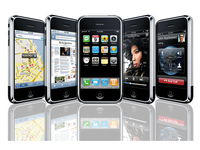
Kevin Russell, CEO of 3, has confirmed to TechRadar the network is aiming to bring the Apple iPhone 3GS to its range next year.
Speaking at the Westminster Future of Mobile eForum, Russell said "We would take the iPhone, and hope to have it in 2010."
He highlighted the company's focus on non-smartphones to build a consumer base that understands the importance of data on mobiles, but hopes to be pushing into the higher end phones soon.
"The reason we haven't stocked many smartphones is we were [prioritising building our customer base], which is 180 degrees different to the other networks.
Customers before phones
"They've gone down the smartphone route first, but we want smartphones on top of millions of customers. But you will see us moving more into smartphones during 2010.
"We like the way we've come through to a position where we could stock the iPhone, but it's not a product we have to rely on."
3's smartphone move has already begun after it announced it will be stocking the HTC Hero later this year, as part of the new Spotify deal.
It also stocks a number of Symbian-based Nokia mobiles, but hasn't had the 'headline handsets' like O2 has with the iPhone and Palm Pre.
Picking up the iPhone will mean that every network will have a relationship with Apple (if you count T-Mobile and Orange as the same entity following the merger) and could lead to a change in the way the device is offered every year.

| |
Read More ...
Windows 7 Week: Windows 7 System Restore explained

Windows 7 has many great features, but System Restore is one of the few genuine lifesavers.
It's a tool that you'll hopefully never have to use, but as with all system maintenance, it's always worth making sure that you're ready in the event of having to call on it.
Its job is to keep notes of everything you change on your computer, enabling you to reverse them with a couple of clicks. Times you might need to use it include clearing up a bit of spyware that managed to sneak its way on to your system, error messages suddenly appearing after installing a new tool, or a critical error developing.
System Restore is switched on by default when you install Windows 7, although it's always worth doublechecking. Type 'restore' into your Start menu (not pressing Return) and you'll see the three key options – opening System Restore, and shortcuts to creating and restoring from a Restore Point.
Windows 7 creates these automatically, once a week or just before you install new software, but you're not bound to this schedule – you can create your own Restore Points whenever you like. For the most part, though, this isn't necessary.
Changes, changes
The most important thing to remember about System Restore is that it isn't a file backup tool – it's a system backup tool, and there's a critical difference.
System Restore's job is to look out for Windows files; the programs that you install; registry settings that get changed; and other behind-the-scenes elements – not your documents.
The advantage of this is that in the event of a disaster, you can get your system up and running without needing to worry about anything you created post-Restore Point being wiped away. The downside is that there's not much that it can do if your problem is a deleted file or corrupted photograph.
Windows 7 does add one useful feature, however. Along with system data, Restore Points track any changes to files and folders, enabling you to go back to previous versions.

RESTORE POINT: The best time to make a System Restore point is when you've just installed/reinstalled Windows 7 and your drivers, and everything's working as it should
Right-click on any file or folder, choose 'Restore previous versions' and you will see the list. This is fantastic for documents with a long lifespan, but it doesn't help you if you only need to rewind time by an hour or so.
System security
What can help is that System Restore works hand-in-hand with Windows Backup, although this isn't switched on by default. You'll find the option to use it in System and Security in your Control Panel.
This provides extra previous version support, with its saved copies accessed from the same place as the System Restore ones mentioned earlier; file backups that enable you to retrieve individual documents; and most dramatically, full system images.
A system image is a complete copy of your hard disc – Windows, system settings, your documents, your files, even your wallpaper settings – that can simply be dropped back on to the drive after a crash, ready to use as though nothing ever happened.
It's a good idea to couple all this built-in protection with an online service. Your data may be safe on a DVD or a network drive at home, but a fire or similar disaster isn't likely to stop at just your computer.
Saving a copy of critical files to the internet gives you many more options, often including access to your files wherever you go, not just if you need to recover them.
Not needing to have DVDs or portable hard drives to hand also means that the process can be invisible, rather than a weekly chore, and can be performed on a more regular basis than any of us would have time for – every few minutes, not every few days. For mass backup and restoration, we like Carbonite (آ£33 a year from www.carbonite.com).
If you want easier access to your files when on the move, Livedrive is an excellent mix of backup tool and online storage. The standard version offers 100GB of space for آ£39.95 a year.
Combine all these, and there's not much that can go wrong. You might lose a file on your hard drive, but you'll always have a copy close to hand. Fail to prepare for disaster, however, and when the worst happens, there'll be nothing you can do.
Protecting your system
1. Automatic process

System Restore runs automatically, and there aren't any complicated options to keep track of. The recommended restore point is simply the last one, but you don't need to remember what it did – important changes are listed.
2. Alternative points

To see more Restore Points, simply click Choose a different restore point followed by Next. This lists the ones Windows has saved, and by clicking Scan for affected programs you get more detail without having to actually run the process.
3. Back up

Backup requires more effort. Visit System and Security in Control Panel to activate it. You can choose to save your files to a network drive (Professional/Ultimate edition only), but in most cases you'll be burning to a DVD.
4. Select files

The default is to let Windows choose which files to back up – which includes the desktop, libraries and standard Windows folders, such as Documents. This will cover 99 per cent of files you want, but you can add more or be more selective.
5. Whole hard drive

The System Image option, on the other hand, copies your whole hard disc. This requires multiple DVDs or a second hard disc (a risky proposition) for a complete system reinstall, but you can't pull individual files from the archive.

| |
Read More ...
Review: Inverto IDLP-23TWMONO

The metal outer case of this compact LNB has been painted glossy white, presumably to minimise temperature rises in hot weather.
Its two feeds each have a 23mm-diameter neck, although a clip-on collar that allows the device to be fitted to a 40mm holder is provided.
Standard F sockets are used for the two outputs, but you don't get the protective shroud fitted to some competing products.
An impressive noise figure of 0.2dB is claimed for both of the LNBs, while conversion gain is said to be between 52dB and 65dB. Alignment markings are embossed into the tops of each feed.
Consistent and stable results
According to the manufacturer, benefits include a high cross-polar performance (i.e. minimal leakage from vertically polarised channels to horizontally polarised ones and vice versa), plus a linear performance curve, a full-band low noise figure and marginal phase noise (all of which influence consistency across the band).
It proved to be easy enough to install. Consistent and stable results were obtained from both satellites – there was little variation of signal strength and quality across the full 10.6-12.75GHz band, though the secondary one yields slightly inferior results.
But that's the penalty you'll pay when using a single dish of standard design to receive more than one satellite. However, we managed to hold onto reception of the secondary satellite for longer than expected (using an 80cm Lenson Heath dish) during bad weather, although in line with our expectations the main satellite fared better.
Both outputs offered similar results, and so the tuners connected to them will be able to receive the same services.
Related Links
| |
Read More ...
Windows 7 Week: Windows 7: should you believe the hype?

The Windows 7 public betas received an enthusiastic reception from just about everyone, with reviews praising them as fast, efficient and crammed with interesting new features.
But does this mean that Windows 7 will be the best version of the OS ever?
Seasoned Microsoft watchers may be wary, remembering that Windows Vista was also lauded on release, with early reviews offering little clue of the problems to come. And a look beyond the excitable headlines reveals some analysts who are already pointing to issues with the new operating system.
Richard Jacobs, Chief Technology Officer at Sophos, highlighted significant problems with XP Mode, the software compatibility tool that provides a copy of XP that runs on your Windows 7 desktop.
"XP Mode doesn't share security settings, security software or patches with the host," Jacobs said, "or inherit any security from Windows 7." And the real problem? "Microsoft isn't providing any tools to help you handle this extra complexity. XP mode isn't a bad idea, but without built-in management, it's a security disaster."

SECURITY ISSUES: XP Mode is useful for running older software, but is it a "security disaster"?
Developer Leo Davidson has exposed problems with the new UAC settings, which allow trusted Windows components to bypass the system and so cut down on the prompts you receive. Sounds good, until you realise that this creates a loophole for malware to exploit.
Davidson warns: "There's nothing to stop third-party programs from injecting code into one of the privileged Microsoft executables, such as Explorer, in order to gain full elevated access to the machine without displaying any UAC prompts."
And the problem is easy to exploit, Davidson says: "It only took me a few hours to write proof-of concept code that was able to run anything with elevation, without triggering a UAC prompt."
And while Microsoft hopes improved power management and speed will make Windows 7 the ideal choice for netbooks, a recent online test reported the operating system lost anything up to a third of its battery life when pitched against Windows XP.
Many netbook forums have threads discussing similar problems, and complaining that Windows 7 is much slower than an XP setup.
Most Windows 7 coverage is still positive. But the majority view isn't always correct, as a look back at Vista's initial reception shows.
Big name analysts – we won't name them, they've suffered enough – gave Vista glowing reports. It's a total myth that Vista requires powerful new hardware, they gushed, because it will run happily on just about anything.
Setup is flawless, the list of new features is impressive and it's a very solid release that's arguably the best version of Windows ever.
The BBC published even more enthusiastic reviews. "Boot time is much improved over XP", we were told. Existing hardware "just works", and Vista is "more stable" and "performs better" than any previous version of Windows.
Put the early reviews under a microscope, though, and there were hints of the problems to come, with comments on UAC irritations and a few people saying Vista was heavy on resources. But they provided little or no mention of the real problems: the slow boot times, lethargic file copying speeds, limited hardware support and all-round poor performance.
This situation only began to change around three months after release, when analysts started to highlight Vista's problems with legacy hardware and software, and its lack of a 'killer feature'.
Performance problems were covered next, persuading many users to avoid Vista altogether. But this couldn't happen with Windows 7 – could it?
Better compatibility
There are already some clear problems with Windows 7. XP Mode and UAC have issues, as we've noted; battery life may not be as good as expected and overall performance may still not match that of Windows XP.

UAC: The new UAC defaults sacrifice security to minimise prompts
When you also consider users' dissatisfaction with some of the user interface changes (Explorer, the taskbar and the Start menu), you can see why some people may not be rushing to upgrade.
On the other hand, there are good reasons to believe that Windows 7 isn't another Vista in waiting. There are far fewer low-level changes, for instance. Microsoft hasn't totally rewritten the TCP/IP stack or drastically changed the file or memory caching systems as it did with Vista, so fundamental new problems are far less likely.
The similarities between Windows 7 and Vista mean that upgrading has less chance of breaking your existing hardware and software; if it works on Vista, then in most cases it should work even better on Windows 7.
And Microsoft has focused the majority of its efforts on the areas where Vista was most heavily criticised: reducing its system requirements, improving boot time and overall performance, and cutting security hassles.
On balance, then, we think Windows 7 is a solid step forward for Microsoft and for users. There remain some issues to be resolved through patches and driver upgrades, though, so if you're happy with your current system, you might want to wait a few months before upgrading, when the picture should be clearer.

| |
Read More ...
Windows 7 Week: Windows 7: should you believe the hype?
The Windows 7 public betas received an enthusiastic reception from just about everyone, with reviews praising them as fast, efficient and crammed with interesting new features.
But does this mean that Windows 7 will be the best version of the OS ever?
Seasoned Microsoft watchers may be wary, remembering that Windows Vista was also lauded on release, with early reviews offering little clue of the problems to come. And a look beyond the excitable headlines reveals some analysts who are already pointing to issues with the new operating system.
Richard Jacobs, Chief Technology Officer at Sophos, highlighted significant problems with XP Mode, the software compatibility tool that provides a copy of XP that runs on your Windows 7 desktop.
"XP Mode doesn't share security settings, security software or patches with the host," Jacobs said, "or inherit any security from Windows 7." And the real problem? "Microsoft isn't providing any tools to help you handle this extra complexity. XP mode isn't a bad idea, but without built-in management, it's a security disaster."
SECURITY ISSUES: XP Mode is useful for running older software, but is it a "security disaster"?
Developer Leo Davidson has exposed problems with the new UAC settings, which allow trusted Windows components to bypass the system and so cut down on the prompts you receive. Sounds good, until you realise that this creates a loophole for malware to exploit.
Davidson warns: "There's nothing to stop third-party programs from injecting code into one of the privileged Microsoft executables, such as Explorer, in order to gain full elevated access to the machine without displaying any UAC prompts."
And the problem is easy to exploit, Davidson says: "It only took me a few hours to write proof-of concept code that was able to run anything with elevation, without triggering a UAC prompt."
And while Microsoft hopes improved power management and speed will make Windows 7 the ideal choice for netbooks, a recent online test reported the operating system lost anything up to a third of its battery life when pitched against Windows XP.
Many netbook forums have threads discussing similar problems, and complaining that Windows 7 is much slower than an XP setup.
Most Windows 7 coverage is still positive. But the majority view isn't always correct, as a look back at Vista's initial reception shows.
Big name analysts – we won't name them, they've suffered enough – gave Vista glowing reports. It's a total myth that Vista requires powerful new hardware, they gushed, because it will run happily on just about anything.
Setup is flawless, the list of new features is impressive and it's a very solid release that's arguably the best version of Windows ever.
The BBC published even more enthusiastic reviews. "Boot time is much improved over XP", we were told. Existing hardware "just works", and Vista is "more stable" and "performs better" than any previous version of Windows.
Put the early reviews under a microscope, though, and there were hints of the problems to come, with comments on UAC irritations and a few people saying Vista was heavy on resources. But they provided little or no mention of the real problems: the slow boot times, lethargic file copying speeds, limited hardware support and all-round poor performance.
This situation only began to change around three months after release, when analysts started to highlight Vista's problems with legacy hardware and software, and its lack of a 'killer feature'.
Performance problems were covered next, persuading many users to avoid Vista altogether. But this couldn't happen with Windows 7 – could it?
Better compatibility
There are already some clear problems with Windows 7. XP Mode and UAC have issues, as we've noted; battery life may not be as good as expected and overall performance may still not match that of Windows XP.
UAC: The new UAC defaults sacrifice security to minimise prompts
When you also consider users' dissatisfaction with some of the user interface changes (Explorer, the taskbar and the Start menu), you can see why some people may not be rushing to upgrade.
On the other hand, there are good reasons to believe that Windows 7 isn't another Vista in waiting. There are far fewer low-level changes, for instance. Microsoft hasn't totally rewritten the TCP/IP stack or drastically changed the file or memory caching systems as it did with Vista, so fundamental new problems are far less likely.
The similarities between Windows 7 and Vista mean that upgrading has less chance of breaking your existing hardware and software; if it works on Vista, then in most cases it should work even better on Windows 7.
And Microsoft has focused the majority of its efforts on the areas where Vista was most heavily criticised: reducing its system requirements, improving boot time and overall performance, and cutting security hassles.
On balance, then, we think Windows 7 is a solid step forward for Microsoft and for users. There remain some issues to be resolved through patches and driver upgrades, though, so if you're happy with your current system, you might want to wait a few months before upgrading, when the picture should be clearer.

| |
Read More ...
Windows 7 Week: Check out historic Windows reviews

So Windows 7 is here and receiving both critical and public acclaim, but how does the well received Microsoft OS compare to its previous incarnations?
If you are curious then, luckily for you, PC Plus has trawled through its extensive back-catalogue and plucked out previous reviews of Windows and put them online in Flash for your perusal.
"My first Windows was 3.0, although before that, I had good old GEM," says PC Plus' Richard Cobbett.
Colour me floppy
"At the time, Windows was interesting just for the wonderful coloured floppy disks, never mind being the future of computing.
"Still, as it developed, PC Plus was there at every stage. We've plundered our archives to see what we said about the biggest moments in Windows history, from Windows 3.0 to Windows ME (one of the reviews we don't exactly stand by, but everyone makes mistakes, right? Right? Windows 7 is great, honest...)."
You can comb through and find out exactly what PC Plus thought about Windows 95 at http://pcplus.techradar.com/node/3140 and see if the Windows hype has lived through the ages.

| |
Read More ...
Xbox 360 Blu-ray drives on the way

The Microsoft Xbox 360 is soon set to get its own separate Blu-ray drives, according to comments made by the company's CEO Steve Ballmer.
Microsoft has, to date, shied away from embracing Blu-ray as a next-gen movie format, preferring instead to focus heavily on its digital download strategy.
However, that may all soon change, if comments made in a recent Gizmodo interview with Steve Ballmer are to be believed.
A 'woolly' confirmation
When asked if the Xbox 360 would be getting a Blu-ray drive anytime soon, Ballmer said: "Well I don't know if we need to put Blu-ray in there - you'll be able to get Blu-ray drives as accessories."
It is hardly an 'official' confirmation and all a little 'woolly' and Microsoft's PR army has been quick to issue 'no comments' when pressed on the matter.

| |
Read More ...
Orange offers 20Mbps broadband as standard

Orange's latest announcement that it plans to offer 20Mbps broadband as standard shows up the government's Digital Britain plans for all Brits to have at least 2 Mbps broadband by 2012 to be sorely lacking.
Orange's new 20Mbps offering shows how the government is "off the mark" according to one broadband expert.
James Parker, broadband manager at Moneysupermarket.com, has been quick to claim that the UK government's plans to introduce universal broadband at a minimum speed of 2Mbps is simply not good enough.
Superfast Orange
Parker applauded Orange's latest moves, which follows the trend towards superfast broadband offerings from the bigger broadband providers such as Virgin Media and BT.
"The only thing to keep in mind is that this offer is up to 20Mbps, so for some people this speed may not be achievable due to their location, but minimum speeds should increase significantly for most Orange customers," he said.
"I hope this announcement encourages more providers to follow suit and up their minimum speeds."

| |
Read More ...
Review: Devolo dLAN 200 AVeasy

The Devolo dLAN 200 AVeasy starter kit consists of twin Powerline adapters, two Ethernet cables and all the relevant documentation.
The full price of this set may make it one of the most expensive solutions, but a quick search online found prices vary considerably. The best price we found was آ£80 (inc. VAT), so it's worth shopping around.
Rather like the D-Link DHP-303, Devolo has gone for a design that makes the Powerline look like a domestic thermostat, so it won't look too out of place in the average home.
The white plastic has a glossy finish, with a grill effect on the sides, while the front of the unit sports the Devolo logo and three cut-out LED lights.
The single Ethernet port is located on the base of the unit, along with a rather unassuming Encryption key. The device is set with encryption running by default, so pressing this button changes the security key.
As with most of the other kits we have tested recently, simply press the button and wait for the green light to flash before repeating on the second adapter. The supplied software allows you to better manage the encryption level of your network.
However, it also comes with a couple of useful utilities for better network management. For instance, the Informer lets you keep tabs on which devices are connected to the network, while the EasyShare tools make moving large files around the network easier to manage.
When it comes to using the Devolo, we found this to be an incredibly fast and resourceful solution. While it lacks features like the D-Link QoS engine for specifying bandwidth to set tasks, we found that streaming HD content and even using it to hook up a games console online offered good, and more importantly constant, throughput speeds.
The dLAN 200 AVeasy may not be the best-known brand available, but it is still a great solution that offers speed and ease-of-use, and all in an unassuming design.
Related Links
| |
Read More ...
MySpace Music Videos launches

MySpace is repositioning itself as a music content delivery platform, rolling out a raft of new music features this week.
First up is the launch of MySpace Music Videos, a searchable collection of music videos from MySpace's music label partners.
It is the first major overhaul to the ailing social network since new chief exec Owen Van Natta took over the company nearly six months ago.
The service is an always-on music video archive provided free to users via MySpace's ad-supported streaming service. The service is currently live in the US and is soon to arrive in the UK.
Additionally, bands and labels will also benefit from MySpace's new Artist Dashboard product, providing users with in-depth analytics such as number of song plays, demographics of listeners and iLike integration.
Courtney Holt, president of MySpace Music, said: "Bands have never had access to proper data about themselves which can they then can use to understand how to promote themselves better and communicate more effectively with fans."
iLike MySpace
Finally, MySpace will now let its users purchase and download music from both iTunes and Amazon MP3 directly via MySpace Music.
iLike was acquired by MySpace in August for a cool $20 million and is the most popular social music app on MySpace's rival social network, Facebook.
MySpace CEO Van Natta said of the new raft of features: "When I joined MySpace I had to refocus the product road map around the things which make MySpace fundamentally different – mainly the socialisation of content.
"Figuring out how people can discover content through others and how you can share content – we have been focusing on that for the last five and s half months and the changes are starting to come out now."

| |
Read More ...
Windows 7 Week: How to back up and upgrade to Windows 7

The release of the highly anticipated follow up to Vista, Windows 7, is here. Over the coming weeks and months, thousands of systems will be upgraded.
While many people will kill two birds with one stone by taking the opportunity to buy a new computer with Windows 7 preinstalled, a large proportion of computer users will go down the upgrade route.
Depending on whether Windows XP or Vista is the base operating system, the upgrade process will be vastly different.
Only Vista users will be able to perform a standard upgrade installation. If you have XP installed, you're going to have to perform a clean install, even if you've bought the upgrade edition of Windows 7.
This means that files and system settings will have to be backed up and restored if the transition to Windows 7 is to be as painless as possible. We're going to take a look at this process over the coming pages.
Prepare to back up
Backing up data is never fun, so it's one of those tasks that most computer users tend to avoid. While backups prove very useful in the event of a hard drive failure or other computing disaster, they're also invaluable when the time comes to reinstall or upgrade Windows.
Manually backing up files and folders is simple enough – the process can involve little more than copying the relevant files to a separate hard drive.

Program and Windows settings are a different matter, and this is where a specially designed tool can be helpful. The Windows Easy Transfer wizard is a great tool for anyone upgrading from XP to Windows 7 as it takes the hard work out of safeguarding data and also backs up other data such as email accounts and system settings.
The Windows Easy Transfer wizard can be found on the Windows 7 installation DVD. It simplifies the process of backing up documents and settings, which can then be restored once a clean installation has been performed.
Unlike an in-place upgrade, going down this route will mean that any software that is already in place will not be retained, so each program will have to be reinstalled afterwards. While a migration is the only real option available to users of Windows XP, it may also appeal to anyone upgrading from Vista.
This is because it results in a cleaner system that's not bogged down with remnants of the previous operating system.
Windows Easy Transfer also comes in handy if you're making the move from a 32-to a 64-bit OS, because this also requires a clean install.
Install Easy Transfer
The transfer tool is located in the Support folder of the Windows 7 disc in a subfolder called Migwiz.
Double-click the executable named 'migwiz.exe' to start the program and click 'Next' to skip the intro screen. Several options for how to transfer data will be presented, including using an Easy Transfer cable or making use of network or removable storage.

In the majority of cases, opting to back up files to an external hard drive will be the easiest option, but the ability to back up to another computer over an existing network may also be useful.
After you've indicated that you're currently working with your old computer, the wizard will perform a scan for items that can be transferred and should be backed up. The results screen will show a list of user accounts that have been detected complete with the amount of data each contains.
While it's possible to trust that the wizard has managed to correctly identify everything you would like to back up, it is a good idea to double-check by clicking the 'Customize' link that appears beneath each entry on the results page.
From the submenu that appears, tickboxes can be used to select the type of data that should be backed up, while by clicking the 'Advanced' link you can select individual folders to add to the transfer set. Having made the required selections, click 'Save' followed by 'Next'.
Backup protection
As a security measure, Windows Easy Transfer allows data to be password-protected, but this is optional. Click 'Save', choose where the backup should be created, enter a suitable name and click the 'Save' button.
While the data saving process is taking place, it's important that Windows is left to its own devices in case an operation makes use of files that are being backed up.
When the wizard has done its work, the folders and settings will have been saved in a '.mig' file in your chosen location. It's a compressed file, so space requirements can be dramatically reduced.
With this step of the migration process complete, spend a little time ensuring that the discs and set-up files for applications that will be installed post-installation are available along with any necessary serial numbers.
It is also worth individually backing up settings for any third-party programs that cannot be included in the migration wizard's backup – such as browser configuration and plug-ins, FTP client settings, feed readers and anything else that would be time-consuming to reinstate manually.
Installing Windows 7
With this done, the installation of Windows 7 can begin. This can be started from within Windows itself or by booting from the set-up disc. The set-up routine will spend a little time extracting files from the disc and copying temporary files into place.
Provided an internet connection is available, select the option to obtain the latest Windows updates during installation and any available files will be downloaded.
When the screen prompting you to choose between upgrading Windows or performing a clean install is displayed, it's important to select the 'Custom (advanced)' option, or the preceding steps will have to be repeated once Windows XP is detected as the base OS.
The installation process is fairly self-explanatory; there are few options that need to be configured and any restarts that are needed will take place without you being prompted to do them. When Windows 7 has been installed, the files and settings that were backed up earlier can be restored using the Windows Easy Transfer wizard.
This time around, there is no need to run the program from the installation disc and a link is now available in the Start menu.
Launch the tool by clicking 'Start | All Programs | Accessories | System Tools | Windows Easy Transfer', click 'Next' and then click the option that relates to the back-up method you used earlier on. Indicate that you're using your new computer and then click 'Yes' to confirm that a backup has already been created.
Browse to the '.mig' file which makes up the backup, enter the password if need be and then click 'Next' to continue.
View your migration reports
It's now possible to choose precisely what data and settings should be migrated in much the same way as the selection was made when creating the migration backup.
In all likelihood, the default options should suit most people. Additional migration settings can be configured by clicking the 'Advanced Options' link that appears in the bottom right-hand corner of the Windows Easy Transfer window.
The Advanced Options window is split into two tabs, the first of which relates to user account settings. Any user accounts that have been created during the Windows 7 installation will be listed, and dropdown menus to the right can be used to associate an older user account in the migration backup with one of the new ones.
Moving to the Map
Drives tab provides another handy option – as you'd expect, the mapping of drives. While this isn't really relevant when a computer is being upgraded from Windows XP to Windows 7, if Windows Easy Transfer is being used to transfer settings from an old computer running Windows XP to a new one running Windows 7, data that was stored on a drive which had been assigned a particular letter on the old machine can be mapped to a new letter on the new machine.
Click the 'Save' button after making any changes to the default settings and then click 'Transfer'. Unless a very large amount of data is involved, the transfer process should be completed fairly quickly.
When it comes to transferring old user account information, you will be asked to provide the password that has been used to log into that account as an extra security measure. All that is left to do is click the button labelled 'Confirm my account information and update content protection'.
This ensures that the correct ownership status is applied to your files and folders according to the user account they relate to.
Windows Easy Transfer is not capable of transferring programs that were installed under the old version of Windows, but once the transfer of supported data is complete a report screen is displayed that provides a selection of helpful information.
It may well be that this report is not needed immediately. Luckily, it can be accessed at any time by clicking the 'Windows Easy Transfer Reports' link in the Start menu.
The Transfer Report tab displays basic information about what has been transferred, listing the individual user accounts as well as the documents and program settings involved. For help with software management, move to the Program Report tab.
The first section of the tab details programs that were included with Windows XP but are no longer included with Windows 7. While links are not provided to suitable alternatives, this list provides details of software you may wish to track down yourself.
Beneath this is a list of programs that were installed in Windows XP but haven't been transferred. Again, this is a very useful list of apps that you are likely to want to install again, and this time links are provided to the manufacturers' websites, so you can quickly download any replacements that you need.
User State Migration
Making use of Windows Easy Transfer is a quick and simple way to upgrade from Windows XP to Windows 7, but it does require a degree of forethought and preparation. However, there is another route open to those migrating from XP.
This method takes advantage of the fact that when a clean installation of Windows 7 is performed over the top of Windows XP, the older operating system is retained in a folder called Windows.old. This folder contains all of the user accounts that have been created along with the documents associated with each of the accounts.
The files found here can be manually copied or moved to the new folders for individual users in Windows 7. This can be something of a time-consuming process, though, and program settings cannot be transferred using this method.
A far better option is to make use of the Windows Automated Installation Kit (or Windows AIK), which can be downloaded from here.

This is a fairly hefty download weighing in at 1.7GB, but the Windows AIK includes a useful utility called the User State Migration tool which can be used to migrate Windows XP settings and files to Windows 7 post-installation without the need for any preparatory work.
The download is an ISO file which will need to be burned to DVD and then installed. After installation, the User State Migration tool can be found in 'C:\Program Files\Windows AIK\Tools\USMT'. There are 32-and 64-bit versions, so ensure that you use the correct one.
While making use of the User State Migration tool does not require advance preparation in the form of creating a backup, it is a command-line scripting tool, so a little time will need to be spent creating a suitable script to migrate files and settings across.
This fact alone should make it clear that the tool has been designed with corporate environments in mind, where hundreds of machines may be upgraded using the same script, but there is no reason for it not to be used at home as well.
There is simply not room in this feature to cover the creation of scripts and the terminology and parameters that can be used, but supporting documentation can be found on Microsoft Technet. Pay a visit to here for advice on how to go about creating a suitable script and how to use the program.
A couple of helpful introductory videos can also be found here and here.
Dual-boot Windows 7 with XP and Vista
Another option for XP and Vista users alike is to set up a dual-boot system that will provide you with the choice of Windows 7 or its predecessor at startup.
This is a great option for anyone who feels they still need access to an older version of Windows, or for those who aren't quite ready to commit to a full installation.
It's also useful for anyone who wants to try out Windows 7 on a couple of machines for a while. Following the installation of Windows there is a 30-day grace period before activation is required, but this can be easily – and legally – extended to four months using a simple procedure.
Towards the end of the first 30-day grace period, click the Start button followed by 'All Programs' and then 'Accessories'. Right-click the Command Prompt entry and select 'Run As Administrator' before providing the necessary password when prompted.

At the Command Prompt type slmgr -rearm and press [Enter] before restarting Windows. This will reset the activation countdown. You can repeat the process three times, resulting in a 120-day period before activation is required.
Windows 7 is the operating system that many people have been waiting for for quite some time, and it's viewed by many as the operating system that Vista should have been.
Whether you are making the move from Windows XP or Vista, there are a range of new tools to try out as well as a new look to experience and new ways of working with files and Windows itself.
Few people look forward to the actual process of upgrading Windows – the end result may be desirable, but the process itself is generally less enjoyable – but by turning to dedicated migration tools, the process can be made as quick and painless as possible.

| |
Read More ...
Magic Mouse teardown reveals extra intelligence

The ever-reliable ifixit.com has again provided us with a beautiful tear-down of the new multitouch Magic Mouse from Apple, revealing that it's '22.5 times smarter than the average mouse'.
Ifixit's tear-downs have quickly become a firm favourite in the office, and its latest takes us inside the brand new Apple gadget - the Magic Mouse.
So what did it find out? Well, for starters, the entire surface of the mouse is covered with capacitive touch sensors, and the mouse contains just 10 grams of aluminium.
Heavy battery
Nearly half of the mouse's weight comes from the two AA batteries, with 37 grams of plastic and a Broadcom BCM2042 Advanced Wireless Keyboard/Mouse Bluetooth Chip also present.
And with the average mouse 'brain' weighing 0.4 grams and the brains of the Magic Mouse weighing 9 grams ifixit points out 'the Magic Mouse is 22.5 times smarter than your average mouse. Who knew?'.
You can find the complete teardown on ifixit.com.

| |
Read More ...
Google seals Twitter search deal

Hours after Microsoft announced that it had come to a deal with Twitter to show its real-time status data in its search, Google has followed suit.
Microsoft got to the announcement of the addition of Twitter data first, but with the internet still reeling, Google quickly revealed its own deal with the microblogging site.
A statement by Marissa Mayer, VP of Search Products, confirmed the deal blogging: "At Google, our goal is to create the most comprehensive, relevant and fast search in the world. In the past few years, an entirely new type of data has emerged - real-time updates like those on Twitter have appeared not only as a way for people to communicate their thoughts and feelings, but also as an interesting source of data about what is happening right now in regard to a particular topic.
Announcement
"Given this new type of information and its value to search, we are very excited to announce that we have reached an agreement with Twitter to include their updates in our search results," she continued
"We believe that our search results and user experience will greatly benefit from the inclusion of this up-to-the-minute data, and we look forward to having a product that showcases how tweets can make search better in the coming months.
"That way, the next time you search for something that can be aided by a real-time observation, say, snow conditions at your favourite ski resort, you'll find tweets from other users who are there and sharing the latest and greatest information."
The arrival of two announcements back to back is, of course, no coincidence, although Microsoft will feel that it has won a small victory by showing off the technology at the Web 2.0 conference and getting the news out first.
Microsoft also announced that Facebook data would be made available through its Bing search engine at an as yet unspecified later date.
However, with many Facebook status updates private, it remains to be seen how much value this will add in the long run compared to the more open Twitter.

| |
Read More ...
Google seals Twitter search deal
Hours after Microsoft announced that it had come to a deal with Twitter to show its real-time status data in its search, Google has followed suit.
Microsoft got to the announcement of the addition of Twitter data first, but with the internet still reeling, Google quickly revealed its own deal with the microblogging site.
A statement by Marissa Mayer, VP of Search Products, confirmed the deal blogging: "At Google, our goal is to create the most comprehensive, relevant and fast search in the world. In the past few years, an entirely new type of data has emerged - real-time updates like those on Twitter have appeared not only as a way for people to communicate their thoughts and feelings, but also as an interesting source of data about what is happening right now in regard to a particular topic.
Announcement
"Given this new type of information and its value to search, we are very excited to announce that we have reached an agreement with Twitter to include their updates in our search results," she continued
"We believe that our search results and user experience will greatly benefit from the inclusion of this up-to-the-minute data, and we look forward to having a product that showcases how tweets can make search better in the coming months.
"That way, the next time you search for something that can be aided by a real-time observation, say, snow conditions at your favourite ski resort, you'll find tweets from other users who are there and sharing the latest and greatest information."
The arrival of two announcements back to back is, of course, no coincidence, although Microsoft will feel that it has won a small victory by showing off the technology at the Web 2.0 conference and getting the news out first.
Microsoft also announced that Facebook data would be made available through its Bing search engine at an as yet unspecified later date.
However, with many Facebook status updates private, it remains to be seen how much value this will add in the long run compared to the more open Twitter.

| |
Read More ...
In Depth: 'Windows 7 is a pivotal moment for Microsoft'

"Windows 7 represents a pivotal moment for Microsoft." Rather than a Microsoft rival or industry analyst, that declaration is according to the corporation's own UK Managing Director Ashley Highfield.
The ex-BBC man was speaking at the UK launch of Windows 7 in London and, as well as talking up confidence in the new operating system, he was also keen to stress that the OS has been developed largely using feedback from consumers.
"Windows 7 has been built by us sure, but Windows 7 has been designed by you [the public]," said Highfield. "We listened and listened and we've got Windows 7. It's got improvements on every level...many of which are just about making things simpler."
The beta download numbers announced were interesting - 8 million people got hold of the beta officially, but Microsoft gleefully admitted that a further 7 million downloaded it via other means, proving vast demand. A million users contributed by sending feedback to the corporation.
PC World's Category Director Jeremy Fennell was also on hand to preview sales but he summed up Microsoft's mood in a sentence; "because of the pre-sale [this Summer's آ£50 Home Premium offer] we've sold more copies of Windows 7 than we did of Windows Vista in the whole of the first year."

CASHBACK OFFER: PC World's Category Director Jeremy Fennell
Fennell added that there was a "high level of awareness – [consumers are] pretty much aware that it's coming this month if not tomorrow."
PC World also cited figures showing that 60 per cent of customers have delayed their purchase until after the release of the OS. 20 per cent of those questioned said they would be buying new hardware to run Windows 7, while 15 per cent said they would upgrade their current hardware.
At the launch, PC World also announced a cashback scheme with آ£100 off new hardware if you trade in an old machine.
But it wasn't quite all tail-wagging. Showing some humility, Highfield admitted that Microsoft's range of services could be described as "slightly patchy over the last few years" before following on to herald Windows 7 as "a new dawn in Microsoft's relationship with its consumer."
Tweaking the user interface
Also at the launch, Sky was on hand to announce a partnership to add Sky Player functionality to Windows Media Center . When pressed whether the partnership was the first of many, Highfield said the move was "indicative of the willingness by Microsoft" to broaden its horizons.
"We see the PC as a complementary device for consuming all media alongside the TV," he added, before referring back to Microsoft's "three screens and a cloud" vision for consumers, encompassing PC, TV, phone and the web.
Head of Windows Experience, Julie Larson-Green, joked that "It's never been a better time to be a PC," before taking the audience through some of the ways Microsoft collected user feedback before developing Windows 7. Having been at Microsoft some 16 years, Larson-Green was responsible for the major user interface changes in Office 2007 such as the ribbon.

LAUNCH EVENT: Julie Larson-Green, John Curran and Ashley Highfield
In tweaking the user interface of Windows, Microsoft also had to ensure that little used features weren't ignored. Larson-Green said that 0.8 per cent of people prefer to stick their taskbar to the left-hand edge of the screen. "We had to make sure that it still worked," she said. "0.8 per cent of a billion is still a lot!"
Larson-Green also talked about the memory footprint of Windows 7 – which half the size that of Windows Vista - as well as minor but useful tweaks such as the OS resetting your printer settings depending on your current location.
The London launch also gave an overview of the new OS to the press, while there was also supposed to be a demo of Sky Player working in Windows Media Center. However, despite three attempts this didn't work, though we got hands-on with it later.
Highfield also caused confusion by appearing to claim that 40 million PCs would be sold in the UK next year. The actual figure, later clarified, is 14 million.
Watch out for more interviews and reaction to the launch over the coming days on TechRadar.

| |
Read More ...
Windows 7 launched by Microsoft

Microsoft Windows 7 has finally launched, bringing the critically acclaimed latest version of the world's most popular operating system.
In keeping with the build up to the launch, Microsoft chose a low-key launch event, in stark contract to the glittering affair that launched the badly-received Windows Vista.
Windows 7 has been a different beast throughout, however, and Microsoft's brave decision to release the beta for a huge public trial has very much paid off.
Not Vista-fied
Although there was the announcement of the Sky Player for Windows Media Center, much of the focus was on an OS that has already shown its quality and that is unlikely to be beset by the problems of its predecessor.
Bringing a whole host of enhancements, Windows 7 is designed to be less irritating, better supported and more scaleable than Vista.
"Windows 7 is much more than just a collection of new features," said Microsoft UK's Managing Director Ashley Highfield, "it is actually a pivotal turning point in Microsoft's history it's really about us listening to what the consumers want and understanding this shift in consumer behaviour.
"They don't want to be defined by being at work or at home they just want something to make their lives easier, simpler, more fun perhaps.
"Windows 7 brings to consumers more choice and value than any previous Microsoft operating system.
"We've worked with partners and consumers alike to deliver an improved user experience with enhanced performance and functionality that promote ease and simplicity in everyday tasks."

'We provide the theatre'
Speaking to TechRadar, Julie Larson-Green – the Corporate Vice President of the Windows Experience – explained that the focus was on making Windows a good fit for the consumer.
"We talk about it in the team as Windows is the theatre and we are trying to provide the great seats and beautiful velvet curtains and great sound but the movie is all about you. It's your movie and we're just trying to provide the backdrop.
"You don't use a computer for Windows you use it for what the PC allows you to do, so that was big focus for us."
Word of mouth
Speaking about the less over the top campaign around the launch of Windows, Mrs Larson-Green explained how important the buzz generated by the public trial had been.
"We want the product to speak for itself, and we want people to use world of mouth and what their experiences are to help sell windows it's about them and not about us. We wanted it to be word of mouth rather than us telling people.
"It's great to see that we were able to do things that resonated with people."

| |
Read More ...


No comments:
Post a Comment