

Batman: Arkham Asylum Enables AA Only on NVIDIA Hardware on PCs
Anti-Aliasing has been one of the most basic image-quality enhancements available in today's games. PC graphics hardware manufacturers regard it as more of an industry standard, and game developers echo with them, by integrating anti-aliasing (AA) features in the game, as part of its engine. This allows the game to selectively implement AA in parts of the 3D scene, so even as the overall image quality of the scene is improved, so is performance, by making sure that not every object in the scene is given AA. It seems that in one of the most well marketed games of the year, Batman: Arkham Asylum, doesn't like to work with ATI Radeon graphics cards when it comes to its in-game AA implementation.
Developed under NVIDIA's The Way it's Meant to be Played program, and featuring NVIDIA's PhysX technology, the game's launcher disables in-game AA when it detects AMD's ATI Radeon graphics hardware. AMD's Ian McNaughton in his recent blog thread said that they had confirmed this by an experiment where they ran ATI Radeon hardware under changed device IDs. Says McNaughton: "Additionally, the in-game AA option was removed when ATI cards are detected. We were able to confirm this by changing the ids of ATI graphics cards in the Batman demo. By tricking the application, we were able to get in-game AA option where our performance was significantly enhanced." He further adds that the option is not available for the retail game as there is a secure-rom.
Read More ...
TechPowerUp Radeon BIOS Editor v1.22 Released
TechPowerUp Radeon BIOS Editor (RBE), has been updated to version 1.22. RBE is our popular ATI Radeon graphics cards BIOS tweaking manipulation utility. One of the main highlights of this release is early support for the Radeon HD 5870 graphics accelerator, among other changes that enhance the application's functionality and stability. The following changes are listed by its developer:
- Added clock tuning wizard.
- Changed fan controller bug workaround settings' description to point out what it does a little better.
- Improved program's startup routine.
- Fixed "GetClockPos reported 0"-error that came up on loading several 4xx0-BIOSes.
- Added preliminary support for Radeon 5870. Note that I'm still not sure about 5850's DeviceID and that signature saving and loading will most likely not work properly on 5xx0s with this version. Furthermore, VT1165 programming is not functioning yet.
Read More ...
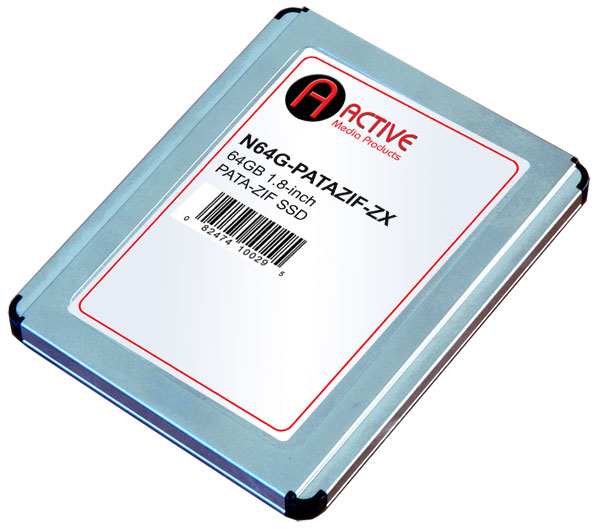
(PR) Active Media Products Announces SaberTooth ZX 1.8-Inch PATA ZIF SSDs
Active Media Products, manufacturer of SSDs and WWF series USB drives, today launched the new SaberTooth ZX series of 1.8-inch PATA ZIF SSDs that are ideal for upgrading popular netbooks such as the Dell Inspiron Mini 12, selected models of Sony Vaio, and more. The new SaberTooth ZX supports sequential read speeds up to 80MB/sec and sequential write speeds up to 38MB/sec. Combined with sub-millisecond access times, these new SSDs deliver double or triple the performance of the default hard drives in most netbooks, resulting in substantially faster bootup, application load and shutdown speeds.
Measuring 70 x 54 x 5 mm, the ZX was designed to the same physical specs as 1.8-inch HDDs. It uses a parallel ATA (PATA / IDE) ZIF interface, and supports PIO mode 6 and Ultra DMA mode 6. SaberTooth ZX is compatible with most netbooks that use 1.8" PATA ZIF hard drives. It is one of the fastest and easiest ways to upgrade dozens of different netbooks and UMPCs to higher performance and more local storage.
Read More ...
NVIDIA Rolls Out its First OpenCL GPU Drivers
In the tussle between its own CUDA GPGPU standard and the OpenCL, NVIDIA is making the right moves by offering its first drivers for OpenCL GPGPU acceleration. The drivers are available for Windows, Linux, and Mac. Any CUDA-capable NVIDIA GPU will be able to use these. The drivers can be downloaded from here, which provide compliance with OpenCL 1.0.
NVIDIA has also released the OpenCL Visual Profiler software that helps developers improve their code by recognizing possible bottlenecks and room for improvements. At a higher level, it profiles actual hardware signals, kernel efficiency, and instruction issue rate; memory latencies; auto-analysis to point of serialization problems, among other things. More information on this can be found here.

Source: TechConnect Magazine
Read More ...
Buffalo Announces USB 3.0 DriveStation External HDD
Buffalo Japan is ready with its first external hard drive that uses the new USB 3.0 interface to eliminate the bandwidth bottleneck posed by the older generation of the interface. The Buffalo DriveStation HD-HXU3, with its USB 3.0 SuperSpeed interface comes in capacities of 1 TB, 1.5 TB and 2 TB. The drive offers transfer rates of around 125 MB/s, on par with drives connected using the eSATA interface. The advantage of this however, is its seamless backwards compatibility with older USB 2.0 generation of the USB interface. The company has also announced the IFC-PCIE2U3 USB 3.0 controller. The two are expected to be available in Q4.

Source: Softpedia
Read More ...
(PR) NVIDIA Collaborates With Microsoft On High Performance GPU Computing
NVIDIA today announced work with Microsoft to promote NVIDIA Tesla graphics processing units (GPUs) for high performance parallel computing using the Windows HPC Server 2008 operating system.
“The coupling of GPUs and CPUs illustrates the enormous power and opportunity of multicore co-processing,” said Dan Reed, corporate vice president of Extreme Computing at Microsoft. “NVIDIA’s work with Microsoft and the Windows HPC Server platform, is helping enable scientists and researchers in many fields achieve supercomputer performance on diverse applications.”
NVIDIA Research developed several GPU-enabled applications on the Windows HPC Server 2008 platform, such as a ray tracing application that can be used for advanced photo-realistic modeling of automobiles. Related to this, NVIDIA worked with Microsoft Research to install a large Tesla GPU computing cluster and is studying applications that are optimized for the GPU.
Read More ...
ASRock Innovates Socket 939 Motherboard with AMD 785G Chipset
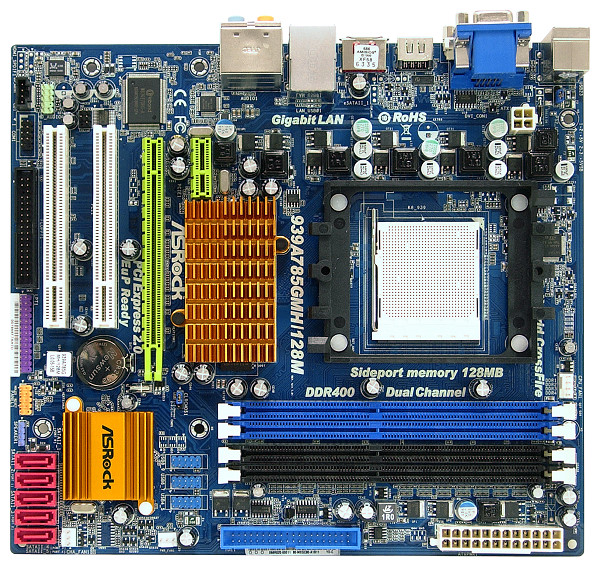
This creation by ASRock is bound to surprise you. The motherboard specialist used a present-generation AMD 785G + SB710 chipset to drive a socket 939 motherboard, called the ASRock 939A785GMH128M. That's right, socket 939, supporting some of the oldest processors in the Athlon 64 and Sempron 64 series. The socket 939 CPU is powered by a 5-phase power circuit. It is wired to four DDR memory slots, supporting dual-channel DDR memory at speeds of up to DDR-400 MHz.
The AMD 785G chipset packs an ATI Radeon HD 4200 class integrated graphics processor with 128 MB SidePort memory, while the SB710 southbridge provides 5 internal SATA 3 Gb/s ports, and one eSATA port. The expansion slots on this micro-ATX motherboard include one PCI-Express 2.0 x16, one PCI-E x1, and two PCI slots. The IGP connects to its displays using DVI-D, HDMI, and D-Sub. 8-channel audio, and gigabit Ethernet make for the rest of it. There is no word on the availability or pricing as yet.
Source: OCWorkbench
Read More ...
Tuniq Intros Propeller 120 CPU Cooler
Tuniq introduced its newest CPU cooler, the Tuniq Propeller 120. This release follows the launch of the Tower 120 Extreme. Measuring 128(L) أ— 127.5(W) أ— 145(H) mm, and weighing at 590 g without the 120 mm fan, The cooler sports an unconventional design. From the CPU base pass four 8 mm nickel-plated copper heat-pipes that make direct contact with the CPU. The two ends of these heat-pipes pass through two blocks of aluminum fins. The fins are somewhat triangular in shape and are pitted for added surface area.
The bundled 120 mm MFDB fan comes with a fan-speed control knob, and spins at speeds between 1000~2000 rpm, pushing up to 90.65 CFM of air, with noise levels of 16~20 dBA آ± 10%. The fan blows air onto the motherboard, passively cooling other components. The Propeller 120 also packs a tube of the company's newest Tuniq TX3 thermal compound. Supported sockets include LGA-1366, LGA-775, and AM3/AM2+/AM2. It comes in two variants, CR-PRO120-BK with black colored fins, and a blue LED-lit fan, and CR-PRO120-SV with normal (chrome) fins and an opaque black fan. The Propeller 120 should start selling this October.


Read More ...
Galaxy Unveils First Single-Slot Air-Cooled GeForce GTX 260 Accelerator
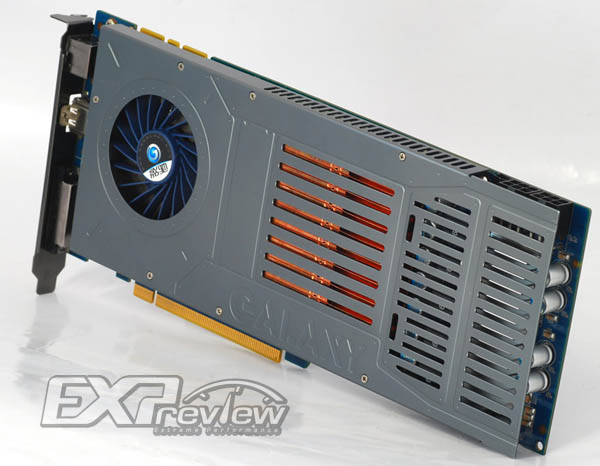
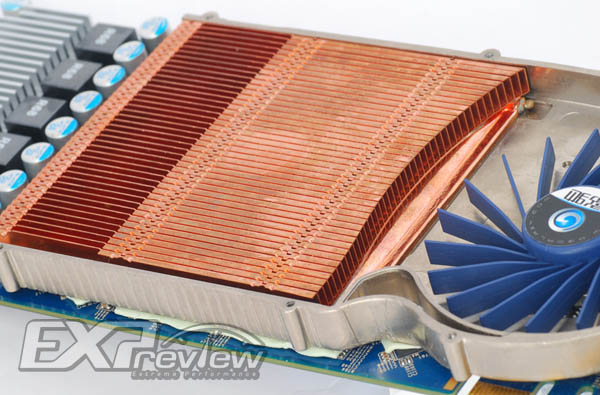
Constantly innovating new graphics cards designs, Galaxy pushed the limits of engineering by coming up with the first GeForce GTX 260 with a single-slot air cooler. To achieve this, the company designed its own long cooler based on the Vapor Chamber (VC) technology. A VC plate sits on top of the GPU and the aluminum base-plate of the cooler (to cool the memory) On top of the VC plate is a dense copper channel array through which air directed by the blower passes. There is a separate heatsink over the VRM area, which cools off under the air-flow from the main cooler.
The entire set of heatsinks is neatly packed under an aluminum shroud. The card packs standard features of the GeForce GTX 260, including 216 shader processors, 896 MB of GDDR3 memory across a 448-bit memory interface, 3-way SLI support, and support for DirectX 10. Connectivity options include one each of DVI-D, HDMI, and S-Video/composite. It draws power from two 6-pin PCI-E power connectors. Availability and pricing of this card is not known just as yet.

Source: Expreview
Read More ...
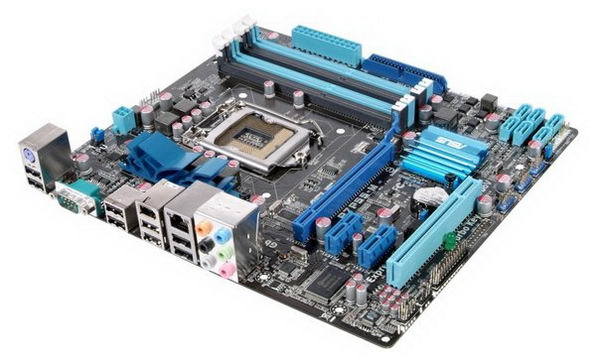
ASUS Readies P7P55-M Micro-ATX Motherboard
ASUS plans to expand its lineup of socket LGA-1156 motherboards based on the Intel P55 chipset, with a new model based on the micro-ATX form-factor. The ASUS P7P55-M packs most features of its larger siblings, making use of the P55 chipset's features. The four expansion slots include PCI-Express 2.0 x16, two PCI-Express x1, and one PCI. The P55 chipset provides six SATA 3 Gb/s ports, other standard features include 8 channel audio, gigabit Ethernet, and Firewire. ASUS exclusives include TurboV, TurboKey and Express Gate. The P7P55-M is expected to ship in mid-October.
Source: Expreview
Read More ...


No comments:
Post a Comment